Jackson USA Soloist SL1: The Guitar Randy Rhoads Never Played
The Jackson Soloist SL1's real icon is Phil Collen, not Randy Rhoads. History, neck-thru construction, specs, tone recipes, and honest buying notes.
Ask most metal fans which Jackson guitar belongs to Randy Rhoads, and they’ll picture the asymmetrical, shark-finned V that launched the entire brand. That guitar is real, and it’s iconic — but it isn’t the Soloist. Rhoads died in March 1982, two years before the Soloist existed as a production model. The confusion is understandable given how thoroughly Jackson’s name is tied to Rhoads, but the Soloist’s real story belongs to a different generation of players, and its single strongest connection isn’t a shred virtuoso at all — it’s Def Leppard’s Phil Collen, whose stock 1986 Soloist cut one of the most recognizable riffs in ’80s rock.
Born at Charvel, Named at Jackson
The Soloist’s roots trace back to Grover Jackson’s time running Charvel, where early “Custom Strat” and “neck-through body Strat” designs were built to order for players wanting something more aggressive than a stock Fender. When Jackson launched his own brand, he refined those ideas into a defined model: a superstrat with a neck-through-body construction (rather than a bolt-on), a deeper cutaway at the lower horn for upper-fret access, premium tonewoods, and a sharper, more squared-off body silhouette than a Stratocaster. Official prototypes existed before the Soloist’s formal 1984 introduction, developing alongside Jackson’s other early designs — the Rhoads V and, two years later, the bolt-on Dinky.
The distinction between the Soloist and the Dinky matters more than it might seem. Both are Jackson superstrats, but the Soloist’s neck-through construction and the Dinky’s bolt-on joint produce genuinely different guitars — a distinction that becomes directly relevant later when sorting out which artists actually belong in this story.
The Soloist’s hardware evolved considerably across its first decade, tracking the broader superstrat arms race of the 1980s. Early 1984-86 production leaned heavily on Kahler tremolos, with the occasional Floyd Rose showing up depending on customer order. By 1987-88, Jackson’s own licensed JT-6 became the default bridge for anyone who didn’t specifically request something else, alongside a mix of Kahlers and genuine Floyd Rose units. From 1989 through 1995, Jackson shifted to a Schaller-made trem known internally as the JT-590 — a design many players still argue holds up as well as the Original Floyd Rose used from 1996 onward, which remains the standard bridge on the SL1 today. That kind of running hardware evolution is typical of how thoroughly hands-on Jackson’s relationship with working guitarists was during the Soloist’s formative years, long before most of the artists discussed below ever picked one up.
Grover Jackson himself sold the Jackson and Charvel brands to International Music Corporation in 1989 and departed the company entirely a year later, meaning nearly all of the artist relationships that follow in this article were built by the company’s later ownership and product teams rather than Jackson personally — a detail that matters for understanding why some of the Soloist’s most famous player connections took shape well after its founding designer had already moved on.
The Famous Players Behind the Soloist
The Soloist’s most thoroughly documented artist connection belongs to Phil Collen. In a MusicRadar interview specifically marking three decades of the model, Collen discussed his 1986 silver crackle Soloist, nicknamed “Crackle Jack,” which appears in the “Women” music video and on the record for “Pour Some Sugar on Me” — the opening lick, played live for the interviewer on the spot. Both tracks come from Def Leppard’s “Hysteria” (1987), an album that would go on to sell over 12 million copies in the US alone. Collen’s relationship with Jackson began through producer Mutt Lange, who introduced him to a Charvel-built instrument during Def Leppard’s “Pyromania” writing sessions — Collen had been playing Ibanez and Fender up to that point, and the neck-through feel converted him immediately.
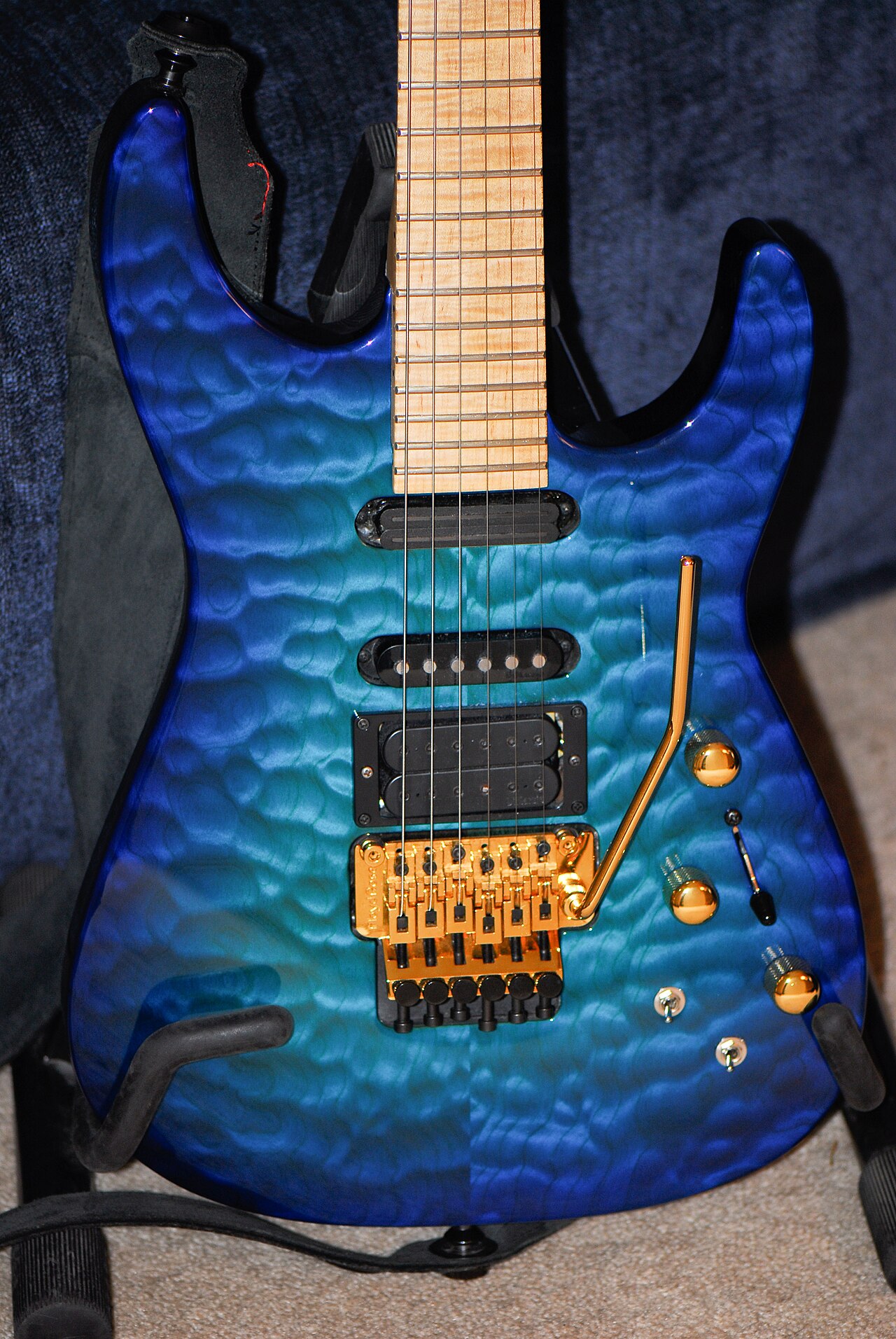
Beyond “Crackle Jack,” Collen’s Jackson collection includes several other well-documented instruments he’s shown off in interviews — “Bela,” a glow-in-the-dark Soloist featuring an image of actor Bela Lugosi as Dracula, which Collen has joked has appeared on more magazine covers than he has. His first proper Jackson signature model arrived around the “Hysteria” tour in 1988, an unusual archtop-style design with a curved top that Collen developed directly with Grover Jackson over the course of a year, sketching ideas on hotel room blackboards while on tour — a genuinely collaborative design process rather than a simple endorsement deal. That instrument eventually gave way to the more conventional PC1 series, which remains one of Jackson’s best-selling signature models decades later, though the standard Soloist that started the relationship remains the guitar most directly tied to Def Leppard’s signature ’80s sound.
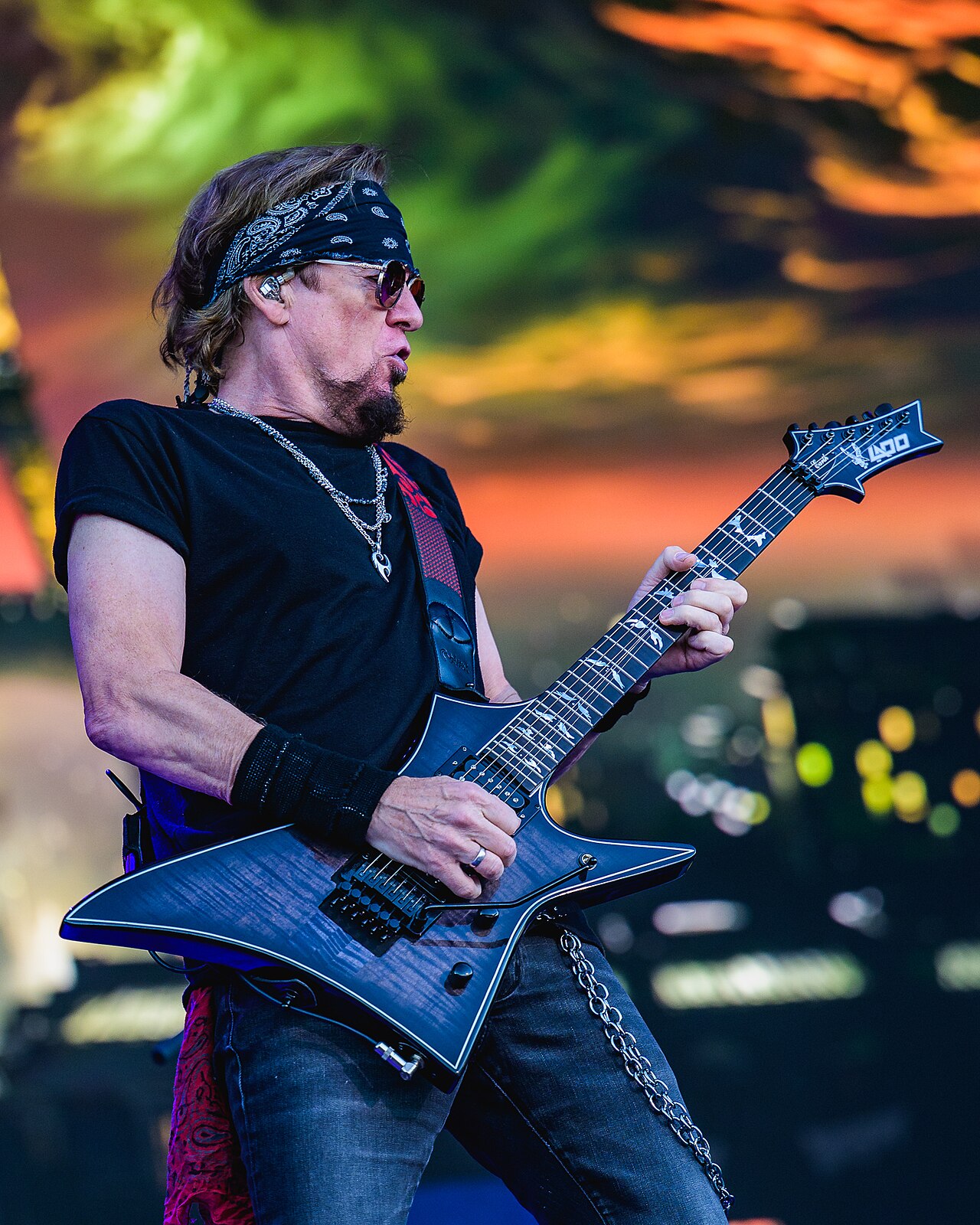
Iron Maiden’s Adrian Smith has a real, if less central, connection. He’s pictured in the booklet for “A Matter of Life and Death” (2006) holding a custom double-neck Jackson Soloist — a 6-string/12-string combination — which he used live for “Children of the Damned” during Maiden’s 2007 tour. Beyond that specific instrument, Smith’s entire current signature lineup with Jackson (the SD, SDM, SDX, and SC1 models) is built on what Jackson itself describes as a “San Dimas Soloist shaped” body — meaning the Soloist’s silhouette runs through Smith’s whole Jackson relationship even though his own signature guitars carry different model names.
Marty Friedman and Misha Mansoor, both suggested by generic gear-list data, don’t actually connect to this specific model. Friedman’s entire Jackson history runs through the Kelly shape — his heavily used 1985 Jackson Kelly (one of the first 500 Jacksons ever built) carried him through “Rust in Peace” and “Countdown to Extinction” — plus a one-off Firebird-inspired prototype photographed for a 1991 Guitar World cover that never became his signature model. His own signature line, the KE-1 and later MF-1, deliberately borrows a Les Paul-style silhouette rather than the Soloist’s. Misha Mansoor’s Jackson signature, the Juggernaut, is explicitly built on the Dinky platform according to Jackson’s own product copy — bolt-on neck, different body proportions — making it a cousin to the Soloist rather than the same guitar.
There is a genuinely interesting cast of confirmed Soloist players. Jim Root of Slipknot has performed with a custom SL1 bearing “ROOT” fingerboard inlays and a Tune-O-Matic bridge in place of the stock Floyd Rose. Ihsahn of Norwegian black metal pioneers Emperor played a Jackson USA SL1 before his later endorsement of Ibanez. Argentine rock icon Gustavo Cerati of Soda Stereo — one of the most influential Latin American rock guitarists of his generation — has been photographed with a blue Jackson USA SL1. Machine Head’s Robb Flynn used a heavily stickered HSS Soloist with a Floyd Rose at the Dynamo Open Air festival in 1995, specifically for songs tuned to C# standard. More recent players include Beartooth’s Caleb Shomo, who has called his Jackson USA SL1 part of the band’s “distinctive” sound, and As Blood Runs Black’s Dan Sugarman.
The Soloist’s Place in the Superstrat Story
The Soloist arrived at a pivotal moment for the superstrat concept as a whole. Eddie Van Halen’s homemade “Frankenstrat” — built partly from a Boogie Body purchased at Wayne Charvel’s original shop — had already proven there was massive appetite for a Stratocaster-shaped guitar reengineered around a single hot humbucker and a divebombing tremolo. Charvel and Jackson spent the late ’70s and early ’80s formalizing that impulse into a repeatable, factory-buildable design language, and the Soloist represents one of the most complete expressions of that effort: premium neck-through construction, extended upper-fret access, and enough tonal flexibility (thanks to its HSS pickup layout) to handle far more than pure metal. It’s part of why players as tonally different as Collen’s arena-rock crunch and Robb Flynn’s downtuned aggression could both find a home on the same body shape.
Full Specifications
Neck-Thru vs. Bolt-On: Why the Soloist Feels Different
The Soloist’s defining structural feature is its neck-through construction, where the neck extends as a single piece of wood all the way to the tail of the body rather than bolting on as a separate piece. Owners consistently describe the resulting sustain as noticeably longer than bolt-on alternatives, a direct byproduct of the unbroken wood path from headstock to bridge. It’s also the feature that separates the Soloist most clearly from Jackson’s own Dinky platform (bolt-on) and, by extension, from guitars like Misha Mansoor’s Juggernaut that use that bolt-on design despite superficial similarities in silhouette.
Neck feel is a frequent talking point in owner reviews. Multiple players describe the SL1’s neck profile as thicker than import-line Jacksons but noticeably thinner than a typical ESP, landing in a comfortable middle ground that suits players with medium-sized hands without feeling cramped during fast lead work. The compound radius fingerboard — rounder near the nut, flatter toward the body — is designed to support comfortable chording in the lower positions while flattening out for effortless bending and shredding higher up the neck.
Dialing In the Tone
Collen’s own “Hysteria”-era sound leaned on Marshall amplification layered with a Rockman headphone practice amp for extra saturation in the studio, DiMarzio pickups swapped into his personal guitars, and a Floyd Rose sustainer driver in later years for extended note length. Collen has specifically credited the Rockman with helping shape Def Leppard’s massive, layered guitar sound on record — a full Marshall stack, he’s noted, would have smothered the vocals and drums given how many guitar overdubs the band was stacking on each track. For players chasing a general Soloist-style tone rather than Collen’s exact rig, three starting points:
Recipe 1: ’80s Arena Rock Rhythm
Bridge humbucker, moderate-to-high gain, scooped mids kept in check with a slight midrange boost to avoid a thin sound, plate reverb. This sits close to the “Pour Some Sugar on Me” rhythm tone — punchy without being harsh.
Recipe 2: Classic Shred Lead
Bridge humbucker, higher gain, slight treble boost, moderate delay for sustain-extending ambience. The Floyd Rose tremolo rewards subtle vibrato and dive bombs in this setting.
Recipe 3: Strat-Adjacent Clean
Neck or middle single-coil (the Classic Stack pickups), clean amp channel, light compression. The stacked single-coils are voiced to cut hum while still delivering a genuinely Strat-like clean tone — useful for the more melodic, less metal-adjacent material a Soloist can also cover.
Buying Guide
The SL1 remains the flagship reference point for the Soloist line, with its three-pickup HSS configuration offering the widest tonal range of the family. Players who prefer a simpler, more direct rock tone might lean toward the two-pickup SL2H instead, which trades the middle single-coil for a 3-way toggle and a more straightforward humbucker-humbucker voicing. Budget-conscious buyers should look at the historical Pro Series and Soloist Pro models from the early ’90s, which used more affordable woods and a Schaller trem rather than a Floyd Rose but retain much of the playing feel at a fraction of the price of a USA model. Entry-level shoppers can also consider the SLSMG (“Super Lightweight Soloist”), Jackson’s budget-tier take on the shape, along with the import-built SL3 and X Series SLX DX models, which trade neck-through construction and premium woods for accessible pricing without losing the fundamental Soloist silhouette. The Japanese-built SL4, produced briefly between 2000 and 2002, occupies an interesting middle ground — 22 frets rather than 24, and a Takeuchi bridge unit rather than a Floyd Rose, but genuinely high-quality alder or mahogany construction that some players rate above the more common import-tier models. Serious collectors specifically chase the pre-1990 examples, since the truss rod design changed in the mid-1990s in a way that some owners feel interferes with the locking nut hardware on later units.
Worth knowing before buying used: Jackson pulled the USA Select Series’ core models, including the SL1, from standard mass production in 2021, shifting American-made Soloists to Custom Select and dealer-order channels rather than off-the-shelf stock. Some retailers still list new units with extended backorder windows, so availability of a genuinely new SL1 can be inconsistent — budget extra patience, or extra searching on the used market, depending on which route you take.
Ownership Notes
A common modification among owners is relocating the volume knob, which many find awkwardly placed on the stock control layout and prone to accidental bumps during aggressive picking — moving it to where the tone knob normally sits is a popular fix. Players looking for hotter output for modern metal tones sometimes swap the neck Classic Stack single-coil for a higher-output pickup, since the stock unit is voiced closer to a vintage single-coil than a hot humbucker. On the collector side, certain 1986-era SL1 units are known to carry a rare red Jackson logo on the headstock rather than the standard finish, a detail that draws a premium among vintage buyers. Overall build quality and factory setup draw consistent praise across owner reviews, with several long-time collectors specifically naming the Soloist as their favorite neck feel across extensive guitar collections that include Gibson, PRS, and ESP instruments.
Several long-term owners specifically contrast the Soloist against Ibanez’s Wizard-profile necks, describing the Jackson’s compound-radius neck as offering more substance in hand without tipping into ESP-style bulk — a middle-ground feel that seems to be the single most consistently praised attribute across owner reviews regardless of era or specific finish. One reviewer who downsized a large personal collection to just three guitars — a vintage Gibson Les Paul Custom, a PRS Custom, and a 1993 USA Soloist — kept the Jackson specifically because of how it held up against instruments costing considerably more. Reports of quality control issues are rare for genuine USA-built units, though buyers should always confirm authenticity carefully given decades of import copies and partscasters built on Soloist-style bodies.
Read our guide to the Jackson Pro Series Rhoads RR24 for the separate Rhoads-shaped branch of the Jackson family.
FAQ
Did Randy Rhoads play a Jackson Soloist?
No. Rhoads died in 1982, before the Soloist’s 1984 introduction. His entire Jackson legacy belongs to the separate Rhoads (originally “Concorde”) V-shaped line.
What’s the difference between the Soloist and the Dinky?
The Soloist uses neck-through-body construction; the Dinky uses a bolt-on neck. They share a general superstrat family resemblance but are structurally different guitars.
Is the USA Soloist SL1 still in production?
It moved from standard USA Select Series production to Custom Select/dealer-order status in 2021. New units are still obtainable but availability and lead times vary by dealer.
What pickups does the SL1 use?
A Seymour Duncan HSS set: Classic Stack single-coil-sized humbuckers at neck and middle, and a TB-4 JB Trembucker humbucker at the bridge.
Is Adrian Smith’s Jackson connection to the Soloist genuine?
Yes, though secondary to his main signature lineup — he’s documented playing a custom double-neck Soloist live in 2007, and his own San Dimas-series signatures are built on Soloist-derived body proportions.
What’s the difference between the SL1 and SL2H?
The SL1 has three pickups (HSS) and a 5-way blade switch; the SL2H has two humbuckers and a simpler 3-way toggle switch. Both share the same neck-through construction, woods, and Floyd Rose tremolo.
Does Misha Mansoor play a Jackson Soloist?
No — his Jackson signature, the Juggernaut, is built on the Dinky platform with a bolt-on neck, a structurally different guitar from the neck-through Soloist despite some visual similarities.
Image credits
- A Jackson PC-1 guitar in Chlorine Blue: ArtBrom, Wikimedia Commons, CC BY-SA 2.0.
- Adrian Smith: Birgit Fostervold, Wikimedia Commons, CC BY-SA 4.0.
Latest News
Related

On This Day
Monday 9 November
From this week: