
ESP LTD EC-1000: The Guitar Gary Holt Kept On Playing
Ben Weinman playing an amber-finished LTD EC-1000 at Wacken Open Air, 2017. Photo: Frank Schwichtenberg, CC BY-SA 4.0.
The affordable Eclipse-shaped guitar Gary Holt and Rammstein's Kruspe reached for. Full ESP LTD EC-1000 specs, history, and buying guide.
Every gear list has a guitar like this one: cheaper than the flagship, less photographed than the signature models, and somehow still the instrument that shows up in more actual working rigs than either. The ESP LTD EC-1000 is the import-tier little sibling of the ESP Eclipse — a shape we already covered in our article on the E-II Eclipse and its two headline names, James Hetfield’s hand-painted Truckster and Kirk Hammett’s Pushead-designed “Spider.” The EC-1000 is what happens when that same silhouette gets built for players who don’t have an endorsement deal, don’t need a Custom Shop, and just want something that can survive a tour van.
It has done exactly that for the better part of three decades, and in the process it has quietly become one of the most heavily gigged single-cutaway guitars in metal that never got a famous name on its headstock — with one notable exception: a Bay Area thrash legend who played one for years before he had a signature model of his own.
A Single-Cut for Every Budget: LTD’s Place in the ESP Family
ESP — Electric Sound Products — started life in Tokyo in 1975 as a shop opened by Hisatake Shibuya that provided custom replacement parts for guitars, before the company began building complete instruments under the ESP and Navigator names for the Japanese market. Like its chief domestic rival Ibanez, ESP was initially known for making high-quality, customized replicas of famous American guitars — Stratocasters, Telecasters, and Gibson Explorers among them, the last of which became the EXP/MX models that James Hetfield made famous with early Metallica.
By the mid-1990s, ESP’s Japanese-made instruments had become genuinely expensive to export, and the company needed a way to reach players outside Japan without the price tag of a hand-built Tokyo instrument. The answer was the LTD line, launched around 1995–1996 as a deliberately more affordable parallel brand. The 1000 series LTDs are made on an assembly line in Korea, whereas the 401 series and below are made in Indonesia — a manufacturing tier system that still roughly holds today, and one worth knowing before you go shopping secondhand.
The EC in EC-1000 stands for Eclipse — the Eclipse in ESP or EC series in LTD are based on traditional single-cut guitars with two humbuckers and separate volume and tone controls, which is another way of saying: this is ESP’s answer to the Les Paul, built the way a Japanese company in the 1980s and ’90s decided to build one — thinner, lighter, with a sharper cutaway and none of a vintage Gibson’s weight or price. The EC-1000 sits at the top of the standard LTD tier, one rung below the Japan-built E-II Eclipse we already covered, and several rungs below the ESP USA Eclipse and any Custom Shop artist model.
The EC name covers a whole family within LTD’s own catalog, not just the 1000. Below the EC-1000 sits the EC-401, a step down in hardware and finish options; below that, the EC-256 and EC-256FM serve as genuine budget entry points, with simpler passive pickups and no locking hardware, aimed squarely at players buying their first serious metal guitar rather than replacing a touring rig. The 1000 designation across ESP’s whole catalog generally signals “top of this particular tier” rather than any specific spec, which is why an EC-1000 and, say, an unrelated MH-1000 or SN-1000FR share a number without sharing hardware — a naming quirk worth knowing since this same numbering convention will recur across the rest of this ESP LTD phase of the project.
Full Specifications
The Famous Players
Our tracking sheet listed the same five names for this SKU that it’s now attached to three consecutive ESP articles in a row: James Hetfield, Kirk Hammett, Stephen Carpenter, Alexi Laiho, George Lynch. It’s the same generic “top ESP artists” roster we already worked through for the E-II Eclipse, the E-II M-II, and the E-II Horizon NT-II — and once again, none of the five has a documented connection to this specific budget-tier instrument. Hetfield’s ESP story runs through the Truckster and the Explorer-shaped Snakebyte (which gets its own LTD signature article later in this very thread, at Rank 218). Hammett’s runs through the Eclipse-based “Spider” and the M-II-based “Ouija” and “Mummy” — plus his own LTD KH-602 signature, coming at Rank 219. Carpenter’s Horizon-based SC series, Laiho’s V-shaped signatures, and Lynch’s Kamikaze all belong to other chapters of the ESP story entirely, not this one.
So we went looking for who actually plays this particular guitar. Equipboard’s database — which tracks 79 documented pro-artist users of the EC-1000 specifically — turned up a much better story.
Gary Holt: The Guitar Before the Signature
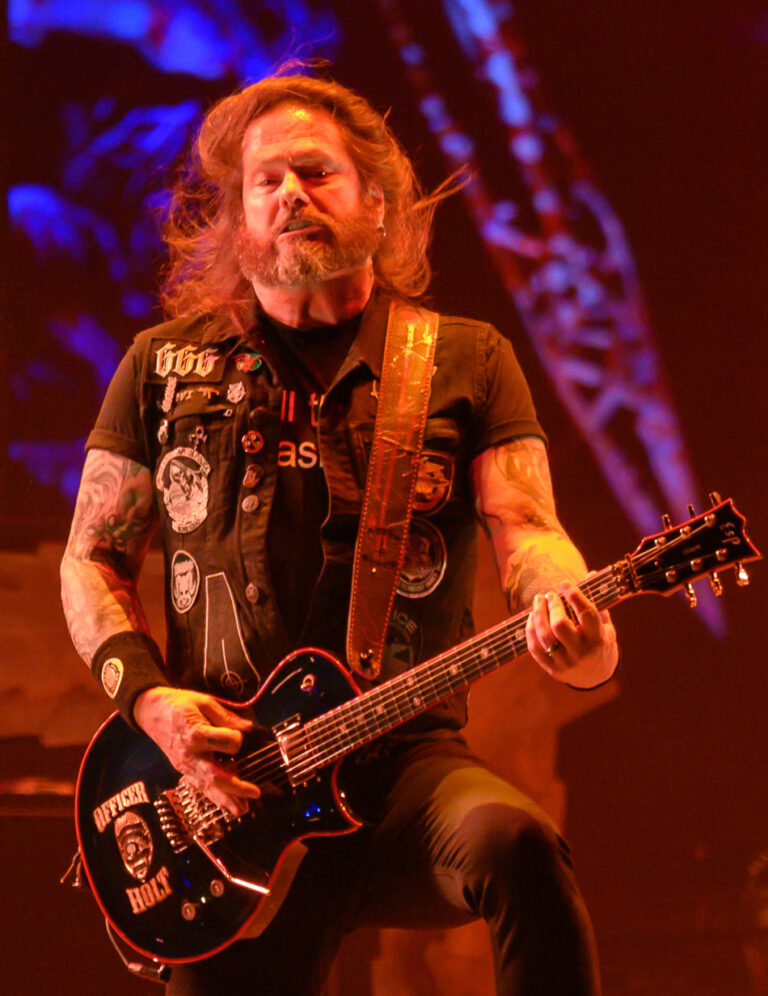
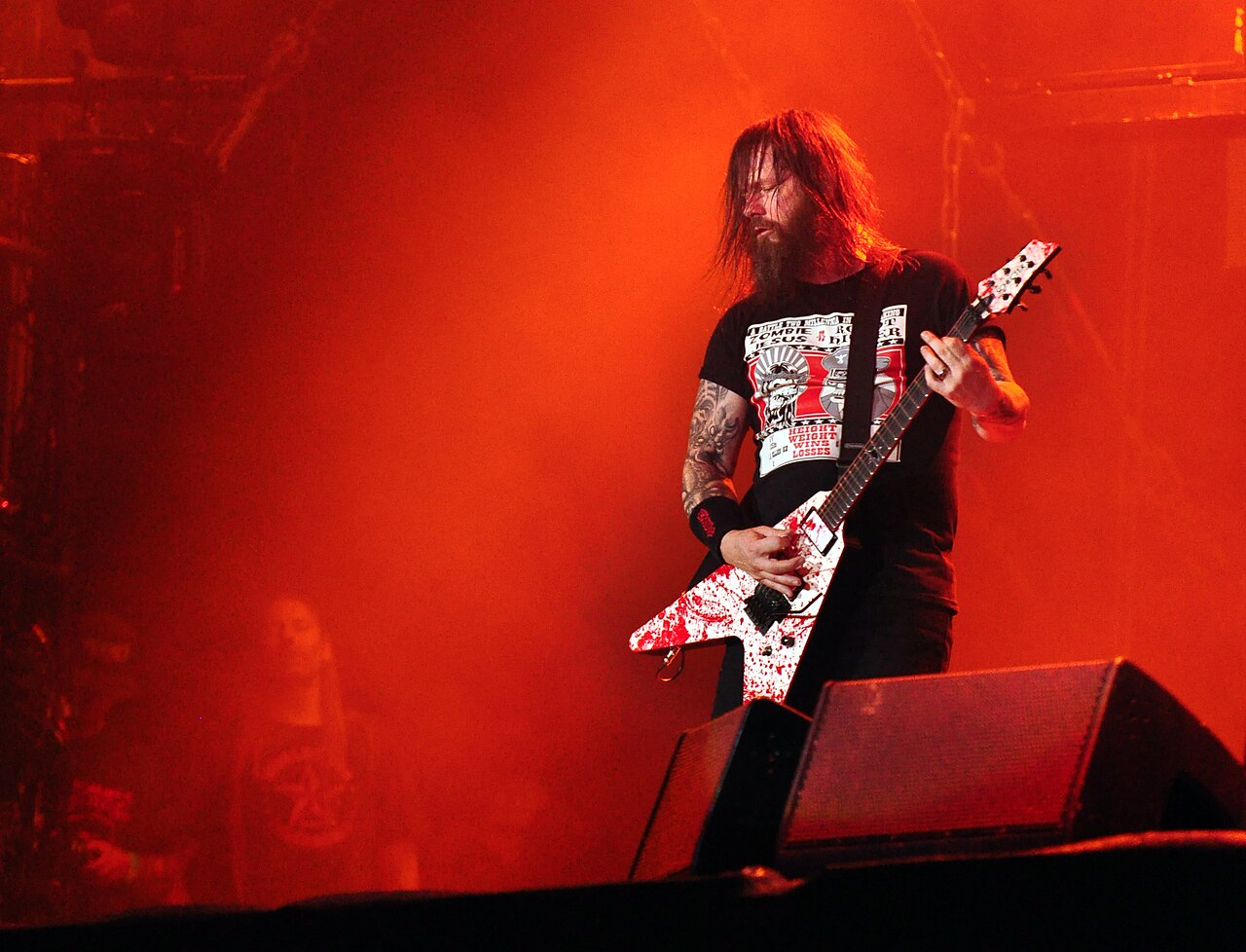
Gary Holt is the rhythm guitarist and de facto leader of Bay Area thrash pioneers Exodus, and has spent long stretches filling in for Slayer’s Jeff Hanneman and later Kerry King on tour. Long before ESP built him his own signature model — the GH-600 — a rig rundown documented Holt using the LTD EC-1000 before his signature was ready, and he still uses it to warm up before shows. That’s a rare and specific kind of endorsement: not a guitar he was handed and photographed with once, but one he genuinely reached for during the exact years he needed something reliable, and kept reaching for even after his name went on a headstock of his own. Fittingly, Exodus’s 2014 album Blood in Blood Out is one of the albums Equipboard has tagged with EC-1000 usage — a direct line from the guitar to Holt’s own band’s studio work during that era.
Richard Z. Kruspe: Flamethrowers and Rammstein’s Solo Project
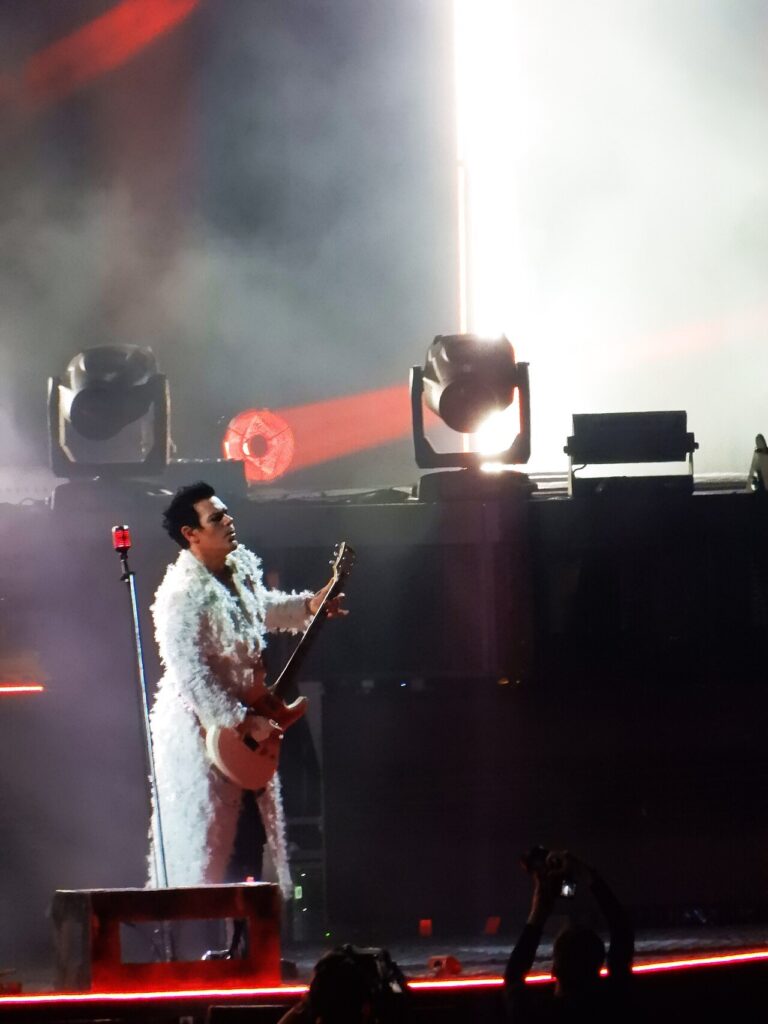
Richard “Zven” Kruspe, Rammstein’s guitarist, has a documented EC-1000 connection through his solo/side project Emigrate rather than through Rammstein itself. Kruspe uses this guitar in the Emigrate music video for “Eat You Alive,” and it also turns up live during a performance of “Stripped” — accompanied, in true Rammstein fashion, by an onstage flamethrower during a 2017 festival run. Emigrate’s 2021 album The Persistence of Memory is also tagged with EC-1000 usage on Equipboard, suggesting the guitar had a real studio role in that project rather than being a one-off stage prop. Kruspe already has an established slug on this site from our earlier project coverage, so we’re linking directly: Richard Kruspe’s gear guide.
The Supporting Cast
Beyond the two headline names, the EC-1000’s artist list runs deep through 2000s and 2010s metalcore and modern metal: Michael Paget of Bullet For My Valentine is visible playing one in the official video for “Tears Don’t Fall”; Tony Perry of Pierce the Veil used a Silver Sunburst EC-1000 before switching to ESP’s Viper shape; Kevin Skaff of A Day To Remember ran a white EC-1000 as a backup guitar in 2010; Andy James (currently of Five Finger Death Punch) has been photographed playing one directly; and Sean Long of While She Sleeps has been filmed with a black-gloss, white-bound EC-1000 marked “Deluxe” on the headstock. None of these are signature-model relationships — they’re just working guitarists who bought or were given a genuinely solid, gig-ready instrument and used it on camera. There’s also a curiosity worth flagging honestly: Anthrax bassist Frank Bello has been documented playing an EC-1000 six-string guitar (not his usual bass) for a specific side project called Attitudes & Altitude — an unusual sighting rather than part of his main rig, but real enough to be worth a mention.
Tone Recipes
The EMG 81/60 pairing is the defining voice of the standard EC-1000, and it’s built for exactly one job: high-gain metal that stays articulate under palm mutes. Real rig data from EC-1000 owners consistently pairs the guitar with gear like the Peavey 6505+ head and a Boss NS-2 noise suppressor in the effects loop — both of which show up repeatedly in “used with” data for this exact guitar — so these recipes lean on that real-world pattern rather than a generic pedalboard fantasy.
- Thrash/death rhythm tone: EMG 81 in the bridge, straight into a high-gain head like a 6505-style amp, gate engaged post-distortion to control the noise floor from the active pickup’s output. Keep the guitar’s tone knob near full — the 81 is already voiced bright and tight, and rolling it back muddies palm-mute definition fast.
- Cleaner verses and leads: Switch to the EMG 60 in the neck position and roll the amp gain back slightly. The 60 is voiced warmer and more vocal than the 81, closer to a PAF-style neck humbucker than a typical active pickup, and it’s the better choice for anything melodic.
- Coil-tapped versatility (CTM DMZ and similarly equipped variants): Pull up on the tone or volume push-pull to split the humbuckers into single-coil mode for a thinner, quack-adjacent tone useful for cleaner rhythm parts or genre crossover — not available on every EC-1000 configuration, so check the specific model before relying on it.
For direct-to-interface recording rather than a live rig, owners on Equipboard commonly pair the EC-1000 with an audio interface like PreSonus’s FireStudio line rather than a full amp stack, running the EMG 81 straight into an amp-modeling plugin — a setup that works well precisely because the EMG’s high output and low noise floor were designed for exactly that kind of direct signal chain in the first place.
EC-1000 vs. the Rest of the ESP Family
This is the guitar that completes a three-tier ladder. The E-II Eclipse is built in ESP’s Tokyo-area factory to a noticeably higher spec ceiling — Fishman Fluence or higher-grade EMG pickup options, compound-radius fingerboards, and a $2,000–2,800 price point. Above that sits the ESP USA Eclipse, hand-built in Los Angeles for players like Alex Skolnick who own the stock, non-signature version outright. The EC-1000 is the entry point into that same body shape and the same general playing feel — set-thru mahogany construction, 24.75″ scale, dual humbuckers — at roughly a third of the E-II’s price and a fraction of the USA model’s. The trade-offs are real: a fixed 13.7″ fingerboard radius instead of the E-II’s compound radius, a simpler three-way switch on most standard configurations, and Korean rather than Japanese manufacturing. But the underlying shape, scale length, and single-cutaway ergonomics are the same guitar in spirit, which is exactly why players like Gary Holt could pick one up, gig it hard for years, and never feel like they were making do with something lesser.
Buying Guide: Know Your EC-1000 Variant
“EC-1000” isn’t one guitar — it’s a family of closely related configurations, and the differences matter when you’re shopping used:
- EC-1000 VB (Vintage Black): The classic configuration — gold hardware, EMG 81/60, TonePros bridge, ebony board with abalone flags. This is the guitar most of the artist sightings above are playing.
- EC-1000FM / EC-1000QM: Flamed or quilted maple top variants, generally with a satin or see-through finish rather than gloss black, same core electronics.
- EC-1000 Evertune: Swaps the TonePros bridge for an Evertune constant-tension system — a genuinely different playing feel, popular with drop-tuned and low-tuned players who want guaranteed pitch stability.
- EC-1000FR / EC-1001FR: Floyd Rose-equipped variants for players who want vibrato on the Eclipse shape, which the standard hardtail configuration doesn’t offer.
- EC-1000 Duncan / EC-1000/CTM DMZ: Passive Seymour Duncan ’59/JB pickups instead of active EMGs, often with coil-tap wiring — the choice for players who want more dynamic response than the compressed, always-on character of active pickups.
- Newer Fishman Fluence-equipped models: Recent production has begun offering Fishman Fluence Modern active pickups on some EC-1000 configurations, with the ability to split tones between neck and bridge — a notably clearer voice than the stock EMG 81/60 pairing.
On the manufacturing question specifically: current official ESP documentation places all 1000-series LTDs on a Korean assembly line, and that’s held true for most of the model’s life. But secondhand shoppers regularly flag units stamped as Indonesian- or Chinese-made from certain production runs, and forum consensus consistently favors the Korean-built examples for fit, finish, and resale value — worth checking the serial number and country-of-origin sticker before buying used.
A left-handed version exists (EC-1000 Left Handed), though color and finish options are more limited than on the right-handed line — a real constraint for left-handed players chasing a specific finish. And regardless of which variant you land on, budget separately for a case: none of the standard configurations ship with one, which catches new buyers off guard given the guitar’s price point sits close to instruments that do include hard cases.
What Owners Say
The EC-1000’s reputation among long-term owners is remarkably consistent. On the positive side: an unusually high-quality finish for the price point, genuinely aggressive and punchy EMG tone suited to metal and hard rock, a comfortable Thin U neck that owners describe as fast without being uncomfortably slim, dependable locking tuners, and a body that’s noticeably lighter on the shoulder than a comparable Gibson Les Paul. Several reviewers explicitly frame it as a Les Paul alternative that punches well above its price bracket.
The complaints cluster around quality-control variance rather than fundamental design flaws: occasional fret-edge sharpness or unevenness straight from the factory, finish that can wear or oxidize faster than expected with heavy touring use, and the odd report of tuning stability issues despite the locking hardware. A few owners also note the guitar runs heavier than some alternatives, enough to cause shoulder fatigue over a long set. None of this is disqualifying — it’s the kind of variance you’d expect from an assembly-line import instrument at this price point, and most owners report the guitar holding up well once any initial setup issues are addressed. A popular upgrade path among owners who want more dynamic range than the stock EMGs offer is swapping in passive pickups like Seymour Duncan’s ’59/JB set or boutique options like Bare Knuckle’s Ragnarok and Cold Sweat, both cited by owners as delivering a less compressed, lower-output alternative voice.
FAQ
Is the ESP LTD EC-1000 the same guitar as the ESP Eclipse?
Not exactly, but it’s built on the same body shape. The EC-1000 is LTD’s (ESP’s affordable sub-brand) take on the Eclipse platform, manufactured in Korea rather than Japan and built to a lower overall spec than the E-II Eclipse or ESP USA Eclipse — but sharing the same single-cutaway silhouette, 24.75″ scale, and general playing feel.
What pickups come stock on the EC-1000?
The standard configuration pairs an EMG 81 in the bridge with an EMG 60 in the neck — both active humbuckers voiced for high-gain metal. Variants exist with passive Seymour Duncan pickups, Fishman Fluence actives, or Floyd Rose-equipped configurations, so it’s worth checking the exact model suffix before buying.
Who actually plays the EC-1000?
Gary Holt of Exodus and Slayer used one for years before ESP built him his own GH-600 signature, and still keeps one for warm-ups. Richard Kruspe of Rammstein has used one in his Emigrate side project, both on video and live. It’s also been documented in the hands of Michael Paget (Bullet For My Valentine), Tony Perry (Pierce the Veil), Kevin Skaff (A Day To Remember), and several other 2000s-and-2010s metal and metalcore guitarists.
Is it made in Korea or Indonesia?
Current production places the 1000-series LTDs, including the EC-1000, on a Korean assembly line. Lower LTD tiers (401 and below) are Indonesian-made. Some older or specific-run units have surfaced with different countries of origin, so it’s worth checking the serial/origin sticker on any used unit.
How does it compare to the E-II Eclipse?
The E-II Eclipse is built in Japan to a higher spec ceiling — compound-radius fingerboard, pricier pickup options, roughly double-to-triple the price. The EC-1000 shares the shape, scale length, and general construction philosophy at a fraction of the cost, with a simpler fixed-radius fingerboard and Korean rather than Japanese manufacturing.
Does it come with a case?
No — a case or gig bag is sold separately on the standard EC-1000, which is worth budgeting for if you’re buying new.
Image credits
- Gary Holt: Jonas Rogowski, Wikimedia Commons, CC BY-SA 3.0.
- Top image: Ben Weinman playing an amber-finished LTD EC-1000 at Wacken Open Air, 4 August 2017; the pictured variant is not the black EMG-equipped configuration in the specification table. Photo: Frank Schwichtenberg. The Dillinger Escape Plan – Wacken Open Air 2017 11, original photograph, CC BY-SA 4.0. Full source frame retained; displayed at reduced size, with no crop or retouch. Adaptations remain subject to the same or a compatible ShareAlike license.
- Gary Holt: Stefan Brending, Wikimedia Commons, CC BY-SA 3.0 DE.
- Richard Z. Kruspe: Tilly antoine, Wikimedia Commons, CC BY-SA 4.0.
Latest News
Related

On This Day
Tuesday 10 November
From this week: