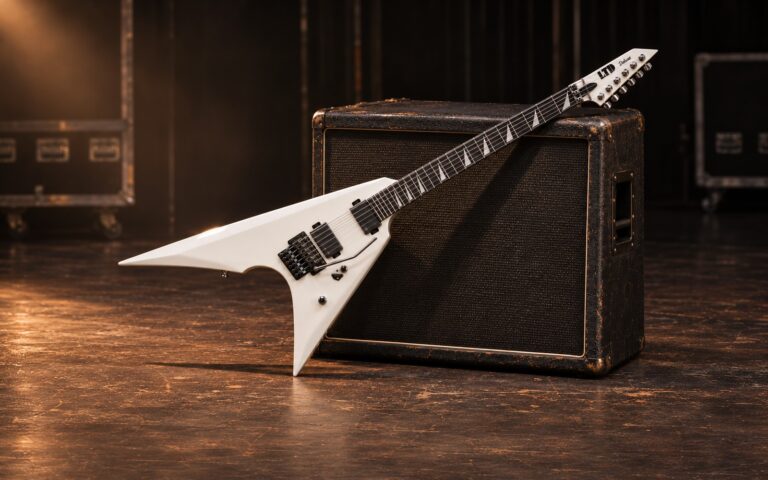
ESP LTD MH-1000: The Shape Built From Two ESP Icons
Half Horizon, half Mirage: how ESP fused two of its own shapes into the LTD MH-1000. Full specs, real players, and an honest buying guide.
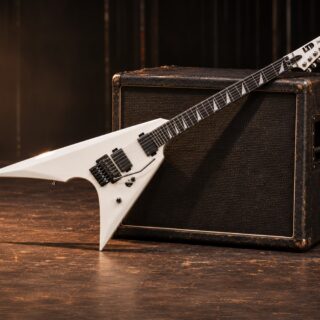
Most guitar shapes have one origin story. The ESP MH has two, and it says so right in the name. The “M” comes from ESP’s Mirage series — the reversed-headstock, thin-necked superstrat line that later became the M-II we covered in this project’s E-II M-II article, the platform behind Kirk Hammett’s “Ouija” and “Mummy.” The “H” comes from Horizon — the carved-top archtop shape we covered via Stephen Carpenter’s E-II Horizon NT-II. ESP’s own product copy is refreshingly direct about it: the MH Series combines the Horizon’s archtop body with the M/Mirage’s inline headstock and extra-thin U-shaped neck. It’s a guitar built, quite literally, from two other guitars this project has already spent full articles on.
That hybrid identity means the MH-1000 never got its own decades-old celebrity legend the way the Eclipse got Hetfield’s Truckster or the M-II got Hammett’s Ouija. Instead, it earned its reputation the slower way — through working touring musicians who picked it because it played well, and through a modern Slipknot signature model that borrowed its body outright.
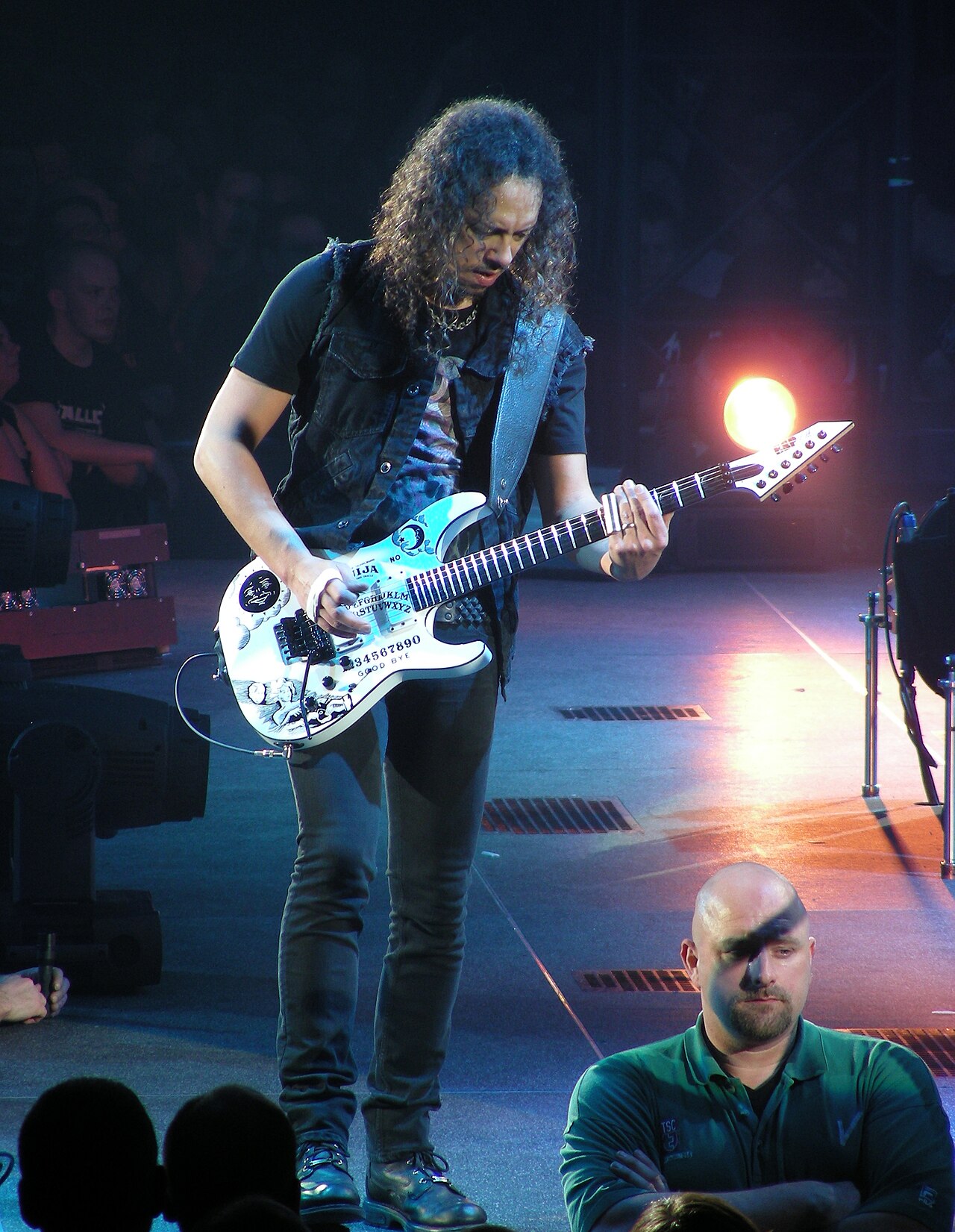
Hybrid shapes like this are relatively rare in the metal guitar world — most manufacturers keep their body families distinct rather than deliberately splicing two established shapes together and selling the result as a third standalone line. Jackson’s Soloist and Dinky stay separate lines despite sharing a manufacturer and a target audience; Ibanez’s RG and S series are visually and structurally distinct rather than merged. ESP’s willingness to combine Horizon and Mirage into a genuinely new catalog entry, rather than treating one as a variant of the other, is part of what makes the MH worth a dedicated look on its own terms.
A Guitar Built From Two Other ESP Guitars
The Mirage series dates back to 1986, a superstrat-era design with a through-body maple neck, double-locking vibrato, and a reversed headstock that made it instantly identifiable on a dark stage. Horizon dates from roughly the same mid-1980s window — one of ESP’s oldest standard shapes, built around a carved archtop body descended loosely from Explorer-era design thinking, and the same platform underneath Stephen Carpenter’s SC signature series covered in our Horizon article. Sometime in the 2000s, ESP’s design team spliced the two together: take Horizon’s arched, contoured body, graft on Mirage’s slim reversed-headstock neck, and the result is the MH — a shape distinct enough from either parent that ESP catalogs it as its own standalone series, alongside Eclipse, Horizon, M, and Viper, in the Deluxe Series lineup that began in 2003.
The distinction between the MH-1000 and its closest sibling, the M-1000, comes down entirely to that hybrid parentage: the M-1000 keeps a flat top over an alder body with a reversed headstock, while the MH-1000 gets Horizon’s carved, quilted top over mahogany. Owners who’ve compared the two side by side describe the difference as mostly cosmetic and tonal rather than ergonomic — same neck feel, same reversed headstock, different body wood and top contour underneath.
The reversed, inline headstock inherited from the Mirage side isn’t just a visual signature — it has a real functional effect on tuning stability. With the low strings routed to the tuners closest to the nut and the high strings routed furthest, the break angle and string length behind the nut end up more evenly distributed across all six strings than on a standard non-reversed headstock, where the low E and high E have noticeably different lengths of string behind the nut. In practice this tends to translate to more even tuning response across the whole set, particularly useful on a guitar built to handle drop tunings. ESP folded the MH into what it now calls the Deluxe Series — a catalog umbrella launched in 2003 that groups together the company’s most popular established shapes (Eclipse, MH, Horizon, M, and Viper) with premium-tier features, sitting conceptually above the more basic Standard Series naming.
Full Specifications
The Famous Players
None of the usual five ESP names (James Hetfield, Kirk Hammett, Stephen Carpenter, Alexi Laiho, George Lynch) has a documented MH-1000-specific connection. Hammett’s superstrat-shaped guitars run through the M-II, not the hybrid MH. Carpenter’s own signature series is Horizon-based but structurally distinct from the MH’s grafted design. Laiho’s and Lynch’s signature lines belong to entirely different shape families. So we went looking independently — and this time the trail led less to legacy metal royalty and more to the working musicians actually gigging this guitar today.
Chris Wiseman: The Guitar Before Ibanez
Chris Wiseman is the guitarist, producer, and co-founder of Connecticut deathcore band Shadow of Intent, and also plays lead guitar in the metalcore band Currents. A documented performance video shows Wiseman playing Shadow of Intent’s “The Great Schism” on an ESP LTD MH-1000ET — footage from before his current Ibanez artist endorsement began. Wiseman has since become a full Ibanez signature-roster player, appearing in the brand’s official artist directory alongside gear like the RGD61ALET and RGA61ALN Axion Label models, and his touring schedule has grown accordingly — his own studio updates cite dozens of shows across multiple countries in a single touring cycle. But the MH-1000ET was part of his rig during Shadow of Intent’s earlier touring years: a genuinely gig-worthy guitar that working musicians reach for before a bigger brand deal arrives, not after. Wiseman also runs his own recording studio out of Beacon, New York, producing for other artists in addition to his own bands — a working musician’s résumé, not a one-off endorsement photo.
Jean Patton: Filling In For Sepultura
Jean Patton is a Brazilian metal guitarist, producer, and co-founder of the band Project46, with more than two decades on stages including Rock in Rio and Monsters of Rock. In 2022, Patton was called up by Sepultura to fill in for guitarist Andreas Kisser on a 23-show European tour — and Instagram documentation shows him playing an ESP LTD MH-1000 six-string during that period, alongside a separate LTD M-1000 that ESP specifically sent him for the Sepultura dates. Patton has also been documented on YouTube playing the extended-range MH-1007 EverTune for a Meshuggah cover — evidence that the MH platform’s appeal extends into the seven-string, drop-tuned end of modern metal as comfortably as it does standard six-string rock.
Mick Thomson’s Signature Borrows This Body
The strongest validation of the MH shape doesn’t come from a player using the exact MH-1000 SKU — it comes from ESP’s own decision to build a Slipknot signature model on top of it. Mick Thomson joined ESP’s artist roster in May 2023, and his resulting signature, the LTD MT-I, is explicitly described by ESP as based on the MH-style body, with an arched top carried over directly from this platform. It’s an important distinction to be honest about: Thomson’s signature isn’t the MH-1000 itself, and he’s primarily documented on his own MT-I rather than the standard-production guitar. But it means the shape underneath this article’s guitar is now also the shape underneath a working Slipknot guitarist’s namesake instrument — about as strong an endorsement of a body design as a manufacturer can give without simply renaming the model after the artist.
A few more MH-family sightings round out the picture on the extended-range side: Jim Davies of The Prodigy has been photographed with a 7-string MH-1007 EverTune, and YouTube singer-songwriter Nathan Sharp (NateWantsToBattle) used the same 7-string EverTune model in a music video cover. Neither is a core metal-guitarist endorsement in the Hetfield-or-Hammett sense, but both add to a picture of the MH platform as a genuinely working instrument across a wider range of genres than its metal-centric marketing might suggest.
Tone Recipes
The MH-1000’s tonal character depends heavily on which pickup configuration you land on, since — unlike the EC-1000’s consistent EMG 81/60 pairing — the MH line ships with genuinely different electronics depending on the exact variant.
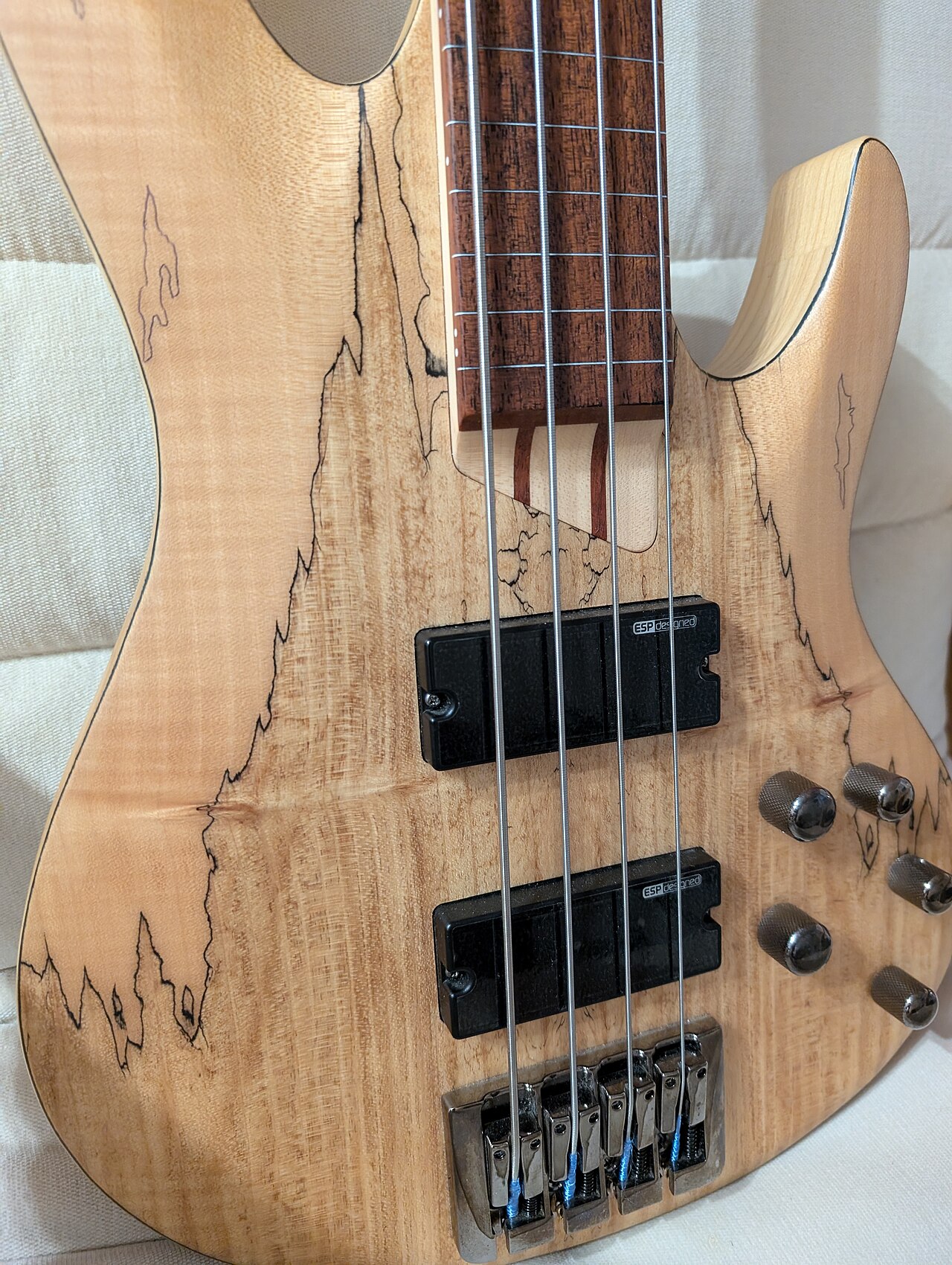
- Deluxe (Fishman Fluence Modern) high-gain rhythm: Bridge pickup, Voice 1 selected (leave the push-pull pot down) — this gives the ceramic Fluence’s high-output, searing crunch character with tight low end and no mud, closer to a hot passive humbucker than a typical clean-and-quiet active pickup.
- Deluxe alternate voicing for cleans and dynamics: Pull up on the push-pull pot to access Voice 2 on either pickup — a more organic, passive-feeling response with noticeably more dynamic sensitivity to pick attack than Voice 1, useful for clean or crunch tones that need to breathe.
- FR variant (EMG 81/85): A more traditional active-pickup metal voicing — 81 in the bridge for tight rhythm work, 85 in the neck for warmer leads, EMG’s usual low-noise, high-output character throughout.
- NT/HS variant (Seymour Duncan Pegasus/Sentient or Hot Rails): The passive option for players who want more amp-dependent dynamics — the Pegasus/Sentient pairing in particular is well regarded for versatility across drop-tuned rhythm and cleaner melodic work in bands like Lamb of God’s and Gojira’s general tonal territory.
For direct recording rather than a full amp rig, the passive-pickup variants pair naturally with modern amp-modeling plugins — a workflow increasingly common among the working musicians covered above, several of whom record and tour using entirely in-the-box rigs built around software amp models rather than physical heads and cabinets, a shift that’s become the norm across modern metal and metalcore over the past several years.
MH-1000 vs. the Rest of the ESP Family
This is the third ESP-family shape this project has profiled from the ground up, after the M-II and Horizon NT-II, and the second LTD-tier entry after the EC-1000. Where the EC-1000 is LTD’s take on the single-cutaway Eclipse, the MH-1000 sits closer to superstrat territory — 25.5″ scale rather than the Eclipse’s 24.75″, a slimmer reversed headstock, and a more aggressive carved top. If the M-II is the “pure” superstrat expression of Mirage DNA and the Horizon NT-II is the “pure” archtop expression of Horizon DNA, the MH-1000 is genuinely the midpoint between the two — a guitar that borrows the best-regarded features of each parent rather than simply being a budget version of either.
Buying Guide: Know Your MH-1000 Variant
The MH-1000 name covers a wider spread of genuinely different configurations than most single LTD model numbers:
- MH-1000 Deluxe: The current flagship configuration — Floyd Rose 1000SE, Grover tuners, Fishman Fluence Modern humbuckers with push-pull dual voicing.
- MH-1000FR: EMG 81/85 active pickups instead of Fishman Fluence, still Floyd Rose-equipped.
- MH-1000 Evertune / MH-1000ET: Swaps the Floyd Rose for an EverTune constant-tension bridge, popular with drop-tuned players who want guaranteed pitch stability without a locking trem’s setup complexity.
- MH-1000NT: Non-tremolo — despite the “NT” suggesting neck-thru to some shoppers, ESP’s own convention uses it to mean non-tremolo here, paired with a TonePros locking Tune-O-Matic and string-thru body instead of any vibrato system.
- MH-1001HS: A humbucker/single-coil-voiced configuration using Seymour Duncan Hot Rails (neck) and Pegasus (bridge), with coil-splitting via push-pull.
- MH-1007 / MH-1007 EverTune: Seven-string extended-range variants, popular for lower-tuned modern metal.
On manufacturing: this is one area where the MH-1000 is genuinely less consistent than the EC-1000. Current documentation and owner reports both describe MH-1000 units coming from both Korean and Indonesian production lines, with at least one buyer specifically noting that Korean-made units tend to show noticeably better quilted-maple top figuring than Indonesian-made ones of the same finish. That’s a real reason to inspect country-of-origin before buying, especially for the figured-top finishes where the visual grade matters most to the purchase decision.
Pricing spreads meaningfully across the variant lineup: the EverTune-equipped models and Deluxe Fishman Fluence configurations sit at the top of the range, generally $1,400–1,700 new, while the standard FR and NT variants land closer to $1,000–1,200. Used prices vary widely depending on hardware condition, particularly on Floyd Rose-equipped units where a worn bridge can meaningfully affect resale value. Left-handed availability is limited across the MH line compared to the EC series, so left-handed players shopping this shape should expect fewer finish and configuration choices.
What Owners Say
Real forum and Equipboard-sourced feedback on the MH-1000 clusters around a few consistent themes. On the neck: owners coming from Ibanez-style thin necks report the MH’s extra-thin U profile as comfortable and non-restrictive rather than a downgrade, which is a meaningful data point since Ibanez necks are often the reference point players use for “fast.” The guitar is repeatedly praised for handling multiple alternate tunings well, with several owners specifically noting comfortable use in both E standard and D standard without needing a full re-setup. Bridge-wise, the Floyd Rose 1000-series hardware on the Korean-built 1000 series is consistently rated as superior to the cheaper Floyd Rose Special used on lower LTD tiers, with better tuning stability cited directly by owners — while the EverTune-equipped variants draw praise for being dramatically easier to live with day to day, in contrast to the Floyd Rose’s more involved setup and maintenance routine.
On the downside: the quilted maple veneer on some units has been criticized as thinner and less dimensional than a genuine deep quilt top, the Floyd Rose can show wear over time on heavily used units, and — as with the EC-1000 — no configuration ships with a case or gig bag included, which is worth budgeting for separately given the guitar’s price point. A handful of owners transitioning from EMG-loaded guitars to the Fishman Fluence Modern-equipped Deluxe variant report an adjustment period getting used to the two-voice system, since the Fluence’s Voice 2 setting behaves noticeably differently from a simple coil-tap and takes some experimentation to dial in for a specific mix context. None of these are dealbreakers reported at a rate higher than typical for the price category — they’re the kind of details worth knowing before ordering a specific finish rather than reasons to avoid the model altogether.
FAQ
What does “MH” stand for on this ESP model?
It’s a portmanteau of two other ESP shapes: the “M” from the Mirage/M series (superstrat-style, reversed headstock) and the “H” from Horizon (carved archtop body). ESP’s own marketing describes the MH as combining design elements from both.
How is the MH-1000 different from the M-1000?
The M-1000 has a flat-top alder body; the MH-1000 has a carved, quilted-maple-topped mahogany body borrowed from the Horizon line. Both share the same reversed headstock and extra-thin U neck profile.
What pickups come on the MH-1000?
It depends on the variant. The current Deluxe configuration uses Fishman Fluence Modern active humbuckers with dual voicing. Other variants use EMG 81/85, or passive Seymour Duncan Pegasus/Sentient or Hot Rails/Pegasus pairings — check the exact model suffix before buying.
Who actually plays the MH-1000?
Chris Wiseman of Shadow of Intent and Currents played an MH-1000ET before his current Ibanez endorsement. Brazilian metal guitarist Jean Patton has been documented on both the MH-1000 six-string and the extended-range MH-1007 EverTune. Slipknot’s Mick Thomson has an ESP signature model, the MT-I, explicitly built on this same body shape.
Is it made in Korea or Indonesia?
Both — current production has been documented coming from each country, with Korean-made units generally reported to have better top-figure quality on quilted-maple finishes. Worth checking the origin sticker before buying, especially for figured-top finishes.
Does it come with a case?
No — a case or gig bag is sold separately across all standard MH-1000 configurations.
Image credits
- An ESP LTD B204 SM FL fretless bass body and pickups: Elmschrat, Wikimedia Commons, CC BY-SA 4.0.
- Kirk Hammett: Merijn Bos, Wikimedia Commons, CC BY-SA 3.0.
Latest News
Related
On This Day
Monday 9 November
From this week: