The Birmingham Bulldozer: Laney’s GH100L and Paul Gilbert’s Fifteen-Year Partnership
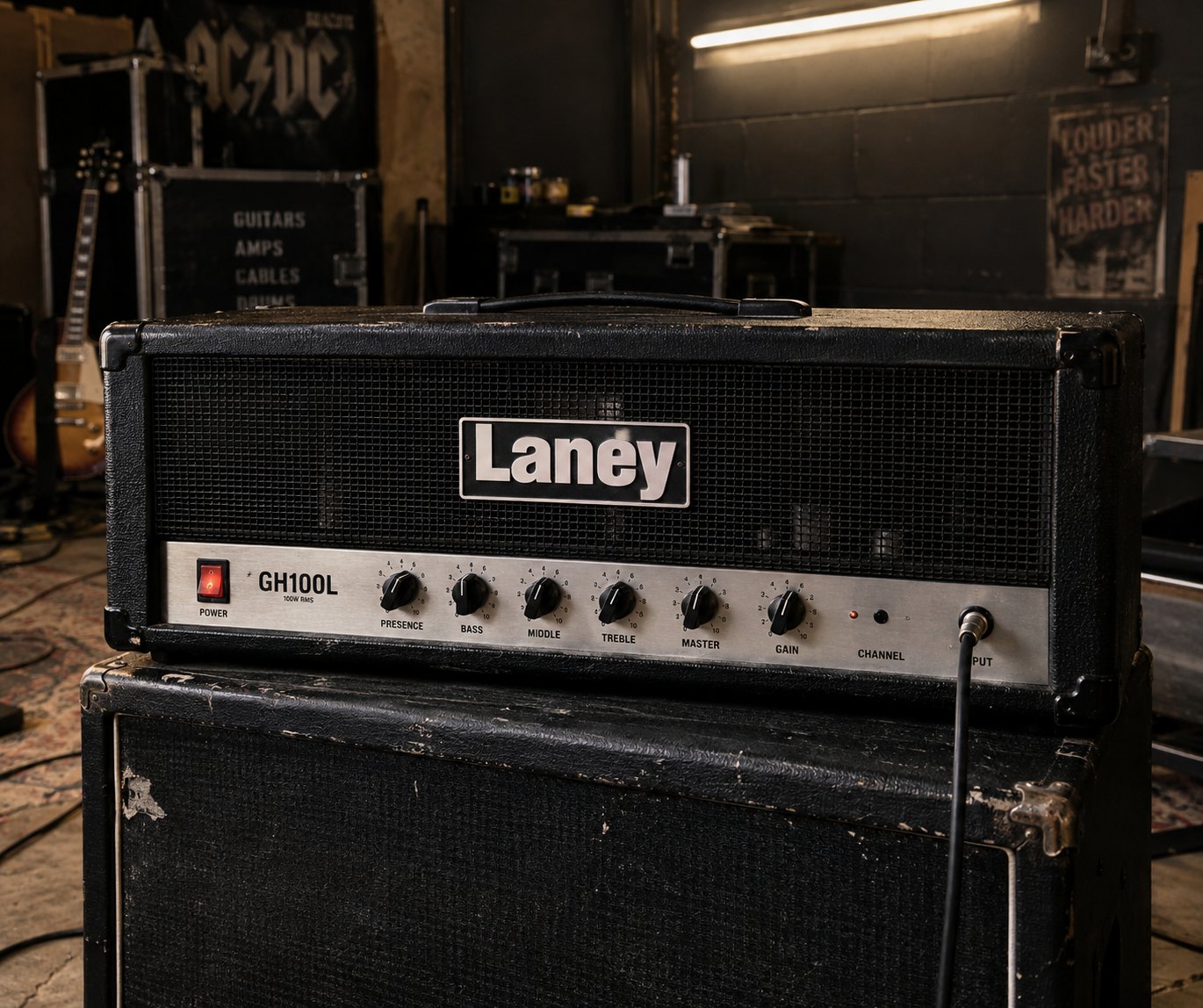
Laney GH100L Head. AI-generated reference illustration, not a photograph.
Laney GH100L: Paul Gilbert's 100W EL34 tube head for 15 years. Specs, verified player history, 5 tone recipes, and a complete used-market buying guide.
In the early 1990s, a specific conversation was happening in rehearsal rooms across Britain and North America. The question was simple: what do you buy when you want a Marshall JCM800 but you need more gain, thicker mids, and something that the rest of the band doesn’t already have stacked in the corner? Laney’s answer was the GH100L — a 100-watt, single-channel EL34 tube head built in Birmingham, England, that landed with exactly the right combination of old-school British roar and a gain structure that went somewhere the JCM800 wouldn’t go without external help.
The amp found its most famous home in Paul Gilbert’s rig. Gilbert — the Racer X and Mr. Big shred architect, one of the most technically precise guitarists in rock history — endorsed Laney and used the GH100L for approximately fifteen years. His relationship with the amp covered the Racer X reunion era, his solo instrumental records, and extended into the “Get Out of My Yard” tour years. That is not a casual brochure claim — it is a fifteen-year working relationship documented across official Racer X rig documentation and gear lists, during which the GH100L was his primary head for concerts and recordings.
The GH100L is discontinued now. It left production many years ago and its successor, the GH100R, has also been superseded in the Laney catalogue. Finding one requires patience on the used market. And yet: the price when you do find one is reasonable, the circuit holds up, and the sound — that particular EL34 British crunch with the extra preamp stage and the thick midrange presence — has no current mass-market equivalent at the same price point. This is the complete story of how it works, who used it, and whether the amp still makes sense for a player in 2024 and beyond.
Born in Birmingham: The Laney Story
Laney Amplification was founded in 1967 by Lyndon Laney in Birmingham, England — the same city, the same decade, and very nearly the same circle of musicians that produced the British rock amp industry. Laney played in The Band of Joy alongside John Bonham on drums and Robert Plant on vocals before either of them joined Led Zeppelin. He built his first amplifiers for that band. The company’s earliest PA systems ended up providing sound for Led Zeppelin’s first United States tour in 1968 — which is a very specific way to prove a concept under fire.
The company spent the 1970s building its reputation for British valve tone, progressing through a range of heads and combos that shared DNA with the Marshall, Vox, and Orange tradition — EL34 power sections, British transformer voicing, the mid-forward character that runs through the whole British amp lineage — while developing its own house sound. Laney is not a Marshall clone operation. The voicings have always been distinct: a different midrange emphasis, a different feel in the low end, a different response to overdrive pedals and different pick dynamics at the front end.
By the early 1990s, the company released what many consider the strongest generation in its history: the GH100L, the GH50L (its 50-watt sibling), and the VH100R (a more complex high-gain design with additional voicing options). These three amps established Laney’s position in the hard rock and metal market of the era and brought the brand its lasting professional credibility outside the UK. They were built in Halesowen in the West Midlands, close to where Laney had set up its larger manufacturing operation after expanding from its Birmingham origins.
The GH100L’s direct predecessor was the A100H, which looked and felt like a modified Marshall 2203 in its external architecture. The GH100L took that baseline and added the most significant practical improvement in the design: an extra, switchable preamp tube that allowed the amp to push beyond JCM800 gain levels without routing signal through an external overdrive pedal. The character of the distortion changes without the EQ coloration that a pedal adds — you get more of the same amp, not a different amp with more distortion sitting on top of it. That is exactly the right design choice for a generation of players who wanted Marshall territory but more of it, more directly, without a board full of gain-stacking boxes.
Inside the GH100L: What the Specifications Actually Mean
The GH100L is a single-channel amplifier. There is no clean channel, no channel switching, no multi-voicing architecture. There is one sound, with a footswitchable gain boost that takes you from the amp’s lower gain state — bright, present, touch-sensitive classic rock crunch — to its higher gain state, with the extra preamp tube engaged, the saturation thicker, and sustained notes longer. Everything else — your pickup choice, your guitar’s volume position, the overdrive sitting in front of the amp — determines where you land within that one character.
The power section runs four EL34 tubes in a Class A/B configuration. EL34s are the definitive British power tube: a particular midrange emphasis, a compression feel as you push them hard, a bloom on sustained notes that 6L6 tubes don’t replicate. The GH100L also includes a switchable bias provision for 5881 tubes, giving players who want to experiment with American-voiced power tubes the option without requiring a full retube and rebias by a technician. Most players leave the EL34s in — the 5881 option is a bonus, not a reason to buy the amp.
One engineering detail that rarely gets mentioned but matters for the long-term health of the amp: the GH100L uses delay turn-on circuitry. The high-tension supply to the power tubes switches on only after the preamp tubes have reached operating temperature, rather than flooding cold output tubes with full plate voltage at switch-on. This is the correct way to build a tube amp for extended tube life, and its presence signals that the original engineering team understood what they were doing beyond just the basic circuit topology.
The control layout is deliberately minimal. Bass, Middle, and Treble set the fundamental voicing. A Master Presence control adds or removes high-frequency air above the standard EQ range — this is the control most often misunderstood; it does not add treble in the way the Treble knob does but adjusts the resonant peak in the output transformer, which affects how the amp feels under the fingers as much as how it sounds. A Switchable Resonance control adjusts the low-frequency character of the power section — get the Resonance right for your cabinet and your playing style, and the low end becomes defined and controlled rather than woolly or loose.
The FX loop is flexible by the standards of its era: it can operate as a standard series insert (signal runs through the loop) or as a sidechain (the signal is tapped and blended back), selectable via a front-panel switch. The return has its own level control. There is also a Link jack that acts as a line-level slave output — useful for running a second power amp and cabinet from the same preamp signal, which is how some players in the 1990s built larger rigs without adding another head’s complexity to the chain.
Specifications
| Feature | Specification |
|---|---|
| Power output | 100W RMS, Class A/B |
| Channels | 1, with footswitchable gain boost |
| Preamp tubes | ECC83 (3×, including extra switchable gain stage) |
| Power tubes | EL34 (4×), switchable bias for 5881 |
| Controls | Bass, Middle, Treble, Master, Presence, Resonance (switchable) |
| FX loop | Switchable Insert or Sidechain, with return level control |
| Inputs | Hi jack, Lo jack |
| Auxiliary output | Link jack (line-level slave) |
| Speaker connections | 1×16Ω, 2×16Ω, 1×8Ω, 2×8Ω |
| Tube life feature | HT delay turn-on circuitry |
| Dimensions | 240 × 678 × 253 mm (H × W × D) |
| Weight | ~21–22 kg (approximately 47 lbs) |
| Status | Discontinued; succeeded by GH100R |
Famous Players: Who Actually Used the GH100L
The GH100L is listed as associated with Tony Iommi, Paul Gilbert, Mattias IA Eklundh, and Guthrie Govan. Three of those four are incorrect for this specific model. Here is what the primary sources actually show.
Paul Gilbert — Confirmed, Approximately Fifteen Years
Paul Gilbert is the GH100L’s definitive documented user. He endorsed Laney for approximately fifteen years, covering the majority of his career from the Racer X era through his Mr. Big years and into his solo output. His connection to the GH100L specifically is documented in the official Racer X rig materials and in the setup documentation for his GOOMY (Get Out of My Yard) tour — Equipboard cites the Racer X page as its source for the GH100L appearing as Gilbert’s primary head during that touring period.

What Gilbert valued in the amp aligns precisely with everything the GH100L is designed to do. His technique is pick-forward and highly articulate — he picks hard, precisely, at high speeds, using alternate picking patterns that demand an amp with fast attack response and consistent note definition across the entire fretboard at high gain. A muddier amp would turn his fast single-note runs into smear. A brighter amp would accentuate pick attack to the point of fatigue. The GH100L’s British mid-forward character tracks each note cleanly, the EL34 power section provides the compression feel that sustains notes under his legato passages, and the extra gain stage lets him push the preamp into the saturation zone he needs without stacking pedals in front.
His documented settings on the GH100L from the Racer X era: Presence at maximum. Bass at 3. Middle at 4.5 to 5. Treble at 4. Master Volume to taste for the room. Gain at maximum. This is a textbook statement of how a hard rock shred player approaches a British single-channel amp: treble back from maximum to reduce edge, mids centred slightly below noon to prevent congestion at high gain, bass conservative to keep the low end tight under fast picking, gain all the way up to exploit the full preamp saturation. The result — that mid-forward, sustaining, highly articulate high-gain lead tone — is audible across his recordings of the period.
Gilbert’s departure from Laney happened around 2007. He was documented using a Marshall Vintage Modern 2466 live in Paris in May of that year during his “Get Out of My Yard” European dates. He subsequently settled on Marshall JCM2000 DSL heads as his standard live platform, citing their reliability and consistent sound regardless of venue. The GH100L’s era in his rig was real, long, and documented in multiple primary sources; his move to Marshall was practical and equally well-documented. Neither era diminishes the other.
Matt Pike (High on Fire) — Confirmed via Equipboard
Matt Pike of High on Fire and Sleep appears in the GH100L’s Equipboard artist listing, and the Laney website has cited his use of the amp. Pike’s approach to the GH100L is categorically different from Gilbert’s: where Gilbert uses it to amplify fast, articulate technique at shred tempos, Pike uses heavy tube amps to produce obliterating, monolithic riff tone at lower tempos with significantly more low-end content in the mix. The GH100L in his rig would have been driven differently — higher Resonance setting, likely the Lo input rather than Hi, a different cabinet load — but the EL34 power section’s natural compression and the amp’s mid-present character suit doom and sludge metal as well as shred.
Pike’s broader amp collection over the years is extensive — he has worked with Soldano SLO-100, Sunn Model T, Orange, Marshall, and Blackstar heads at various points — and the GH100L appears as one of several heads he cycled through. His core tonal identity in High on Fire depends on sheer physical weight and saturation, and the GH100L contributed to that toolkit during the period he used it.
Tony Iommi — Wrong SKU; Not the GH100L
Tony Iommi‘s name is frequently associated with Laney as a brand, and with good reason — the company has produced two signature amplifiers bearing his name, and his original Laney relationship is one of the most documented amp partnerships in British rock history. The confusion arises because that history belongs to a completely different model. Iommi’s foundational Laney was the LA100BL — the original 1969 Supergroup unit, a no-master-volume 100-watt head that he drove through a Dallas Rangemaster treble booster into the Normal input, deliberately overloading the preamp to produce the saturation of the Black Sabbath and Paranoid recordings. He switched to modified Marshalls in 1979.

His later Laney signature instruments are the GH100TI (a GH100L-format head with Iommi-voiced circuit modifications) and the TI100 (a refined later-era signature). Neither is a standard GH100L, and the GH100L itself does not appear in any verified documentation of Iommi’s working rigs. The connection is brand-level — Laney/Iommi — not model-level. The GH100TI is a modified variant built around a specific artist’s requirements. It is not the amp this article describes.
Mattias IA Eklundh — Ironheart, Not GH100L
Mattias IA Eklundh of Freak Kitchen is a documented Laney artist, but his confirmed SKU is the Ironheart IRT60H — Laney’s modern high-gain three-channel head launched around 2012, a very different amplifier from the GH100L in architecture, era, voicing, and gain structure. He appears as one of the primary Ironheart artists on Equipboard, alongside other contemporary progressive and metal players who came to Laney in the Ironheart’s first years. The GH100L predates his documented Laney relationship by at least a decade and does not appear in his verified gear documentation.
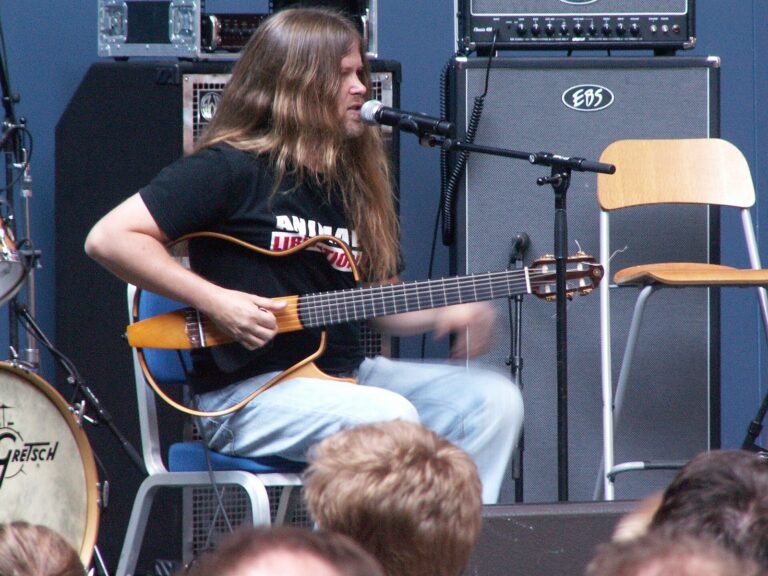
Guthrie Govan — FRFR/Fractal, Not a Tube Head
Guthrie Govan‘s live rig in his documented touring period uses Fractal Audio processing into active FRFR (full-range, flat-response) cabinets — a modelling-based approach that is categorically different from running a tube head into a passive speaker cabinet. His name appearing on a list of GH100L users cannot be reconciled with his documented rig in any primary source. Govan is one of the most technically sophisticated guitarists in the world, and his rig choices reflect that sophistication — but the GH100L is not part of it in any verified documentation.
What the GH100L Sounds Like
The GH100L occupies a specific tonal territory most easily understood by mapping its character relative to its obvious reference point, the Marshall JCM800. They share a family resemblance: British, EL34, Class A/B, single-channel with master volume, voiced for hard rock and the heavier end of classic rock. But the GH100L is not a JCM800 clone, and the differences are musically meaningful.
The midrange on the GH100L sits at a slightly higher frequency emphasis than a standard JCM800 — there is more presence in the 1.5 to 3kHz range, which gives individual notes a sharper edge in a band mix and makes picked articulation more audible at volume. The low end is controlled and defined rather than loose; the Resonance control lets you tune how much weight the bottom end carries, but even at higher Resonance settings the low end remains articulate rather than blooming into the bass guitar’s territory. This is why it works for shred: fast picking patterns in the lower strings stay separated rather than blurring into rumble.
The extra switchable preamp gain stage is the GH100L’s most significant circuit distinction from a standard JCM800-derived design. Engaging it pushes the preamp harder without altering the EQ response the way an external overdrive pedal does — the tonal character stays consistent, just with more saturation and longer sustain. The distortion texture at high gain has a slightly compressed, smooth quality that is recognisable on recordings made with the amp: not fizzy, not scooped, not hyped, but with a density in the upper-midrange frequencies that works particularly well for melodic lead lines and fast single-note runs at high speed.
The amp rewards volume. At bedroom levels, the EL34 power section runs cool and the amp sounds two-dimensional relative to its full-volume character. At rehearsal and stage volumes, the power tubes saturate, the compression feel increases, and the amp develops the bloom and natural interaction that the design is built around. This is not an amp for silent recording or home practice without external attenuation — it is a live performance instrument that needs air to demonstrate what it actually does.
Five Tone Recipes
1. Paul Gilbert “Technical Difficulties” Shred Lead
This is the setting that maps to Gilbert’s documented Racer X and solo-era lead work. Gain footswitch in the boosted position (extra preamp stage engaged). Presence: maximum. Bass: 3. Middle: 4.5 to 5. Treble: 4. Master: loud enough that the power section contributes to the compression. Cabinet: a British-voiced 4×12 loaded with Celestion Vintage 30s or G12T-75s. Pickup: bridge humbucker, guitar volume at full. No overdrive in front of the amp. The amp does the work. What you get is a sustained, articulate, mid-forward high-gain tone that tracks fast picking without blurring and sustains naturally without feedback at comfortable stage volumes. The “Technical Difficulties” style demands that every note in a fast phrase is audible and defined — this setting delivers that.
2. Matt Pike Doom/Sludge Crush
Resonance: 8 to 9. Bass: 7. Middle: 6. Treble: 4. Presence: 5. Gain footswitch in the boosted position. Use the Lo input rather than Hi to reduce input headroom and allow the amp’s gain structure to behave differently at the front end. Drop-tuned guitar (D standard or lower), lower strings played with a hard pick attack. Cabinet: a 4×12 with heavy-voiced speakers capable of handling significant low-frequency content — the goal here is physical weight in the low-mid range rather than articulation. The result is the kind of crushing mid-heavy riff tone that sits in a doom or sludge metal mix with maximum physical presence.
3. Classic British Hard Rock Rhythm
Gain footswitch in the non-boosted position (lower gain state). Presence: 7. Bass: 5. Middle: 5. Treble: 7. Master: appropriate for the room. The amp in its non-boosted state is at its most JCM800-adjacent — brighter, more aggressive in the pick attack, less saturated, more dynamic. For rhythm playing on a Les Paul or any guitar with a pair of humbuckers, this setting produces the crunch that drives a rock band’s middle frequencies without stepping on the bass player or the vocalist. A Tube Screamer-style overdrive in front at unity gain (level matched, drive off) tightens the low end further — a textbook British hard rock rhythm chain of the era.
4. Singing Lead Tone with Power-Section Bloom
Gain footswitch boosted. Presence: 6. Bass: 4. Middle: 6. Treble: 5. Master at the threshold where the power section begins contributing to the compression. Use a neck humbucker, or dial the guitar’s volume back to 7 or 8 on a bridge humbucker, to soften the top end and emphasise the midrange bloom. The result is a singing, sustaining lead tone that feeds back controllably at close range to the cabinet — the kind of held note that sounds like it could continue indefinitely, with a natural warmth in the sustain tail. This is the amp’s true performance character: push it without an overdrive and let the power section do the work.
5. Edge-of-Breakup British Blues Crunch
Gain footswitch in the non-boosted position. Bass: 6. Middle: 5. Treble: 6. Presence: 5. Master high enough for the power section to work. Guitar volume at 6 to 7 with a single-coil pickup — a Stratocaster bridge or middle position is particularly good here. At this setting, the GH100L produces a clean-ish, punchy sound with significant pick dynamics: roll the guitar volume back to 4 and the amp cleans up toward sparkle territory; push the guitar volume to 10 and it breaks up naturally into the crunch range. This is not a Fender clean, but for players who want British grit with expressive dynamic response from a single-channel amp, this setting demonstrates the full range of the architecture.

How the GH100L Compares
The most natural comparison is the Marshall JCM800 2203, the amp the GH100L was explicitly designed to rival. The JCM800 is brighter and more cutting in the high mid range; the GH100L is slightly warmer in the mids and carries the practical advantage of that extra gain stage without external help. Players on the used market who find the JCM800’s natural gain insufficient for high-gain styles often find the GH100L a more efficient solution than adding a pedal chain in front of an 800 — the gain character stays consistent with the amp’s own voice rather than reflecting a pedal’s colouration on top.
The Laney LA100BL Supergroup — Iommi’s actual original Laney — is the GH100L’s Birmingham ancestor. The Supergroup is a no-master-volume design that requires substantial volume to develop its character, with no FX loop and no switchable gain stage. It is a 1960s circuit in a 1990s world. The GH100L is the evolution of the same brand’s philosophy: more functional, more gain on tap, more practical for a working stage rig, but built on the same EL34 British foundation and the same fundamental approach to British amp voicing.
The Hiwatt DR103 Custom 100 is the other definitive British 100-watt EL34 head of the classic era. The Hiwatt is significantly cleaner, more powerful-feeling in the clean headroom, and more expensive on both the new and used markets. Players who want a pedal platform with maximum clean headroom choose the Hiwatt; players who want the amp itself to generate the distortion character choose the Laney. They are different tools for different approaches to the same sonic tradition.
The Bogner Helios 100 is the modern boutique continuation of the British EL34 100-watt tradition. It is more refined, more controllable at lower volumes, more versatile in its voicing options, and considerably more expensive. If you want the GH100L’s general tonal territory in a currently-manufactured, under-warranty, hand-wired instrument with boutique pedigree, the Helios is the correct direction. If you want the GH100L’s directness, its slight crudeness at the edges, its old-school response at full volume, the Bogner’s refinement may actually be a step away from what makes the Laney distinctive.
The GH100R — the GH100L’s own successor — deserves mention because it is occasionally available on the used market at similar prices. The GH100R adds MIDI switching, digital reverb, push-pull EQ options in the midrange, and a cabinet simulator output. These are all practical additions for a working musician. But the circuit was revised alongside the feature additions, and players who have used both frequently note that the GH100L has a directness and a rawness in its gain character that the GH100R smoothed out in the name of versatility. The GH100R is the more practical amp; the GH100L is the more characterful one.
Buying a GH100L in 2024 and Beyond
The GH100L was discontinued some years ago and has not been in production for a long time. It does not appear in Laney’s current catalogue. Finding one requires the used market — Reverb, eBay, and specialist UK guitar dealers are the most reliable places to look. Prices vary depending on condition, location, and the seller’s knowledge of what they have. In the UK, where more units landed originally, prices tend to be lower. Expect to spend roughly $400 to $700 USD in good working condition; exceptional examples in excellent cosmetic condition with original documentation will push higher.
Before buying, verify the following. First, the power tubes: ask when the EL34s were last replaced and who did the biasing. A professional retube with a matched set plus labour should cost $100 to $150. If the amp has not been retubed in the seller’s ownership and they do not know the history, budget for this immediately after purchase. Second, the FX loop switch: toggle it between Insert and Sidechain and listen for crackling or signal dropout. A dirty switch is common on amplifiers of this age and is usually fixable with contact cleaner. Third, the footswitch circuit: bring a latching footswitch and verify that the gain boost engages and disengages cleanly. Fourth, the speaker output jacks: confirm that you know the impedance of the cabinet you are running and that it matches one of the amp’s speaker output options. Running the wrong impedance load damages the output transformer over time. Fifth, idle hum: some hum at 100 watts is normal. Excessive hum at low volume suggests a failing power supply filter capacitor, a common issue on amps of this age that any competent amp technician can address.
The amp is heavy — 21 to 22 kilograms, approximately 47 lbs, without a case. A proper flight case adds significant additional weight. This is not an amp you carry into a venue alone without a plan.
Owning the GH100L
The FX loop switch is the most commonly misunderstood control on the GH100L. In Insert mode, the loop sits in series in the signal path and every device connected to it is active in the chain. In Sidechain mode, the loop output taps the signal without interrupting it, and the return level control sets how much of the processed signal blends back. Using the wrong mode for your specific setup produces unexpected results — a time-based effect in Sidechain mode when you expected Insert behaviour is a confusing situation to diagnose mid-soundcheck. Know which mode your rig requires before the show.
Power tube substitution: the GH100L includes a dedicated switch for 5881 bias. If you want to run 5881s, use the switch — do not simply install 5881s into sockets biased for EL34s without adjusting. They draw different current and the result is either starved tubes or shortened tube life depending on which direction the bias sits. Either use the onboard switch as intended or have a technician check the bias settings after a tube change. Most players run EL34s and leave the 5881 switch alone, which is the sensible default.
The amp needs volume to perform. At bedroom levels, the EL34 power section runs cool and the amp sounds flat and characterless relative to what it does at stage volumes. Players who need the power section’s compression and bloom at rehearsal or recording levels should investigate power attenuators. A reactive attenuator — the Universal Audio OX, a Koch Dummybox, or a Rivera RockCrusher — preserves more of the amp’s natural feel than a resistive type by presenting the amp’s output stage with a reactive impedance rather than a static resistive load. The character changes slightly with any attenuator, but a reactive type brings the GH100L’s sweet spot into manageable volume territory without stripping out the power section’s contribution entirely.
Cabinet matching matters more on the GH100L than on many modern amplifiers because the amp’s midrange voicing interacts meaningfully with the speaker’s own resonance peak. The Celestion Vintage 30 is the standard pairing in this amp’s natural habitat — it adds a midrange peak around 3kHz that complements the amp’s own midrange emphasis and produces the scooped-low-and-high, mid-spike character of 1990s British hard rock and shred production. The G12T-75 is a darker alternative that smooths the high mid and suits heavier material. UK-built Fane-loaded cabinets produce a warmer result with more low-end authority and are worth investigating if you find the Vintage 30 combination too aggressive in the top end.
The amp’s weight means it will outlast most modern plastic-chassis designs if maintained. The transformers — built to the same standard as the rest of the British amp industry of the era — seldom need replacement if the amp has been operated at the correct speaker impedance. Electrolytic capacitors in the power supply are the most likely maintenance item on a 30-year-old unit: budget for a cap job if you are buying one without a known service history, and the amp will likely be reliable for another generation of use.
Frequently Asked Questions
Is the Laney GH100L still in production?
No. The GH100L was discontinued many years ago and was succeeded in Laney’s catalogue by the GH100R, which added MIDI switching, digital reverb, and additional EQ features. Current Laney production focuses on the Lionheart, Ironheart, and other contemporary lines. GH100L units are available only on the used market.
Is the Laney GH100L the same as the GH100TI Tony Iommi signature?
No. The GH100TI is a separate model with circuit modifications voiced specifically around Tony Iommi’s preferences. It shares the GH100L’s physical format and EL34 power configuration but has different preamp voicing, EQ response, and gain character. The GH100L is the standard production model; the GH100TI is a modified variant built around one specific artist’s requirements. The two are distinct amplifiers that happen to share an external chassis format.
What is the footswitchable gain boost doing electrically?
It engages the extra ECC83 preamp tube that the GH100L adds to its standard JCM800-derived preamp circuit. The additional tube stage increases gain without altering the EQ balance in the way an external overdrive pedal does — the character of the distortion stays consistent with the amp’s voice, just with more saturation and longer sustain. This is why players who understand the design value it over simply stacking a pedal in front of a lower-gain head: the extra tube stage sounds like more of the same amp rather than a different tonal shape applied on top of it.
Can I use the GH100L at lower volumes for home practice?
You can, but the amp’s character develops most fully when the power section is working. At bedroom levels, the EL34 power tubes run cool and the amp sounds significantly two-dimensional compared to its full-volume character. For home use, a quality power attenuator — reactive types are preferable to simple resistive loads for tone preservation — between the amp and cabinet brings the character into a manageable volume level without completely removing the power section’s contribution to the tone.
What cabinet does the GH100L pair best with?
The GH100L is traditionally paired with a 4×12 loaded with Celestion Vintage 30s or G12T-75s, both of which complement the amp’s British mid-forward character. The Vintage 30 emphasises the midrange and suits lead playing and fast shred styles. The G12T-75 is darker and suits heavier rhythm work. UK-built Fane-loaded cabinets produce a warmer result with more low-end authority. Impedance: the amp supports 4, 8, or 16 ohms — match the cabinet correctly to avoid long-term output transformer damage.
How does the GH100L compare to a Marshall JCM800?
They share a family resemblance and the GH100L was explicitly designed to compete with the JCM800. The practical differences: the GH100L has a footswitchable extra gain stage that extends its high-gain range without external pedals; the JCM800 is slightly brighter and more cutting in the upper mids; the GH100L has a slightly warmer, thicker mid presence. Players who find the JCM800’s natural gain insufficient for high-gain styles often find the GH100L solves the problem more directly than stacking pedals in front of an 800.
How reliable is the GH100L on the used market?
The design is robust and the delay turn-on circuitry protects the output tubes at switch-on. Units are now 30-plus years old in many cases and will need standard valve-amp maintenance: fresh output tubes with correct biasing, potentially fresh preamp tubes, and inspection of electrolytic capacitors in the power supply section. These are all routine repairs for any competent amp technician. The transformers are well-built and seldom need replacement if the amp has been operated at the correct speaker impedance. A serviced GH100L should be reliable for years of regular use.
Did Paul Gilbert endorse Laney formally and for how long?
Yes. Gilbert was a Laney endorsing artist for approximately fifteen years, during which the GH100L was his primary head for live performance. His departure from Laney happened around 2007 when he transitioned to Marshall JCM2000 DSL heads, citing their reliability and consistency on tour. The endorsement period covered his most prolific recording and touring years — the Racer X reunion output, a large portion of his Mr. Big tenure, and his solo instrumental records including the “Get Out of My Yard” era. Fifteen years with one manufacturer is a long endorsement by any standard.
Image credits
- Paul Gilbert: MrPanyGoff, Wikimedia Commons, CC BY-SA 3.0.
- Top image: GuitarGangsters AI-generated reference illustration, not a photograph.
- Paul Gilbert: GS2019 – Paul Gilbert by Production Partner / Lars Horstmann, Wikimedia Commons, CC BY-SA 4.0.
- Mattias IA Eklundh: Karl Jonsson, Wikimedia Commons, CC BY 2.0.
- Tony Iommi: Carl Lender, Wikimedia Commons, CC BY 2.0.
Latest News
Related
On This Day
Friday 13 November
From this week: