The Rectifier That Broke Its Own Rules: Mesa/Boogie Badlander 100
Mesa/Boogie Badlander 100 rewrites the Rectifier with EL34 tubes, Channel Cloning, and built-in CabClone IR. Specs, tone recipes, and honest player history.
In November 2020, Mesa/Boogie did something unexpected. The company that had built its Rectifier identity on 6L6 power tubes, on the alchemy of tube versus silicon rectification, and on the thundering asymmetry of the Dual Rectifier’s two very different channels, quietly tore up the blueprint. The Badlander 100 arrived wearing the Rectifier badge, but under the hood it was a different animal entirely — British EL34s as standard, two channels running the exact same preamp circuit, and solid-state rectification across the board. The name said Rectifier. The engineering said something new.
For players who had grown up with the Dual or Triple Rectifier’s raw sag and the ritual of tube versus diode switching, the Badlander was a provocation. No Spongy mode. No channel asymmetry. No Recto-specific sagging low end. What it offered instead was precision — a tighter, more articulate high-gain platform aimed squarely at the modern metal and hard-rock player who wants the Rectifier’s muscle without its tendency to bloom and swoop. Combined with the first factory-built-in CabClone IR loader on a Rectifier head, it was the most technologically complete Mesa amp since the Mark V series.
It also turned out to be one of the last amps Mesa designed as an independent company. Gibson completed its acquisition of Mesa/Boogie in January 2021, two months after the Badlander launched. The amp now lives on legacy.mesaboogie.com — discontinued but still widely traded on the used market. Whether that’s sad or convenient depends entirely on your budget.
From Dual Rectifier to Badlander: A Brief History of the Recto Line
To understand what the Badlander changed, you need to know what it came from. Randy Smith and Doug West introduced the first Rectifier — the Dual Rectifier Solo Head — in 1992 at the NAMM show. It was, at the time, the loudest, most gain-on-demand amp Mesa had ever built. Two channels, two rectifier options (tube 5U4 for sag and bloom, silicon for attack and tightness), six 6L6 power tubes, and enough gain to define an entire decade of heavy rock and grunge. The Dual Rectifier became so successful that it spawned the Triple Rectifier, the Roadster, the Road King II, the Recto-Verb series, and an entire sub-culture of amplifier modification built around its preamp circuit.
By the late 2010s the Rectifier series had become its own museum piece — beloved for its sound but increasingly compared unfavorably to modern competitors in terms of tightness, noise floor, and direct-recording usability. Friedman, Diezel, Bogner, and a generation of boutique amp makers had studied the Recto circuit and refined it. Mesa’s answer was not to modernise the Dual Rectifier itself — that remained in production, essentially unchanged — but to build a parallel line that took the Rectifier name and reconceived the engineering from the power section up.
The Badlander 100 was the first result, announced 16 November 2020. It was joined shortly after by the Badlander 50, which added a 1×12 combo format option alongside the head and rackmount versions available to the 100-watter. Both were discontinued after Gibson’s acquisition reshaped the Mesa product line — though used examples circulate freely and the platform earned enough of a reputation in its short life that it is actively sought.
What Actually Changed: The Badlander’s Engineering Decisions
The single most significant change was also the one least visible on the front panel: the power tube selection. Every previous full-wattage Rectifier head — Dual, Triple, Roadster, Road King — shipped with 6L6 power tubes as standard. American tubes, American voicing. The Badlander 100 ships with four Mesa EL34s. This is not a minor swap. EL34s run at higher plate voltage, produce more upper-midrange presence and a slightly harder, more compressed response compared to 6L6s. The result is a Rectifier that opens with a more British character — tighter on the low end, more forward in the upper mids, with a different kind of harmonic saturation under compression. Mesa retained the rear-panel bias-select switch so you can roll in 6L6s without calling a technician, but the amp is voiced around EL34s as its factory state.
The second change is the rectifier itself. Despite the name, the Badlander uses only silicon diode rectification. There is no tube rectifier option, no Spongy switch, no selectable sag. This was deliberate. Mesa chose diode rectification for its tighter, more immediate attack response — the same reason the Single Rectifier always ran diodes, and the same reason the Badlander 50 reviewer at Premier Guitar noted it “feels very much like a black-panel Fender” on clean even with the EL34s. What the Badlander does offer in place of the tube-rectifier Spongy switch is a three-way power selector and a Bold/Variac toggle. The Variac position reduces supply voltage slightly, introducing a controlled compression and sag that provides a mild vintage-style response without the full commitment of tube rectification. Think of it as a tunable parameter rather than a binary tube/diode choice.
The third change is Channel Cloning. In traditional two-channel amp design, each channel has its own preamp architecture. Channel 1 is clean, channel 2 is dirty — or more complex variants, but fundamentally distinct circuits. The Badlander runs both channels through an identical preamp circuit. Channel 1 and Channel 2 are the same topology with separate controls. What this means practically is that you can set both channels to different points on the same gain and voicing spectrum: rhythm and lead both derived from the same character, or clean on channel 1 and crunch on channel 2 from the same preamp DNA. Mesa describes this as enabling the amp to be “two of itself” rather than two distinct personalities.
The fourth — and commercially most significant — change is the built-in CabClone IR. Mesa’s CabClone had been available as a standalone unit before the Badlander launched. Building it into the head changed the amp’s utility profile completely. Eight Mesa cabinet impulse responses are onboard (dynamic mic and ribbon mic “captures” of Mesa cabs). A USB connection on the rear panel accepts third-party IRs, so you can load your own captures or any of the vast libraries of commercial IRs. When you unplug the speaker cable, an internal load automatically engages, enabling fully silent recording or front-of-house DI use without a cab in the signal chain. A headphone output and XLR balanced DI output complete the direct-recording suite. Per-channel IR assignment means channel 1 and channel 2 can run different cabinet simulations independently.
Complete Specifications: Mesa/Boogie Rectifier Badlander 100
Famous Players
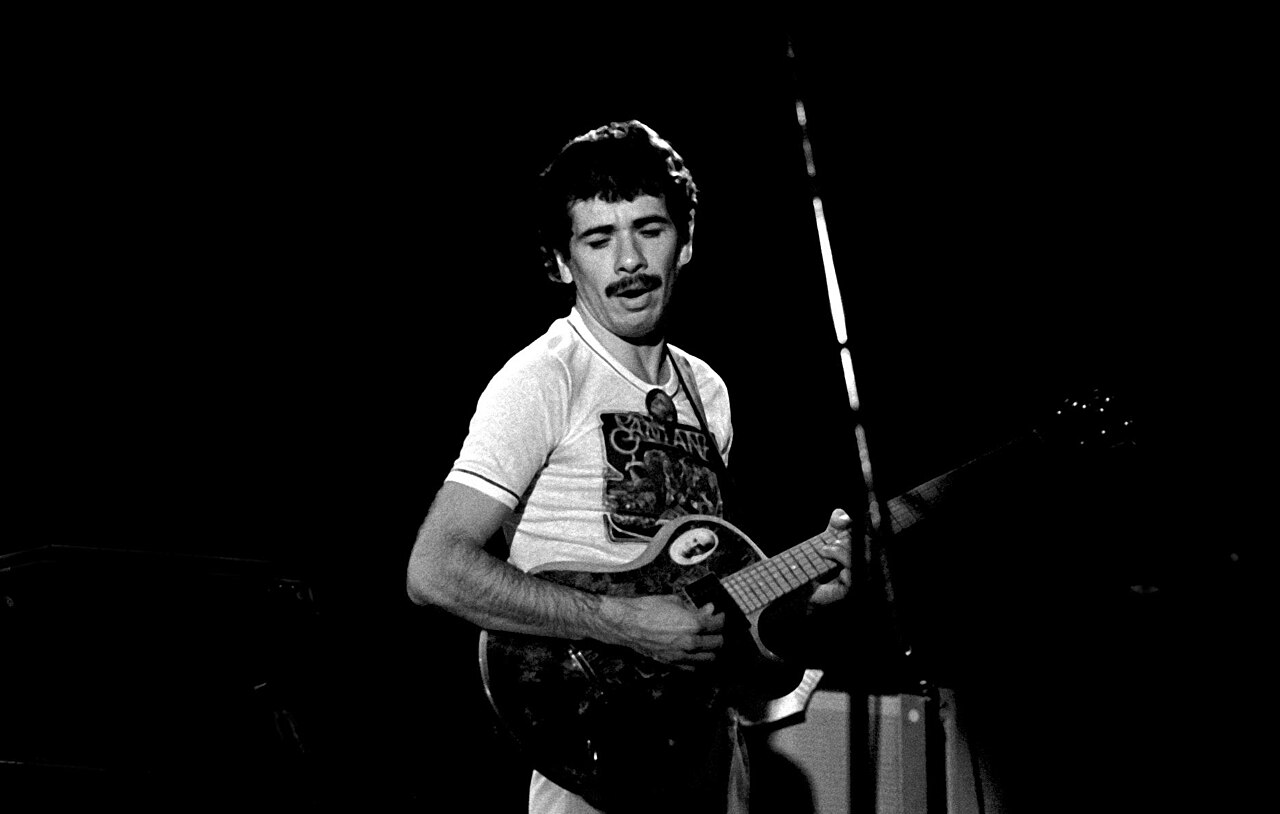
If you have read earlier installments of this guide covering the Mesa/Boogie Rectifier series — the Dual Rectifier, the Triple Rectifier, the Trem-O-Verb, the Recto-Verb 25, the Mini Rectifier, the Roadster, or the Road King II — you already know what is coming. The artists commonly associated with this amp — Carlos Santana, John Petrucci, Metallica, Larry Carlton, and Andy Timmons — form a brand-level association list, not a per-SKU player roster.
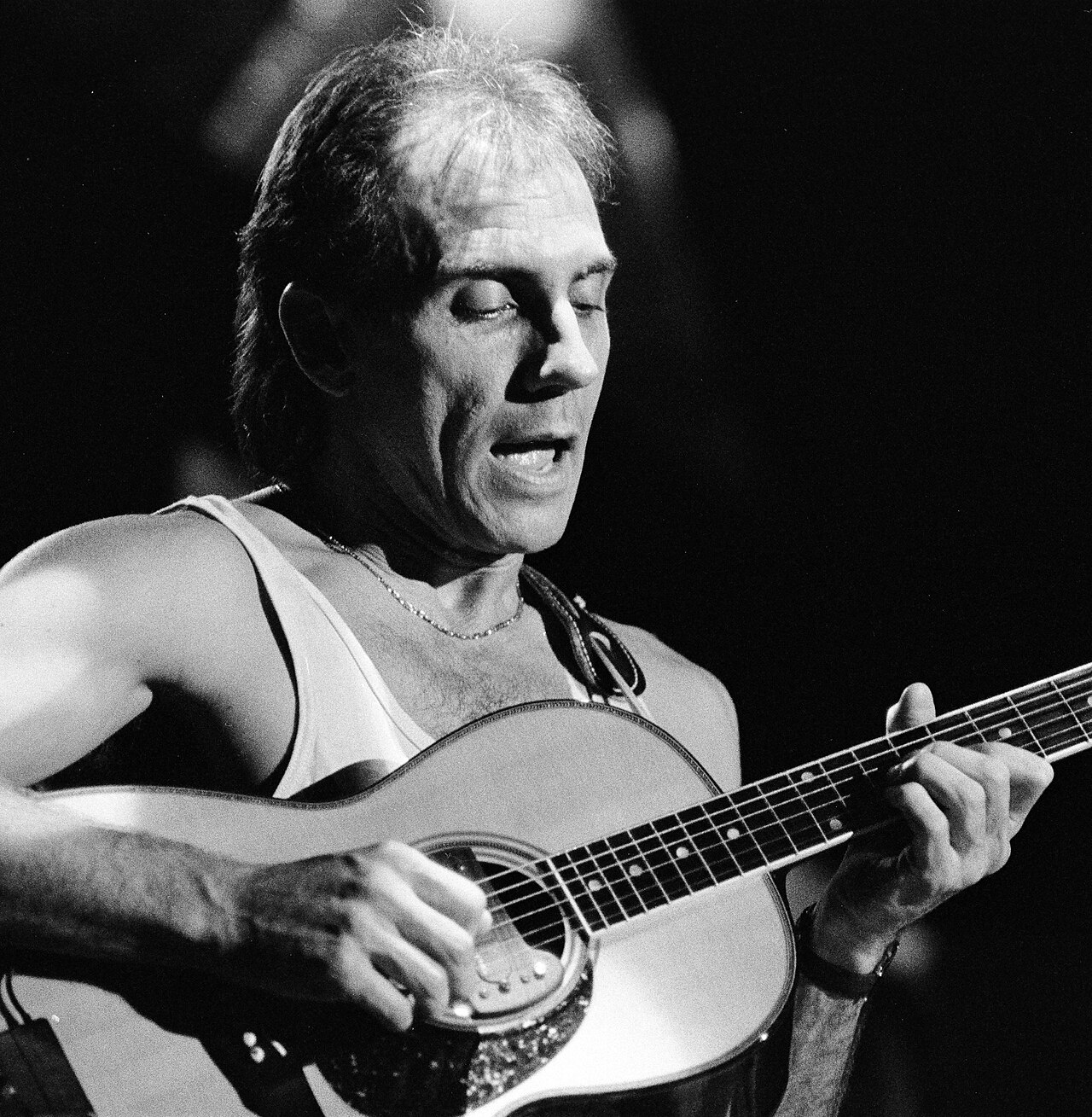
The individual debunks have been documented at length in those earlier articles and will only be summarised here. Carlos Santana’s primary Mesa amp is the Mark I, verified by his guitar tech on camera and by his decades of association with the company beginning with that early Mark I prototype. John Petrucci designed and records through the Triaxis and JP-2C; no credible source documents him using a Badlander. James Hetfield built his recorded tone with a Triaxis/2:90 rack system and later the Triple Rectifier; he is not documented on any Badlander-era Mesa product. Larry Carlton moved away from Mesa when the amps “didn’t sound the same” (his own description) and has used Dumble amplifiers as his primary platform since the mid-1980s. Andy Timmons’s documented touring rig runs a Lone Star and Stiletto Deuce Stage II per Premier Guitar’s 2016 Rig Rundown. None of the five are on a Badlander, and none can be placed there with primary-source evidence.
There is a specific historical reason the Badlander roster is thin: the amp launched in November 2020, two months before Gibson’s acquisition closed, and was discontinued within a relatively short production window. Its market life was brief enough that fewer touring-level players cycled it into documented rigs before it disappeared from the new-market catalogue. The amps that get famous-player documentation are typically those with years on the market — long enough to appear in magazine Rig Rundowns, tour tech interviews, and artist-page features that require the amplifier to be on active tour cycles.
What can be verified independently: Ola Englund, the Swedish guitarist known for his work with The Haunted, Solar Guitars, and as one of the most influential guitar YouTube creators of the 2010s–2020s, performed the official Mesa/Boogie Badlander launch demo in November 2020. The video — “NEW MESA BOOGIE RECTIFIER – BADLANDER” on his YouTube channel, published on the day of the launch — documents him playing the amp in a Metal Devastation Radio feature and promotional context. This is a direct, primary-source connection: Ola Englund played the Badlander 100 in the amp’s own official launch video. He also appears on Equipboard’s Badlander 100 listing with the same provenance. The connection is genuine and verifiable.
Sek Loso (real name Yuthana Boonlert), Thailand’s most celebrated rock guitarist and frontman of Loso — a band with a cultural footprint in Thai rock similar to what Bon Jovi or Guns N’ Roses achieved in Western markets — also appears on Equipboard’s Badlander 100 listing. His use of the amp is documented at Equipboard level but without the explicit primary-source video or interview confirmation available for Ola Englund.
Beyond these two, Mark Tremonti is worth a brief mention as a Rectifier-family player who has been closely associated with Mesa throughout his career, though his documented touring amp of choice has been the Triple Rectifier rather than the Badlander. Tom Morello‘s Dual Rectifier use is well-documented, again for the older platform. The Badlander arrived at a moment when many touring guitarists at that level were already committed to modeler-based rigs, which further limits the documented roster for any new conventional amp released after 2018.
How the Badlander 100 Actually Sounds
The Badlander’s character is best understood in contrast to the Dual Rectifier it ostensibly replaces as Mesa’s flagship high-gain head. The Dual Rectifier — particularly in its vintage and modern high-gain modes — is known for a pronounced mid scoop: a bowl-shaped frequency response that pushes the low end and high end forward while recessing the upper midrange. This gives the classic Recto its wide, atmospheric quality in a band mix and its immediate “wall of sound” impact in a room. It also makes it harder to cut through a dense arrangement without a boosting pedal in front or careful EQ on the board.
The Badlander addresses this differently. The EL34 power section shifts emphasis toward the upper midrange — the 800Hz–3kHz region where guitars cut through dense arrangements. Diode rectification removes the sag and bloom of the Dual Rectifier’s tube mode, delivering a more immediate attack transient. The result is a high-gain amp that is more forward in the midrange, more articulate on the low end, and less prone to the bass bloom that could make the old Recto feel loose under palm-mute attack. Forum consensus, borne out by Premier Guitar’s Badlander 50 review, describes it as occupying the space between a classic Rectifier and a Marshall — the Recto’s output stage power with a tighter, more British-influenced frequency character.
The three modes — Clean, Crunch, Crush — are straightforward in concept but cover real tonal ground. Clean mode, even at 100W into a Recto 4×12, delivers genuine clean headroom up to significant volume levels before the power section begins contributing harmonic saturation. Unlike the Dual Rectifier, which can start compressing even on its clean mode at loud volumes, the Badlander’s diode-rectified power section stays clean longer. Crunch mode occupies the medium-gain territory Mesa has historically struggled to voice convincingly in the Rectifier line — a touch-sensitive overdrive that responds to picking dynamics rather than simply adding compression at all attack levels. Crush mode is the modern high-gain Recto voice: tight, dense, palm-mute-friendly, with enough gain on tap to handle anything from hard rock to extreme metal without an overdrive pedal in the loop.
The Variac switch deserves specific attention. Where the old Rectifier Spongy mode ran the power supply through a tube rectifier, introducing true circuit-level compression and response change, the Badlander’s Variac mode reduces the supply voltage by a controlled amount. The practical result is similar — a softer attack, more sag in the power section, a slight sweetening of the harmonic character — but the mechanism is different and the degree of change is less dramatic than a full tube-rectifier swap. Think of it as turning the clock back from a tight modern studio tone to a more organic, breathing feel: audible and useful, but not a radical transformation.
The 20-watt Triode mode warrants a specific note. Wiring the EL34s in Triode at 20 watts changes the power section topology, not just the output level. Triode mode produces a rounder, slower-attack character with a softer high-end roll-off and a more liquid quality under sustain — similar in concept to what the Mini Rectifier’s 10W Triode mode delivered, but applied to EL34s instead of the Mini’s EL84s. At 20W Triode the Badlander becomes a different amp — less punishing, more vintage-voiced, genuinely useful for lead tone at lower stage volumes.
Tone Recipes and Settings
1. Modern Metal Chunk — Ch.2 Crush, 100W, EL34
This is the amp doing what the Rectifier badge implies. Set gain at 7, treble at 6, mid at 4, bass at 6.5, presence at 6.5, master at whatever the room requires. Bold power switch engaged. EL34s stock. The tighter low end of the diode/EL34 combination delivers palm mutes that stay separated instead of collapsing into a low-frequency wash. A TS-style pedal or Mesa’s own Throttle Box in front of the input can add definition and tighten the pick attack further without dramatically changing the character. This setting cuts through a dense two-guitar arrangement without EQ correction on the board — something the Dual Rectifier frequently required.
2. EL34 Crunch — Ch.1 Crunch, 50W, EL34, Variac
Set gain at 5, treble at 7, mid at 5.5, bass at 5, presence at 5.5, master at rehearsal volume. Engage Variac. The combination of medium gain, EL34 upper-mid push, and slight Variac sag produces a tone that sits between a pushed Marshall and a Vox — harder than the AC30’s breakup, warmer than a JCM800 at this output level. Touch dynamics are genuinely responsive: hit the string hard and the amp breaks up, back off the pick pressure and it cleans up without losing body. An excellent platform for blues-rock and alternative rock that wants vintage weight without the Dual Rectifier’s mid scoop.
3. Big Clean — Ch.1 Clean, 100W, Bold, EL34
Gain at 3, treble at 6.5, mid at 5, bass at 5.5, presence at 4.5, master at playing volume. The Badlander’s Clean mode at full output delivers more clean headroom than any previous Rectifier head. A Telecaster or Stratocaster into this setting produces bell-like articulation with the kind of dynamic headroom a country or funk player needs. The EL34s add a slight warmth to the upper midrange that stops it sounding sterile. At this output level the CabClone IR output, blended with a room mic, can deliver the clean tone as a DI without sacrificing the interaction between guitar and amp.
4. 6L6 Rectifier Classic — Ch.2 Crush, 100W, EL34→6L6 swap, Bold
Bias-select to 6L6 on the rear panel. Gain at 8, treble at 5.5, mid at 3.5, bass at 7, presence at 7, master to taste. This setting deliberately moves the Badlander toward its Dual Rectifier heritage: 6L6s restore the scooped-mid, wide-frequency-window character of the classic Recto, and the Badlander’s otherwise tighter circuit partially retains it without fully replicating the old amp’s bloom. This is the sound for players who want a touch of Badlander precision applied to a more traditional Recto voice. Note that the character change is real but the Badlander does not become a Dual Rectifier — the diode rectification and the different preamp architecture both remain. Think “Recto-influenced” rather than “Recto-identical.”
5. Triode Lead — Ch.2 Crush, 20W Triode, EL34, Variac
Gain at 6, treble at 5.5, mid at 6.5, bass at 5, presence at 5, master at a controlled volume level. The 20W Triode mode with Variac engaged produces the most vocal, organic, and vintage-responsive setting the Badlander can produce. Sustain sings without becoming shrill. Pick attack has a rounded quality that responds to the bow-hold position of the pick. This is a recording and small-stage setting rather than a large-room live tone, but it is where the amp reveals the most character under a player’s hands. Through the CabClone IR into a DAW, this setting records without the typical struggle of dialing in a room-filling high-gain amp for studio use.
Comparisons: Where the Badlander Sits
The most direct comparison is with the amp the Badlander implicitly replaced: the Mesa/Boogie Dual Rectifier Solo Head. The Dual Rectifier remains in production as of this writing; the Badlander was discontinued. The Dual Rectifier offers tube rectification, 6L6 power tubes as standard, channel asymmetry (the two channels are not identical), and the Spongy/Bold switch that defined its generation. The Badlander is tighter, more articulate, and more direct-recording-ready out of the box. Players who have internalised the Dual Rectifier’s sound — who want the sagging low end and the mid scoop — will find the Badlander more disciplined than expected. Players who loved the Dual Rectifier’s gain structure but spent years fighting its loose low end will find the Badlander a significant upgrade.
Against the Mesa/Boogie Triple Rectifier Solo Head, the Badlander is the more practical choice for most players. The Triple Rectifier delivers 150 watts of 6L6 power through three pairs of output tubes — a sheer scale of output that very few playing situations require. The Badlander’s 100/50/20W flexibility addresses a broader range of venues without the Triple’s weight, heat, and tube-maintenance overhead. The Triple remains the choice for players specifically seeking that 150W headroom on arena stages, but the Badlander is not significantly quieter at 100W in any practical playing context.
The Mesa/Boogie Roadster Head is a closer sibling: both are discontinued, both live on legacy.mesaboogie.com, both are 100-watt Rectifier-family heads. The Roadster offers 4 channels (vs the Badlander’s 2), per-channel rectifier switching (tube or diode per channel), and the flexible architecture of the Road King platform in a simpler form. What the Roadster lacks is the Badlander’s EL34 default character, the CabClone IR integration, and the fine-grained wattage control. Used prices tend to overlap, making the choice largely a function of whether you need four distinct preamp channels (Roadster) or a streamlined two-channel setup with a superior direct-recording feature set (Badlander).
Outside the Mesa family, the Friedman BE-100 is the most frequently cited competition in forum discussions. The BE-100 is similarly EL34-driven, similarly aimed at modern high-gain rock and metal, and similarly priced in the used market at ~$2,000–$2,800 depending on vintage. The Friedman’s gain structure is voiced for a more refined, Marshall-derived high-gain character — warmer in the lower mids, less aggressive in the upper frequencies — where the Badlander is more forward and cutting. Players who find Marshall-style high-gain too dark for their application tend to prefer the Badlander; players who find Mesa’s Rectifier character too bright or modern tend to go Friedman.
The Orange Thunderverb 50 or 200 provides a third reference point: also EL34-driven, also aimed at high-gain British rock, also available in multiple wattage versions. Orange’s ChamberTop design produces a different kind of low-end response — more mid-forward and “boxy” compared to the Badlander’s wider frequency window. The Thunderverb is simpler in feature set (no onboard IR loader, no digital output options) and more specific in its tonal identity. If you need the versatility of three modes and a full direct-recording suite, the Badlander wins the feature argument conclusively. If you want a single, distinctive voice and maximum simplicity, Orange’s platform has its own adherents.
Buying Guide: Used Market Navigation
The Badlander 100’s used-market position in 2026 is that of a discontinued premium amp from a respected maker’s final independent-design era. Prices range from approximately $1,200 for examples with cosmetic wear or minor issues to $1,800 for pristine specimens in original condition. The rackmount format trades at a slight discount to the head format due to the additional rack requirements.
Before buying, run through these checks. First, play all three modes on each channel separately and confirm that the Clean mode does not break up unexpectedly early, the Crunch mode responds cleanly to pick dynamics, and the Crush mode does not produce excessive noise floor at moderate gain settings. The Badlander’s buffered effects loop is always in circuit — verify that the loop send/return does not introduce noise in your application if you plan to run effects in it. Note that there is no effects-loop mix control on this amp, unlike some Mesa designs, so parallel effects integration requires an external loop blender.
Check the CabClone IR functionality: disconnect the speaker cable and verify that the internal load engages, the headphone output works, and the USB IR loading port is functional. These are complex electronic systems that are rarely damaged but worth confirming before purchase. The power tube type is easily verified — open the rear and confirm EL34 vs 6L6 installation; either is correct, but knowing which you have helps set expectations before playing.
Note that the Badlander ships with a single-button footswitch for channel switching. There is no MIDI integration on this amp. If your rig relies on MIDI for amp switching — for example, a pedalboard with a MIDI controller or a switching system — the Badlander requires an external relay trigger solution or a manual footswitch only. This is a real constraint for complex rigs and one of the points where the amp’s feature set is genuinely limited compared to, say, the Mesa Mark series with its built-in MIDI.
The amp weighs 41 lbs, which is moderate for a 100-watt tube head of this specification. It is comparable to the Dual Rectifier head in weight and rack or head-case hardware from any standard amp-head manufacturer will fit it without modification.
Ownership Notes
The Badlander 100 runs four power tubes in its full 100W mode. Mesa specifies fixed-bias / maintenance-free, meaning the amp self-biases within the design window for the supported tube types (EL34 or 6L6 via bias select). This does not mean the amp never needs tube maintenance — it means the bias adjustment procedure is integrated into the bias-select switch’s functionality rather than requiring external adjustment. Replacement tube sets should be matched quads from a reputable supplier; swapping individual tubes without replacement of the matching set can introduce channel imbalance.
The CabClone IR system’s eight onboard IRs were programmed by Mesa and represent a curated set of their own cabinet captures. They are competent but may not match the frequency character of the third-party IR libraries that many recording guitarists have developed strong preferences for. The USB IR-loading feature is straightforward to use: connect to a computer, the amp presents as a storage device, drag your IR files in, disconnect. No drivers required for this process on any current operating system. Onboard IRs and custom-loaded IRs are independently assigned per channel.
Running without a cabinet — via the internal load and CabClone IR — is technically valid and works well. However, the absence of a physical speaker in the room removes the acoustic coupling and air-movement interaction that contributes to how the amp “feels” when playing. Players who are sensitive to this will notice the difference. For recording purposes it is transparent; for practice and enjoyment it is a compromise worth understanding before committing to a permanently cab-free setup.
Frequently Asked Questions
Is the Badlander 100 the same as a Dual Rectifier?
No. Beyond sharing the Rectifier family name, they differ substantially in power tube type (EL34 vs 6L6 as stock), rectifier type (silicon diode only vs selectable tube/diode), channel architecture (identical Channel Cloning vs distinct preamp channels), onboard features (CabClone IR vs none), and frequency character. They are related by lineage and market positioning, not by circuit.
Why does the amp say “Rectifier” if there’s no tube rectifier?
The Rectifier name is a Mesa brand category that has historically encompassed both tube-rectified and diode-rectified amps. The Single Rectifier Solo Head used only diode rectification from the start. The Badlander continues this pattern. Within the Rectifier family, “Rectifier” describes a gain architecture and tonal approach rather than a specific power supply design. The Bold/Variac switch on the Badlander provides a degree of supply-voltage variation, but it is not a tube rectifier.
Can I easily swap between EL34s and 6L6s?
Yes. A bias-select switch on the rear panel toggles between EL34 and 6L6 bias settings. No re-biasing procedure is required. You install the tubes, flip the switch, and play. The tonal character change is real and significant — expect the amp to be warmer, wider in the frequency window, and less mid-forward with 6L6s. Both tube types are fully supported by the factory design.
Does the 20-watt mode actually work for bedroom practice?
At 20 watts in Triode mode the amp is quieter than at 100 watts, but it remains a powerful amplifier. Through a full 4×12 cabinet it is still capable of significant volume at modest master-volume settings. For true bedroom-level practice the CabClone IR into headphones is the correct solution — this completely bypasses the speaker and runs the amp silently at any wattage. The 20W mode is best understood as a stage and studio tone option rather than a volume-reduction solution for domestic use.
Is there reverb on the Badlander 100?
No. The Badlander 100 has no onboard reverb. This was a deliberate design decision — Mesa’s philosophy with the Badlander was to concentrate the feature set on gain, channel control, and the CabClone IR system. Reverb, if required, belongs in the effects loop or in the signal chain after the CabClone DI output.
How does the CabClone IR sound compared to a real microphone on a cabinet?
In direct comparisons, Mesa’s CabClone IRs are among the better factory-provided impulse responses on the market. They capture phase coherence and mic placement accurately. In a direct recording context — where you are feeding the XLR output to a DAW without any room microphone blended in — the result is clean and usable without significant post-processing. For recording contexts where you want the additional complexity of room sound, microphone interaction with speaker cone movement, and harmonic summation from a room microphone, a physical cabinet and a mic will still offer something distinct. The IR is a tool for consistency, portability, and noise control; a mic’d cab is a tool for character and organic complexity.
Why was it discontinued so quickly?
The Badlander launched in November 2020. Gibson completed its acquisition of Mesa/Boogie in January 2021. Product line rationalisation after the acquisition removed a number of models including the Badlander. The amp was not discontinued due to poor performance or market failure — it had strong reviews and a growing community of users — but because post-acquisition strategic decisions altered Mesa’s production priorities. Used examples are the only way to obtain one.
How does the Badlander 100 compare to the Badlander 50?
The Badlander 50 uses two EL34 power tubes rather than four, reducing stock output to 50 watts (with a 20W Triode option). It is also available as a 1×12 combo format not offered for the 100-watter. The preamp circuit is identical. The 50’s slightly lower output power produces a marginally different power-section feel — somewhat softer under hard playing — while retaining all the same modes, CabClone IR features, and Channel Cloning topology. The 50 is the better choice for studio-centric players; the 100 is the correct choice for players who need the additional headroom for loud stage contexts or who specifically want the four-tube power section.
Image credits
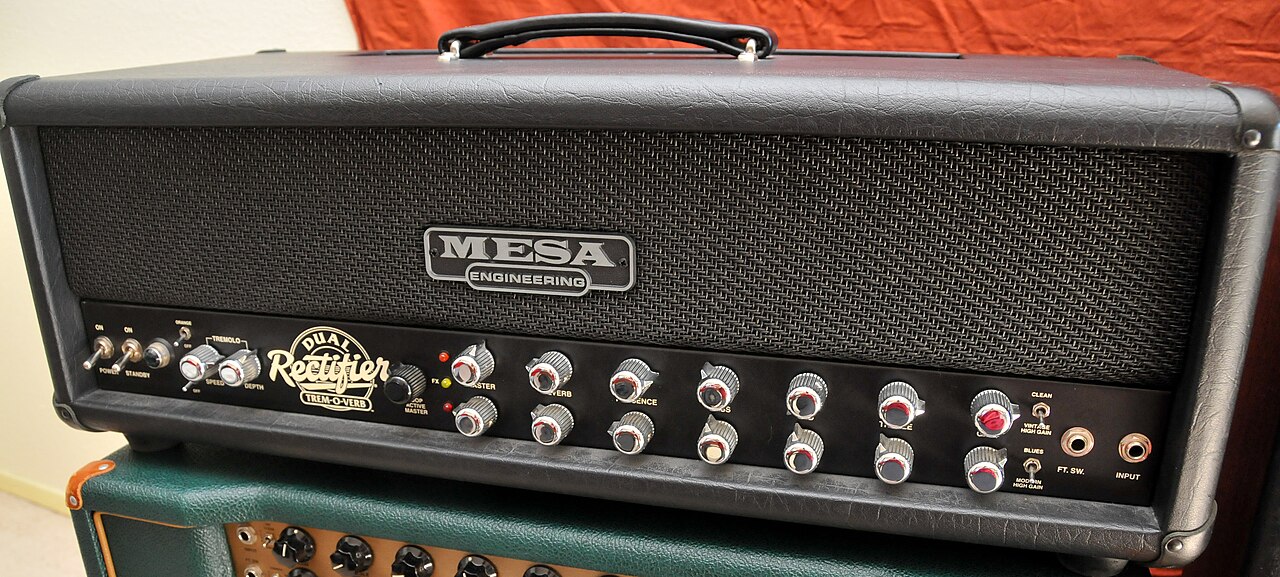
- A Mesa Boogie Dual Rectifier Tremoverb 100 watt head: ArtBrom from Seattle, Wikimedia Commons, CC BY-SA 2.0.
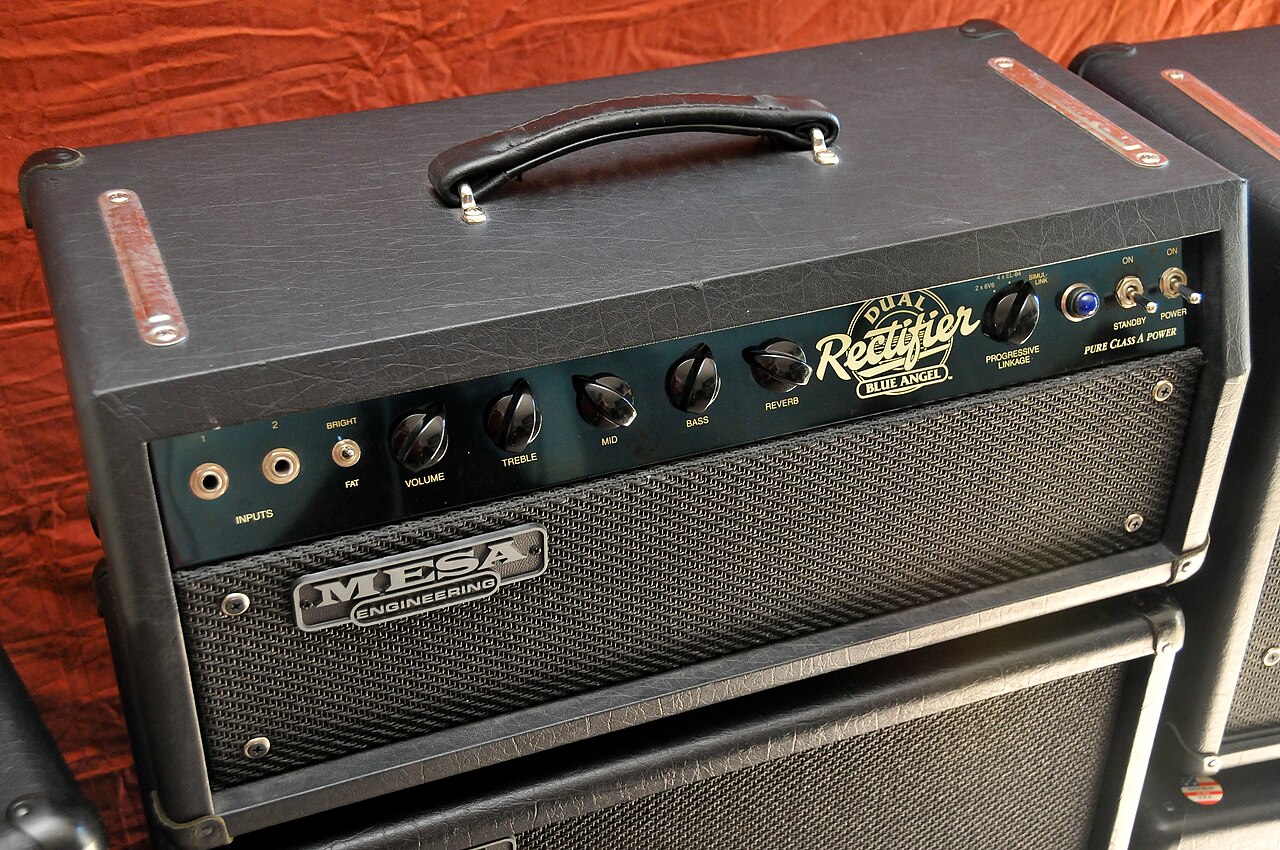
- A Mesa Boogie Blue Angel head: ArtBrom from Seattle, Wikimedia Commons, CC BY-SA 2.0.
- Carlos Santana: Heinrich Klaffs, Wikimedia Commons, CC BY-SA 2.0.
- Larry Carlton: Kenneth C. Zirkel, Wikimedia Commons, CC BY-SA 4.0.
Latest News
Related
On This Day
Tuesday 10 November
From this week: