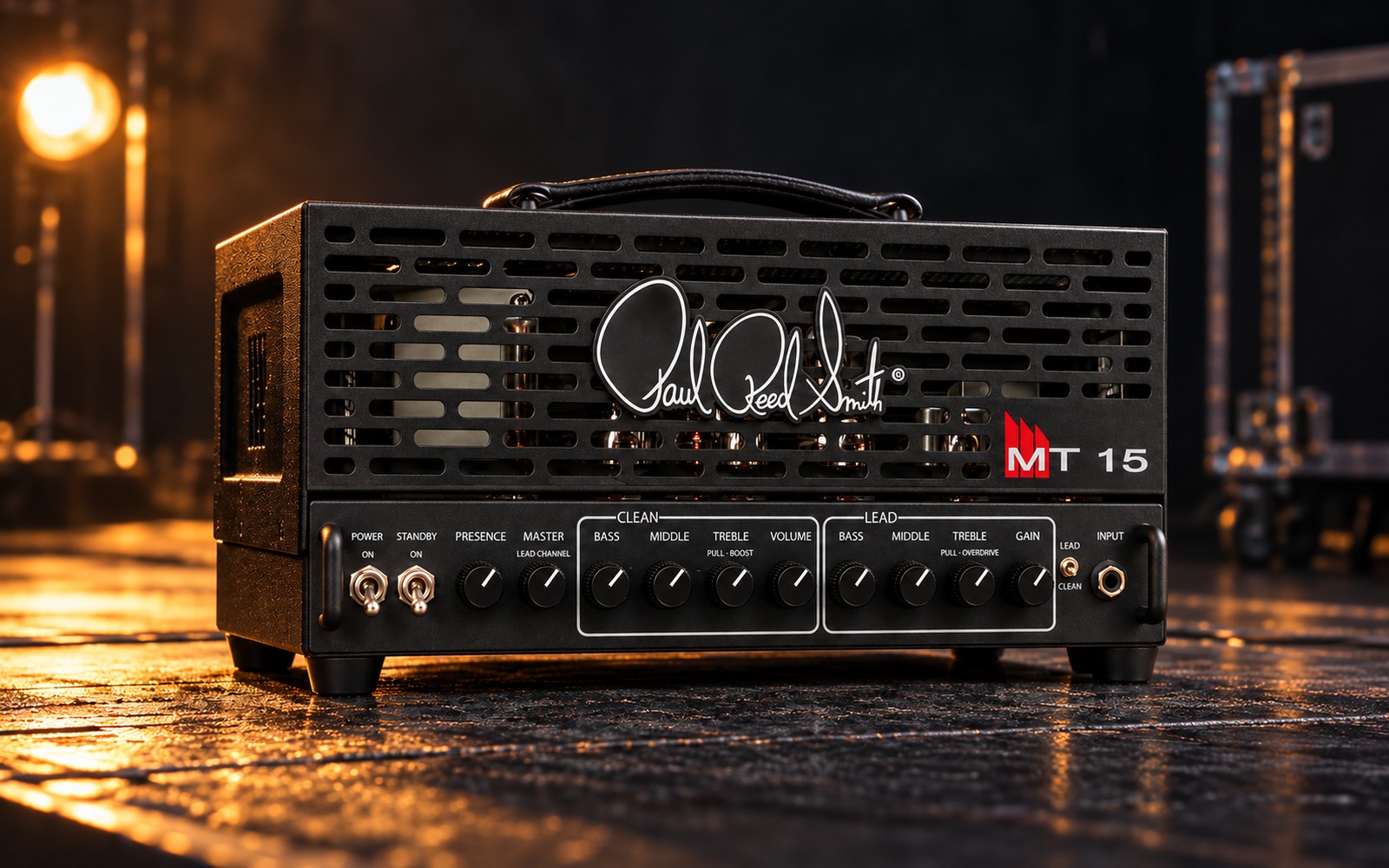
The Lunchbox That Bites: PRS MT 15 Mark Tremonti Signature Head
PRS MT 15 Mark Tremonti: full specs, V1 vs V2 comparison, tone recipes, famous players and buying guide for the lunchbox amp that punches above its weight.
Fifteen watts doesn’t usually scare anyone. Fifteen watts in a lunchbox head suggests practice amp, dorm-room companion, the kind of thing you pack in a gig bag alongside your cables and spare picks. Then someone hands you a PRS MT 15 and asks you to crank it through a closed-back 1×12 in a rehearsal room with a loud drummer — and that comfortable assumption dissolves immediately. The MT 15 doesn’t sound like 15 watts. It doesn’t feel like 15 watts. It has the low-end authority and preamp saturation density of an amp running significantly more iron, and it will absolutely hold its own without a microphone in a room where someone’s hitting drums hard.
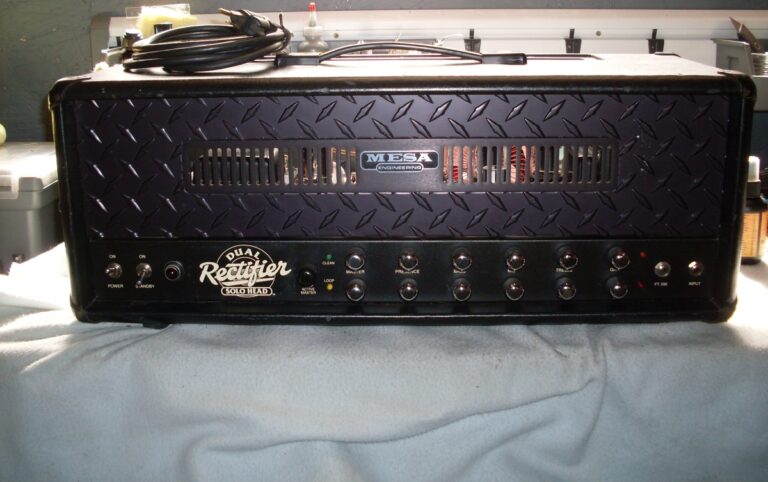
That’s not marketing. That’s what happens when a signature-amp design brief starts with the words “make it sound like Mark Tremonti’s touring rig.” Because Tremonti tours with massive rigs. He runs a 100-watt three-channel head into oversized Mesa 4×12 cabinets loaded with Celestion British V30s. He is, by disposition, a loud-amp player. Getting those characteristics — tight low end, five gain stages of preamp saturation, that particular harmonic density that makes the chords on “Blackbird” and “Isolation” hit like they do — down into a 17.8-pound steel chassis was not a simple task. The fact that PRS and Doug Sewell managed it at a price that, when the amp launched in 2018, came in under $700, is the reason the MT 15 has spent years earning “best lunchbox high-gain amp” verdicts across every major guitar publication.
Mark Tremonti, PRS, and Why This Amp Exists
Mark Thomas Tremonti was born April 18, 1974, in Detroit, Michigan. His path to becoming one of the most recognisable lead guitarists in hard rock runs through Creed — three multi-platinum albums, 26 million records sold in the US, a defining piece of late-nineties stadium rock — and then, after the band fractured in 2004, into Alter Bridge with bassist Brian Marshall, drummer Scott Phillips and vocalist Myles Kennedy. Alter Bridge is where Tremonti’s guitar playing came fully into focus for the wider guitar press: sophisticated rhythms, articulate high-gain leads, and an obvious command of dynamics that a pure “loud = good” player rarely demonstrates.
PRS connected with Tremonti while Creed was touring in support of My Own Prison in the late 1990s. That relationship deepened over the following decade into one of the longest-running artist partnerships on the PRS roster. Tremonti eventually became one of the first PRS artists to have both Core and SE signature guitar models — and, with the MT 15, the first to add a signature amplifier. The MT 15 launched at the 2018 Winter NAMM show in Anaheim and walked away with a “Best in Show / Gotta Stock It Award” from Sammy Ash on the first day of the show. That’s a telling endorsement: the industry, before any reviewer had filed a piece, already understood that this amp would sell.
The design conversation started with a specific constraint. Tremonti and PRS chief amp designer Doug Sewell wanted a low-wattage amp — something practical for home and studio use — but they needed it to carry the character of Tremonti’s touring sound. “The challenge was getting a lot of tone and features in a little box,” Tremonti said at launch. “We’re all blown away with how it turned out. It’s going to be great for someone to take it out of the box, set everything to noon, and have it sound great.” That last sentence is significant: an amp that sounds correct at noon is an amp designed with its taper curves, gain staging and voicing sorted before it leaves the factory.
The Engineering: Why 6L6s in a 15-Watt Amp
The decision that defines the MT 15’s character — and that required the most creative engineering — is the power tube choice. Most 15-watt amplifiers run 6V6s (the American small-signal bottle) or EL84s (the British alternative, snappy and compressed). PRS tried 6V6s first. They didn’t work. “His favorite tube is the 6V6’s big brother, the 6L6,” Sewell explained in the original press materials. “We realized that we couldn’t get a tone he was happy with without using those.”
The 6L6GC is the tube in a Fender Twin Reverb, a Mesa/Boogie Mark series amp, and Tremonti’s own touring rigs. It delivers a fuller, rounder low end than a 6V6, with less natural compression and a cleaner headroom character before breakup. Running a pair of them at 15 watts requires reducing the plate voltage significantly below what they’d normally see in a 40- or 50-watt design — which means adding “metal-amp-design techniques to give the low-end legitimacy without flabbiness,” as Sewell put it, and using smaller power and output transformers sized appropriately for the reduced supply. The result is a 15-watt amp whose bass response doesn’t apologise for itself. Drop-D riffs don’t turn into mud. Single-note leads below the twelfth fret on the low E don’t lose definition. The tubes contribute the fullness the design brief demanded; the circuit ensures the output stage doesn’t let that fullness collapse into bloat.
The preamp section follows the same logic as the PRS Archon: five gain stages before the master volume on the lead channel. That is a lot of gain stages. Most two-channel rock amps with comparable stage counts were being sold as standalone high-gain machines, not as half of a versatile two-channel head. The MT 15’s lead channel can sustain feedback from across a medium room. It can produce the kind of harmonically saturated, singing lead tone where the note blooms and grows rather than attacking and decaying. At reduced gain it can approximate a cranked Plexi — the crunch is there, the articulation doesn’t disappear, and the low end retains its punch.
Circuit Layout and Controls
The MT 15 is a two-channel, fixed-bias tube head with a tube-driven series effects loop. The chassis is all-steel in black, built to a standard that matches the amp’s performance tier rather than the lunchbox aesthetic sometimes implied by the size.
Preamp tubes occupy six 12AX7/ECC83 sockets in a specific functional layout: V1 is the input stage, V2 handles the clean channel, V3 and V4 are both in the lead channel (accounting for the gain density), V5 drives the effects loop, and V6 is the phase inverter feeding the output stage. Two TAD 6L6GCM-STR tubes power the output stage. The tube designations on PRS’s own specification sheet are worth noting — TAD sources tubes to a tighter tolerance than the generic consumer market, and the -STR suffix indicates a “Selected for Tremonti” matched pair. Whether that matters sonically is debatable, but it reflects the level of attention that went into the production spec.
Lead Channel
Treble, Middle, Bass, Gain and Master Volume are the core controls. The Treble knob has a push/pull function: pulling it out removes two of the five gain stages, producing what PRS calls “vintage, crunchier mid-gain tones.” That single control gives you two fundamentally different preamp gain structures from one channel. The high-gain position is Tremonti territory — metal, hard rock, harmonically dense solo work. The pulled position opens up the crunch end of classic rock and hard blues playing, where you want saturation but not compression stacking. It’s a genuinely useful split rather than a marketing trim.
Clean Channel
Volume, Treble, Middle and Bass, with the Treble also carrying a push/pull function — in this case a boost that adds “a touch of gain, fullness, and harmonics.” The clean channel has a lot of headroom. Premier Guitar’s Dave Hunter noted in the 2018 review that a Les Paul with humbuckers couldn’t push the channel into breakup until the volume was high enough to be inappropriate for most home settings, even at half power. Whether that’s a virtue or a limitation depends on what you want. As a pedal platform, a very clean amp is ideal — you’re running the pedal’s character into a transparent output, not fighting the amp’s own voicing. As a standalone crunch source, the clean channel requires either the boost engaged or a significant hit from the guitar’s own pickup output.
Global Controls and Rear Panel
A single Presence control is shared between both channels. It operates in the negative feedback loop — turning it up reduces feedback, releasing more high-mid and upper treble, making the amp feel wilder and more three-dimensional. It affects both channels identically, which means finding a setting that works for both is part of dialling the amp in.
The rear panel carries the effects loop send and return jacks (series, tube-driven), three speaker output jacks in a 2× 8-ohm parallel plus 1× 16-ohm layout, the bias monitoring test points and adjustment trimmer, the half-power switch stepping the amp from 15 to 7 watts, and the IEC power inlet. The footswitch jack connects the included single-button unit that toggles between clean and lead channels. There is no reverb. There is no effects loop bypass. There is no standby switch — same design philosophy as the PRS HDRX series.
Specifications
Famous Players: Who Actually Uses the MT 15
This is where honesty requires some precision. This is his amp, developed in direct collaboration with him. But his live touring rig, as documented in Premier Guitar’s 2023 Alter Bridge Rig Rundown, uses the PRS MT 100: the 100-watt, three-channel head that runs into two oversized Mesa 4×12 cabinets loaded with Celestion British V30s. The MT 15 is explicitly designed for home, studio, and small-room use — Tremonti said so himself at launch. So the situation is: Mark Tremonti designed the MT 15 around his tonal preferences, uses it as a reference during development, and presumably deploys it in contexts where bringing an MT 100 and two 4×12s would be unreasonable. He is not using it on arena stages, and no primary source claims otherwise. This is a clean signature-amp case in one respect (it genuinely sounds like his touring rig in miniature) and a nuanced one in another (his actual touring rig is the MT 100).
The more interesting Famous Players story lives with the two confirmed Equipboard artists using the original MT 15.
Mark Holcomb (Periphery) is listed on Equipboard as an MT 15 user, with documentation from a guitar clinic video in which he explains that he switched to the MT 15 for clinic contexts specifically because it’s more portable than his standard Periphery touring rig. Mark Holcomb is a PRS artist (his own SE and Core signature guitar models have been in production for years) and his adoption of the MT 15 for educational and clinic work is a logical extension of that relationship. It’s worth noting that his main stage amp is the PRS Archon — the same shared-DNA circuit that informs the MT 15’s preamp architecture. The family resemblance is not a coincidence.
Tyler Larson of the Music Is Win YouTube channel is also Equipboard-listed, with video documentation of his MT 15 use. Tyler Larson is not a touring musician in the conventional sense but is a significant presence in the online guitar education world, with a following in the millions who have watched him demonstrate gear. His MT 15 appears across multiple videos; the documentation is genuine. His endorsement carries real-world weight for the amp’s target demographic.
Two additional users appear in the Equipboard listing without named identification in the publicly available summary, bringing the documented total to four professional or semi-professional players. For a compact signature amp aimed at non-touring use cases, that count is respectable. The MT 15 does not try to be an MT 100; its genuine Famous Players story reflects that.
The V1-to-V2 Transition: What Changed in 2025
The original MT 15 launched in 2018 at $649 street. At that price it was, as Guitar World noted, something close to bargain-tier for what it delivered — “The outstanding tones of the MT 15’s Clean and Lead channels and their truly independent character would make this amp a bargain at twice its price, but for $649 it is a best-buy for true aficionados of modern rock guitar tones.”
The 2025 V2 revision carries a $949 price tag at current retail — a $300 increase from the original. What did that buy? According to PRS, the key change is the push/pull overdrive control on the Lead channel Treble knob. PRS’s own page describes it as removing two gain stages to produce “vintage, crunchier mid-gain tones.” The V1 had a more linear gain-only lead channel; the V2 effectively gives you two preamp characters in one. PRS also notes that the V2 features the voice of the MT 100’s overdrive channel — which means the high-gain position on the V2 is more directly aligned with Tremonti’s touring sound than the V1 ever was.
The price increase is real and requires acknowledgement. The V1 used market — where units in clean condition regularly appear at $400–$550 on Reverb — represents genuine value for players who don’t need the V2’s expanded gain range. The V2 at $949 is competitive within the high-gain lunchbox segment (comparable to a Mesa/Boogie Mini Rectifier or a Friedman Pink Taco), but it’s no longer the obvious price-to-performance winner the original was at $649. The circuit improvement is substantive; the value equation depends on whether mid-gain versatility matters to you.
Tone Recipes and Settings
Mark Tremonti’s Lead Setting (PRS Suggested)
Gain at 3 o’clock (high), Treble at 12 o’clock, Middle at 11 o’clock, Bass at 12 o’clock, Master at whatever your room requires. Presence at 12 o’clock. This is the published PRS “Suggested Setting” for Tremonti’s lead tone — the saturated, harmonically dense, tight-bottomed sound that defines Alter Bridge’s heavier moments. Run it with a Fender Stratocaster for singing single-note clarity; run it with a humbucker guitar for the full chug.
Tremonti Mid-Gain Crunch (Pull the Treble)
Start from the above setting. Pull the Treble knob out. Reduce Gain to 10–11 o’clock. The two removed gain stages open up the dynamic range significantly — you get attack on the pick and decay instead of full saturation throughout. This is the “Plexi-era hard rock” voice the V2 added. A Gibson Les Paul Standard with the bridge pickup runs into this particularly well: the humbucker warms the midrange, the reduced-stage preamp delivers crunch without mush.
Boosted High-Gain Metal
Lead channel, Gain at maximum, Master at rehearsal volume, Treble at 10 o’clock (slightly scooped), Middle at 11 o’clock, Bass at 1 o’clock. Add an Ibanez TS9 Tube Screamer in front with the Drive at zero, Level at maximum, Tone at noon. The TS9 in this configuration doesn’t add distortion — it tightens the low end, focuses the midrange, and increases the signal level into the input stage. The result is a harder-attacking, more focused high-gain tone that stays articulate even in drop tunings. This is the approach Tremonti uses on his MT 100 rig; the same logic applies at lower wattage.
Clean Pedal Platform
Clean channel, Volume at noon, Treble at 1 o’clock, Middle at noon, Bass at 11 o’clock, Presence at 11 o’clock. Half-power switch engaged if you need to reduce volume. The clean channel at these settings is genuinely clean — no breakup, excellent frequency balance. Route your dirt pedals, modulation, and delays through the front of the amp and the effects loop respectively. A drive pedal that would disappear into a Marshall JCM800’s natural breakup at practice volumes comes alive here because the amp isn’t adding its own character.
Clean with Boost Crunch
Clean channel, Volume at 2 o’clock (high), pull the Treble boost. The boost adds harmonics and a touch of gain — at these levels you’ll get the clean channel beginning to breathe, the kind of tone that sits between sparkle and bite. Use with a Strat and single-coil pickups for a touch-sensitive, slightly throaty clean that breaks up on hard picking without losing clarity on lighter strokes.
Comparisons With Similar Amps
PRS Archon 50 Head
The PRS Archon 50 shares the MT 15’s five-stage lead channel architecture and ships the 2025 Archon Classic at $1,149 — $200 more than the MT 15 V2. The Archon runs 2× 6CA7 power tubes (the American EL34 equivalent), where the MT 15 uses 6L6GCM-STR. The 6CA7 gives the Archon a slightly more forward, aggressive midrange character; the 6L6 in the MT 15 is warmer and rounder down low. Both offer five gain stages and a clean channel with real headroom. The Archon is a 50-watt amp — four to five times the wattage of the MT 15 V2 in full-power mode — so if venue volume is the primary constraint, the Archon wins on headroom and projection. If you need the MT 15’s half-power switch and its lunchbox portability, the Archon’s wattage becomes a liability rather than an asset.
PRS HDRX 20
The PRS HDRX 20 is a 20-watt Plexi-circuit amp at $899 — close to the MT 15 V2 in price, same lunchbox category, same PRS build standard. The tonal differences are fundamental. The HDRX 20 is voiced around Hendrix’s Woodstock Marshall: bright, harmonically open, clean-to-crunch rather than crunch-to-metal. Its lead capability is the cranked-single-channel plexi, not a dedicated high-gain channel. The MT 15 is a two-channel amp with five gain stages of dedicated preamp distortion on the lead side; the HDRX 20 gets its gain from volume. A player who wants controllable modern high-gain at low stage volumes should be in front of an MT 15. A player who wants to dial up vintage Hendrix-era textures with a master volume should be in front of the HDRX 20.
Marshall JCM800 2203
The Marshall JCM800 2203 is the ancestor of the MT 15’s tonal brief — the 100-watt British single-channel that defined hard rock and heavy metal from the early 1980s onward. A vintage JCM800 in working order runs $1,500–$2,500 on the used market; a new reissue is around $1,700. The MT 15’s lead channel can produce JCM800-adjacent tones, especially in the V2’s pulled-Treble reduced-gain position — the crunch structure is similar even if the circuit heritage is different. The actual JCM800 is louder, has more dynamic range at full power, and has the particular quality of a vintage British output transformer that no modern PCB-construction amp fully replicates. It also offers zero flexibility: it’s a single channel, there’s no master volume on the original, and using it at home volumes requires an attenuator. The MT 15 trades some of that vintage magic for a control set that actually works in the real world.
Mesa/Boogie Mini Rectifier Twenty-Five
The Mini Rectifier Twenty-Five runs at 10W or 25W, uses one or two EL84 tubes, and starts around $1,100 new. It’s a Rectifier-circuit amp — scooped mids, massive bottom end, the sound of Tool and Metallica’s Black Album rather than Alter Bridge. The Mesa’s power tube character is fundamentally different from the MT 15’s 6L6: the EL84 is snappier, brighter, and more compressed; the 6L6 is warmer and more linear. Both are small high-gain heads. A player in the modern metal or drop-D djent space will likely prefer the Mesa’s character; a player coming from hard rock, shred, or classic Tremonti tones will find the MT 15’s voicing more natural.
Fender Deluxe Reverb
The Fender Deluxe Reverb is included here not as a high-gain competitor but as the alternative to the MT 15’s clean channel. If your musical context requires pristine American clean tones, built-in spring reverb, and single-coil character, the Deluxe Reverb at its 22-watt output gives you something the MT 15 can’t: Fender’s specific circuit voice and that reverb tank. The MT 15’s clean channel is very good but it’s voiced neutrally rather than expressively; the Deluxe Reverb has a sound that many players consider irreplaceable. If you need both clean and high-gain in one box without external effects, the MT 15 is the correct choice. If you only need great clean tones, the Deluxe Reverb deserves serious consideration.
Buying Guide: Which Version, and for Whom
The MT 15 exists in two distinct market pools. The original V1 — produced from 2018 through the 2024 revision — appears regularly on Reverb and the used markets of major dealers at $400–$550 in good condition. The V2 launched in 2025 at $949 new, with no immediate used supply. Both are the same fundamental amp; the V2’s primary addition is the pull-Treble overdrive stage removal on the lead channel.
If the mid-gain range is not your priority — you want maximum high-gain all the time and a clean pedal platform — the V1 at $450–$500 used is among the best high-gain value propositions in the sub-$1,000 market. If you want the V2’s expanded gain palette and the updated circuit alignment with the MT 100’s overdrive channel voice, and you’re in a musical context where mid-gain classic rock sits alongside modern high-gain work, the $300 premium for the V2 is justified.
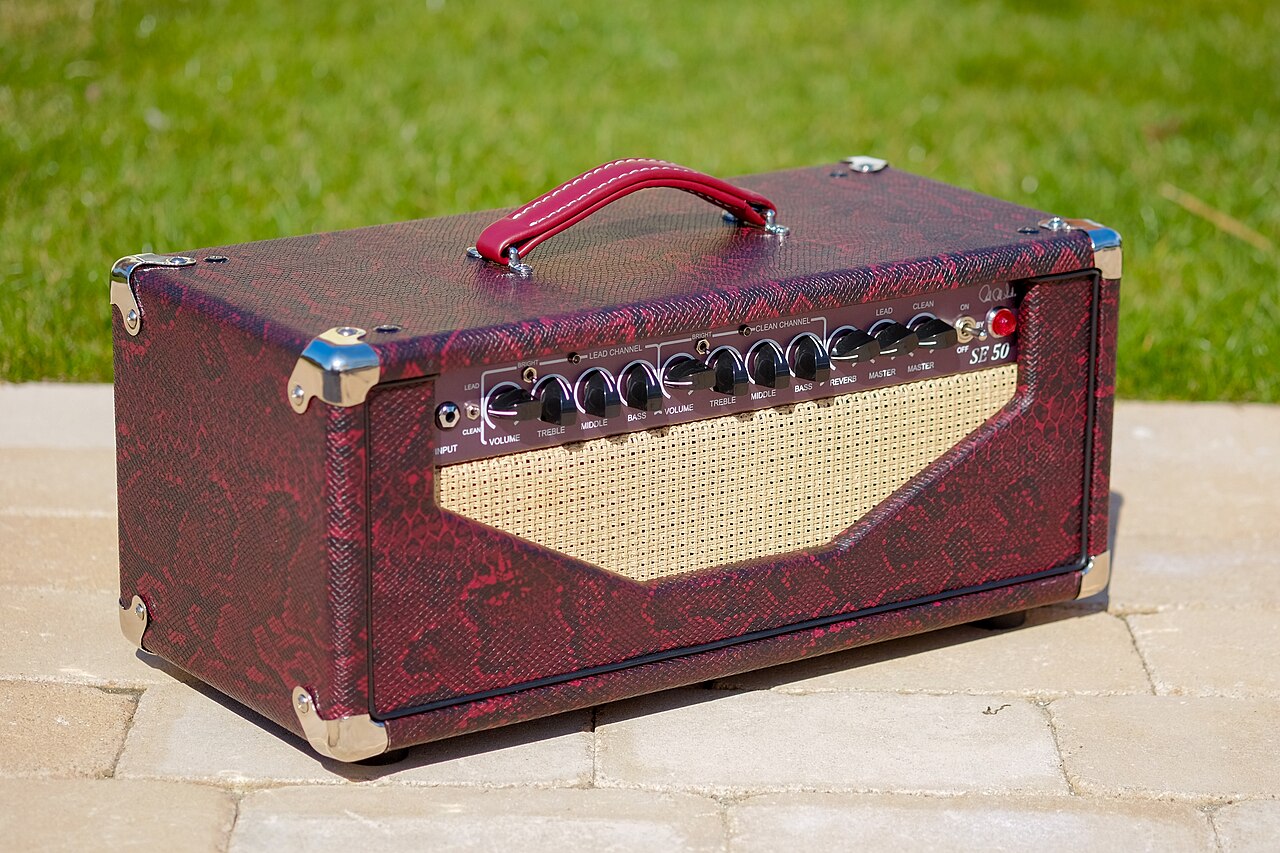
The MT 15 is correctly suited to: home recording, small-venue amplification (with or without a microphone), practice with headphone routing via a load box, and studio tracking where you want consistent high-gain tones without physically placing a miked 100-watt stack in an isolation booth. It is not suited to unmiked stage work in venues where you’re competing with a loud PA or a drummer who tunes down. At 15 watts, the physical headroom for stage-level projection is limited. The half-power switch to 7 watts is genuinely useful at home; on stage it reduces already limited headroom further.
Ownership Notes
Retubing: The fixed-bias design means retube requires a bias adjustment, which the rear-panel monitoring jacks and trimmer make straightforward. You don’t need to open the chassis to bias this amp — a bias probe or a multimeter on the monitoring points is enough. PRS specifies a target bias current range; any amp technician can set this, and the process is fast. Stick with 6L6GC-type tubes (6L6GC, 6L6GCM, 5881). The 5881 is technically a lower-dissipation variant and will bias correctly but may sound slightly different at the threshold of breakup.
Speaker matching: The MT 15 ships as a head only. The companion cabinet PRS originally offered was a closed-back 1×12 with a Celestion Vintage 30 at 16 ohms. The Vintage 30 is an excellent match for the MT 15’s voicing — its characteristic low-mid presence peak (around 800Hz–1kHz) complements the amp’s high-gain tone rather than fighting it. An open-back 1×12 with a Celestion G12H-30 or a Greenback will shift the character toward a lighter, more vintage texture. A 2×12 open-back cab will increase the perceived low-end but soften the focused punch of the closed-back pairing.
Effects loop: The tube-driven series FX loop is the correct place for time-based effects (reverb, delay, chorus, flanger). Gain pedals and drives should go in front of the amp. The TS9-into-high-gain-input approach described in the tone recipes above is the most effective use of the front-end; running a drive pedal through the effects loop will yield unpredictable results because the loop sits in the signal chain after the preamp stage.
No standby switch: Like the HDRX series, the MT 15 has no standby switch. PRS uses high-value filter capacitors that ramp voltage slowly on power-up, providing a degree of tube protection. To mute the amp during breaks without full power-down, partially pull the input cable — breaking the tip contact without grounding the signal.
Noise floor: A five-stage high-gain preamp in a compact chassis introduces noise-floor considerations. A gate is effectively mandatory for heavy playing — the MXR Smart Gate or an Ibanez TS808HW as a buffer in front, plus a dedicated noise gate in the effects loop, is Tremonti’s own documented approach on the MT 100, and the same logic applies at MT 15 scale.
Frequently Asked Questions
Is the PRS MT 15 loud enough for a live gig?
Miked, yes — 15 watts into a single 12-inch closed-back cabinet can be captured adequately by a decent dynamic microphone and will come across clearly in a PA at any small to medium venue. Unmiked, the answer depends on the room and the drummer. A loud drummer in a 200-person venue will push the MT 15 to its limits; in smaller rooms or in a rehearsal context without PA support, it holds its own at full power. The half-power mode at 7 watts is for home and studio use, not for competing with live percussion.
What’s the difference between the V1 and V2?
The primary addition in the 2025 V2 is the push/pull Treble control on the lead channel. Pulling the knob removes two of the five gain stages, producing a “mid-gain” crunch voice that the V1 lacked entirely. PRS also describes the V2’s lead channel as carrying the voicing of the MT 100’s overdrive channel — meaning it’s more closely aligned with Tremonti’s actual touring sound. The price increased from $649 (V1 original street) to $949 (V2 current). The V1 is the better value on the used market; the V2 is the more versatile amp.
Does the MT 15 work for genres other than metal and hard rock?
The clean channel is a capable pedal platform and works well for blues, indie rock, and even country playing when fed through appropriate single-coil guitars. The lead channel at reduced gain (and especially with the V2’s stage-removal feature engaged) handles classic rock, Southern rock, and the crunchier end of blues without difficulty. It’s designed around Tremonti’s tonal vocabulary, which is modern hard rock and metal — but the circuit isn’t so voiced that it refuses to do anything else.
Can I use EL34 tubes instead of 6L6s?
No — the EL34 uses a different pinout from the 6L6 family and cannot be substituted directly. You can use any 6L6GC-class tube (6L6GC, 6L6GCM, 6L6GCM-STR, 5881) and bias within the specified range. The 5881 is lower-dissipation and may sound slightly different at the edge of breakup. Stick with the 6L6 family and you won’t damage the amp.
Does the MT 15 have reverb?
No built-in reverb. Run a reverb pedal through the effects loop (post-preamp) for the most natural reverb behaviour. A small dedicated digital reverb unit in the loop — anything from an Electro-Harmonix Holy Grail to a Strymon Flint — will work cleanly at the loop’s unity gain level.
Is the MT 15 Mark Tremonti’s main live amp?
No. His documented 2023 touring rig (from Premier Guitar’s Alter Bridge Rig Rundown) uses the PRS MT 100, a 100-watt three-channel head run into two oversized Mesa 4×12 cabinets with Celestion British V30s. The MT 15 is the home/studio/small-venue version of his tonal approach, designed for contexts where a full touring stack isn’t appropriate. This is by design, not a gap in the signature relationship — Tremonti explicitly described the MT 15 as suited to “recording, practicing, writing, or playing a small room.”
How does the MT 15 compare to the PRS Archon?
Both share a five-stage lead channel architecture. The Archon 50 runs 6CA7 power tubes (American EL34 equivalent), uses 50 watts, and skews toward maximum saturation on the lead channel. The MT 15 runs 6L6 power tubes, uses 15 watts, and (in V2 form) offers more gain-range flexibility via the push/pull lead channel Treble control. The Archon is the stage-ready higher-wattage option; the MT 15 is the portable, home-friendly smaller sibling. Both are valid — the choice is primarily about wattage requirements and whether 50 watts makes sense for your playing environment.
What cab should I pair with the MT 15?
The PRS closed-back 1×12 with a Celestion Vintage 30 is the designed pairing and an excellent one. The Vintage 30’s low-mid presence peak (around 800Hz–1kHz) suits the MT 15’s preamp voicing, and the closed-back construction reinforces the tight low end the 6L6 tubes deliver. If you want more spread and a slightly less focused low-end punch, a 2×12 open-back with a mix of a Vintage 30 and a Celestion G12H-30 provides more dimensional room sound. For recording, going direct through a load box or a reactive load with impulse responses avoids the cabinet question entirely while retaining the amp’s character.
Image credits
- Top image: GuitarGangsters AI-generated reference illustration, not a photograph.
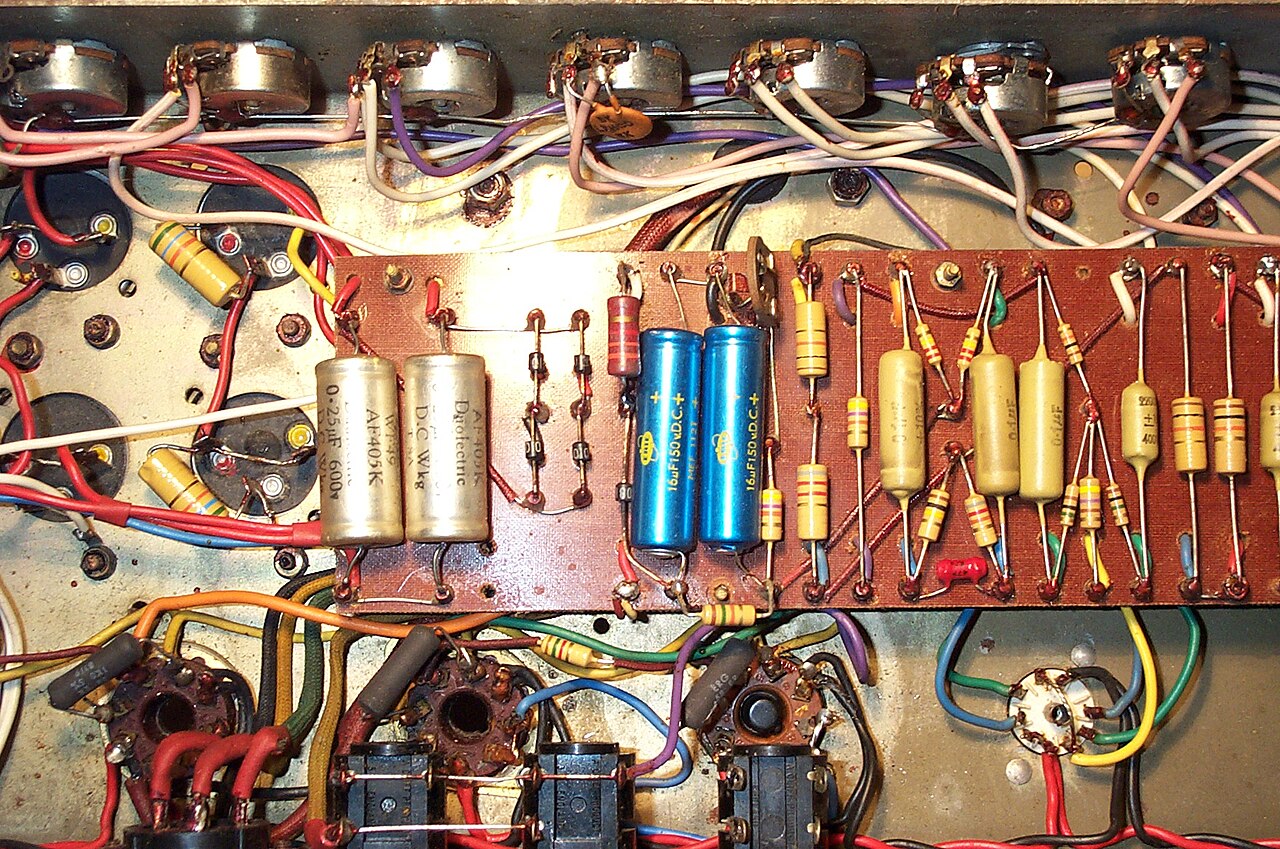
- Inside a tube guitar amplifier: germanium from Eichwalde, Germany, Wikimedia Commons, CC BY 2.0.
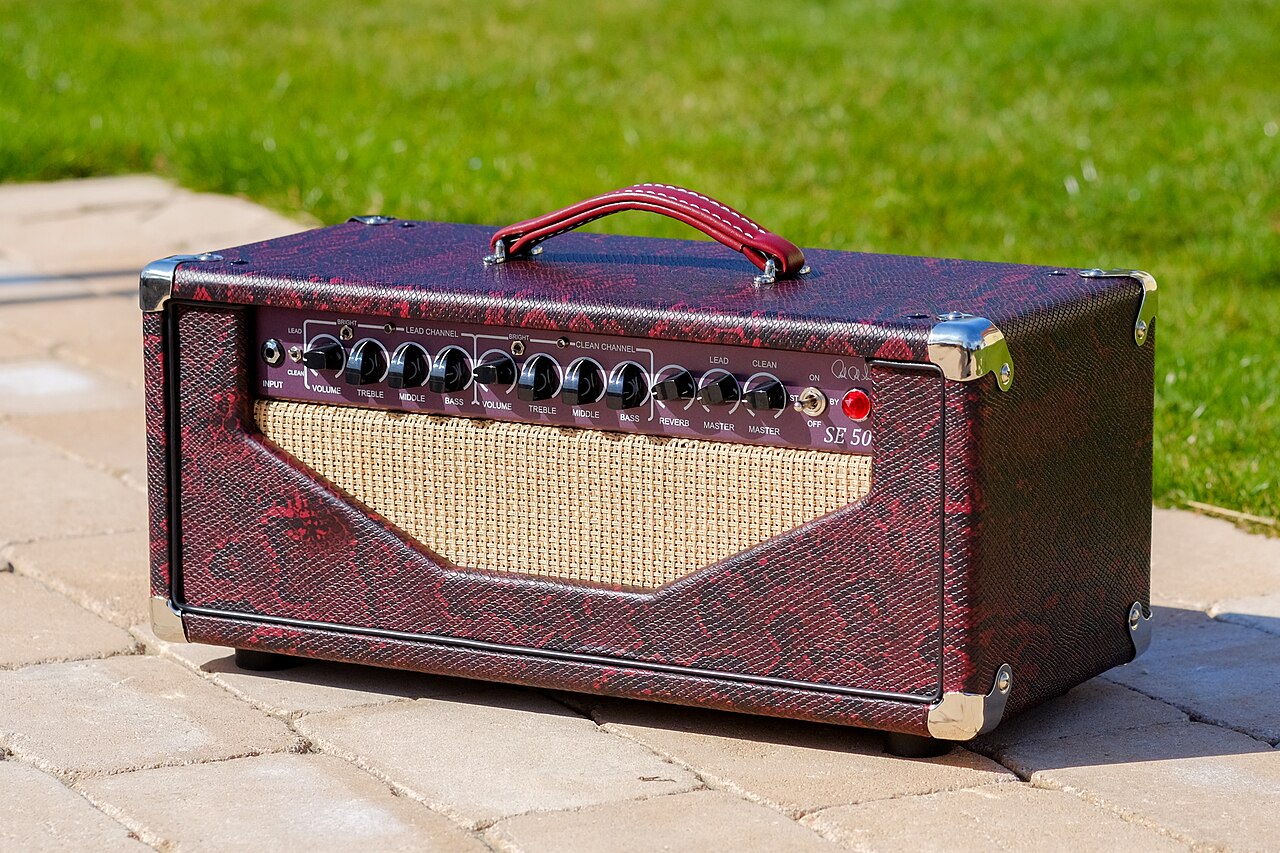
- A PRS SE50 guitar head amplifier: Dieter Karner from Roggendorf (Schollach), Austria, Wikimedia Commons, CC BY 2.0.
- A PRS SE50 guitar head amplifier on a paved surface: Dieter Karner from Roggendorf (Schollach), Austria, Wikimedia Commons, CC BY 2.0.
Latest News
Related
On This Day
Monday 9 November
From this week: