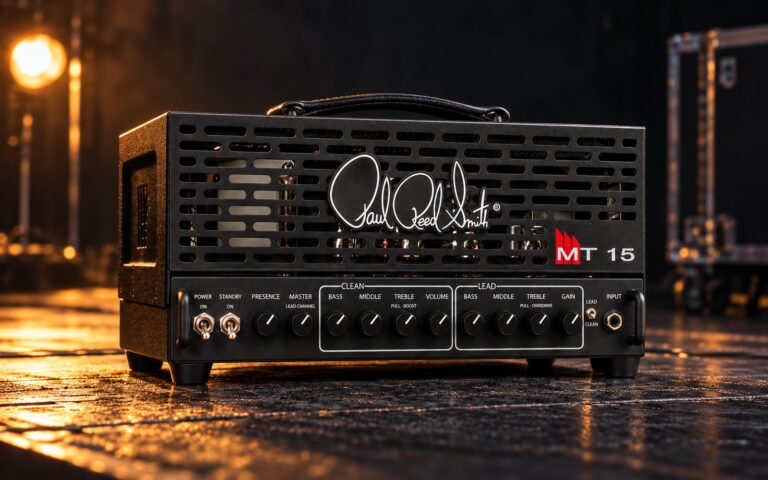
The Fly-In Amp That Could: How the Victory V30 The Countess MKII Became Guthrie Govan’s Most Trusted Touring Head
Guthrie Govan's touring amp of choice, the Victory V30 Countess MKII is a 42W all-valve lunchbox with clean, crunch and lead modes. Full specs.
Most guitar amplifiers start with a blank schematic and a vague brief about what the marketing team wants to sell. The Victory V30 The Countess MKII started differently — with one of the most technically demanding guitarists on the planet telling a British amp designer what he actually needed to survive a world tour in carry-on luggage.
Guthrie Govan — known for his work with The Aristocrats, Asia, GPS and the Fellowship and widely regarded as among the most complete guitarists working today — needed an amp that could fly with him, plug into any cab in any backline rental on any continent, and cover everything from immaculate clean chord melody to sustaining high-gain lead lines without a trace of compromise. Victory’s chief designer Martin Kidd built him one. Then, in 2018, they made it better.

The V30 The Countess MKII is a 42-watt, two-channel, three-mode all-valve lunchbox head that weighs 8.2 kilograms, fits in a padded bag barely bigger than a road atlas, and — according to Govan himself — has coped “effortlessly with every sonic challenge I’ve been able to throw at it” as both touring and studio tool. For the price, that is an extraordinary credential verifiable from primary sources.
This article covers the full story of the Countess MKII: where it came from, what changed in the update, how it sounds across its three gain modes, and what to look for if you are hunting one on the used market.
Victory Amplifiers and the Guitar That Started It All
Victory Amplifiers is a young company by British boutique standards. Martin Kidd — formerly of Cornford Amplification, which earned a devoted following in the 2000s before closing in 2011 — founded Victory in 2013. Cornford built muscular, harmonically dense handwired heads; Victory inherited that philosophy but extended it into a broader palette of voicings and, crucially, a determination to make lunchbox-format heads that did not sound like lunchbox-format heads.
The very first Victory product was the original V30 The Countess. Not the V40, not the VX Kraken, not any of the many heads that would eventually fill the Victory catalogue — the Countess, developed with Guthrie Govan as his “flying amp” before the company had shipped a single order. That makes the V30 more than a popular model; it is the founding document of Victory’s entire design philosophy.
Govan’s requirement was specific: a single-cab-pairable head he could take as hand luggage on commercial flights, delivering his clean tone — clear enough for intricate chord melody and hybrid-picking runs, with enough headroom to take pedals transparently — and his lead tone (high-gain, sustaining, responsive to pick attack dynamics at speed) without needing two separate amps or a cab full of outboard gear. The original V30 delivered this in a two-channel format with a power section switchable between 30W, 15W, 9W and 2W via front-panel and rear-panel switches.
It sold well. Players appreciated the portability and tonal range. But feedback accumulated over years of real-world use, and two specific complaints emerged consistently: the bass could feel a little thick in the overdrive mode at gigging volumes, and there was no tonal middle ground between the amp’s extremely clean channel and its high-gain lead — nothing for classic rock, lighter crunch, or pushed-clean blues territory.
Victory’s response was methodical. “The reason we decided upon a Mark II version was largely down to customer feedback,” Kidd told MusicRadar’s Nick Guppy in 2018. The circuit development borrowed partly from the V130 The Super Countess — a higher-powered sibling that launched in January 2017 — incorporating its crunch architecture into the existing lunchbox chassis. Then Kidd took the evolving design back to Govan. “Spending time with Guthrie,” he explained, “and performing some modifications as we went along based on his observations, I think was when the Mark II design finally came together; giving us three gain structures and five very useable sounds, while retaining much of the character of the original that Guthrie still felt at home with.”
The MKII was announced at NAMM in January 2018 and shipping from February that year — Victory’s updated take on its own founding instrument.
MkI to MKII: What Changed and Why
On the outside, the most visible change is cosmetic: the MKII chassis is finished in black chrome powder coat rather than the MkI’s previous coating. The result is a purposeful, industrial aesthetic — Victory’s trademark unperforated chevrons on the front and back of the top cover and clean cream lettering — that looks deliberately serious on a stage or in a rack. Inside, the PCB uses high-temperature capacitors and metal-film resistors throughout for low noise and thermal consistency, with all wired connections carefully routed to avoid strain.
The front panel controls are nearly identical to the MkI: two pairs of gain and master volume for clean and lead channels, sharing a conventional passive bass, mid, and treble EQ. The new Crunch mode hides in plain sight: it is engaged by pulling up on the clean channel’s gain knob — a push/pull function — and is simultaneously footswitchable via the supplied two-button footswitch alongside the main clean/lead channel change button.
On the rear, the MkI’s single-ended mode — which dropped power to 9W or 2W by switching the output section to one valve — has been removed. In its place, Victory added external bias test and adjustment points. This is a meaningful practical upgrade: changing output valves on the original V30 required opening the chassis and working around live high-voltage components. The MKII lets you set bias from outside the amp with a multimeter and a trim pot. A manual Nomod switch also appears on the rear panel, complementing the footswitchable version accessible during performance.
The Nomod function needs its naming explained because it is counterintuitive. “Nomod” means no modification — it is the original, open, full-bass response that Govan preferred when they voiced the amp together. The “modified” position (Nomod OFF, accessed via the footswitch) is the tighter, more focused bass that customers had asked for. In other words: Nomod switch engaged = original Govan voicing; Nomod switch disengaged = the tighter alternative added for MKII. Victory named the option Govan liked the baseline, which tells you something about whose preferences shaped the design.
Power output went from 30W to 42W between MkI and MKII — not because players needed more stage volume, but because the revised circuit and the expanded choice between 6L6 and EL34 output valves naturally produces more headroom at rated power. The low-power mode is retained and drops to 7W. The power section runs either two 6L6 tubes (shipped as standard) or two EL34s — the user’s choice, with external bias adjustment to match.
The Countess MKII is the same size and weight as its predecessor (342×185×185mm, 8.2kg) and still includes a two-button footswitch and padded carry bag. The essential “flying amp” brief is intact; the changes address the specific frustrations players articulated over five years of real touring use.
Specifications at a Glance
Famous Players: Guthrie Govan
The artist connection here is not the standard “brand endorser on a photo call” situation that occupies most amp reviews. Guthrie Govan genuinely designed the V30 with Martin Kidd — the original model in 2013 and the MKII update between 2017 and 2018 — and continues to use it on tour and in the studio. Victory’s own artist page documents this plainly: “Guthrie and Victory collaborated on the V30 MKII which was originally developed as his ‘flying amp.'” His own quote on that page: “I’ve been using this thing not only as my ‘go to’ touring amp but also as a kind of ‘Swiss Army knife’ in the recording studio… and It’s coped effortlessly with every sonic challenge I’ve been able to throw at it.”

Multiple independent primary sources confirm the same relationship: the Premier Guitar NAMM 2018 press release states the MKII “was developed in conjunction with Guthrie Govan”; Guitar World’s January 2018 news piece calls it “the 42-watt, two-channel, three-mode all-valve guitar amp [that] replaces Victory’s first ever Compact amp head, which the company developed with Guthrie Govan”; MusicRadar’s full review (Nick Guppy, August 2018) opens: “Originally designed for the insanely talented Guthrie Govan as his ‘fly-in’ amp, the V30 is one of Victory’s most popular models.”
This is rare. A player with no management-level obligation to endorse anything, whose stated requirements drove the product design at a fundamental level, still using the result as his primary touring amp years after the collaboration. That is worth stating plainly, because it is genuinely unusual in an industry where “artist relationship” usually means a royalty agreement and a social media post.
Who is Guthrie Govan? Depending on which section of the guitar community you ask, he is the most technically complete player alive — a musician whose facility spans jazz, fusion, country, blues, flamenco, classical, metal, and pretty much anything else without ever sounding like he is switching modes. Born in Essex in 1971, he passed the Grade 8 music exam at the age of eight and spent decades as one of the most in-demand session and clinic players in the UK before wider public exposure arrived through his 2006 solo album Erotic Cakes and, more significantly, through The Aristocrats — the trio he co-leads with bassist Bryan Beller and drummer Marco Minnemann.
The Aristocrats’ music is the most useful reference point for understanding what the Countess MKII has to deliver in the real world. Their arrangements move within a single piece from delicate fingerpicked intros through jazz-inflected chord melody passages into high-speed fusion unison lines and, at the far end, legitimately heavy gain. The amp that serves Govan across all of that is not a high-gain specialist or a clean machine — it is a versatile tool that responds accurately to guitar-side dynamics and player intent. The MKII’s three modes and Nomod function exist because Govan needed precisely that range in a single head small enough to go in the overhead locker on a commercial flight.
His primary guitars are the Charvel Govan Signature — a superstrat designed to his specification and built by Fender’s Custom Shop, with carefully chosen pickups and hardware selected for tonal versatility and road reliability. The combination of a Charvel with medium-output humbuckers through the Countess MKII clean channel is the context in which that channel’s “spanky, medium-fast attack” was voiced. It is not a vintage single-coil amp, but it handles single coils equally well because the fundamental architecture privileges clarity and dynamic response over character colouration at the front end.
No other touring artist is currently documented at primary-source level on the V30 Countess MKII specifically. This is a one-player story — but it is a well-sourced, verified one, which in the world of amp endorsements is worth more than a roster of names attached to nothing but brand deals.
How It Sounds: Clean, Crunch and Lead
MusicRadar’s Nick Guppy reviewed the MKII in August 2018, testing through a Vintage 30-loaded 2×12 cabinet with a Fender Custom Shop Nocaster and a 1972 Les Paul Custom. His findings align closely with the amp’s stated design intentions, which is always a good sign when the designer was working to a documented brief.
The clean channel fires up with practically no hum or hiss. At low gain, it has genuine headroom — it stays clean under a Les Paul humbucker at moderate pick attack, which is harder to achieve at 42W than it might seem when the circuit is tuned for pedal transparency rather than maximum gain-per-watt. Guppy describes the treble as “bright without the annoying high-frequency fizz that some amps suffer from,” and the midrange as “warm but stays just on the right side of being too nasal.” These are not vague praise words; they indicate a designer who knew which frequency regions he was actively avoiding in each direction.
The clean channel takes pedals exceptionally well. This is by design: Govan uses a substantial pedalboard, and the MKII clean was voiced as a platform for pedal-driven overdrive rather than as an amp that produces all its character internally. A transparent or lightly saturated clean with fast transient response is exactly what a Klon-style overdrive or a Tube Screamer needs to operate as intended — the pedal adds the drive character; the amp adds its own voice on top of it. Players who favour overdrive-in-front-of-clean-amp approaches will find the MKII’s clean channel to be one of the better implementations in the lunchbox category.
The Crunch mode sits between the clean and lead channels in gain structure. It uses the clean channel’s gain and master volume controls, plus the shared passive EQ — there is no separate gain trim or independent tone shaping. This introduces inherent compromise: if the gain is dialled conservatively for Crunch territory, there may be less clean headroom than some players want, and vice versa. Guppy calls the Crunch “ballsy and aggressive when wound up,” which is accurate, and also notes that “some degree of compromise is needed” on the single EQ shared across all three modes. In practice, most players set the Crunch voicing first, accept a slightly reduced clean headroom, and use guitar volume to clean up on the fly — a technique that works well given the MKII’s dynamic responsiveness.
The lead channel is the core of what the original V30 was. It delivers “fluid, high-gain overdrive” (Guppy) that is “stunning for modern rock and metal” — and explicitly noted as “somewhat over the top for styles that work best with less distortion.” This is honest amp-design: the lead channel has all the sustain anyone is ever likely to need, with what Guppy calls the “characteristic Victory sparkle” — a slightly compressed, even sustain with a musical top-end cut rather than a fuzzy wall of gain. If you want light crunch for classic rock lead, use the Crunch mode; the lead channel is voiced for players who need saturation and sustain, not for those who want a pushed tweed.
The Nomod function adds its most useful character to the lead channel specifically. At higher gain settings, the original full-bass voicing can push the low strings toward thickness and undefined muddiness in a band context — Guppy confirms that the Nomod tight setting “helped improve articulation at higher gain settings” on the overdrive channel, and that “it’s handy to have the original un-modified… voice as well.” Players in bigger rooms or in band contexts with heavy bass and drum low-end will default to Nomod-tight on the lead channel. In a home studio or small-venue context, the original full-bass voice has warmth and size that the tight setting sacrifices.
Overall, MusicRadar’s verdict: “three very useable sounds that cover a wide range of playing styles and musical genres, while holding true to the vibe that made the original version such a popular choice.” The clean is perhaps a little flat in isolation but excellent with pedals; the Crunch is aggressive and directionally useful; the lead has all the sustain and the “characteristic Victory sparkle.” At the launch price, “top-drawer build quality and serious boutique tone at a very reasonable price.”
Five Tone Recipes and Settings
1. Fusion Clean Platform (Govan-Voiced Reference)
Channel: Clean. Crunch: off. Gain: 3. Master: 6. Bass: 6, Mid: 5, Treble: 6. Nomod: off (full bass). Guitar: Fender Stratocaster or humbucker guitar, volume 8. Run a low-gain transparent overdrive (Klon-style, or TS9 with Tone at noon, Drive minimal, Level above unity) in front for lightly pushed passages. This is the clean-pedal-platform the amp was designed around — dynamic headroom, fast transient response, sparkle without ice-pick edge. Roll guitar volume to 6 for fully transparent clean; pick harder for natural pick-attack compression. Switch to the TS9 for the lightly pushed passages; switch back for the chord sections. This is the topology Govan uses in The Aristocrats.
2. Pushed Classic Rock Crunch
Channel: Clean, Crunch engaged (push/pull up on clean Gain knob). Gain: 6. Master: 5. Bass: 5, Mid: 6, Treble: 5. Nomod: off. Guitar: Gibson Les Paul Standard, bridge humbucker, volume 10. This is vintage hard rock territory — the driven crunch that suits a Zeppelin riff or a Whitesnake-era blues-rock run. The midrange sits forward of a Marshall without the prominent upper-mid bark. Sweep guitar volume between 7 and 10 to move from rhythm work to a slightly hotter single-note line without engaging the footswitch. Back off to 6 for a slightly cleaner chord voicing in the verse.
3. Hard Rock Lead — Tight and Defined
Channel: Lead. Gain: 8. Master: 5. Bass: 5, Mid: 6, Treble: 6. Nomod: on (tight bass, footswitch engaged). Guitar: Les Paul, bridge humbucker, volume 10. Add an Ibanez TS9 in front — Tone at 9 o’clock, Drive minimal, Level above unity — to tighten the input signal and push the preamp. The Nomod-tight setting removes the low-end thickness that would blur fast palm mutes and high-gain chord stabs at gigging volumes. The TS9 in front accentuates the midrange and gives the lead tone a focused quality under a band mix.
4. Blues-Rock Moderate Crunch
Channel: Crunch. Gain: 5. Master: 6. Bass: 6, Mid: 7, Treble: 5. Nomod: off. Guitar: Fender Stratocaster, middle or neck pickup, volume 8. A medium overdrive that sits comfortably in blues-rock lead territory — enough grind for expression, controlled enough for chord work to remain clear. Back the guitar volume to 5 for a clean-edged Hendrix-style rhythm approach; push to 10 and pick harder for a hotter single-note solo voice. The Strat’s lower output keeps the Crunch mode at a productive range that a humbucker would push a step further into heavier territory.
5. Studio Ambient Clean
Channel: Clean. Crunch: off. Gain: 2. Master: 7 (in low-power 7W mode). Bass: 5, Mid: 4, Treble: 7. Nomod: off. Guitar: Stratocaster, neck pickup, volume 7. A studio clean optimised for layered textures and ambient recording — airy, open, and uncoloured enough to sit under reverb and delay treatments without fighting them. The MKII’s 7W low-power mode is well-suited here: at reduced volume through a moderate cab, the clean character remains present and the transformer behaviour stays predictable. Run a reverb and long delay through the effects loop after the preamp for post-EQ time-based treatment.
How the V30 MKII Compares
Victory V40 The Duchess
The most direct sibling comparison. The V40 The Duchess is also a Victory lunchbox head designed by Martin Kidd, but its brief is fundamentally different: the V40 is a clean platform for pedalboard-first players — single-channel, voiced for maximum headroom and transparency, with the MkII version adding three-way Voice and Mid-Kick switches plus digital reverb. The V30 MKII was designed to produce its own crunch and lead tones internally, through three gain structures. If your playing is built around pedal-driven overdrive chains running into a clean amp, the V40 is the correct tool. If you want an amp that handles three genuinely different gain levels internally with a single shared EQ, the V30 is yours. Both share the same chassis footprint and are equally portable.
Marshall JCM800 2203
The JCM800 2203 is the cultural reference point for British high-gain tone in a single-channel format. It is heavier, louder, less portable at 100W, and voiced with more prominent upper-mid push than the Countess MKII’s lead channel, which sits smoother and more compressed at saturation. The JCM800 rewards guitar-volume dynamics to move from clean to crunch; the V30 MKII offers dedicated switching. For small venue and studio use, the V30 MKII at 7W or 42W into a single or double-twelve is substantially more practical. For stages where “this is a Marshall” communicates something before a note is played, the JCM800 still carries cultural weight the Countess cannot match.
Fender Deluxe Reverb
The Fender Deluxe Reverb sits at the opposite end of the architectural spectrum: single-channel, built-in spring reverb, two 6V6 power tubes producing American clean tone that breaks up only at volume. If you need clean headroom, spring reverb, and a deeply familiar American voice, the Deluxe Reverb has been the right answer for sixty years. The V30 MKII has more gain range, more power, more voicing flexibility, and no onboard reverb. They are not competing for the same gig: the Deluxe Reverb is for players who want Fender clean tone and pedals; the V30 MKII is for players who need a self-sufficient British-flavoured head that generates its own drive across three levels.
Orange Rockerverb 50 MKIII
The Rockerverb 50 is Orange’s flagship two-channel British tube head — larger, heavier chassis, separate dirty channel with independent EQ, built-in reverb, and a very distinctive compressed midrange voice that many players find irreplaceable. It offers more isolation between clean and dirty tones than the V30’s shared passive EQ, and the independent per-channel EQ is a real structural advantage for players who need drastically different tone shapes between channels. The V30 MKII’s advantage is portability, the Nomod bass flexibility, bias accessibility, and the documented Govan collaboration that shaped the voicing. Budget: broadly similar street prices, with the Rockerverb typically higher new. A used Rockerverb 50 and a new Countess MKII can land at the same number.
Mesa/Boogie Mark V:25
The Mark V:25 is Mesa’s lunchbox entry in the high-feature channel-switching market: 25W/10W/1W power settings, five amplifier modes spanning clean to tight modern high-gain, separate EQ per channel, and a five-band graphic EQ. It is an architecturally richer and more complex amp to dial in, with channel-independent EQ that the V30 MKII does not offer. The V30’s proposition is simplicity and focus: three modes voiced to work coherently together rather than independently, and a design built around one very specific player’s touring requirements. If you want total per-channel independence with graphic EQ and multiple power modes, the Mark V:25 has more knobs and more flexibility. If you want a focused all-valve head that does three things extremely well within a single shared identity and fits in a carry-on bag, the V30 MKII is quicker to deploy and more predictable in use.
Buying Guide: New, Used and What to Watch For
The V30 Countess MKII launched in February 2018 at £999/€1,129/$1,239 MAP. Victory heads hold their value reasonably well on the used market — the brand’s reputation for build quality and the Govan connection both support resale. Used examples in good condition typically appear in the £600–£800 range in the UK and $700–$900 in the US, a meaningful discount from new or new-old-stock pricing. Reverb.com carries the most active supply.
When buying used, check the following. First, confirm whether the power valves are EL34 or 6L6 — the amp ships with 6L6 as standard, but many owners swap to EL34 for a different power-section character. Neither is wrong, but know what is fitted. Second, test the external bias adjustment: the trim pot should respond smoothly without stiff spots or erratic movement. Third, test the push/pull Crunch function on the clean gain knob — this mechanical switch sees more use than any other control and should engage and disengage positively with a clear click. Fourth, check the footswitch LEDs confirm clean/crunch/lead and Nomod status reliably on channel changes. Finally, inspect all rear-panel speaker output jacks — lunchbox heads spend time being carried in bags, and sockets can work loose over years of transit.

A note on cabinet pairing: Victory voices its heads for a wide range of cab configurations. The Vintage 30-loaded 2×12 that MusicRadar’s reviewer used is a natural match for the MKII’s British voicing and the Countess’s forward midrange character. The low-power 7W mode works well in a home studio context through a quality 1×12 — full 42W at home volume requires master settings low enough to limit the preamp’s expressiveness, while 7W through a 1×12 at moderate levels allows the channel characters to express themselves properly.
Owning the Countess MKII
The 342×185×185mm chassis is genuinely hand-luggage portable — smaller than a desktop PC tower. The included padded carry bag provides basic protection for transit and storage. For international touring with checked baggage, a proper flight case is advisable; for carry-on use in aircraft, the footprint fits most overhead bins on mid-range and long-haul commercial flights, though weight limits vary by carrier and class.
Valve life in a well-maintained head at moderate gigging use is typically two to three years for preamp 12AX7s and one to two years for output 6L6s or EL34s. The external bias adjustment — accessible without opening the chassis, requiring only a multimeter and a trim-pot screwdriver — makes valve replacement a fifteen-minute routine rather than a workshop visit. Victory publishes the bias specification, and maintaining it between valve sets requires no specialist knowledge beyond following their published procedure. This is a practical feature that substantially reduces long-term ownership costs compared with heads that require a technician to set bias.
The 6L6-versus-EL34 choice is worth exploring on your own setup. The 6L6 (the American standard) tends toward a firmer low end, extended highs, and even power-section compression across the dynamic range. The EL34 (the British standard, used in Marshalls and Vox AC30 derivatives) brings earlier power-stage breakup at medium master settings, a more pronounced upper-midrange character, and the compressed chime associated with British rock. Many players keep a spare matched pair of both types and swap depending on the context — the external bias adjustment makes this a casual maintenance task rather than an event.
The absence of onboard reverb is the most commonly raised concern among potential buyers. Victory made a deliberate decision not to include digital reverb in the V30 MKII, prioritising tonal integrity and circuit simplicity in a dense chassis. For studio work, this is irrelevant — outboard reverb is universal practice. For live use, a reverb pedal at the end of the pedalboard or in the series effects loop is the standard solution, and players using the MKII as Govan uses it — as the output device for a complete pedalboard system — already have reverb covered before the amp’s channel switching comes into play.
The single shared EQ across all three modes is the one consistent practical constraint. Players who require radically different EQ shapes between clean and lead — a bright, scooped clean alongside a dark, mid-forward lead — will find the effects loop the solution: a parametric EQ pedal in the effects loop, switching between presets for different channels, addresses the limitation without affecting the amp’s own voicing. Most players, however, find that once the lead sound is dialled in, the clean and crunch modes follow the same EQ sensibly — the three modes are designed to coexist within a single shared tonal identity, not to conflict.
Frequently Asked Questions
What is the Victory V30 The Countess MKII?
It is a 42-watt, two-channel, three-mode all-valve lunchbox guitar amplifier head designed by Martin Kidd of Victory Amplifiers in England, co-developed with guitarist Guthrie Govan. It features Clean, Crunch and Lead modes, a footswitchable Nomod bass-response function, a series effects loop, and external bias adjustment. It was announced at NAMM in January 2018 and available from February 2018, replacing the original V30 The Countess (MkI) which was Victory’s founding product from 2013.
How does the Crunch mode work?
Crunch is activated by pulling up on the clean channel’s gain knob — a push/pull function — or by pressing the corresponding button on the included two-button footswitch. It uses the same gain and master volume controls as the clean channel, plus the shared passive EQ. There is no separate Crunch gain trim or independent tone shaping. Some balancing between clean and Crunch tones is necessary during initial setup; most players set the Crunch first and use guitar volume control to extend the clean headroom further.
What exactly does the Nomod switch do?
The Nomod function switches between two bass responses. “Nomod” (switch engaged) = the original, open, full-bass response that Guthrie Govan preferred during the design process — no modification from his baseline voicing. Nomod off (switch disengaged) = the tighter, more focused bass response added for MKII customers who found the original voicing thick at higher gain settings in a live band context. The naming is counterintuitive: the tighter setting is the “modification,” while the original Govan voicing is “no modification.” Nomod is footswitchable during performance and also accessible via a rear-panel manual switch.
Can I use EL34 tubes instead of the stock 6L6s?
Yes. The MKII accepts either 2× 6L6 or 2× EL34 output valves and is user-configurable. The 6L6 (fitted as standard) produces a firm, extended American-character power section with even compression. The EL34 delivers a more British character — earlier power-stage saturation, a slight upper-midrange emphasis, and classic chime associated with Plexi-era Marshall tones. After swapping, use the external bias adjustment points to set the correct idle current according to Victory’s published specification for the MKII.
What happened to the single-ended mode from the MkI?
The single-ended mode — which dropped the MkI to 9W or 2W by operating the output section on one valve rather than two — was removed in the MKII. The MKII has two power levels (42W and 7W) via the front-panel switch, both using the full push-pull valve arrangement. External bias adjustment was added as a compensatory practical upgrade, making valve maintenance easier than the single-ended mode’s extreme low-wattage practice function was providing in real-world use.
Is there any reverb?
No. The V30 MKII has no onboard reverb. Victory’s design brief prioritised tonal integrity and circuit simplicity over additional features. For live use, add a reverb pedal to the end of your pedalboard or run one through the series effects loop. For studio use, add reverb post-amp at the desk or via your DAW. Players using the MKII as Govan uses it — as the output device for an extensive pedalboard — typically have reverb covered before the signal reaches the amp’s input.
What cabinets work well with the V30 MKII?
The MKII supports multiple speaker impedance options (check the rear panel markings on your specific unit) and is comfortable driving 1×12, 2×12, and 4×12 configurations. A Vintage 30-loaded 2×12 is a natural fit for the amp’s British voicing. A 1×12 loaded with a Celestion Creamback G12M or a WGS Veteran 30 is a practical touring configuration at a manageable size. The amp pairs sensibly with most quality guitar speakers in the 16/8/4Ω range and does not require a proprietary Victory cabinet.
How does the MKII compare to the Victory V40 The Duchess?
Both are 42W Victory lunchbox heads designed by Martin Kidd, but with different core briefs. The V40 The Duchess is a clean platform — single-channel, built for maximum headroom and pedal transparency, with digital reverb and the MkII’s three-way Voice and Mid-Kick switches for voicing character. The V30 MKII is a three-mode head that generates crunch and lead tones internally from a self-contained valve circuit co-designed with Guthrie Govan. If your tone is built around pedal overdrive into a clean amp, the V40 was designed for you. If you want an amp that covers clean, crunch, and high-gain lead without relying on your pedalboard to provide the gain, the V30 is the correct choice.
Image credits
- A glowing power tube: Rob Robinette, Wikimedia Commons, CC BY-SA 4.0.
- A small band stage with amps and drums: Andy Rennie from Glasgow, Wikimedia Commons, CC BY-SA 2.0.
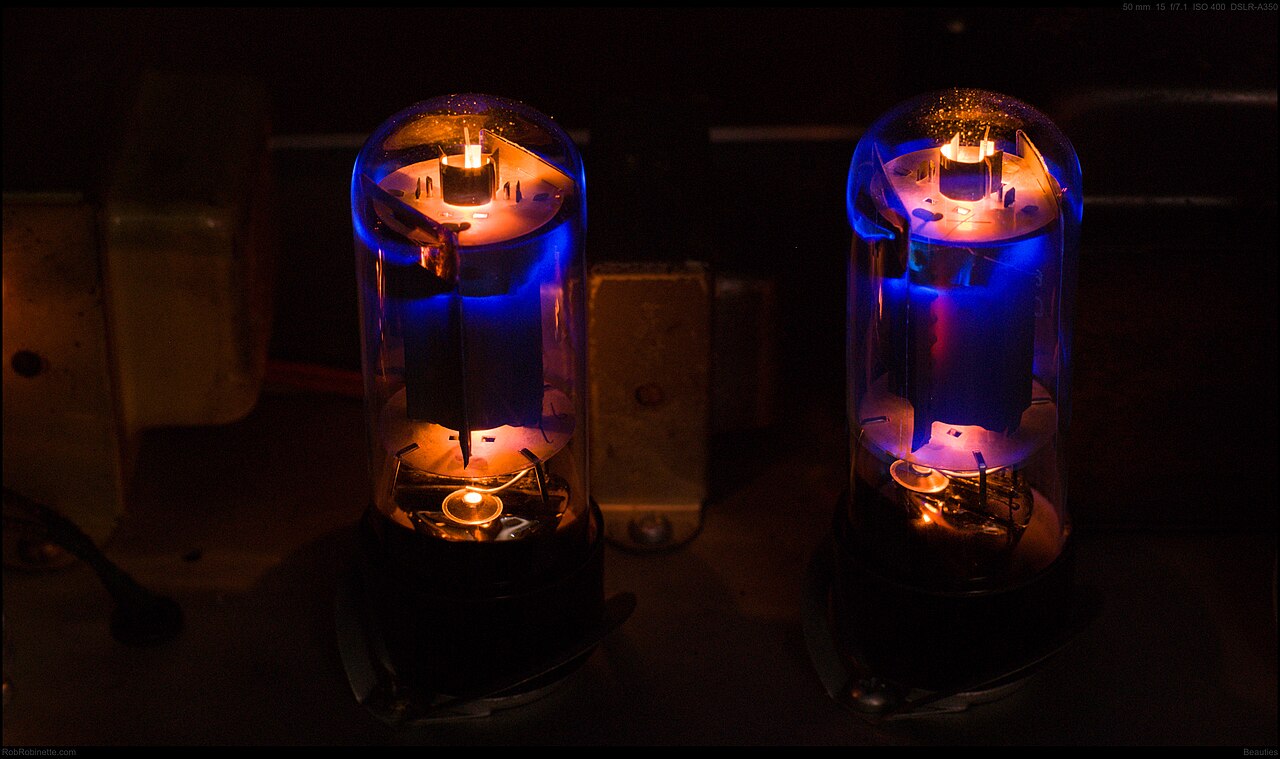
- Two glowing power tubes in an amp: Rob Robinette, Wikimedia Commons, CC BY-SA 4.0.
- Guthrie Govan: ArtBrom, Wikimedia Commons, CC BY-SA 2.0.
Latest News
Related
On This Day
Monday 9 November
From this week: