250 Helix Effects, One Footswitch, Zero Excuses: The Line 6 HX One Is the Swiss Army Knife Your Pedalboard Has Been Waiting For
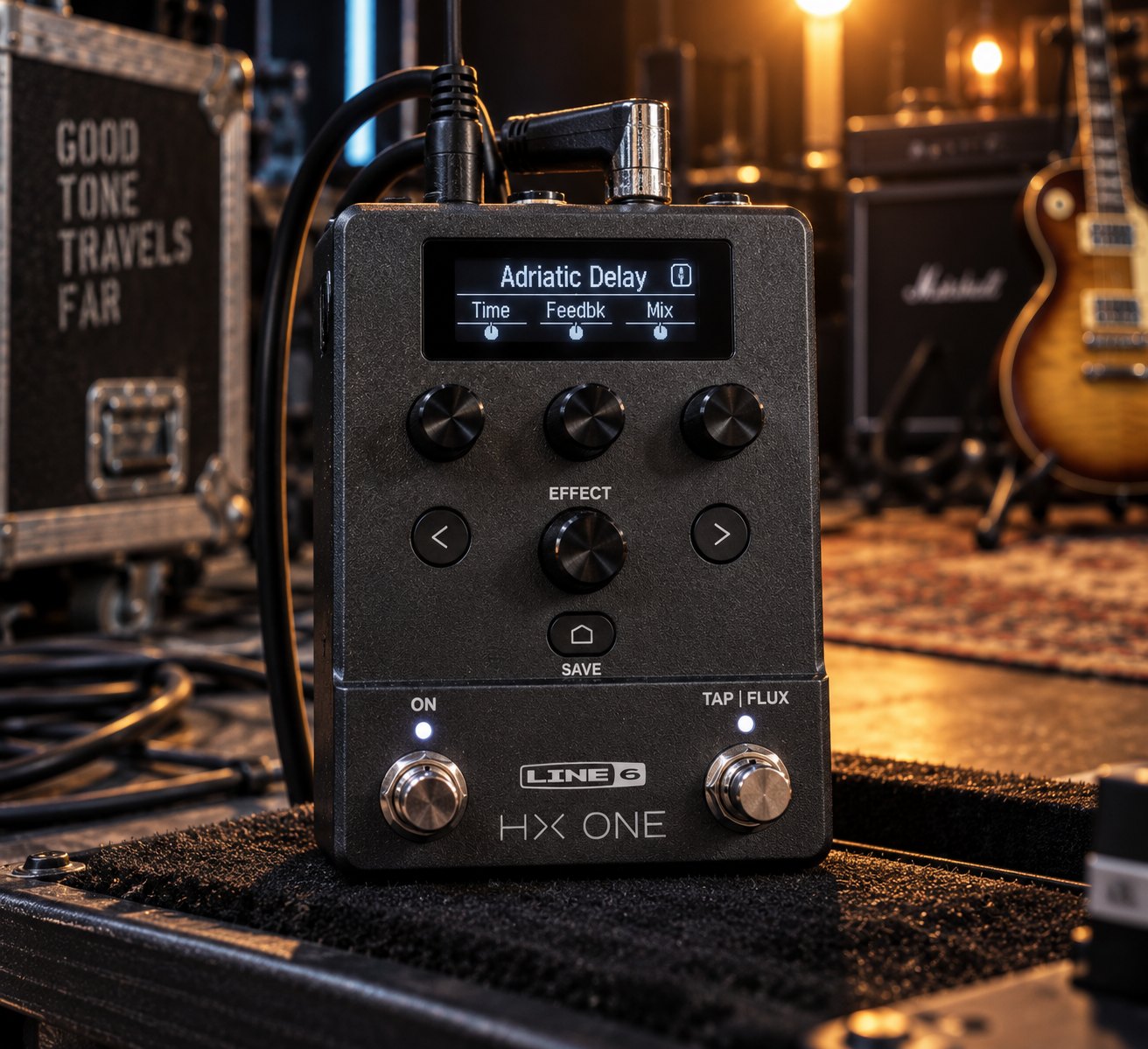
Line 6 HX One. AI-generated reference illustration, not a photograph.
Line 6 HX One review: 250+ Helix effects in a compact stompbox at $299. Specs, tone recipes, honest famous players, and buying guide for the M5 successor.
There is a specific kind of guilt that lives on guitar pedalboards. Not the guilt of spending too much — that passes — but the guilt of the single-purpose pedal you bought for one song, one texture, one fleeting idea that never quite made it into the set list. The ring modulator you still haven’t used live. The octave fuzz that came out once at rehearsal and has been on the bottom row ever since. The flanger you are too afraid to sell in case the right song eventually arrives.
Line 6 has been aware of this particular guilt for a long time. Back in 2011, they released the M5 Stompbox Modeler — a compact, one-effect-at-a-time unit that let a player dial in any of 100+ effects from a single box. Nashville session players quietly adopted it in enormous numbers. The M5 became a staple of working guitarists’ boards not because it was flashy, but because it was honest: one great effect, zero menu-diving, done. It became such a fixture that when Line 6 eventually discontinued the M5, the requests from artists, guitar techs, and tour managers were immediate and loud: give us a new one, but make it Helix-quality.
That request produced the Line 6 HX One, announced in 2023 and reviewed widely by May 2024. It is not the M5’s direct replacement so much as its philosophical successor — same one-at-a-time discipline, same compact footprint — but now running the full HX algorithm library from the Helix Floor, HX Stomp, and HX Effects. The result is one of the more interesting pedals of the mid-2020s: a box that can be a vintage tape echo, a polyphonic pitch shifter, a Klon-class overdrive, or a lush shimmer reverb, depending on the song, the show, and the moment.
From M5 to HX One: The Long Road to Helix in a Stompbox
Understanding why the HX One exists requires a quick recap of Line 6’s modular evolution. The company — founded in 1996 in Calabasas, California by Susan Wolf, Marcus Ryle, and Michel Doidic, later acquired by Yamaha Guitar Group around 2013-2014 — built its reputation on the premise that digital modeling could faithfully recreate not just amplifiers but the entire signal chain. The POD (1999), the DL4 Delay Modeler, the DM4, FM4, and MM4 stompboxes: these were the building blocks of the ecosystem.
The Stompbox Modeler family arrived in 2008-2011: M13 (2008), M9 (2009), M5 (2011). Each was designed around the same effects library, just in different configurations. The M13 gave you four simultaneous effects across 15 footswitches. The M9 gave you three simultaneous effects in a smaller chassis. The M5 gave you exactly one effect at a time — and that constraint turned out to be a feature, not a limitation. The M5 was lighter, cheaper, and infinitely understandable. You knew where you were in the signal chain. You knew what the pedal was doing. It vanished from awareness and became, simply, the effect you were using.
The Helix platform, launched in 2015, rewrote Line 6’s algorithm library. The HX modeling engine — used in the Helix Floor, Helix LT, HX Stomp, and HX Effects — delivered audibly improved realism for amp models, distortions, reverbs, and time-based effects. The M5’s 100-effect library stayed in service, but it was running on legacy DSP. Session players kept asking: M5 format, Helix quality, please.
Line 6’s Chief Product Design Architect Eric Klein — who had worked on the original M5 — framed the brief simply: “We wanted whatever might replace M5 to not just bring it into the world of Helix, but keep that magic.” The magic he meant was ease of use, physical compactness, and the psychological simplicity of one effect, one knob-grab, one footswitch. Product Owner Anthony Taglianetti added a key new requirement: per-preset pre/post routing, so the pedal could intelligently place itself before or after an amp depending on whether you were using a drive or a reverb.
The result: the HX One. Same size as a mid-range stompbox (96 x 125 x 62 mm, roughly 1.5 Boss compact pedals wide). Full Helix algorithm quality. Over 250 effects and counting, growing with every firmware update. And Flux — a feature that does not exist on any other Helix hardware.
Specifications

One Effect at a Time: Why This Is the Right Choice
The obvious question is why Line 6 didn’t simply give the HX One two or three simultaneous effects, the way the M9 did. The answer, from Eric Klein’s own account, is philosophical and market-driven in equal measure. The M5’s discipline — one effect, total clarity about where you are in the chain — was the specific reason session players and touring techs loved it. The moment you allow two effects to run simultaneously, you create a signal chain question: what order are they in? That question demands menus, programming, decision trees. The M5 and HX One short-circuit all of that.
In practice, the constraint is far less limiting than it sounds. Most players have dedicated drive pedals, dedicated compressors, and a tuner already on their board. What they lack is a single box that can become a phase shifter for one song, a lush plate reverb for the bridge of another, a polyphonic pitch shifter for a half-step-up moment, and an octave fuzz for something else entirely. That is exactly the niche the HX One fills: the “special effect” slot that previously required four separate boxes and four separate power taps.
Guitar World’s Chris Gill put it clearly: “The Line 6 HX One is perfect for guitarists who primarily use pedal-based rigs and want to incorporate Line 6’s outstanding HX effect models but don’t want to bother with complicated programming or multi-effects patches.” MusicRadar’s Rob Laing called it “a chameleon for your pedalboard” and positioned it directly alongside Eventide’s H9 as the two best single-box all-rounders available. Both reviewers published their findings in May 2024, and both awarded the pedal strong marks.
The Flux Feature: An Expression Pedal Without the Pedal
The most genuinely new element in the HX One — not present in any other current Helix hardware — is Flux. Activated by holding down the Tap footswitch until the LED turns white, Flux turns that second footswitch into a parameter automation controller. You store two different parameter states for the current effect, then tap to ramp between them. The transition speed is configurable, and it can be tempo-synced: set it to ramp over four bars and you have an automated swell that breathes with the arrangement rather than cutting in on a knife edge.
Anthony Taglianetti described it: “I can tempo sync a Flux movement so that HX One gradually adjusts the Wet mix of a reverb over a span of four bars.” Eric Klein adds: “It’s especially cool with tape delays where you have full control over self-oscillation squeals or atmospheric space noises.” In performance terms, this is an expression pedal’s dynamic quality delivered without floor-space, without TRS cables, and without the inconsistency of foot-pressure control. Flux compensates for the HX One’s one-effect-at-a-time constraint by giving the single active effect a degree of live expressiveness that a static parameter setting cannot approach.
The Algorithm Quality: What “Helix” Actually Means Here
The phrase “HX modeling” refers to a specific generation of Line 6 DSP architecture introduced with the Helix platform in 2015. It represents a generation jump from the M-series algorithms: the distortions and overdrives feel more responsive to pick attack and playing dynamics; the reverbs have more convincing tail decay; the pitch-shifting algorithms run polyphonically rather than monophonically, which matters enormously when playing chords.
On polyphonic pitch shifting specifically, Eric Klein made a blunt claim: “There’s sort of a consensus that as far as hardware goes, our polyphonic pitch shifting is better than anything else out there.” That is a bold statement and one that the industry broadly has not contradicted — the Helix polyphonic algorithms, particularly PolyPitch and PolySustain, are widely cited in rig rundowns and forum discussions as the standard by which other hardware pitch shifters are measured.
The effects library also includes standout models that function as Line 6 originals rather than vintage recreations: Particle Reverb (granular), Glitch Delay, Retro Reel tape emulation, Shuffling Looper, and the Ganymede algorithmic reverb — effects that are distinctive enough to be compelling on their own, not just approximations of classic hardware. These are the effects that have made Line 6’s tone architects, per Klein’s own account, think “wow, that’s cool enough to be its own pedal.”
The sound quality difference between the M-series and HX modeling is audible and consistent across effect categories. The HX One is not a budget alternative to the Helix range; it runs the same core DSP. The trade-off is simultaneous block count, not quality.
Famous Players: Honest About What We Can and Cannot Confirm
The artist roster for the HX One lists Bill Kelliher, Vernon Reid, Nita Strauss, John Browne, and Steve Stevens. These are heavyweight names, and all five have documented relationships with the Line 6 brand — but establishing that any of them uses the HX One specifically, rather than other Helix-family hardware, is a different matter entirely.
Bill Kelliher (Mastodon) has evolved from Fractal Audio rigs to Helix-based setups in recent years. His Helix Floor use is documented, and the HX One is well within his workflow aesthetic. But no rig rundown, pedalboard photograph, or interview quote places him specifically on an HX One as of this writing. Connection: plausible but unconfirmed.
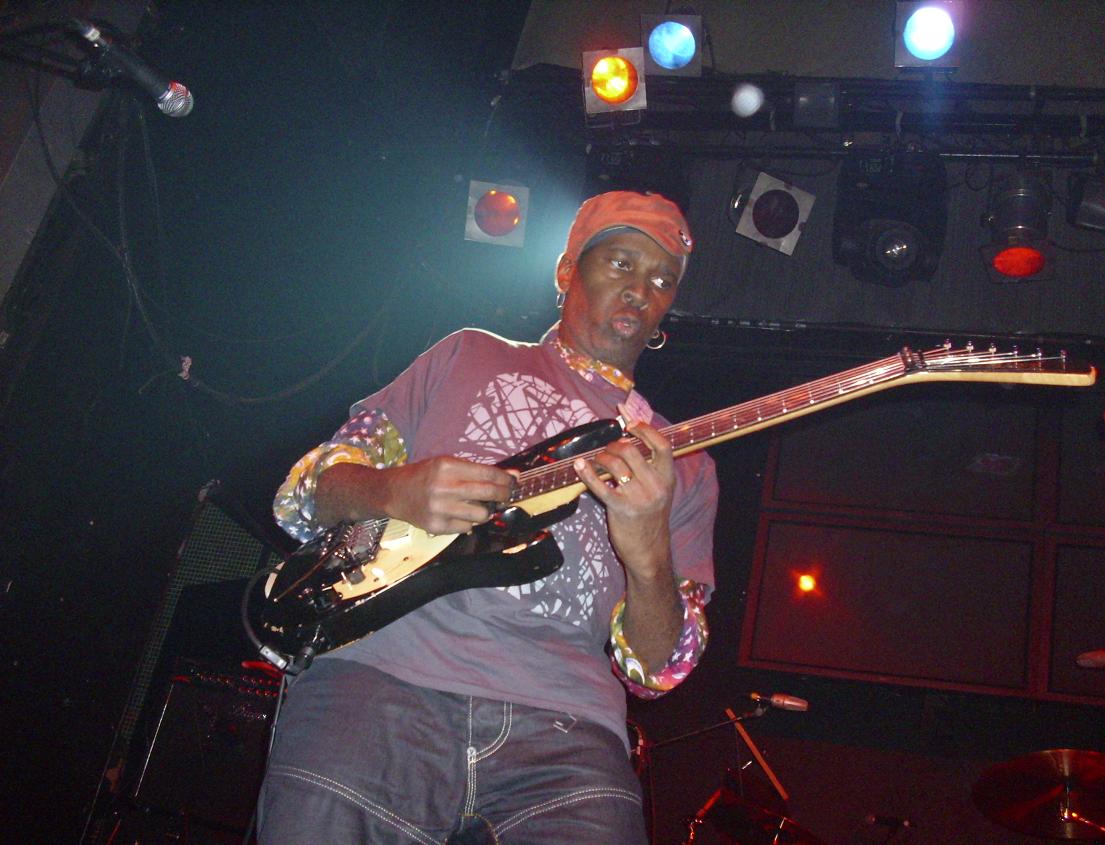
Vernon Reid (Living Colour) is one of the most technically adventurous guitarists in rock — a player who, in a 2013 Premier Guitar Rig Rundown by Rebecca Dirks, was documented running a Line 6 M9 modded by JVH3 Audio for cleaner bypass alongside a Roland VG-99, Zoom G3, and Eventide H9. The M9-to-HX-One logical progression makes obvious sense for a player with his appetite for signal processing. But no primary source documents that transition. Connection: historically grounded, currently unconfirmed.
Nita Strauss, whose touring rig has centred on Boss GT-1000 and Kemper Profiler in documented recent configurations, has not been placed on an HX One by any primary source found in research. Connection: not confirmed.
John Browne (Monuments) runs a Helix-centred rig and would be a natural HX One candidate for supplementary effects duty, but no specific documentation was found. Connection: not confirmed. Steve Stevens has used Line 6 rack hardware — Mod Pro, Echo Pro — for years, but those are Helix-era rack units, not the HX One stompbox. Connection: brand association, not SKU-specific.
The honest position is that the HX One is too recently released (2023) and too niche within the Line 6 catalogue for the “famous players” field to have accumulated the same verified-primary-source depth as older, more iconic units. What the research does surface is a different set of confirmed users: session guitarists and working touring players who adopted it immediately because they understood exactly what problem it solved.
Yvette Young (Covet) appeared in Line 6’s official HX One launch video, demonstrating the Shuffling Looper in a multitrack performance that left the pedal’s designers — by their own account — stunned. Young used the HX One to create layered, glitchy loop architecture in real time, showing a side of the pedal that most players had not imagined. Her video is the closest thing the HX One has to a signature moment.
Tim Pierce — the session guitarist whose endorsement of the M5 was cited repeatedly across years of interviews and whose video “The NEW Pedal EVERYONE Is Talking About” was embedded in MusicRadar’s HX One review — continued the transition from M5 to HX One as the studio goto for a player who has zero patience for unnecessary complexity. Pierce’s M5 endorsement on the record: “I see these M5s on a lot of Nashville studio guitarist pedalboards. It’s really a really good workhorse.” The HX One inherited that rep.
Jamie Hince (The Kills) was photographed with an HX One on his pedalboard at The Kills’ Route du Rock 2024 show — direct photographic evidence in a live touring context.
Tone Recipes and Settings
Recipe 1: Nashville Session Clean Delay (Tim Pierce Territory)
Effect category: Delay. Effect: Tape Echo (EP-1 Echoplex emulation). Set Time to dotted-eighth note synced to tempo, Mix at 20-25%, Feedback at 30%. Bypass set to Buffered DSP Bypass for the cleanest low-impedance output into your amp’s clean channel. Flux: store low-feedback setting at rest, high-feedback (50%) at tap, so a single tap while sustaining a note sends the delay cascading without requiring an expression pedal. This is the invisible delay — present in the room but never obvious in the mix.
Recipe 2: Prog-Metal Shimmer (Bill Kelliher-Adjacent Atmosphere)
Effect category: Reverb. Effect: Glimmer (shimmer reverb). Decay at 3.5 seconds, Mix at 35-45%, Pitch at +1 octave, Predelay at 20ms. Run the HX One in four-cable method with Post routing (reverb after the amp’s preamp). Flux: store dry-ish (Mix 15%) at rest, wet (Mix 55%) at tap. Use during clean intros before the band enters — hit Flux a bar before the downbeat and let the shimmer bloom into the room. This is the effect that makes a riff feel like it’s already in a cathedral.
Recipe 3: Vernon Reid Parallel Mod Madness
Effect category: Modulation. Effect: Barberpole Phaser (infinite phaser sweep illusion). Rate at 0.4 Hz, Mix at 60%, Feedback at 40%. True Bypass mode. Use a high-gain drive pedal earlier in the chain (not inside the HX One) to keep the drive tone separate. The Barberpole’s characteristic unresolved, always-rising sweep adds the kind of psychedelic instability that characterised Reid’s parallel-chain approach on the M9. Engage it on sustained notes; disengage for rhythm work. The phase never resolves — which is exactly the point.
Recipe 4: Single-Coil Tele Bite (Four-Cable Pre Position)
Effect category: Gain. Effect: Kinky Boost (Xotic EP Booster model). Level at +6 dB, Tone at 10 o’clock (slight treble cut). HX One in Pre routing position, pushing the amp’s input harder. Adjust impedance to match a low-output single-coil (around 1MΩ). This is not a drive — it is a presence boost and impedance buffer in one. The Kinky Boost brings out the attack transient on a clean Fender without adding harmonic distortion. For Telecaster players who want their amp to feel like it’s being played harder without actually changing the amp setting.
Recipe 5: Yvette Young Glitch Loop (Shuffling Looper Texture)
Effect category: Looper. Effect: Shuffling Looper. Record a short phrase (4-8 bars), then engage the Shuffle function to have the looper rearrange loop segments in real time. Adjust the Slice parameter to control segment length. With Flux, you can ramp the Shuffle rate from slow rearrangement (Flux at rest: Slice at 2 beats) to rapid glitch chop (Flux engaged: Slice at 1/16 note). This is not a background loop — it is a live texture generator. Run it through a reverb pedal downstream for maximum depth. Use sparingly: once per set is enough, and it will be remembered.
Comparisons
The Line 6 M9 runs three simultaneous effects, has a 28-second stereo looper, and costs $150-220 used. The HX One runs one effect, has a 60-second mono looper, and costs $299 new. The M9’s three-at-once architecture is genuinely useful for complex live rigs — a compressor, a modulation, and a delay in a single box. But it runs the older M-series algorithms, and the quality gap in pitch-shifting and reverb is audible. For new purchases, HX One is the correct choice. For players on tight budgets who just need solid multi-effects at low cost, the used M9 market remains excellent.
The Eventide H9 is the closest philosophical equivalent to the HX One: one effect at a time, algorithmic quality that rivals dedicated hardware, app-managed library, $400-500 street. The H9’s harmonic pitch-shifting algorithms — Harmonizer, PitchFuzz, Crystals — are legitimately competitive with HX One’s polyphonic pitch models and represent different flavors rather than clear quality hierarchy. H9 also runs parallel wet/dry paths which the HX One does not. For reverb and delay, the HX One’s library is larger and arguably more varied; for pure harmonizer applications, the H9 retains its specialist edge.
The Line 6 HX Stomp runs up to six simultaneous effects blocks plus amp and cab models at $699. For players who want to build full patches — amp, drive, modulation, delay, reverb in one small box — the Stomp is the right product. The HX One at $299 is emphatically not a budget Stomp; it is a different product for a different workflow. Players with amp-based rigs who want to add HX effects without building patches belong on the HX One. Players who want to run amp-modelled rigs or need multiple effects simultaneously belong on the Stomp.
The Neural DSP Quad Cortex at $1,699 is in an entirely different market tier — a full floor modeller with amp captures, IR loading, and a touchscreen interface. Comparing it directly to the HX One conflates two very different use cases. The Quad Cortex replaces an amp; the HX One supplements one. A player who uses a real amp and wants to add texturally adventurous effects should not be spending $1,700 on a modeller; they should spend $299 on the HX One and leave the rest of the money in their pocket.
The Boss GT-1000 Core (around $499) runs 32 simultaneous effects and amp models in a compact chassis. It is more similar to the HX Stomp in philosophy — patch-based, deep, capable. It trades the HX One’s simplicity for comprehensive patch-building; that trade suits players who are willing to program. The GT-1000 Core’s effects are excellent but the DSP architecture is not the same HX quality, particularly in pitch-shifting. Side by side on polyphonic pitch, the HX One wins clearly.

The TC Electronic Plethora X5 at roughly $299 runs five TonePrint effects simultaneously and is positioned explicitly as a pedalboard-builder’s tool. It competes more directly with the HX Effects than the HX One, but players choosing between the two at the same price point should know: the HX One’s individual effect quality per algorithm is higher, but the Plethora X5 gives you five at once. For complex multi-effect applications, Plethora wins on utility. For individual effect quality and breadth of library, HX One wins clearly.
Buying Guide
The HX One is a current product available new at $299 from all major retailers including Sweetwater, Guitar Center, B&H, Andertons, and Thomann. It includes the 9.6V 500mA power supply — do not skip this: 9V/100mA from a standard daisy chain will not power it correctly, and some daisy-chain voltage irregularities will introduce noise. The HX One needs a clean 500mA output from an isolated power supply such as Strymon Zuma, Cioks DC7, or Voodoo Lab Pedal Power.
Used units began appearing in 2024 at $200-250 in excellent condition. Because the HX One runs firmware and does not have mechanical components beyond the footswitches, buying used is low-risk. Check: firmware version (update to current via Line 6 Central before committing to any preset work), footswitch responsiveness, OLED screen clarity, and that the mini USB and expression jacks are undamaged. The Line 6 HX One Librarian app allows you to back up and restore all presets, which means a used unit arriving with someone else’s presets is a non-issue.
The expression pedal bundle (HX One + Line 6 EX-1) adds roughly $70 at retail and makes Flux even more useful. If you plan to run the four-cable method, budget for quality patch cables (at least four) of the right lengths; the HX One’s I/O is compact and crowded at the back, so straight-end cables are not ideal — right-angle patch cables keep the back panel tidy.
Ownership Notes
The HX One mounts at any position on a pedalboard. Because it has stereo I/O, placing it after a mono signal chain and letting it output stereo is legitimate — the HX One will expand the signal to stereo at that point for reverbs and modulations, which works well into a stereo power amp or two-amp setup. Note that four-cable method forces mono; if stereo output matters to you, the FCM routing is not the right option.
Firmware updates are essential. Line 6’s pattern with the Helix family has been consistent: new effects are added with firmware updates at no cost, typically 10-20 new models per year. The MusicRadar review counted 273 effects at time of publication in May 2024; the launch number was approximately 250. Running current firmware is how you keep the library growing. Update via USB connection to the Line 6 Central desktop app (Windows / macOS).
Power supply tip: 500mA is the rated draw. Use a 500mA or higher isolated output. A 300mA output will underdrive it, causing artifacts particularly in the DSP-Bypass mode and in complex reverb tails. An isolated output is strongly preferred over a daisy chain — the HX One’s DSP is sensitive to power noise in a way that a simpler analog pedal is not.
The adjustable input impedance deserves attention. Set it to match your pickups: low-output vintage single-coils benefit from 1MΩ; active pickups or high-output humbuckers can run at lower impedance settings. This is not a cosmetic feature — it affects the tonal response of every effect that follows, particularly dynamic effects like compressors and overdrives. Line 6 Central allows you to set impedance per preset, which is sophisticated functionality that most players leave at the default.
For gigging, set presets in logical set-order to enable sequential scrolling. The HX One can be configured to scroll up and down through all 128 presets using the two footswitches — in this mode parameter editing is bypassed — which is clean for live use where you just need the next sound. Alternate this with effect-browse mode for rehearsals when you want to audition new effects on the fly.
FAQ
Can the HX One run two effects at the same time?
No. One effect at a time is the fundamental design constraint and the point of the product. The Flux feature adds expression-style parameter automation within that single effect, which gives it more dynamic range than a static preset, but it does not create a second effect block. If you need two simultaneous effects, the HX Stomp or HX Effects are the correct Line 6 products.
Does the HX One include amp and cab models?
No. Effects only. If you want HX amp modeling, the HX Stomp (starting at $699) is the entry point. The HX One is intended for players with existing amp-based rigs who want to add HX-quality effects without building amp patches.
What is Flux and why does it matter?
Flux is a built-in expression controller unique to the HX One — not present on any other Helix hardware. It stores two sets of parameter values for the active effect, then ramps between them when the Tap/Flux footswitch is pressed. The transition speed is configurable and can be tempo-synced. It effectively gives you an expression pedal’s dynamic control over a single effect without requiring a physical expression pedal or any external cable.
What power supply does the HX One need?
9.6V DC, 500mA minimum, center-negative, isolated preferred. The included adapter is adequate but takes a wall outlet. For pedalboard use, a clean isolated 500mA output from a quality supply (Strymon, Cioks, Voodoo Lab) is the correct solution. A standard 9V/100mA or daisy-chain output will not work reliably.
How does the HX One compare to the older M5?
Same one-at-a-time architecture, same physical philosophy, significantly upgraded algorithms. The HX modeling engine runs polyphonic pitch shifting, richer reverb tails, and more organically responsive overdrive models than the M-series DSP. The HX One also adds 128 presets (vs. M5’s 24), a longer looper (60 sec mono vs. 24 sec), MIDI Out (M5 had MIDI In only), USB-C, adjustable input impedance, and Flux. It is a meaningful generational improvement, not a repackage.
Can the HX One be used for bass?
Yes. The HX library includes bass-appropriate effects — envelope filters, octave, compression, and several drives designed for low-frequency dynamics. The adjustable input impedance handles the wider frequency range of bass pickups. Run the output directly to a bass amp’s effects return or a full-range PA for the cleanest results.
Is the HX One discontinued?
As of 2026 it is a current product available new at $299. Line 6 has continued adding effects via firmware updates, which is the strongest indicator of ongoing platform commitment. The Helix family has received consistent firmware support since 2015; there is no indication that the HX One is approaching end-of-life.
What is the difference between True Bypass and DSP Bypass on the HX One?
True Bypass routes the signal around the digital circuit entirely when the pedal is off — no coloration, no buffer, but potentially tone-sucking over long cable runs. DSP Bypass keeps the digital circuit active and outputs through the DSP when bypassed, providing a clean buffer that maintains signal integrity at the cost of the circuit always being in the signal path. For most pedalboard contexts DSP Bypass is the practical choice; True Bypass is for purists running short cable runs who want zero digital involvement when the pedal is off.
Image credits
- Nita Strauss: Raph_PH, Wikimedia Commons, CC BY 2.0.
- Steve Stevens: Stefan Brending (2eight), Wikimedia Commons, CC BY-SA 4.0.
- Vernon Reid: Mario, Wikimedia Commons, CC BY 2.0.
- Top image: GuitarGangsters AI-generated reference illustration, not a photograph.
Latest News
Related
On This Day
Monday 9 November
From this week: