Before the Algorithm Came the Amp: The Tech 21 SansAmp Classic Story
The SansAmp Classic launched in 1989 and rewrote the rules for direct guitar recording. Full specs, player history, tone settings, and buying advice.
In 1989, every serious guitarist still hauled a valve amplifier. That was the deal. You wanted the sound, you lifted the weight, you prayed the tubes held through the second set. Andrew Barta — guitarist, electronics engineer, and apparently the right person to be annoyed at the right moment — decided that arrangement was ridiculous. The box he built in a back office in New York City to prove his point became the Tech 21 SansAmp Classic, a 100% analog amp-and-speaker simulator that launched the entire “going direct” movement in electric guitar recording and has never been bettered on its own specific terms in the 35 years since.
That is not hyperbole. The SansAmp Classic was the catalyst. Line 6, Kemper, Neural DSP, Fractal Audio — none of them would exist in the form they do without the conceptual breakthrough the Classic represented in 1989. It is the pedal that proved a guitarist could walk into a studio, plug into a DI box, and come out the other end sounding like a cranked Marshall. The rest of the industry spent three decades chasing that idea with ever more processing power. Barta did it with field-effect transistors and a bank of eight tiny DIP switches.
1989 — The Year a Guitarist Fixed Direct Recording
Andrew Barta’s frustration was specific: too much time in the studio getting the amp sound right, not enough time actually playing. “It was also about the frustration factor of spending the majority of time — and money — in the studio getting the right sound and then having little time left over to actually record,” he has explained. The options before 1989 were not encouraging. You could mic a valve amp and fight with the room, the bleed, and the cost of keeping old tubes alive on the road. Or you could use Tom Scholz’s Rockman, which had been a genuine innovation in 1982 but had a sound that was immediately identifiable as the Rockman — lush, compressed, and unmistakably a box. Barta wanted something genuinely amp-like that fit in a gig bag.
He pitched the concept to the major pedal manufacturers of the day. Every single one passed. “It was all negative!” he recalls. “They couldn’t get past their own tube amp snobbery to see the potential.” Barta, urged on by friend and future company VP Dale Krevens, decided to manufacture it himself under the name Tech 21. “I had no intention of becoming a manufacturer,” he admits. “But it was a blessing in disguise.”
The SansAmp — “without amplifier” in the most literal French translation — launched in 1989 as a FET-based analog circuit that modelled the complete signal chain: preamp stage, phase inverter, push-pull output stage, output transformer, and close-miked speaker cabinet, all in solid-state electronics, all in a box smaller than a paperback novel. No digital conversion. No latency. No firmware. Just analog circuitry that behaved, dynamically, like a real amplifier when you dug in and backed off.
Foreigner guitarist Mick Jones was among the first professional players to try it, and became an early evangelist — spreading the word through the touring circuit at a time when “going direct” was still viewed with suspicion by most live sound engineers. Jones also played an unexpected role in shaping the final product, which brings us to the eight switches.
The Eight Switches That Were Never Meant to Stay
During the development of the original SansAmp, Barta included a bank of DIP switches in the prototype purely as a design tool — a way to audition different voicing options before settling on the final circuit. Once he had home in on the best sound, the plan was to remove them and present a clean, simplified front panel to the market.
Mick Jones talked him out of it. After playing the prototype, Jones argued that the switches were not a quirk but a feature — they made the circuit uniquely flexible in ways that a fixed voicing never could. Barta kept them, and those eight Character switches became the SansAmp Classic’s most distinctive and most misunderstood interface element.
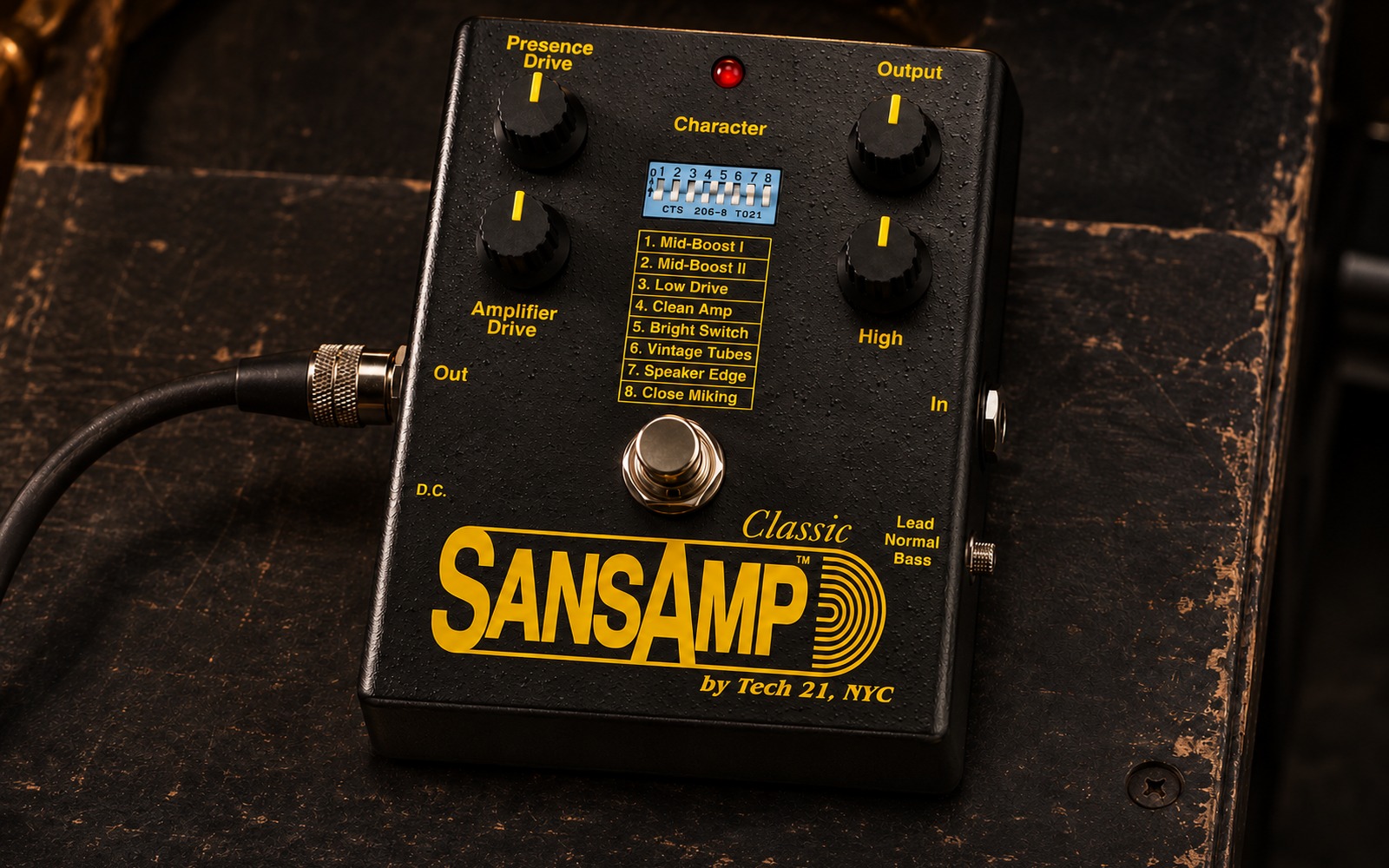
The eight DIP switches, each labelled on the enclosure, are: Mid Boost I, Mid Boost II, Low Drive, Clean Amp, Bright Switch, Vintage Tubes, Speaker Edge, and Close Miking. In practice they work as a fine-voicing system operating underneath the main knob controls — adjusting the harmonic content, the feel of the speaker simulation, the saturation character of the preamp stage, and the microphone placement model. Used in combination with the main controls, they produce what Tech 21’s own documentation honestly describes as “countless (we know, we’ve tried) combinations and permutations.” Sound On Sound’s Dave Lockwood, reviewing the 2012 reissue, summed up the practical reality: “Like a good instrument, the SansAmp Classic will repay time spent getting to know how all its parameters interact.”
Discontinued, Reissued, Hiatus, Reissued Again
The SansAmp Classic had a production life that mirrors its cult status. The original 1989–era units ran until Tech 21 eventually discontinued them — the original hybrid ceramic-substrate circuit used metal evaporation and laser-cut resistors, a manufacturing process that became increasingly difficult to sustain. In 2009, to mark the 20th anniversary, Tech 21 produced a limited run of 500 numbered reissue units, which sold out immediately. The surge of interest convinced Tech 21 to bring the Classic back into full production in 2012 with identical circuitry to the original but using more readily available modern materials where needed — Sound On Sound confirmed it “seems to perform in exactly the same way, so the feel and the sound are every bit as good.”
In 2016 the Classic was again put on a manufacturing hiatus. In 2021, in response to another surge of demand — partly driven by the pandemic home-recording boom, partly driven by a generation rediscovering analog hardware as digital fatigue set in — Tech 21 reissued it a second time. The 2021 version remains in production today. It is still made in the USA. The circuit is unchanged. The owner’s manual is the same document. The plastic battery holder is the same one that drew the only criticism in the SOS 2012 review: “an authentic 1989 design.” Some things should stay exactly as they are.
Specifications
| Feature | Specification |
|---|---|
| Circuit type | 100% analog, FET-based (CMOS), zero latency |
| Tube amp emulation | Complete signal chain: preamp → power amp → speaker sim |
| Input switch (3-position) | Lead (Marshall-type), Normal (Mesa Boogie-type), Bass (Fender-type) |
| Knob controls | Presence Drive (preamp saturation + tonality), Amplifier Drive (power amp), Output (level), High (brightness / output EQ) |
| Character switches (8 DIP) | Mid Boost I, Mid Boost II, Low Drive, Clean Amp, Bright Switch, Vintage Tubes, Speaker Edge, Close Miking |
| Speaker simulation | Built-in, designed to replicate multiply-miked cabinet response — smooth, even, without single-mic peaks and notches |
| IR compatibility | External IR can be inserted after the SansAmp for additional flavor |
| Output character | Flat output optimized for external EQ flexibility |
| Footswitch | Yes (bypass) |
| Power | 9V alkaline battery or Tech 21 DC9 adapter (not included) |
| Dimensions | 3.75″ × 4.75″ × 2″ |
| Country of manufacture | USA |
| Current street price | ~$329–$375 new |
| Equipboard users | 41 documented professionals |
Note on the input switch labelling: the three positions correspond to EQ and gain voicings rather than specific amp brands. “Lead” cuts low end and emphasises mids and highs — the Marshall reference. “Normal” is a mid-weighted voicing with the Mesa Boogie-style presence of the upper midrange. “Bass” introduces the mid-range dip of Fender clean amplifiers, which also makes it the right starting point for bass guitar and rhythm work in the classic clean-to-lightly-driven range. The SansAmp’s own documentation lists the following example sounds: Vintage and Hot-Wired Marshall (AC/DC and Van Halen-style), Mesa Boogie, Hiwatt, Fender Lead (B.B. King), Fender Rhythm and Bass, and Ampeg SVT for bass.
Famous Players
With 41 documented professionals on Equipboard and 35 years of recording history, the SansAmp Classic’s user list reflects its status as a genuine industry standard rather than a niche boutique product. The honest challenge with artist verification is that a DI box does not appear in stage photographs the way a guitar or amplifier does — it lives in the rack, the studio outboard chain, or the XLR run to the front of house. That structural invisibility means primary sources matter more than usual here.
The most significant well-documented connection is Mick Jones of Foreigner, established in multiple Barta interviews including a Guitar.com feature published November 2025, which explicitly names Jones as an early adopter who evangelized the SansAmp’s tone and efficiency through word-of-mouth in the touring world. More specifically, the Guitar.com piece confirms it was Jones’s direct advice that led Barta to retain the DIP switches in the final product. This is not an Equipboard attribution — it is documented in the designer’s own account of the product’s development.
Joe Satriani is documented on Equipboard with his own words about using the SansAmp on Flying in a Blue Dream — his 1989 album, recorded that same year the Classic launched, with producer John Cuniberti. Satriani’s quote describes the logic exactly: moving between studios for a single record was making it nearly impossible to match guitar sounds from session to session. The SansAmp, which could be taken anywhere and produced consistent results direct to tape, was the solution. He also describes using a SansAmp (in combination with software reamp work) on his 2010 album Black Swans and Wormhole Wizards, establishing the Classic as part of his toolkit across two decades. This is own-words documentation, which is the highest tier.
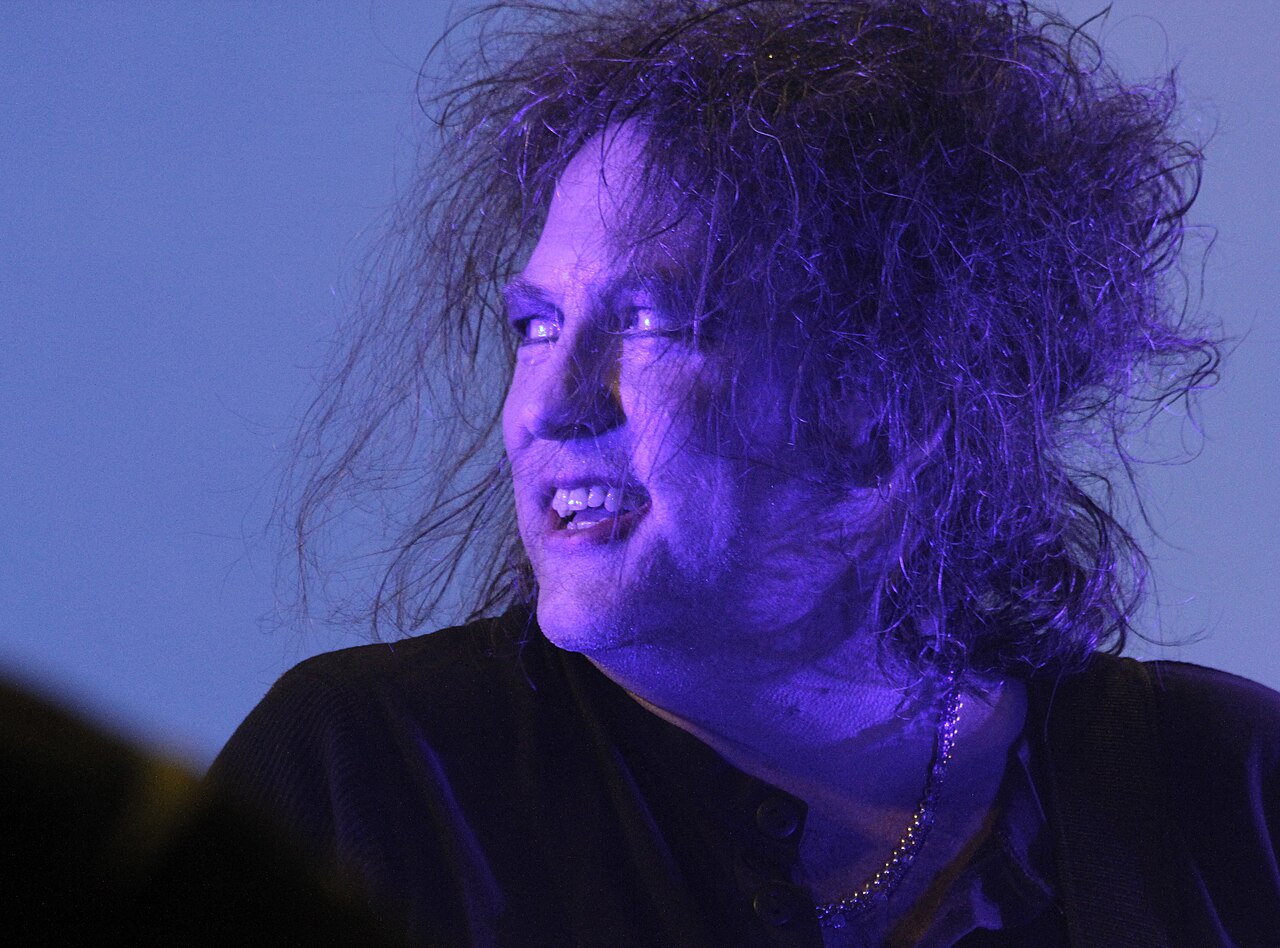
Robert Smith of The Cure is listed in a sidebar of a Guitar World April 2000 article, an archived source retrieved via the Wayback Machine, which places the SansAmp Classic in his effects rig at that time. A sidebar in a published magazine interview is a secondary source — it is not Robert Smith’s own words about the specific unit — but it is published, not speculative.
Kurt Cobain and Thom Yorke of Radiohead are among the 41 artists listed on Equipboard. No primary source — an interview quote, a published gear rundown, or a rig photograph — has been located that places either of them on this specific unit. Cobain’s documented studio chain included the Boss DS-1, Boss DS-2, ProCo Rat, and EHX Small Clone as the core signal path; a SansAmp is plausible for DI scratch or reference tracks but cannot be confirmed. Yorke is similarly listed without primary evidence. Both are noted as Equipboard attributions, framed for what that means: a user-contributed data point without a named primary source behind it.
Pearl Jam bassist Jeff Ament has a user-uploaded photograph on Equipboard showing him with the SansAmp Classic. A photograph in a rig context is secondary evidence — better than an Equipboard text claim but below an interview quote — and it confirms the unit was in his physical possession at a minimum. Bassist Doug Wimbish (Living Colour, Tackhead, later Sugarhill house bassist) appeared in one of Tech 21’s earliest SansAmp advertisements in 1991, which represents a commercial endorsement relationship rather than independent documented use, but places him in the earliest wave of players the company was targeting.
Tone Recipes and Settings
Marshall Crunch (Vintage AC/DC Style)
Input: Lead. Presence Drive: 2 o’clock. Amplifier Drive: 1 o’clock. Output: to taste. High: noon. DIP switches: Bright Switch on, Speaker Edge on, Vintage Tubes on, all others off. This produces the mid-forward, compressed crunch of an older Marshall running hot — the Angus Young zone. The Lead setting’s bass cut keeps the low end tight rather than loose and boomy; the Speaker Edge switch adds the resonant peak that gives a 4×12 its characteristic presence in the upper mids. Dig in and the preamp responds; back off the guitar volume to 7 and the Classic cleans up the same way a real amp does.
Hot-Wired High Gain (Van Halen, JCM800)
Input: Lead. Presence Drive: 3 o’clock. Amplifier Drive: 2 o’clock. Output: 9 o’clock (high gain means high output, trim here). High: 1 o’clock. DIP switches: Mid Boost I on, Bright Switch on, Speaker Edge on, Close Miking on. The Close Miking switch tightens the speaker simulation, reducing the room air and giving that on-axis SM57 quality that defines the ’80s high-gain studio sound. The Mid Boost I adds the upper-mid nasal quality that makes high gain cut through a dense mix. Volume sensitivity is reduced at this gain level — it will not clean up as dramatically as a lower Presence Drive setting, but note dynamics still register.
Fender Clean / B.B. King Lead
Input: Bass (the Fender voicing despite the label). Presence Drive: 10 o’clock. Amplifier Drive: 9 o’clock. Output: noon. High: 2 o’clock. DIP switches: Clean Amp on, Vintage Tubes on. The Bass input position dips the mids and opens the highs and lows in the way a Fender Twin or Deluxe sits in a room — spacious, clear, with the fundamental of the note leading rather than the harmonics. Vintage Tubes softens the compression character and adds warmth in the low mids. This is the starting point for B.B. King-style blues work: single-note lead with the guitar’s tone rolled back to 7, nothing fierce about the attack.
Mesa Boogie — Studio Rhythm
Input: Normal. Presence Drive: 2 o’clock. Amplifier Drive: noon. Output: to taste. High: noon. DIP switches: Mid Boost II on, Low Drive on, Vintage Tubes on. The Normal position provides the upper-mid emphasis that is the core of the Boogie sound — that nasal, focused midrange that makes a Mesa cut through a live mix without needing to turn it up. Low Drive adjusts the compression behaviour of the virtual power stage, delivering a tighter, punchier response rather than a loose vintage-style breakup. Good for tight, palm-muted rhythm playing where articulation matters as much as sustain.
Direct Bass (Ampeg SVT Approximation)
Input: Bass. Presence Drive: 10 o’clock. Amplifier Drive: 11 o’clock. Output: to taste. High: 9 o’clock (keep the highs down; this is about fundamental and warmth). DIP switches: Low Drive on, Vintage Tubes on, Mid Boost I on. The SansAmp has always been a serious bass DI, used on pro recordings for the same reason it is used on guitar — it delivers harmonic warmth that pure DI into a mic pre cannot. This setting approximates the tubey warmth of a classic SVT at moderate stage volume. For more aggression and grind, increase Presence Drive gradually; the Classic responds to bass guitar pickups without the loading problems that affect some guitar-focused pedals.
The SansAmp Classic has no preset memory. Every setting is built from scratch by working the main knobs and the eight DIP switches. The user guide that ships with the unit provides starting-point settings, and the following recipes are adapted from those combined with the documented style presets from Tech 21’s own material.
How It Compares
The honest comparison question for the SansAmp Classic in 2026 is not whether it is a better amp simulator than a Line 6 Helix, a Neural DSP Quad Cortex, a Kemper Profiler, or a Fractal Audio Axe-FX III Mark II. It is not. By every measurable metric of realism, preset recall, amp model variety, effects integration, and user interface design, the modern digital platforms win. A Helix can recall 1,024 presets across its entire snapshot system. The Quad Cortex uses neural networks trained on real amplifiers. The Kemper profiles actual physical amps. None of those things are what the SansAmp Classic does.
What the Classic does is produce a sound and a dynamic response that remains, after 35 years and all the DSP in the world, uniquely its own. Sound On Sound’s Dave Lockwood, who has used modelling products since Line 6’s original Pod, put it plainly: the Classic’s dynamic response is “far more amp-like than that of any modeller I’ve tried, cleaning up and altering tonality in just the right way on both individual notes played softly and with the guitar’s volume backed off.” That observation from 2012 still holds because it is describing analog physics rather than software fidelity — the FET circuit responds to the impedance and signal level from your pickups the same way a real amp does, because the underlying interaction is the same kind of electrical relationship.
Compared to its own sibling, the Tech 21 SansAmp GT2, the Classic is the more complex and more flexible instrument. The GT2 simplified the interface dramatically — three 3-way switches plus Drive and Level, 27 voicing combinations at most. The Classic’s eight DIP switches make the total number of combinations effectively uncountable. The GT2 is the better gigging tool: fast to set, easy to recall a sound night after night. The Classic is the better studio tool: deeper in voicing options, more willing to produce unexpected sounds when you combine switches you have not tried before, more capable of subtlety at lower gain settings. For players who want one device that does everything in a pedalboard context, the GT2. For players who want to find a sound and live in it, or who spend time in studios and care about the specific texture of high-gain DI sounds, the Classic.
The comparison to a Fender Deluxe Reverb — one of the amplifiers the Classic is sometimes used to replace — illustrates the fundamental tradeoff in direct recording. A real Deluxe Reverb in a good room with a good microphone sounds like a Deluxe Reverb in a way no pedal fully matches. The SansAmp does not try to capture that. It creates its own analog approximation of tube-amp behaviour — one that has appeared on Grammy-winning records, on countless live tours, in studios from New York to Tokyo — and that approximation can be used anywhere, with no microphone, no room, no volume, and no wait. For songwriters, touring musicians, and engineers working in controlled or acoustically compromised spaces, that trade is worth every penny.
Buying Guide
The SansAmp Classic is available new from authorised Tech 21 dealers at approximately $329–$375 depending on region. It is still in current production (2021 reissue, made in USA) and comes with a warranty.
The used market offers original units at $150–$250 depending on era and condition. The original pre-2009 units used a ceramic-substrate hybrid manufacturing process that has since been updated with more modern materials — the circuit is identical, the construction differs slightly. Both sound the same according to the 2012 SOS review, which directly compared an original to the 2012 reissue and found them indistinguishable in use. On the used market, look for:
- All eight DIP switches operate correctly — these are small and can develop oxidation in older units. Work each switch several times and listen for dropouts or change in character.
- Footswitch functions cleanly — the bypass switch sees a lot of use on units that have lived on a pedalboard.
- Battery compartment lid intact — the plastic lid is the Classic’s documented weak point and replacement parts are not always available.
- Era identification: the 2009 20th Anniversary run of 500 units carries numbered badges and commands a collector premium. The 2012 production reissue runs have no such numbering. The 2021 current production units are the most readily available new.
The SansAmp Classic is not true bypass — it is a buffered bypass unit. That means signal passes through the circuit’s buffer even when the footswitch is engaged. For most applications this is neutral or positive (a good buffer at the start of a long cable run is a benefit), but for signal-chain purists who want hard-wire bypass, this is worth knowing before purchase.
Living With the SansAmp Classic
The Classic has a reputation for requiring time to learn. This is accurate. Unlike a digital modeler with preset names and save functions, the Classic requires you to understand what each control and switch does before you can reliably return to a sound. The printed owner’s manual that ships with the unit contains named starting-point settings — these are worth working through systematically when you first get the pedal, because they give your ears reference points for what each switch actually does in combination with the others.
For recording use specifically: the Classic outputs flat by design, meaning it expects downstream EQ to handle tonal shaping for the final mix. The High control is more powerful than it looks at extreme positions — use it conservatively until you understand its range. The Output control at 50–75% into a line input minimises self-noise at high Presence Drive settings. At cleaner settings, some users find the speaker simulation less convincing than at high-gain settings — the SansAmp’s strength is always most apparent when the preamp stage is working hard.
The headphone trick documented in the Equipboard community — inserting the jack halfway into the output to send a mono signal to one headphone cup — is a genuine silent practice method, though not a designed feature. Use it at low Output levels.
For bass guitar: the SansAmp Classic is genuinely excellent for bass, not merely acceptable. The Bass input position was designed with this in mind. Keep the High control conservative, use Low Drive to manage the power amp feel, and the output will sit in a mix with the harmonic warmth that is otherwise only achievable by miking a real amp in a real room. Tech 21 has documented the Classic’s use “on bass and drums to vocals — in fact, anything that might benefit from the addition of a highly controllable dose of tube-like warmth.”
The PSA-1 plugin, co-developed by Tech 21 and Bomb Factory, brings the SansAmp algorithm into the box and was for a period bundled with Pro Tools. It is a useful reference for understanding the hardware’s voicing, though the plugin and the hardware have different dynamic responses — the analog circuit responds to input impedance in ways that analog-to-digital conversion interrupts.
Frequently Asked Questions
What does the SansAmp Classic actually do that a regular distortion pedal does not?
A distortion pedal adds clipping and harmonic distortion to your signal, then sends that signal to an amplifier which adds its own character and then to a speaker. The SansAmp Classic simulates the entire chain — preamp, power amp, and speaker cabinet — in one analog circuit designed for direct output. You do not need an amplifier after it. The built-in speaker simulation is designed to replicate the even response of a multiply-miked cabinet, so what comes out of the XLR or quarter-inch output is a sound ready for a PA system, a recording interface, or a DAW with no further processing required.
Is the SansAmp Classic the same as the SansAmp GT2?
They are different products with different interfaces that share the same underlying SansAmp technology. The GT2 (introduced 1993) replaced the eight-DIP-switch Character section with three simpler 3-way switches (Amp, Mod, Mic) giving 27 fixed voicing combinations. The Classic’s DIP switch system gives a much larger number of tonal options but requires more time to explore. The GT2 is faster to use live; the Classic is more versatile in the studio.
Can the SansAmp Classic be used in a loop with a real amp?
Yes, though with some nuance. Running it in front of a clean-channel amplifier means both the SansAmp’s speaker simulation and the real speaker are shaping the sound — which can produce odd coloration. Many players bypass the speaker simulation for this use case by adjusting the DIP switches (Speaker Edge off, Close Miking off) to reduce the simulation’s contribution and use the Classic purely as a preamp and power amp emulator into the real amp’s input. Alternatively, some connect it in an amp’s effects loop to bypass the amp’s preamp entirely.
Does the SansAmp Classic work for modern high-gain metal?
Yes, within limits. The Classic’s Presence Drive and Amplifier Drive combination can produce very high gain sounds that clean up with excellent sensitivity and sit well in a mix. It is not a dedicated metal platform — it does not have the extreme low-end tightness and scooped-mid character of a Diezel or Peavey 5150 emulation. For modern death metal and djent tones, a digital platform will give you more control over the specific character of the bass end. For ’80s hard rock, classic heavy metal, and blues-rock saturation, the Classic is excellent.
What is the difference between the 2021 reissue and the original 1989 unit?
The circuit is identical — same schematic, same topology, same switch labels, same knob functions. The manufacturing materials have been updated where the original hybrid ceramic-substrate process was no longer practical. Sound On Sound’s review of the 2012 reissue, which was the first update to use modern materials, concluded it was indistinguishable in use from the original. The 2021 reissue uses the same approach. The plastic battery compartment, frequently noted as the only cosmetic weakness, has also remained unchanged across all versions.
Can the SansAmp Classic be used as a DI box for recording bass?
Yes, and it has been used this way on professionally recorded albums since 1989. The Bass position on the input switch was designed specifically for this application. It provides the mid-range dip characteristic of Fender-style bass amplifier voicing, which sits well in a mix without the mid-forward push that can make direct bass recordings sound hollow. The all-analog circuit responds to bass guitar pickups without the loading issues that affect some pedals designed primarily for guitar.
Why is there no preset memory on the SansAmp Classic?
Because the circuit architecture has no digital components at all — there is no microprocessor, no memory, and no analog-to-digital conversion in the signal path. The absence of memory is not an oversight; it is the unavoidable consequence of a design choice that also produces the zero latency and the analog dynamic response that users value. Players who need preset recall for live use typically either mark their settings on the unit with a paint pen, use the GT2 or another SansAmp variant with simplified controls, or run the Classic as a static-voiced preamp that they never change between shows.
Is the SansAmp Classic still relevant in an era of modelers like the Helix and Quad Cortex?
Relevant for a specific purpose: yes. Digital modelers have surpassed it in realism, preset count, effects integration, and ease of use by enormous margins. The SansAmp Classic exists in a different category — it produces its own analog voice that 35 years of recorded music has proven to work, with a dynamic response that analog circuitry handles differently from even the best digital approximations. Players who have tried both and choose the Classic are not making a sentimental choice; they are making an aesthetic one. The sound is genuinely different. Whether that difference matters depends entirely on what you are making.
Image credits
- Top image: GuitarGangsters AI-generated reference illustration, not a photograph.
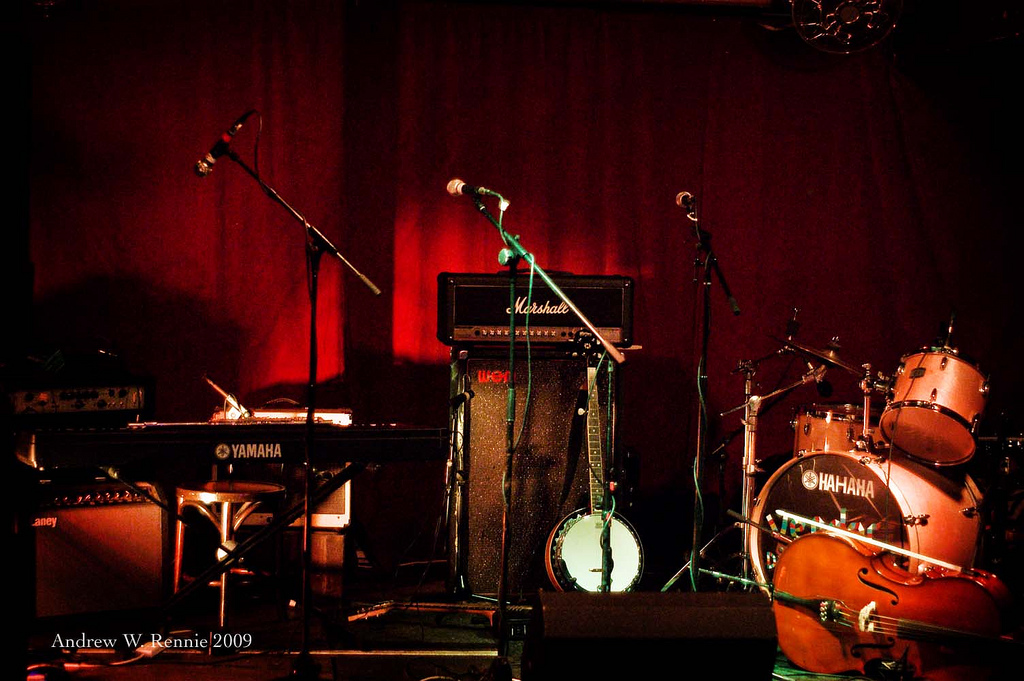
- A small band stage with amps and drums: Andy Rennie from Glasgow, Wikimedia Commons, CC BY-SA 2.0.
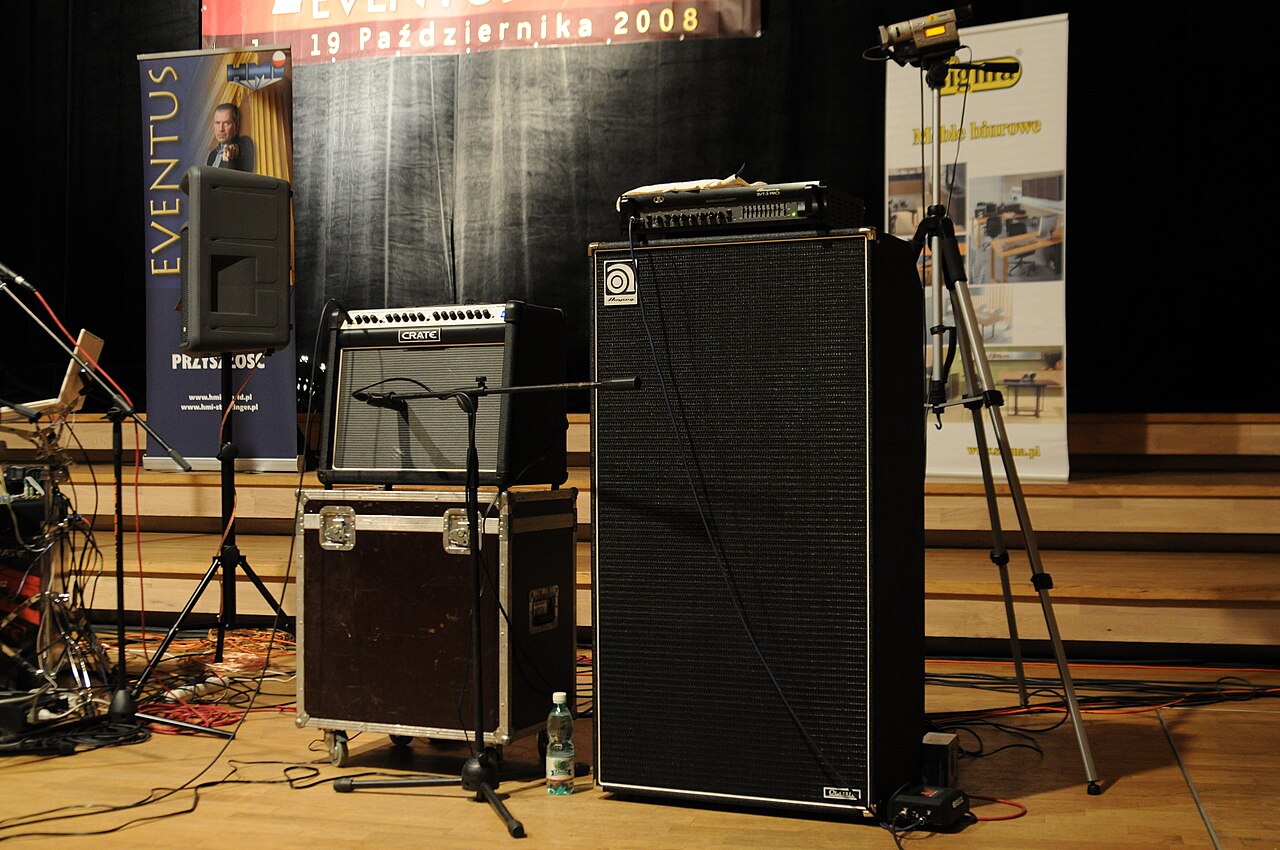
- Amplifiers and a speaker cabinet on a stage: Kuba Bożanowski from Warsaw, Poland, Wikimedia Commons, CC BY 2.0.
- Robert Smith: Christopher Johnson, Wikimedia Commons, CC BY-SA 2.0.
Latest News
Related
On This Day
Monday 9 November
From this week: