Six Amps in a Lunchbox: The Walrus Audio ACS1 Amp + Cab Simulator Is the Backline You Never Have to Carry Again
Six amp models, 12 cab IRs, and true stereo in a pedalboard box. We break down the Walrus Audio ACS1's tones, specs, and who it's really built for.
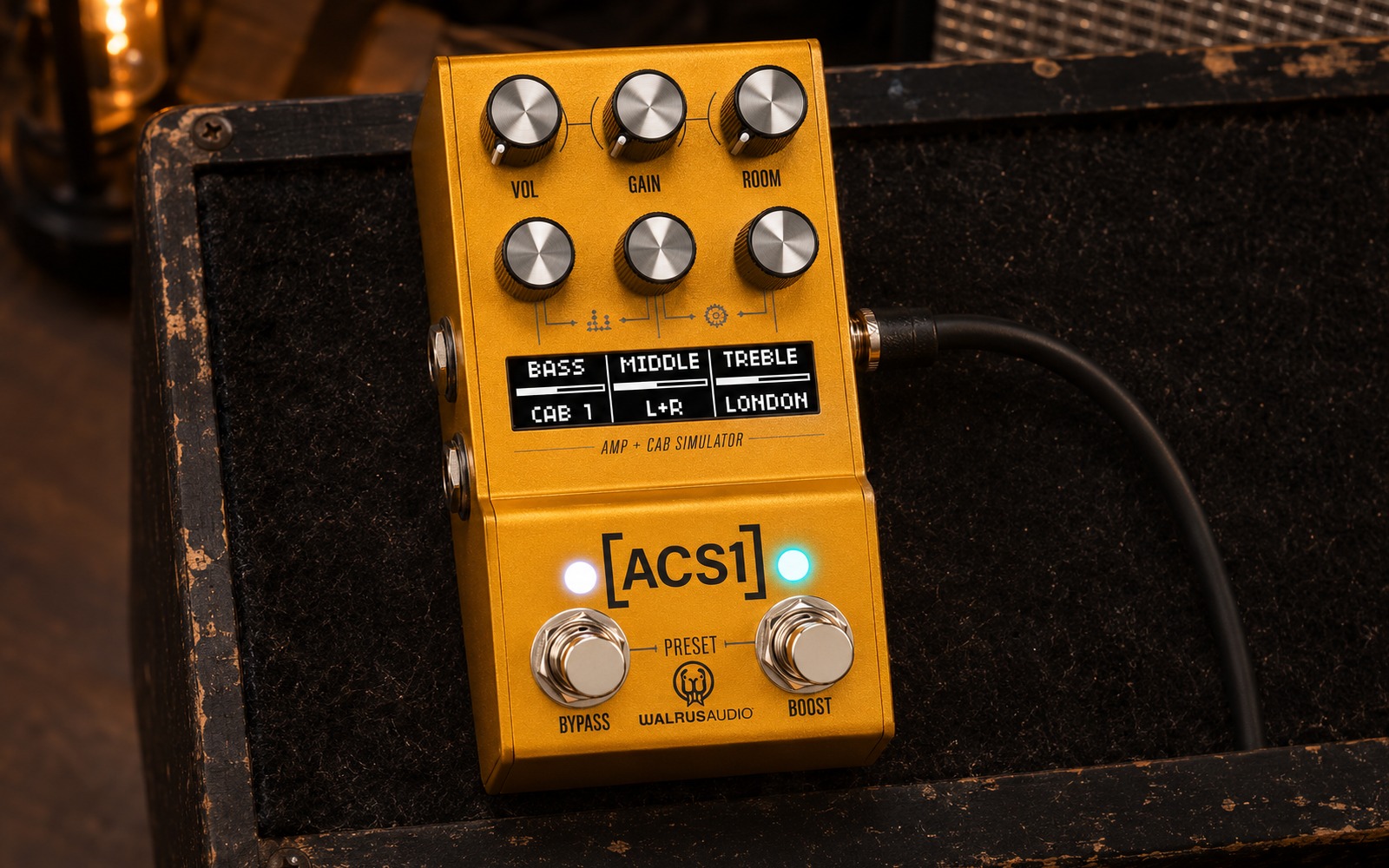
There is a moment every touring guitarist knows — the one where you’re dragging a 65-pound head up a set of stairs while the bassist walks past you carrying a direct box and a smile. The tube amp is magnificent. The tube amp is irreplaceable. The tube amp is also, in certain contexts, a punishment. That tension is exactly what the Walrus Audio ACS1 Amp + Cab Simulator was built to resolve. It fits on your pedalboard, weighs under a pound, costs less than a used Deluxe Reverb, and contains inside it convincing digital captures of a Fender Deluxe Reverb, a 1962 Marshall Bluesbreaker, a 1960s Vox AC30, a Peavey 5150, an Orange Rockerverb, and a Mesa Boogie Dual Rectifier — six of the most storied amplifiers in the history of electric guitar. Whether it fully replaces a real amp is a question worth interrogating. Whether it makes the argument for itself, honestly and loudly, is not.
Oklahoma City’s Quiet Powerhouse: The Story of Walrus Audio
Walrus Audio started in Oklahoma City in 2011, built from late-night breadboarding sessions and the shared conviction that guitar pedals could be both technically excellent and visually beautiful. The company’s founder had previously run another venture called Mammoth — hence the company’s preference for tusked animals — and the “Walrus” name has no mythology attached to it beyond that private joke. What the company did develop, and quickly, was a reputation for pedals that looked like art objects and sounded like they meant it.
Colt Westbrook joined as general manager in 2014, when the headcount was three. He eventually became president, and by 2021 the company was shipping roughly 60,000 units per year to players from OKC’s own backyard to tour buses on five continents. A private equity firm acquired ownership in 2018, but the culture — attentive customer service, limited lifetime warranty, distinctive commissioned artwork on every enclosure — stayed intact.
The artwork, worth mentioning, is a genuine differentiator. Walrus pedals are drawn by hand, in a style described as classically animated, primarily by Oklahoma artist Nathan Price. The result is a product that looks at home in a guitar collection or on a rehearsal room shelf. The ACS1 MKII ships in an anodized gold finish with black and green ink — loud on the pedalboard, quieter than it has any right to be at the mixing desk.
The Mako Series launched in 2020 as Walrus Audio’s premium product tier — studio-grade effects and modeling at a price point below the flagship floor units from Neural DSP and Fractal. The ACS1 was the crown of that line: not an overdrive or a reverb but the amp itself, the entire preamp and speaker chain, crammed into a format that shares a footprint with a standard Boss compact.
The original ACS1 launched at $399/£365/€411. Walrus released a firmware update to address early complaints about limited gain. Then, in late 2024, the MKII arrived at $449.99/£419/€499 — with six amp models instead of three, twelve cab IRs instead of six, a 2-inch OLED screen replacing the original toggle switches, USB-C replacing USB-A, 32-bit floating-point processing replacing the original 24-bit architecture, and a lower noise floor across the board. This article covers the current MKII version, with original MKI specs noted where relevant to used-market buyers.
What Is the Walrus Audio ACS1 MKII?
The ACS1 MKII is a digital amp and cabinet simulator in a compact metal enclosure. You plug your guitar in, choose an amp model, choose a cabinet IR, set your EQ and room ambience, and the output signal is ready for a mixing desk, an audio interface, an FRFR speaker, or a power amp driving a passive cabinet. There is no actual power amp stage inside — the ACS1 handles preamp and cab simulation only. It is the tool that removes the speaker from the equation, or more precisely, replaces it with a faithful mathematical model of one.
The signal path is intentionally clean. 24-bit 48kHz converters (from the published MKI spec; the MKII uses 32-bit internal processing) accept your guitar signal, process it through the selected amp algorithm and IR, add optional room reverb, and output a post-speaker signal ready for mixing. A noise gate and additional Amp EQ controls (presence, resonance) live in the on-screen menu for players who need them.
| Specification | ACS1 MKII |
|---|---|
| Amp Models | 6 (Fullerton, London, Dartford, Red, Citrus, Tread) |
| Cabinet IRs (factory) | 12 (6 × Tone Factor, 6 × York Audio) |
| IR Loading | Yes (custom WAV IRs via walrusaudio.io) |
| Processing | 32-bit floating point; Sharc + ARM co-processors |
| Converters | 24-bit 48kHz A/D and D/A |
| Onboard Presets | 3 (red / green / blue LED indicators) |
| MIDI Presets | Up to 128 |
| Screen | 128 × 32 px OLED |
| Connections | L/Mono + R inputs, L/Mono + R outputs, 6.35mm headphone, USB-C, MIDI In, MIDI Thru |
| Bypass | True Bypass and Buffered Bypass (switchable) |
| Boost | Dedicated footswitch (+4 dB gain/volume, preset-assignable) |
| Power | 9V DC center-negative, 300mA (supply not included) |
| Dimensions | 125 × 67 × 50 mm (4.9″ × 2.52″ × 2.64″ with knobs) |
| Weight | 0.79 lbs / 0.36 kg |
| Finish | Anodized gold, black and green ink |
| Warranty | Limited lifetime |
| Price (MKII) | $449.99 / £419 / €499 |
Six Amp Models: The Full Breakdown
Walrus Audio named each amp model after a place rather than the amp it simulates — a deliberate choice that sidesteps trademark issues while rewarding the player who knows their history. The first three are vintage-clean to moderate-gain. The final three are high-gain models added for the MKII.
Fullerton is named for Fullerton, California — Leo Fender’s hometown and the city where Fender Musical Instruments was founded. The amp model is a Fender Deluxe Reverb: bright, clear, loaded with headroom, with the characteristic low-mid warmth and glassy top end that made the Deluxe a studio staple from the 1960s onward. Factory IRs pair it with a vintage 1966 Fender Deluxe (mic’d with a Royer 121 ribbon) and a Fender Super Reverb 4×10 as the alternative. MusicRadar’s reviewer called it “bang-on, with an openness to the mids and a roundness to the bass.” The boost footswitch performs best here, adding just enough push without smearing the clean headroom.
London captures a 1962 Marshall Bluesbreaker — the JTM45-loaded 2×12 combo that reshaped the sound of British rock. The name is self-explanatory: Marshall’s entire operation has always been London through and through. The model delivers a “harmonically rich, valve-driven breakup” per Walrus Audio’s own description — articulate, sensitive to pick attack, cleaning up beautifully when you roll back the guitar’s volume control. Guitar World’s reviewer found it the most dynamically responsive of all six models. Gain does not go far into high-saturation territory; treat it as a pushed-clean to light-crunch canvas and drive it with an external overdrive for heavier territory.
Dartford represents a 1960s Vox AC30. Dartford is the town in Kent, England where Vox began and where the AC30’s distinctive character was forged. The model captures the jangly, cutting top-end of the AC30 — the sound of the British Invasion. Guitar World’s MKII reviewer raised a fair criticism: the Dartford model emphasises the jangly high frequencies but misses some of the “honky,” pushed mid-range that makes a real AC30 instantly identifiable. Compared directly to a live AC30, the model sounds “more Fender-esque than Vox.” It is still usable and musical; it just does not fully capture the mid-range warmth that makes the real amp beloved.
Red models the Peavey 5150’s Red Channel — the aggressive, saturated side of the amp Eddie Van Halen co-designed with Peavey in 1992. Tight low end, focused midrange, bright highs, relentless gain. Guitar World’s reviewer described it as “aggressive, heavy, and with enough gain to sink a battleship.” Does it sound exactly like a 5150? Not precisely — it captures the essence rather than the letter. But for the style of music the 5150 defines, it does the job convincingly. Guitar World: “The lows are tight, the mids are focused, and the highs are sweet.”
Citrus is based on the Orange Rockerverb, the warm, harmonically rich channel-switching head Orange introduced in 2004. Warm mids, punchy lows, creamy top-end saturation that maintains definition even under heavy gain. The Citrus is arguably the most versatile model in the high-gain trio — it can do Angus Young-style Aussie rock crunch at lower gain settings and move into convincing heavy territory at higher settings without becoming scooped and sterile.
Tread takes on the Mesa Boogie Dual Rectifier — the amp that defined the sonic vocabulary of 2000s hard rock, punk, and metal. The name is a nod to Mesa Boogie’s distinctive diamond-plate faceplate aesthetic. Massive gain, scooped mids, aggressive top end, almost infinite sustain. Guitar World found it effective for Metallica-style riffing, though the scooped character that defines the real Rectifier is by design, not a flaw in the model.

Each model can be bypassed independently, and the same applies to the cab IRs — useful for players who want the preamp character without the speaker simulation, feeding into a physical cabinet through a power amp.
Famous Players: The Amps Behind the Models
The Walrus Audio ACS1 carries no single famous guitarist’s name on the enclosure — it is not a signature product, and Walrus Audio does not maintain a traditional artist-endorsement roster at the SKU level. The Equipboard listing for the original MKI notes over ten working musicians using the pedal, but these are working professionals rather than marquee headliners, and no primary-source confirmation — manufacturer product page with photo, verified Rig Rundown, or artist interview — places a household-name guitarist specifically on the ACS1 by version.
The famous names in this article belong instead to the amplifiers the ACS1 models. Eric Clapton recorded Blues Breakers with Eric Clapton in 1966 through a 1962 Marshall JTM45 Bluesbreaker combo — the exact amp the London model simulates. That session changed what electric blues sounded like and gave the Bluesbreaker its permanent cultural status. The tone Clapton achieved — singing, harmonically dense, full of controlled feedback at the edge of breakup — is precisely what the London model is reaching for.
Brian May built Queen’s guitar sound on Vox AC30 stacks, running multiple units in parallel for his famous layered-arpeggio arrangements. Angus Young used a Vox AC30 during AC/DC’s early years before transitioning primarily to Marshall. The AC30 sound — chiming, sparkly, present — is what the Dartford model is attempting to reproduce, even if it leans toward the high-frequency character over the mid-range warmth in the MKII version.
Eddie Van Halen co-designed the Peavey 5150 in 1992, naming it after the address of his 5150 Studios in Coldwater Canyon. The amp was Eddie’s attempt to codify the specific gain structure and dynamic response he had spent two decades chasing. The Red model in the ACS1 is built on this legacy. Similarly, James Hetfield of Metallica has been documented using Mesa Boogie Rectifier configurations across multiple albums — the same amp the Tread model simulates, and the riff context Guitar World’s reviewer gravitated toward when testing it.
Jimmy Page used early Marshall amplifiers throughout Led Zeppelin’s career — adjacent territory to the London model’s Bluesbreaker voicing, though a different Marshall variant. Dave Mustaine of Megadeth built much of his rhythm tone on Mesa Boogie amplifiers, placing him squarely in Tread territory.
The honest framing is this: the ACS1 carries the heritage of six legendary amplifiers inside one box. No single guitarist’s name anchors the story because no single guitarist defines all six of those instruments. The product is not a tribute to one player’s rig — it is a toolkit that lets you access the sonic DNA of six distinct decades of guitar amplifier history from a single footswitch on a pedalboard.
Five Tone Recipes
Recipe 1: California Studio Clean (Fullerton)
Set Amp to Fullerton. Gain at 9 o’clock (low, for maximum headroom). Volume at 1 o’clock. Bass at 12, Mid at 11 (slight scoop), Treble at 1. Room at 9 o’clock (small room ambience). Choose the Royer 121-mic’d Fender Deluxe cab IR. Place a compressor before the ACS1 and a hall reverb after. Use neck pickup, pick lightly. Result: the clean Californian tone that sits under a singer-songwriter vocal without competing for space. Works equally well for country chicken-picking and jazz-adjacent indie.
Recipe 2: Bluesbreaker Crunch (London)
Set Amp to London. Gain at 12 o’clock. Volume at 12. Bass at 1 o’clock, Mid at 1, Treble at 12. Room at 8 (almost none — close-mic’d cabinet feel). Choose the JTM50-voiced cab IR (Tone Factor Marshall cabinet). Place a mild tube-screamer-style overdrive before the ACS1 with Tone at noon and Drive low. Use bridge pickup. Roll back guitar volume to 7 for the clean-up. Result: the pushed-clean-to-crunch palette that defines early Clapton, Kossoff, and SRV-adjacent playing. The London responds to pick attack and guitar volume the way a real valve amp does.
Recipe 3: British Invasion Jangle (Dartford)
Set Amp to Dartford. Gain at 10 o’clock. Volume at 12. Bass at 10 (cut a little), Mid at 2 (push the honky mid-range the model naturally underplays), Treble at 12. Room at 11 (some studio ambience). Front cab IR. Use neck pickup on a semi-hollow or single-coil guitar. Add a short slapback delay (60–80ms, one repeat) after the ACS1. Manually boosting the Mid knob from its default position is the critical step — it corrects the Dartford model’s tendency to over-emphasise high frequencies at the expense of the AC30’s characteristic lower-mid push.
Recipe 4: Modern Metal (Red or Tread)
Set Amp to Red for tight 5150-voiced aggression, or Tread for scooped Mesa Rectifier weight. Gain at 2–3 o’clock (high). Volume at 10–11. Bass at 12, Mid at 9 (intentional scoop on Tread — leave higher on Red), Treble at 1. Room at 7 (no reverb — gate does the cleanup). Activate the noise gate in the menu (threshold around -50dB). Choose a Mesa 4×12 oversized cab IR from the York Audio set. Use bridge humbucker, pick hard, palm-mute. Add a tight noise gate pedal before the ACS1 for chunk. Result: the wall-of-Mesa tone that defined post-2000 metal production.
Recipe 5: Orange Warmth for Stereo Width (Citrus L + London R)
In MKII stereo mode, press the middle encoder to switch to independent L/R control. Assign Citrus to the left channel with a slightly warmer cab IR (Orange 4×12, York Audio set). Assign London to the right channel with the Two Rock Creamback IR. Blend both Gain settings at 11–12 o’clock. Add separate Room settings: L at 10 (room), R at 9 (drier). The result is a wide stereo image where neither amp perfectly defines the guitar — they complement each other. Run into two DI boxes or a stereo audio interface. This is the ACS1’s most distinctive capability and one no single-amp modeler can replicate.

Five Comparisons
Strymon Iridium ($399): The ACS1’s most direct competitor and the pedal reviewers consistently reach for in comparisons. The Iridium also models three amps — a Fender-style, a Marshall-style, and an AC-30-style — with a similar philosophy: compact, stereo, IR-loaded, direct-to-desk. MusicRadar found the ACS1’s Fullerton model “sounds bang-on, with an openness to the mids and a roundness to the bass that makes Strymon’s effort sound ever so slightly flat in comparison.” The Iridium’s main advantage is tonal smoothness and a slightly more natural amp response at the cost of versatility. The ACS1 MKII adds three high-gain models the Iridium does not offer and gains the OLED screen, making the $50 premium largely justified for players who need the full gain spectrum.
Neural DSP Quad Cortex: The Neural DSP Quad Cortex operates in a different category — a floor unit with a touchscreen, 80+ amp captures, and hardware profiling capability — but sits within a comparable budget conversation at around $1,700. The Quad Cortex captures specific amplifiers by profiling real hardware; the ACS1 models by algorithm. Profiling is theoretically more accurate to a specific unit on a specific day; algorithmic modeling is more consistent from unit to unit. The practical gap has narrowed considerably. For a player who needs six amp models and no floor unit, the ACS1 is the clear choice. For a player who wants to capture their own amp and build a full effects chain, the Quad Cortex does things the ACS1 simply cannot.
Kemper Profiler Head: The Kemper Profiler Head pioneered the profiling concept in 2011 and remains the reference standard for capturing the behavior of a specific amplifier. At roughly $1,700, it is also considerably more expensive and significantly larger. The Kemper is for players who own specific tube amps and want perfect digital replicas of them; the ACS1 is for players who want a well-executed set of legendary models without owning or profiling anything. Different use cases, different budgets.
Line 6 Helix Floor: The Line 6 Helix Floor is the comprehensive option — over 80 amp models, an effects library running to hundreds of units, built-in routing matrix — at around $1,500. It is a full rig replacement; the ACS1 is a pedalboard component. Players who build signal chains with external pedals and want a compact amp-and-cab endpoint will find the ACS1 a better fit. Players who want everything in one unit, including effects, should look at the Helix ecosystem.
Two Notes ReVolt Guitar: The Two Notes ReVolt Guitar takes an entirely different philosophical position: a real 12AX7 tube running at 200V plate voltage models three channels (Fender Bassman, Marshall JMP Super Lead, Soldano SLO-100), with digital IR processing for the cabinet stage. The ACS1 is fully digital and captures more amp types; the ReVolt delivers a genuine tube preamp stage at the expense of versatility. At $399 vs. $449.99, they compete directly for budget. If you care about a real tube in the preamp stage, ReVolt. If you want six amp models and high-gain capability, ACS1.

Buying Guide
The current MKII lists at $449.99 / £419 / €499 and is available from authorized dealers worldwide as well as direct from walrusaudio.com. Walrus ships most orders within one to three business days and covers its pedals with a limited lifetime warranty — meaning a defect is covered for life, not just for a year.
Used original MKI units appear on Reverb and eBay in the $170–$250 range. The MKI is a capable pedal with three excellent vintage amp models and a solid IR suite, but the MKII’s three additional high-gain models, OLED screen, lower noise floor, and 32-bit processing represent a substantial generational improvement. Unless your budget requires it, the used MKI is a compromise. Pay the modest premium for MKII.
Power supply: the ACS1 requires 9V DC center-negative at 300mA minimum. Most quality isolated pedalboard supplies (Strymon Zuma, Cioks DC7, MXR DC Brick ISO) will handle it on a standard 500mA outlet. Daisy-chain supplies are not recommended by Walrus and will introduce noise on the high-gain models. The supply is not included.
If you plan to run the ACS1 into an audio interface for recording, a quality DI box between the ACS1’s output and the interface is not mandatory but recommended — the ACS1’s output impedance is balanced-compatible via the headphone out, but standard 1/4″ guitar outputs benefit from a proper balanced conversion for longer cable runs or noisy studio environments. For FRFR speakers, connect directly.
Firmware updates are free and delivered via walrusaudio.io. Walrus has a documented history of meaningful firmware improvements post-launch — the MKI gain update being the clearest example — so registering your unit and checking for updates is a genuinely useful first step.
Ownership Notes
The OLED screen is the quality-of-life upgrade the MKII delivers most tangibly. On the MKI, switching amp models required reading small toggle positions; on the MKII, the screen confirms which amp and cab are active at a glance. When you adjust an encoder dial, the screen also shows the previous value alongside the current one — useful for returning to a known starting point mid-session.
Preset saving on the MKII works as follows: dial in your sound, then press and hold the Bypass and Boost footswitches simultaneously. Both LEDs will flash to confirm the save. Cycle through presets by pressing and releasing both footswitches together — the pedal cycles through red, green, and blue. For additional banks, access the Global Sound menu by pressing the left and middle encoders simultaneously. The pedal boots in the last-used preset when powered on.
The independent L/R stereo mode is the feature most players discover later and wonder why they didn’t use earlier. Pressing the middle encoder switches between L, R, and L+R control. Once in independent mode, you can assign different amp models, different cab IRs, and different EQ settings to each channel. The phase and polarity behavior between channels is managed by Walrus Audio’s algorithm — you will not get phase cancellation from running mismatched models in stereo.
The noise gate is in the menu rather than on a dedicated knob, which is a reasonable design choice given the enclosure size. For high-gain models (Red, Tread especially), enable the gate and set threshold to taste. On clean models, leave it off — it can trim the natural decay of a chord slightly earlier than you want in a studio context.
IR loading requires a USB-C cable and a browser or desktop session at walrusaudio.io. The process is straightforward once you create a Walrus account. WAV IR files from any third-party source can be loaded. The pedal holds the twelve factory IRs plus any custom IRs you upload, up to the available memory.
One genuine limitation noted by multiple reviewers: the Dartford (Vox AC30) model benefits from manual mid-range compensation. Push the Mid encoder to 1–2 o’clock to restore the lower-mid push the model somewhat underplays. It is a quick fix and should be part of any Dartford preset setup.
Frequently Asked Questions
Can the Walrus Audio ACS1 completely replace a real tube amplifier?
For recording direct and live FRFR performance, it does the job convincingly. The dynamics and touch-sensitivity of the models — particularly the London — impressed multiple professional reviewers. Where tube amps still have an advantage is in the physical interaction between your guitar and a real speaker cabinet moving air. The ACS1 eliminates that feedback loop by design. For most modern live rigs where consistency and portability matter more than that specific physical interaction, the ACS1 is a fully workable replacement.
What is the difference between the original ACS1 and the MKII?
The MKII adds three high-gain amp models (Red/Peavey 5150, Citrus/Orange Rockerverb, Tread/Mesa Boogie Dual Rectifier) to the original three vintage models. It replaces toggle switches with an OLED screen and encoder push controls, upgrades USB-A to USB-C, moves to 32-bit floating-point processing from the original architecture, achieves a lower noise floor, and increases headroom. The cab IR count doubles from 6 to 12. The MKI and MKII sound sonically similar on the shared three amp models, but the MKII is a meaningfully improved platform.
Do I need an FRFR speaker to use the ACS1?
FRFR (full-range, flat-response) speakers are the most common choice and deliver the most accurate representation of the amp and cab models. Alternatives include a studio monitor, an audio interface into headphones, or a power amp feeding a passive guitar cabinet. If you use a traditional guitar amp, run the ACS1 into the amp’s effects return to bypass the amp’s own preamp stage — going into the front input will stack two amp colorations on top of each other. The headphone output is 6.35mm and usable for practice without any additional equipment.
Can the ACS1 be used with bass guitar?
Technically yes — the Fullerton and London models in particular can produce usable bass tones, and the IR section will accept any valid impulse response including bass cabinet captures. It is not a purpose-designed bass solution, but players who double on bass and guitar have found the Fullerton clean model particularly accommodating at lower frequencies.
How does MIDI integration work on the ACS1 MKII?
The ACS1 MKII accepts MIDI In for preset recall, parameter control, and bank switching, and passes MIDI signal through the MIDI Thru jack. Up to 128 presets can be stored and recalled via MIDI, making it compatible with any MIDI controller or switcher. Program Change messages recall presets; Control Change messages can adjust parameters in real time. Connect a MIDI controller to the ACS1’s MIDI In, chain other MIDI devices from its MIDI Thru. The pedal’s Global Sound menu contains MIDI channel assignment settings.
What are the Tone Factor and York Audio IRs included in the MKII?
Tone Factor (David Hislop and Kenyon Reed) provides the six IRs paired with the three vintage amp models: Fullerton, London, and Dartford. Their captures were engineered with vintage and period-correct cabinet selections, designed to complement the warmth and breakup character of those models. York Audio (Justin York) provides the six IRs for the high-gain models: Red, Citrus, and Tread. York Audio’s captures tend toward modern, high-definition representations of aggressive cab configurations. Both designers are well-regarded in the IR community, and the pairings are intentional — each designer’s aesthetic matches the gain character of the amps they’re paired with.
Is the ACS1 worth buying over cheaper alternatives like the Boss IR-2?
The Boss IR-2 (around $200) offers two amp channels and onboard IR capability in an even smaller format. The ACS1 MKII at $449.99 provides six amp models, twelve IRs from professional designers, a full stereo independent L/R assignment system, 128 MIDI presets, and a Boost footswitch. For live performance rigs where amp variety, stereo imaging, and MIDI integration matter, the ACS1 justifies the premium. For home recording with a simple signal chain, the IR-2 or comparable budget options may serve perfectly well. The honest answer depends entirely on how many amp colors your performance requires.
How loud is the ACS1 output for live use?
User feedback (Walrus’s own website, via Ty P.’s review) flagged output level issues when running into FRFR speakers — specifically needing to push Volume significantly higher than expected. This appears to be a characteristic of the unit’s output impedance rather than a consistent defect, and Walrus Audio has engaged directly with affected users. If you are running into a powered FRFR speaker with high sensitivity (100dB+), set the ACS1’s Volume control between 1 and 3 o’clock for comfortable stage levels. If you are running into an interface or a less sensitive powered cabinet, higher Volume settings may be needed. Test in your specific rig before relying on it live.
Image credits
- Top image: GuitarGangsters AI-generated reference illustration, not a photograph.
- A guitarist playing on stage in front of an amp: Bex.Walton, Wikimedia Commons, CC BY 2.0.
- Angus Young: TheACDCDoctor, Wikimedia Commons, CC BY-SA 4.0.
- Eddie Van Halen: Anirudh Koul, Wikimedia Commons, CC BY 2.0.
Latest News
Related


On This Day
Monday 9 November
From this week: