Dave Mustaine Guitars & Gear: The Complete Guide to Megadeth’s Guitar Maestro’s Rig
Dave Mustaine's guitars, amps, and effects — the complete guide. Jackson King V #1, Dean VMNT, Gibson Flying V, Marshall JCM800, Fractal Axe-FX, spider chord technique, and Megadeth's essential gear.
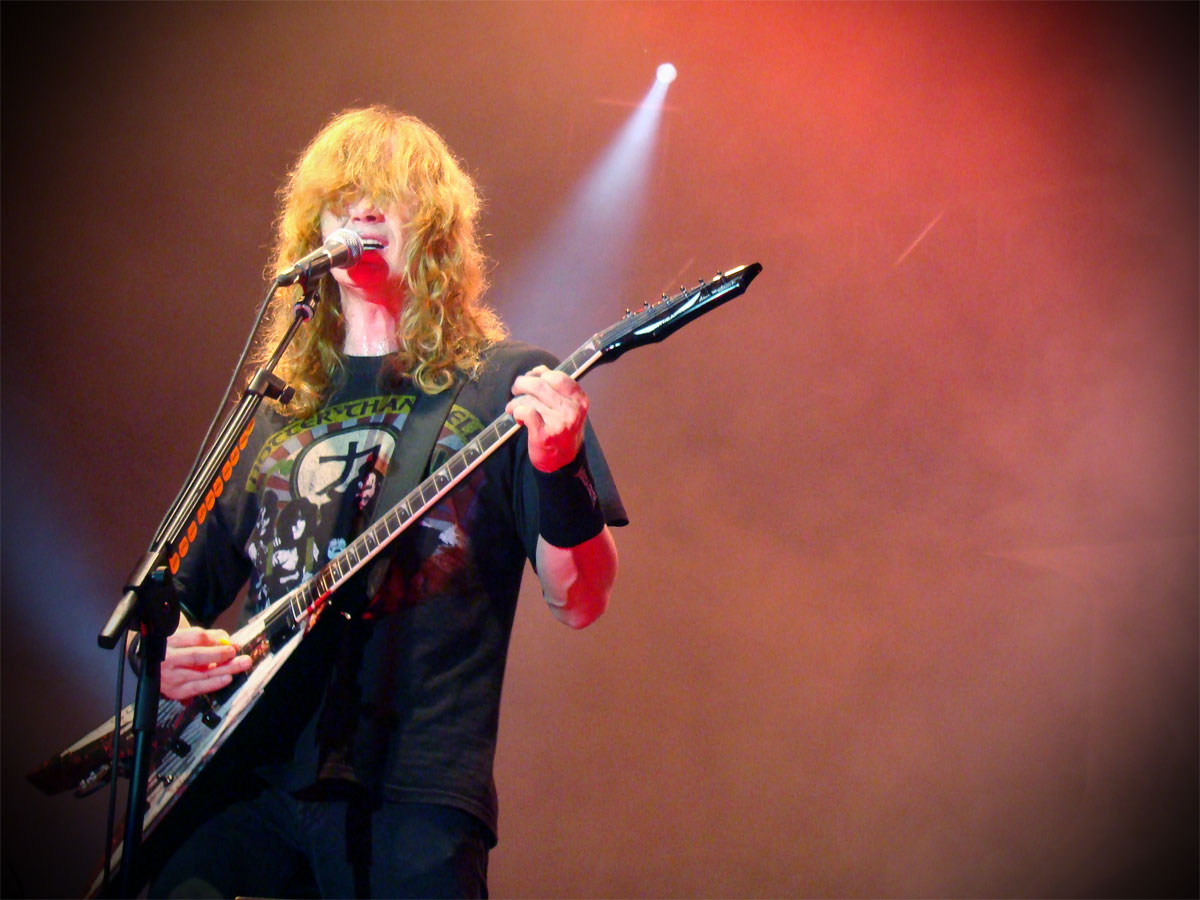
Dave Mustaine performing in Venezuela, 2008. Photo: Ed Vill. Work: Dave Mustaine en Venezuela. Source: https://www.flickr.com/photos/edvill/2528834705/ Licence: CC BY 2.0 https://creativecommons.org/licenses/by/2.0/ Source image unchanged.
Gear Timeline
On September 10, 1983 — Dave Mustaine’s twenty-second birthday — the phone rang and it was Lars Ulrich telling him he was out of Metallica. Not fired, exactly, and not mid-tour; put on a Greyhound bus back to Los Angeles from New York, with his guitar and amplifier shipped separately, while the band continued its East Coast run. The firing that produced the most famous act of spite in heavy metal history: Mustaine went home to Los Angeles, formed Megadeth, and over the subsequent four decades produced eleven Grammy nominations, fifty million records sold, and a body of guitar work that placed him alongside Hetfield, Hammett, Hanneman, and King in the “Big Four” of thrash metal. Rolling Stone ranked him the 38th greatest guitarist of all time. Metal Hammer called him the greatest rhythm guitarist in metal. And he did it with a specific combination of technical sophistication — the harmonic intelligence, the spider-chord voicings, the lead guitar complexity — that Metallica didn’t have room for, and that Megadeth gave him the space to develop fully.
The Journey
David Scott Mustaine was born on September 13, 1961, in La Mesa, California. He began playing guitar in his teens, worked his way through the underground metal scene in Los Angeles, co-founded Metallica in 1981 with Lars Ulrich, and was fired in 1983 after substance-related conflicts within the band. The subsequent founding of Megadeth with bassist David Ellefson and guitarist Greg Handevidt — with Mustaine taking on vocal duties in addition to lead guitar — produced the band’s debut Killing Is My Business… and Business Is Good! in 1985. Peace Sells… but Who’s Buying? (1986), So Far, So Good… So What! (1988), Rust in Peace (1990), and Countdown to Extinction (1992) followed, establishing Megadeth as one of the primary forces in thrash metal’s commercial and artistic history.
His gear evolution — from BC Rich Bich in the early years through Jackson King V to Dean VMNT to Gibson signature models, with amplification ranging from early Marshalls through Fractal Axe-FX digital processing — is a biography in equipment of a musician who has been relentlessly forward-looking about his tools while maintaining the specific V-shape guitar identity that defines his visual and tonal character. The Jackson King V custom built on October 10, 1986 — a date he has cited as one of the most important in his gear history — remains his “#1” guitar and the reference point for everything that followed. This is the complete guide to all of it.
Background: From La Mesa to the Greyhound Bus to Megadeth’s Forty Years
Mustaine’s pre-Megadeth years were the crucible in which the specific technical abilities and the specific guitar identity that Megadeth required were forged. He grew up in La Mesa, California, and San Diego County, and the specific Los Angeles underground metal scene he entered in his late teens — the tape-trading network, the club circuit, the community of technically ambitious musicians who were pushing the thrash metal template beyond what the mainstream metal of the early 1980s had established — gave him both the peer community and the musical influences that shaped his approach. Alice Cooper, Ted Nugent, the Sex Pistols, and Aerosmith appear in his early influence lists alongside the standard metal canon; the eclectic range explains the melodic sensibility that distinguishes his songwriting from more straightforwardly aggressive thrash peers.
The Metallica period (1981-1983) was professionally formative despite its brevity. He co-wrote significant material that appeared on Kill ‘Em All (“The Four Horsemen,” originally titled “Mechanix”) and contributed to the early development of the Metallica sound. The firing — and specifically the manner of the firing, the Greyhound bus rather than a personal conversation — produced the specific motivational fuel that has powered his career ever since. He has discussed this directly and repeatedly: the desire to prove that Metallica made a mistake in firing him, and the willingness to make Megadeth better than Metallica as a demonstration of that mistake. Whether this is accurate or not as a historical assessment, it is accurate as a biographical fact: Mustaine’s relationship with his Metallica history has been one of the primary motivating forces of his professional life.
Megadeth’s technical ambition — the complex guitar arrangements, the quick tempo changes, the interweaving of two guitar parts, the lead guitar solos that are compositionally complex rather than just technically fast — exceeded Metallica’s approach and established a distinct identity within thrash metal’s rapidly developing vocabulary. Rust in Peace (1990) — with its specific combination of technical complexity, melodic sophistication, and tonal aggression — is universally considered the peak of Megadeth’s achievement and one of the most celebrated heavy metal albums ever recorded. “Tornado of Souls” specifically is cited by guitarists across multiple genres as one of the finest heavy metal solos in the form’s history.
His health challenges — the right arm nerve damage in 2002 that required years of physical therapy and was initially feared to be career-ending, throat cancer in 2019 that was successfully treated — and his conversion to Christianity in 2002 have added biographical dimensions that his earlier, more self-destructive career trajectory didn’t suggest. He has remained sober since approximately 2000. He has survived the health crises. He has continued recording and touring, with Megadeth releasing The Sick, the Dying… and the Dead! in 2022 to strong reviews. He remains, at sixty-four years old in 2026, the defining guitarist, vocalist, and songwriter of one of heavy metal’s most technically ambitious bands.
The specific timeline of Mustaine’s guitar brand evolution tells a story of the guitar industry’s relationship with its most prominent endorsers as much as it tells the story of Mustaine’s personal preferences. BC Rich Bich (early 1980s) → Jackson King V (1985, custom October 10, 1986 “#1” guitar, signature model 1991) → ESP DV8/Axxion (2003-2006) → Dean VMNT (2006-present, primary) → Gibson Flying V (2021, ambassador). Each transition reflects both a commercial relationship and a tonal/aesthetic evolution: the early BC Rich’s extreme heavy metal aesthetic, the Jackson’s specific King V character and the personal relationship with the Jackson custom shop, the ESP period’s technical innovations, the Dean partnership’s longevity and the specific VMNT design development, and the Gibson return to the historical Flying V that inspired the entire V-guitar lineage. Mustaine moved through the entire industry of V-shaped electric guitar manufacturing and ended up with the company that made the original.
The Rig: Dave Mustaine’s Guitars, Amps, and Effects
Guitars
Dave Mustaine has stated that the Jackson V Number One has been his primary guitar — the first Jackson King V custom-built specifically for him, completed on October 10, 1986. Jackson had created the King V model from a downsized version of the Double Rhoads design, and Mustaine’s specific customization established the specifications that would become standard on all his subsequent Jackson signature models. His custom King V featured 24 frets (rather than the standard 22 on other King V models), a smaller medium fretwire (rather than the extra-jumbo frets standard on most Jacksons), and his preferred pickup configuration. The custom build completed in October 1986 — which Jackson staff recall as a specific date in the instrument’s history — established the prototype for the Jackson KV Pro signature model introduced in 1991.
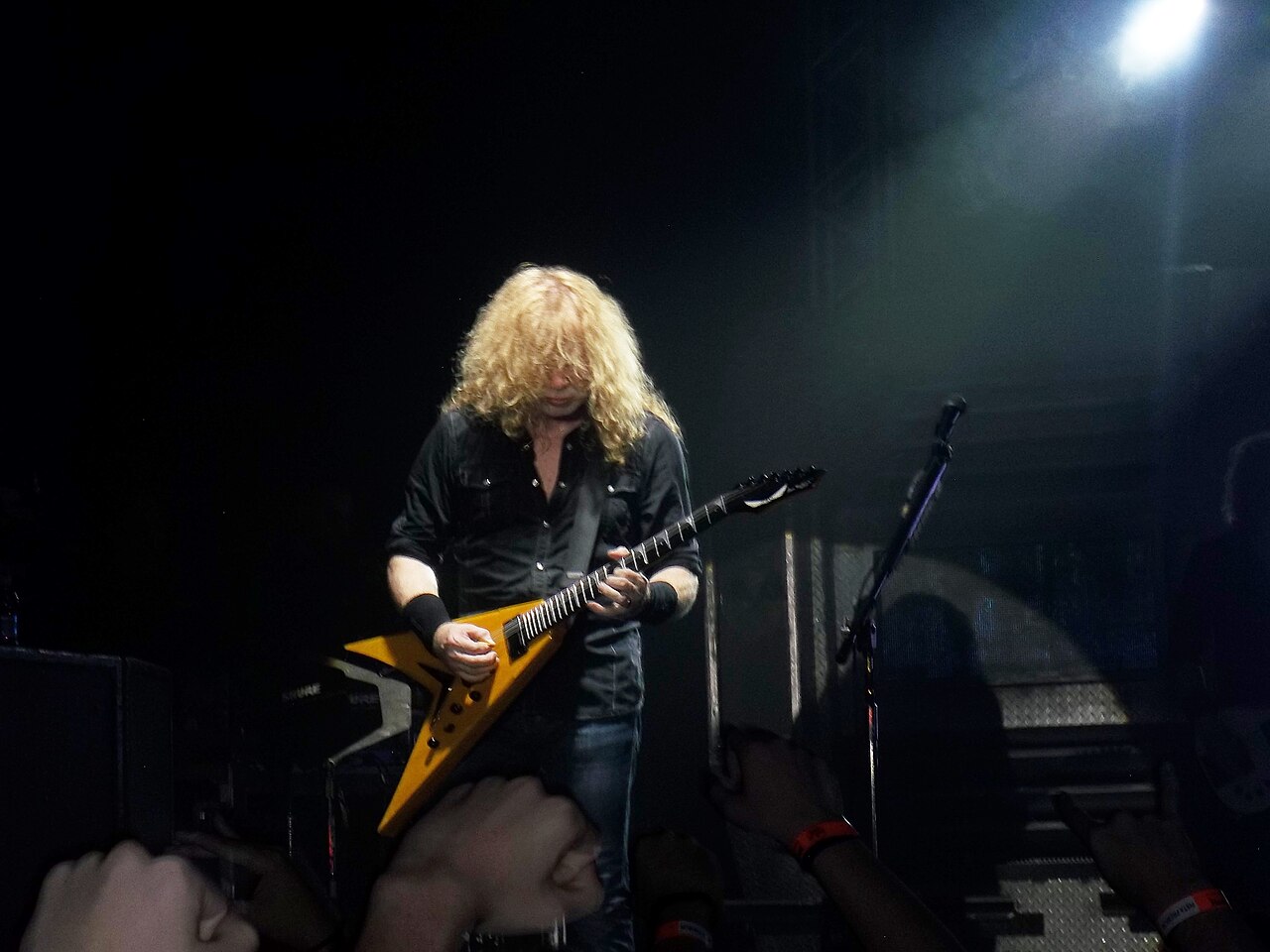
The Jackson King V’s specific tonal character: a mahogany body with a maple top (on some variants), through-neck or set-neck construction, and the specific V silhouette that Mustaine has maintained as his visual identity across his entire career. Mustaine was so identified with the King V that he is often credited with making it one of the most iconic guitar shapes in metal — though the design predated him, it was his forty-year career with V-shaped guitars that established it as the definitive thrash metal guitar silhouette alongside the Flying V and Explorer.
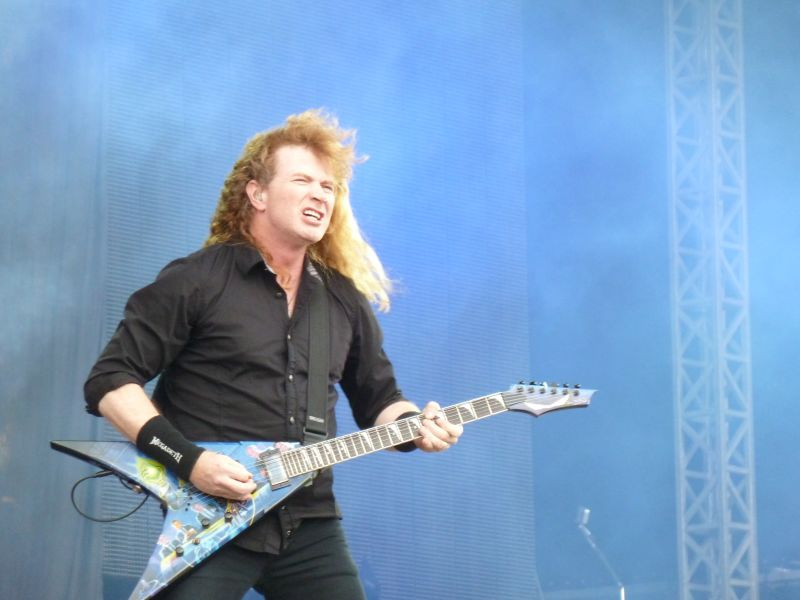
After leaving Jackson (early 2000s), a brief ESP period, and then signing with Dean in 2006-2007, Mustaine’s primary guitars became the Dean VMNT — a signature model specifically based on his preferred Jackson King V specifications with modifications. The VMNT (V Mustaine) features sharper lines than the King V, Seymour Duncan Livewire active humbuckers, a mahogany body, 24 frets, and medium fretwire consistent with his original Jackson preferences. The Dean VMNT “Holy Grail” and “Gears of War” custom-painted variants became among the most recognized visual elements of Megadeth’s concert presence in the 2010s.
More recently, Mustaine has been drawn to the VMNT in natural Korina (limba wood) finish — “Present-day, however, has seen Mustaine using mainly his all-black V-shaped Dean and one of his all-time favorite models in a natural Korina finish.” The Korina VMNT provides the specific warm, resonant tonal character of Korina wood, historically associated with the original 1958 Gibson Explorer and Flying V production models that used the material before the supply chain shifted.
In 2021, Mustaine became a Gibson ambassador and launched a full product line of Gibson signature models. The Gibson Dave Mustaine Flying V — featuring Mustaine signature humbuckers, a black finish with gold hardware, and E-335 style inlays — represents his return to the original manufacturer of the Flying V body shape that has defined his guitar identity. The Gibson Korina Flying V in particular — with the same Korina wood construction as the original 1958 Gibson Flying Vs — gives Mustaine access to the tonal character of the historical originals that inspired his entire V-guitar career.
In the early days of his career, Dave mostly played his BC Rich Bich guitar — the elaborate, multi-pointed heavy metal guitar that was the standard choice in the early 1980s underground metal scene. The green BC Rich Bich appears in documented photographs from 1985 Megadeth performances. Before the Jackson King V established his visual and tonal identity, the BC Rich represented the extreme heavy metal aesthetic that the underground metal community valued in the early 1980s.
A Jackson King V Doubleneck guitar appears in documented Megadeth performances — notably for “In My Darkest Hour,” a song that requires specific tuning configurations. The doubleneck provides access to two different tuned guitars within a single instrument, avoiding mid-song retuning in live performance contexts.
Mustaine’s pickup evolution tracks his guitar brand history. On Jackson guitars: Seymour Duncan TB-4 (Trembucker, the tremolo-compatible version of the SH-4 JB) in the bridge and SH-4 in the neck — the first guitar to feature this combination was the 1991 Jackson KV Pro signature model. On Dean VMNT: Seymour Duncan Livewire active humbuckers — active like the EMG system but with the Seymour Duncan circuit character, providing tight low-end and sharp attack suited to thrash metal rhythm playing.
He generally uses the “spider chord” technique when performing power chords, allowing him to play them in fast yet streamlined fashion as well as reducing string noise. The spider chord — named for the hand position that resembles a spider, with the index finger fretting one string while adjacent fingers reach for others in a configuration that spans unusual string distances — allows Mustaine to voice complex chord shapes at high tempos by reducing unnecessary finger movement. The technique is one of Mustaine’s specific technical innovations, providing a physical approach to heavy chord playing that differs from standard power chord technique and suits his specific compositional style.
Amps
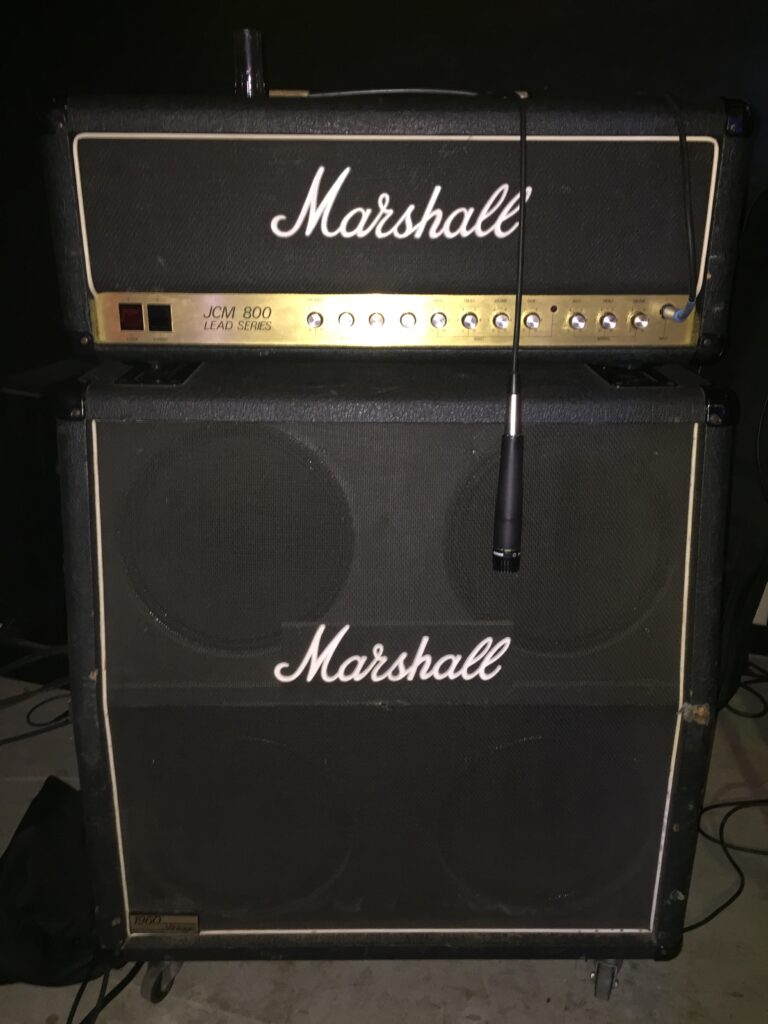
During Megadeth’s most commercially and critically successful period — Peace Sells… but Who’s Buying? (1986) through Countdown to Extinction (1992) — Mustaine’s primary amplification was the Marshall JCM800. The JCM800’s specific character: a modified version of the classic Marshall JMP architecture with a new input gain stage that provides significantly more distortion than the original plexi-era circuit. The JCM800’s natural distortion character — aggressive, mid-forward, with the specific Marshall “crunch” quality — provided the rhythm foundation for Megadeth’s classic recordings. A Marshall JVM Series JVM410H also appears in his documented current live setup.
Randall amplifiers — specifically the Century series solid-state and tube-hybrid models — appear in Mustaine’s documented live touring configurations during various periods. Randall’s specific high-gain character, combined with the solid-state reliability that touring demands, provided him with consistent amplification across the demanding schedules of major tours.
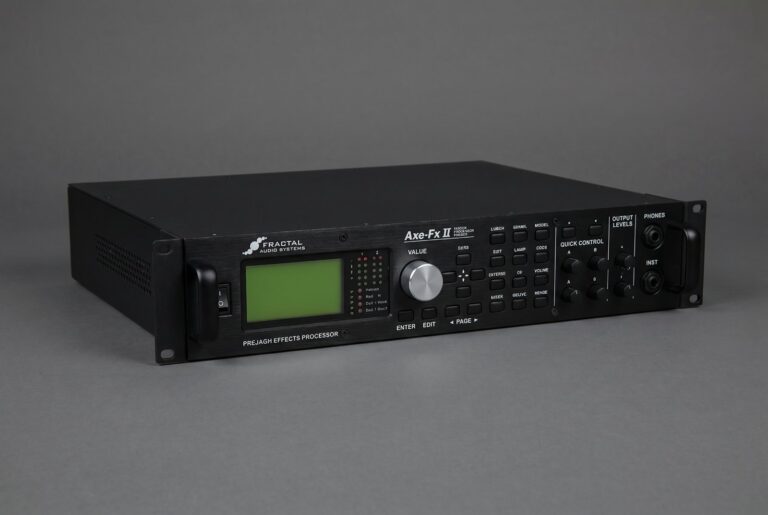
Dave Mustaine has been using the Fractal Audio Axe-FX II Guitar Effects Processor since 2012. The Fractal provides comprehensive amp modeling and effects processing, allowing Mustaine’s live signal chain to use modeled versions of his preferred amplifiers (including Marshall models) with the consistency and reliability of digital technology. The transition from vintage analog amplification to digital modeling reflects the practical considerations of a touring musician — the Axe-FX’s ability to recall exact amp settings from MIDI presets, its resistance to environmental variations, and its comprehensive effects library gave him tools unavailable from vintage tube amplifiers alone.
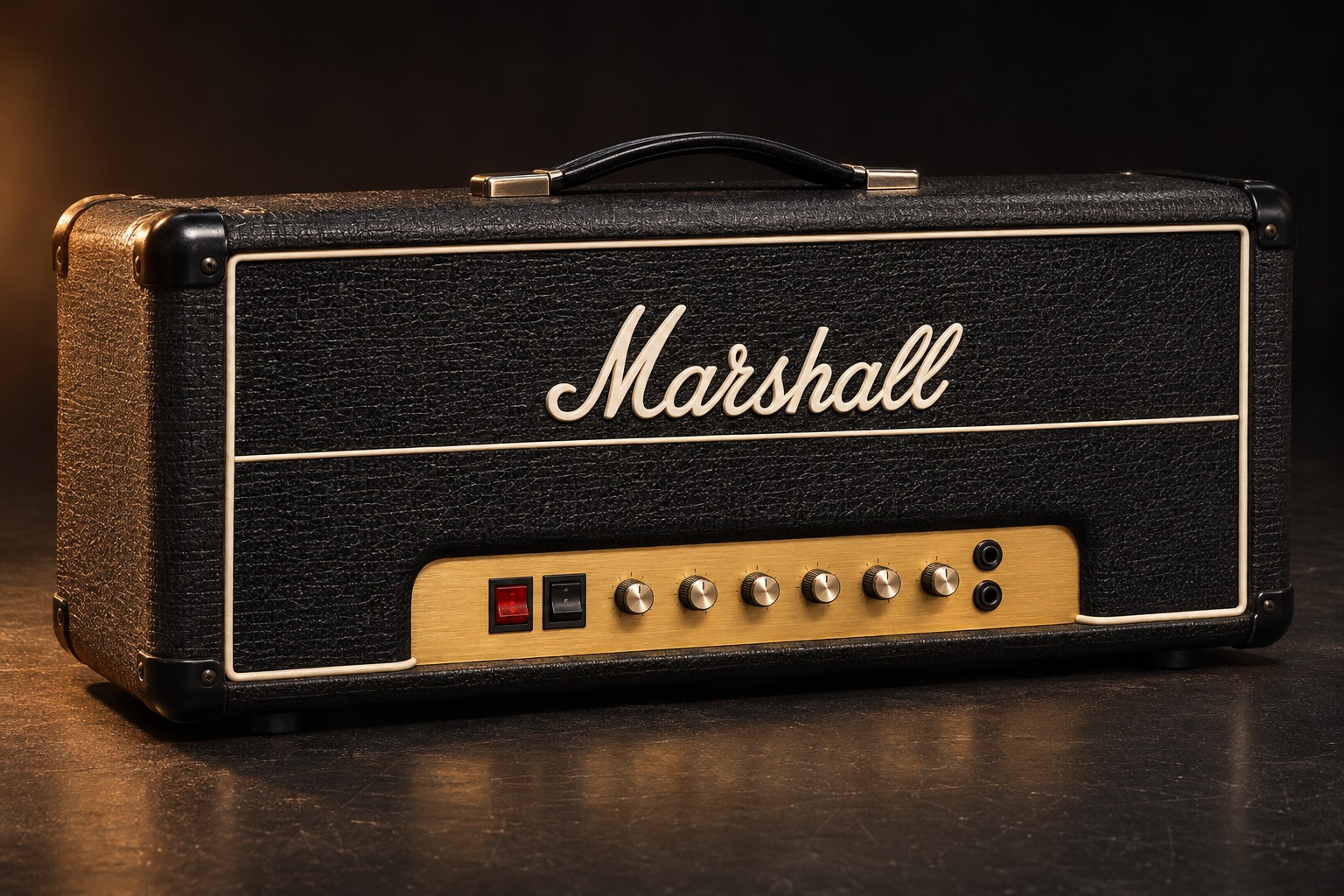
Like Hetfield, Mustaine used Marshall JMP heads in the early Megadeth period — before the JCM800 became his primary reference and before the more complex amp configurations of later years. The JMP’s specific character was the foundation of the raw, aggressive early Megadeth recordings.
Effects
Mustaine maintains a simple effects setup, currently focusing on wireless systems and occasional use of wah pedals and boost pedals, preferring to keep his signal path direct and uncluttered. This minimal approach — the opposite of the complex rack systems that characterized some 1980s metal guitarists — reflects his preference for the guitar and amplifier’s natural interaction as the primary tonal element.
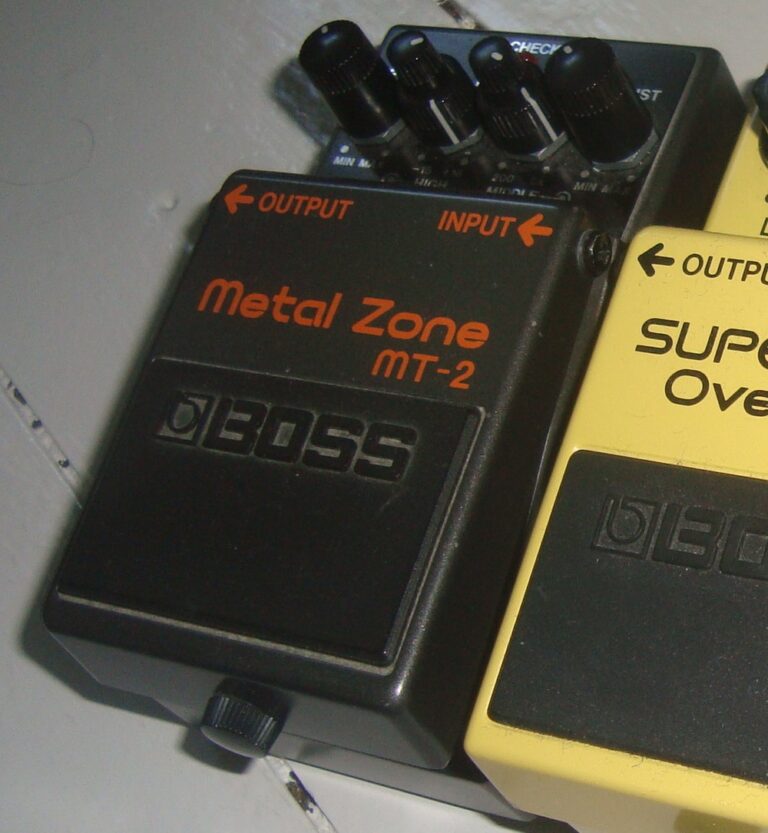
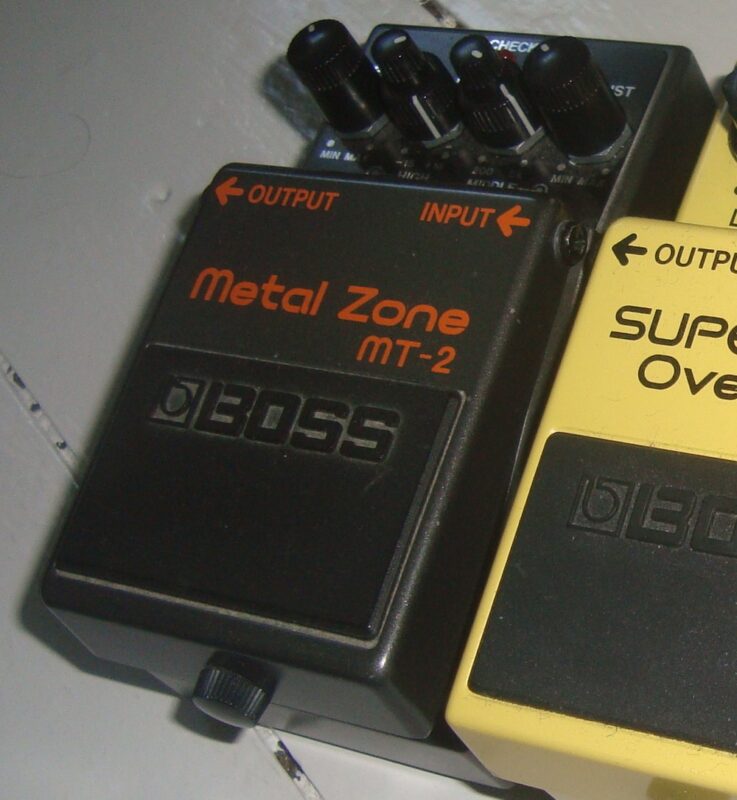
A Boss MT-2 Metal Zone distortion pedal owned by Mustaine has been documented and sold through Reverb.com. The MT-2’s presence in his documented collection suggests use in specific recording or rehearsal contexts, though his live setup has been generally more minimal.
A wah pedal appears in Mustaine’s documented effects for specific lead passages — the swept filter expression that characterizes his more melodic lead work in songs like “Tornado of Souls.” His wah use is selective rather than constant.
For live performance, Mustaine uses a wireless guitar system that allows freedom of stage movement without the cable constraints of a wired connection. The wireless system maintains signal quality across the stage areas that Mustaine covers during Megadeth’s performances.
His right arm nerve damage in 2002 — which temporarily left his arm partially paralyzed and was initially feared career-ending — produced one of the more remarkable recoveries in rock guitar history. The injury, sustained from sleeping in an unusual position that compressed a nerve in his right arm, required surgery and years of physical therapy. The recovery required relearning the picking technique and physical rebuilding of the right arm’s muscular conditioning. This is not a trivial challenge for a guitarist whose specific downpicking and complex lead work place extreme physical demands on the right hand and arm. His return to performance demonstrated both the depth of his commitment to the instrument and the resilience that has characterized his survival of multiple career-threatening challenges.
Playing Style & Tone Philosophy
Dave Mustaine’s playing style is the most compositionally complex in the thrash metal tradition — combining the rhythm precision of thrash with lead guitar sophistication that draws from the classical influences (Baroque melodic construction, neo-classical scale patterns) he absorbed alongside the standard metal vocabulary. His lead playing on tracks like “Tornado of Souls,” “Holy Wars… The Punishment Due,” and “Symphony of Destruction” is not just technically fast but melodically developed — the solos tell stories, develop themes, and conclude with compositional logic that elevates them above technical display.
The rhythm playing is equally distinctive. The spider chord technique — his specific approach to power chord voicing at high tempos — produces a cleaner, more streamlined character than standard power chord playing. His rhythm parts on Peace Sells and Rust in Peace demonstrate the specific combination of tight, aggressive thrash rhythm and harmonic sophistication (unexpected chord substitutions, modal shifts, complex rhythmic displacements) that distinguishes Megadeth from more harmonically static thrash acts. This harmonic intelligence — derived partly from his brief but musically formative Metallica period, partly from the classical guitar influences he absorbed, and partly from his own compositional development — is the specific element that makes Megadeth’s music more harmonically complex than most of their thrash contemporaries.
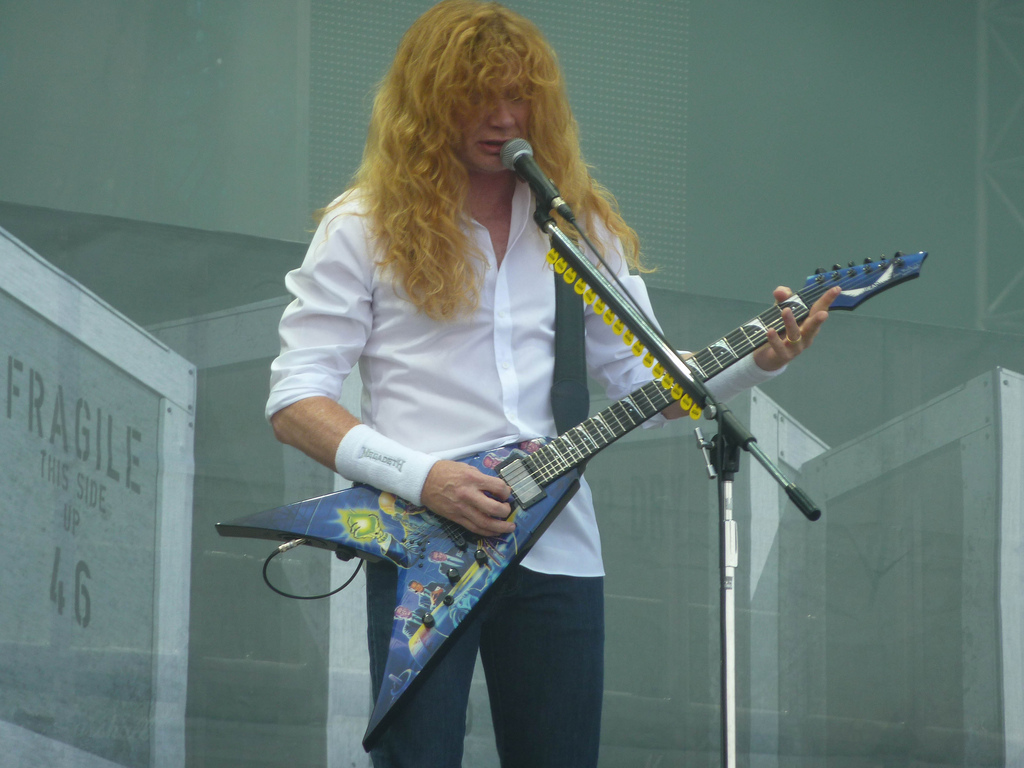
His tone philosophy has evolved alongside his guitar and amplifier choices: from the raw, high-gain Marshall approach of the early years to the more refined, processed contemporary digital setup. The consistent element across these evolutions: V-shaped guitars. The Flying V and King V shapes have been his primary instruments from the early 1980s to the present, and the specific ergonomic and tonal character of the V shape — the body’s specific balance point, the lower bout’s absence allowing the strumming arm to access the strings at a specific angle — has shaped how he physically engages with the instrument in ways he has maintained as a constant across all gear changes.
The Rust in Peace period — with Marty Friedman as second guitarist — represents Megadeth’s most fully realized artistic vision. Friedman’s Eastern-inflected melodic approach combined with Mustaine’s classical/thrash synthesis to produce a two-guitar interplay of unusual sophistication. The specific guitar duet on “Five Magics,” the interlocking rhythm parts of “Tornado of Souls,” the harmonic complexity of “Hanger 18” — these tracks demonstrate what happens when two guitarists of genuine compositional intelligence work together in a heavy metal context. Mustaine’s rhythm foundation on Rust in Peace is as important as the lead work that has received more critical attention: the specific way he voices power chords with harmonic extensions, the rhythmic displacements within the thrash metal framework, and the structural sophistication of the arrangements are the compositional achievements that make Rust in Peace the album it is.
His vocal identity — the distinctive nasal tone, the specific phrasing borrowed from his San Diego roots and his punk/metal influences, the delivery that simultaneously conveys menace and melodic sophistication — is inseparable from his guitar work in Megadeth’s recordings. Unlike most metal bands where the vocalist and guitarist are different people with different performance roles, Mustaine does both simultaneously, which shapes how his guitar parts are constructed: they must work against his vocal lines rather than in competition with them, must provide the harmonic foundation for his singing while also being interesting enough to stand alone as guitar music. This vocalist-guitarist integration shapes his specific approach to rhythm guitar arrangement in ways that are audible across Megadeth’s catalog.
The “Tornado of Souls” solo — widely cited by guitarists and critics as one of the greatest in heavy metal — demonstrates the specific compositional approach that Mustaine brings to lead guitar. The solo builds its melodic content across four distinct sections, each developing the preceding musical ideas, with the harmonic language incorporating both the classical chromatic approach he absorbed and the aggressive, descending runs of the thrash metal tradition. It is not a collection of impressive techniques displayed sequentially; it is a coherent musical statement with beginning, development, climax, and resolution. This compositional intelligence — treating the solo as a composed piece rather than an improvised demonstration of technical vocabulary — is Mustaine’s most important contribution to the grammar of heavy metal lead guitar.
How to Sound Like Dave Mustaine
Getting Dave Mustaine’s rhythm tone requires a V-shaped guitar with high-output pickups and a high-gain Marshall-style amplifier, plus the specific EQ voicing that gives his rhythm playing its tight, aggressive character.
Guitar: A Dean VMNT or Jackson King V is the authentic choice. Gibson Flying V with Mustaine signature pickups for the contemporary Gibson era approach. Any V-shaped guitar with high-output humbuckers (Seymour Duncan SH-4 JB, Livewire, or equivalent). 24 frets preferred for the additional upper-register range his lead playing requires.
Amp: Marshall JCM800 or JVM410H for the authentic Marshall character. Fractal Axe-FX with Marshall models for the contemporary approach. The amp should provide aggressive, present high-gain distortion with Marshall’s specific midrange character.
Amp Settings (Marshall JCM800 or equivalent):
| Control | Setting (0–10) | Notes |
|---|---|---|
| Gain/Preamp | 7–9 | High — aggressive thrash rhythm requires significant gain |
| Bass | 6–7 | Full but not boomy — V guitars have specific low-end character |
| Mid | 4–6 | Slightly scooped — Mustaine’s mid-forward but not as scooped as Hetfield |
| Treble | 7–8 | Bright — note definition and attack clarity |
| Presence | 7–8 | High — the cutting quality that makes Megadeth’s guitar audible in the mix |
The spider chord technique: For downtuned power chord work at high tempos, experiment with the spider finger position — index finger on the root note, fourth (pinkie) or third finger reaching across two strings rather than the standard one-fret-below power chord position. This allows a slightly different barre position that some players find reduces string noise and allows cleaner articulation at high speeds. Learn it slowly before attempting Megadeth tempos.
Influence & Legacy
Dave Mustaine’s influence on guitar playing operates through two specific channels: the technical precedent he set for harmonic complexity in thrash metal, and the personal mythology of his career — the Metallica firing, the decades of effort to prove the world wrong, the specific combination of success and failure that makes his biography one of the more dramatically compelling in rock music. Both the technical contribution and the narrative have influenced subsequent generations of metal guitarists.
The technical contribution is most clearly visible in the generation of thrash and technical metal guitarists who cite “Tornado of Souls” as a formative influence — who absorbed both the lead guitar sophistication and the compositional approach of Mustaine’s best work and carried it forward into their own music. His specific combination of classical melodic influences with thrash metal aggression opened a tonal and compositional direction that hundreds of subsequent guitarists have explored.
His solo on “Tornado of Souls” specifically deserves mention as one of the most studied and most celebrated in heavy metal: melodically developed, emotionally direct, technically demanding without being technically demonstrative, and building to a conclusion with compositional logic rather than just increasing technical intensity. This is what great guitar soloing sounds like, and it is what Mustaine achieved at his peak.
For context on where Mustaine fits in the thrash metal guitar tradition, the comparison with James Hetfield’s rhythm-first approach to Metallica’s guitar shows the specific contrast within the “Big Four” that makes both figures essential. Hetfield’s strength is in the rhythm playing — the downpicking, the palm muting, the physical precision; Mustaine’s strength is in the lead playing and compositional complexity — the harmonic sophistication, the melodic intelligence, the specific solo approach. The Metallica firing that divided them ultimately showed what each brought to the table that the other didn’t.
The comparison with Kerry King’s Slayer guitar approach shows the parallel career in thrash metal’s “Big Four” — King and Mustaine operating in the same commercial and critical context with completely different aesthetic approaches: King’s maximally aggressive, Mustaine’s more melodically sophisticated. The contrast shows the breadth of what thrash metal guitar encompasses.
And the comparison with Randy Rhoads’ classical influences on heavy metal guitar shows the specific lineage: the neoclassical approach to metal guitar that Rhoads established and that Mustaine absorbed — the Baroque melodic construction, the chromatic approaches, the specific scale vocabulary that gives Megadeth’s lead playing its specific European classical character beneath the American thrash metal surface.
Dave Mustaine is sixty-four years old in 2026. Megadeth continues to tour. The Sick, the Dying… and the Dead! was released in 2022. The Dean VMNT in natural Korina finish is in the guitar case. The Gibson Flying V signature models are in production. The Fractal Axe-FX is in the rack. And somewhere in the harmonic complexity of the rhythm parts, in the melodic sophistication of the solo on “Tornado of Souls,” in the specific V-shaped guitar’s resonance through the Marshall-voiced digital preamp — is the sound of a musician who responded to being put on a Greyhound bus by becoming one of heavy metal’s most important guitarists. Spite as motivation. The music as proof. The guitar as the instrument of both.
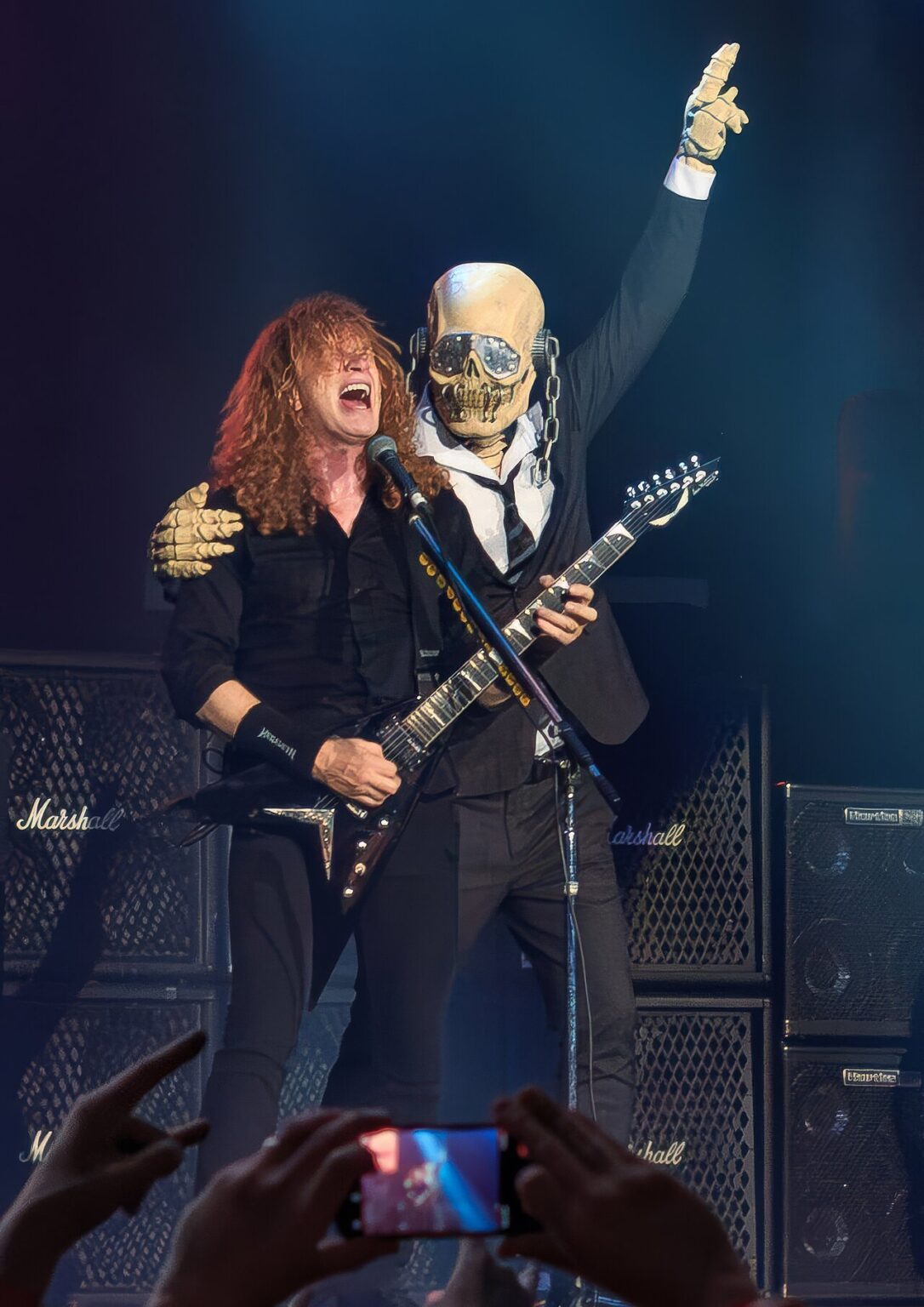
The cultural dimension of Mustaine’s career extends beyond the music to the specific mythology his biography has generated. The Greyhound bus firing. The decades-long competition with Metallica that he has discussed openly and that has shaped how the metal community understands both bands. The recovery from right arm nerve damage. The throat cancer diagnosis and treatment in 2019. The sobriety since approximately 2000 after decades of substance problems. And the ongoing recording and touring of a musician in his mid-sixties who has survived enough to have had multiple career-ending experiences without the career actually ending. This is a mythology of persistence — not the clean-arc mythology of success-and-vindication, but the more complicated mythology of survival across repeated setbacks, with the music as the constant through all of it. The Jackson King V custom-built on October 10, 1986 remains his “#1.” Forty years later. The guitar and the musician both still going.
His Grammy nomination history — eleven nominations, representing repeated formal industry acknowledgment across multiple decades of Megadeth recordings — documents the Recording Academy’s specific recognition of Megadeth’s sustained quality rather than a single commercial breakthrough. The nominations span Best Metal Performance, Best Hard Rock Performance, and other categories across albums from Peace Sells through Dystopia (which won Best Metal Performance in 2017 for “Dystopia”). That 2017 win — for an album recorded when Mustaine was in his mid-fifties, after decades of setbacks and recoveries — was received within the metal community as a long-overdue formal acknowledgment of the band’s consistent quality. Megadeth sold more than fifty million records worldwide and received eleven Grammy nominations across their fourteen studio albums. The guitar-and-amp combination at the center of all of it: V-shaped instrument, Marshall-voiced high-gain amplification, the spider chord reducing string noise so the complex harmonic ideas are audible at thrash metal tempos.
The Jackson King V’s specific contribution to heavy metal guitar culture — beyond Mustaine’s personal use — is worth documenting. When Jackson completed Mustaine’s “#1” custom on October 10, 1986, and then subsequently mass-produced the Dave Mustaine Signature Series King V with his specifications (24 frets, medium fretwire), the instrument became one of the best-selling Jackson models. The King V’s visual identity — the asymmetric V shape, the headstock, the specific scale of the design — was established as a heavy metal guitar silhouette primarily through Mustaine’s four-decade association with it. Entire generations of metal guitarists bought King Vs specifically because of Mustaine’s playing. The Dean VMNT is essentially the same concept carried forward under a different brand name; the continuity of design philosophy across the brand transitions demonstrates how central the specific V configuration is to Mustaine’s instrument identity.
Dave Mustaine is sixty-four years old in 2026. Megadeth continues to record and tour. The Dean VMNT in natural Korina finish is in the case. The Gibson Flying V signature model is in production. The Fractal Axe-FX is in the rack. And somewhere in the harmonic complexity of the rhythm parts, in the melodic sophistication of the “Tornado of Souls” solo, in the specific V-shaped guitar’s resonance through the Marshall-voiced digital preamp, and in the unresolved narrative of the man who was put on a Greyhound bus on his twenty-second birthday and spent the next forty years proving that was a mistake — in all of that is what Dave Mustaine has contributed to heavy metal guitar. It is, on the evidence of fifty million records and eleven Grammy nominations and one of the finest guitar solos in the form’s history, considerable.
The specific question of whether Mustaine’s Metallica work or his Megadeth work is more important to guitar history does not have a clean answer, and the attempt to frame it that way misses what is most significant. He contributed compositionally to Kill ‘Em All and the early Metallica template; he built Megadeth from nothing into one of heavy metal’s defining bands; his specific guitar technique (the spider chord, the neoclassical lead vocabulary, the specific rhythm sophistication) influenced dozens of subsequent guitarists; and his ongoing career — the persistent refusal to accept the end of the story that the Greyhound bus seemed to announce — has produced music of sustained quality across four decades. The guitar does not know about the biography. It knows about the notes. The notes, across the entire span of his career, have been consistently excellent.
Frequently Asked Questions: Dave Mustaine Guitars & Gear
What guitar does Dave Mustaine play?
Dave Mustaine has used V-shaped guitars throughout his career. His primary guitar for decades was the Jackson King V — specifically the “#1” custom-built on October 10, 1986, which became the prototype for the Jackson KV Pro signature model introduced in 1991. After transitions to ESP (2003) and Dean (2006), the Dean VMNT became his primary instrument — a signature model based on the King V specifications with sharper lines and Seymour Duncan Livewire active pickups. Notable VMNT models include the “Holy Grail” and “Gears of War” custom-painted variants, and the natural Korina VMNT. In 2021 he became a Gibson ambassador and launched Gibson Dave Mustaine signature models including the Flying V in Korina finish. Early career (1984-1985): BC Rich Bich.
What amplifiers does Dave Mustaine use?
Dave Mustaine’s primary amplifier during Megadeth’s classic period (1986-1992) was the Marshall JCM800 — the high-gain British tube amplifier that defined heavy metal rhythm tone in the mid-to-late 1980s. He has also used Randall amplifiers (Century series) for touring reliability. Since 2012, he has incorporated the Fractal Audio Axe-FX II as his primary live signal processing unit, using modeled Marshall and other amplifier characters through the digital system. The Marshall JVM410H also appears in his contemporary live setup. His amp settings typically feature high gain, slightly scooped mids, high treble and presence for the aggressive, present Megadeth rhythm tone.
What is the “spider chord” technique?
The spider chord technique is Dave Mustaine’s specific approach to playing power chords at high tempos while reducing string noise and maintaining clean articulation. The technique uses an unusual hand position — resembling a spider — where the index finger frets one string while adjacent fingers reach across multiple strings in a configuration that spans larger string distances than standard power chord technique. This allows Mustaine to voice complex chord shapes at the fast tempos of thrash metal with cleaner note definition and less unwanted string noise than conventional power chord fingering produces.
Why was Dave Mustaine fired from Metallica?
Dave Mustaine was fired from Metallica on September 10, 1983 — his twenty-second birthday — and put on a Greyhound bus back to Los Angeles from New York while the band continued its East Coast run. The firing was precipitated by substance-related behavioral issues within the band — specifically conflicts and incidents related to alcohol and drug use that Ulrich and Hetfield had decided were incompatible with continuing to work together. Mustaine has discussed the firing extensively over the decades, consistently acknowledging its role as the primary motivational force behind Megadeth’s creation and his subsequent determination to prove the decision was wrong. Metallica’s management later confirmed the specific reasons.
What is “Tornado of Souls” and why is it significant?
“Tornado of Souls” is a track from Megadeth’s Rust in Peace (1990) that contains what many guitarists and critics consider one of the greatest heavy metal guitar solos ever recorded. The solo — approximately 32 seconds of melodically developed, harmonically sophisticated, technically accomplished lead guitar — builds from its opening phrase to a conclusion with the compositional logic of a classical cadenza, each phrase developed from the previous and moving the melodic content forward. Marty Friedman’s guest solo on the track is also celebrated, but Mustaine’s playing throughout the song is the foundation. The track is a reference point for the level of melodic intelligence that guitar soloing in heavy metal can achieve.
What is the Megadeth “Big Four” and how does Mustaine fit in?
The “Big Four” of thrash metal refers to the four bands credited with creating and defining the thrash metal genre in the mid-1980s: Metallica, Megadeth, Slayer, and Anthrax. Dave Mustaine is unique in the Big Four in having been a founding member of both Metallica and Megadeth — he co-founded Metallica in 1981, was fired in 1983, and immediately founded Megadeth, which went on to be considered one of the most technically ambitious of the Big Four. The narrative connection between the two bands — Mustaine’s firing from one leading directly to the creation of the other — is one of the most significant “what if” stories in metal history, and Mustaine’s subsequent forty-year career has produced an argument that the firing enabled rather than ended a major career.
Is Dave Mustaine in the Rock and Roll Hall of Fame?
As of 2026, Dave Mustaine and Megadeth have not been inducted into the Rock and Roll Hall of Fame. Megadeth became eligible in 2010 (twenty-five years after their 1985 debut) and has been a regular discussion point in Rock and Roll Hall of Fame eligibility conversations given their platinum certifications, eleven Grammy nominations, fifty million records sold, and their foundational role in thrash metal. Mustaine’s unique position — co-founding two of the Big Four bands — is particularly unusual. The Hall’s electoral process has historically given less weight to metal genres compared to rock and pop, though the induction of Metallica in 2009 established that thrash metal is within the Hall’s scope.
Image credits
- Marshall JMP 2203 (Early Megadeth, Kill ‘Em All Era Tone): GuitarGangsters AI-generated reference illustration, not a photograph.
- Dave Mustaine: Jhonesilverio, Wikimedia Commons, CC BY-SA 4.0.
- Top image: Ed Vill, Flickr, CC BY 2.0.
- Dave Mustaine: photo by Will Russell, via Wikimedia Commons, CC BY 2.0.
- Dave Mustaine: photo by Ingo Hoffmann, via Wikimedia Commons, CC BY 2.0.
- Marshall JCM800: John2112, Wikimedia Commons, CC BY-SA 4.0.
- Boss MT-2 Metal Zone: David J, Flickr, CC BY 2.0.
- Dave Mustaine live: Justice for the Beholder of the Harvester of Blackened Straw, Wikimedia Commons, CC BY-SA 4.0.
- Fractal Audio Axe-Fx II: GuitarGangsters AI-generated reference illustration, not a photograph.