One Million Zones: How the Boss MT-2 Metal Zone Became the World’s Most Divisive Distortion Pedal
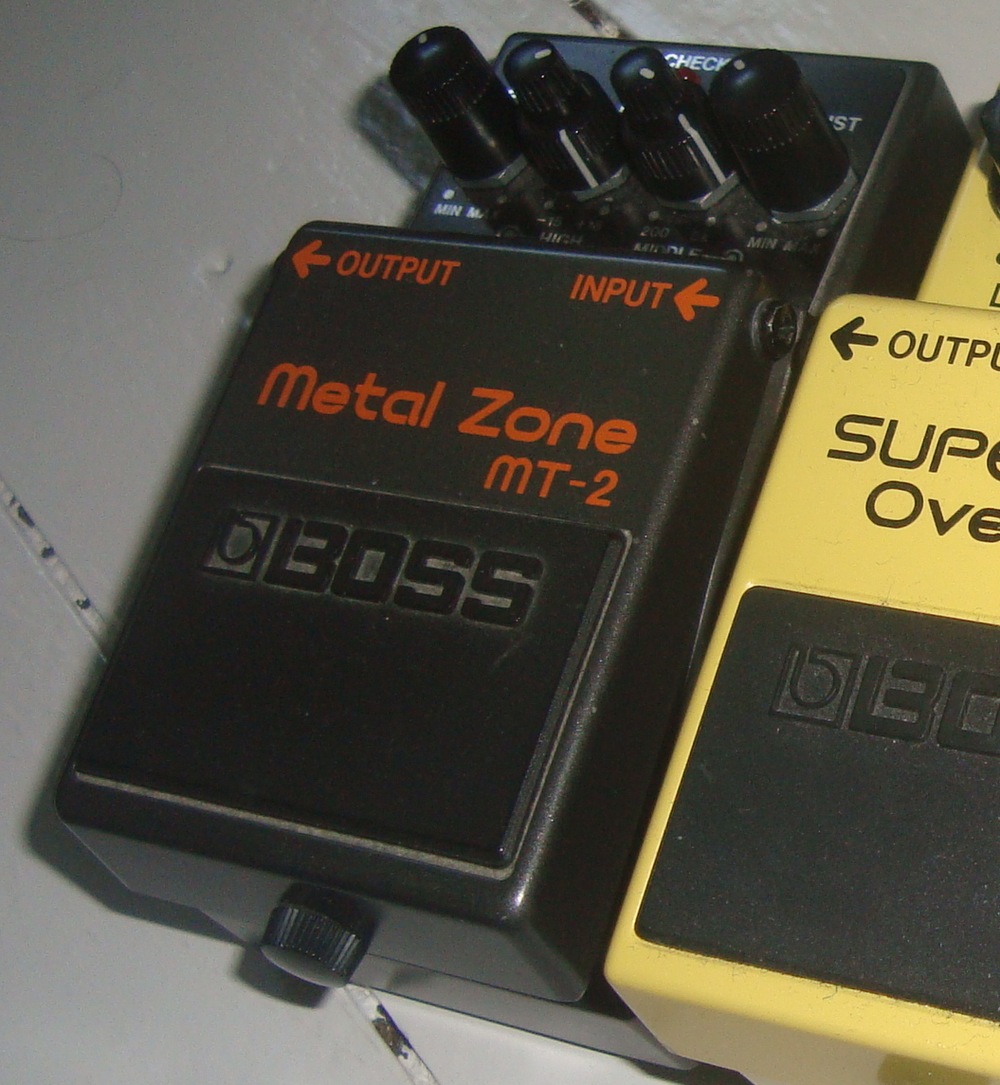
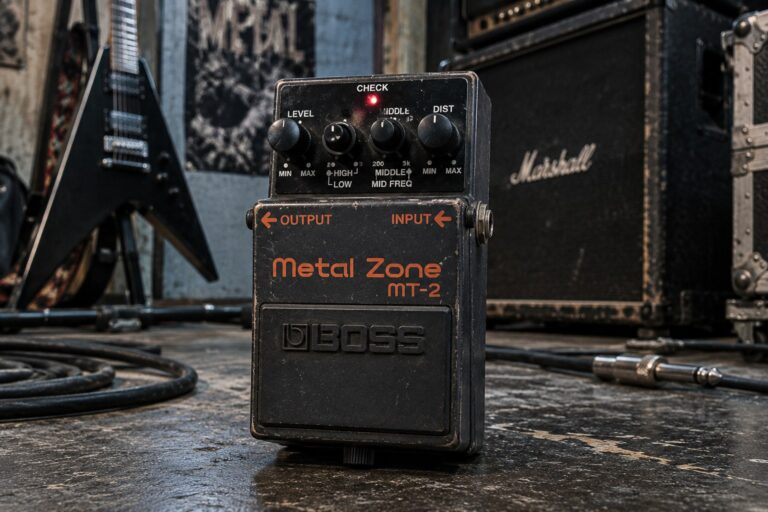
Boss MT-2 Metal Zone, cropped from a photograph of three Boss pedals. Photo: “Boss fx pedals” by David J (sebilden), CC BY 2.0 (https://creativecommons.org/licenses/by/2.0/). Cropped to retain the complete featured pedal, resized and JPEG re-encoded; neighboring pedal edges remain. Source: https://www.flickr.com/photos/sebilden/13108107374/
The Boss MT-2 Metal Zone is the most divisive pedal in history and one of the most capable. Full history, specs, famous players, and best settings.
In October 1992, Guitar Player magazine held a shoot-out of 29 distortion pedals. The editors declared the Boss MT-2 Metal Zone the standout model for metal players. Demand was so high that the store which had loaned the pedal for review asked for it back before the magazine could photograph it — they needed it to fill backorders. That moment captures the MT-2’s opening act perfectly: instant legitimacy, instant demand, instant hunger.
Then came the backlash. By the mid-2000s, the Metal Zone had become a punchline — “buzzing bees,” “worst pedal ever made,” the obligatory joke in every forum thread about bad tone. Premier Guitar would later observe that “the endless hordes of preteens that butchered ‘Crazy Train’ through a Metal Zone at their local Guitar Center probably didn’t help” the pedal’s reputation. The image stuck. The MT-2 became the stompbox that bedroom players cranked to ten and experienced guitarists sneered at.
Here’s what gets lost in that narrative: one million Metal Zones sold. Continuous production since 1991 — over thirty years and counting. Prince used it on tour throughout the 1990s. Joe Bonamassa calls it his favourite Boss dirt pedal. Simon Neil of Biffy Clyro built his arena-filling wall of sound around it. Kurt Ballou — one of the most respected ears in heavy music production — keeps one patched into a tube mic preamp at his GodCity Studio because “nothing else will do.” The MT-2 was never the problem. The problem was the assumption that maximum gain is the correct destination.
Origin Story: After the HM-2
To understand why the MT-2 exists, you need to understand what it replaced. The Boss HM-2 Heavy Metal launched in 1983 and found a fierce niche among Scandinavian death metal players — its compressed, chainsaw-like roar became the signature sound of early Swedish death metal, a tone so specific and extreme that engineers still request it by name. Outside that niche, though, the HM-2 was a difficult pedal to sell. Its usable range was narrow. It was uncompromising to the point of inflexibility. When Boss discontinued it, they needed something for the same market that could do more.
Former Boss president Yoshi Ikegami identified the real gap in the market: high-gain amplifiers capable of the tones professional metal guitarists were chasing were expensive and generally out of reach of non-professional players. Among those who had them, the unique tonal character came largely from how each player sculpted midrange frequencies. A distortion pedal that offered the same level of EQ control — the kind of midrange shaping you could dial in and own — would be genuinely useful rather than just another box of pre-baked saturation.
The MT-2 launched in 1991 with that philosophy at its core. Boss’s engineering team built a dual-stage gain circuit, a seven-filter network spanning both pre-distortion and post-distortion shaping, and a semi-parametric three-band EQ section unlike anything in a compact pedal at the time. Premier Guitar described it as “literally the hottest piece of gear in the guitar world” upon release. The Guitar Player shoot-out result followed a year later. The Metal Zone was a serious piece of gear from the moment it hit shelves.
Circuit Deep-Dive: What Actually Happens Inside
The MT-2’s architecture is substantially more complex than its compact enclosure suggests. Most distortion pedals work on a simple model: gain stage, clipping, tone control, output. The Metal Zone runs a genuinely different scheme, and understanding it explains both why the pedal sounds the way it does and why so many players have struggled to get the best from it.
The first stage is a pre-distortion EQ and gain section. Before any clipping occurs, the signal passes through a filter network that shapes the frequency content going into the gain stage. This pre-emphasis adds clarity and harmonic definition — as Kurt Ballou notes, “there’s some pre-emphasis EQ that’s always present which adds clarity and harmonics even at low gain.” The signal is already being coloured before the distortion circuit even sees it.
The dual-stage gain circuit then applies distortion in two passes — first through a hard-clipping stage (analogous to amp clipping) then through a soft-clipping diode stage. This layered approach gives the MT-2 its characteristic combination of hard edge and body. It is more aggressive than the asymmetric soft-clipping of the SD-1 or the symmetric soft-clipping of the TS9, producing more even-order harmonics alongside the odd-order content that defines solid-state distortion character.
After distortion, the signal passes through the post-distortion EQ section — the famous three-band control that intimidates so many players on first encounter. The High and Low controls each offer around 15dB of cut or boost at their respective frequency points (approximately 10kHz shelving and 100Hz). The Middle control offers a similar range of cut or boost, but its centre frequency is dictated by a separate Mid Freq knob that sweeps the entire range from 200Hz to 5kHz. This is the control that makes the MT-2 unique. You are not just adjusting how much mid you want; you are choosing which midrange frequencies matter in the first place.
Guitar World’s analysis of the High control is particularly instructive: it functions as a shelving EQ that interacts with the pedal’s other settings in ways that are not immediately obvious. Rolling it back removes the fizz that plagues high-gain tones at low volumes — but rolling it too far removes the high mids that keep the distortion articulate, pushing the sound into an overly dark, woolly territory. The ideal position for most applications sits between nine and one o’clock, adjusted by ear relative to the amp and room.
The dominant mistake with the MT-2 — the one that produced a generation of bad-sounding bedrooms — is treating the Dist control as a target rather than a threshold. The useful range for most musical applications begins well below noon. Kurt Ballou uses low gain settings. Joe Bonamassa’s advice is direct: “Just because it’s called the Metal Zone, that doesn’t mean you need to run the gain all the way up.” At moderate gain with careful EQ placement, the MT-2 is a versatile, sonically interesting distortion. At maximum gain with everything scooped and the High control at maximum, it produces exactly the maligned buzzing-bees sound — which is a user setting, not a circuit limitation.
Specifications
Famous Players
Prince — MT-2 on Tour Throughout the 1990s
That Prince used a Boss MT-2 Metal Zone on his pedalboard is thoroughly documented by the guitarcloud.org Prince Equipment Archive and confirmed by Boss. The MT-2 appeared in his rig around the time of the Love Symbol Album era — documentation places it on his pedalboard for a July 9, 1996 performance for NBC’s Today Show, and it is widely cited as the pedal used on “The Undertaker.” For a player whose gear choices were famously idiosyncratic and who consistently surprised audiences expecting one thing before delivering another, the Metal Zone was exactly the kind of extreme, unexpected tool that served his approach. Prince ran clean, amplifier-based tones alongside aggressive distortion; the MT-2’s sculpted high-gain gave him a texture that sat in stark contrast to his clean tones, which is precisely how he used it.
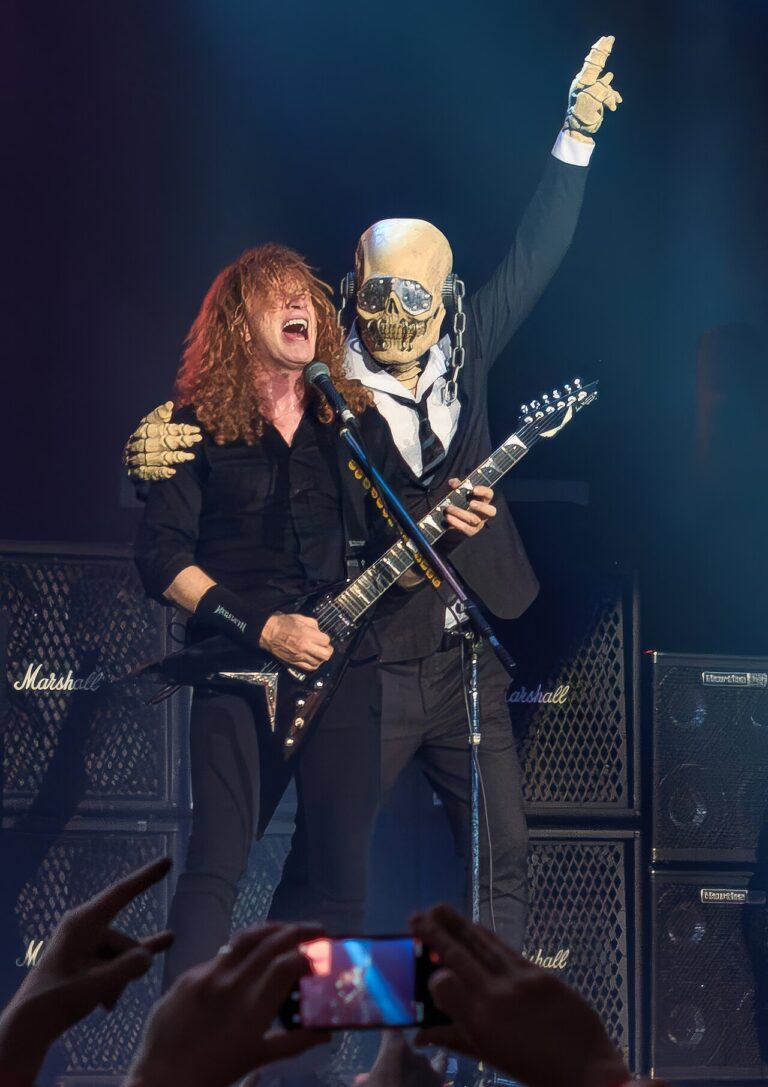
Dave Mustaine — Megadeth / Confirmed MT-2 User
Dave Mustaine’s association with the Boss MT-2 is confirmed through Boss official documentation and cemented by the 2019 charity auction he held through Reverb.com, during which he sold off a large quantity of personal gear — including an MT-2 bearing serial number FL61715. Premier Guitar lists Mustaine among the Metal Zone’s documented users, and his name appears in the Boss official retrospective article on the pedal. In the context of Megadeth’s gear history — a rig built around high-gain Marshall-derived tones, custom Jackson guitars, and a relentless pursuit of maximum clarity at extreme gain — the MT-2’s semi-parametric EQ would have been a useful tool for sculpting tight mid-heavy distortion. Whether it made recordings is not firmly established, but his personal ownership and use of the pedal is confirmed.
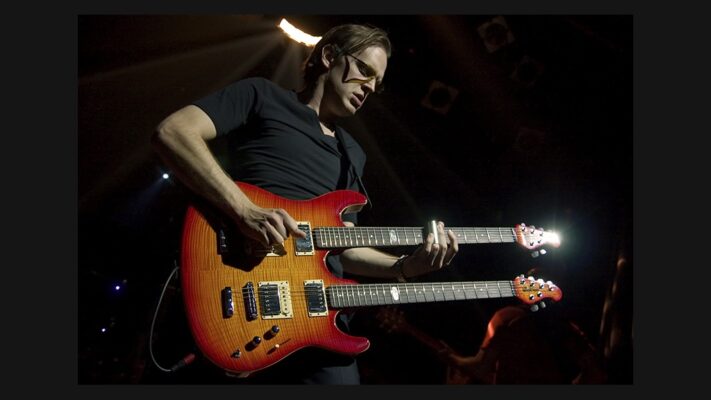
Joe Bonamassa — “My Go-To Boss Dirt Pedal”
Joe Bonamassa’s MT-2 advocacy is among the most genuinely surprising entries in the Metal Zone’s famous-player roster. In a Guitar World interview, Bonamassa named the MT-2 his favourite Boss “dirt” pedal and delivered the line that has become the clearest corrective to the pedal’s mistreated reputation: “Just because it’s called the Metal Zone, that doesn’t mean you need to run the gain all the way up.” A player whose primary sonic world is late-1960s British blues-rock and classic American electric blues turning to a Metal Zone for character suggests the MT-2’s EQ architecture can deliver textures well outside the obvious metal territory. Running it at lower gain settings, the pedal’s pre-distortion frequency shaping produces a mid-forward, harmonically complex bite that works in a blues context — an argument for the MT-2 as a genuinely versatile distortion that simply requires a more thoughtful approach than the all-knobs-at-max default.
Kirk Windstein — Down / Crowbar
Kirk Windstein’s MT-2 use is documented in the Wikipedia article on the Metal Zone with sourcing to MusicRadar’s extensive round-up of confirmed players. As the guitarist and vocalist of Crowbar and co-guitarist in Down, Windstein occupies a specific sonic territory — sludge metal and doom, where massive, dense, slow-moving distortion tones are the entire point. The MT-2’s ability to produce thick, saturated gain with its Low control boosted and midrange carefully shaped makes it a natural fit for a player whose entire aesthetic is built around weight and density. His confirmed MT-2 use is consistent with the pedal’s reputation in the doom/sludge community, where its bass response and extreme gain availability translate more naturally than in the faster thrash contexts where it gets maligned.
Warren Haynes — The Allman Brothers Band / Gov’t Mule
Warren Haynes’s presence on the MT-2 users list — documented in Sweetwater’s comprehensive history of the Metal Zone — is another example of the pedal crossing genre lines in ways its name obscures. Haynes’s primary sonic world is Southern rock and blues, territory where organic amp distortion and guitar dynamics are paramount. His use of the MT-2 points toward the same conclusion that Bonamassa draws: at lower gain with EQ carefully placed, the Metal Zone’s character is distinct from what its branding suggests. Whether Haynes deploys it as a primary drive or as a texturing tool in specific moments is not extensively documented, but his confirmed use belongs to the same category of unexpected MT-2 applications — players who know exactly what they’re looking for and found it in a pedal they weren’t supposed to be using.
Simon Neil / Biffy Clyro — The Definitive MT-2 Setting
Simon Neil of Biffy Clyro is the most extensively documented MT-2 user in the Boss official canon, with guitar tech Richard Pratt providing detailed settings and methodology in the Boss article on the pedal’s history. Neil runs the MT-2 through a Marshall 1959 Super Lead 100-watt reissue (one of three amps in his chain), and the interaction between the pedal’s EQ and that amp’s headroom is central to his sound. The specific setting Pratt documents: Level at 3 o’clock, Dist just over halfway, Low pushed to 3 o’clock, High at noon, with both the Mid Freq and Middle controls pulled back to around 10 o’clock — a deeply scooped configuration that removes the midrange content and lets the Low and High controls do the work. Pratt’s description: “It’s a big, serious, scooped distortion.” Neil runs a Fender Stratocaster with overwound Texas Special pickups through a front-end compressor, then into the MT-2, which then drives the Marshall SLP for an effect Pratt calls “a wall of sound” — the Marshall doing the frequency transmission at volume while two other amps (Fender clean, Audio Kitchen The Big Trees) cover other frequency zones. The MT-2 is “pretty much covering every single frequency” that the other amps aren’t. Neil uses factory-stock MT-2 units — modified ones “sound different to what he’s used to,” so Pratt sources standard production models.
Munky / Korn — Lo-Fi and Width
Korn’s Munky (James Shaffer) uses the MT-2 for a specific purpose rather than as a primary drive — guitar tech Jim Otell documented that the Metal Zone creates an “AM radio or lo-fi sound” in the Korn rig, notably on “Did My Time.” Running it into Mesa Boogie Triple Rectifier Solo heads, the MT-2 provides additional width and range to the dirty channel’s output. This is a sophisticated deployment: using the pedal’s extreme EQ architecture not to stack distortion on top of amplifier distortion in the straightforward sense, but to create a filtered, frequency-specific character that exists alongside the amp’s gain. The MT-2 here is a tone-shaping tool more than a distortion source. Confirmed via Boss official article and Equipboard documentation.
Kurt Ballou / Converge — Studio Tool at GodCity
Kurt Ballou’s relationship with the MT-2 is the most intellectually interesting of all documented users. As a guitarist in Converge — one of hardcore’s most critically respected bands — and as producer of dozens of significant heavy records at his GodCity Studio in Salem, Massachusetts, Ballou’s gear choices carry real weight. He has used the MT-2 in two modes: briefly in Converge to push vintage tube amps by cranking the output while keeping distortion low and EQ flat (even then, he notes, “it’s far from transparent”); and more consistently at GodCity, patched straight into a tube mic preamp to achieve what he calls “those blackened 4-track tones.” The direct-into-preamp use bypasses a guitar amplifier entirely, treating the MT-2 as a recording-specific signal processor rather than a performance pedal. “It doesn’t get used often,” Ballou says, “but when it does, nothing else will do.” His broader advice on the MT-2 is the most useful summary of its design logic: “Guitarists tend to turn things all the way up, but, as with most gear, that’s not typically the best way to use an MT-2.”
Tone Recipes and Settings
1. Classic Scooped Metal (Simon Neil / Biffy Clyro Method)
This is the most influential documented MT-2 setting: Level at 3 o’clock, Dist at 1 o’clock (just over halfway), Low boosted to 3 o’clock, High at noon, both Mid Freq and Middle pulled back to around 10 o’clock. Use into a 100-watt British-style amp with a 4×12 cabinet — the combination of the pedal’s scooped EQ and the amp’s natural volume response creates the “wall of sound” effect Biffy Clyro have built their live tone around. A compressor before the MT-2 tames pick dynamics for consistency. Requires volume to fully develop; monitor at performance levels to assess the low-end response correctly.
2. Moderate Gain Lead (The Bonamassa/Blues Approach)
Dist at 9–10 o’clock (lower than noon), Level at unity or slightly above, Low at noon, High between 11 and 1 o’clock, Mid Freq at around noon (targeting approximately 1–1.5kHz), Middle boosted slightly to 1–2 o’clock. This setting keeps the midrange present rather than scooped, producing a thicker, less fizzy character that works for blues-rock lead and classic rock rhythm. Use with a clean to slightly breaking-up amp — the MT-2’s pre-emphasis EQ gives the tone character and definition even at lower gain settings. Joe Bonamassa’s approach points in this direction.
3. Death/Sludge Metal Low-Tuned Rhythm
Dist at 2–3 o’clock, Level at noon, Low at 2 o’clock (boosted but not maxed — maximum Low can cause flub at drop or open tunings), High at 11 o’clock (slight cut to control fizz), Mid Freq at 7–9 o’clock (200–500Hz range, emphasising the low-mid body), Middle at noon (moderate). This setting targets the low-mid warmth that sludge and doom require — dense, saturated distortion with body rather than shriek. Works well with a high-headroom clean channel at stage volume. Consistent with Kirk Windstein’s stylistic territory.
4. Ballou Amp-Push Setting (Low Gain, Flat EQ)
Dist at 8–9 o’clock (nearly minimum), Level at 2–3 o’clock (high output to push the amp or preamp), High at noon, Low at noon, Mid Freq at noon (approximately 1kHz), Middle at noon (flat). As Ballou documented, this setting produces “some pre-emphasis EQ that’s always present which adds clarity and harmonics even at low gain” — using the MT-2 as an amp driver rather than a distortion source. High output into a tube amp’s input stage increases the amp’s own saturation and compression. A transparent pedal this is not (“far from transparent” by Ballou’s admission), but as a flavouring for amp drive it provides a consistent character absent from traditional boosters.
5. Direct-to-Preamp Studio Method
For recording without a traditional amp: MT-2 output direct into a tube mic preamp’s input. Set Dist at noon to 1 o’clock, Level at maximum to drive the preamp input hard, EQ adjusted for the frequency response of the preamp (most tube preamps benefit from a slight High cut at 10–11 o’clock and Low at noon to compensate for the transformer’s natural low-end warmth). Ballou’s approach at GodCity targets “blackened 4-track tones” — the character of cheap recorded distortion from the cassette-tape era, a sound difficult to achieve any other way. Useful for demo recordings, noise/experimental contexts, or any application requiring the aesthetic of degraded analog recording.
How the MT-2 Compares
The MT-2 occupies specific territory within the Boss distortion family that becomes clearer when you place it alongside its siblings. The Boss DS-1 is architecturally simpler — single gain stage, three controls — and produces a harder-edged, less saturated distortion with less EQ range. The DS-1 is easier to dial in and more immediately usable at a wider range of gain settings; the MT-2 rewards patience and offers greater tonal depth in exchange for a steeper learning curve.
The Boss SD-1 sits in a completely different category — asymmetric soft-clipping overdrive rather than hard distortion, voiced to push tube amplifiers rather than replace them. The SD-1 adds harmonic colour without the saturation level the MT-2 delivers; used together, with the SD-1 before the MT-2, you can add midrange warmth to the MT-2’s gain — though stacking them requires careful gain management to avoid excessive noise.
Against the Ibanez TS9, the contrast is starker still: the TS9 is a low-to-medium gain overdrive with a pronounced midrange hump around 720Hz designed to push tube amps into natural saturation. The MT-2 is a standalone distortion source with enough gain to function without a tube amplifier doing any work. They represent opposite design philosophies, and neither replaces the other.
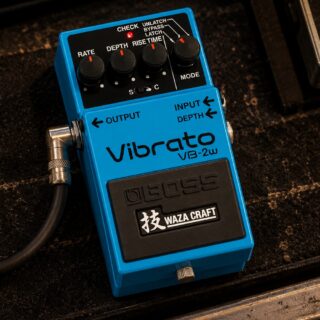
The MT-2W Waza Craft (2018) retains the original circuit in Standard mode with a lower noise floor, and adds a Custom mode that enhances lower mids and tightens the low-end response for a more focused, contemporary metal sound. Players who have always loved the MT-2’s fundamental character but found it slightly loose in the low end report the Custom mode addresses this specifically. At approximately $229–249 new versus $109.99 for the standard MT-2, it represents a meaningful upgrade for regular users rather than a casual purchase.
Outside the Boss family, the MT-2 competes with the Mesa/Boogie grid-of-controls philosophy (high-cost amplifier-based approach) that it was originally designed to democratise. Standalone comparison pedals include the MXR Fullbore Metal (~$100 new, more aggressive mid-scooping character with noise gate), the Digitech Metal Master (discontinued but common on the used market, ~$30–50, less EQ sophistication), and various boutique high-gain options at two to four times the MT-2’s price that target the same sonic territory with fewer controls and more opinionated voicing.
Buying Guide
The standard Boss MT-2 at approximately $109.99 new is one of the most straightforward purchases in pedal retail — it has been in production since 1991 with essentially no variation in the standard version, quality control is consistent (Simon Neil’s tech Richard Pratt explicitly notes consistency across units as a practical advantage), and the used market is saturated with examples at $50–80 in excellent condition. There is no vintage premium, no sought-after production run, no chip-sourcing mythology — all MT-2 units across the production history use the same core circuit and deliver the same fundamental character. This is unusual in the world of distortion pedals and is a genuine practical advantage.
The MT-2W Waza Craft at $229–249 new makes sense for a player who has already confirmed the MT-2’s usefulness in their rig and wants lower noise and the Custom mode’s tighter low-end. It does not transform the pedal into something categorically different; it refines what the MT-2 already does. If you are uncertain whether you like the MT-2’s sound, buy the standard version first.
The MT-2-3A 30th Anniversary limited edition (2021) has collector value beyond its sonic properties; it is not a sonic upgrade and should be assessed as such. Used examples appear at modest premiums over standard MT-2 pricing.
One practical note for used purchases: inspect the DC jack and check that the output is clean and consistent. The MT-2’s 7mA current draw means it will run indefinitely on any reasonable pedalboard power supply. There are no battery-related compromises or power-supply compatibility issues to navigate.
Ownership Notes
The MT-2 uses buffered bypass — the same electronic switching system as every other standard Boss compact pedal. This has the same practical implication as with the DS-1, SD-1, and BD-2: germanium Fuzz Face-type fuzzes placed after the MT-2 will interact poorly with its low-impedance output. If you run a vintage-style fuzz, place it before the MT-2 in the signal chain, not after. All other standard pedal types (overdrives, delays, modulation, reverb) interact normally with the MT-2’s output.
Noise is the MT-2’s most frequently cited practical issue, particularly at high gain settings. The pre-distortion gain stage amplifies everything entering it, including noise from single-coil pickups, poor cable shielding, and ground issues in the signal chain. A noise gate (Boss NS-2 is the most common pairing — Simon Neil’s tech uses it specifically with the MT-2) after the MT-2 controls the noise floor effectively. The NS-2 loop method (MT-2 in the NS-2 send/return) is the most noise-efficient approach and the one Biffy Clyro use on specific songs where a gated chug sound is required.
The Mid Freq control is the key to the MT-2’s character. Most players who dismiss the pedal have never seriously explored it — they have left it at its default position and adjusted the Middle knob without understanding that they are simultaneously choosing which frequencies that knob addresses. Spend time with Mid Freq alone, sweeping it through its range with Middle and the other EQ controls set to noon: you will hear the entire character of the pedal shift from nasal and cutting (high Mid Freq, targeting upper mids) through full and boxy (mid range) to warm and heavy (low Mid Freq, targeting low mids). The sweet spot varies by guitar, pickup type, and amplifier. Finding it is the investment that separates MT-2 owners who love their pedal from those who don’t understand why they bought it.
Volume is not optional for the MT-2 at scooped settings. At low volumes, a heavily scooped setting (Simon Neil’s approach) loses the low-end weight that gives it character and sounds thin. At stage volumes or through a proper monitoring setup, the physics of speaker air movement restore the impact. If you are exclusively a bedroom player, the MT-2 is better used at moderate gain with the EQ less dramatically sculpted than the classic scooped approach — the resulting tone is more balanced at low volumes.
FAQ
When was the Boss MT-2 Metal Zone released?
The Boss MT-2 Metal Zone launched in 1991 as a high-gain distortion pedal designed to provide metal guitarists with professional-level EQ control at a compact pedal price point. It replaced the Boss HM-2 Heavy Metal and has remained in continuous production since its debut, selling over one million units — more than any other Boss distortion or overdrive pedal except the DS-1.
What makes the MT-2’s EQ different from other distortion pedals?
The MT-2 uses a semi-parametric three-band EQ after its distortion circuit. The High and Low controls each offer approximately 15dB of cut or boost at fixed frequency points. The Middle control offers the same range, but its centre frequency is set by a separate Mid Freq knob that sweeps from 200Hz to 5kHz — meaning you choose which midrange frequencies to cut or boost before you apply the cut or boost. This level of control is unusual in a compact distortion pedal and is the source of both the MT-2’s flexibility and its reputation for being complex to dial in correctly.
Is the Boss MT-2 Metal Zone suitable for genres outside metal?
Yes. Joe Bonamassa names it his favourite Boss dirt pedal despite operating primarily in blues and classic rock. Kurt Ballou uses it at low gain settings for specific production applications at GodCity Studio. Warren Haynes has used it despite his Southern rock and blues primary context. The key is understanding that the MT-2’s maximum gain and maximum scooped EQ settings produce the stereotypically “bad” metal sound — but at moderate gain and with careful mid placement, the pedal’s character and pre-distortion harmonic complexity produce textures that work across genres. “Just because it’s called the Metal Zone, that doesn’t mean you need to run the gain all the way up” — Joe Bonamassa.
What is the difference between the MT-2 and the MT-2W Waza Craft?
The MT-2W (released 2018) retains the original circuit in Standard mode, with a lower noise floor than the standard production MT-2. It adds a Custom mode that enhances lower mids and tightens the low-end response — designed to address the slightly loose low frequencies that some players find in the standard MT-2 at extreme gain settings. Custom mode voices the pedal for contemporary metal approaches that favour tight, focused low-end over the broader, heavier low-frequency character of Standard mode. The MT-2W is not a sonic transformation; it is a refinement of what the standard MT-2 already does.
Does the MT-2 work well with single-coil pickups?
Yes, but with caveats. Simon Neil runs the MT-2 through Stratocasters with overwound Texas Special pickups — a confirmed successful application. Single-coil pickups are noisier than humbuckers, and the MT-2’s pre-distortion gain stage amplifies all input including pickup noise. A noise gate (the Boss NS-2 is the standard pairing) after the MT-2 controls the noise floor at high gain settings. Neil’s tech uses the NS-2 specifically on songs requiring a gated chug character. At moderate gain settings, single-coil noise is less of a practical issue, and the single-coil’s natural articulation and top-end definition interacts interestingly with the MT-2’s pre-distortion frequency shaping.
How should the MT-2 be positioned in the signal chain?
Standard position is after any wah and volume pedal, before time-based effects (delay, reverb). As a buffered pedal, the MT-2 actively drives the cable capacitance downstream — this means modulation, delay, and reverb pedals receive a clean, impedance-stable signal regardless of cable length. Germanium fuzz pedals should go before the MT-2 rather than after, as the MT-2’s low-impedance output interacts poorly with the high-input-impedance design of vintage Fuzz Face-style circuits. Overdrives and boosters placed before the MT-2 will push its gain stage further and alter the distortion character; placed after, they add output volume and mild colouration without affecting the distortion itself.
What amplifier does the MT-2 work best with?
A high-headroom tube amplifier provides the best results, particularly at scooped settings. Richard Pratt’s documentation of Simon Neil’s rig is explicit on this point: “Because of its enormous gain, we can only use the MT-2 if we use an amp with enough headroom. If we don’t, it can sound like the midrange is a bit too fizzy.” The Marshall 1959 Super Lead 100-watt reissue is Neil’s solution — adequate headroom to transmit the pedal’s full low-end response to a 4×12 cabinet at stage volume. Solid-state amplifiers and low-headroom combo amps produce the fizzy, thin character that gave the MT-2 its bad reputation; the same settings through an appropriate tube amplifier at volume deliver the wall-of-sound character that professional users achieve.
Why did the MT-2 develop such a negative reputation?
The combination of extreme gain availability, a complex EQ section that required understanding to use, and adoption by beginners who cranked every knob to maximum without guidance produced a generation of genuinely bad-sounding MT-2 tones. Premier Guitar’s observation that “the endless hordes of preteens that butchered ‘Crazy Train’ through a Metal Zone at their local Guitar Center probably didn’t help” the pedal’s reputation is accurate and fair. Music Radar attributed the problems to the tone controls being “too complicated” for players who hadn’t learned how to use them, combined with too much gain available by default. The same circuit, used intelligently by experienced players including Simon Neil, Prince, Joe Bonamassa, and Kurt Ballou, produces results that range from arena-filling walls of sound to studio-specific recorded textures. The MT-2 was not the problem. The instruction manual was.
Image credits
- Top image: Boss fx pedals by David J (sebilden). CC BY 2.0. Cropped to retain the target pedal and resized for web.
- Dave Mustaine: Justice for the Beholder of the Harvester of Blackened Straw, Wikimedia Commons, CC BY-SA 4.0.
- Joe Bonamassa: Raúl Ranz, Wikimedia Commons, CC BY 2.0.
- Boss MT-2 Metal Zone: GuitarGangsters AI-generated reference illustration, not a photograph.
Latest News
Related
On This Day
Thursday 12 November
From this week: