Analog Man King of Tone: The Waitlist Pedal That Became a Modern Legend
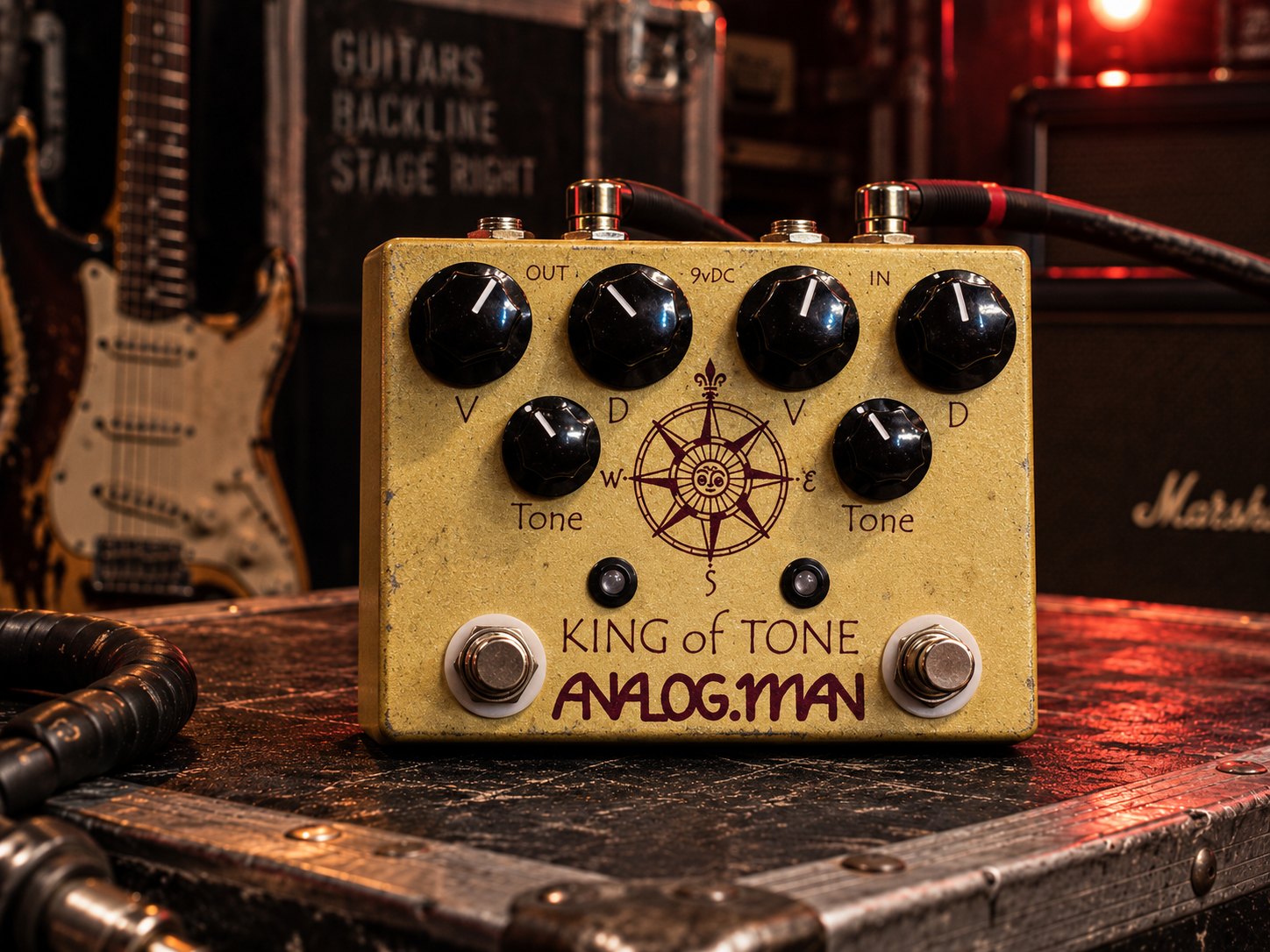
Analog Man King of Tone Overdrive Pedal. AI-generated reference illustration, not a photograph.
The Analog Man King of Tone is a handbuilt dual-overdrive with a famous waiting list. Full guide: specs, famous players, tone recipes and buying tips.
There is no other piece of guitar gear quite like the Analog Man King of Tone. Not because it delivers tones no other pedal can match — plenty of overdrives do remarkable things — but because of what it represents: a handbuilt, small-batch overdrive pedal operating out of Bethel, Connecticut, with a waiting list so long it’s become part of the mythology. Players have put their names on the list, forgotten about it, started bands, released albums, changed their rigs entirely — and then one day received an email saying their King of Tone was ready. That arc is not a bug in the story. It is the story.
For guitarists deep in the drive-pedal rabbit hole, the Analog Man King of Tone — universally abbreviated KOT — sits at the crossroads of obsession and pragmatism. It is beloved by working musicians who need a transparent, touch-sensitive overdrive that doesn’t fight with their amp, and simultaneously fetishized by gear collectors who wouldn’t dare use one through anything but a hand-wired boutique combo. Both camps are right. The KOT earns its reputation every time it gets plugged in.
This is the full story of where it came from, what it does, who plays it, how to dial it in, and whether the wait — or the premium on the used market — is worth it for you.
Origin: A Collaboration in the Catskills
The King of Tone was born out of frustration with the Ibanez Tube Screamer. Not because the Ibanez TS9 Tube Screamer is bad — it’s one of the most influential overdrive circuits ever designed — but because for Jim Weider, longtime guitarist for The Band, its signature mid-hump and compression were working against him rather than with him. Weider wanted an overdrive that let his guitar breathe: less compression, more headroom, transparency instead of coloration.
He brought the problem to Mike Piera, known in guitar circles simply as Analog Mike, who ran a boutique pedal shop and repair business in Connecticut. Piera had been doing mods on Tube Screamers and other classic circuits for years, and he understood immediately what Weider was after. The answer, they found, was a modified version of the Marshall Bluesbreaker pedal — a circuit from the early 1990s that Marshall had largely abandoned but which offered exactly the characteristics Weider needed: low compression, wide frequency response, and a natural feel that responded to pick attack the way a good tube amp does.
Piera began refining the design in the early 2000s, and after several prototype versions (Version 3 was briefly produced in late 2004 but plagued by footswitch issues), the definitive Version 4 arrived in the spring of 2006. It has remained essentially unchanged since. The KOT became the rare piece of gear that reaches its final form and stays there — no significant circuit revisions, no chasing trends, no “mkII” designed to fix something that was never broken.
The Design: Two Channels, One Vision
The King of Tone’s most distinctive feature is its dual-channel architecture. The enclosure contains two completely separate overdrive circuits, each with its own Volume, Tone, and Drive controls, each with its own footswitch. Those two circuits are routed in series — the right-hand (red) channel feeds into the left-hand (yellow) channel in the standard configuration — creating a system of remarkable versatility for what is mechanically a relatively simple design.
| Feature | Detail |
|---|---|
| Circuit basis | Modified Marshall Bluesbreaker |
| Channels | Two independent overdrive circuits in series |
| Controls per channel | Volume, Tone, Drive |
| Internal DIP switches | Select Clean, OD, or Distortion mode per channel |
| Power | 9V DC (standard center-negative) |
| True bypass | Yes |
| Construction | Handbuilt in Bethel, Connecticut, USA |
| New price (MSRP) | Approximately $245 |
| Used/secondary market | Typically $400–$700+, depending on version and options |
| Wait time (new) | Historically 2–6+ years; recent estimates ~22 months |
Inside the pedal, small DIP switches allow each channel to be configured in one of three modes: Clean (a boost with minimal overdrive character), OD (the standard transparent overdrive voicing), or Distortion (more gain and compression, closer to a light distortion than the other two modes). This means the KOT can function as a clean boost into a dirty overdrive, a dual-stage overdrive, or a stacked gain machine, all within the same housing. Most players use both channels in OD mode and stack them — one channel low on drive for always-on color, the second kicked in for solos.
The key sonic characteristic that distinguishes the KOT from Tube Screamer-derived circuits is what it doesn’t do. It doesn’t cut bass frequencies. It doesn’t compress your pick attack into a narrow dynamic window. It doesn’t push a pronounced mid-hump into an amp that already has its own EQ voice. Instead, it amplifies the signal with relatively flat frequency response and soft clipping that behaves somewhat like a tube stage being gently pushed into saturation. The result is transparency — the pedal sounds like your guitar and amp, just more of it, and with a musical edge when the drive is engaged.
This is not the right tool for everyone. Players who love a Tube Screamer’s focused midrange push for cutting through a dense mix may find the KOT slightly undefined by comparison. Players who want scooped, tight, modern gain need to look elsewhere. But for guitarists who want the amp to remain the primary voice — the KOT just gives it a firmer handshake — the circuit is nearly without peer among production overdrives.
The Waiting List: Myth Made Real
No discussion of the Analog Man King of Tone can avoid the waiting list. It has, at various points, stretched to four, five, and reportedly six years. Players have signed up for one while attending university and received it after graduating, getting a job, and moving to a different city. That is not a marketing gimmick or a calculated scarcity stunt. It is the direct result of a genuine manufacturing constraint.
The specific diodes and capacitors specified in the KOT’s circuit were discontinued by their manufacturers years ago. Analog Man had to stockpile them. Production capacity is constrained by how many units those stockpiled components allow. Mike Piera has chosen not to redesign the circuit to accommodate modern, more available substitutes — to do so would be to make a different pedal, and the KOT is what it is. Beginning in 2016, Analog Man imposed a four-unit lifetime limit per customer, because too many buyers were immediately flipping units at a profit on Reverb and eBay.
The secondary market confirms the demand. New KOTs list at approximately $245. Used examples in good condition typically sell for $400–$700, with rare early versions and specific option configurations pushing higher. A pedal that holds twice its retail value on the resale market is telling you something about what people who have actually played one think of it.
Famous Players
John Mayer
John Mayer is perhaps the most recognizable name associated with the King of Tone, and his use is confirmed by multiple pedalboard photographs and documentary evidence. Mayer’s approach to overdrive has always leaned toward transparency — he tends to play into high-headroom amps (Dumble, Two-Rock, custom Fender-style builds) that do most of the heavy lifting, and uses overdrive to nudge them further rather than to impose a dramatic character of their own. The KOT is perfectly suited to this philosophy. Whether he’s using a Fender Stratocaster or a Gibson Les Paul Standard, the KOT adds drive without erasing the guitar’s identity.
Kenny Wayne Shepherd
Kenny Wayne Shepherd brings a harder-edged, Texas-blues roar to his rig, and the KOT helps him push his Fender amps into the kind of saturated but still dynamic territory that defines that style. Shepherd’s playing is attack-heavy and physically assertive, and the KOT’s touch-sensitivity rewards exactly that — the harder you dig in, the more it opens up. His use of the pedal is documented on Equipboard and consistent with his general preference for drive that lets his Stratocaster breathe.

Other Documented Users
The broader confirmed player list for the King of Tone reads like a who’s-who of players who care about transparency above all else. Trey Anastasio of Phish has used one in a rig that prizes dynamic feel over raw gain. Rich Robinson of the Black Crowes reportedly got his from Jim Weider himself while at Levon Helm’s studio in Woodstock — the pedal literally passing from the guitarist who helped birth it to another roots-rock legend. Noel Gallagher, Jason Isbell, Joey Landreth, Jimmy Herring, Brent Mason, and Pete Thorn are among the names associated with the KOT across various sources and rig documentation.
A Note on Unconfirmed Claims
For accuracy: Jim Campilongo’s documented rig centers on a minimalist setup — Telecaster into Fender Princeton, with JAM Pedals endorsements and a philosophy of playing as directly into the amp as possible. No primary-source confirmation (Premier Guitar rig rundown, manufacturer artist page, video footage) places a King of Tone on his board. He is mentioned in some web discussions, but that does not constitute verification. Josh Smith similarly does not use the Analog Man King of Tone — he uses King Tone Montreal Assembly pedals (the Soloist Overdrive and The Duellist), which are entirely separate products from an entirely separate company. The name similarity causes frequent confusion online. Both guitarists are exceptional players worth following; neither appears to use this specific pedal based on available documentation.
Tone Recipes and Settings
The Stacked Blues Cannon
This is the classic KOT application. Set both channels to OD mode. Left channel: Drive at 9 o’clock, Tone at noon, Volume to unity with bypass. Right channel: Drive at 10 o’clock, Tone at 11 o’clock, Volume slightly above unity. Use the left channel as your base tone — a gentle push that keeps the amp warm — and kick the right channel in for solos. The stacked result stays clear and defined because neither channel is compressing heavily on its own.
The Transparent Boost Platform
Left channel set to Clean mode with Drive at minimum and Volume at whatever level you want to hit the amp harder. Right channel in OD mode with Drive at 10–11 o’clock. This gives you a clean volume boost on one footswitch and a warm overdrive on the other, both transparent enough to stack under a fuzz if needed. Pairs well with a Fender Deluxe Reverb that’s already running a bit warm.
The Singing Lead Voice
Both channels in OD mode. Left channel: Drive at noon, Tone at noon, Volume just above unity. Right channel in Distortion mode: Drive at 9 o’clock, Tone at 10 o’clock, Volume matched. The distortion mode on the right adds compression and sustain that makes notes sing without losing the fundamental attack. This is particularly effective with a Les Paul-style humbucker guitar where the extra warmth becomes bloom rather than muddiness.
The Always-On Color
Many professionals use the KOT not for dramatic drive jumps but for permanent coloration. Set the left channel to Clean mode with Drive at zero and Volume at +3–5dB above bypass. Leave it on all the time. It warms the signal, removes the “cold” feel that even good quality cables and true-bypass switching can introduce, and gives your amp the feeling of being hit by a slightly hotter source. The right channel functions as your primary overdrive before the left-channel boost. The boost raises the level after the overdrive rather than driving its input harder; whether this produces a louder output or more amp distortion depends on the amp’s available headroom.
Comparisons and Context
The King of Tone occupies a specific niche in the overdrive landscape that’s worth mapping against its near neighbors. The Ibanez TS9 Tube Screamer is the circuit the KOT was explicitly designed to not be: the TS9’s mid-hump and bass cut focus it beautifully for cutting through a mix, but that character is always there regardless of what the guitarist wants. The KOT lets more of the fundamental guitar sound pass through unaltered.
The Boss BD-2 Blues Driver is interesting to compare because it also offers a relatively flat frequency response and a picking-attack-sensitive clipping behavior. The BD-2 is cheaper, available everywhere, and sounds excellent — but its gain structure is somewhat rougher and more asymmetric than the KOT’s smooth Bluesbreaker-derived clipping. The BD-2 is a working musician’s pedal; the KOT is what happens when you refine that concept in a boutique setting over two decades.
The Marshall Bluesbreaker itself — the original circuit the KOT modifies — is rare and increasingly expensive. Various modern recreations exist (the Wampler Paisley Drive, the J. Rockett Archer, several others), and many are excellent. But the specific voicing, component tolerances, and layout choices Piera has made in the KOT represent years of refinement on top of the original design, not a straight clone. It sounds like a better Bluesbreaker because it is.
The JHS Morning Glory, the Keeley Blues Driver, and the Wampler Tumnus all chase similar sonic territory at lower price points and without waiting lists. Any of them might satisfy a player who needs this character of overdrive immediately. But none of them are quite the same circuit, and in blind testing, experienced players consistently identify the KOT as having a particular feel — a kind of elasticity and dynamic openness — that they find harder to replicate elsewhere.
Buying Guide
There are essentially three ways to obtain a King of Tone in 2026:
Get on the waiting list: Go directly to analogman.com and follow the current instructions for joining the waiting list. There is no deposit required. When your name reaches the top, you’ll receive an email with a short window to purchase. The base price is approximately $245, with additional charges for optional LED upgrades, different diode configurations, and internal mods. This is the only way to get a new, fresh-from-the-shop KOT. The wait is real, currently estimated in the range of 22 months, though this figure fluctuates.
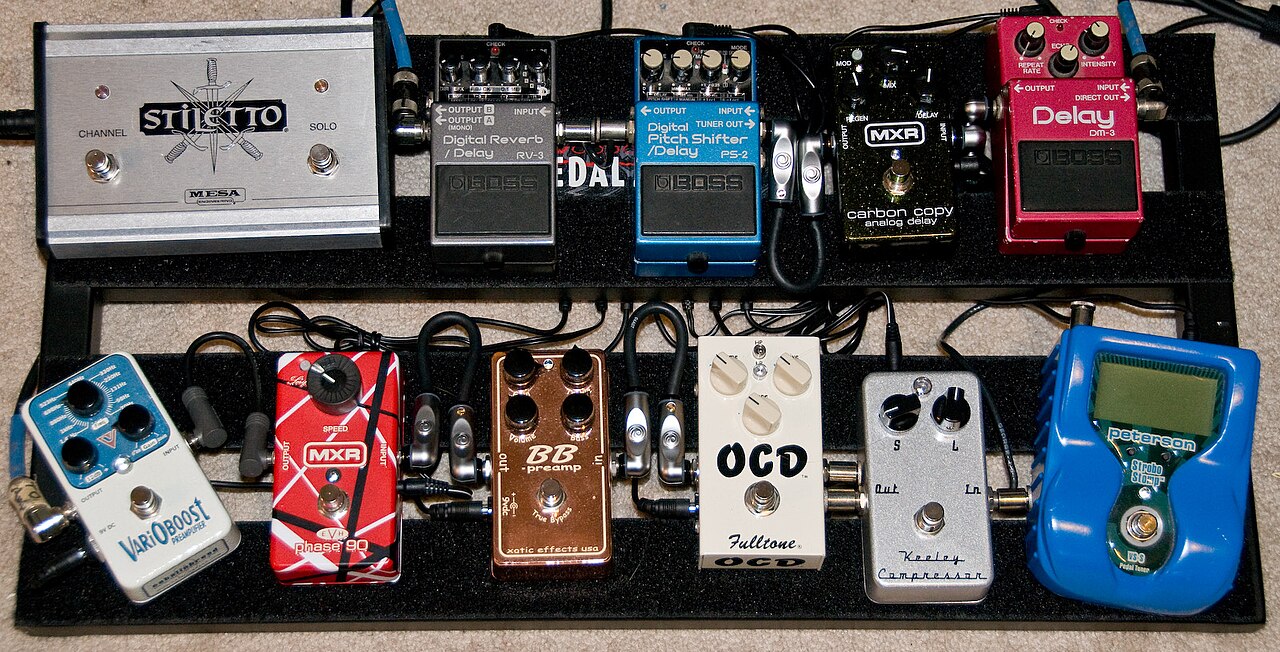
Buy used: Reverb, eBay, and guitar-forum classified sections surface KOTs regularly. Expect to pay $400–$700 for a clean example in working order. Version 4 units (the current version, identifiable by the “Ver4” marking or date codes after spring 2006) are what you want — the earlier versions had footswitch reliability issues. Verify that all four knobs (two per side) turn smoothly and that both channels switch cleanly. Internal DIP switches should be accessible via a small hole in the back panel.
Consider alternatives: If the wait and premium pricing are prohibitive, the sonic territory the KOT occupies is genuinely approachable via the JHS Morning Glory V4, Wampler Tumnus Deluxe, or the Marshall Bluesbreaker reissue (the “Origin” series recreation). None are identical, but all share the Bluesbreaker-derived character of transparency and dynamic response.
Ownership Notes
The KOT is a robust, straightforward pedal to own. There are no batteries — it runs on standard 9V center-negative DC only, with typical current draw well under 10mA per channel. It does not have expression pedal capability or MIDI. It is entirely analog. The internal DIP switches are accessed via holes in the back panel and can be adjusted with a small flathead screwdriver without opening the enclosure.
One practical note: because both channels are in series, the order in which you engage them matters. Turning on the left channel alone gives you one stage of overdrive. Turning on the right alone gives you a second stage. Turning on both gives you the stacked result. Engaging the right channel with the left off, then engaging the left, will produce a volume jump rather than a gradual increase — something to be aware of during performances where you’re making channel changes under pressure.
The KOT is true bypass on both channels via 3PDT switches. Some users report slight signal degradation from running through both true-bypass switches when the pedal is fully bypassed — this is a known behavior of true bypass in general rather than a KOT-specific issue, and it’s audible only in high-gain, low-noise studio contexts or when A/B’d directly with the buffered output of another device in the chain.
Frequently Asked Questions
Is the Analog Man King of Tone worth the wait?
For guitarists who have a specific need for transparent, touch-sensitive dual-stage overdrive and want the most refined version of Bluesbreaker-derived circuitry available, yes — with patience. If you need an overdrive now and your primary amp is anything other than a boutique clean platform, the gap between the KOT and high-quality alternatives like the JHS Morning Glory or Wampler Tumnus is narrower than the wait would imply.
What is the difference between the King of Tone and a Marshall Bluesbreaker?
The King of Tone is a dual-channel modification and refinement of the Bluesbreaker circuit, with component selection refined over years, internal mode switching options the original lacked, and a series-chained dual-channel architecture. It’s better in almost every technical sense — but the Bluesbreaker reissue is a much cheaper entry point to the same sonic neighborhood.
Can the King of Tone replace a Tube Screamer?
Functionally, yes. Sonically, they do different things. The TS circuit cuts bass and boosts mids, creating that famous nasal focus. The KOT preserves bass and passes a flatter frequency range, creating a more transparent drive. If your amp needs the Tube Screamer’s focus to sit in a mix, the KOT may sound undefined. If your amp already has character and you want drive that works with it rather than reshaping it, the KOT is the stronger choice.
What are the internal DIP switch options?
Each channel has a three-position DIP switch that selects Clean mode (volume/boost with minimal clipping), OD mode (the standard Bluesbreaker-derived overdrive), and Distortion mode (more gain and compression, closer to a light distortion character). The switches are accessible from the back panel without opening the pedal.
How does the dual-channel design work in practice?
The two channels are in series — left feeds right. You can use either channel independently or stack them for additional gain and density. The most common configuration is both channels in OD mode, left at a lower drive setting for base tone and right kicked in for solos. The series routing means the right channel’s input sees whatever the left channel is outputting.
What does the King of Tone sound like with humbuckers versus single-coils?
Both work beautifully, but in different ways. Single-coil guitars (Stratocasters, Telecasters) pick up the KOT’s clarity and openness most directly — the transparency of the circuit allows the coil’s natural character to come through. Humbuckers push the KOT’s input harder, which generates more harmonic richness and earlier saturation at the same Drive setting. Les Paul players may want to set Drive slightly lower than Strat players for equivalent gain levels.
Is the used market price justified?
From a purely sonic standpoint: probably not — excellent alternatives exist at lower prices. From a scarcity standpoint: the secondary market is simply reflecting supply and demand. If you want this specific circuit right now rather than in 22 months, you’re paying for immediacy. Whether that premium is worthwhile depends entirely on whether you have a pressing need and no acceptable alternatives.
What amps pair best with the King of Tone?
The KOT was designed to work with amplifiers that already have character — clean-to-edge-of-breakup tube amps where the overdrive circuit is nudging the amp further rather than creating gain from scratch. Fender-style amps (Deluxe Reverb, Princeton, Twin Reverb) are the classic pairing. High-headroom clean platforms (Two-Rock, Dumble-style, boutique Fenders) showcase its transparency most fully. It can work into dark-voiced British amps, but the result is denser and may require Tone adjustments to maintain clarity.
Image credits
- A pedalboard with a mix of effects pedals: ArtBrom, Wikimedia Commons, CC BY-SA 2.0.
- Kenny Wayne Shepherd: Andreas Lawen (Fotandi), Wikimedia Commons, CC BY-SA 4.0.
- Top image: GuitarGangsters AI-generated reference illustration, not a photograph.
Latest News
Related
On This Day
Monday 9 November
From this week: