Way Huge Green Rhino Overdrive MkV: The Smallest Rhino in the Herd, and the Most Misunderstood
The Way Huge Green Rhino MkV packs a Tripps-designed Tube Screamer variant into a Smalls box. Full specs, verified players, tone recipes and buying advice.
There is a particular kind of pedal that never gets written about properly, and the Way Huge Green Rhino Overdrive MkV is the patron saint of the type. It is not rare enough to be collectable. It is not weird enough to be a conversation piece. It does not have a signature artist, a limited run, a hand-painted enclosure, or a mythology built out of forum arguments. It is a green Tube Screamer variant in a small box, and for four years it sat quietly on the shelf at every major retailer while people walked past it to buy something with a better story.
And yet if you actually put one in front of an amp, the thing does something that most of the pedals with better stories cannot do: it lets you decide, with a single knob and a single internal switch, exactly how much low end and exactly how much low-midrange your overdrive has. That is not a small thing. It is arguably the single most common complaint players have about the entire Tube Screamer family, and Jeorge Tripps solved it in 1994 — or 1996, depending on which source you believe, and we will get to that — and has been refining the solution ever since.
Housekeeping: the version numbers on this pedal are a genuine mess, and nobody warns you
Before a single word about tone, some untangling is required, because the Green Rhino’s naming history is the most confusing in the Way Huge catalogue and it directly affects what you should buy.
First: the original 1990s pedal was never called “the Green Rhino MkI.” It was called the Green Rhino Overdrive II, and the “II” had nothing to do with revisions. It was there to distinguish it from Way Huge’s other overdrive, the Red Llama. There was only ever one version of the Green Rhino during the company’s original 1992–1999 lifespan, and it was always the Overdrive II. So when you see a MkII on Reverb and think “ah, the second one,” you are looking at a pedal from 2011 that shares a numeral with a pedal from the mid-nineties by pure coincidence.
Second: there is no MkIII. Aion FX, whose Karkadann project is a direct adaptation of the MkII circuit and whose documentation is the most careful public account of the pedal’s lineage, notes flatly that “there is no record of a Mark III” — either it was an unreleased prototype or Dunlop simply skipped a number.
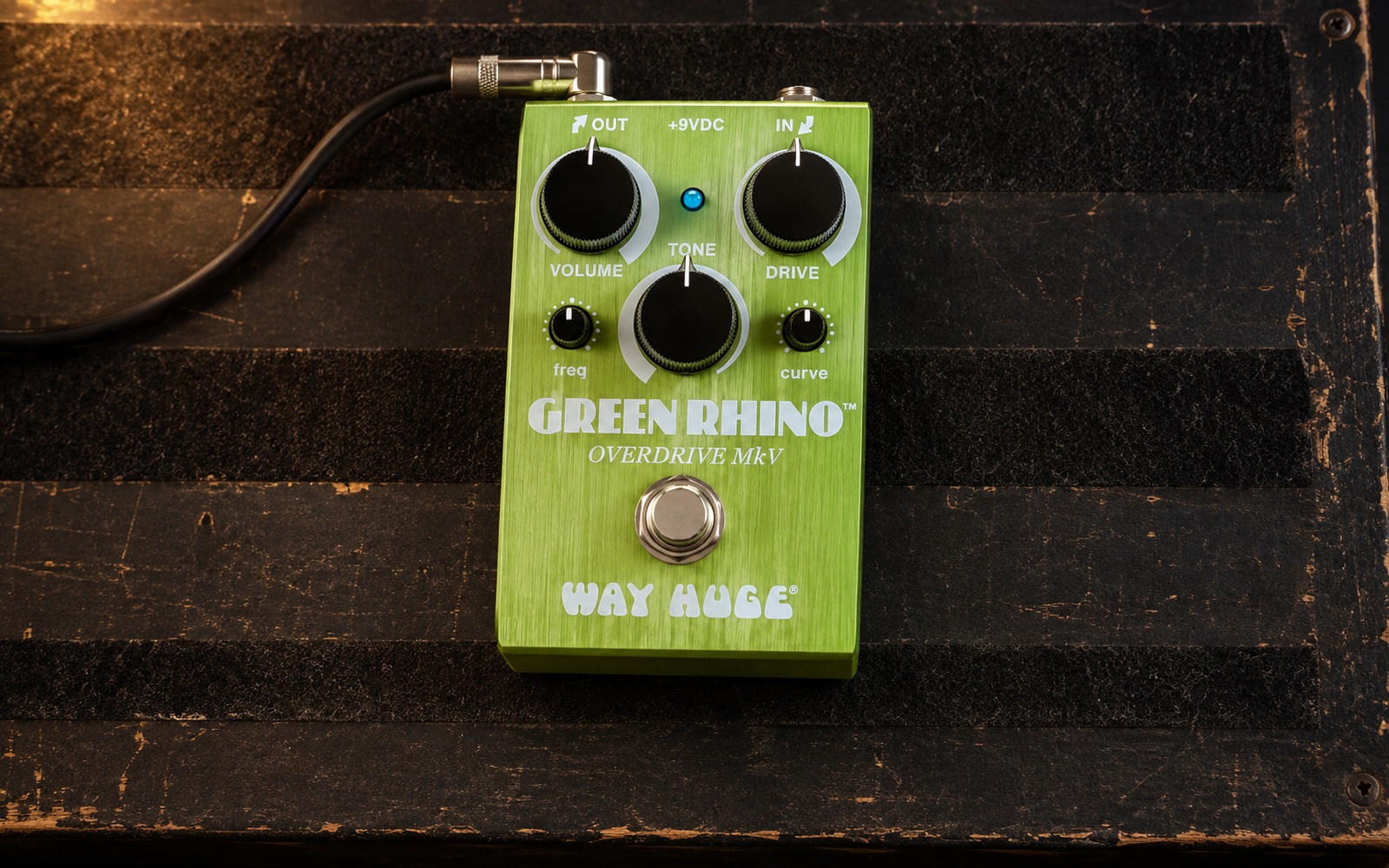
Third, and this is the one that costs people money: the MkV is not a newer or better MkIV. It is a smaller, differently-featured pedal released four years later. The MkIV (WHE207, 2016) is a standard-size enclosure with separate 100 Hz and 500 Hz controls plus a Classic switch that drops both EQ stages to return the pedal to the sound of the 1990s original. The MkV (WM22, 2020) is a Way Huge Smalls-format box with one Freq knob, whose centre frequency you choose with an internal switch, plus the Curve control the MkIV had dropped. Neither is the superset of the other. They are siblings, not sequels.
Fourth, and most current: the MkV is discontinued. Dunlop’s own product page carries the line “LEGACY PRODUCT / NO LONGER IN PRODUCTION” in bold at the head of the description. Retail stock has not caught up — Sweetwater, Guitar Center, Musician’s Friend and Amazon were all still listing it new at $159.99 as of September 2026, with Reverb showing new units at $143.99 and used ones from $75. That gap between “the factory has stopped” and “the shops still have some” is the buying window, and it will not stay open.
Where the Rhino came from: Jeorge Tripps, 419 pedals, and a decade of silence
Way Huge Electronics was founded and run by Jeorge Tripps, and the company was active between 1992 and 1999. That is a short window, and the production numbers were tiny. Aion FX puts the figure at 419 units of the Green Rhino Overdrive II produced while Way Huge was active — and this was, technically, the company’s best-selling pedal. Four hundred and nineteen. For context, that is fewer pedals than a mid-size builder now ships in a good month.
The design brief was simple and, for its moment, slightly heretical. Like most boutique overdrives of the period, the Green Rhino took the Ibanez TS-808 Tube Screamer as its starting point — you can read the full story of that circuit in our feature on the Ibanez TS808 Tube Screamer — but where most builders treated the 808’s midrange hump as gospel, Tripps treated its bass rolloff as a bug. He built in more low-end thump. In 1994 that was a minority opinion. Today the “Tube Screamer with the bass put back” is practically its own product category.
When Way Huge closed its doors, the Green Rhino did the thing that only happens to genuinely good, genuinely scarce pedals: it became more desirable than the thing it was copying. Premier Guitar‘s Jordan Wagner, reviewing the reissue in December 2010, put it plainly — the Green Rhino “became arguably more desirable to collectors than the pedal that it was designed to emulate,” commanding several hundred dollars used at a time when a TS-808 reissue was pocket change.
In 2008 Tripps went to work for Jim Dunlop, who wanted the Way Huge brand back with real manufacturing behind it. Tripps designed the MkII himself and it shipped in 2011 at a $129 street price. The MkIV followed in 2016. The MkV — announced from Benicia, California on 30 July 2020, street $129.99 — was the fifth-numbered, fourth-actual member of the family, and the first to fit in the Smalls enclosure.
The 1994-versus-1996 problem
Premier Guitar says the Green Rhino was “originally introduced in 1994.” Aion FX says the original “was first released in 1996.” Both are careful, well-sourced outlets and neither cites a first-party document, because there does not appear to be one: Way Huge in its original incarnation was a very small operation that did not produce dated catalogues. We state both and take neither as settled. What is not in dispute is the window — mid-nineties, during the 1992–1999 company lifespan — and the fact that fewer than 420 were made.
Which Green Rhino is which
| Version | Year | Enclosure | EQ controls beyond Tone | Notes |
|---|---|---|---|---|
| Green Rhino Overdrive II | 1994 or 1996 (disputed) | Original Way Huge full-size | None — Volume, Tone, Drive only | ~419 units total; “II” distinguishes it from the Red Llama, not from a MkI |
| MkII | 2011 | 2 mm brushed aluminium, full size | 100 Hz (±12 dB) and Curve | Designed by Jeorge Tripps at Dunlop; $129 street; the version most pros own |
| MkIII | — | — | — | Does not exist in any public record |
| MkIV (WHE207) | 2016 | Slimmer full-size | 100 Hz, 500 Hz, plus Classic switch | Drops Curve; Classic switch bypasses both EQ stages for the 1990s voice |
| MkV (WM22) | 2020 | Way Huge Smalls | Freq (100 Hz or 500 Hz, internal switch) and Curve | $129.99 launch; no Classic switch; discontinued, legacy status on Dunlop’s site |
Specifications
All figures below are from Dunlop’s own WM22 manual unless noted. Dunlop states that all measurements were made with the controls at centre.
| Specification | Figure |
|---|---|
| Model number | WM22 |
| Effect type | Overdrive (analogue, op-amp based, Tube Screamer topology) |
| External controls | Volume, Drive, Tone, Curve, Freq |
| Internal control | Freq centre-frequency switch: 100 Hz or 500 Hz |
| Input impedance | 600 kΩ |
| Output impedance | 3 kΩ |
| Nominal input level | +6 dBV |
| Throughput gain | Up to +50 dB @ 1 kHz |
| Tone control at full counter-clockwise | −20 dB @ 3 kHz |
| Bypass | True bypass |
| Current draw | 18.5 mA |
| Power requirement | 9 V DC |
| Power connector | 5.5 mm × 2.1 mm, positive voltage on the outer sleeve (i.e. standard centre-negative) |
| Battery | Single 9 V; external supply disconnects the battery; unplug the input jack to preserve battery life |
| Recommended supplies | Dunlop ECB003, DC Brick, Iso-Brick, Mini Iso-Brick |
| Jacks | Top-mounted, 1 × 1/4″ in, 1 × 1/4″ out |
| Launch street price | $129.99 (July 2020) |
| Status | Legacy product, no longer in production |

A note on the dimensions you will find online. Equipboard’s spec block lists height 2.3″, width 3.7″, depth 4.9″ and a weight of 0.81 lbs for the MkV. Those are almost certainly shipping-carton figures, not the pedal. The whole selling proposition of the Smalls format is that it is substantially narrower than a standard compact enclosure, and a box measuring 3.7″ × 4.9″ would be larger than a Boss compact, which is the opposite of the truth. Trust the format, not the aggregator. Dunlop does not publish enclosure dimensions for the WM22 in the manual, which is why the bad figure has propagated unchallenged.
The controls, one at a time
Volume
Output level. Given a throughput gain spec of up to +50 dB at 1 kHz, there is far more on tap here than unity, and the Rhino will happily function as a straight level-shove into an amp that is already cooking. Most players run it somewhere in the lower third for a rhythm sound and use the extra as a solo shove.
Drive
Overdrive intensity, and the most conventional control on the pedal. The important characteristic — reported consistently by owners and matching the circuit’s Tube Screamer heritage — is what happens at the bottom of the sweep. At zero Drive the Green Rhino retains a gentle, nearly clean tone with mid emphasis, which is noticeably less distorted than a TS-808 at a comparable setting. It works as a mid-forward clean boost in a way a stock 808 does not.
Tone
EQ from warm to bright, and it is a passive control: it cuts high end as you turn it down rather than adding anything as you turn it up. Dunlop quantifies the extreme — full counter-clockwise gives −20 dB at 3 kHz, which is a very substantial darkening. Owner consensus, gathered from the r/guitarpedals threads Equipboard aggregates, puts the useful window between roughly 2 and 4 o’clock for a balanced sound with most rigs.
Curve
This is the control that separates the Green Rhino from every other green box, and it is widely misunderstood because it is subtle. Dunlop describes it simply: it “tames aggressive highs.” Premier Guitar, reviewing the MkII where the control debuted, was more precise: Curve cuts frequencies above 1 kHz by as much as 6 dB, but it does so inside the clipping stage, which makes it far more subtle than a straight 1 kHz shelf applied after the fact.
That “inside the clipping stage” detail is the whole point. Because you are shaping the signal before it is clipped rather than after, you change the character of the distortion, not just its brightness. Wagner’s description in that review — a control “more felt than heard” — is exactly right, and it is why players coming from a Tube Screamer often report that Curve does nothing for the first ten minutes and then becomes the knob they cannot live without. One owner’s framing is the most useful shorthand available: it behaves like a presence control in reverse.
Freq
A cut/boost with a detented, notched neutral centre position, operating at either 100 Hz or 500 Hz depending on the internal switch. On the MkII, Premier Guitar measured the equivalent 100 Hz control’s range at a full ±12 dB, and Dunlop’s MkIV literature quotes the same ±12 dB figure for both bands, so that is the range to assume here.
At 100 Hz you are working on the fundamental low end — the thing every Tube Screamer variant famously removes. Boosting it turns the Rhino from a blues-lead pedal into a standalone rhythm overdrive that can hold down a riff. Cutting it tightens the pedal for high-gain amp front-ends where extra bass just turns to mud.
At 500 Hz you are working on the low-mids — the honk-versus-scoop region. Boosting adds the bark that helps a guitar cut through a dense mix; cutting hollows the pedal out and moves it towards a more modern, scooped drive character.
The internal switch, and a correction
The Freq switch is a small internal DIP switch. Reaching it means opening the pedal — which guitar.com flagged in its launch coverage as the MkV’s one genuine ergonomic complaint, and it is a fair one. This is a set-and-forget decision, not a performance control.
Two claims that circulate about this switch are wrong, and both come from the same aggregated owner-comment pool. One says the internal switch toggles between 500 Hz and 1 kHz. It does not; Dunlop’s manual, the launch press release and the product page all say 100 Hz or 500 Hz, and they agree with each other, which is rarer than it should be. The other says a “toggle switch up activates classic TS808 mode, bypassing the 100 Hz and 500 Hz knobs.” That describes the MkIV’s Classic switch, not the MkV. The MkV has no Classic switch and no way to bypass its EQ stage other than parking Freq at its notched centre. If a listing or a forum post promises you Classic mode on a MkV, the seller has the wrong pedal in mind.
Famous players: an honest accounting
This section is going to be shorter and blunter than the internet would like, because the honest answer is the interesting one.
There is no verified professional user of the Green Rhino MkV specifically. Equipboard, which tracks pro rigs and which lists 28 artists for the MkII and 9 for the MkIV, has an empty artist-usage section for the MkV and a single community setup. Its genre-usage tallies for the model run to single digits. We looked for a rig rundown, a board photo, an interview citation — anything model-specific — and did not find one. Anyone telling you a named professional plays a MkV is, at best, describing a Green Rhino of unspecified vintage.
That is not a knock on the pedal. It is a consequence of two things. The MkV shipped in July 2020, into a world with no tours, no rig rundowns and no backstage board photography for the better part of two years — the same timing problem that has flattened the documented rosters of half the pedals released that year. And professionals who already owned a Green Rhino had no reason to replace a working full-size MkII with a smaller version of roughly the same circuit.
What is verified is the family. These are Green Rhino users of other generations, and their relevance here is that they are playing substantially the same circuit:
- Troy Van Leeuwen (Queens of the Stone Age) — the strongest documented case. Premier Guitar‘s Rig Rundown puts a Way Huge Green Rhino in a rack drawer alongside an Aqua-Puss, an EarthQuaker Devices Dispatch Master, a Fuzzrocious Demon and an MXR Q Zone, with Way Huge Supa-Puss and Pork Loin stomps on the main board. Van Leeuwen is not in our guitarist archive, but his bandmate Josh Homme is, and the QOTSA guitar rig is a two-person system.
- Paul Gilbert — documented with a Green Rhino MkII on his board. Gilbert is a long-standing Way Huge user across several models, which makes the credit more persuasive than a one-off photo.
- Stone Gossard — photographed with a Green Rhino MkII, sitting between a Boss tremolo and a ZVEX Box of Rock. That neighbour is telling: a mid-forward TS variant next to an amp-in-a-box is a classic two-stage rhythm/lead arrangement.
- Tony Esposito (White Reaper) — a MkIV, in a documented touring board with a TC Electronic Polytune, Boss GE-7, Boss NS-2, a Jacques analogue chorus and a Boss DD-8.
- Juan Alderete — a MkII. A bass credit, which matters more than it looks (see below).
- Dallas Green, Tim Wheeler and Sae Otsuka — the three artists Equipboard surfaces for the MkIV.

The pattern worth noticing is the bass credit. Alderete’s MkII is not an outlier. Wagner’s Premier Guitar review closes with an unusually direct aside — he ran the MkII into an Ampeg BA115 with a Kramer USA Striker bass and wondered aloud why Way Huge did not simply build a bass version, telling bassists in italics that they need to try it. A Tube Screamer variant with ±12 dB at 100 Hz is, functionally, a bass overdrive that happens to be marketed at guitarists. If you play bass and have been ignoring green pedals on principle, this is the one to reconsider.
Tone recipes
1. The honest 808 (Freq switch: either)
Volume 11 o’clock, Tone 2 o’clock, Drive 10 o’clock, Curve fully counter-clockwise, Freq at the notched centre. This is the closest the MkV gets to the original Overdrive II voice, since it has no Classic switch to do it for you. Mid-forward, dark-ish, polite. Use it into a clean amp as a mid-hump for solos.
2. Standalone rhythm (Freq switch: 100 Hz)
Volume noon, Tone 2 o’clock, Drive 1 o’clock, Curve 10 o’clock, Freq 2 o’clock. The 100 Hz boost puts back everything the Tube Screamer topology removes. This is the setting that turns the Rhino from a lead pedal into something you can play a whole set on — Stonesy open-chord work, sixteenth-note riffing, anything where a thin drive falls apart.
3. Amp shove for a cooking Plexi (Freq switch: 100 Hz)
Volume 2 o’clock, Tone noon, Drive 8 o’clock, Curve noon, Freq 10 o’clock. Barely any Drive, plenty of Volume, and a cut at 100 Hz so the amp’s own bass doesn’t turn to porridge. Compare with the approach in our Wampler Plexi-Drive Deluxe feature — this is the front-end version of the same idea.
4. Strat blues (Freq switch: 100 Hz)
Volume 11 o’clock, Tone 1 o’clock, Drive 11 o’clock, Curve 9 o’clock, Freq 1 o’clock. Owners consistently report this territory as the pedal’s Stevie Ray Vaughan setting with a Strat, and the reason is the 100 Hz boost: SRV’s tone was never thin, and a stock Tube Screamer into a single-coil bridge pickup is.
5. Cut-through lead (Freq switch: 500 Hz)
Volume 1 o’clock, Tone 2 o’clock, Drive 1 o’clock, Curve 11 o’clock, Freq 2 o’clock. Boosting the low-mids is how you get a guitar to sit in front of a dense arrangement rather than beside it. This is also the setting most likely to trip the pedal’s documented weakness — see the ownership notes below on bass masking.
6. Modern scoop (Freq switch: 500 Hz)
Volume noon, Tone 3 o’clock, Drive 2 o’clock, Curve noon, Freq 9 o’clock. Cutting 500 Hz hollows the classic Tube Screamer honk out of the middle and leaves something closer to a transparent drive. If this is where you always end up, you may actually want an EarthQuaker Devices Plumes or a MXR Timmy instead, and that is a genuinely useful thing to learn about yourself.
7. Edge of breakup on a clean solid-state amp (Freq switch: 100 Hz)
Volume 1 o’clock, Tone 1 o’clock, Drive 8 o’clock, Curve 9 o’clock, Freq 1 o’clock. Owners report this specific use case repeatedly — a small clean amp, a Strat, and the Rhino doing the entire job of the missing power-stage compression. The near-clean behaviour at low Drive is what makes it work.
8. Stacked into a second drive (Freq switch: 500 Hz)
Volume 2 o’clock, Tone noon, Drive 9 o’clock, Curve noon, Freq noon. Rhino first, tighter drive second. Owners specifically flag pairing with a Boss BD-2 Blues Driver or a Plexi-style box for Eric Johnson and eighties-metal lead territory.
9. Bass overdrive (Freq switch: 100 Hz)
Volume noon, Tone 11 o’clock, Drive 11 o’clock, Curve 8 o’clock, Freq 3 o’clock. Full 100 Hz boost, Tone rolled back, Curve fully taming the top. This is the Premier Guitar discovery, and it is the least-known thing about the pedal.
Settings are given as clock positions. Freq’s centre position is detented, so “noon” is a real, findable neutral rather than an approximation.
Comparisons
Versus the Ibanez TS808. The Rhino is the 808 with the argument settled in your favour. Same fundamental topology, same midrange character, but with the bass rolloff made adjustable in both directions and the treble made shapeable inside the clipping stage. At equivalent low Drive settings the Rhino is noticeably cleaner. If you love your 808 and only wish it had more weight, this is the pedal; if you love your 808 exactly as it is, buy the TS808HW and stop reading.
Versus the Ibanez TS9. The TS9 is brighter and more aggressive in the output stage. The Rhino gets there via the Tone knob but arrives with more low end intact.
Versus the Maxon OD808. The OD808 is the purist’s route — same designer lineage, no EQ additions, arguably the best-executed straight version of the circuit. The Rhino is the pragmatist’s route. Neither is more authentic; the Maxon is just less argumentative.
Versus the EarthQuaker Devices Plumes. Owners who have compared them directly report the Plumes as brighter and the Rhino as offering more headroom and more tonal shaping, with the Rhino preferred by anyone specifically wanting traditional Tube Screamer snarl. The Plumes is the modern, clean-clipping reinterpretation; the Rhino is the classic with better tools.
Versus the Nobels ODR-1. The ODR-1’s Spectrum control does something structurally similar — a broad tilt rather than a fixed-frequency boost/cut — and the ODR-1 is famously full in the low end without needing to be told. If your only complaint about Tube Screamers is bass, the ODR-1 solves it by default; the Rhino solves it by giving you the dial.
Versus the Fulltone OCD and Fulldrive 2 MOSFET. Different families. The OCD is an amp-like, more open drive; the Fulldrive is a Tube Screamer relative with a boost stage bolted on. The Rhino’s answer to “more” is EQ, not extra gain stages, which keeps it more usable at high Drive.
Versus the Klon Centaur. Not a real comparison in circuit terms, but a real one in shopping terms, because both get bought to do the “push a cooking amp” job. The Klon does it by adding clean headroom around a small amount of dirt. The Rhino does it by adding a midrange hump you can move. The Klon is more transparent; the Rhino is more corrective.
Versus the MkII and MkIV. If you want the Classic switch and the ability to dial 100 Hz and 500 Hz independently, you want the MkIV and you must accept a bigger box and no Curve. If you want Curve and the smallest possible footprint and can live with choosing one band at setup time, the MkV is the one. If you want the version the professionals actually own and you do not care about size, the MkII is cheap on the used market — Equipboard’s aggregate showed one at $70.66 — and it has both 100 Hz and Curve.

Buying guide
Buy it new while you still can. Dunlop has marked the MkV a legacy product, but as of September 2026 the retail channel had not adjusted: $159.99 new at the major US retailers, $143.99 through Reverb, £149.00 at Gear4Music. Discontinued pedals whose circuits remain in production elsewhere in a catalogue typically do not appreciate — but they do vanish, and the Smalls-format Green Rhino is currently the only compact way to buy this circuit new.
The used market is the real story. Reverb showed used MkV units from $75. At that price this is one of the more absurd value propositions in overdrive: a Tripps-designed circuit, true bypass, top jacks, a battery compartment, and an EQ section that solves the single most common complaint about the entire green-pedal genre.
Decide the Freq band before you buy, not after. Because the switch is internal, this is the one decision the pedal makes awkward. As a rough guide: if you play bass, or if you use the pedal as a standalone rhythm drive, or if you play single coils, choose 100 Hz. If your main use is a lead boost into an already-dirty amp, or you play in a band with a busy low end and need the guitar to cut without adding weight, choose 500 Hz. Most players who set it and leave it end up at 100 Hz.
Do not buy it expecting Classic mode. It does not have one. If the vintage Overdrive II voice specifically is what you are after, the MkIV is the version with the switch that delivers it.
Ownership notes
Power. 18.5 mA is trivial; any isolated supply will run it. The connector is 5.5 mm × 2.1 mm with positive voltage on the outer sleeve — standard centre-negative, the same as almost everything else on your board. It takes a 9 V battery despite the small enclosure, which owners note is unusual for a compact pedal and which is genuinely useful for testing a board fault.
Higher voltages. Owners report running the MkV safely at up to 18 V for extra headroom and finer gain-control resolution, with some preferring 12 V for a flatter midrange bump. This is owner experience, not a manufacturer specification. Dunlop’s manual says 9 V DC and nothing else. If you try it, you do so at your own risk and against the documentation.
Build. The Smalls format uses board-mounted jacks and pots, a departure from the older full-size Way Huge pedals with their off-board wiring and 2 mm brushed aluminium shells. Owners have flagged this as a durability question mark. In practice it is the same construction as most modern compact pedals and it is fine on a board; it is simply less bombproof than a MkII, which was built like a brick.
The one real sonic complaint. Aggregated owner feedback flags two consistent criticisms: the high end is less articulate than some competitors, and — the more useful one — the pedal can mask the bass instrument in a band mix if you lean too hard on the low-frequency boost. That is not a defect, it is physics: you have been handed ±12 dB at 100 Hz and you are standing in the bass player’s frequency range. Boost at 100 Hz when you are the only guitar and the arrangement is sparse; use 500 Hz, or cut, when there is a lot going on underneath you.
The Curve knob takes a week. Do not judge it in a shop. It is a 6 dB shelf above 1 kHz operating inside the clipping stage, which means its effect compounds with Drive. At low Drive it is nearly inaudible; at high Drive it is the difference between a usable lead tone and an ice pick.
Frequently asked questions
Is the Green Rhino MkV just a smaller MkIV?
No. The MkIV has independent 100 Hz and 500 Hz controls plus a Classic switch and no Curve control. The MkV has a single Freq control switchable between those two frequencies internally, plus Curve, and no Classic switch. They are different feature sets in different enclosures, released four years apart.
Is the MkV still in production?
No. Dunlop’s product page carries a bold “LEGACY PRODUCT / NO LONGER IN PRODUCTION” notice. Retail stock was still widely available at full price as of September 2026, but the factory has stopped.
Can I change the Freq frequency without opening the pedal?
No. The 100 Hz / 500 Hz selection is made with an internal switch, which requires removing the backplate. guitar.com‘s launch coverage named this as the pedal’s main ergonomic drawback, and that is a fair criticism. Treat it as a setup decision.
How much low end can the Freq control actually add?
Premier Guitar measured the equivalent control on the MkII at a full ±12 dB, and Dunlop quotes ±12 dB for both bands on the MkIV. That is a very large range — enough to take the pedal from tighter-than-a-Tube-Screamer to a genuine bass overdrive.
Does the MkV have a Classic or TS808 mode?
No, and forum posts claiming otherwise are describing the MkIV. The closest the MkV gets is parking the Freq knob at its notched centre detent, which leaves the EQ neutral but does not replicate the MkIV’s full bypass of both EQ stages.
Is this a good bass pedal?
Better than almost anyone realises. Premier Guitar‘s review of the MkII explicitly told bassists to try it and wondered why Way Huge had not built a dedicated bass version. Set the internal switch to 100 Hz and boost. The one documented professional Green Rhino user from the bass world, Juan Alderete, is not an accident.
Which famous guitarists use the Green Rhino MkV?
None that we could verify. Equipboard’s artist-usage section for the MkV is empty, against 28 artists for the MkII and 9 for the MkIV. Documented Green Rhino users of other generations include Troy Van Leeuwen of Queens of the Stone Age, Paul Gilbert, Stone Gossard, Tony Esposito of White Reaper and Juan Alderete. The MkV launched in July 2020 into a period with no touring and no rig documentation, which is the most likely explanation for the blank.
Can I run it at 18 volts?
Owners report doing so successfully for extra headroom, and some prefer 12 V for a flatter mid bump. Dunlop specifies 9 V DC and only 9 V DC. This is an undocumented modification to the pedal’s operating conditions and it is entirely at your own risk.
How much should I pay for one?
New: $143.99–$159.99, or £149 in the UK, while stock lasts. Used: from around $75 on Reverb. At the low end of the used range this is one of the best-value overdrives available anywhere, and a used MkII at a comparable price is the only serious competition — from the same circuit, by the same designer.
Image credits
- Top image: GuitarGangsters AI-generated reference illustration, not a photograph.
- Paul Gilbert: matt barsden, Wikimedia Commons, CC BY-SA 2.0.
- Paul Gilbert: MrPanyGoff, Wikimedia Commons, CC BY-SA 3.0.
- Stone Gossard: Lugnuts, Wikimedia Commons, CC BY-SA 4.0.
Latest News
Related
On This Day
Monday 9 November
From this week: