Maxon OD808 Overdrive: The Circuit That Built Rock Guitar — Made by the People Who Invented It
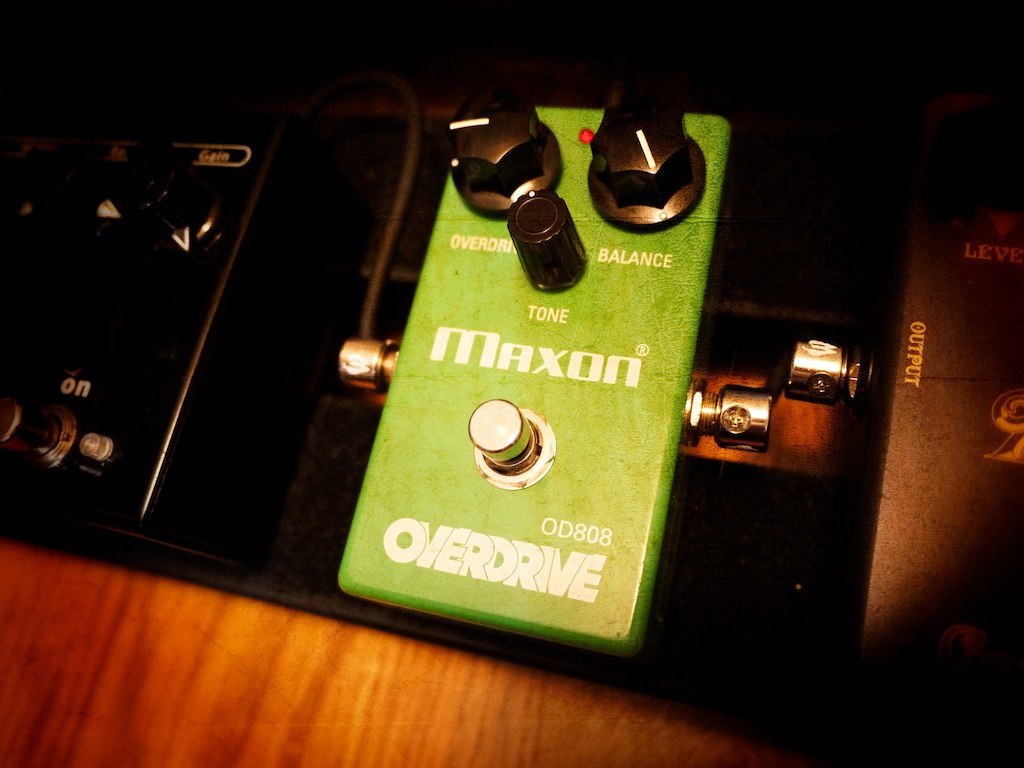
Maxon OD808, photographed 1 October 2013.
The Maxon OD808 is the original 808 overdrive circuit — JRC4558 op-amp, Panasonic MA150 diode. Used by Mark Morton, Dutkiewicz and Lee Malia.
There’s a philosophical puzzle buried in the overdrive market: can a pedal be a clone of itself? The Maxon OD808 Overdrive sits at the center of that paradox. Maxon’s engineers — specifically Susumu Tamura — designed the original 808 circuit back in 1979. Maxon then built that same circuit for Ibanez under a different name, the TS808 Tube Screamer, and the world fell in love with what it thought was someone else’s idea. Maxon was always there. The OD808 is not a copy of the TS808 Tube Screamer. It is what the TS808 Tube Screamer is a copy of.
That correction matters, because understanding where the OD808 came from changes how you hear it. When Stevie Ray Vaughan stacked two of these circuits at the Dallas Auditorium in 1983 and created a tone that redefined Texas blues guitar, the actual electronics inside the Ibanez enclosures were built by Maxon in Japan. The OD808 Reissue — currently in production and wearing Maxon’s own green livery — gives you that same circuit topology, with the same JRC4558 op-amp, the same Panasonic MA150 clipping diode, and a few carefully considered tweaks that actually reduce noise without touching the sound. It is, by any reasonable measure, the most authentic version of the most influential overdrive circuit in history.
And then in the 2000s, something unexpected happened: the OD808 became the secret weapon of an entirely different genre. Metal guitarists discovered that a circuit designed for Texas blues was the perfect tool for tightening up the bottom end of a Mesa Boogie or Peavey 5150 running full saturation. Mark Morton uses one in 2026. Adam Dutkiewicz built his entire signature Killswitch Engage sound around one. Lee Malia of Bring Me the Horizon plugged his Les Paul into an OD808 and a JCM800 and called it a day. The pedal’s remarkable ability to cut mud and add clarity at high gain isn’t a bug in the 808 circuit — it’s a direct consequence of how the clipping works, and understanding that mechanism is the key to using the OD808 well regardless of what genre you play.
The Invention: How Maxon Built the Most Important Overdrive Circuit in History
Susumu Tamura and his colleagues at Nisshin Onpa — the Japanese electronics company that eventually became Maxon — developed the OD808 circuit around 1979. At the time, the overdrive pedal category was still being defined. Fuzz boxes had dominated the 1960s; distortion pedals were emerging in the late 1970s. What Tamura designed was categorically different from both: a circuit that produced soft, natural-sounding clipping at moderate gain levels, specifically intended to simulate what happens when you push a tube amplifier’s input stage into gentle saturation.
The core innovation was topological. Rather than using a separate, dedicated clipping stage — the approach used by most distortion and fuzz circuits, where diodes clip the signal in a standalone section — Tamura placed the clipping element inside the negative feedback loop of the main amplifier stage. A Panasonic MA150 diode sits in that feedback loop, and when the signal gets large enough, it begins to conduct and reduces the amplifier’s gain in a soft, gradual, asymmetric way. This is why 808-style overdrive sounds different from virtually everything else: the clipping doesn’t happen to the signal after it’s been amplified; it happens as part of the amplification process itself. The result is a compressed, singing, organically distorted character that behaves more like a tube amp than a clipping circuit.
The choice of op-amp matters significantly in this architecture, because the op-amp’s own characteristics interact directly with the feedback loop. The JRC4558 dual op-amp that Tamura specified — and that the OD808 Reissue continues to use — has particular slew rate and frequency response characteristics that contribute to the warm, slightly rounded character of the 808 sound. This is not audiophile mythology: the LegendaryTones A/B comparison from 2008 demonstrated measurable and audible differences between units built with different op-amps, and the JRC4558 consistently tracks closest to the original sonic character.
Maxon built these pedals for Ibanez under OEM arrangement throughout the late 1970s and into the 1980s. Both companies sold what was essentially the same circuit in different enclosures under different names. When Ibanez’s distribution through Maxon eventually changed, and as vintage TS808 prices climbed toward the stratosphere in the collector market, Maxon reissued the OD808 under their own brand with the original circuit intact. The Reissue makes one change to the original design: the output resistors have been repositioned and their values increased to reduce microphonic noise, a practical fix for a problem that plagued vintage units — static electricity building up on the chassis and producing hum. Maxon is explicit that this change has no audible effect on tone. Independent A/B testing has confirmed this.
Specifications
One specification note worth flagging for guitarists coming from the Ibanez side of the family: the third control on the OD808 is labeled “Balance,” not “Level.” It performs the same function — output volume control — but the different name causes confusion. Turn it clockwise to increase the overall output level of the pedal. In every practical application, treat it identically to the Level knob on a TS808 or TS9.
The 5mA current draw is genuinely remarkable and deserves emphasis. This is one of the lowest-current overdrive pedals available at any price point. Any power supply with even a 50mA isolated output can handle it without strain. Multiple OD808s daisy-chained off a single isolated 100mA output will still have headroom to spare. Pedalboard power budget is never a consideration with this unit.
Famous Players: Verified User Connections
The Maxon OD808’s player community spans a remarkable range of genres. The honest picture, verified through primary sources, looks quite different from the marketing shorthand of “SRV used one” — the full story is both more accurate and more interesting.
Mark Morton (Lamb of God)
The most current primary-source confirmation comes from Mark Morton‘s Premier Guitar Rig Rundown from 2026, filmed at a Nashville stop on the Lamb of God tour supporting their twelfth studio album, Into Oblivion. Morton’s live rig centers on a Neural QuadCortex for amp modeling and switching, with the Maxon OD808 on the pedalboard for boost duties. This is the OD808 in its characteristic modern metal role: not as a standalone overdrive, but as a tightening and definition tool in front of a high-gain rig. Morton’s use of the OD808 alongside Neural DSP technology is representative of how the pedal bridges eras — a forty-year-old circuit doing precision work in 2026 metal production.

Adam Dutkiewicz (Killswitch Engage)
Adam Dutkiewicz, founder of Killswitch Engage and Grammy-winning producer, is the figure most associated with the OD808’s adoption in the metalcore and heavy metal world. His use of the Maxon OD808 is documented through multiple sources: the Premier Guitar Rig Rundown for Killswitch Engage, the YouTube “Hear Their Gear” video produced by Maxon specifically featuring Dutkiewicz and Joel Stroetzel demonstrating their use of OD808 and Maxon AD-9 Pro in the band’s live rig, and Guitar FX Depot’s documented signal chain for his stage setup. Dutkiewicz uses the OD808 in front of Hughes & Kettner Triamp heads — the combination that produced the tight, articulate metalcore sound on albums from The End of Heartache through to their later records. His name appears on the Maxon official product page as the emblematic example of the OD808’s metal adoption, and it’s warranted: arguably no single guitarist did more to bring the 808 circuit into the modern heavy music vocabulary.

Lee Malia (Bring Me the Horizon)
Premier Guitar’s Perry Bean documented Lee Malia’s setup in a 2014 Rig Rundown filmed before a Nashville show. Malia’s approach is quintessentially “less is more”: heavy strings tuned to C or lower, Gibson and Epiphone Les Pauls with a range of pickup configurations, and a signal chain anchored by a Marshall JCM800 running at volume. The Maxon OD808 is the primary dirt pedal in this chain, used to push the already-saturated JCM800 further and add the mid-range cut that helps low-tuned, heavy-gauge strings retain definition. The combination of Les Paul bridge humbucker, OD808 at moderate Drive, and a loud JCM800 is practically a manual for achieving the British heavy sound that Malia refined across Bring Me the Horizon’s catalogue.

Chris Traynor (Helmet, Bush)
Chris Traynor offered one of the most direct endorsements in the OD808’s documented player history: “I started using this pedal in Helmet because it was the only pedal that would give a clear, good quality gain — I’ve used it on every record I’ve recorded.” This quote captures something fundamental about the OD808’s appeal that makes it distinct from the SRV-blues narrative: for a certain kind of alternative and post-grunge guitarist running clean amps with demanding, complex chords and unconventional tunings, the OD808’s clarity under gain is uniquely valuable. Helmet’s technical, angular guitar work demands a pedal that adds saturation without turning the harmonic relationships into mush. The 808 circuit’s soft-knee compression and mid emphasis achieve this in a way that simpler distortion designs do not.

On Stevie Ray Vaughan and the 808 Circuit
The Maxon product page attributes SRV’s famous tone to the OD808, and in a circuit-lineage sense, this is not wrong — the electronics inside SRV’s Ibanez TS808 Tube Screamers were built by Maxon. However, SRV used Ibanez-branded TS808 and TS9 pedals; he died in 1990, before any Maxon-branded OD808 Reissue was available to consumers. The Stevie Ray Vaughan connection to the 808 circuit is real and documented; the connection to the Maxon OD808 Reissue as a product is an attribution of heritage, not direct use. If you want to sound like SRV using his actual circuit, the Maxon OD808 Reissue is as close as you can get — but be accurate about what that means.
Why the OD808 Dominates Metal: The Physics of Tightening
The metal adoption of the 808 circuit is not counterintuitive once you understand what the circuit actually does to a signal. When you run an OD808 with the Drive knob at minimum (or near minimum) and the Balance knob at maximum, you’re not adding distortion in the conventional sense. You’re boosting the midrange and very slightly compressing the low end before it hits the amp’s input stage.
High-gain amplifiers — Mesa Boogie Rectifiers, Peavey 5150/6505s, EVH amps, modern Friedmans — produce enormous gain at their preamp stages. The problem is that this gain is applied equally to all frequencies, and the low end of a guitar signal — especially a detuned guitar — can become “flubby” or undefined under extreme preamp saturation. Bass frequencies produce audible mud that obscures pick attack and makes fast playing sound like a blur rather than distinct notes.
The OD808’s inherent frequency curve has a gentle bass rolloff below about 700 Hz and a lift in the midrange centered around 700–1000 Hz. When this shaped signal hits the input of a high-gain amp, the amp saturates the midrange more than the low end. The result is tighter, more defined, more articulate saturation — the characteristic “chunky” metal rhythm tone that most players associate with the genre since the mid-2000s. Every metalcore album from roughly 2004 to the present has been shaped by this interaction. The OD808 didn’t adapt to metal; metal adapted its sound to the OD808’s capabilities.
Tone Recipes: Seven Settings to Start With
1. Clean Boost / SRV-Style Push (Blues)
Drive: 2–3. Tone: 4–5. Balance: 9–10. Into a clean or edge-of-breakup tube amp. This applies the 808 circuit the way SRV applied his TS808s — as a clean-ish boost that pushes the amp’s preamp tubes into natural compression and harmonic richness. Works best with single-coil guitars (Stratocaster bridge/middle position) into a Fender-style amp. Let the amp do the distorting; the OD808 supplies the headroom reduction and mid-focus.
2. Mid-Gain Blues Standalone (Moderate Gain)
Drive: 5–6. Tone: 5. Balance: 5–6. The OD808 as a standalone dirt channel into a clean amp. This is the classic “bluesy crunch” application — enough gain for single-note lead lines to sing and sustain, not so much that chord definition collapses. Tone at noon is a good starting place; back off slightly for a warmer character, increase for more bite and presence.
3. Metal Tight Boost (High-Gain Amp)
Drive: 0–1 (minimum). Tone: 5–6. Balance: 8–10. In front of a high-gain amplifier (Mesa, 5150, Diezel, EVH, etc.). This is the Adam Dutkiewicz / Mark Morton approach: the OD808 is not providing distortion; the amp is. The OD808’s contribution is frequency shaping and a slight compression that removes low-end flub and adds midrange definition. Results are immediate and dramatic — djent, metalcore, and thrash rhythms become tighter and more articulate in a way that can’t be achieved by EQ alone.
4. Stacked OD (SRV Double Stack)
Run two OD808 pedals in series. First pedal: Drive 3, Tone 4, Balance 7. Second pedal: Drive 2, Tone 5, Balance 8–10. This is the technique Maxon documents as SRV’s approach — stacking two 808-circuit pedals to create a more compressed, sustained, harmonically complex overdrive than a single unit can achieve. The interaction between two soft-knee clipping circuits produces a character that’s distinctly different from simply raising the Drive knob on a single unit.
5. Les Paul / Humbucker Rhythm
Drive: 3–4. Tone: 6–7. Balance: 5–6. Humbuckers have more bass energy and upper-midrange complexity than single coils, and the combination of humbucker warmth plus the 808’s natural midrange lift can produce a slightly congested character if Tone is left at noon. Pushing Tone to 6–7 o’clock helps clear the mids and adds the presence needed for rhythm work to cut through a full band mix.
6. Single-Coil High-Definition Lead
Drive: 4–5. Tone: 3–4. Balance: 6–7. Single-coil pickups are already bright; the OD808’s inherent treble character can become harsh in a lead context if Tone is above noon. Backing Tone down to 3–4 o’clock produces a warmer, smoother lead voice with enough sustain for expressive playing without the edge becoming irritating at higher volumes. Good starting point for Strat-into-Vox-style lead tones.
7. Presence Boost (Always On)
Drive: 1. Tone: 5. Balance: 7. Always on, at all times. Used to add a consistent presence and midrange focus to the clean signal before it hits the amp. This is a “set it and forget it” application where the OD808 functions like an always-on EQ with very subtle compression. Some players find their tone suddenly sounds flat and thin when they turn this off — which is the point. The 808 circuit as an always-on foundation layer is a legitimate and widely-used technique.

Comparisons: OD808 vs. The Competition
Maxon OD808 vs. Ibanez TS808 Tube Screamer Reissue
These are the same foundational circuit in different enclosures with slightly different component choices. The Ibanez TS808 Reissue costs slightly more (roughly $149–$169 new) and comes in the familiar Ibanez enclosure. The Maxon OD808 has the repositioned output resistors that improve the noise floor, a smaller and lighter enclosure (260g vs the TS808’s slightly heavier build), and a softer-click plunger switch that many players prefer over the more traditional stomp switch. Sonic differences between them are marginal and largely dependent on the specific components in individual units. For most players, the choice between them is ergonomic and aesthetic rather than tonal. The OD808 is typically less expensive at street prices and offers the honest historical narrative as a bonus.
Maxon OD808 vs. Ibanez TS9 Tube Screamer
The TS9 circuit introduces additional component differences from the TS808 baseline — slightly brighter voicing, a touch more aggressive in the upper midrange, and a character that some players describe as “harder” or “punchier” compared to the OD808’s “warmer” and “rounder” character. The TS9 is available new for around $89–$99, making it the most affordable entry point into the 808 circuit family. The OD808 is generally considered to track closest to the vintage TS808 sound; the TS9 is a variation on that baseline rather than a direct parallel. For blues players after the most authentic vintage character, OD808. For players who want a bit more edge and brightness, TS9.
Maxon OD808 vs. Ibanez TS808HW Hand Wired
The TS808HW (current V2 at $299.99) is the premium expression of the TS808 circuit: hand-wired on turret boards, select-screened JRC4558D chips, true bypass, MOGAMI internal wiring. The LegendaryTones 2008 A/B test placed the TS808HW above the Maxon OD808 in the “most vintage” ranking (below only an actual 1980 vintage TS808). If “closest to the original” is the paramount goal and budget allows, TS808HW. If you want the authentic 808 circuit in a reliable, affordable, well-built production pedal, OD808.
Maxon OD808 vs. Boss BD-2 Blues Driver
The Boss BD-2 is a fundamentally different circuit — more open-sounding, brighter, with a more complex harmonic character that some describe as “more guitar-amp-like” and others describe as “less controlled.” The BD-2 does not produce the 808-style mid-hump that makes the OD808 so effective as a metal tightening boost; it’s more transparent in the mids. Players who prefer their amp’s natural tonal character preserved tend to prefer the BD-2; players who want the mid-focused push that helps them cut through a dense mix tend to prefer the OD808. Both are excellent; neither is a substitute for the other.
Maxon OD808 vs. Maxon OD9 Pro+
The Maxon OD9 is the 9 Series variant of the TS9 circuit — same topological relationship as the OD808 to the TS808, but tracking the TS9 revision rather than the TS808. The OD9 Pro+ adds a Class A buffer to the bypass circuit and is generally aimed at players who want a more premium build with true circuit integrity. The OD808 uses an older, arguably more “correct” circuit topology for players chasing the vintage SRV-era character. The OD9 appeals to players who found the TS9 circuit an improvement over the TS808 voicing.
Buying Guide: New vs. Used vs. The OD808X
The current Maxon OD808 Reissue is available new from US dealers at approximately $115–$145. Godlyke, Inc. — Maxon’s former US distributor — notes on their website that they are no longer receiving inventory from Maxon Japan, though they direct interested buyers to the TWA Source Code overdrive, a new collaboration with Susumu Tamura himself for those who want a pedal designed by the OD808’s original creator with modern updates. For the standard OD808 Reissue, other authorized US dealers (Guitar Center, Sweetwater, Musician’s Friend) continue to carry it when in stock.
Used OD808s appear regularly on Reverb in the $70–$110 range for units in excellent condition. The circuit is robust and doesn’t require regular maintenance; a used unit with no obvious cosmetic damage and working controls is as reliable as a new one. The jacks and switch are the components most likely to show wear with age — test both before buying used.
The Maxon OD808X Overdrive Extreme is a separate product that adds a switchable hard-clipping diode stage, expanding the gain range significantly beyond the standard OD808’s soft-clipping ceiling. The OD808X is voiced differently and covers a wider gain range, but it is not a drop-in replacement for the OD808 in applications that specifically call for the classic 808 character. Premier Guitar’s review of the OD808X notes the expanded capabilities while being clear that the X-mode is a different tonal destination. Buy the OD808X if you want both the classic 808 tone and a higher-gain mode; buy the standard OD808 if you want the purest version of the original circuit.
Living with the OD808: Practical Ownership Notes
The buffered bypass on the OD808 is worth addressing directly, because it comes up regularly in pedalboard discussions. When bypassed, the OD808’s internal buffer remains in the signal path, which slightly loads the pickup’s output impedance and can affect the behavior of other buffers and buffer-sensitive pedals (vintage wahs, early fuzz circuits). If you run the OD808 in a chain with a fuzz — particularly a vintage-style silicon or germanium fuzz — position the fuzz before the OD808 to preserve the fuzz’s optimal input impedance conditions. If you run a true-bypass pedal chain with no other buffers, the OD808’s buffer at any point in the chain can actually be beneficial, providing impedance matching for longer cable runs.
The 5mA current draw means the OD808 is genuinely compatible with any power supply arrangement. A battery will last an exceptionally long time — Maxon’s low current consumption is one of the practical advantages of the compact enclosure design over some of its competitors. For pedalboard use, any standard isolated 9V output handles it without issue.
The “Balance” knob labeling is a genuine source of user confusion. New OD808 users sometimes set Balance at noon and wonder why the pedal sounds quiet compared to bypass — the control is functioning as intended, the name is just unintuitive. Think of it as a volume knob and set it accordingly: usually 7 or higher for unity gain or above, depending on your Drive setting and pickup output.
The OD808’s smaller enclosure (61mm wide vs. 73mm for a standard Boss compact) means it takes slightly less pedalboard real estate than either the Ibanez TS808 or a Boss-format pedal. For cramped boards this is a practical advantage. The soft-click plunger switch is less percussive than traditional stomp switches and makes the pedal easier to engage quietly during live performance.
FAQ
Is the Maxon OD808 the same circuit as the Ibanez TS808?
Yes, at the fundamental circuit topology level. Both use the same op-amp (JRC4558), the same clipping diode (Panasonic MA150) in the same negative feedback loop configuration, and the same basic control architecture. Maxon’s Reissue changes the output resistors to reduce noise, which has no audible effect on tone. Specific component values and physical construction differ between the two products, which can produce subtle variations between individual units, but they are built on identical circuit DNA — because Maxon designed the circuit for both of them.
Did Stevie Ray Vaughan actually use the Maxon OD808?
SRV used Ibanez TS808 and TS9 Tube Screamers, which were manufactured by Maxon. The Maxon-branded OD808 Reissue as a consumer product was not available during SRV’s lifetime — he died in 1990. The OD808 Reissue is the most accurate recreation of the circuit SRV used, made by the same company that built his pedals, but calling SRV an OD808 “user” would be technically inaccurate.
Why do metal guitarists use an overdrive pedal designed for blues?
The 808 circuit’s mild compression and slight low-end rolloff solve a specific problem that high-gain amplifiers create: low-end flub and loss of note definition at extreme preamp saturation. Running the OD808 with Drive near zero and Balance high in front of a high-gain amp shapes the signal before it hits the preamp, reducing muddiness in the low end and adding midrange definition. The result is tighter, more articulate distortion. The circuit’s application to metal is counterintuitive on paper but makes complete physical sense once you understand the frequency shaping involved.
What’s the difference between the Balance knob and the Level knob on a TS808?
They are functionally identical — both control the overall output volume of the pedal. Maxon chose the label “Balance” for the same control that Ibanez labels “Level.” Set it the same way you would set the Level knob: clockwise for more output, counterclockwise for less. The terminology difference has confused many guitarists over the decades, but there is no actual functional difference.
Does the OD808’s buffered bypass cause problems?
In most modern pedalboard contexts, no. The buffered bypass can cause interaction problems specifically with vintage-style fuzz circuits (Big Muff, vintage silicon/germanium fuzz) that need to see the direct high impedance of a guitar pickup at their input. If you run a fuzz, place it before the OD808 in your signal chain. In other contexts — clean boosts, drives, modulation, delay, reverb — the buffer is either neutral or beneficial for maintaining signal quality over long cable runs.
Is the Maxon OD808 better than the Ibanez TS808 reissue?
Maxon claims a lower noise floor and slightly warmer, fuller character for the OD808 compared to the Ibanez TS808 Reissue, and independent testing has generally supported the noise floor claim. “Better” depends on your application and ears. The OD808 is typically less expensive at street prices. The TS808 Reissue has more retail availability and the brand recognition that comes with the “Tube Screamer” name. If you play them side by side, experienced players can often hear a difference; A/B tests in controlled environments suggest the OD808 has more low-end transparency. Whether this makes it “better” is a question only your amp and your ears can answer.
What does the Tone knob actually do?
The Tone knob on the OD808 controls the cut-off frequency of a passive RC high-pass filter in the circuit. Turned fully counterclockwise, it rolls off treble and produces a dark, warm character. Turned fully clockwise, it emphasizes upper midrange and high frequencies for a brighter, more cutting sound. At noon it’s roughly neutral, though the circuit has a natural mid-emphasis regardless of the Tone setting. For humbucker players, pushing Tone clockwise of noon often helps; for bright single-coil players, noon or slightly counter-clockwise is often more flattering.
How does the OD808 compare to boutique 808-style clones?
The boutique market is full of TS808-inspired overdrives — Analogman King of Tone, JHS Bonsai (which includes 9 TS-type voices), Keeley’s TS variants, and dozens more. Most of these offer additional features: switchable clipping modes, internal trimmers for voicing adjustment, true bypass options, or modified component values for different tonal characters. The OD808 offers none of these — it is the base circuit, built to spec, at a price significantly below most boutique variants. For players who want the authentic 808 experience without modification, the OD808 is the correct choice. For players who want the 808 circuit as a starting point for customization or who want switchable modes, the boutique market has compelling options at higher prices.
Image credits
- Mark Morton: Matthias Bauer, Wikimedia Commons, CC BY-SA 3.0.
- Top image: Maxon OD808, photographed on 1 October 2013. Photo: Mekkjp. Source photograph, CC BY-SA 2.0. Full source frame and existing warm color treatment retained; proportionally resized for display. No new crop or retouch. Adaptations remain under the same license.
- Mark Morton: Matthias Bauer, Wikimedia Commons, CC BY-SA 3.0.
- Lee Malia: Sven Mandel, Wikimedia Commons, CC BY-SA 4.0.
- Adam Dutkiewicz: Stefan Brending ( 2eight ), Wikimedia Commons, CC BY-SA 3.0.
- Chris Traynor: Justin Higuchi, Wikimedia Commons, CC BY 2.0.
Latest News
Related

On This Day
Tuesday 10 November
From this week: