Way Huge Conspiracy Theory: The Klone That Stopped Pretending It Was a Secret
Way Huge Conspiracy Theory WM20 guide: full specs from the manual, verified players, nine tone recipes, Klon comparisons and used-market buying advice.
Every other Klon-inspired pedal on earth arrives with a small, embarrassed cough. The marketing copy talks about “transparent overdrive” and “harmonic enrichment” and “a legendary gold box,” and everybody involved — the builder, the reviewer, the customer — quietly agrees not to say the word out loud. There is a whole genre of pedal writing built on that cough. It is exhausting.
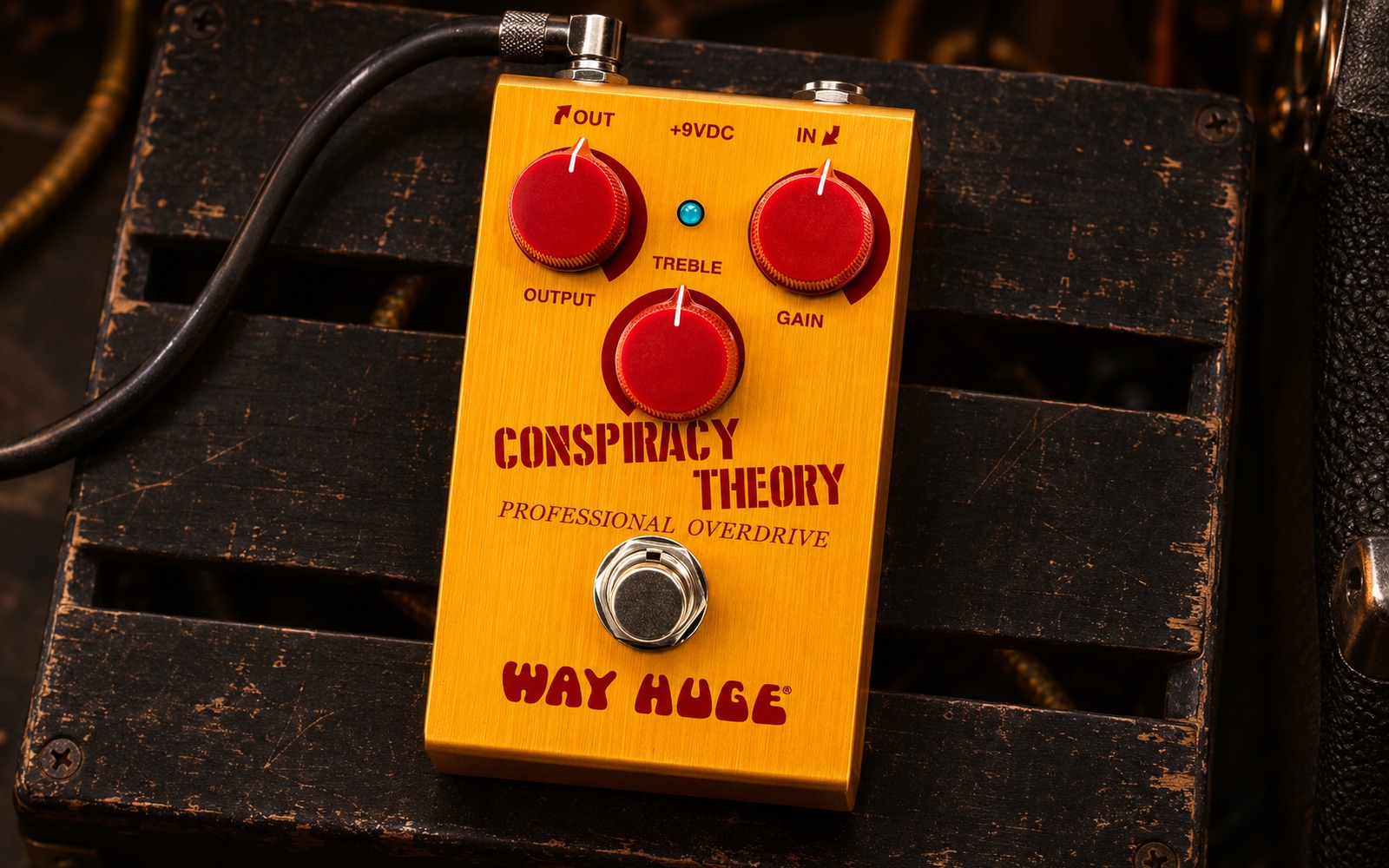
Way Huge did the opposite. They put the circuit in a gold enclosure with fat red knobs, wrote a manual about alien technology and shadowy organisations embedded deep within the deepest of states, printed “THE OVERDRIVE PEDAL THAT THEY DON’T WANT YOU TO KNOW ABOUT!” across the front page, and called the thing Conspiracy Theory. The joke is not subtle. The joke is not supposed to be subtle. It is a pedal that walks into the room wearing a tinfoil hat and a name badge that says HELLO, I AM A KLONE, and in doing so it says more honest things about the entire Klon phenomenon than a thousand carefully-worded product pages ever did.
Because here is the thing about the mythology: the mythology is the product. A circuit that costs a manufacturer a few dollars in parts became a five-figure collectable because a small number of people could not get one, and because a much larger number of people decided the ones who could not get one must be missing something extraordinary. Way Huge’s contribution to guitar culture was to point at that, laugh, and then — crucially — actually build a very good pedal underneath the gag.
This is a feature article, not a review. What follows is what the Conspiracy Theory is, where it came from, what the first-party documentation actually says (including where Way Huge’s own documentation disagrees with itself), which players have genuinely been photographed with one, how to set it, and how it stacks against the rest of the low-gain drive world.
Housekeeping: The Model Number, The Name, and The Size
Two small clarifications before anything else, because both cause confusion in listings and forum threads.
First: this pedal is the WM20, and its full name on Dunlop’s own product page is the Way Huge Smalls Conspiracy Theory Professional Overdrive. “Smalls” is Way Huge’s compact-enclosure sub-line — the same family that later produced the Swollen Pickle Smalls, the Geisha Drive Smalls and the Supa-Lead Smalls. Some retailers and secondary sources have circulated a “WHE207” designation. The number that appears on the pedal, on the box, on the manual PDF and on Dunlop’s site is WM20. If a listing quotes something else, treat it as a copy-paste error rather than a variant.
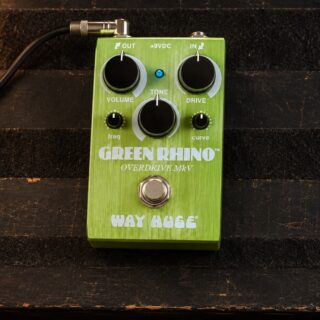
Second: there is no full-size version. Unlike the Green Rhino, which exists in both full-size and Smalls housings, or the Swollen Pickle, which has lived in both, the Conspiracy Theory was a Smalls pedal from birth. If you are searching used listings for a “big box Conspiracy Theory,” you are searching for something that was never made. What you may be thinking of is the Deep State, a later and separate Way Huge Klon-adjacent design in the larger enclosure — a different pedal with a different feature set and a considerably higher used price.
Where It Came From: April 2019, and a Company That Had Already Done This Once
Way Huge announced the Conspiracy Theory on 18 April 2019. MusicRadar’s Michael Astley-Brown broke it that morning under a headline that did not bother with euphemism either: “New Smalls stompbox based on Klon Centaur.” The announced price was $129, with no firm availability date — “later this year,” which turned out to be accurate; the pedal reached reviewers by the autumn.
Astley-Brown made one observation in that piece worth holding onto, because it explains something about how the Dunlop group operates. Way Huge is part of the Jim Dunlop family of brands. So is MXR. And MXR had already released a Klon-derived pedal — the Sugar Drive — before the Conspiracy Theory existed. One corporate parent, two in-house brands, two independent takes on the same famous circuit, sold alongside each other. That is not a mistake or an internal turf war; it is the deliberate logic of a house of brands, where MXR sells one voice to one kind of player and Way Huge sells another voice, with a joke attached, to a different kind. Anyone who has looked at the MXR Timmy sitting in the same catalogue as half a dozen other low-gain Dunlop drives has seen the same strategy at work.
The other piece of background: Way Huge had done the “irreverent name on a serious circuit” trick for nearly thirty years by this point. Jeorge Tripps founded the company in 1992, closed it in 1999, and relaunched it under Dunlop in 2008 with the Pork Loin, the Fat Sandwich and the Swollen Pickle MkII. Aqua Puss. Red Llama. Camel Toe. Saucy Box. Doom Hammer. Stone Burner. A brand with that naming history was never going to release a Klone called the “Gold Standard Transparent Overdrive.”
What the Circuit Actually Does
Strip away the alien technology and the pedal does the thing every good Klon-derived circuit does: it runs your dry signal and a clipped, filtered signal in parallel, and the Gain knob progressively swaps one for the other. At low Gain settings you are hearing mostly your own guitar with a layer of harmonic content bonded onto it — hence the pedal’s persistent reputation as a “clean boost that is not quite clean.” As Gain comes up, the clipped path dominates and you get actual overdrive, but the dry path never fully leaves, which is why the pedal stays articulate at settings where a Tube Screamer would already be compressing the life out of the attack.
The parallel-path idea is not exotic — it is the same fundamental architecture that makes the Pork Loin work, and the same reason both pedals are so often described as “three-dimensional.” Way Huge’s marketing bullet points for the Conspiracy Theory say it plainly: “Blends clean signal with for smooth, transparent tones” (the typo is theirs, faithfully reproduced across their own site and Delicious Audio’s reprint of the press copy) and “Increased headroom for dynamic, wide open sound.”
That headroom claim is the one spec that tells you the most. The manual lists throughput gain up to +50 dB at 1 kHz — an enormous amount of available output for a three-knob overdrive, and the number that explains why so many players use this as a permanently-on level-and-body pedal rather than as a solo boost.
Specifications
All electrical measurements are Way Huge’s own, taken with controls at centre; noise measurements are A-weighted.
The First-Party Naming Discrepancy — And Why It Matters More Than It Sounds
Way Huge cannot agree with Way Huge about what the loudest knob is called.
The WM20 manual, which is the pedal’s own documentation, is unambiguous: control 1 is the OUTPUT knob, and the descriptive paragraph says “use the Output and Treble controls to set just how far your signal penetrates.” The Dunlop web product page, using what is otherwise the same block of copy, says “with Gain, Volume, and Treble controls” and “use the Volume and Treble controls.” Delicious Audio’s reprint of the launch press release also says Volume. Guitar World’s review says Output. Retail listings split roughly down the middle.
This is the seventh consecutive brand whose own literature contradicts itself on a basic point, and by now the honest thing to do is treat it as normal rather than scandalous. Marketing copy and engineering documentation get written by different people at different times, and only one of them has the schematic open. The rule that has held every time: when a manual and a product page disagree, believe the manual. Practically, of course, it makes zero difference — it is the output level control either way — but it matters for a specific and unglamorous reason: if you are buying used and the seller’s photos are low-resolution, knowing that the legend on a genuine WM20 reads OUTPUT rather than VOLUME is a small authenticity check that costs you nothing.
There is a similar, sillier disagreement about the colour. Way Huge and most retailers describe the enclosure as gold. Guitar World’s Paul Riario described it as “copper-orange.” Photographs suggest both descriptions are defensible depending on the light, which is exactly the kind of thing that happens when a paint choice is deliberately referencing a legendary finish without matching it.
The Controls, One at a Time
Gain
The only control that changes the character of the pedal rather than its level or tilt. Below about nine o’clock you are in boost territory — the clipping stage is barely engaged and the pedal is behaving as a high-headroom buffer with a small harmonic sheen. Between ten and two it is doing the thing it is famous for: a fat, bluesy, touch-sensitive breakup that Guitar World characterised as behaving “more like a cranked, low-wattage Fender amplifier with singing sustain.”
Past three o’clock the pedal is not, by modern standards, a high-gain device — this is a limitation and everybody who has reviewed the pedal says so — but it does something specific and useful. Riario’s note is the best description on record: “diming the Gain knob calls up thick overtones that segue into otherworldly feedback as you turn up your guitar’s volume.” That is not a gain-per-se effect; it is the sound of a parallel-path circuit reaching the end of its clean headroom while the dry signal is still trying to get through.
Treble
Not a conventional tone knob, and worth understanding properly. The manual gives one hard number: at full counter-clockwise, the tone control produces −20 dB at 3 kHz. That is a very deep cut at exactly the frequency where pick attack and string noise live. Turned up, the control does not simply add treble in a hi-fi sense; it restores and then exaggerates the high-mid content that the clipping stage generates.
The practical consequence: this control interacts with your amp far more than most tone knobs. Into a dark amp it is the most important control on the pedal. Into a bright Fender-style amp, most players end up somewhere between nine and eleven o’clock and never touch it again.
Output
With +50 dB of available throughput gain, the useful range is compressed into the bottom third of the knob’s travel for most rigs. Unity with a typical humbucker-equipped guitar into a clean amp usually lands somewhere around nine to ten o’clock. Anything past noon is a deliberate front-end assault on the amp, and that is a legitimate way to use this pedal — see the tone recipes below.
Famous Players — Verified, With the Evidence Named
The Conspiracy Theory has a smaller confirmed roster than the older Way Huge pedals, which is what you would expect from a design that is only a few years old. But the evidence that does exist is unusually good, for one boring physical reason: a gold box with red knobs is instantly identifiable in a bad photograph. You cannot mistake this pedal for anything else on a crowded board at 200 pixels wide, which means photo-based attributions here are far more reliable than they are for, say, a black rectangle with white text.
Joe Bonamassa
The strongest credit, and the one with the most context. Bonamassa posted his rig for the 2025 European tour to Instagram, and the Conspiracy Theory is visible on the board. This is not a surprise: Bonamassa’s relationship with Way Huge is deep and documented — his tech Mike Hickey names the Pork Loin in a Premier Guitar Rig Rundown, and Bonamassa is the named co-designer on both Way Huge signature overdrives, the Overrated Special and the Doubleland Special.
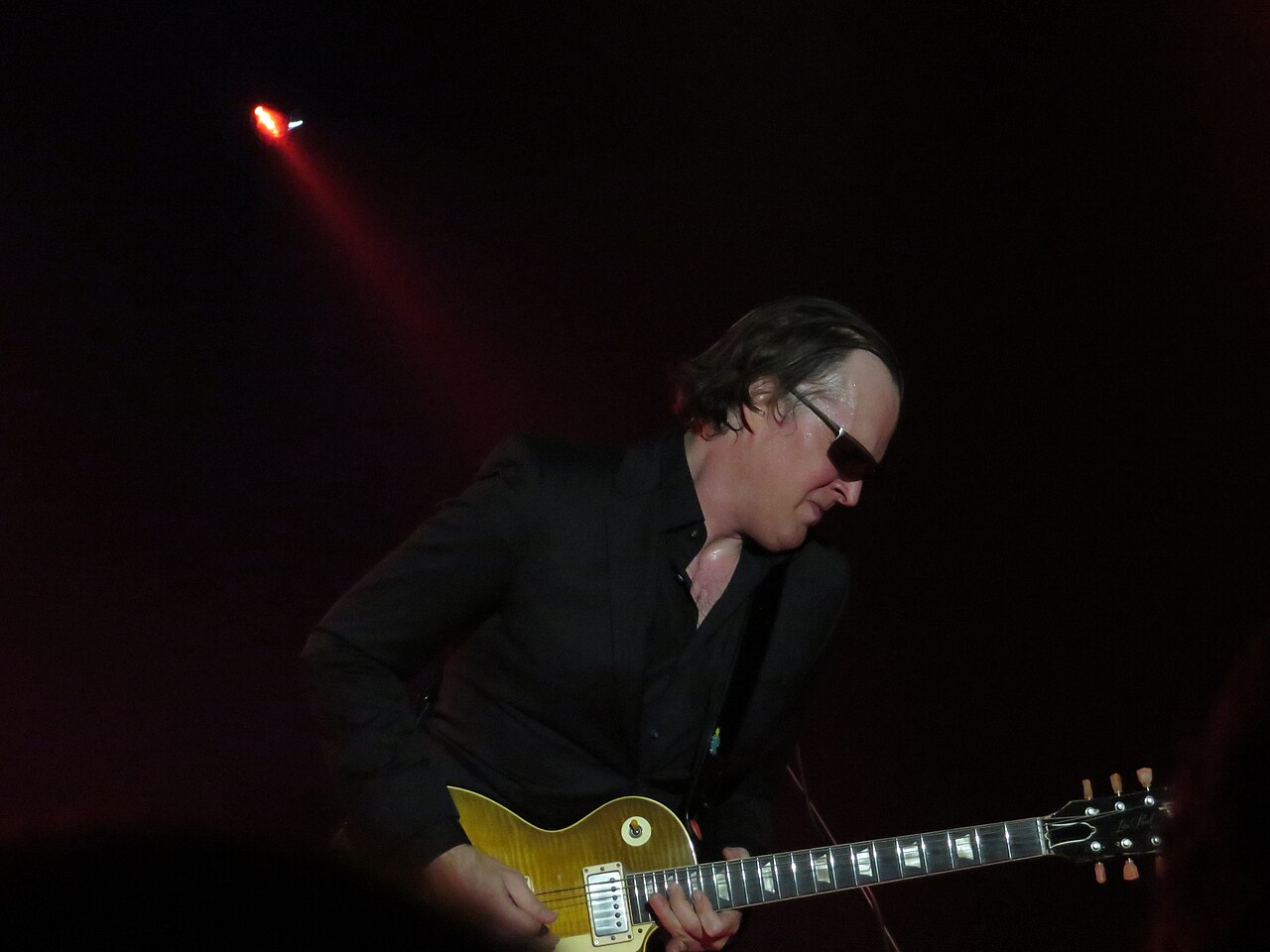
That last point needs stating loudly because the internet gets it wrong constantly: the Doubleland Special is a Bonamassa collaboration, not a John Mayer one. It is voiced on the Dumble Overdrive Special, and people reach for Mayer’s name by reflex whenever the word “Dumble” appears. Bonamassa’s name is the one on the pedal, the serial numbers and the signature card.
Christone “Kingfish” Ingram
My favourite entry on the list, because the evidence is the player thinking out loud rather than a static photo. In an Instagram story posted on 24 February 2021, Ingram showed the Conspiracy Theory while deliberating between overdrives — and specifically mentioned possibly going back to the MXR Sugar Drive. Two Dunlop-family Klones, one player, one board, an actual on-the-record comparison between them. That is the house-of-brands strategy described earlier, playing out in real time on a working blues guitarist’s pedalboard. It is also an honest reminder that a confirmed sighting is not the same as a permanent endorsement; players try things and send them back.
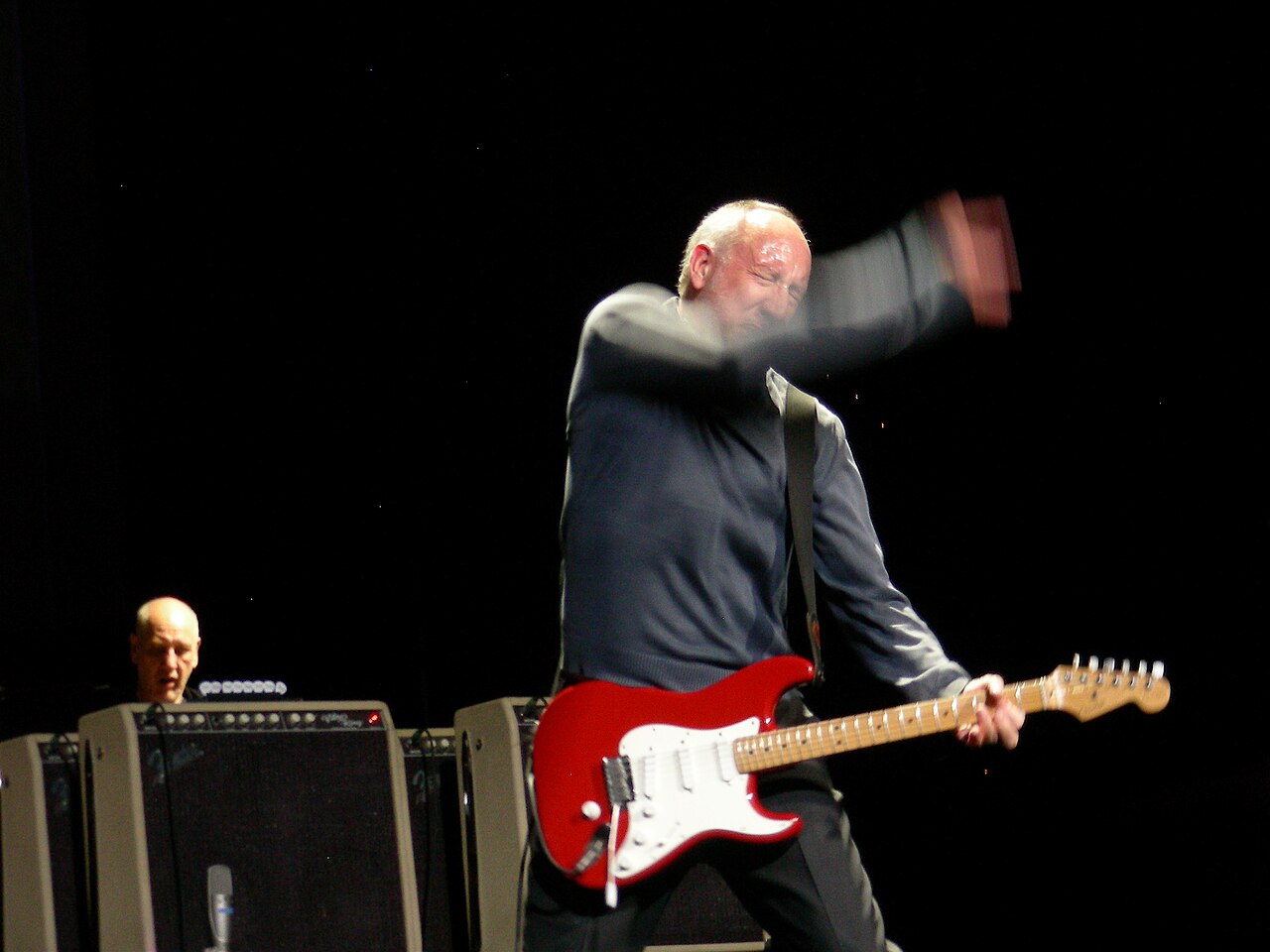
Pete Townshend
Townshend is listed as a user on the strength of a photograph of his pedalboard shared by an Instagram user. The pedal is identifiable in the image. I am flagging the provenance rather than hiding it, because “a fan photographed a board” is a weaker chain of evidence than “the artist posted his own rig” or “Premier Guitar filmed it,” and readers deserve to know which tier a claim sits in. Given how distinctive the enclosure is, I am inclined to accept it — but it is a photo credit, not a quote.
Russ “Satchel” Parrish — Steel Panther
Confirmed in a Premier Guitar Rig Rundown for Steel Panther filmed in 2023, hosted by John Bohlinger, where the pedal appears in the board shots. Rig Rundowns remain the single most reliable public source for gear attribution, because the camera goes over the board slowly and the tech usually narrates. The credit is solid, and it is a useful data point against the assumption that this is purely a blues pedal.
Butch Walker
Visible at the 35:01 mark of Andrew Masters’ 2022 YouTube studio tour of Walker’s home setup, sitting in the mixing area. Walker — producer, solo artist, and a name attached to an enormous quantity of mainstream rock and pop records — using it as a studio tool rather than a live pedal fits the pedal’s character exactly.
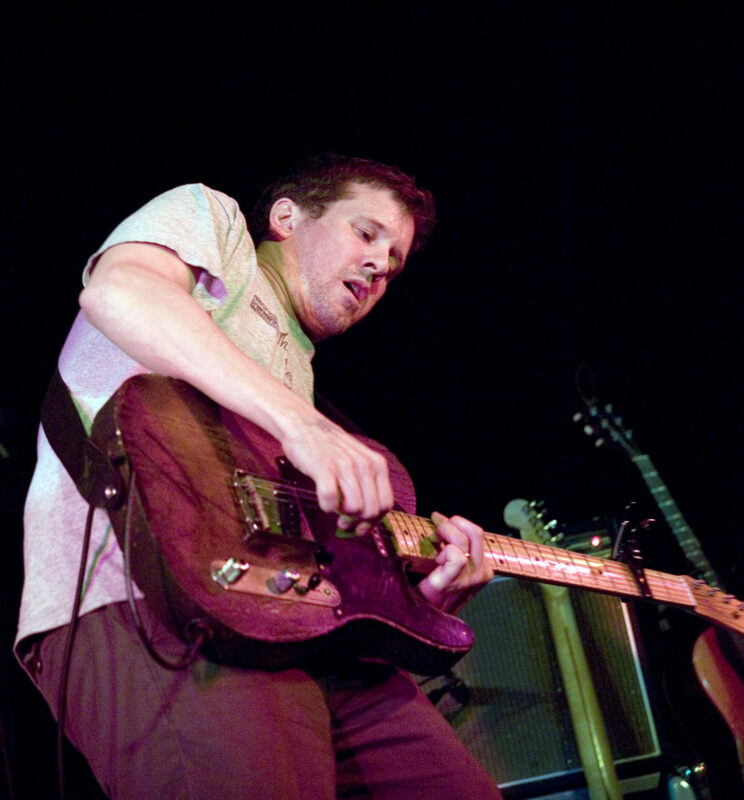
Mac McCaughan — Superchunk
Photographed on his live pedalboard on 9 September 2025. Superchunk is not a band anyone associates with boutique transparent overdrive, which is precisely why the credit is interesting: the Conspiracy Theory’s low-gain, headroom-forward voice works as a rhythm-guitar thickener in loud melodic punk just as well as it works under a blues solo.
Ian Fowles
Guitarist with the Aquabats and Gerard Way and the Hormones, a Dunlop artist, and the only player on this list who has said anything quotable about the pedal. On Instagram: “I love a good conspiracy theory… My new favorite is this one from Way Huge Electronics. It’s their take on that overpriced/overhyped mythical beast. And it rips.”
That is an artist, on the record, calling the original overpriced and overhyped while endorsing the copy. It is the whole thesis of the pedal in two sentences, and it is worth more than any amount of marketing copy about alien technology.
Who is not on this list
The usual Klon-adjacent names — the players whose association is with the original gold box rather than with this pedal — do not belong here, and I am not going to pad the section with them. If you have read that John Frusciante, Jeff Beck or any given famous Klon owner uses a Conspiracy Theory, ask for the photograph. The seven credits above are the ones with sources attached.
Tone Recipes
1. The Always-On (the way most owners actually use it)
Gain 8 o’clock · Treble 10 o’clock · Output 10–11 o’clock. Barely any clipping, a small amount of added weight and forward-ness, and roughly 2–4 dB of level. Leave it on for the entire gig. This is what the 600 kΩ input impedance and the enormous headroom figure are for.
2. Cranked Small Fender
Gain 12 · Treble 11 · Output 10. The sound Guitar World described — a low-wattage tube amp at the edge, with sustain that hangs on longer than the gain amount suggests it should. Play with the guitar volume at 8 and roll it up; the pedal cleans up almost completely at 6 and gets genuinely aggressive at 10.
3. Blues Lead, Touch-Sensitive
Gain 2 o’clock · Treble 12 · Output 11. Neck humbucker. Fat, singing, thick in the mids. This is the Bonamassa/Kingfish end of the pedal’s range and it is what the circuit was designed around.
4. Stacked in Front of a Tube Screamer
Conspiracy Theory: Gain 9 · Output 1 o’clock → into TS9: Drive 9 · Level 12. The Klone-first order. You are using the Conspiracy Theory as a big, full-spectrum level push into the Screamer’s mid-hump, which keeps the low end that a TS on its own throws away. This is the single most common stacking arrangement in modern blues-rock rigs.
5. Behind the Dirt
BD-2 or fuzz → Conspiracy Theory: Gain 8 · Treble 9 · Output 1 o’clock. Placing it after a dirt pedal turns it into a level and body control for the whole dirt stage. The Treble cut at 9 o’clock tames fizz that no amount of amp EQ will fix.
6. Rhythm Thickener (the Superchunk setting)
Gain 10 · Treble 1 o’clock · Output 11. Bridge pickup, open chords, loud amp. Adds definition and cut without adding compression, so the chord voicings stay legible in a dense mix.
7. Solo Boost Only
Gain fully down · Treble 12 · Output 2 o’clock. Clean, enormous, and — because of the parallel dry path — noticeably less coloured than a mid-humped boost. Compare against the Xotic EP Booster if you want a genuinely different flavour of the same job.
8. Dark Amp Rescue
Gain 11 · Treble 3 o’clock · Output 11. Into an amp with too much bottom and not enough air. The Treble control’s behaviour above noon is where this pedal earns its keep on stages where you do not control the backline.
9. Feedback Sustain
Gain maximum · Treble 12 · Output 12 · guitar volume 10. Loud amp, stand near it. This is Riario’s “otherworldly feedback” setting, and it is the only way to hear what the circuit does when the dry path finally loses the argument.
Knob positions are given as clock positions. All of these assume a reasonably clean amp unless stated.
Comparisons
Versus the original
The obvious one. Our Klon Centaur feature covers the original at length, so the short version here: the Conspiracy Theory is not marketed as a component-level clone, and the reviewers who have A/B’d them describe the Way Huge as smoother in the mid-harmonics rather than identical. Riario’s summary — “yet another type of ‘Klones’ overdrive, and this time around, I’m willing to admit it’s pretty darn close” — is about as strong an endorsement as a magazine tech editor will give without claiming equivalence. The price gap is measured in orders of magnitude.
Versus the EHX Soul Food
The Soul Food is the cheap-and-cheerful Klone that got the whole affordable-Klone category started. It is brighter, thinner and more obviously a budget product; it also costs roughly half as much and has a switchable buffer. The Conspiracy Theory is the fuller, warmer, more expensive answer.
Versus the MXR Timmy
Different philosophies entirely. The Timmy is a genuine transparency pedal with independent bass and treble cuts and a clipping toggle — it is designed to get out of the way and let you subtract. The Conspiracy Theory is not transparent in that sense at all; it adds a specific harmonic colour and a mid-forward push. If you want a tone-shaping tool, Timmy. If you want a voice, this.
Versus the Analog Man King of Tone
The King of Tone is the other pedal whose reputation outran its supply, and the comparison is instructive. Two independent low-gain channels versus one; a multi-year waiting list versus a shelf at every dealer; roughly twice the money on the used market versus a pedal you can order this afternoon. The Conspiracy Theory does one thing where the KoT does two, but availability is a feature.
Versus a Tube Screamer
The TS808 scoops the bass and humps the mids. The Conspiracy Theory keeps the bass and adds harmonics. They are not competitors; they are stacking partners, which is why recipe 4 above exists. If you have only ever used a Screamer, the first thing you will notice about this pedal is how much low end survives.
Versus the Nobels ODR-1
The ODR-1 is the Nashville answer to the same question — full-range, non-scooped, session-friendly. It is cheaper, it has the Spectrum control instead of a simple Treble, and it is arguably the better value. The Way Huge has more headroom and a more distinctive upper-midrange character.

Versus the Way Huge Pork Loin
Worth drawing out, because both are parallel-path Way Huge overdrives. The Pork Loin blends a soft-clipped drive against a voiced clean preamp — the clean side is an active, coloured circuit with four internal trimpots controlling it. The Conspiracy Theory blends against your unprocessed dry signal. The Pork Loin is the more adjustable pedal and the more coloured one; the Conspiracy Theory is simpler, brighter, more available and considerably cheaper, since the Pork Loin is discontinued and now commands a large used premium.
Buying Guide
Current status: in production. Dunlop lists the WM20 at $159.99 as of 2026 — up from the $129 announcement price and the $129.99 street price Guitar World quoted at launch, which is roughly what six years of manufacturing inflation looks like. It is stocked by every major dealer.
Used market. Aggregated pricing data puts the average around $148, with new units clustered at $152–$159.99 and used listings appearing as low as $85. That is a healthy discount for a pedal with no known reliability issues, no version changes to worry about, and no internal trimpots to have been fiddled with by a previous owner. If you are buying used, buy used. There is no early-unit-versus-late-unit question here — a rarity in this category.
What to check on a used unit. The knobs (jumbo red, easy to lose, easy to replace), the footswitch feel, and the enclosure finish, which is a painted gold that will show honest wear on the edges. Confirm the legend reads OUTPUT / GAIN / TREBLE and the model number reads WM20. Ask whether it has been powered from a daisy chain with anything unusual.
Who should buy one. Players who want the Klon voice without either the money or the waiting list; anyone building a two-drive board who needs the fuller, non-scooped half of the pair; blues, blues-rock and roots players; and anyone who wants a permanently-on tone thickener with enough headroom to also serve as a solo boost.
Who should not. Anyone who needs real gain. Every reviewer, every owner and Way Huge’s own positioning agree on this: the Conspiracy Theory’s ceiling is low-to-medium overdrive. If your amp is clean and you want distortion from a pedal, buy a distortion pedal. And if you specifically want transparency in the strict sense — no added colour at all — this is the wrong tool; go and read about the Timmy.
Ownership Notes
Power. The 5.5 mm × 2.1 mm jack is positive on the outer sleeve — the standard Dunlop/Boss-style convention, and the opposite of the centre-negative wiring used by several boutique brands. Get this wrong and nothing happens; get it wrong with the wrong supply and something expensive happens. At 18.5 mA the pedal is trivially easy to power and will run happily off any isolated brick output.
Battery. A 9-volt battery works, plugging in an external supply disconnects it, and the pedal drains the battery whenever a cable is in the input jack. Unplug when you are done. At 18.5 mA a good alkaline will last a very long time, but there is no reason to run a permanently-boarded pedal from a battery.
Placement. Front of the chain, after the tuner and any wah or fuzz. It is true bypass, so it will not buffer your signal when off — if it is the first pedal on a long cable run and you notice high-end loss, that is the cable, not the pedal, and the fix is a buffer somewhere in the chain.
Board space. Roughly 4″ × 2.4″ and 0.59 lb. This is the whole argument for the Smalls line and the reason the pedal shows up on so many crowded professional boards next to much larger units.
Frequently Asked Questions
Is the Way Huge Conspiracy Theory an exact Klon clone?
Way Huge has never claimed component-level equivalence, and the honest answer from people who have compared them directly is that it is close but not identical — smoother through the mid-harmonics than most K-clones, per Guitar World’s review. It is a Klon-derived design that captures the voice and the behaviour rather than a copy sold as a copy.
What is the model number — WM20 or WHE207?
WM20. That is what appears on Dunlop’s product page, in the manual and on the pedal. WHE-prefixed numbers belong to the full-size Way Huge line; WHE201, for example, is the Pork Loin.
Is the knob called Output or Volume?
The manual says Output; Dunlop’s web copy says Volume. It is the same control. Believe the manual — the pedal itself is legended OUTPUT.
How much gain does it have?
Low to medium. Fully cranked it produces thick overtones and controlled feedback at volume rather than modern high-gain distortion. Every review notes this as its main limitation and none of them treats it as a flaw, because the pedal is not attempting to be a distortion box.
Can it be powered by a battery?
Yes — a single 9-volt battery. Inserting an external supply disconnects the battery automatically. Unplug the input cable when not in use to stop the battery draining.
What power supply does it need, and which polarity?
9 VDC via a 5.5 mm × 2.1 mm jack with positive voltage on the outer sleeve. Dunlop’s ECB003, DC Brick, Iso-Brick and Mini Iso-Brick are all specified. Current draw is 18.5 mA.
Does it stack well with other overdrives?
Unusually well, and this is one of its main selling points — Guitar World specifically noted that it “pairs incredibly well with other overdrives and distortions.” Its full-range, non-scooped output makes it an excellent partner in front of a Tube Screamer, and its headroom makes it an equally good level control placed after a dirt pedal.
Which famous players actually use one?
Photo- or video-confirmed users include Joe Bonamassa (2025 European tour rig, posted by the artist), Christone “Kingfish” Ingram (Instagram story, February 2021), Russ “Satchel” Parrish of Steel Panther (Premier Guitar Rig Rundown, 2023), Butch Walker (2022 studio tour video), Mac McCaughan of Superchunk (live board photo, September 2025), Ian Fowles (Dunlop artist, own Instagram post), and Pete Townshend (fan-shared pedalboard photo — the weakest link in the chain, flagged accordingly).
Is it worth buying used?
Yes. There are no revisions, no internal trimpots and no known failure modes, and used units appear as low as $85 against a $159.99 list price. The only reasons to buy new are the warranty and the box.
Image credits
- Top image: GuitarGangsters AI-generated reference illustration, not a photograph.
- Pete Townshend: Heinrich Klaffs, Wikimedia Commons, CC BY-SA 2.0.
- Joe Bonamassa: Steve, Wikimedia Commons, CC BY 2.0.
- Pete Townshend: Kubacheck, Wikimedia Commons, CC BY 2.0.
- Mac McCaughan: John from Washington/Baltimore, U.S.A, Wikimedia Commons, CC BY 2.0.
Latest News
Related
On This Day
Monday 9 November
From this week: