Six Reverb Types, One Gunmetal Box: How the MXR M300 Changed the Practical Pedal Game
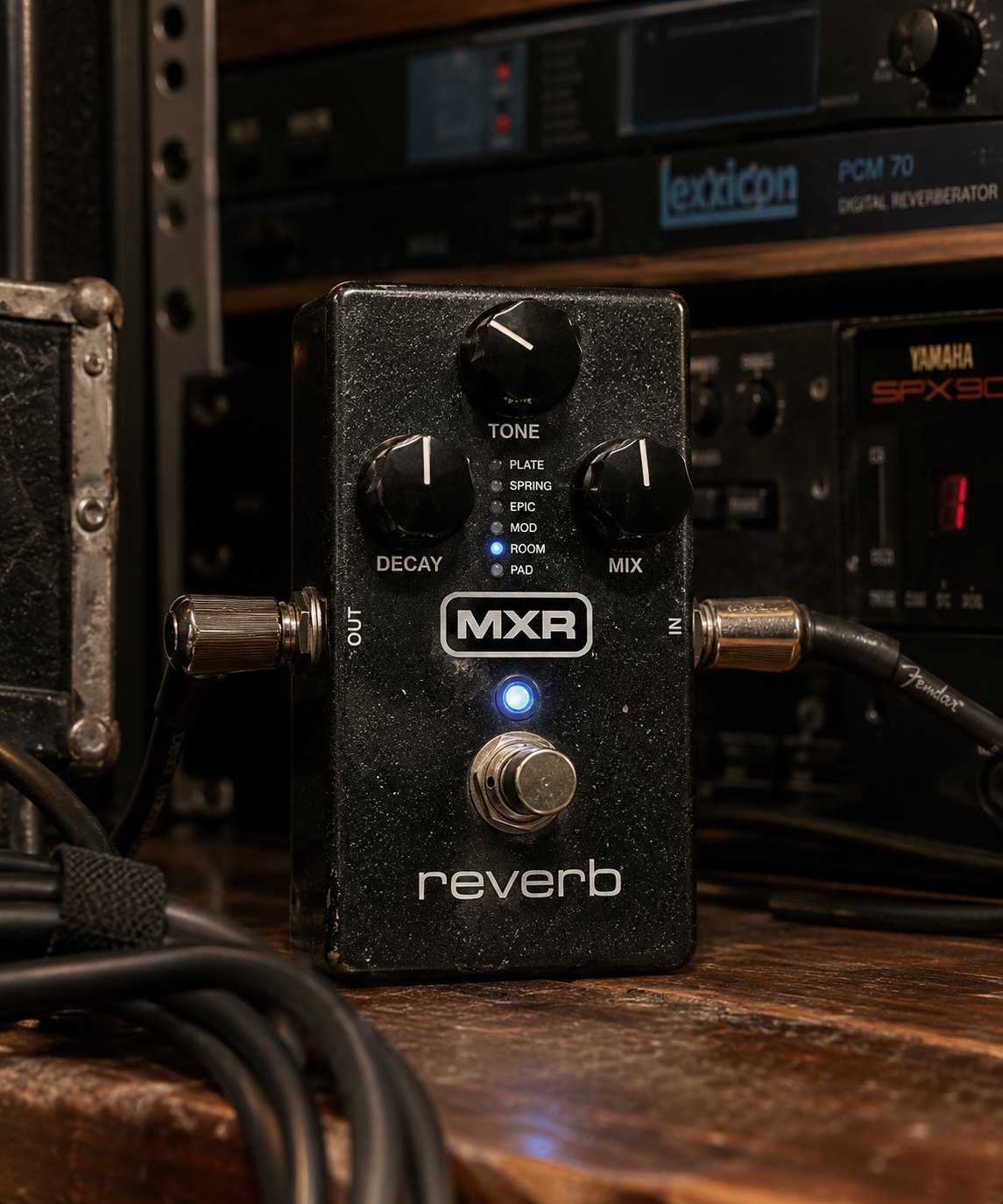
MXR M300 Reverb Pedal. AI-generated reference illustration, not a photograph.
Six distinct reverb voices in a three-knob MXR box — from authentic spring splash to ambient shimmer. The M300 covers your reverb needs at any gig.
There was a moment in the early 2010s when the reverb arms race got genuinely absurd. Boutique builders were stuffing twelve knobs, hidden menus, and seventeen voices into every stomped enclosure on the market. Deep reverb suddenly meant deep user manuals. Gigging guitarists who simply wanted something better than their amp’s spring tank found themselves drowning in algorithmic options before they’d even plugged in.
MXR’s answer was the M300 Reverb, and it landed like a breath of cold, cavernous air. Six distinct, professionally tuned reverb types — Plate, Spring, Epic, Mod, Room, and Pad — in a standard-sized gunmetal enclosure with exactly three knobs. No secondary menus. No downloaded presets. Push the Tone knob until the LED color matches the sound in your head, dial in Decay and Mix, and play. That deceptively simple premise made the M300 one of the most booked reverb pedals of the past decade: 68 professional artists on Equipboard, a Premier Guitar review that called it “the most practical” reverb for gigging players, and a permanent spot on Jerry Cantrell’s I Want Blood tour rack.
This is the story of how MXR compressed a reverb universe into three knobs — and why that radical restraint was the right call.
MXR and the Reverb Problem: A Brief History
MXR launched in Rochester, New York in 1974, built around analog stompboxes that were robust, no-nonsense, and factory-floor predictable. The Phase 90, the Distortion+, the Carbon Copy — all shared the same design philosophy: reduce the interface to the essential controls, spend the engineering budget on the circuit quality, and trust the player’s ears to do the rest.
Digital reverb, however, is a different animal. Unlike analog circuits, digital algorithms carry limitless potential for feature creep. The temptation to add one more voice, one more shimmer variant, one more hidden parameter is almost irresistible — and most manufacturers gave in to it. By 2016, when MXR released the M300, the reverb market had bifurcated into two camps: simple one-type pedals (spring only, hall only) and complex multi-type units that demanded significant time investment to master.
The M300 staked out a third position: six carefully crafted, genuinely different voices behind an interface so clean it would have looked at home in 1977. The award-winning MXR design team didn’t just grab six reverb algorithms off the shelf — they tuned each one individually, the way they’d voice an analog circuit, until it had character and depth that matched the highest-end rack units. Then they handed it to the player wrapped in three knobs.
That’s the M300’s origin story, and it explains why the pedal found homes on rigs as different as a grunge-metal arena rack and a jazz-fusion chopping-board pedalboard.
Six Voices Explained: What Each Mode Actually Does
The M300’s voice selector lives inside the Tone knob. Press it to cycle through the six voices; each press illuminates one of three LEDs in either green or red. Two colors times three positions equals six modes — a system that’s elegant until you try to make a subtle Tone adjustment and accidentally skip a mode. PG reviewer Charles Saufley flagged this in his 2016 review: “You’ll have to use a light touch when making tone adjustments. The push switch is sensitive and it’s very easy to accidentally switch voices.” That’s the M300’s one genuine gotcha, and it’s worth knowing before you reach down to tweak mid-gig.
Once you’ve memorized which LED color corresponds to which voice, the system becomes intuitive. Here’s what each mode actually delivers:
Plate
The studio workhorse. Plate reverb originated in 1950s recording studios — massive metal sheets driven by transducers, producing a dense, smooth decay that became the defining reverb texture of pop and rock recording. The M300’s Plate captures that shimmering wash without the 600-pound steel sheet. It’s the set-and-forget mode: Decay at 9–11 o’clock, Mix at 9–10 o’clock, Tone rolled back slightly from maximum, and it disappears behind your dry signal the way a great Plate always should — present but invisible. Saufley particularly noted that darker Plate settings with short Decay times “created a nice zone for lo-fi, garage-Spector tone textures.”
Spring
MXR describes this as setting “a new standard for truly authentic sounding reverb without coiled metal.” That’s a bold claim, and the M300 largely delivers on it. What makes this Spring mode special is what the Tone knob does within it: rotated counterclockwise, it produces the dark, wooly splash of a vintage Fender or Magnatone tank; near noon it occupies the sweet spot of classic amp-spring jangle; rolled up, it becomes the bright, dripping splatter of a surf record. In effect, the Tone knob gives you a full range of spring character inside a single mode — which makes Spring arguably the most depth-packed voice on the pedal. It also handles fuzz tones surprisingly well; most digital reverbs get nasty at the receiving end of heavy fuzz, but the M300’s hi-fi analog dry path with 20 volts of headroom from Constant Headroom Technology keeps the dry signal clean regardless of what you’re feeding it.

Room
The most understated mode and, in some contexts, the most useful. Room at short Decay settings adds a subtle sense of physical space — the acoustic evidence that you’re playing in a room rather than a vacuum — without smearing the note definition. This is the mode for live clean tones, jazz, or any context where reverb should be felt rather than heard. At longer Decay settings, Room opens into something richer and more organic, but unlike Hall modes, it stays controlled rather than washing out. Saufley noted that short Room settings can “evoke the less-than-charming space of an empty apartment” when played solo, but in a band context, it becomes a foundation for other textures to sit within.
Mod
Plate reverb plus pitch and phase modulation in the feedback path. The result is a dreamy, drifting spaciousness that’s particularly effective on sustained chords and slow melodic passages. Keep the Mix lower than you think you need to — the modulation becomes more present as the reverb decays, and too much Mix can push Mod from atmospheric to seasick. At restrained settings, Mod adds the kind of shimmer that made certain 1980s arena guitar tones feel like they came from another dimension.
Epic
Dunlop describes Epic as “multiple interwoven analog-tone delay lines and complex modulation — not unlike watching light bounce off fragments of mirror.” That’s accurate. Epic is the most alien of the six voices: multiple modulated reverb reflections that collide and refract in ways a physical room never could. At shorter Decay settings it’s dense and cinematic; at longer Decay, the harmonic shards PG mentioned become more apparent — this is a mode for deliberate use, not as an always-on texture. It works particularly well in a band context where other instruments fill the midrange and the Epic overtones read as atmosphere rather than clutter.
Pad
The shimmer mode, and then some. Where most shimmer reverbs add an octave-up pitch-shifted tail, the M300’s Pad brings sub-octave and octave-up content, combined with echoes, synth/organ-style modulation, and reverb itself. It’s an instrument in its own right when Decay is pushed up and Tone is dialed in thoughtfully. Roll Tone back for dark, low-organ swells that sit under clean chords. Push Tone forward for the high-octave, floating quality that Saufley described as “angels-on-high sonic sensations.” Pad is the mode that put the M300 in ambient territory — and it’s one reason the pedal appeals to players who want orchestral texture from a single stompbox.
Controls and Features
| Control/Feature | Detail |
|---|---|
| Decay | Controls reverb tail length from short ambience to long cavernous sustain |
| Tone | Shapes reverb brightness/character; also push-button voice selector (6 voices via LED color/position) |
| Mix | Wet/dry blend; fully clockwise = 50/50 wet/dry; 100% wet available |
| Expression Input | Dunlop DVP series expression pedal: toggle and blend between two stored knob configurations |
| Stereo I/O | Stereo input and stereo output — full stereo-in, stereo-out capability |
| Bypass | True relay bypass (hard true bypass) OR trails bypass — user selectable |
| 100% Wet Mode | Available for use in effects loops or ambient chain applications |
| Dry Path | Hi-fi analog dry path, 20V headroom via Constant Headroom Technology |
| Power | 9V DC; ECB003 adapter included; Dunlop Iso-Brick, Mini Iso-Brick compatible |
| MSRP | $235.99 USD |
| Street (new, 2026) | ~$189–220 USD |
| Street (used excellent, 2026) | ~$120–155 USD |
Famous Players: Who Actually Uses the MXR M300
The M300 is associated with The Edge, John Mayer, Mark Lettieri, Mateus Asato, and ambient guitarists. Honest research tells a more precise story — and it’s still a good one.
Jerry Cantrell — CONFIRMED
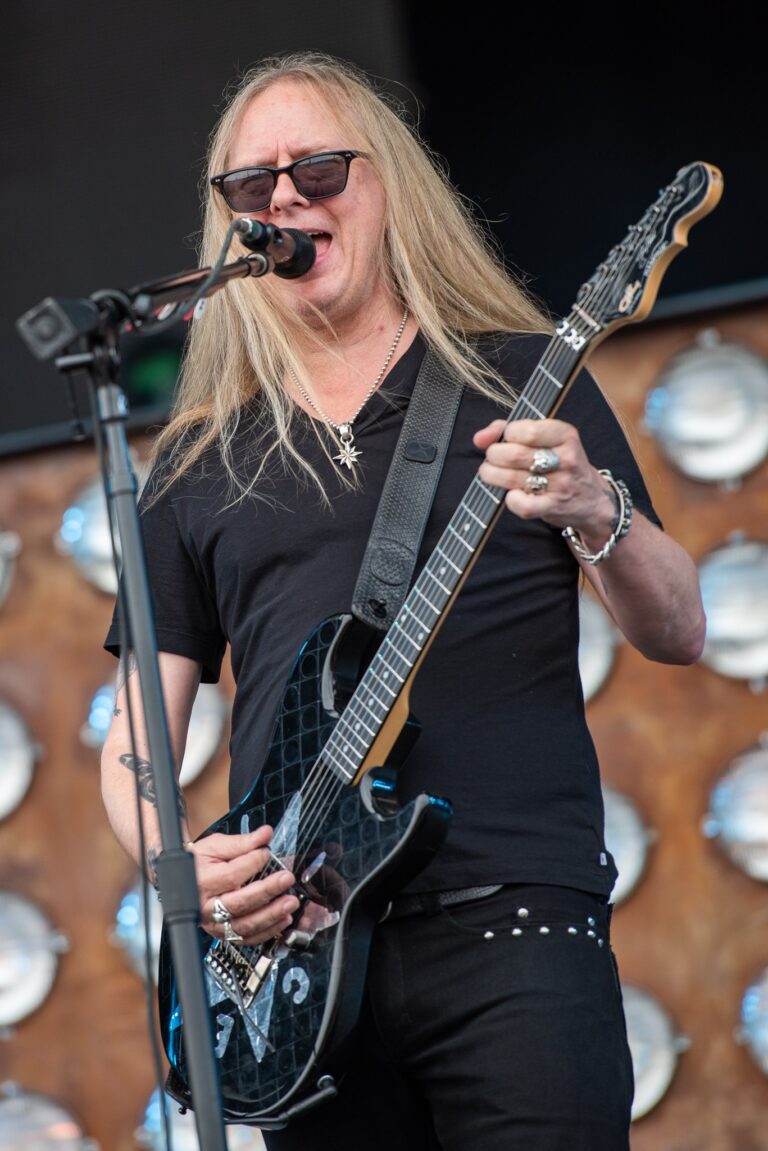
Jerry Cantrell of Alice in Chains had the MXR M300 Reverb in his rack for the 2024 I Want Blood solo tour, documented in Premier Guitar’s 2024 Rig Rundown. In a rack configuration alongside MXR Smart Gates, MXR Timmy, Strymon Ola chorus, MXR Six Band EQ, MXR Ten Band EQ, Boss DD-500, MXR EVH Flanger, Boss CE-5, MXR Poly Blue Octave, and Ibanez TS808HW, the M300 handled his reverb duties for the tour. Cantrell is a longtime Dunlop artist — his signature Wylde Audio relationship aside, his rack has historically been an MXR-heavy environment — but the M300 appearing alongside those other units in 2024 represents a specific, documented choice. His guitar context: massive, detuned, crunchy tones from ES-335-style guitars through Friedman-type high-gain amplification. That the M300 holds its own at the end of that signal chain — not getting eaten by gain, not washing out the doom-grunge heaviness — speaks to the pedal’s headroom and clarity under duress.
Mark Lettieri — NOT CONFIRMED (honest note)
The spreadsheet lists Mark Lettieri — but Lettieri doesn’t appear in the guitarist link database, and more importantly, neither of his two Premier Guitar Rig Rundowns confirm M300 use. The 2018 Snarky Puppy Rig Rundown shows Lettieri’s reverb as TC Electronic Hall of Fame 2. The 2024 Fearless Flyers Rig Rundown with Cory Wong shows a TC Electronic TonePrint Plethora X5 handling his digital effects including reverb — no M300. Lettieri is named here to be accurate: he’s associated with MXR pedals (MXR Deep Phase is documented on his Fearless Flyers board), but the M300 specifically isn’t a confirmed piece of his rig in any primary source at time of writing.
Read our guide to the TC Electronic Hall of Fame 2.
The Edge — Reverb Heritage, Not Confirmed M300
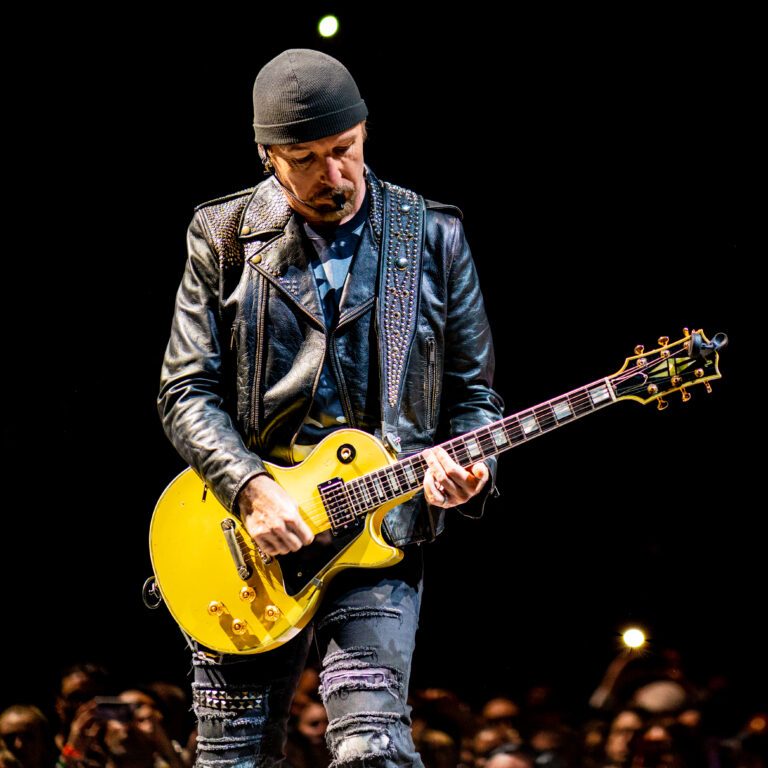
The Edge is the architect of guitar-as-reverb — the reason an entire generation of players treats reverb not as decoration but as composition. But his documented reverb tools are a different ecosystem entirely: Korg SDD-3000 delays, TC Electronic 2290 rack units, Eventide H910/H3000 harmonizers, and custom-configured Strymon BigSky setups in various tour rigs. No primary source — not a U2 Rig Rundown, not a Guitar World feature, not a manufacturer partnership document — confirms the M300 as Edge gear. He’s referenced here because the M300 inhabits the same conceptual space — the idea that reverb is the composition, not the afterthought — but that’s inspiration, not ownership.
Mateus Asato — Secondary Source Only
Mateus Asato is the Instagram-era virtuoso whose ambient, melodic playing style naturally aligns with the M300’s Pad and Epic modes. Some secondary sources, including community gear databases, list him as an M300 user. No PG Rig Rundown or manufacturer primary source confirms this specific pedal at time of writing. He’s mentioned here in the sonic context where the M300 thrives — lyrical, texture-forward playing — but readers should treat the M300–Asato connection as unverified in the primary-source sense this series requires.
Equipboard’s 68 Artists
Equipboard’s 68 professional artists on the M300 is the clearest evidence this pedal is genuinely embedded in pro rigs across genres. The listing includes John Frusciante and Jim Root among others — but as always in this series, community-aggregated Equipboard data is treated as context, not confirmation. Jerry Cantrell’s documented 2024 touring rig is the confirmed anchor point.
Tone Recipes and Settings
Recipe 1: Classic Studio Plate (All Genres)
Voice: Plate. Decay 9–11 o’clock. Tone 12 o’clock. Mix 9 o’clock. This is the set-and-forget reverb for live playing — present, supportive, invisible. Works on any pickup type, any amp. Start here.
Recipe 2: Surf Spring Splash (Fender Strat or Tele)
Voice: Spring. Decay 11 o’clock. Tone 2–3 o’clock (bright, dripping). Mix 12 o’clock. The M300’s Tone-within-Spring system lets you push this to genuine surf territory without separate controls. Works best with a clean Fender-type amp.
Recipe 3: Vintage Dark Spring (Gibson or Clean Archtop)
Voice: Spring. Decay 10 o’clock. Tone 8–9 o’clock (very dark). Mix 10–11 o’clock. The dark Spring mode approximates a warm, old-school Magnatone-type tank. Superb behind jazz chords or a clean Eric Clapton Cream-era lead line.
Recipe 4: Ambient Shimmer (Pad Mode, Clean or Light Gain)
Voice: Pad. Decay 2 o’clock. Tone 1–2 o’clock. Mix 11 o’clock. Let chords ring and build the Pad tail behind them. Roll back your guitar volume slightly for more controlled shimmer. Use the expression pedal to fade the Pad in during chord swells and back down for single-note phrases.
Recipe 5: Cantrell-Style Trail (High-Gain Context)
Voice: Room. Decay 9–10 o’clock. Tone 12 o’clock. Mix 9 o’clock. At the end of a high-gain signal chain, Room at conservative settings adds physical presence without smearing the pick attack. True-bypass or trails-bypass selection matters here: set Trails bypass so reverb decays naturally when you kill the drive pedal for a clean interlude.
Recipe 6: Modulated Dream Space (Mod Mode, Clean Amp)
Voice: Mod. Decay 12 o’clock. Tone 11 o’clock. Mix 9–10 o’clock. The pitch/phase modulation in the Mod feedback path creates a slowly orbiting space that works particularly well on suspended chords and major 7 voicings. Think early-80s arena guitar atmosphere.
Recipe 7: Epic Cinematic Layer (Effects Loop, Stereo Out)
Voice: Epic. Decay 12–1 o’clock. Tone 11 o’clock. Mix 9 o’clock. Run into effects loop with stereo outputs to two amps. Epic’s modulated multi-reflections spread beautifully in stereo — the fragments-of-mirror quality becomes genuinely spatial when left and right channel get separate reflections. Keep Mix conservative.
Expression Pedal: The M300’s Hidden Depth
The expression pedal input is the M300’s most underused feature. Connect any Dunlop DVP-series expression pedal, and the M300 stores two different knob configurations — one for heel position, one for toe position — and smoothly blends between them as you sweep the pedal. This isn’t a simple Decay-only morphing; it interpolates across Decay, Tone, and Mix simultaneously.
The practical application: set heel position for a restrained room reverb (low Decay, low Mix, neutral Tone) and toe position for an expansive Plate or Pad wash (high Decay, higher Mix, brighter Tone). A single sweep transforms your tone from dry and direct to spatially dissolved — without touching the pedal board manually. For solos, ambient swells, or the moment a song needs to breathe, this is the M300 operating at its most compositional.
Bypass Modes: Trails vs. True Relay
The M300 ships with selectable bypass: true relay bypass (your signal goes directly to the output when the pedal is disengaged — zero buffering, zero coloration) or trails bypass (when you disengage the pedal, the reverb tail continues to decay naturally rather than cutting off abruptly). The choice matters in practice.
Trails bypass is the right choice for most live applications — a reverb that hard-cuts when you switch off sounds like the room disappeared, which is disconcerting to audiences even if they can’t articulate why. True relay bypass is the right choice for players who position the M300 before overdrives or fuzzes in the chain (though at the end of a chain, where reverb usually lives, trails is almost always preferable).
Comparisons with the Competition
The M300 sits in a competitive slot — roughly $189–235 new, covering the same price point as several well-regarded reverb pedals.
vs. TC Electronic Hall of Fame 2 (~$149–169): The Hall of Fame 2 has the TonePrint app ecosystem — a massive library of downloadable reverb voices created by artists and engineers. If you want voices beyond what’s built in, TC’s app is a genuine advantage. The M300 counters with its hi-fi analog dry path and 20V Constant Headroom Technology, which means the dry signal is audibly cleaner under high input signals — relevant for hotter pickups or active electronics. The HoF2 is slightly cheaper and more flexible in terms of voices; the M300 is more plug-and-play and has better headroom documentation. Both are class-appropriate tools; Mark Lettieri chose the HoF2 in his touring rigs, which says something about that pedal’s performance credentials at this price level.
vs. Boss RV-6 (~$139–159): The RV-6 is Boss’s compact multi-reverb, and it’s a reliable, well-built pedal with eight modes. The M300 edges it on headroom and the analog dry path architecture. The RV-6 has a dedicated Dynamic mode (reverb responds to pick attack) and a more traditional Modulate mode structure. The M300’s Pad mode (sub-octave + octave-up + shimmer + modulation) goes further into ambient territory than anything the RV-6 offers. At similar prices, both are valid choices — the M300 for ambient/shimmer applications, the RV-6 for a traditional range with good delay/reverb combination.
vs. Strymon BigSky (~$449): This comparison addresses what you’re paying for. The BigSky has twelve modes, deep per-mode editing, MIDI integration, and Strymon’s reputation for best-in-class algorithm quality. For players who need to dial in specific reverb characters precisely — recording engineers, producers, session players who need a specific Plate decay shape for a specific song — the BigSky’s editing depth is worth the price. For gigging players who want six excellent reverbs that they can navigate live without looking at a menu, the M300 at roughly half the price is the rational choice. The M300 is also physically smaller and simpler to power. These are different tools for different working contexts.
vs. Electro-Harmonix Holy Grail Nano (~$89): The Holy Grail Nano is a one-knob wonder — Spring, Hall, Plate, one Mix knob, done. If all you need is a single great spring reverb on a budget, the Holy Grail Nano is exceptional for the price. The M300 is for players who need a full palette and are willing to spend for it. These pedals address different needs.
Pairing the M300 with Other MXR Pedals
MXR’s product line builds naturally toward an all-MXR signal chain. The M300 pairs predictably well with the MXR Carbon Copy Analog Delay for the standard delay-into-reverb architecture that defines much of classic and contemporary rock tone. The Carbon Copy’s analog warmth generates slightly darker, tape-like echoes that feed into the M300’s Plate or Room mode particularly well — the pre-reverb decay of the delay blurs in a way that sounds more organic than digital delay into digital reverb.
The MXR M305 Tremolo — also documented at this Rank — creates a specific Gilmour-esque texture when placed before the M300 in Plate or Mod mode. The chopped tremolo pulse enters the reverb and its after-image spreads across the decay, producing a flanged-feeling atmospheric tremolo that’s richer than either effect alone.
The MXR Phase 95 placed before the M300 in Epic mode produces a complex modulated space that moves through the reverb tail in unpredictable ways — the phaser’s frequency sweep alters the harmonic content of what Epic then processes. It’s an ambient guitar player’s tool, not a subtle color, but it’s musically useful in the right context.
Signal Chain Placement and Practical Notes
Reverb belongs at or near the end of the signal chain — after drives, modulation, and delay. The M300’s 100% wet mode makes it viable in effects loops (parallel effects loop: M300 handles the wet path while the amp’s own dry signal runs through the loop’s parallel path). In a series effects loop, set Mix conservatively to avoid drowning the amp’s own character.
The M300 draws modest current on 9V DC — Dunlop rates the ECB003 included adapter as appropriate, and any standard isolated output on a pedal power supply handles it without complaint. No battery option is mentioned in the documentation, so plan for a DC adapter. The Iso-Brick and Mini Iso-Brick are the Dunlop-native solutions if you’re already powering other MXR pedals from those supplies.
The Tone knob gotcha bears repeating for live use: when you need to adjust Tone mid-song, press gently from the side rather than directly down. The push mechanism is integrated into the potentiometer shaft and is sensitive to direct vertical pressure. A slightly angled, lighter touch from the side adjusts the Tone control without triggering a mode change. This becomes second nature after a few rehearsals but is worth flagging for new M300 owners who experience unexpected mode skips at first.
Buying Guide
The MXR M300 Reverb appears in current production at a street price of roughly $189–220 USD new in 2026. Used units in excellent condition trade for approximately $120–155 USD. The MSRP is $235.99. Dunlop provides a warranty on new units; the ECB003 adapter is included in the box.
For players considering the M300 used: the main things to check are the Tone knob’s push mechanism (press it multiple times to confirm all six LED positions cycle correctly — a faulty push switch is the most common M300 hardware issue after heavy use), the expression pedal jack (insert a cable and confirm both stored configurations morph correctly), and the bypass selector (confirm both true relay and trails modes function). The digital circuitry is generally robust; the mechanical push-knob is the component most susceptible to wear over years of touring use.
The M300 suits: players who want six professional reverb types without a learning curve, gigging guitarists who need to navigate sounds quickly under performance conditions, and anyone running a signal chain where headroom and analog dry-path integrity matter. It doesn’t suit: players who need per-mode deep editing, MIDI patch recall, or more than six reverb types — those players should look toward the Strymon or TC Electronic premium tier.
Ownership Notes
Long-term owners of the M300 consistently report two things: first, they end up using two or three voices almost exclusively (usually Spring and Plate, with occasional Pad deployments), and second, they’ve never found a replacement that handles the practical gigging requirements — quick mode access, reliable bypass, clean dry path — as efficiently at the price point. The M300 is one of those pedals that reveals its quality through sustained use rather than first impressions. The modes that seem subtle at home reveal their sophistication in a band context.
The Spring mode, in particular, is frequently cited as a reason players never move on from the M300. Authentic spring emulation in a digital pedal is genuinely hard — the non-linearity of the real physics is notoriously difficult to model convincingly. The M300’s Spring mode’s Tone control allowing character adjustment from dark vintage to bright splatter gives this mode a range that many dedicated spring pedals don’t achieve.
The pedal’s weight and build quality are standard MXR — die-cast aluminum enclosure, solid footswitch, input/output jacks on the sides. It fits neatly on any standard board in one MXR-footprint. Stereo outputs are real stereo: connect to two amps and the signal genuinely spreads — not a simple signal split, but proper stereo imaging in the reverb field.
FAQ: MXR M300 Reverb
What are the six reverb types in the MXR M300?
Plate (studio plate emulation), Spring (analog amp-spring character with adjustable Tone for dark through bright), Room (natural acoustic space), Mod (plate plus pitch/phase modulation), Epic (multiple interwoven modulated reverb reflections), and Pad (sub-octave + octave-up + shimmer + modulation + reverb — a full ambient voice).
How do you switch between voices on the MXR M300?
Press the Tone knob. Each press cycles through the six voices, indicated by three LEDs that light up in either red or green. Each LED position in each color = one voice. Use a light lateral touch rather than direct downward pressure to avoid accidentally triggering a mode change when you only intend to adjust the Tone control.
Does the MXR M300 have true bypass?
Yes — and it also offers trails bypass as an alternative. True relay bypass passes your signal directly when the pedal is disengaged with no buffering. Trails bypass lets the reverb tail decay naturally when you disengage the pedal rather than cutting off abruptly. The bypass mode is user-selectable.
Can the MXR M300 be used in stereo?
Yes. The M300 has stereo input and stereo output. Running it into two amps in stereo produces genuine stereo imaging in the reverb field — particularly effective in Epic mode, where the modulated reflections spread differently between channels.
What does the expression pedal do on the MXR M300?
Connect a Dunlop DVP-series expression pedal to blend between two stored knob configurations. Heel position = one stored configuration of Decay, Tone, and Mix. Toe position = a second stored configuration. The pedal interpolates smoothly between the two as you sweep it — useful for moving from subtle room reverb to expansive shimmer mid-song.
Is the MXR M300 a good reverb for high-gain guitar?
Yes. The hi-fi analog dry path with 20V Constant Headroom Technology keeps the dry signal clean even with hot pickups or buffered drives upstream. Room mode at conservative settings adds physical presence without washing out pick attack. Jerry Cantrell used it on his 2024 I Want Blood tour within a high-gain AIC-style context.
What’s the difference between the MXR M300 Pad mode and a standard shimmer reverb?
Standard shimmer adds an octave-up pitch-shifted reverb tail. The M300 Pad mode adds sub-octave, octave-up, echoes, and synth/organ modulation simultaneously with the reverb — it’s a more orchestrally layered effect than a single-octave shimmer. Tone control allows dialing from dark sub-heavy swells to bright angelic high-octave territory.
How does the MXR M300 compare to the Strymon BigSky?
The BigSky has twelve modes, deep per-mode editing, MIDI integration, and higher algorithm complexity — it’s the right tool for players who need precise, recallable reverb configurations. The M300 has six modes behind three knobs at roughly half the BigSky’s price — it’s the right tool for players who need professional-grade reverb quickly in a live context. Different tools for different working approaches, not necessarily better or worse.
Image credits
- Jerry Cantrell: Morten Jensen, Wikimedia Commons, CC BY 2.0.
- Top image: GuitarGangsters AI-generated reference illustration, not a photograph.
- Jerry Cantrell: Stefan Brending (2eight), Wikimedia Commons, CC BY-SA 4.0.
- The Edge: by Joe Ahorro, Wikimedia Commons, CC BY-SA 4.0.
Latest News
Related
On This Day
Monday 9 November
From this week: