The Holy Grail at Your Feet: Inside the EHX Holy Grail Neo’s Three-Mode Reverb
EHX Holy Grail Neo: Spring, Hall, and Plate reverb in one nano stompbox. Tone recipes, signal chain tips, and honest buying advice for this EHX classic.
There is a peculiar kind of bravery in releasing a reverb pedal with one knob. In a market crowded with multi-algorithm processors offering eleven reverb types, tap tempo, secondary parameters, stereo outputs, and expression inputs, Electro-Harmonix shipped the Holy Grail Neo in 2015 with a single Reverb knob and a three-position toggle switch. That is the entire control surface. And yet the Neo has quietly accumulated sixteen professional users on Equipboard, landed on Bonehead’s Wembley Stadium pedalboard for the Oasis Live ’25 reunion tour, and remained in continuous production for over a decade. The simplicity is not a compromise. It is the design.
The Holy Grail Neo is a compact digital reverb stompbox offering three tailored algorithms — Spring, Hall, and Plate — housed in Electro-Harmonix’s standard nano enclosure. It succeeds the original Holy Grail (circa 2001–2002), which pioneered the compact spring reverb stompbox format and introduced a generation of guitarists to quality digital reverb outside a rack unit. The Neo strips the concept to its essentials: one knob for wet/dry mix, one toggle for algorithm selection, true bypass, and a power adapter in the box. Everything you need, nothing you don’t.
EHX’s own tagline captures the pitch perfectly: “Your quest for an ultra pedalboard-friendly stompbox that includes plate reverb is fulfilled!” And Reverb.com, quoted on EHX’s product page, puts the user experience cleanly: “A single effect level control is all you’ll need to bask in the lush tones of a studio plate reverb, hair-raising hall, or classic amp-style spring reverb.”
History: The Holy Grail Family Tree
The Electro-Harmonix Holy Grail reverb pedal debuted around 2001–2002, with its initial writeup appearing in Vintage Guitar magazine’s June 2002 issue. EHX founder Mike Matthews discovered the Crystal CS4811 DSP chip at a trade show, and the result was one of the first compact digital spring reverb stompboxes on the market. The original Holy Grail came in a large silver enclosure with three modes: Spring, Hall, and the now-legendary Flerb — a flanged reverb hybrid that blurred the line between modulation and reverb, sounded genuinely alien, and was described by at least one contemporary reviewer as something “most folks probably won’t use very much.” That underestimation is part of the Flerb’s charm in retrospect. It became the original Holy Grail’s cult personality.
The Holy Grail Plus followed, expanding the feature set with a Room algorithm and multifunction secondary controls for decay, damping, and modulation speed — making it the more versatile sibling at the cost of simplicity. Then in 2015, EHX revisited the concept with the Holy Grail Neo: same compact spirit as the original, shrunk into the nano enclosure (4.5″ × 2.75″ × 2.1″), with one significant algorithmic trade. The Flerb was dropped. In its place: Plate.
This is not a neutral swap. Plate reverb — a studio staple since the 1960s, built from large suspended metal sheets with transducers driving them — is enormously more practical for most players than Flerb ever was. Plate sounds great on guitars, voices, and virtually every instrument. It sits in a mix without fighting other elements. It’s warm, smooth, and tonally balanced. Whether the ghost of Flerb mourns its replacement is a matter for internet forum debate. For working players who need a reverb that fits everywhere, Plate is the correct call.
The Holy Grail Nano, current-production alongside the Neo, simplifies further still: Spring and Hall only, same nano enclosure. The Neo holds the middle ground — two workhorse modes plus Plate, no Flerb, no complexity. It is exactly what the name implies: the Neo update to the Holy Grail concept, optimized for modern nano pedalboards.
Specifications
The Three Algorithms
Spring
The Spring algorithm is a digital recreation of the spring reverb tanks found in vintage guitar amplifiers — particularly the drip and splash of classic Fender reverb circuits. Spring reverb has a distinctive character: it attacks quickly, has a pronounced early reflection, and features the characteristic “boing” or “drip” when notes decay or strings are struck hard. On a tube amp with a real reverb tank, this splash is a mechanical property of the spring coil being physically excited. On the Holy Grail Neo, EHX’s DSP models that behaviour convincingly.
Spring works best with single-coil guitars through clean or lightly broken-up amplifiers. It is the correct choice for surf, rockabilly, early country, and psych-rock applications. It sits naturally behind a Fender Stratocaster or Telecaster into a Vox AC30, where the character of the amplifier and the reverb reinforce each other rather than fighting. At lower Reverb knob settings, it adds depth and space without announcing itself. At higher settings, it becomes the central sonic element — waves of decay washing over each chord.
Hall
The Hall algorithm simulates the acoustic behaviour of large enclosed spaces — concert halls, cathedrals, arenas. Hall reverb has a longer pre-delay before the wash arrives, a smoother initial transient, and a longer decay than Spring. It occupies space in a mix differently: where Spring snaps and splashes, Hall swells and sustains.
Hall is the most genre-neutral of the three modes. It works on lead lines behind a clean amp, adds depth to strummed chords without the wobble of Spring’s character, and is the appropriate choice whenever a player wants presence and dimension without a specific vintage-amp flavour. At low Reverb knob settings, Hall is nearly subliminal — just enough air to lift a dry sound. At higher settings it opens into genuine ambient territory, where held chords bloom into spatial washes.
Plate
Plate reverb — physically achieved by suspending a large sheet of metal and driving it with a transducer — was a studio staple of the 1960s and ’70s before digital units made it available outside of major recording facilities. Plate has a different character from both Spring and Hall: it is tonally balanced across the frequency spectrum, smooth in its early reflections, and unusually musical. It doesn’t have the Spring’s pronounced splash or the Hall’s long ambient tail. It sits in a mix like a fine mist rather than a wave.
Plate is especially effective on clean arpeggios, fingerpicking, voice-like lead tones, and recordings where Spring would be too retro and Hall too grand. On a Telecaster through a clean amp, Plate gives a studio-polished quality to notes that makes them feel carefully produced rather than raw. It was the right call to add it to the Neo, and for many players it will become the default starting position.
Famous Players: Who Actually Uses the Holy Grail Neo
The Holy Grail Neo now has a very concrete primary-source connection to one of 2025’s most talked-about tours.
Paul “Bonehead” Arthurs (Oasis) — Confirmed, Oasis Live ’25
Paul Arthurs — “Bonehead,” rhythm guitarist and founding member of Oasis — uses the Holy Grail Neo as his sole reverb unit on the Oasis Live ’25 world tour, including Wembley Stadium shows. On August 3, 2025, Arthurs posted a clear photograph of his Wembley stage setup to Instagram, showing his complete pedalboard: a Radial Engineering PZ-DI (for acoustic switching), Boss TU-3W Waza Craft tuner, Hamstead Soundworks Ascent clean boost, ThorpyFX Heavy Water dual boost — and the Electro-Harmonix Holy Grail Neo, engaged via a dedicated “NEO” footswitch label on his board.
The context is everything. This is one of the most anticipated concert tours in rock history — Oasis’s first performances since their 2009 split — and Bonehead’s approach to it is deliberately minimal. His amps are two Cornell Plexi 1×12 combos and two Marshall JCM900 2×12 combos (one Plexi and one JCM active at a time), and his entire effects setup is five pedals, two of which are boost pedals. The Holy Grail Neo is his only spatial effect. No delay. No modulation. Just reverb, handled by the simplest possible unit.
This is the Holy Grail Neo doing exactly what it was designed for: sitting at the end of a minimal chain, adding the necessary depth to large-room guitar tones without complicating the signal path. At Wembley Stadium, with a wall of amps and a crowd of ninety thousand, the Neo’s single knob and three-mode toggle is the right tool.
Lee Kiernan (IDLES) — Primary Source Documented
Lee Kiernan, guitarist in post-punk band IDLES, has documented using an EHX Holy Grail reverb in his studio writing setup, with confirmation via MusicRadar’s coverage of an EarthQuaker Devices “Bored to Death” pedalboard tour video (March 2021). Kiernan’s setup for writing involves two packed Pedaltrain Novo 24 pedalboards, and the Holy Grail is one of his foundational anchor effects. His approach to the pedal is instructive and unconventional: rather than placing reverb at the end of the signal chain (the standard position, after all gain and modulation), Kiernan runs the Holy Grail early — before his drive pedals.
“That’s something I actually stole off of Alan [Duggan] from Girl Band,” Kiernan told MusicRadar. “He talks about how he puts the reverb early and then one after; sending the reverb into the drives, that pushes things in a different direction.” The technique transforms what the Holy Grail does in a mix. Instead of reverb coating an overdrive tone from the outside, the reverb is baked into the signal before it reaches distortion — the wet, reverberant signal gets driven, thickened, and saturated together. The spatial element becomes part of the gain structure rather than a wash added on top. It is the defining signal chain insight in Kiernan’s noise-rock approach, and the Holy Grail is specifically called out as the vehicle for it.
Equipboard lists Kiernan as a Holy Grail Neo user specifically. The MusicRadar primary source identifies the pedal as “Holy Grail reverb” without specifying the Neo variant by name. The distinction is noted honestly — the Neo is the current compact production model and the most likely candidate for his writing rig, but the exact variant is not confirmed to the level of a labeled pedalboard photograph.
Other Equipboard-Documented Users
Equipboard lists sixteen professional artists using the Holy Grail Neo, including Dominic Simper (The Vines), Gina Gleason (Baroness), Doug Gillard (Guided by Voices), Christoph Hahn (Swans), Ryland Oehlers, Becca Stevens, Dan Zamora, and others. All are Equipboard secondary documentation — listed without primary-source photography or tech interview confirmation of the Neo specifically. They are not included in tone claims in this article. The Bonehead and Kiernan connections are the primary verified artist data points.
Tone Recipes and Settings
Spring — Surf and Rockabilly Drip
For authentic surf reverb: engage Spring mode, set Reverb knob to approximately 2 o’clock. Play with a light right-hand attack on single-note runs. The Neo will produce the characteristic splash and drip of a Fender reverb tank running at medium intensity. For deep Dick Dale-style immersion, push to 3–4 o’clock. For a cleaner, Duane Eddy slapback-adjacent sound, pull back to 10–11 o’clock. Into a Fender Stratocaster or Fender Telecaster, Spring mode on the Neo is as genre-correct as it gets in a nano enclosure.
Spring — Ambient Country
For pedal steel-influenced lead tones: Spring mode at 1 o’clock into a clean Fender-style amp. Use a volume pedal’s swell to remove the attack entirely, then let the reverb sustain carry the note. The Holy Grail’s Spring algorithm blooms naturally behind slow, sustained notes. This approach works particularly well on a Telecaster bridge pickup into a Vox AC30 with the amp reverb bypassed.
Hall — Arena Depth
Set Hall mode, Reverb knob at 11 o’clock. This is the setting for adding dimension to live rhythm guitar in a large-venue context without muddying chord changes. The Hall’s pre-delay gives each strum time to articulate before the reverb arrives — the result is space and width without smear. Increase to 1 o’clock for lead lines. This is in the general territory of what a minimal, always-on reverb looks like for a large-stage guitar player; it’s likely in the range where Bonehead operates the Neo in a live Oasis context.
Hall — Ambient Washes
For atmospheric, shoegaze-adjacent lead tones: Hall mode at 3–4 o’clock into a clean amp, guitar volume rolled back to 6 or 7. As individual notes sustain, the Hall reverb blends the dry and wet signals into a shimmering, continuous wash. This is where the single knob’s simplicity becomes especially useful — there is no decay to adjust, no pre-delay to tweak. You dial in how much wet you want and play.
Plate — Studio-Polish Clean Tones
Plate mode at noon into a clean amp is the Holy Grail Neo’s most universally applicable setting. Arpeggiated chord sequences, fingerpicked acoustic-style electric, and vocal-adjacent lead tones all benefit from Plate’s smooth, balanced character. The reverb sits behind the notes rather than announcing itself, adding dimension and presence without colouring the tone the way Spring does. For recording applications where Spring feels too vintage and Hall too grand, Plate at noon is the default starting point.
Kiernan’s Early-Chain Configuration
For players interested in Lee Kiernan’s approach: Holy Grail Neo at the start of the chain (after tuner), Reverb at approximately 11 o’clock to 1 o’clock in Spring or Hall mode, followed by overdrive or fuzz pedals. The reverb signal enters the gain stage wet, so the driven tone carries spatial information baked into its texture. The result is heavier and more atmospheric than the same overdrive applied after reverb. Try this with a germanium fuzz or a dirty EQ boost rather than a transparent overdrive — the interaction is more dramatic. Be aware that true bypass switching with reverb early means you’ll hear the reverb cut cleanly when the drive is engaged if the two are on separate loops; keep them in the same active section of the chain.
Comparisons: When the Holy Grail Neo Is (and Isn’t) the Right Call
The most important comparison is against EHX’s own Oceans 11, which offers eleven reverb algorithms, hidden secondary parameters per mode, an external INFINITE jack, tap tempo in Echo mode, and substantially more tonal range. The Oceans 11 draws 150mA versus the Neo’s 75mA, requires its included adapter for most isolated supplies, and has a genuine learning curve in its Secondary Knob Mode. The Holy Grail Neo draws 75mA, has no secondary parameters, and you understand everything about it within two minutes.
If you need variety — shimmer, reverse, modulated reverb, swell — the Oceans 11 is the correct pedal. If you need Spring, Hall, or Plate and nothing else, the Neo gives you those three algorithms at lower current draw, smaller mental overhead, and competitive pricing. The simplicity is not a concession to the Oceans 11; it’s a different design philosophy for a different type of player.
Against the TC Electronic Hall of Fame 2, the key differentiator is preset storage. The HOF 2 stores three presets with footswitch access, includes MASH pressure-sensitive footswitch functionality, and supports TonePrint for custom algorithm loading. The Holy Grail Neo stores nothing — it reads the knob position in real time, which means your setting is always visible but never recallable electronically between gigs. For players who need preset switching, the HOF 2 is the smarter buy. For players who set one mode and leave it — Bonehead’s approach — the Neo’s lack of presets is irrelevant.
Against the MXR M300, the Neo loses in feature count (the M300 offers six algorithms, stereo I/O, and expression pedal input) but wins in enclosure size, simplicity, and cost. The M300 is a substantial pedal that earns its footprint. The Neo is a nano pedal that earns its place precisely because it takes almost no footprint at all.
Against the Boss RV-6, the comparison is similar: the RV-6 has eight modes, stereo, and +Delay. It is a more capable pedal in almost every measurable category. The Neo’s advantage is the same it holds over every comparison: one knob, three modes, smallest possible package, done.
The honest summary: the Holy Grail Neo wins when minimalism is the goal. It loses when flexibility is the goal. The player who needs to know when to use it is the player who already has a specific reverb type in mind, wants to set it and forget it, and is building a board around simplicity rather than options.
Buying Guide
The Holy Grail Neo is available new for approximately $105–$143 depending on the retailer, with the EHX list price at $143.30. Equipboard lists the average street price at $129. This puts it in the same general price tier as the TC Electronic HOF 2 and below the Boss RV-6 and MXR M300. Used examples in excellent condition are available for $60–$90 — a reasonable entry point for a simple, durable digital pedal.
No battery is included or accepted; the Neo requires the 9.6VDC-200mA adapter included in the box, or a compatible power supply output. At 75mA current draw, most isolated power supply outputs rated at 100mA or higher will handle the Neo without issue — this is significantly more manageable than the Canyon or Oceans 11, both of which draw 150mA and routinely undermine budget isolated supplies. The Cioks DC7, Strymon Zuma, and Truetone CS12 all handle 75mA easily on any output. Even basic power supplies with 100mA isolated outputs work correctly. The Neo is one of the least demanding pedals in the EHX nano lineup on this axis.
Used market pricing is fairly stable. Because the Neo has been in continuous production since 2015 with no significant circuit revisions, used examples are functionally identical to new units. There is no “golden era” version to chase and no production-year quality debate. Buy the best-condition example in budget.
Ownership Notes
The Reverb knob on the Holy Grail Neo controls only wet/dry mix — it is not a decay control and does not adjust pre-delay, room size, or any other reverb parameter. What you hear in any mode at a given knob position is what the algorithm gives you: Spring always sounds like the EHX Spring algorithm; Hall always sounds like the EHX Hall algorithm; Plate always sounds like Plate. There is no way to shorten the Spring’s tail or extend the Hall’s decay. This is the core limitation of the Neo’s design and the core of its simplicity. If you need parametric control, the Neo is not your pedal. If you are comfortable with the character EHX built in and just need the knob to control how much of it appears in your mix, the single-knob design is genuinely satisfying to use.
True bypass switching means the Neo is completely removed from the signal path when off. In long true-bypass chains, this is generally a positive — no impedance loading when bypassed. In a chain where other pedals are also true bypass, the combined cable run before a buffer can cause HF roll-off in some setups; a buffer at the front of the chain addresses this.
The 9.6VDC adapter included by EHX is centre-negative, the same polarity as the vast majority of guitar pedals. It can power only the Neo from a wall outlet; it cannot be used to power other pedals from the same output. Most players with a multi-output pedalboard supply will use that instead of the included adapter, which then serves as a gig bag backup.
Placement in the signal chain: the standard position is after all gain pedals and before the amplifier, as the final spatial effect in the chain. Lee Kiernan’s early-chain approach (described above in tone recipes) is a deliberate exception that produces a specific sonic result — it’s a creative technique, not a correction to conventional wisdom. For most players in most contexts, the Neo at the end of the chain after drives and modulation is the correct baseline.
FAQ
What is the difference between the Holy Grail Neo and the Holy Grail Nano?
The Holy Grail Nano (current production alongside the Neo) has two reverb modes: Spring and Hall. The Holy Grail Neo has three: Spring, Hall, and Plate. The Neo adds Plate reverb at a small price premium. For most players, the Neo is the smarter buy — Plate is a useful addition that covers studio-clean applications where Spring and Hall feel too characterful. If you specifically don’t want Plate and prefer to save a few dollars, the Nano covers the two most essential modes.
Does the Holy Grail Neo have the Flerb setting from the original Holy Grail?
No. The original Holy Grail (2001–2002) and some later variants included Flerb — a combined flange/reverb algorithm with a distinctive alien character. The Neo replaces Flerb with Plate. EHX made this change when redesigning for the nano enclosure in 2015. Plate is substantially more practical for most playing contexts. If you specifically want Flerb, you need an original large-format Holy Grail or a Holy Grail Plus on the used market.
Can I run the Holy Grail Neo on a battery?
No. The Holy Grail Neo does not accept batteries. It requires the included 9.6VDC-200mA power adapter or a compatible pedalboard power supply output. At 75mA current draw, most standard isolated power supply outputs handle it without issue.
What does the Reverb knob actually control?
The Reverb knob is a wet/dry mix control, ranging from 100% dry (fully counterclockwise) to 100% wet (fully clockwise). It does not control decay time, pre-delay, room size, or modulation. The reverb character in each mode is fixed by the algorithm; the knob determines only how much of that reverb appears in your output signal.
Is the Holy Grail Neo true bypass?
Yes. When the footswitch is engaged in bypass mode, the Neo’s circuitry is completely removed from the signal path. This is standard for EHX nano pedals and means there is no tonal impact when the pedal is bypassed. Note that there are no reverb tails in bypass mode — the reverb cuts immediately when you engage bypass, rather than fading naturally.
How does the Holy Grail Neo compare to the EHX Oceans 11?
The Oceans 11 offers eleven reverb algorithms with secondary parameters, an external Infinite jack, and tap tempo in Echo mode. It draws 150mA and has a learning curve. The Holy Grail Neo offers three algorithms, one knob, and draws 75mA. The Neo is for players who know which of Spring, Hall, or Plate they need and want to set it and forget it. The Oceans 11 is for players who need variety and are willing to invest time in understanding the pedal’s full capability. Both are quality reverbs at different points on the complexity spectrum.
Who are the most notable confirmed users of the Holy Grail Neo?
Paul “Bonehead” Arthurs (Oasis) is the most prominently confirmed user, documented via his own Instagram photograph of his Wembley Stadium pedalboard during the Oasis Live ’25 reunion tour (August 2025). Lee Kiernan (IDLES) has been documented using an EHX Holy Grail reverb via a 2021 MusicRadar feature on his writing setup — with Equipboard listing the specific model as the Neo. Sixteen professional artists are listed as users on Equipboard.
Is the Holy Grail Neo worth buying used?
Yes. The Neo has been in continuous production since 2015 with no documented circuit revisions. Used examples in excellent condition for $60–$90 perform identically to new units at $105–$143. There is no version preference to consider and no age-dependent tonal character (it is a digital pedal). A well-maintained used Neo is a sensible buy.
Image credits
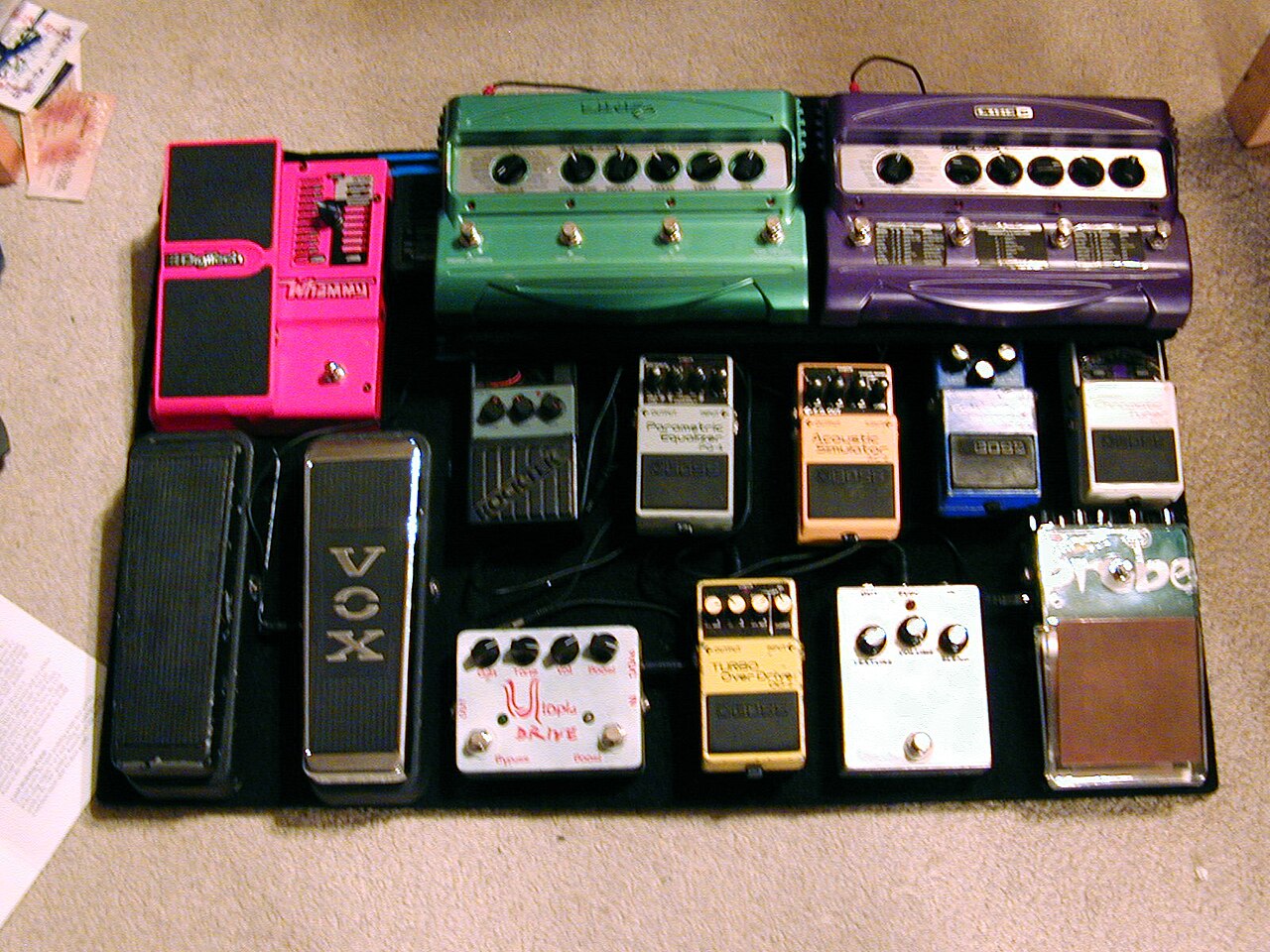
- A pedalboard with wah and effects pedals: John Athayde, Wikimedia Commons, CC BY 2.0.
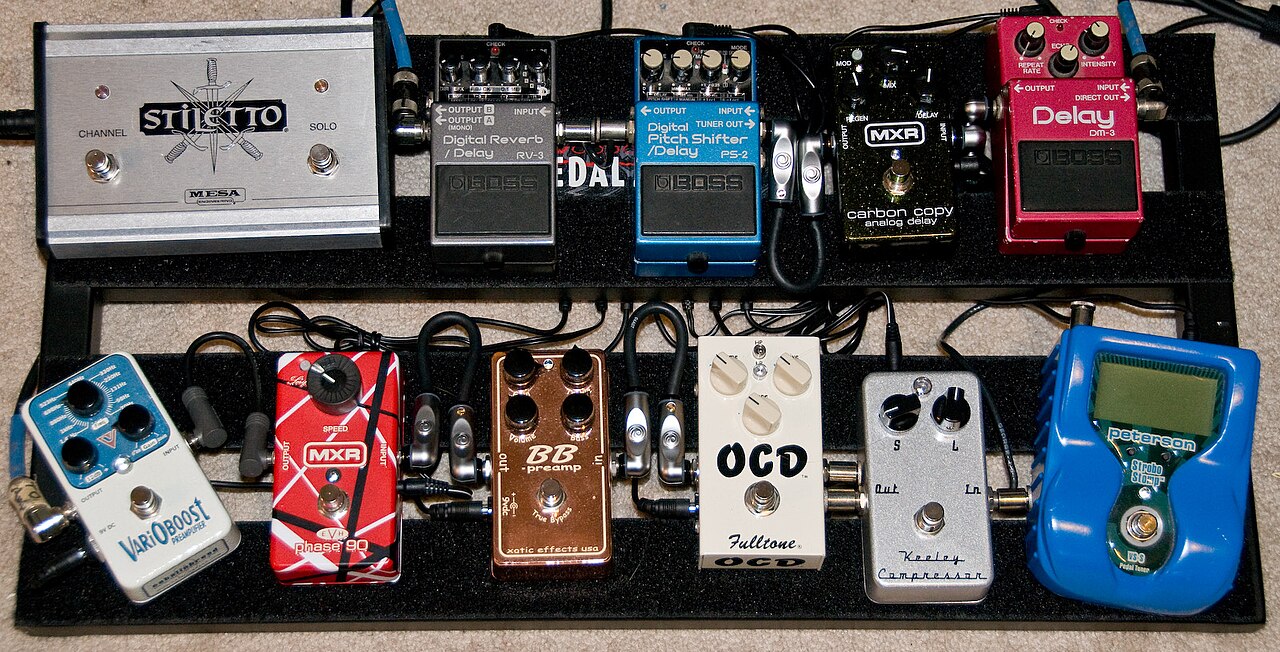
- A pedalboard with a mix of effects pedals: ArtBrom, Wikimedia Commons, CC BY-SA 2.0.
Latest News
Related
On This Day
Monday 9 November
From this week: