Wampler Ego Compressor: The Squeeze Machine That Earned Its “Industry Standard” Badge the Hard Way
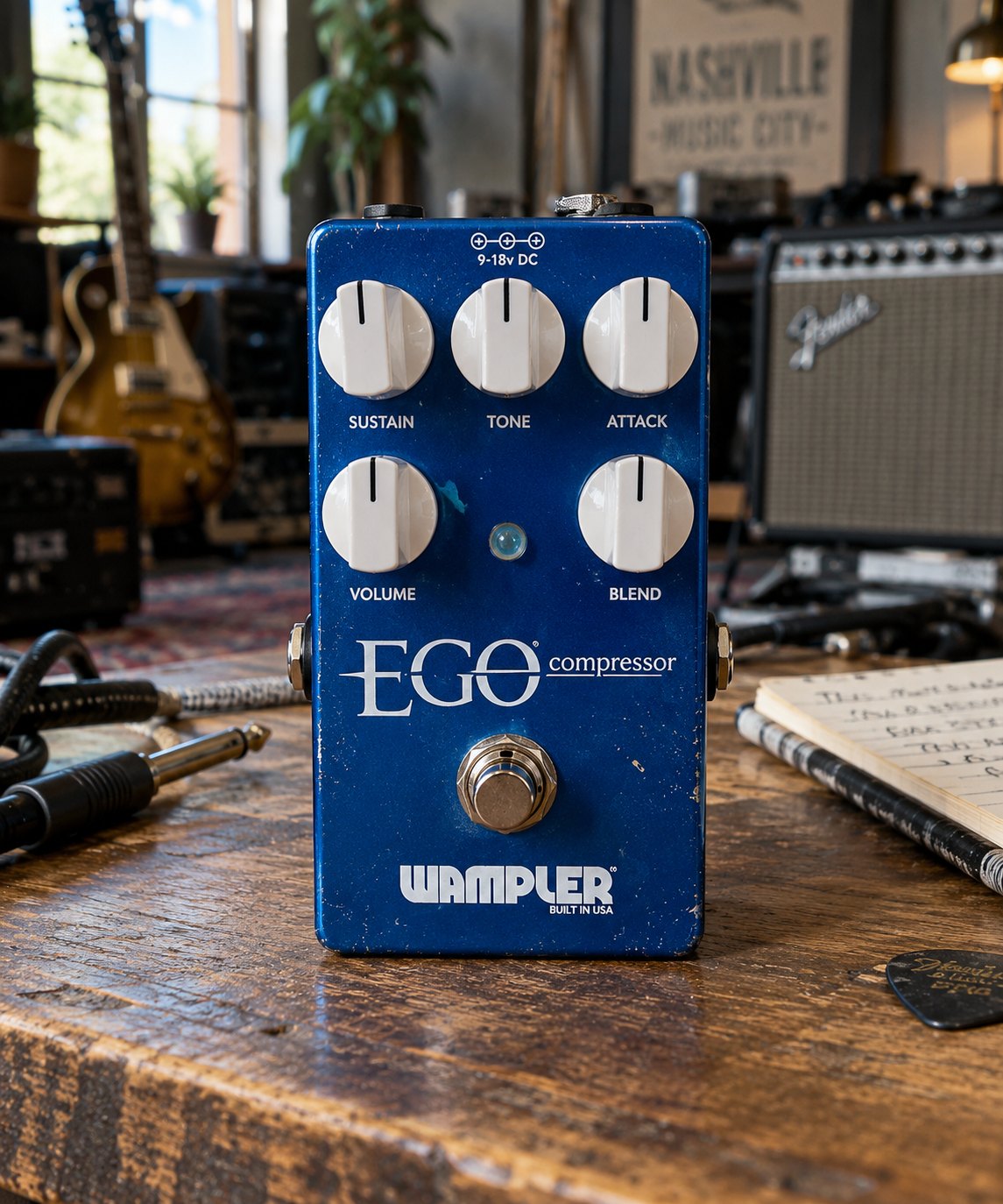
Wampler Ego Compressor Pedal. AI-generated reference illustration, not a photograph.
Wampler Ego Compressor: OTA-based compressor with Blend, Attack, and Tone controls. Used by Brent Mason and Cory Wong. Full specs, settings, and comparisons.
There’s a moment every guitarist experiences when they finally dial in a great compressor. The notes don’t get louder or softer — they just feel more there. Pick softly and the guitar responds. Dig in hard and it stays controlled. The dynamics are still yours to command, but they’ve been given a framework, a shape, a kind of musical gravity that makes every note count. That’s what compression done right feels like. And that’s precisely what the Wampler Ego Compressor delivers — which is why Wampler’s own website labels it, without any apparent embarrassment, the “industry standard in guitar pedal compression.” In this case, the marketing actually lines up with the reality.
Brian Wampler built his reputation on the American boutique tradition of taking a classic circuit and asking one simple question: what would this be if we didn’t compromise? For the Ego Compressor, the answer involved starting with the OTA-based Ross Compressor/MXR Dyna Comp lineage — the same foundational circuit that Nashville session veterans had trusted for decades — and then adding three controls that completely transform how the pedal can be used: a Blend knob for parallel compression, a Tone control to counter high-frequency roll-off, and a proper Attack parameter so you can actually shape the transient. The result is a compressor that works as a transparent always-on tone enhancer, a squishy country-picker’s weapon, and a studio-grade parallel processing tool — sometimes all within the same set of knob positions.
It has also, quietly, become one of Nashville’s most visible compressors — and Nashville is the city where compression is treated as a religion.
The Ross Lineage: Why OTA Circuits Became Country Guitar’s Secret Weapon
To understand why the Ego Compressor sounds the way it does, you need to understand what an OTA compressor is and why it became the default circuit for everything from country chicken-pickin’ to stadium-rock sustain. OTA stands for Operational Transconductance Amplifier — specifically the CA3080 chip that Ross used in the Ross Compressor (late 1970s) and that MXR subsequently deployed in the Dyna Comp. The CA3080 compresses using voltage-controlled current, which gives OTA-based compressors a specific character: they’re fast, they’re musical, they clamp down on transients with a squashy immediacy that peak limiters and soft-knee designs don’t quite replicate, and they have a warmth that comes partly from the chip and partly from the way the circuit interacts with your guitar’s pickups and impedance.
That warmth is why Nashville developed such a love affair with OTA compressors. Brent Mason, the most-recorded session guitarist in Nashville history, spent years relying on the Ross circuit’s character to give his Telecaster licks that coiled, spring-loaded feel — the one where a picked note seems to gather itself before releasing into the room. Albert Lee, the English guitar legend who became one of the most in-demand country session players in Los Angeles, built his entire articulation style around the way a well-set compressor let him play quietly but still cut through a mix with maximum definition. James Burton — Elvis Presley’s guitarist and one of the architects of the Telecaster’s Nashville sound — understood intuitively what compression did to sustain and string-to-string balance in a way that just made recordings sound more finished.

The problem with the original Ross circuit — and to a lesser extent the MXR Dyna Comp — is that it’s a blunt instrument. You get Sensitivity (compression amount) and Output (level). That’s it. No blend. No tone. No attack shaping. The compression is on or it isn’t, and at high settings it rolls off the top end and kills the pick attack in ways that can make a Telecaster sound like it’s playing through a pillow. Brian Wampler’s contribution was to solve every one of those problems simultaneously without straying from the OTA circuit’s fundamental warmth.
Wampler Ego Compressor: Official Specs
Controls Explained
Sustain is your compression depth — how hard the OTA circuit clamps down on your signal. At low settings, it’s a gentle touch: a little sustain extension, a slightly more even string-to-string response, nothing dramatic. Wind it up past noon and you’re in classic squash territory. Near maximum, you’re in full country hyper-compression — pedal-steel-style sustain that can hold a note almost indefinitely while sounding deliberately affected in the best possible way.
Attack shapes the front edge of each note. Turned counterclockwise (fast Attack), the compressor clamps down almost immediately after the pick transient, giving you that snappy, percussive quality that country and funk guitarists live for. This is the chicken-pickin’ setting: notes snap out of your guitar with a quick, precise peak before the sustain body of the note comes through. Turned clockwise (slow Attack), the compressor lets the initial pick attack pass through uncompressed — the note starts naturally, then the compression comes in to shape the tail. This produces a more amp-like, transparent feel, particularly useful for lead playing where you want your technique visible rather than smoothed over.
Tone is one of the Ego’s most underrated controls. OTA compressors historically darken the top end of your tone, particularly at higher Sustain settings — this is why some players reject compressors as tone-suckers. Wampler’s Tone control directly counteracts this. Turned clockwise, it adds presence and brightness back into the compressed signal. Turned counterclockwise, it softens the tone further — useful for taming a bright single-coil into something warmer and more envelope-like. Set it right and your compressed tone sounds identical to your bypassed tone in terms of frequency balance, just with better dynamics.
Blend is the real engineering innovation — and arguably the single control that separates the Ego from a thousand OTA compressors that came before it. Fully counterclockwise, you hear only your dry, uncompressed signal (useful if you just want to check what bypass sounds like). Fully clockwise, you’re hearing 100% compressed signal — full squash, all Ego all the time. At every point in between, you’re running parallel compression: your uncompressed guitar signal blended with a compressed version of itself. Set the Blend to around 9 or 10 o’clock and you barely know the compressor is doing anything — but your tone is somehow larger, more present, more even. This is the studio-console trick that record engineers use on vocal tracks and drum buses to make recordings sound finished without sounding processed. The Ego puts it on your pedalboard for $199.97.
Volume is your output level — essentially a make-up gain control to compensate for any level changes introduced by the compression. At higher Sustain settings, you’ll typically need to increase Volume to stay at unity gain with your bypassed signal.
Famous Players: Who Actually Uses the Ego Compressor
The Equipboard database lists 48 professional artists using the Wampler Ego Compressor. Three are particularly well-documented and worth examining in detail.
Brent Mason
If there’s a single guitarist whose presence on the Ego Compressor’s credit list should make you pay attention, it’s Brent Mason. The most recorded session guitarist in Nashville history — the man who played lead guitar on more country hits than almost anyone alive — has been documented using the Ego Compressor both in official Wampler demo videos (including a GearFest 2013 Sweetwater presentation recorded with Brian Wampler himself) and in pedalboard photographs. Mason spent his entire career building his sound around the interplay of a Telecaster, a great amp pushed just past clean, and a compressor doing the invisible heavy lifting underneath every lick and run. That he chose the Ego speaks directly to what Wampler accomplished with the OTA circuit: it has the warmth and musical squash of the vintage Ross/Dyna Comp lineage, but without the tonal compromises and the lack of control that made the originals frustrating for professional use. The Brent Mason Sweetwater GearFest video is a primary source — this is a working Nashville legend demonstrating the pedal in a real-world context, not a marketing arrangement.
Mason also has a signature Wampler pedal: the ReWired Brent Mason Signature Overdrive. His relationship with Wampler as a brand is long-standing and documented across multiple productions. His use of the Ego Compressor predates the signature model and continues alongside it.
Cory Wong
Cory Wong — the Minneapolis-born funk and soul guitarist who became one of Vulfpeck’s most distinctive voices before launching a successful solo career — used the Wampler Ego Compressor as a cornerstone of his live rig for years. His signal chain was documented in a Premier Guitar Rig Rundown: Strat into a Shure wireless, then directly into the Wampler Ego Compressor, then into an envelope filter and further effects. The Ego sat first in his chain, doing what a great always-on compressor does: providing the baseline dynamic control and tonal foundation that everything else builds on. Wong’s playing style — rhythmic funk strumming with explosive single-note accents, all requiring fast attack and a tight, controlled dynamic window — is exactly the use case the Ego’s Attack and Blend controls were designed to address.
Wampler subsequently developed a signature Cory Wong Compressor and Boost pedal. The fact that Wong moved from the stock Ego Compressor to a signature instrument designed in collaboration with Brian Wampler is itself a strong secondary confirmation of how central the Ego’s compression character was to his live sound. The signature model added a boost function and an XLR output, but the core compression circuit — the same OTA-based character with Blend, Attack, and Tone — remained essentially the Ego’s DNA.
Korey Cooper
Korey Cooper, guitarist and keyboardist for the rock band Skillet, was documented using the Wampler Ego Compressor in a RockView Live Rig Rundown. Cooper’s use of the Ego in a hard rock context is a useful reminder that compression isn’t only for country or studio players — in a band context, it serves as a tone glue that helps a guitar sit in a dense mix without losing definition or feeling thin when the volume is up. The Ego’s Blend control is particularly well-suited to this application: you can compress enough to even out your picking dynamics without sucking the life out of your attack, leaving the band’s rhythm section room to breathe.
Nashville Lineage (Sonic Context, Not Confirmed Ego Users)
It’s worth being explicit about the sonic neighborhood the Ego Compressor lives in. Vince Gill, Albert Lee, and James Burton are not confirmed Wampler Ego Compressor users — but they are the tradition that the Ego exists to serve. Gill’s impossibly clean, sustaining Telecaster leads on “When I Call Your Name.” Lee’s machine-gun alternate-picked country licks that somehow feel relaxed and swinging simultaneously. Burton’s role in defining the Telecaster’s role in American roots music, from the Sun Records sessions to Elvis’s Las Vegas shows. These players built the compression vocabulary the Ego was designed to enable — even if they developed that vocabulary with different tools.
Brad Paisley — who has a direct relationship with Wampler through his Paisley Drive Deluxe signature pedal (guitargangsters-rank776) — is similarly not confirmed as an Ego user, but represents the modern continuation of that Nashville compression tradition. His tone relies on a compressor doing exactly what the Ego does best: establishing a consistent, controlled baseline that makes his elaborate Telecaster technique legible even in the loudest live contexts.
Tone Recipes and Settings
Classic Nashville Squash (Country Chicken-Pickin’)
Sustain: 3 o’clock. Attack: 7-8 o’clock (fast, fully counterclockwise). Tone: 1-2 o’clock (slightly bright to compensate). Blend: 4-5 o’clock (heavy but not 100%). Volume: adjust to unity. This is the snappy, percussive compression that makes hybrid-picked country licks pop. The fast Attack lets each note snap before the compression clamps. The high Sustain extends the tail. The Blend control keeps a trace of dry signal so the notes still feel physical and present rather than processed.
Studio Parallel Compression (Always-On Transparency)
Sustain: 10-11 o’clock. Attack: 12-1 o’clock (medium-slow). Tone: 12 o’clock (flat, neutral). Blend: 10-11 o’clock (mostly dry with compressed signal blended in). Volume: unity or slightly above. This is the invisible mode — the setting where you don’t know it’s on until you bypass it and suddenly realize your tone has lost all its glue. Ideal for strats and teles in a band context where you need consistency without effect.
Pedal-Steel Sustain (Lead/Ambient)
Sustain: 4-5 o’clock (maximum). Attack: 2-3 o’clock (slow). Tone: 12-1 o’clock. Blend: 5 o’clock (100% compressed). Volume: increase to compensate. This is the deliberately-affected mode where compression is the sound, not invisible processing underneath it. Slow attack means your pick articulation is still there at the very front of each note; maximum Sustain holds notes for as long as your string vibrates. Great for single-note lines that need to hang in the air.
Funk Rhythm Tightener (Cory Wong-style)
Sustain: 12 o’clock. Attack: 8-9 o’clock (fast-medium). Tone: 1 o’clock. Blend: 1-2 o’clock (balanced dry/wet). Volume: unity. The moderate Blend keeps the transients alive while the compression evens out strummed chord dynamics. Fast Attack adds snap to muted strokes. Tone brightens just enough to keep a Strat present in a dense rhythmic mix.
Humbucker Warmth Enhancer
Sustain: 11 o’clock. Attack: 1-2 o’clock (slower). Tone: 11 o’clock (slightly dark). Blend: 3 o’clock (leaning compressed). Volume: unity. Humbuckers have naturally thicker, rounder transients than single coils — they need less Sustain and can handle a slightly darker Tone setting. The slower Attack lets the humbucker’s natural warmth come through before the compression shapes the sustain.
How the Ego Compressor Fits in Your Signal Chain
Standard practice is to place the Ego Compressor first in your chain — before overdrives, before modulation, before delays and reverbs. There are two reasons for this. First, compressors work best on the widest dynamic signal you can feed them: your raw guitar. Once you’ve run through an overdrive, your dynamics are already shaped by the drive circuit; compressing again just adds squash on top of squash. Second, the Ego’s OTA circuit responds to the impedance characteristics of your guitar’s pickups, and inserting a buffered pedal before it slightly changes the circuit’s behavior — not catastrophically, but perceptibly to trained ears.
The one exception worth noting: if you’re using a fuzz pedal (especially a germanium fuzz or a vintage Fuzz Face circuit), the fuzz should go before the Ego. Fuzzes are highly sensitive to input impedance — they need to see the high impedance of your guitar directly — and placing a compressor before the fuzz changes the fuzz character in ways most players find unpleasant. Everything else can follow the Ego in any order.
In a studio context, placing the Ego at the end of your chain (after drives and modulation) is a valid approach — you’re using it more as a leveler than a tone-shaper, catching peaks and creating consistent output for the recording interface. This is closer to how a rack compressor would be used in a traditional recording setup. The Blend control makes this approach more practical than it would be on a conventional OTA compressor: even at the end of the chain, you can keep significant dry signal blended in to preserve the attacks that your drives and effects created.
Ego Compressor vs. the Competition
vs. MXR Dyna Comp
The MXR M102 Dyna Comp is the Ego’s direct ancestor — same OTA circuit, same fundamental compression character, decades of Nashville and studio history behind it. At $79.99 MSRP versus the Ego’s $199.97, the Dyna Comp wins on price. But the tradeoff is control: two knobs (Output and Sensitivity) versus the Ego’s five. You can’t blend in dry signal on the Dyna Comp, so at high Sensitivity it squashes everything including your pick attack and high frequencies. The Ego gives you all of the Dyna Comp’s warmth and OTA character plus the Blend, Tone, and Attack controls to manage the compression’s side effects. For pure budget country squash, the Dyna Comp works. For any application requiring nuance, the Ego is in a different league.
vs. Keeley Compressor Plus
The Keeley Compressor Plus is probably the Ego’s most directly comparable competitor: boutique OTA-based compression with blend function, similar price tier, and a devoted Nashville user base. The Keeley has a tighter, more attack-forward character — it cuts through a mix more aggressively. The Ego is warmer, more “lush” and “swampy” in the descriptions of players who’ve owned both. Neither is objectively better; they’re different flavors of the same circuit philosophy. Players who need their guitar to project forward in a dense mix often prefer the Keeley. Players who want compression to feel like an extension of the amp’s natural behavior tend to gravitate toward the Ego. If you’re comparing them in person, the Tone knob on the Ego is genuinely useful for tuning the frequency balance in ways the Keeley doesn’t offer.
vs. Wampler Mini Ego Compressor
Wampler makes a smaller version of the Ego at a lower price point. The Mini Ego Compressor captures the essential character of the full-size pedal in a smaller enclosure with fewer controls — specifically losing the Attack and Tone knobs. If your application is simple (always-on transparent compression, or basic squash for country) and pedalboard space is tight, the Mini Ego is worth considering. But if you need the full control set to dial in a specific dynamic response, the standard Ego’s Attack control alone is worth the size and price difference.
vs. Wampler Mini EGO 76
The newer Mini EGO 76 is based on the 1176 Peak Limiter topology rather than the OTA Ross circuit — it’s a different kind of compression altogether. The 1176-style circuit has faster attack times and a different clipping character that many players describe as more “studio” and less “guitar pedal.” Both are Wampler products and both are quality instruments, but they’re solving different problems. The Ego’s OTA warmth is what Nashville tradition runs on; the EGO 76’s FET-limiter character is closer to what you’d find in a recording studio rack.
Buying Guide
The Wampler Ego Compressor is widely available new at most major guitar retailers at or near MSRP ($199.97). Street pricing in 2026 runs approximately $165–$200 for new condition. Used examples in excellent condition typically sell for $105–$145 on Reverb and equivalent used-gear markets, which makes the used market a reasonable option if budget is a concern — the pedal is mechanically simple and built to last.
Note that there are two primary versions of the Ego Compressor. Version 1 has side-mounted input/output jacks. Version 2 (current production) has top-mounted jacks, which most players with organized, densely-packed pedalboards prefer. When buying used, check the photos to confirm you’re getting the current top-jack version if that’s your preference. Both versions use the same circuit and sound identical; it’s purely a physical layout difference.
The Wampler EGO is covered by a 5-year limited warranty from Wampler Pedals. Register your product at wamplerpedals.com within ten days of purchase to ensure warranty coverage. The pedal draws a modest 14mA at 9V — well within the output capacity of virtually any power supply, including daisy-chain units — or 22mA at 18V. For 18V operation, ensure your power supply has an isolated output capable of the higher voltage. The battery LED will flash three times when the battery charge is getting low, a useful warning before it affects your tone.
Wampler’s customer support phone number is (765) 352-8626 and email is help@wamplerpedals.com. Given the USA manufacturing and 5-year warranty, the Ego is a long-term investment rather than a disposable pedal purchase.
Ownership Notes: Living with the Ego Compressor
Several real-world ownership quirks are worth noting. First, the enclosure is taller than many pedals — specifically, the footswitch sits higher than on more compact designs, which means your foot may sometimes catch the Blend knob when engaging the pedal. This is a documented complaint from owners; if you place it on a flat board surface, consider leaving it in a position where the Blend control won’t be accidentally nudged. Some players mount the Ego on a raised section of their pedalboard to give their foot a more natural angle.
Second, the True Bypass switching means no buffer is in the signal path when the pedal is bypassed. In a rig with very long cable runs — particularly relevant for country session players who may run fifty feet of cable to front-of-house — the absence of a buffer can cause high-frequency loss before the signal reaches the pedalboard. If this is your scenario, consider adding a dedicated buffer pedal (or a buffered-bypass pedal) early in your chain.
Third, the 18V option is worth experimenting with. Moving from 9V to 18V doesn’t dramatically change the Ego’s character the way it does on some drives — but it increases headroom, and players report that at 18V the compressor feels slightly more “open” and less prone to the very subtle gain reduction artifacts that can appear at high Sustain settings on 9V. The 22mA draw at 18V still fits comfortably in any isolated power supply output rated at 100mA.
Fourth: the Ego does work on bass guitar. The OTA circuit handles bass frequencies well, and the Blend control is particularly useful for bass applications because it preserves the low-end punch (dry signal) while the compressed layer adds sustain and evenness. This isn’t its primary use case, but it’s worth knowing if you occasionally pull double duty.
FAQ: Wampler Ego Compressor
What circuit is the Wampler Ego Compressor based on?
The Ego Compressor uses an OTA (Operational Transconductance Amplifier) circuit — specifically the Ross Compressor/MXR Dyna Comp lineage built around the CA3080 chip. Wampler’s additions are the Blend control for parallel compression, the Tone control to compensate for OTA high-frequency roll-off, and the Attack control to shape transient response. The fundamental warmth and musicality of the OTA character is preserved; the added controls address everything that made vintage OTA compressors frustrating to use without limits.
What does the Blend control actually do?
The Blend control mixes your unprocessed dry guitar signal with the compressed signal, allowing parallel compression. At fully counterclockwise, you hear only dry signal (no compression). At fully clockwise, you hear 100% compressed signal. Anywhere in between, you blend both. The key advantage is that the dry signal preserves your pick attack and natural transients even at high Sustain settings — you get the sustain and evenness of compression without losing the physical presence of your picking hand. This is how top-tier studio engineers compress on vocal tracks and drum buses; the Ego brings it to the pedalboard.
Is the Attack knob fast or slow when turned clockwise?
Clockwise is slow Attack. Counterclockwise is fast Attack. Fast Attack (CCW) = the compressor clamps down quickly, giving notes a snappy, percussive quality — good for chicken-pickin’ and funk. Slow Attack (CW) = the initial pick transient passes through before the compression engages — more transparent, more amp-like, better for lead playing where articulation should be visible. This labeling is the opposite of how some players initially expect it to work; worth memorizing before your first gig with the pedal.
Can I run the Ego Compressor at 18V?
Yes. The official specs list power consumption as 14mA at 9V and 22mA at 18V, confirming that 18V operation is supported. Running at 18V increases headroom and slightly opens up the compression character at high Sustain settings. It’s worth trying if your power supply has an isolated 18V output. Do not use an 18V adapter on a pedal designed for 9V-only — but the Ego is explicitly rated for the higher voltage.
Where should the Ego Compressor go in my signal chain?
First position — before overdrives, drives, modulation, delay, and reverb. This is the standard approach and the one that best exploits the OTA circuit’s interaction with your guitar’s pickup impedance. The one exception: fuzzes (especially Fuzz Face and germanium circuits) should go before the Ego, as they need direct access to your guitar’s high-impedance output. Everything else follows the Ego.
What’s the difference between the Ego Compressor and the Cory Wong Compressor?
The Wampler Cory Wong Compressor is a signature model developed in collaboration with Cory Wong, who used the standard Ego Compressor on his pedalboard for years. The Cory Wong model adds a Boost function (with a separate rotary control and a profile switch for flat boost vs. saturated boost) and an XLR output. The core compression circuit — OTA-based, with Sustain, Attack, Tone, and Blend controls — is derived from the Ego’s design. The stock Ego Compressor is the compression-only version; the Cory Wong adds boost and pro-audio output functionality.
Does the Ego Compressor work well with humbuckers, or is it mainly a single-coil pedal?
It works well with both. Single-coils benefit from the Ego’s ability to even out the string-to-string volume differences inherent in offset-coil construction, and the Tone control can counteract the slight high-frequency roll-off that becomes more noticeable with bright Strats and Teles. Humbuckers already have a thicker, more compressed fundamental character, so you generally need less Sustain and a slower Attack setting — but the parallel compression approach via the Blend control is just as useful for thickening a humbucker’s tone without killing its natural sustain and warmth.
Is the Ego Compressor worth the price over budget OTA compressors?
The MXR Dyna Comp is $79.99. The Wampler Ego is $199.97. That’s a meaningful price difference. Whether it’s worth it depends entirely on how much you value the three extra controls — Blend, Tone, and Attack. If you use compression only as an occasional effect and basic squash settings work for you, the Dyna Comp is excellent. If compression is genuinely central to your tone and you need the ability to dial in parallel compression, control attack response, and compensate for frequency roll-off, the Ego’s control set is worth the premium. It’s not a better circuit — it’s a more controllable version of the same circuit, which is a different thing.
Image credits
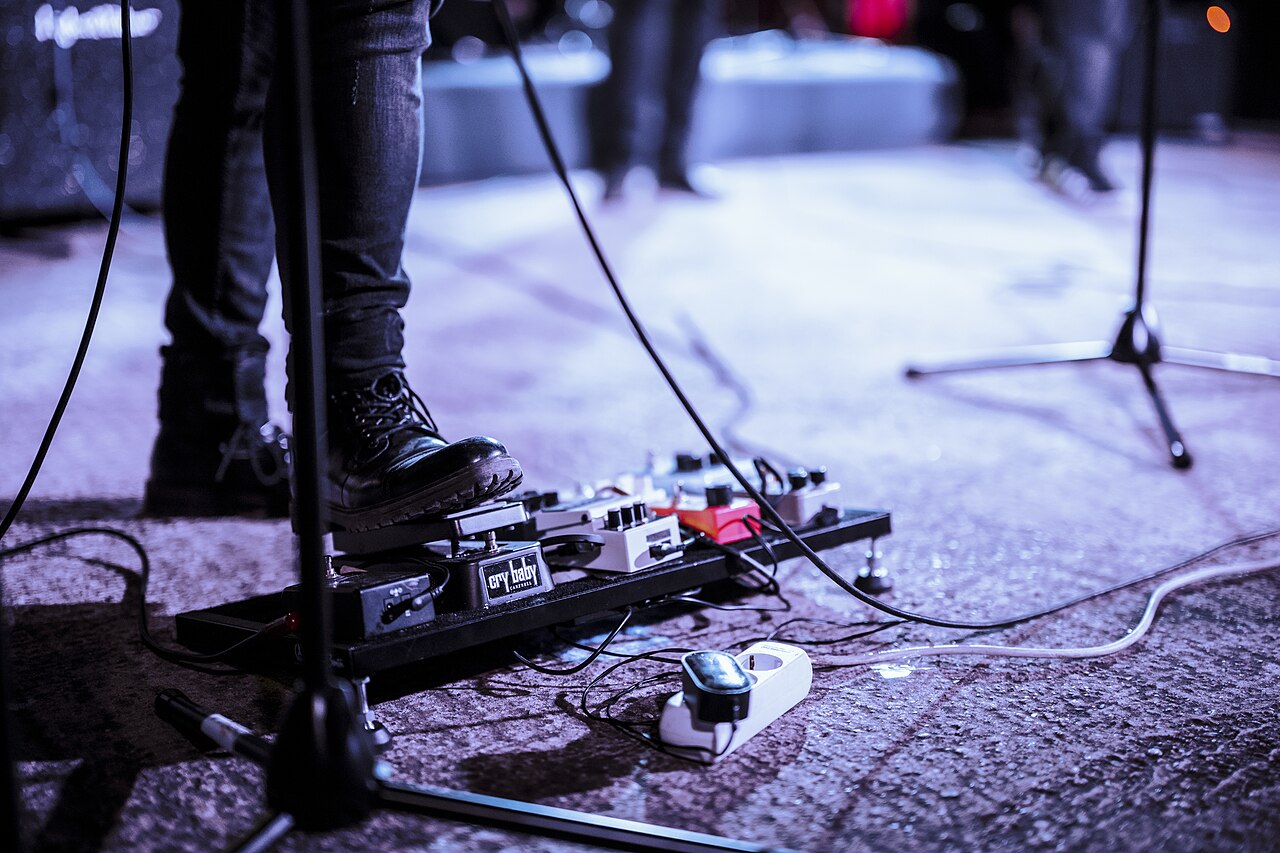
- A guitarist using an effects pedal on stage: Shixart1985, Wikimedia Commons, CC BY 2.0.
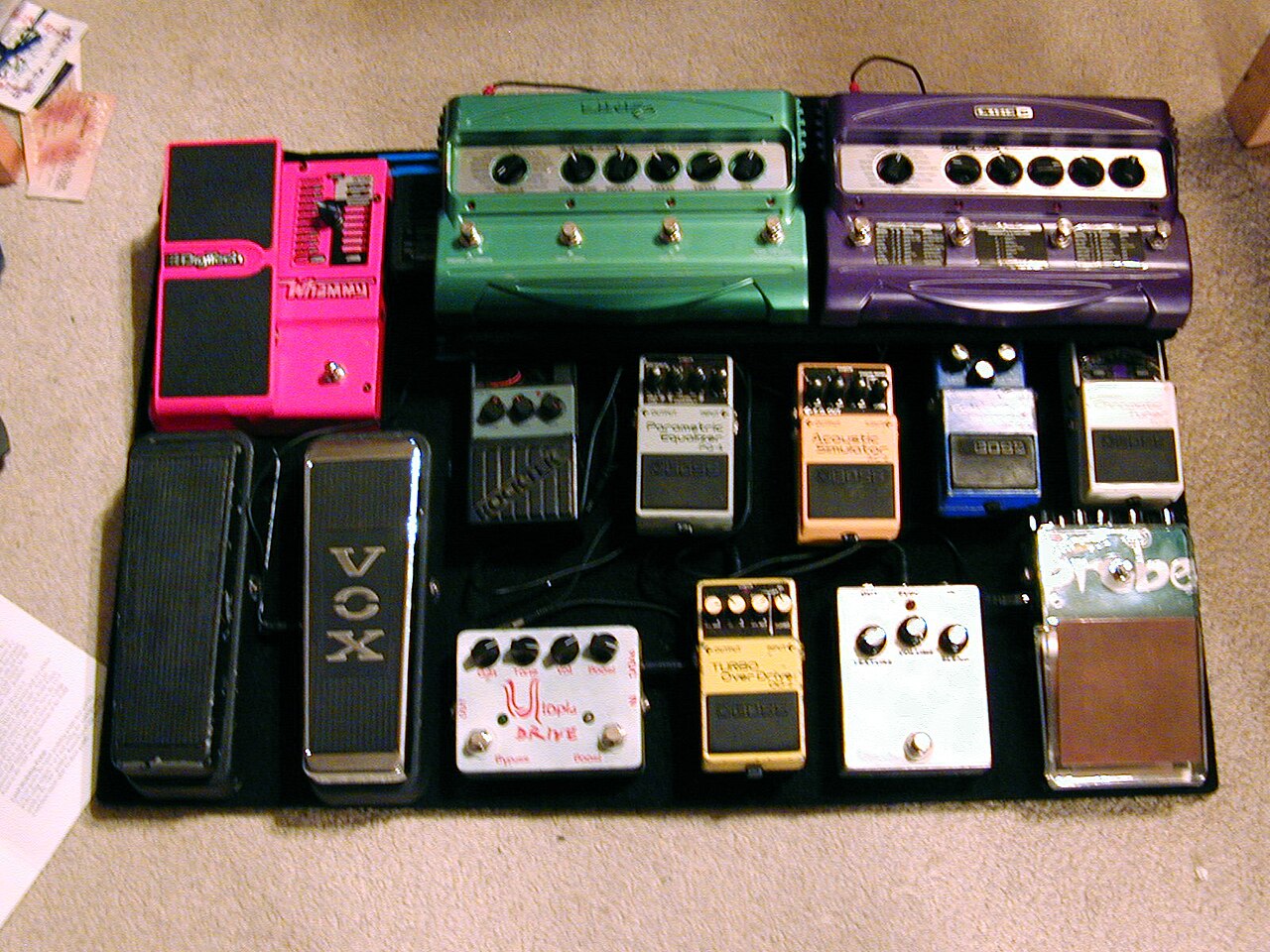
- A pedalboard with wah and effects pedals: John Athayde, Wikimedia Commons, CC BY 2.0.
- Albert Lee: Andreas Lawen (Fotandi), Wikimedia Commons, CC BY-SA 4.0.
- Top image: GuitarGangsters AI-generated reference illustration, not a photograph.
Latest News
Related
On This Day
Monday 9 November
From this week: