Walrus Audio 385 Overdrive MKII: The Movie Projector That Refused To Die
An AI-generated illustration of the Walrus Audio 385 Overdrive MKII.
Walrus Audio 385 Overdrive MKII guide: the Bell & Howell projector amp origin, MKII vs original, verified players, tone settings, comparisons and FAQ.
Somewhere in a garage in Hamilton, Ontario, in the early 1990s, a technician named Bernie Raunig unbolted the amplifier section from a Bell & Howell Filmosound home-movie projector, wired a guitar jack to it, and accidentally started a thirty-year chain reaction that ends with a yellow pedal on your board.
That is not marketing embroidery. That is the actual lineage of the Walrus Audio 385 Overdrive MKII, and it is one of the very few pedal origin stories in this entire guide that does not begin with somebody reverse-engineering a Tube Screamer.
The 385 is named after a machine that was never meant to make music. The Bell & Howell Filmosound 385 was a piece of mid-century audio-visual office equipment — a 16mm film projector with a tube amplifier bolted to its underside so that classrooms and church halls could hear the soundtrack. It had a pair of 6V6 power tubes, transformers built to hi-fi tolerances, and a single tone knob. It also, entirely by accident, had one of the sweetest compressed overdrive characters of any amplifier circuit built in the 1950s.
Walrus Audio spent, by their own account, “endless hours of research” on one of these things before releasing the original 385 Overdrive in August 2016. Seven years later they came back and rebuilt it. This is the story of both versions, what actually changed, who genuinely plays one, and — because this matters more than usual with this particular pedal — where the widely circulated facts about it are simply wrong.
The Projector Amps: A Real History, Not A Marketing Story
Bell & Howell introduced the Filmosound line in 1932. The models that matter to guitarists arrived from the mid-1940s onward, because those had a removable amplifier chassis bolted to the underside of the projector body — meaning the amp could be unscrewed and used entirely independently of the film mechanism. It was, as the guitar writer and repairer Huw Price put it in his 2019 Guitar.com teardown, effectively a one-stop shop: chassis, transformers, tubes, and a faceplate that already looked vaguely like a guitar amp.
Most Filmosounds ran a pair of 6V6 power tubes into roughly 15 watts. Canadian-built examples often used EL84s instead. From the late 1950s onward they carried Schumacher transformers — the same supplier Fender was using in the same period, which is the single most-quoted fact about these amps and the one most responsible for their reputation.
Bernie Raunig and the “Bernie” amps
Raunig, working in Hamilton, Ontario, began converting Filmosounds for local musicians in the 1990s. He built somewhere between 15 and 30 of them. They became known simply as “Bernie” amps and acquired a reputation wildly disproportionate to their number. It is generally accepted in the Canadian amp community that Colin Cripps — Blue Rodeo, and a sideman for Sarah McLachlan and Bryan Adams — bought the very first one and never stopped using it. Raunig’s amps were mostly EL84-based, because Canadian Filmosounds were.
Raunig left the amp business, but the idea outlived him. Tony Teixeira of Tex Amps in Toronto has worked on roughly ten original Bernies and reverse-engineered the circuit; he reports that Bernie used none of the original Filmosound circuit at all, only the chassis, transformers and tubes. Anthony Roos of At Mars Amplification in Minneapolis converts the earlier 6V6 models. Andy Drinkall’s Oldamps does the same in the UK. Every one of them says a version of the same sentence: the magic is in the transformers.
Blake Mills, and why prices went up
The modern spike in Filmosound interest is largely attributable to one record. Blake Mills recorded his 2014 album Heigh Ho using converted projector amps maintained by the California tech Austen Hooks. Mills told Premier Guitar that the projector amps were good for everything he does — well-rounded, with an attack envelope that sat exactly where he wanted it, neither too aggressive nor too compressed to cut through a mix. Roos of At Mars says plainly that Mills’s influence pushed prices on the later models high enough that he shifted his own business to the earlier brown-panel units.
A Filmosound projector sold for around $850 in 1959. Adjusted, that is roughly $8,000 in current money. These were expensive, over-engineered pieces of professional equipment, which is precisely why the parts inside them still sound good seventy years later.
2016: Walrus Puts A Projector In A Box
Walrus Audio announced the original 385 Overdrive from Oklahoma City on 15 August 2016, at a retail price of $199. The press release is unusually specific about what they were chasing: the Filmosound’s “simple, but effective controls, plus dual 6V6 output section make for a simple and extremely responsive amp that has an amazing compressed overdrive when cranked.”
Two design decisions define the pedal and both come straight from the amp.
The tone stack was split. The Filmosound stacks bass and treble behind a single tone knob. Walrus broke them apart into independent Bass and Treble controls, each capable of boost and cut. That is why the 385 can do mid-scooped and mid-humped voicings that the source amp physically cannot — you can carve a notch or build a bump rather than just rolling off the top.
The circuit runs internally at 18 volts. This is the part people skip past, and it is the whole pedal. Charge-pumping the internal rail to 18V buys headroom, and headroom is what lets the circuit stay dynamically responsive instead of collapsing into fixed clipping. Walrus’s stated reason is exact: it “helps us nail the same dynamic feel of the amp in a stomp box. This means it is extremely sensitive to how hard you dig in — just like the amp.”
You feed it 9V. It runs at 18V inside. That distinction confuses a lot of people and is worth holding onto.
A correction: 6V6, not EL84
Here is a factual error that has propagated widely, including into otherwise excellent journalism. Guitar.com’s Filmosound feature states in passing that “there’s even a Walrus Audio pedal called the 385 Overdrive that’s designed to emulate an EL84-loaded Filmosound.”
That is not what Walrus says. Both the 2016 press release and the current product page specify a dual 6V6 output section. The first-party source is unambiguous and it disagrees with the secondary source. The confusion is understandable — the most famous converted Filmosounds, Raunig’s Bernies, were EL84 amps — but the pedal is modelled on the 6V6 variant, which is the darker, grittier, more compressive of the two. Ramon Goose, who owns both types, describes the 6V6 models as “a bit grittier and darker” and the best of the two for slide, compressing “in a really musical way.” If you have been buying the 385 expecting AC15-style chime, you have been sold the wrong amp.
What Actually Changed In The MKII
Walrus announced the 385 MKII on 13 October 2023, seven years after the original, at $249. The circuit core is the same. Everything around it moved.
The A/B footswitch and the second gain stage
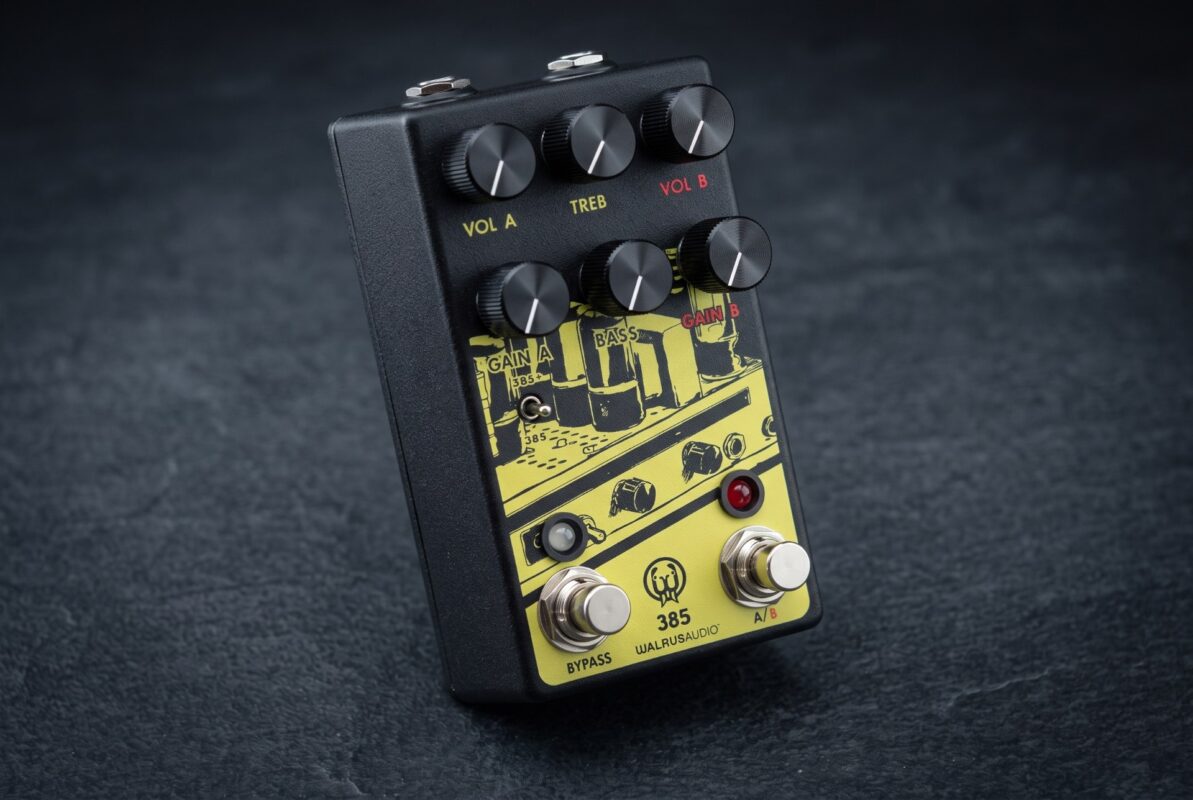
The headline change. The MKII adds a second footswitch and a second full set of Volume and Gain knobs. Stepping on A/B swaps which pair is active. The Bass and Treble controls are shared between both — this is not a two-channel pedal in the amplifier sense, it is one voice with two footswitchable gain-and-level presets.
Walrus’s stated reasoning is worth quoting because it is honest about how the original was actually used. On release, players adopted the 385 for its amp-like dynamics at low gain. Then a second constituency found that cranking the gain produced a distortion-like character unique to the circuit. Two camps, one pedal, no way to have both. The A/B switch is a direct response to that.
The 385+ toggle
A small toggle that slams the front end of the circuit with an additional gain stage, pushing the pedal into saturated, sustaining, near-fuzz territory. Two things about it are worth knowing before you buy, and neither appears in the marketing copy:
- It is global, not per-channel. It affects both A and B simultaneously. Several owners have publicly wished it were assignable to one side only.
- It reduces your usable gain range. With 385+ engaged, gain settings much past noon can produce squeal at rest depending on your guitar, pickups and room. This is a documented owner observation, not a defect.
The boring changes that matter most
Top-mounted jacks and a soft-touch, relay-based true bypass. If you have ever tried to fit a side-jack pedal into a tightly packed board, you already understand why this is arguably the most practically significant update in the whole MKII. The relay bypass also means the switch is silent and mechanically soft rather than a clicking 3PDT.
Specifications
| Specification | Walrus Audio 385 Overdrive MKII |
|---|---|
| Type | Amp-voiced overdrive, analogue |
| Inspiration | Bell & Howell Filmosound 385 projector amplifier (dual 6V6, ~15W) |
| Original release | 385 Overdrive, 15 August 2016, $199 |
| MKII release | 13 October 2023, $249 |
| Controls | Volume A, Gain A, Volume B, Gain B, Treble, Bass |
| Switching | Bypass footswitch, A/B footswitch, 385+ toggle |
| Tone stack | Independent Bass and Treble, each boost and cut |
| Internal voltage | 18V (internally boosted from 9V input) |
| Bypass | Relay-based true bypass, soft-touch |
| Jacks | Top-mounted |
| Power | 9V DC centre negative, 100mA minimum, isolated supply recommended |
| Battery operation | None |
| Enclosure | Die-cast, 4.77″ x 2.6″ x 1.39″ including knobs |
| Finishes | Textured black with David Hüttner projector illustration (yellow/red ink); flat black with Josh Yosurack tube illustration (cream ink) |
| Warranty | Walrus Audio limited lifetime |
| Status (Sept 2026) | Current production; MSRP $249.99, street commonly $170–$212 |
Famous Players: An Honest Accounting
This is the section where most gear articles about the 385 quietly cheat, so let us be precise about what is and is not documented.
Every verified artist sighting of a 385 is of the original 2016 pedal, not the MKII. As of September 2026, Equipboard’s entry for the 385 MkII lists no artists at all, while the entry for the original lists a dozen. That is not evidence that nobody gigs a MKII — it is a three-year-old pedal in a market where crowd-sourced gear databases lag reality badly — but any article claiming a named MKII user is claiming something no public source supports.
Documented on video or in interview
- Misha Mansoor (Periphery) — posted a photograph of a board he described as a “work in progress pedalboard/inspiration station” with a 385 on it. Photographic, first-party, but explicitly a workbench rather than a touring rig.
- Dustin Kensrue and Teppei Teranishi (Thrice) — both seen using 385s in Walrus Audio’s own Songs at the Shop: Episode 11. Worth noting the obvious: this is a video produced by the pedal’s manufacturer, at the manufacturer’s own facility. It is real usage on camera, but it is not independent.
- Joey Landreth (The Bros. Landreth) — discusses his use of the 385 on That Pedal Show. Landreth is a slide and open-tuning player working in exactly the compressed, sustaining, amp-like territory the 6V6 Filmosound was best at, which makes this the most musically coherent endorsement on the list.
- Drew Shirley (Switchfoot) — described his rig including the 385 in a Pedal of the Day interview in 2016.
- Jacob Tilley (Young the Giant) — a 385 is visible in his rack drawer in Premier Guitar’s 2017 Rig Rundown photography.
Documented photographically
- David Ryan Harris — board shot posted March 2021.
- Eli Maiman (Walk the Moon) — board shot posted February 2019.
- Lights & Motion — October 2021 Instagram story showing a board with both the 385 and the Walrus Warhorn.
- Tom Renaud (Lord Huron) — brief glimpse of his board in live footage, which is thinner evidence than the rest and should be treated as such.
The Thrice album claim, and why it does not hold up
Equipboard lists Thrice’s To Be Everywhere Is to Be Nowhere as an album featuring the 385. That record was released on 27 May 2016. Walrus announced the 385 on 15 August 2016 and it shipped on pre-order after that. The album was written, tracked and mixed months before the pedal existed as a shipping product.
It is not impossible that Thrice had a prototype — Walrus is an Oklahoma company with real artist relationships and the Songs at the Shop session proves the connection is genuine — but as stated, the album credit is chronologically unsupportable. Treat it as an artefact of a crowd-sourced database backfilling gear onto a discography, which is one of the most common failure modes of that kind of site.
What is fair to say: the 385 has a real constituency among American alt-rock and roots players — Thrice, Switchfoot, Young the Giant, Walk the Moon — and among slide and open-tuning specialists. It has essentially no presence in metal, none in vintage-blues circles, and it is not a pedal anyone reaches for to sound like a specific record.
Tone Recipes
The Edge-Of-Breakup Preset Pair (the reason to own a MKII)
Channel A: Gain 9 o’clock, Volume 1 o’clock. Channel B: Gain 1 o’clock, Volume noon. Bass noon, Treble noon, 385+ off.
This is the configuration the MKII exists to make possible. A is a fat, slightly compressed clean boost that adds body without obvious dirt. B is a genuine crunch. One footswitch between verse and chorus, no volume drop, no tap-dancing. Build every other setting from here.
Filmosound Slide
Gain 2 o’clock, Volume to taste, Bass 2 o’clock, Treble 11 o’clock, 385+ off. Neck pickup, heavy attack.
The 6V6 projector-amp voice at its most characteristic: dark, thick, sustaining, compressed in a way that makes single notes bloom rather than spike. Roll the bass up further than feels sensible — the source amp was famously bass-heavy and the pedal tolerates it.
Scooped Rhythm
Gain 10 o’clock, Bass 2 o’clock, Treble 2 o’clock, Volume 1 o’clock.
Boosting both ends creates a mid-scoop the single-knob original amp could never produce. Excellent for chording underneath a vocal in a dense arrangement, because the guitar occupies the frequencies the voice does not. This is the setting that makes the split tone stack worth the design effort.
Mid-Hump Lead
Gain 1 o’clock, Bass 10 o’clock, Treble 10 o’clock, Volume 2 o’clock.
The inverse. Cutting both ends leaves a midrange bump that pushes a solo forward without touching the amp. Less nasal than a TS9 doing the same job, because the 385’s mids are broader and lower.
385+ Sustain
385+ on, Gain 11 o’clock maximum, Volume noon, Bass 1 o’clock, Treble 11 o’clock.
Thick, chewy, nearly-fuzz sustain for single-note lines. Keep gain conservative — past noon with the boost engaged, most rigs will start squealing at rest. Owners consistently report this and it is worth respecting rather than fighting.
Stacked Into A Muff
385 first in chain, Gain 10 o’clock, Bass noon, Treble 1 o’clock, into any Big Muff variant.
The 385’s midrange is unusually well suited to filling the scoop of a Muff-family fuzz. One owner specifically flags this pairing as producing “really full fuzz.” The 385 is doing tone-shaping work here more than gain work.
All settings assume a clean-ish amp. The 385 is a dynamics pedal before it is a gain pedal — every one of these settings changes character substantially with picking force, which is the entire point of the 18V rail.
How It Compares
Against the Walrus Ages Five-State Overdrive: the closest in-house comparison and the more common cross-shop. The Ages is a construction kit — five clipping states and a parallel dry blend, built for players who enjoy building a sound. The 385 is a character pedal with one voice and two levels of it. If you want options, Ages. If you want an amp, 385.
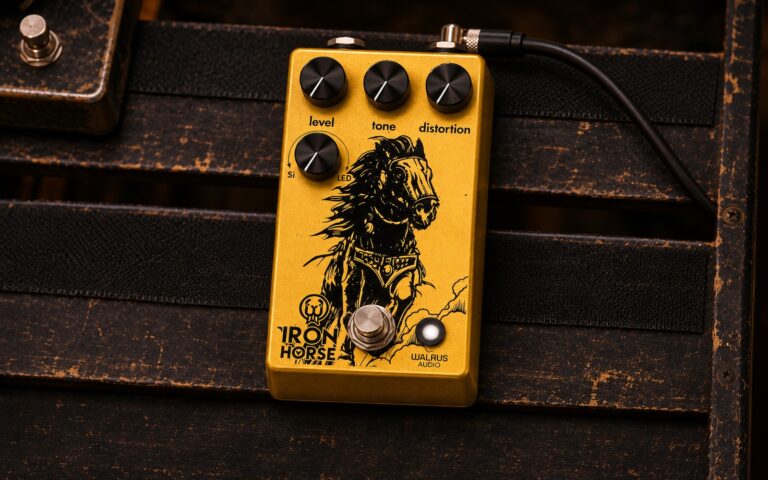
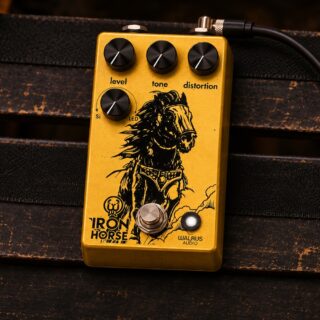
Against the Walrus Iron Horse V3: not really competitors. The Iron Horse is an LM308 distortion with a hard, aggressive edge. The 385 is warm, compressed and dynamic. They stack better than they substitute.
Against the Fulltone OCD: the most obvious rival in the amp-in-a-box category. The OCD is brighter, more open, and cleans up more dramatically with the guitar volume. The 385 is darker, more compressed, and more forgiving of heavy attack. The OCD flatters a Fender; the 385 flatters a Gretsch or a hollowbody.
Against the Klon Centaur and its descendants: a comparison one 385 owner made pointedly, arguing the 385 is the more genuinely transparent of the two once either is actually overdriving. Whether you accept that depends entirely on your definition of transparent. The Klon adds a mid-forward push and preserves clean signal in parallel; the 385 adds compression and 6V6 colour. Neither is neutral.
Against the Nobels ODR-1: both are “not a Tube Screamer” drives with distinctive midrange. The ODR-1 has a broader, flatter mid response and a Spectrum control that tilts the whole voice. The 385 has more compression and a genuine tone stack. The ODR-1 is the better utility drive; the 385 has more personality.
Against the Analog Man King of Tone and MXR Timmy: these are the transparency-first designs. If your goal is to add gain while altering your amp’s voice as little as possible, all three of those beat the 385, which is not trying to be invisible.
Against the Boss BD-2 Blues Driver: similar dynamic sensitivity, opposite frequency character. The BD-2 is famously bright and slightly fizzy at the top; the 385 is dark and thick. Players who find the BD-2 harsh often land on the 385.
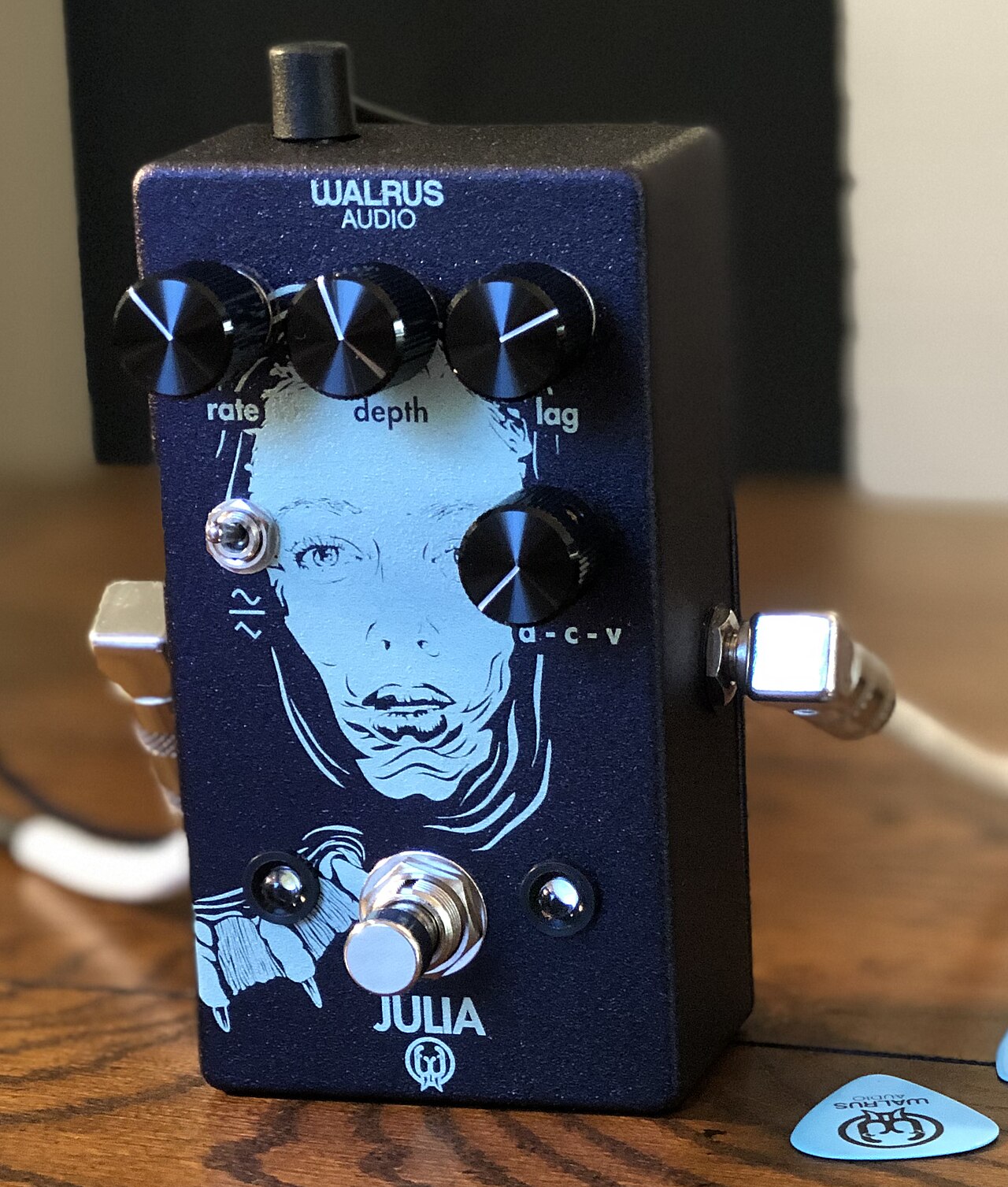
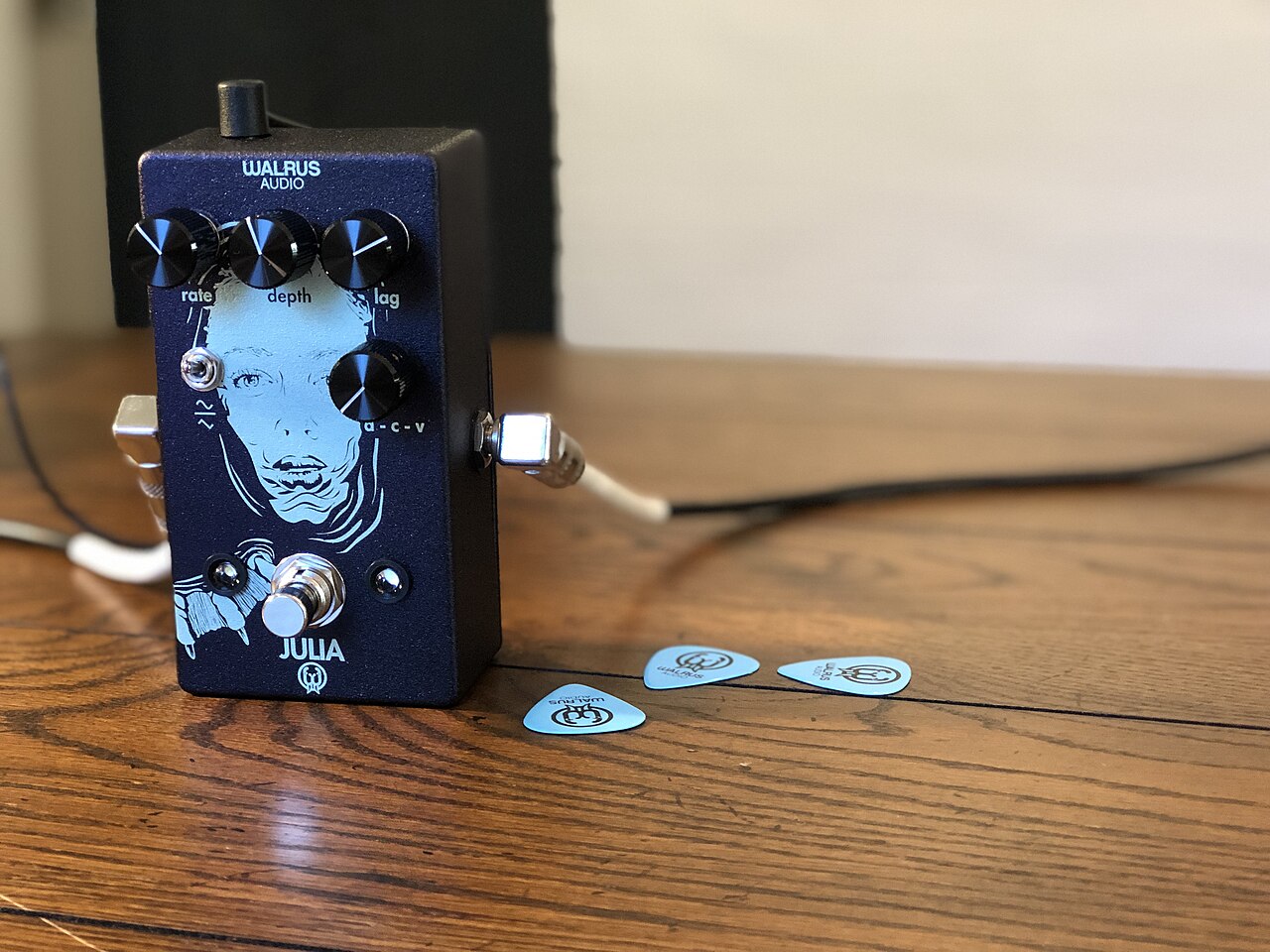
For the wider Walrus context, the 385 sits alongside the ARP-87 delay, Slö reverb and Julia chorus as one of the four pedals that built the company’s reputation in the mid-2010s.
Buying Guide
MKII new: MSRP $249.99. Walrus discounts it directly with reasonable frequency — $212.49 at the time of writing — and street pricing across major retailers ran roughly $170 to $212 as of early September 2026. Anything at or under $180 new is a good price.
MKII used: a three-year-old boutique pedal in current production, so used prices sit close enough to discounted new that the warranty usually justifies buying new. Walrus’s limited lifetime warranty is transferable to the product, not the owner, but a first-hand purchase removes ambiguity.
Original 385 used: this is the interesting end of the market. The MK1 is the same core circuit with one gain stage, side jacks and mechanical bypass. If you only ever use one gain setting — and a lot of people do — the MK1 delivers the identical voice for meaningfully less money. Buy the MK1 if you want the sound; buy the MKII if you want the switching.
Finishes: two, at the same price. Textured black with David Hüttner’s illustration of the original Filmosound projector in yellow and red ink, or flat black with Josh Yosurack’s warm-tube illustration in cream. Walrus also periodically issues limited-run finishes, including a 2024 Black Friday Floral Series version, which command a modest premium on the secondhand market for reasons that have nothing to do with tone.
Ownership Notes
Power it properly. 9V DC centre negative, 100mA minimum. The internal charge pump to 18V makes this circuit more sensitive to supply noise than a simple 9V drive, so Walrus’s recommendation of an isolated supply and warning against daisy chains is engineering advice rather than boilerplate.
There is no battery option. None of the current Walrus core line takes one, and the relay bypass means the pedal passes no signal at all without power — it will not fall back to a passive true-bypass path. Plan your board accordingly.
It will expose your right hand. This is the most consistent theme in owner feedback and the thing to know before purchase. One player put it well: the 385 “does make you more attentive to your right hand.” That is a virtue if you play dynamically and a liability if you do not. A pedal that responds this strongly to attack will faithfully reproduce an inconsistent one.
Placement. First in the chain, or immediately after a compressor. Putting a compressor after the 385 defeats the dynamic response you are paying for.
Frequently Asked Questions
Is the Walrus Audio 385 MKII discontinued?
No. It is a current Core Series product as of September 2026, listed in both finishes on Walrus Audio’s site and stocked at major retailers.
What amp is the 385 actually based on?
The amplifier section of a Bell & Howell Filmosound 385 16mm film projector, running a pair of 6V6 power tubes at roughly 15 watts. Walrus specifies 6V6 in both the 2016 press release and the current product page. Sources describing it as an EL84 emulation are mistaken, although the confusion is understandable given that the most famous converted Filmosounds — Bernie Raunig’s — were EL84 amps.
Is the MKII worth upgrading from the original 385?
Only if you want the switching. The core voice is the same. What you gain is a second footswitchable gain-and-volume preset, the 385+ boost, top jacks and relay bypass. If you leave your 385 on one setting permanently, there is no tonal reason to upgrade.
Does the 385 MKII have two independent channels?
Not in the amplifier sense. A and B share the Bass and Treble controls and share the 385+ toggle. What switches is the active Volume and Gain pair. Think of it as two presets on one voice rather than two channels.
Why does the 385+ switch squeal?
It adds a gain stage at the front of the circuit, on top of whatever the Gain knob is already doing. With high-output pickups or in a noisy room, gain settings much past noon with 385+ engaged can oscillate at rest. Back the gain off; the boost is already supplying plenty.
Does the 385 run at 18 volts?
Internally, yes — but you feed it a normal 9V DC supply and the pedal boosts the rail itself. Do not attempt to power it from an 18V output.
Is it a transparent overdrive?
No, and it is not trying to be. It adds compression and a distinctly dark, 6V6-flavoured midrange. Some owners argue it is more transparent than a Klon-style circuit once either is genuinely overdriving, which is a defensible claim about a specific comparison rather than a claim of neutrality. If transparency is the goal, look at a Timmy or a King of Tone.
Which guitars suit the 385 best?
Anything that benefits from thickening rather than brightening. Hollowbodies, Gretsches, P-90s, lapsteel and slide rigs all sit particularly well with it — the compression and low-mid weight are doing the work a small tube amp would do. Very dark humbucker guitars into an already dark amp are the one combination where the 385 can become muddy, and the Treble boost exists partly for that case.
The Verdict
The 385 MKII is a strange pedal to recommend, because the honest recommendation depends on a question about you rather than about the pedal. It is an accurate, well-executed emulation of a mid-century office appliance that was never designed to be played through, and its virtues — compression, darkness, extreme sensitivity to attack — are the virtues of that appliance rather than of modern overdrive design.
If you play with a consistent, expressive right hand, and if your problem is that your rig sounds thin rather than that it sounds dull, the 385 is one of the genuinely distinctive drives on the market and the MKII’s A/B switching solves the one real complaint about the original. If you want a transparent boost, or a Tube Screamer, or something that flatters a sloppy picking hand, this is emphatically not it.
Bernie Raunig built perhaps thirty amplifiers in a Canadian garage and then quit. Three decades later, an Oklahoma pedal company put his idea in a die-cast box with top jacks and a relay bypass, and it is still selling. Not many pieces of office equipment get that kind of afterlife.
Image credits
- A Walrus Audio Julia chorus and vibrato pedal: Guitar Chalk, Wikimedia Commons, CC BY 2.0.
- A Walrus Audio Julia chorus and vibrato pedal, close up: Guitar Chalk, Wikimedia Commons, CC BY 2.0.
- Top image: GuitarGangsters AI-generated reference illustration, not a photograph.
- Walrus Audio 385 Overdrive MKII: AI-generated illustration by GuitarGangsters, based on the manufacturer’s product design (not a photograph).
Latest News
Related
On This Day
Monday 9 November
From this week: