
Politics at Concerts: You Bought a Ticket. Did You Buy the Speech?
A concert ticket is no pledge of political allegiance. Where should artists and fans draw the line between expression, confrontation and a lecture?
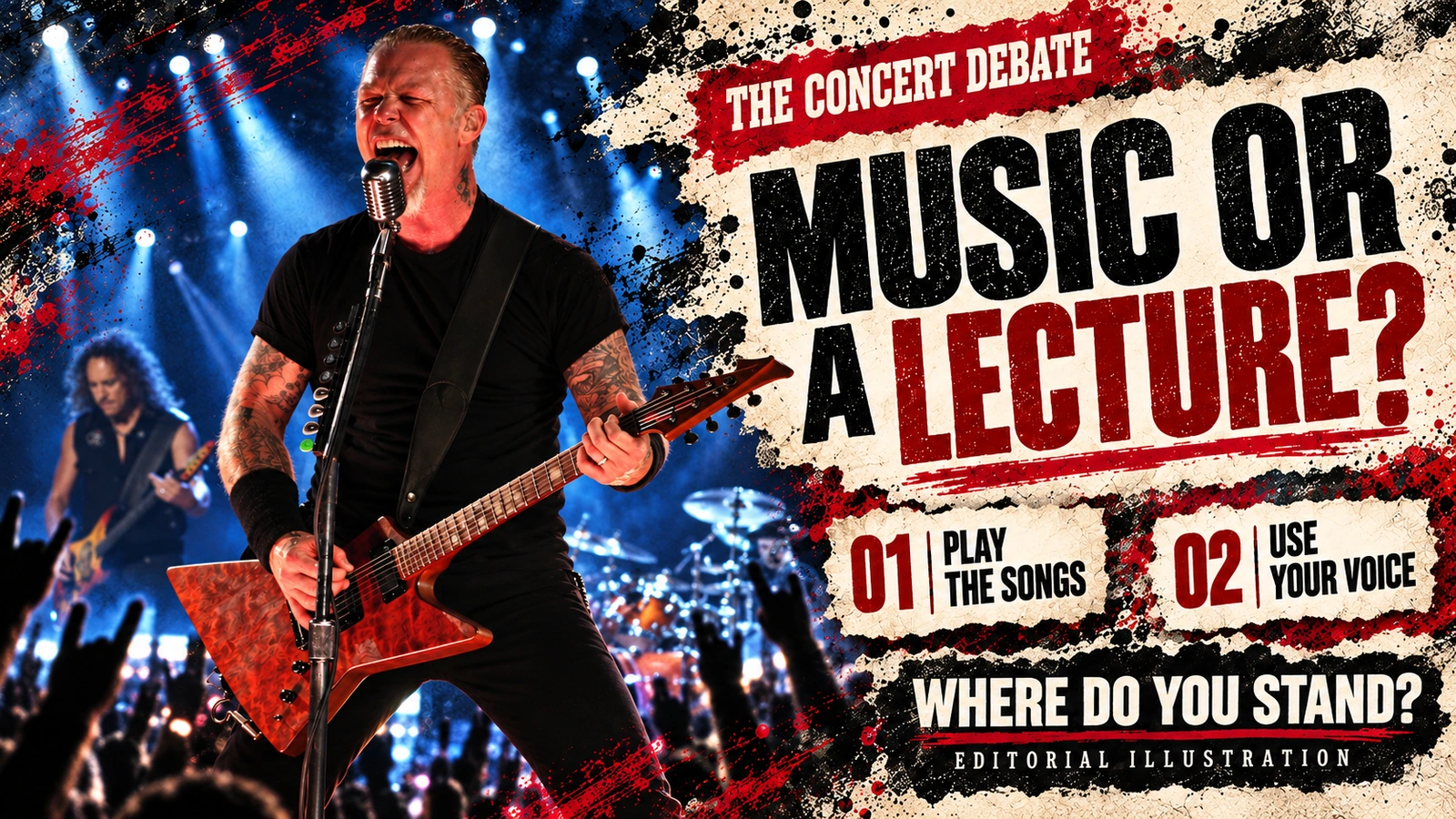
Opinion / Debate
A concert ticket buys you a place in the crowd. It should not be mistaken for a pledge of political allegiance.
That is the strongest argument for keeping political lectures off the stage. Fans can love the same guitar solo while disagreeing about almost everything outside the venue. For a couple of hours, sharing that song can be enough.
But there is a difficult question underneath the slogans: who gets to decide when artistic expression becomes a lecture?
What James Hetfield actually put on the table
According to Louder’s report of Metallica’s October 10, 2026 show at Sphere in Las Vegas, James Hetfield thanked fans for the time, travel and money involved in getting there. He then said Metallica was not there to influence the audience as some other entertainers do, presenting the show as an escape into music.
There is something worth defending in that choice. A performer can look at a divided room and decide to give everyone a shared experience. Choosing that kind of show does not require every person in the audience to think alike.
It also does not establish that every musician who makes a different choice is abusing the microphone. Hetfield can define Metallica’s approach. He cannot define the purpose of every other artist’s work.
Nikki Sixx offers a useful distinction
A circulating Nikki Sixx concert clip welcomes fans across political affiliations and sexual orientations. Its filming date remains unclear in current reporting, so treating it as a fresh response to Hetfield would go beyond the evidence.
Sixx’s earlier position is better documented. Discussing Sixx:A.M. in a November 2016 NME interview, he said: “We don’t feel that’s right for us. It doesn’t mean it’s not right for somebody else.”
That second sentence matters. It leaves room for different bands, different audiences and different ideas about what a concert should be. You can reject the political speech at your own show without demanding silence from everyone else.
Gene Simmons similarly opposed celebrity political commentary in 2016 on Fox Business and in a March 2026 TMZ interview.
Political music changes the expectations
Any rule that says politics has no place in rock immediately runs into the music itself.
Rage Against the Machine’s official description of its debut album explicitly foregrounds its political messages. For that band, political confrontation is part of the artistic proposition. Expecting it to disappear would mean asking for a different kind of band.
Iron Maiden illustrates another route. “Paschendale” draws on a First World War battle, as described in Geoff Barton’s interview and report archived on Maiden’s official site. Historical storytelling can make listeners consider suffering, power and human decisions without turning into instructions about the next election.
These approaches are not identical. Neither gives us a neat division between meaningful political art and harmless entertainment. Songs can challenge people. They can also let people reach their own conclusions.
Fans have freedom, too
The person holding the microphone deserves freedom of expression. The person who paid to stand in front of it deserves freedom of response.
A fan can dislike a speech without supporting censorship. They can decide the interruption spoiled the show, tell the artist why, or choose another gig next time. Buying an album does not create a lifelong obligation to applaud its creator’s opinions.
Equally, paying for admission does not make the performer your employee for the evening. A ticket is no guarantee that every lyric, joke or statement will be comfortable.
The useful distinction is respect. Does the artist invite the audience to think, or treat agreement as the price of belonging? Does the fan object to the interruption itself, or only to hearing a view they dislike?
Try reversing the politics. Would you welcome the same length of speech from an artist defending the opposite position? If your answer changes immediately, your argument may be about the message rather than the microphone.
There should be room for protest, storytelling and pure escape in live music. There should also be room to say that tonight, after paying for the ticket and making the journey, you wanted the songs.
Where do you draw the line: the artist, the subject, the length of the speech, or whether you agree?
For the playing behind the debate, explore our guide to Tom Morello’s guitars and gear.
Image: AI-assisted editorial illustration adapted from Alberto Cabello’s Madrid 2009 photograph, CC BY 2.0. Composition, background and typography modified. Editorial wording, not an artist quotation.
