
Investigate Earl Hooker guitars gear and you find the equipment behind one of the most technically accomplished and most musically gifted guitarists the Chicago blues tradition ever produced — a Mississippi-born musician who relocated to Chicago and spent his career demonstrating a slide guitar mastery that musicians of every generation, including B.B. King and Muddy Waters, acknowledged as extraordinary. Hooker was a guitarist’s guitarist: known primarily to insiders and to serious blues students rather than to mainstream audiences, playing with a technical facility and a musical intelligence on the slide guitar that remains without equal in the Chicago tradition, yet dying in 1970 at forty-one before his music could reach the wider audience it deserved. His twin-neck guitar, his Stratocasters, and his diverse amplifier setups served a musical vision of slide guitar that extended the instrument’s vocabulary beyond anything his contemporaries had attempted.
This guide covers Hooker’s complete equipment picture: the Stratocasters and unusual twin-neck instruments that defined his tonal palette, the diverse amplification that served his exploratory musical approach, his wah pedal use that was decades ahead of its commercial adoption, and the playing philosophy of a musician who treated the slide guitar as an instrument of unlimited expressive possibility rather than as a technique with specific traditional applications. Understanding Earl Hooker’s gear is understanding how technical genius operates when it has no conventional limits to respect.
Background
Earl Zebedee Hooker was born on January 15, 1929, in Clarksdale, Mississippi — the same Delta county that produced Muddy Waters, Sam Cooke, and Ike Turner, and one of the most fertile single geographic areas for American musical genius in history. He began playing guitar as a child and demonstrated from the earliest age the specific technical gift — the hand coordination, the musical ear, the specific physical relationship with the instrument — that would make him one of the most accomplished guitarists in any tradition.
He relocated to Chicago in the 1940s and became part of the South Side blues scene at the moment of its most rapid development — the period when the electrified Chicago electric blues was being defined by Muddy Waters, Howlin Wolf, Little Walter, and their contemporaries, and when the specific combination of electric guitar, electric harmonica, and rhythm section was creating the most important new development in the American blues tradition since the Delta acoustic tradition had been established a generation earlier.
His slide guitar work — using a metal or glass slide on the guitar strings while picking with the other hand — was widely acknowledged by contemporaries and by subsequent generations as the most technically accomplished in the Chicago tradition. B.B. King, who rarely acknowledged the superior technical accomplishment of any contemporary guitarist, specifically cited Hooker’s slide playing as extraordinary. Muddy Waters, whose own slide playing was the foundation of the entire Chicago electric slide tradition, acknowledged Hooker’s technical mastery with genuine admiration.
Despite this peer recognition, Hooker’s commercial success was limited by chronic tuberculosis that prevented sustained touring, by a peripatetic career that never achieved the focused recording consistency that gave other Chicago blues artists their commercial profiles, and by the specific character of his music — technically sophisticated, sometimes experimental, often instrumental — that positioned him as a musician’s musician rather than a mainstream blues star. He died on April 21, 1970, from tuberculosis complications, leaving a recording legacy that was rediscovered and increasingly appreciated in the decades after his death.
Earl Hooker Guitars Gear: The Complete Rig
Guitars
Hooker’s guitar collection was unusually diverse for a Chicago blues musician of his era — reflecting the breadth of his musical curiosity and his willingness to use whatever instrument best served the specific musical idea he was pursuing at each moment.
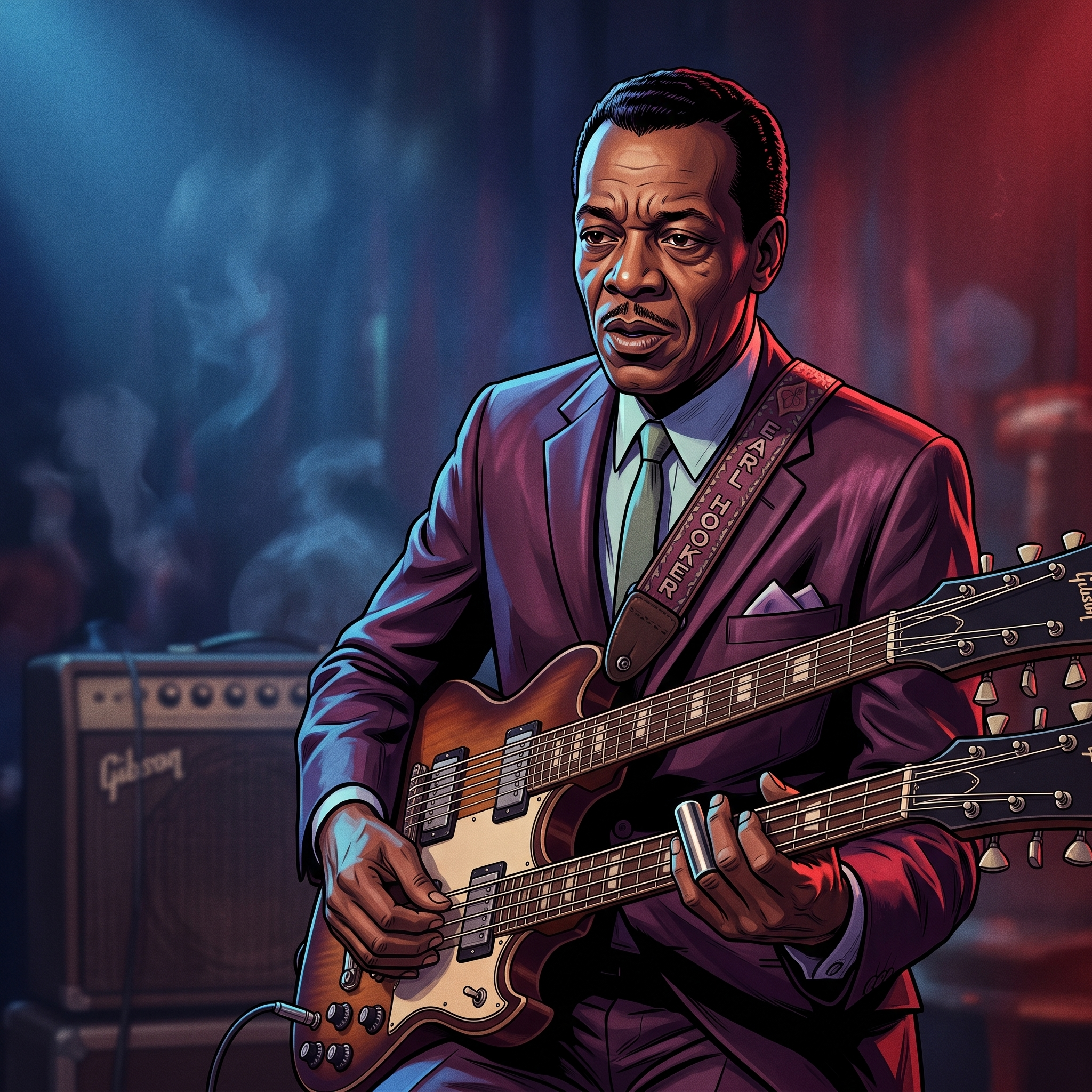
His most iconic instrument was a double-neck guitar — specifically a custom instrument with a standard six-string neck and a separate lap steel or Hawaiian guitar neck. This unusual configuration allowed him to switch instantly between standard electric guitar technique and the open-tuned lap steel approach without the logistical complexity of changing instruments, and it gave his live performances and recordings a specific tonal variety that no single-neck instrument could have provided. The double-neck’s visual distinctiveness was as striking as its practical utility — a guitar that looked as unconventional as the music it was designed to produce.
He also played Fender Stratocasters as his primary standard electric guitar — particularly for the slide guitar work that was his primary musical identity. The Stratocaster’s vibrato system was specifically useful for slide playing, allowing him to raise and lower the pitch of held slide notes through the vibrato arm in ways that gave the slide technique additional expressive possibilities beyond what conventional slide playing allowed. The combination of the glass or metal slide with the vibrato arm gave his slide passages a quality of pitch control and expressive variation that was essentially unique in the Chicago blues tradition.
Various other Gibson and other electric guitars appeared across his career — the standard Chicago blues complement of ES-335, ES-175, and other semi-hollow and hollow instruments for specific recording and performance contexts that required the warmer humbucker character rather than the Stratocaster’s single-coil brightness.
His slide technique used both metal slides (steel or chrome) and glass bottleneck slides — different materials for different sonic characters. Metal slides produced a brighter, more metallic sustain with harder attack; glass slides produced a warmer, rounder character with smoother attack. His ability to choose between materials for specific tonal purposes reflected the same practical acoustic intelligence that characterised every other aspect of his equipment approach.
String gauges were typically heavy — appropriate for slide playing, where the higher string mass gave the slide technique its characteristic sustain and volume, and where the higher string action typically used for slide playing required heavier gauges to maintain appropriate string tension and tone quality.
Amps
Hooker’s amplification was as diverse as his guitar collection — reflecting his exploratory musical approach and his willingness to try different combinations for different specific effects.
His primary amplifiers included Fender amplifiers of various types — the Super Reverb, the Deluxe, and other Fender designs that gave his slide playing the warm American valve character appropriate for the Chicago blues tradition. The Fender’s clean character at working volume allowed the slide’s natural sustain and the specific harmonic character of his technique to come through without the tonal coloration of driven amplification.
He also used smaller boutique and vintage amplifiers for specific recording applications — his experimental musical approach leading him to try unusual equipment combinations that might produce specific tonal results not achievable through conventional choices.
The natural character of the Stratocaster through Fender amplification at working volume was the foundation of his slide tone — the single-coil’s specific brightness and the Fender’s warm clean character together producing the specific quality of warmth-with-definition that suited the slide technique’s sustaining, melodic character.
Effects
Hooker was one of the earliest and most sophisticated users of the wah pedal in Chicago blues — deploying it in the mid-1960s before the commercial wah pedal revolution that Hendrix and Clapton brought to mainstream rock awareness, and using it in specifically musical ways that reflected genuine creative exploration rather than trend following.
His use of the Vox Clyde McCoy wah pedal — the original wah pedal design from 1966 — on slide guitar passages was one of the most distinctive and most musically innovative elements of his late-career recordings. The combination of slide guitar and wah pedal created a specific tonal interaction — the wah’s swept bandpass filter interacting with the slide’s sustained, gliding pitches — that produced an almost vocal quality of expressive variation that conventional slide playing couldn’t achieve. This specific combination was genuinely innovative in the blues context and showed Hooker’s willingness to explore technical possibilities that other Chicago blues musicians were not pursuing.
The vibrato arm of his Stratocaster was itself an effects tool — used in combination with the slide to produce pitch variations beyond the slide’s normal range, giving his playing a quality of extreme pitch expressiveness that was essentially impossible on instruments without vibrato systems. This combination of slide technique, vibrato arm, and wah pedal gave Hooker’s most experimental playing a tonal range and an expressive vocabulary that remained decades ahead of the mainstream Chicago blues approach.
Playing Style & Tone Philosophy
Earl Hooker’s playing style was defined by technical mastery in service of genuinely exploratory musical ideas — a combination that was as rare in the blues tradition as in any other. His slide technique was the most complete available in the Chicago blues context: the intonation accuracy that placed notes precisely on pitch without the pitch ambiguity that less controlled slide players lived within, the dynamic range that moved smoothly from the quietest whisper to the loudest shout within a single phrase, and the specific quality of expressiveness — the way the slide created specific melodic shapes — that showed genuine musical intelligence rather than habitual technique.
His instrumental approach — favouring instrumental blues that showcased the guitar’s musical possibilities without the vocal context — reflected his specific musical orientation toward the guitar as a complete musical statement rather than as an accompaniment to singing. The guitar in his hands was a solo voice that needed no additional musical context, and his best recordings showed this clearly: music that was complete in itself, melodically interesting and emotionally communicative without requiring a vocalist to give it meaning.
The wah pedal’s integration into his slide approach was as genuinely creative as any technical innovation in the Chicago blues — taking a new commercial product and using it in a musical way that the product’s designers hadn’t anticipated, combining it with an established technique in a way that produced genuinely new musical possibilities. This creative use of technology — finding musical applications for equipment that others were using more conventionally — was characteristic of his broader approach to the guitar and its possibilities.
Tonally, his philosophy was explorer’s philosophy: try anything that might produce an interesting musical result, keep what works, abandon what doesn’t. The twin-neck guitar, the wah pedal on slide, the vibrato arm combined with slide technique — all reflected genuine musical curiosity rather than adherence to conventional blues guitar approaches. His equipment was always in service of musical ideas that were ahead of his contemporaries.
How to Sound Like Earl Hooker
Guitar Approach
A Fender Stratocaster with a vibrato system — essential for the vibrato arm combination with slide technique. Heavy strings (.012–.056 or heavier) for adequate slide sustain and volume. A metal slide for the brighter, more cutting character; a glass slide for the warmer alternative. High action on the slide strings for clean slide technique without fret buzz. The technical demands of Hooker’s slide approach are substantial: accurate intonation, dynamic control, and the specific combination of slide technique and vibrato arm require extensive development before the results become musically useful.
Amp Approach
A Fender Super Reverb or Deluxe at working volume — clean American valve character that allows the slide’s natural sustain to develop fully. A wah pedal (Vox Cry Baby or similar original-spec unit) for the slide-wah combination that was Hooker’s most distinctive tonal innovation. The wah on slide guitar requires specific technique — the sweep calibrated to the slide’s pitch movement for maximum vocal expressiveness.
| Control | Setting | Notes |
|---|---|---|
| Volume | 5–7 | Natural 6L6 warmth — slide guitar needs sustain, not distortion |
| Treble | 6 | Moderate — Stratocaster single-coils provide brightness naturally |
| Middle | 5 | Neutral mids — slide sustain is the primary character |
| Bass | 4 | Controlled bass for slide definition across the full range |
| Reverb | 4 | Moderate reverb — slide guitar benefits from atmospheric dimension |
Influence & Legacy
Earl Hooker’s legacy was the specific legacy of a musician whose technical genius exceeded his commercial success during his lifetime — a pattern that was consistent throughout the blues tradition but that was more extreme in his case than in almost any comparable career. The musicians who knew his playing first-hand — B.B. King, Muddy Waters, and the Chicago blues community generally — consistently cited him as the most technically accomplished guitarist in the tradition, and the recordings that documented his playing showed why this assessment was accurate.
His death at forty-one from tuberculosis cut short what might have been an extraordinary late-career development — he died in 1970, just as the blues revival was beginning to bring serious critical and commercial attention to the Chicago blues tradition, and his timing was as tragically bad as his musical gifts were extraordinarily good. The rediscovery of his recordings in the decades after his death gave him a posthumous recognition that his lifetime commercial profile had never provided.
His influence on subsequent slide guitarists — both those who knew his work directly and those who absorbed the Chicago electric slide tradition that he had done as much as anyone to define — was as significant as any single player’s contribution to the tradition’s development. The slide-wah combination and the vibrato arm integrated with slide technique that he pioneered were both subsequently explored by other musicians who may or may not have been aware of Hooker’s specific precedent.
For players exploring the Chicago electric slide tradition that Hooker defined, the rigs of Muddy Waters — whose Delta-rooted slide approach was the foundational model that Hooker extended technically beyond what Waters himself had pursued — and Elmore James, whose specific slide guitar approach was as commercially prominent as Hooker’s was technically accomplished, provide essential comparison. The experimental dimension of his approach connects to Sonny Sharrock‘s work, which shows how similar willingness to explore the guitar’s extreme technical possibilities produced genuinely new musical territory in a completely different tradition.
Two Bugs and a Roach: The Definitive Document
Two Bugs and a Roach (1968) — Hooker’s Arhoolie Records album that documented his playing at its most fully developed and most consistently achieved — was the single most important document of his specific guitar approach and the recording that has given subsequent generations their most complete picture of what his playing actually sounded like at its best. The album’s title, with its characteristic blues humour, belied the musical seriousness of what it contained: a complete demonstration of Hooker’s slide guitar mastery across multiple musical contexts, showing the full range of his specific approach in a recorded format that gave each element of the playing its appropriate acoustic presence.
The guitar tones on the album — the Stratocaster and double-neck instruments through Fender amplification, with the wah pedal deployed selectively for specific passages — showed the specific combination of tonal warmth and technical precision that defined his approach. The slide’s intonation accuracy was immediately apparent in the recordings — every note landing on its target pitch with a precision that distinguished his playing from the more pitch-approximate approach of other slide guitarists. The dynamic range that he deployed within individual phrases — from the quietest whisper to the most forceful emphasis — gave the recording its specific character of controlled emotional expression rather than merely technical display.
The Arhoolie Records approach — like Alligator and Delmark, a label committed to authentic documentation over commercial production — gave the recordings their specific quality of honest representation. The guitar tones were the natural result of the instruments and amplifiers in the specific recording environment, without the elaborate processing that might have given the recordings a more contemporary sound at the cost of historical accuracy. The specific character of Hooker’s playing — its technical precision, its emotional intelligence, its specific tonal warmth — was captured as directly as the recording technology of the period allowed.
The Slide Technique: Precision Within Expression
Understanding Earl Hooker’s slide technique in specific technical detail illuminates both why his playing was so extraordinary and why the specific equipment he used was acoustically appropriate for achieving the specific results he sought. Slide guitar technique — placing a glass or metal tube on the fretting fingers of the left hand and using it to fret strings against the fretboard without actually pressing them down — required a specific combination of technical skills that most guitarists who attempted it found extremely difficult to develop to a professional standard.
The primary technical challenge of slide guitar was intonation: the slide had to be placed precisely over each fret to produce the correct pitch, since there was no fret to act as a fixed stopping point as in conventional technique. A millimetre too far forward or back would place the note sharp or flat of the intended pitch, and at the speeds and fluency that professional slide playing required, this intonation accuracy had to be achieved through highly developed muscle memory rather than through conscious calculation. Hooker’s intonation accuracy — consistently placing notes on pitch even in rapid passages — was what B.B. King and other contemporaries identified as most extraordinary about his technique, because they knew from their own experience how difficult this precision was to achieve and how rarely any guitarist achieved it at Hooker’s level.
The vibrato technique that gave slide guitar its characteristic expressive character — the oscillating pitch variation of a note held on the slide — was produced by oscillating the slide along the string length while maintaining contact with the strings. The amplitude and rate of this oscillation determined the character of the vibrato: wide and slow for a bluesy, singing quality; narrow and fast for a tighter, more controlled character. Hooker’s vibrato control — his ability to calibrate amplitude and rate for specific musical purposes — was as developed as his intonation, giving each sustained note its appropriate expressive character rather than a fixed, habitual vibrato applied regardless of context.
The Wah Pedal Innovation
Hooker’s use of the wah pedal on slide guitar — specifically his use of the Vox Clyde McCoy wah (the original commercial wah pedal design that appeared in 1966) in combination with slide technique — was one of the most genuinely innovative equipment deployments in the history of the Chicago blues guitar. Understanding what specifically this combination produced, and why it was musically innovative rather than merely unusual, gives the most complete picture of his specific contribution to the tradition’s sonic vocabulary.
The wah pedal worked by moving a bandpass filter through the audio frequency spectrum as the rocking foot pedal was operated — the toe-down position emphasising high frequencies, the heel-down position emphasising lower frequencies. When applied to guitar playing, this frequency movement gave chord and note playing a vocal quality — the vowel-like sound of the filter sweep approximating specific speech sounds as it moved through the frequency spectrum. This vocal quality had made the wah a popular expression tool for lead guitarists including Hendrix and Clapton, who used it for the rhetorical expressiveness it added to blues lead playing.
When Hooker combined the wah with slide guitar technique, the specific acoustic interaction between the two effects produced something genuinely different from either the wah on conventional electric guitar or conventional slide guitar without the wah. The slide’s pitch movement — the gliding quality that gave slide guitar its characteristic distinction from conventional fretted guitar — interacted with the wah’s frequency movement in a way that produced a complex double expressiveness: pitch changing simultaneously with frequency emphasis, creating a quality of vocal sound that was more extreme and more expressive than either element alone. This specific combination — slide pitch movement plus wah frequency movement — gave specific passages a quality of almost human vocal articulation that conventional guitar technique couldn’t produce and that slide without wah couldn’t produce either.
The Double-Neck Guitar
Hooker’s double-neck guitar — one of the most distinctive instruments in the history of Chicago blues — deserves specific examination of both its practical advantages and the specific musical purposes it served. Understanding the double-neck’s specific capabilities gives a more complete picture of why Hooker chose to use such an unusual instrument and what musical possibilities it opened up that single-neck alternatives couldn’t provide.
The practical advantage of the double-neck was immediate instrument access to two completely different guitar configurations — in Hooker’s specific case, a standard six-string electric and a lap steel Hawaiian guitar — without the interruption of picking up a different instrument. In live performance, switching between instruments required time, physical handling, and the disruption of the performance’s musical flow. With the double-neck, switching was instantaneous — a matter of moving the right hand to the other neck, which was positioned to allow natural access from the single playing position. This practical advantage was genuinely musically significant in live performance, where the ability to shift instantly between standard and Hawaiian guitar techniques gave the performance a fluency that instrument switching couldn’t replicate.
The musical possibilities that this instant switching enabled were as significant as the practical convenience. Hooker could move between the standard guitar’s fretted chord and single-note technique and the Hawaiian steel’s open-tuned slide technique within a single musical phrase, creating transitions between the two approaches that no single-neck instrument could achieve. The Hawaiian steel’s specific character — the open tuning, the lap-played position, the steel bar’s specific tonal character — was different enough from the standard electric guitar’s character that the switch between necks was a genuine tonal as well as technical transformation, giving the music access to two distinct sonic worlds within the same performance.
Earl Hooker’s complete equipment story — the innovative double-neck, the Stratocaster with vibrato arm used in combination with slide, the wah pedal deployed on slide guitar before it became a mainstream blues rock practice, and the clean Fender amplification that served the slide technique’s sustaining character — was ultimately the story of a musician whose technical curiosity and musical intelligence led him to explore equipment possibilities that other Chicago blues musicians hadn’t imagined. The gear served a musical vision that was decades ahead of the mainstream; the vision was cut short by illness and death at forty-one; and the recordings that documented it remain among the most technically extraordinary and most musically innovative in the entire Chicago blues tradition. That is the complete Earl Hooker gear story, and it represents one of American music’s greatest unrealised potentials — a genius who died before the world was ready to recognise what he had done.
The Clarksdale, Mississippi origin of Hooker’s musical formation — the same county seat that was the crossroads of Coahoma County and one of the most musically fertile single locations in American history — placed him within the Delta blues tradition at its deepest source. Clarksdale had produced Muddy Waters (from the Stovall Plantation just outside the city), Sam Cooke, Ike Turner, and dozens of other significant American musicians, and the specific musical culture of Coahoma County — the specific character of Delta blues guitar that had developed from Robert Johnson’s time through the electrification era — was the foundational model that Hooker’s Chicago development extended technically beyond what any of his contemporaries had achieved. Understanding the Clarksdale foundation beneath the Chicago technical sophistication gives a more complete picture of why Hooker’s playing had both the emotional depth of the Delta tradition and the technical innovation of the Chicago development simultaneously — because he genuinely embodied both, rather than choosing between them.
The tuberculosis that defined and limited Hooker’s career — preventing the sustained touring and recording consistency that gave other Chicago blues artists their commercial profiles — was one of the more tragic examples of illness shaping a musical legacy in ways that were both musically and personally devastating. Tuberculosis in the mid-twentieth century was a serious chronic condition that required specific management — rest, limited physical exertion, and care — that was fundamentally incompatible with the demands of professional touring. The physical demands of performing night after night in different clubs and different cities would have worsened the condition, and Hooker’s ability to work at all was a product of managing the tuberculosis within the constraint of limited professional activity rather than the sustained touring career that would have given him the commercial profile his talent deserved. The specific character of his recording career — sporadic, distributed across multiple labels, without the focused recording identity that artists with more stable professional circumstances maintained — was as much the product of the tuberculosis as of any artistic choice, and understanding this context gives a more honest picture of why one of Chicago blues’ most talented musicians remained relatively unknown during his lifetime.
The Stratocaster’s vibrato system’s specific role in Hooker’s slide playing — and why this specific guitar feature was musically significant in a way that was unique to his approach — reflected genuine understanding of how the vibrato arm could extend the slide technique’s expressive range beyond its conventional limits. In conventional slide guitar playing, pitch variation was produced entirely by the slide’s movement along the strings — pressing the slide down to raise pitch (closer to the bridge, where tension was higher), moving toward the nut to lower pitch. The pitch range available through slide movement was limited by the practical extent of the slide’s travel along the fretboard, and the quality of pitch variation was the specific gliding quality produced by the slide’s continuous contact with the strings. By adding the vibrato arm’s pitch control — raising or lowering the pitch of the entire guitar through changes in string tension — Hooker extended the slide technique’s pitch range beyond what slide movement alone could produce, giving his playing access to pitch relationships and pitch movements that conventional slide technique couldn’t achieve. This combination — slide movement pitch variation plus vibrato arm pitch variation — created a complex, multi-dimensional pitch expressiveness that was genuinely without precedent in the Chicago blues tradition.
The Arhoolie Records context — founder Chris Strachwitz’s specific commitment to documenting the authentic acoustic blues and country blues traditions that major labels were not recording — gave Hooker’s late career recordings their most important documentary context. Strachwitz’s approach was consistent with Alligator’s subsequent commitment to authentic documentation: recording artists in appropriate contexts with appropriate equipment, capturing their natural playing character without commercial production modifications that might have made the recordings more commercially accessible at the cost of historical accuracy. The specific guitar tones on the Arhoolie recordings — the slide guitar’s natural character through appropriate Fender amplification in an appropriate recording environment — gave the recordings their specific quality of authentic acoustic documentation that remained as revealing decades after the recording as at the time of its production.
The guitar-as-instrument-of-unlimited-possibility that Hooker’s approach embodied — the willingness to try any technical or equipment combination that might produce an interesting musical result, regardless of whether that combination was conventional within the tradition — was as specific a musical philosophy as the more conservative tradition-respecting approach of musicians who worked within established technical and equipment conventions. The blues tradition had always valued innovation and individual voice — the specific quality of personal expression that distinguished each musician’s approach from every other’s — and Hooker’s technical and equipment innovations were as much an expression of this individualising value as the more conservative innovations of musicians who worked within established technique. He was not departing from the tradition’s values when he used the double-neck or the wah pedal on slide; he was expressing the tradition’s deepest value of individual voice and musical exploration through the specific means available to him in his specific musical and historical context. The equipment was radical; the values it served were as traditional as the blues itself.
The B.B. King acknowledgment of Hooker’s technical superiority — which King expressed explicitly in interviews and in conversations with fellow musicians — was one of the most significant endorsements available in the Chicago blues world. King, whose own guitar technique was acknowledged as the most influential in the Chicago and Texas blues tradition’s subsequent development, rarely identified any other living guitarist as technically superior to himself; the specific character of his acknowledgment of Hooker showed genuine admiration rather than merely respectful collegiality. Understanding why King specifically identified Hooker’s slide playing as extraordinary gives a more precise picture of what was musically exceptional about it: the intonation accuracy that other slide players struggled to achieve, the dynamic control that gave each note its specific expressive weight, and the specific quality of musical intelligence that was expressed through the technique. These were qualities that King — a musician of exceptional technical intelligence himself — was particularly equipped to recognise, and his recognition gave Hooker’s technical achievements their most authoritative external validation.
The glass slide versus metal slide distinction — and Hooker’s ability to use both for specific tonal purposes — illustrated the same practical acoustic intelligence about material properties that had always informed the best blues musicians’ equipment choices. Glass slides (typically made from wine bottles or specifically manufactured glass cylinders) produced a warmer, rounder tonal character than metal alternatives, with a smoother attack quality and a softer sustain that suited slower, more lyrical slide passages. Metal slides (typically steel, chrome, or brass) produced a brighter, more cutting character with a harder attack quality and a brighter sustain that gave rapid slide passages their specific definition and presence. Hooker’s selection of material for specific musical purposes — choosing glass for the warmer, more lyrical passages and metal for the more aggressive, driving material — reflected genuine understanding of what each material contributed and why the difference mattered musically. This level of acoustic discrimination in slide material choice was rare even among serious slide guitarists, and it was another expression of the comprehensive equipment intelligence that characterised his overall approach.
The specific historical moment of Hooker’s career — the late 1940s through 1970, spanning the period from the first electrification of the Chicago blues through the early blues rock era — placed his musical development within the most important period of transition in the electric guitar’s history. He was present as the electric guitar was first being developed as a genuinely sophisticated musical instrument capable of expressing the full range of the blues tradition’s emotional content, and his specific contributions — the technical development of slide technique, the equipment innovations of the double-neck and the wah pedal on slide — were as historically important to the tradition’s technical development as the better-known contributions of Muddy Waters and B.B. King to its emotional and stylistic development. That he was not acknowledged as such during his lifetime was one of the Chicago blues tradition’s most significant oversights, and the subsequent critical recognition that has given his work its appropriate historical status has been as much a correction of an historical injustice as a genuinely new musical discovery.
The Muddy Waters relationship — Hooker’s connection to the musician who was both the foundational model for the Chicago electric slide tradition and an acknowledged admirer of Hooker’s specific slide mastery — was one of the more interesting musical relationships in the Chicago blues history. Waters’ own slide playing was the primary model for the Chicago electric slide tradition: the specific technique, the specific tonal approach, and the specific emotional register of Waters’ Delta-rooted slide work were the foundation from which virtually every Chicago slide guitarist of the subsequent generation developed. Hooker’s technical relationship with this tradition was not that of a student who had learned from Waters and then applied that learning, but of a musician who had absorbed the same Delta roots independently and had then developed the technique in a direction that Waters himself — a more emotionally rooted and less technically experimental player — had not pursued. The specific interaction between these two approaches — Waters’ emotional depth and technical groundedness versus Hooker’s technical innovation and exploratory spirit — illustrated the full range of what the Chicago electric slide tradition was capable of, with each musician representing a different dimension of the tradition’s complete expressive potential. The equipment that served each approach was similar in fundamental character — the electric guitar through American valve amplification — but different in the specific choices made within that fundamental character, reflecting the different specific musical values each musician was pursuing through the same broad tradition.
Frequently Asked Questions: Earl Hooker Guitars & Gear
What guitar did Earl Hooker play?
Earl Hooker’s most iconic instrument was a custom double-neck guitar with both a standard six-string neck and a lap steel neck — an unusual configuration that allowed instant switching between conventional and Hawaiian guitar techniques. He also played Fender Stratocasters as his primary standard electric, using the Stratocaster’s vibrato arm in combination with slide technique for expressive effects unique in the Chicago blues tradition.
What amp did Earl Hooker use?
His primary amplifiers were Fender designs — Super Reverb and Deluxe combos that gave his slide playing the clean American valve character appropriate for the slide technique’s sustaining, melodic requirements. His diverse musical approach led him to use various other amplifier types for specific recording contexts, reflecting the same experimental orientation that characterised every other aspect of his equipment approach.
What made Earl Hooker’s slide technique so exceptional?
His slide technique was exceptional for its specific combination of intonation accuracy, dynamic range, and expressive musical intelligence. Where many slide players worked within the pitch ambiguity that the technique naturally produced, Hooker placed his notes with precision that other slide players rarely achieved. His combination of slide technique with the Stratocaster’s vibrato arm and the wah pedal created expressive possibilities that were genuinely unique in the Chicago blues tradition.
Why was Earl Hooker not more commercially successful?
Hooker’s limited commercial success resulted from a combination of factors: chronic tuberculosis that prevented sustained touring and recording consistency, an instrumental approach that was less immediately accessible than the vocal blues that dominated the commercial market, and a peripatetic career that never established the focused recording identity that other Chicago blues artists achieved. His musical sophistication positioned him as a musician’s musician rather than a mainstream blues star.
What was the wah pedal’s role in Earl Hooker’s playing?
Hooker was one of the earliest sophisticated users of the wah pedal in the Chicago blues context — deploying it in the mid-1960s on slide guitar passages in ways that were genuinely innovative. The combination of the wah’s swept bandpass filter with the slide’s sustained, gliding pitches created an almost vocal quality of expressive variation that conventional slide playing couldn’t produce. This specific combination was decades ahead of mainstream adoption and reflected Hooker’s willingness to explore equipment possibilities other Chicago blues musicians weren’t pursuing.
What is the double-neck guitar?
The double-neck guitar is an instrument with two complete guitar necks — in Hooker’s case, a standard six-string electric neck and a separate lap steel or Hawaiian guitar neck — sharing a single body. The practical advantage of this configuration was the ability to switch instantly between standard electric guitar technique and the open-tuned Hawaiian style without the logistical complexity of multiple instruments. The double-neck allowed Hooker to access two completely different tonal characters and two completely different playing techniques within the same performance without interruption.
What are Earl Hooker’s most important recordings?
His most significant recordings include his sessions for various Chicago blues labels in the 1950s and 1960s, particularly the recordings that documented his slide guitar work most completely. The Arhoolie Records albums — particularly Two Bugs and a Roach (1968) — documented his playing at its most fully developed and gave him his most consistent recorded legacy. His sideman recordings with various Chess Records artists showed his slide work in the ensemble context where its specific musical function was most clearly demonstrable.
Genre:
Chicago Blues
Decades:
1950s | 1960s | 1970s
Related stories
The Edge Guitars & Gear: The Complete Guide to U2’s Guitar Genius’s Rig
The Edge's guitars, amps, and effects — the complete guide. Gibson Explorer, Vox AC30, dotted eighth-note delay, Korg SDD-3000, and how to nail that massive U2 tone.
Tim Henson Guitars & Gear: The Complete Guide to Polyphia’s Guitar Innovator’s Rig
Tim Henson's guitars, amps, and effects — the complete guide. Ibanez TOD10, TOD10N nylon, Fractal Axe-FX, Neural DSP Archetype, hybrid picking, and how to nail that Polyphia clean-crunch tone.
Tom DeLonge Guitars & Gear: The Complete Guide to Blink-182’s Single-Pickup Strat, Mesa Triple Rectifier & Invader Tone
Tom DeLonge guitars & gear: Blink-182 guitarist. Custom Shop Strat single Seymour Duncan Invader, Mesa Boogie Triple Rectifier, MXR EVH Flanger — Enema of the State tone guide.