
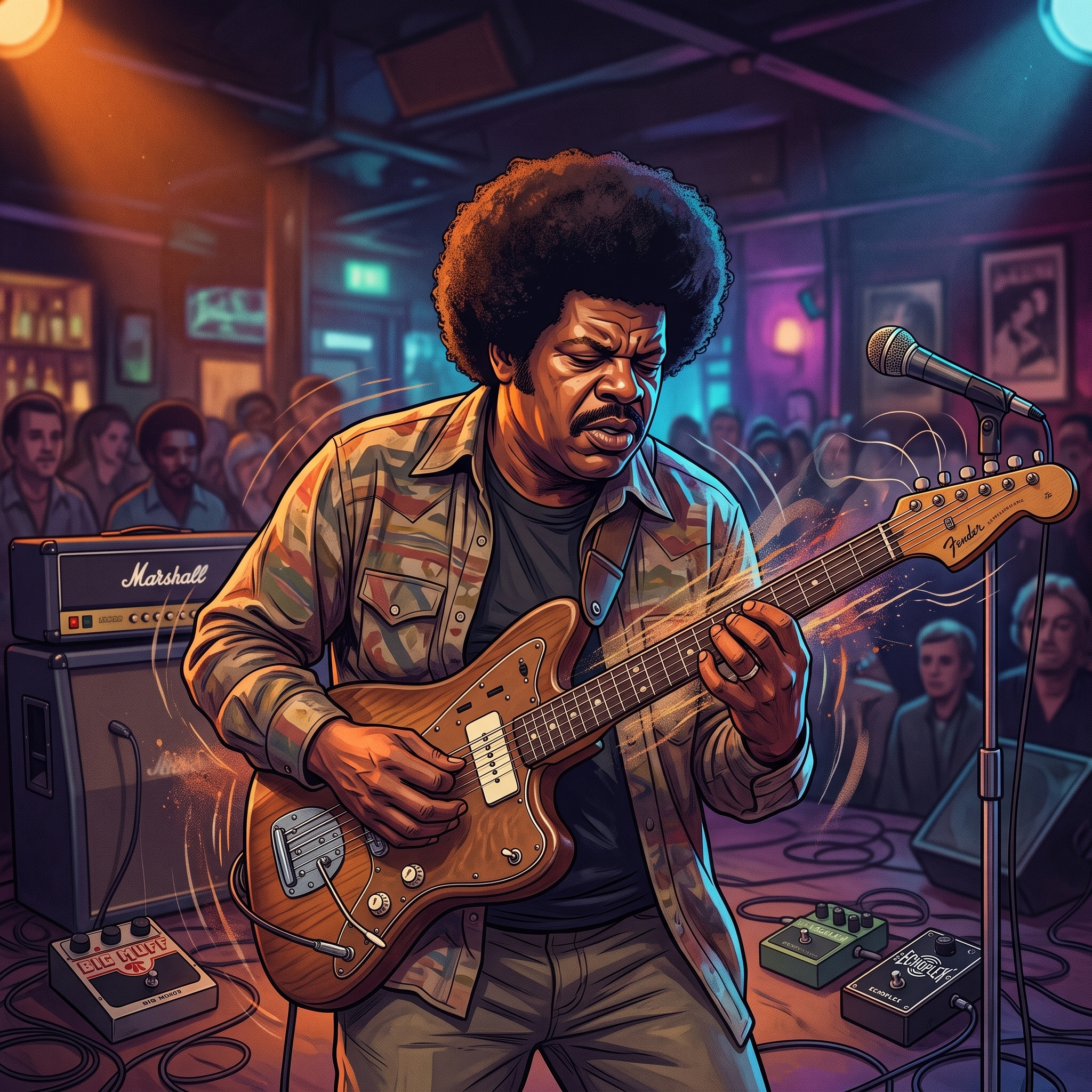
Investigate Sonny Sharrock guitars gear and you find the equipment behind one of the most radically individual and most genuinely revolutionary voices in the history of the electric guitar — a Ossining, New York-born musician who brought the electric guitar into the free jazz tradition at a time when the two seemed fundamentally incompatible, who played with Herbie Mann in mainstream jazz contexts while simultaneously pursuing some of the most extreme sonic experiments available in any genre, and who in his mature work with the power trio Last Exit created a music of almost overwhelming intensity that placed the electric guitar at the furthest edge of what organized noise could express. Sharrock did not play the guitar in any conventional sense — he assaulted it, he wrestled with it, he used it as a machine for generating specific kinds of controlled chaos, and the results were either the most exciting or the most terrifying guitar music available depending on the listener’s relationship with sonic extremity. His equipment served these purposes with complete appropriateness.
This guide covers Sharrock’s complete equipment picture: the Gibson guitars that he drove to the edge of feedback and noise, the amplification that gave his extreme playing its specific character of warm intensity rather than mere harshness, his minimal but purposeful effects use, and the playing philosophy of a musician who understood that the guitar’s possibilities extended far beyond the blues and rock traditions that had defined its parameters. Understanding Sonny Sharrock’s gear is understanding how the guitar can be a vehicle for the most extreme musical expression while remaining recognizably a guitar.
Background
Warren Harding Sharrock was born on August 27, 1940, in Ossining, New York. His early musical aspiration was not to be a guitarist but to be a saxophonist — he wanted to play saxophone in the manner of John Coltrane, whose free jazz saxophone approach was one of the primary influences on his subsequent guitar work. When asthma prevented him from pursuing the saxophone professionally, he turned to guitar and attempted to translate the Coltrane approach — the long, searching melodic lines, the harmonic freedom, the physical intensity of expression — to the very different physical properties of the electric guitar.
This specific origin — a frustrated saxophonist attempting to play the guitar like a saxophone — explained much of the specific character of his approach. He did not approach the guitar as guitarists typically did, from the foundation of the blues or rock and roll tradition, but from the foundation of free jazz saxophone playing, which had completely different physical and musical conventions. The guitar didn’t have the saxophone’s specific range of extended techniques, but it had its own extended techniques — feedback, volume pedal swells, extreme string bending, the use of the instrument’s body and headstock as percussion surfaces — that could produce some of the same emotional and musical content.
His professional career began through the New York jazz scene of the 1960s, where he appeared with Herbie Mann’s commercially successful flute-and-jazz ensemble and simultaneously pursued the more extreme musical territory that his own compositional vision occupied. The tension between the commercial jazz context (Mann’s music was genuinely accessible popular jazz) and the free jazz extremism of his own approach gave his career a specific quality of productive contradiction that shaped the music he made in both contexts.
His work with Last Exit — the power trio he co-founded with bassist Bill Laswell and drummer Ronald Shannon Jackson, with Peter Brötzmann on saxophone — was the fullest realisation of his musical vision: music of extraordinary intensity that placed the electric guitar at the furthest extreme of what organised sound could achieve. The Last Exit recordings documented this vision with the rawness and immediacy that the music required.
Sonny Sharrock Guitars Gear: The Complete Rig
Guitars
Sonny Sharrock’s guitar choices were oriented toward warmth and sustain — qualities that enabled the specific kind of extended, feedback-based playing that was central to his approach — rather than toward the brightness and definition that dominated most guitar aesthetics.
His primary guitar was a Gibson ES-335 — the semi-hollow thinline archtop with PAF-spec humbucking pickups. The ES-335’s specific combination of semi-hollow body resonance and humbucker warmth produced the sustained, warm tone that enabled the feedback-based playing approach that was central to his musical vocabulary. The semi-hollow body’s acoustic resonance made it more feedback-susceptible than solid-body alternatives at high volumes — the hollow wing sections resonated with the amplifier’s acoustic output, creating the feedback loops that Sharrock used as musical material rather than merely as technical problems to be controlled.
He also used Gibson SG models — the double-cutaway solid body that Gibson had initially marketed as the “new Les Paul” — for the lighter weight and different balance that the SG’s slim mahogany construction provided. The SG’s humbuckers (typically T-Top designs from the period he was playing) gave similar warmth and sustain to the ES-335’s pickups while the solid body construction produced different feedback characteristics — less acoustically susceptible to the amplifier’s output, with feedback that was more controllable and more precisely pitchable when sought.
He tuned his guitars in non-standard ways for specific recordings and performances — using detuning and unusual string configurations to produce specific harmonic and tonal effects that standard tuning didn’t allow. This willingness to treat tuning as a compositional variable rather than as a fixed framework reflected the broader musical philosophy of someone for whom the guitar’s conventions were starting points rather than constraints.
String gauges ran heavy — typically .012–.056 or heavier — providing the string mass that sustained feedback and controlled noise playing required. Heavy strings under proper tension produced different feedback characteristics from lighter alternatives, sustaining feedback at specific pitches more reliably and giving the noise playing a more controlled character.
Amps
Sharrock’s amplification was characterised by warmth and volume — the specific combination of American valve warmth and extreme volume levels that enabled the feedback-based, intensity-focused playing approach he pursued.
His primary amplifiers were Marshall Super Lead heads — the 100-watt EL34-based British designs that ran at volumes high enough to create the feedback conditions his music required. The Marshall’s midrange warmth and natural EL34 saturation at high volumes gave the feedback a specific musical quality — warm, harmonically complex, sustained in ways that gave the extended passages their character of organised intensity rather than mere noise.
He ran the Marshalls into 4×12 cabinets — the standard Marshall configuration — producing the acoustic output necessary for the feedback levels that his music required. At the volumes he played, the acoustic coupling between the guitar and the cabinet was sufficient to produce continuous feedback at specific pitches that he could control through the guitar’s position relative to the speakers and the guitar’s own body resonances.
He also used Fender amplifiers in specific contexts — particularly for the more commercial jazz work with Herbie Mann and for earlier recordings that required the cleaner American character that Fender amplification produced. The Fender’s 6L6 character was less appropriate for the extreme feedback playing but more appropriate for the melodic jazz context that Mann’s music required.
Effects
Sharrock’s effects chain was minimal — the extreme intensity of his approach was produced through physical technique and extreme amplification rather than through elaborate signal processing. The specific kind of organised chaos he pursued was best served by the most direct possible signal path, allowing the instrument’s and amplifier’s natural character to provide the primary sonic material.
A volume pedal was the most important element of his effects chain — enabling the swell attacks and dynamic management that gave specific passages their specific quality of notes emerging from silence or receding into it. The volume pedal at the front of the signal chain gave him real-time control over the amount of signal reaching the amplifier, which in turn controlled the feedback threshold and the overall intensity level of the playing.
A fuzz pedal — various germanium and silicon units — appeared for specific applications where additional gain and harmonic density were required beyond the Marshall’s own natural saturation character. The fuzz added additional sustain and harmonic complexity to already-sustained passages, enabling specific qualities of noise and feedback that the amplifier alone didn’t produce.
The guitar’s position relative to the amplifier was itself one of his primary “effects” — moving the guitar closer to or further from the speaker cabinet changed the feedback character, with specific positions producing feedback at specific pitches that he had learned through practice. This physical approach to feedback management was as sophisticated a technique as any pedal-based effect, requiring developed spatial awareness and physical control that took years to develop.
Playing Style & Tone Philosophy
Sonny Sharrock’s playing style was defined by the specific approach of treating the guitar as a saxophone — attempting to produce the long, searching, physically intense musical statements of free jazz saxophone playing through the very different physical properties of the electric guitar. This approach required developing guitar techniques that had no precedent in the conventional guitar tradition and that were understood by the conventional tradition as mistakes or limitations rather than as intentional techniques.
His melodic approach — the long, sustained, searching lines that occupied extended passages of his solos — showed the Coltrane influence most directly. The lines moved through harmonic space without regard for the underlying chord structure, following a musical logic of their own that was more akin to modal improvisation than to the chord-based harmonic approach of most jazz guitar. The specific technical means of producing these lines on the guitar — the combination of conventional picking, string bending, feedback sustain, and the use of both hands in non-conventional ways — gave the resulting sound a specific character that was recognizably guitar but equally recognizably not guitar-as-normally-played.
His use of volume and noise as musical material — treating the guitar’s feedback and the amplifier’s extreme volume not as problems to be controlled but as resources to be deployed — was one of the most genuinely radical approaches to the electric guitar available in any musical tradition. The organisation of noise into musical statements — distinguishing between different qualities of noise, different pitches of feedback, different dynamics of volume — required a musical intelligence as demanding in its way as any conventional musical discipline.
Tonally, his philosophy was extreme warmth at extreme volume — the Gibson’s humbucker warmth giving the noise a musical character rather than a merely abrasive one, the Marshall’s EL34 saturation at high volume adding harmonic richness to the sustained feedback passages. The specific combination of warmth and intensity in his tone — which distinguished his approach from the more clinical noise of some free jazz guitar players — was one of the most striking qualities of his recorded work.
How to Sound Like Sonny Sharrock
Guitar Approach
A Gibson ES-335 or SG with humbuckers — heavy strings (.012–.056 or heavier). The approach is fundamentally different from conventional guitar technique: study Coltrane’s saxophone playing for the melodic and harmonic philosophy, and study how to translate that philosophy into guitar techniques that have no conventional precedent. Develop feedback control — learn which positions relative to the amplifier produce feedback at which pitches — before attempting to use feedback as musical material.
Amp Approach
A Marshall Super Lead at high volume into a 4×12 cabinet. The volume is not optional — the specific feedback and acoustic coupling that Sharrock’s approach required only occurred at high volume levels where the acoustic output of the cabinet was sufficient to drive the guitar’s strings into sustained resonance. A volume pedal at the front of the chain for dynamic control. The specific harmonic density of the approach came from the EL34’s natural saturation at these volumes rather than from additional gain pedals.
| Control | Setting | Notes |
|---|---|---|
| Volume | 8–10 | High — feedback and acoustic coupling require volume |
| Treble | 6 | Moderate — warmth is the goal, not brightness |
| Middle | 7 | High mids — EL34 midrange warmth gives noise its musical character |
| Bass | 5 | Moderate bass for controlled low-end in noise passages |
| Presence | 5 | Moderate — warmth over clarity in extreme noise context |
| Volume Pedal | Dynamic control | Front of chain — controls feedback threshold and overall intensity |
Influence & Legacy
Sonny Sharrock’s legacy was the specific legacy of a musician who demonstrated that the electric guitar’s possibilities extended far beyond the blues and rock traditions that had defined its parameters — that the guitar could be a vehicle for the most extreme musical expression available in any genre without ceasing to be recognizably a guitar. His influence on subsequent noise rock, no-wave, and experimental guitar players was substantial and direct, with musicians including Thurston Moore and Lee Ranaldo of Sonic Youth, Glenn Branca, and subsequent generations of experimental guitarists citing his approach as a primary influence.
His late-career recordings — including the acclaimed Ask the Ages (1991), his final studio album recorded with Pharoah Sanders, Charnett Moffett, and Elvin Jones — showed a musician at the height of his powers and suggested a late-career maturity and accessibility that his death in 1994 cut short. The album’s critical acclaim and its commercial reception were both significantly larger than anything in his previous career, suggesting that his musical vision had finally found its appropriate audience just as his life ended.
For players exploring the free jazz and experimental guitar tradition that Sharrock helped define, the rigs of Will Sergeant — whose Echo and the Bunnymen work showed how similar approaches to the guitar as texture generator rather than melodic instrument developed in a completely different musical context — and Leigh Stephens, whose Blue Cheer extreme-volume approach pioneered the high-volume feedback guitar in a rock context before Sharrock’s free jazz equivalent, provide illuminating comparison. The noise and feedback dimensions of his playing connect to Dave Brock‘s Hawkwind approach, which showed how similar extreme-volume and feedback-based guitar playing developed in the psychedelic rock tradition.
Memphis Underground: Free Jazz Meets Commercial Context
Herbie Mann’s Memphis Underground (1969) — the live album that documented Sharrock’s work in Mann’s commercial jazz ensemble in Memphis — provides one of the most striking single documents of his approach in a context that had not been designed to accommodate it. The album’s specific production approach — capturing a live performance with the directness of the recording conditions — gave listeners access to Sharrock’s playing in a context where the contrast between Mann’s accessible jazz and Sharrock’s extremism was fully audible rather than softened by studio production.
The specific guitar tone on the album — the Gibson’s warm humbucker character through what was probably Fender amplification at moderate volumes (the commercial jazz context required more controlled volume levels than his own music) — showed Sharrock’s approach in a state of productive restraint. He was playing in a commercial jazz context with a musician whose primary values were accessibility and entertainment, and the specific quality of controlled extremism that resulted — his playing clearly pushing against the constraints of the context without fully abandoning them — produced music of genuine tension and genuine interest.
The guitar’s role in Mann’s ensemble was supposed to be supportive — providing harmonic and rhythmic accompaniment to Mann’s melodic flute. Sharrock’s version of this role was to provide harmonic and rhythmic accompaniment of an extremely unconventional kind — using the guitar’s specific extended techniques to accompany the flute’s melody in ways that had no precedent in the jazz guitar tradition. The resulting juxtaposition — flute melody with free jazz guitar “accompaniment” — was one of the most unusual ensemble textures in commercial jazz of the period and was probably the most widely heard exposure to Sharrock’s playing during his lifetime.
The Coltrane Foundation: Saxophone Logic Applied to Guitar
The John Coltrane influence on Sharrock’s guitar approach was not merely stylistic but structural — Coltrane’s specific approach to free jazz saxophone playing provided the fundamental musical logic that Sharrock translated to the guitar. Understanding what specifically Coltrane contributed to Sharrock’s approach illuminates both the musical philosophy and the specific technical solutions he developed to translate saxophone logic to guitar physics.
Coltrane’s approach — particularly in the late-career free jazz period of Ascension (1965) and the live recordings from 1965 onward — was characterised by long, searching melodic lines that moved through harmonic space with apparent disregard for conventional chord structures, the physical intensity of extended performance, and the use of the saxophone’s full technical range (including overblowing, multiphonics, and other extended techniques) as expressive tools. These qualities — the harmonic freedom, the physical intensity, and the use of extended techniques — were the specific things Sharrock attempted to translate to the guitar.
The translation required developing guitar techniques that had no conventional precedent. The saxophone’s overblowing technique — producing harmonics above the fundamental by increasing air pressure — had a guitar equivalent in feedback: the acoustic-electromagnetic feedback loop that produced harmonic overtones when the guitar was held near a high-volume amplifier. The saxophone’s multiphonics — producing multiple pitches simultaneously — had a rough guitar equivalent in the combination of chord playing and feedback, where the held chord and the feedback pitch interacted to produce complex multi-tonal sounds. These translations were not exact replications of the saxophone techniques but guitar approximations of the same musical functions, developed through years of experimentation and refinement.
Last Exit: The Ultimate Realisation
Last Exit — the free jazz power quartet that Sharrock co-founded with Bill Laswell, Ronald Shannon Jackson, and Peter Brötzmann — was the musical context in which his specific approach found its most complete and most uncompromising realisation. Understanding the specific dynamics of the Last Exit ensemble helps explain how his specific equipment approach served the music’s specific requirements.
The combination of musicians in Last Exit was unusual and specifically chosen: Laswell’s bass brought both the rhythmic foundation and a specific electronic bass vocabulary that went well beyond conventional jazz bass playing; Jackson’s drumming brought the physical intensity and the rhythmic sophistication of his specific background in Ornette Coleman’s music and his own Prime Time band; Brötzmann’s saxophone brought the European free jazz extremism that had developed independently of the American free jazz tradition but that shared its fundamental values of intensity and freedom. Sharrock’s guitar was the fourth element in this specific combination, and his Marshall-at-extreme-volume approach was the appropriate guitar response to the intensity that the other three musicians brought to the ensemble.
The specific equipment requirements of the Last Exit context — maximum volume for maximum acoustic coupling between guitar and speaker, warmth from the EL34’s natural saturation at those volume levels, the ES-335’s semi-hollow feedback susceptibility as a primary tool rather than a problem — were not the requirements of a conventional jazz ensemble or even of a conventional free jazz ensemble, but of a specific and unusual musical project that pushed the physical limits of what acoustic instruments could generate while maintaining musical organisation. Sharrock’s equipment was exactly right for exactly this context, and understanding both the context and the equipment together gives the most complete picture of either.
Ask the Ages: Late-Career Synthesis
Ask the Ages (1991) — the album that won Sharrock the widest critical recognition of his career — represented a synthesis of everything he had developed through decades of extreme musical experimentation, presented with a combination of accessibility and depth that suggested a late-career artistic maturity of unusual completeness. Understanding what the album achieved, and how his specific equipment served those achievements, illuminates both the album’s specific character and the broader arc of his career.
The album’s instrumentation — guitar, saxophone, bass, drums — was a conventional jazz quartet in format but completely unconventional in execution. Pharoah Sanders’ saxophone brought a different kind of free jazz expressionism from Brötzmann’s European approach — warmer, more blues-influenced, more explicitly spiritual in its musical character. Charnett Moffett’s bass and Elvin Jones’s drums provided rhythmic structures that were more clearly musical than the organised noise of the Last Exit context. And Sharrock’s guitar — still the warm, sustaining Gibson through the Marshall — was deployed with more melodic clarity and more harmonic structure than on the Last Exit recordings, giving the album a quality of emotional directness that the most extreme free jazz contexts sometimes obscured.
The specific guitar sound on Ask the Ages — warm, present, sometimes melodic and sometimes intensely distorted, with the feedback passages used as specific musical statements rather than as continuous sonic fields — was the most complete documentation of what his specific approach was capable of achieving at its most musical and most accessible. The ES-335’s warmth gave the melodic passages their beauty; the Marshall’s intensity gave the extreme passages their power; and the specific combination of both, in a musical context that demanded both qualities simultaneously, produced the most widely appreciated document of his specific musical vision.
Sonny Sharrock’s death in 1994 — from a heart attack at fifty-three — cut short a career that had just produced its most mature and most widely appreciated work. The equipment he used throughout: the warm, semi-hollow Gibson through the extreme-volume Marshall, with the volume pedal and occasional fuzz as the only processing — was in service of a musical vision of extraordinary originality and extraordinary commitment. The gear served the extremism; the extremism served the music; and the music demonstrated that the electric guitar’s possibilities extended beyond any conventional musical tradition’s conception of what the instrument was for. That is the complete Sonny Sharrock gear story, and it remains one of the most radical and most genuinely revolutionary in the history of the electric guitar.
The specific acoustic mechanism of controlled feedback — the primary technique of Sharrock’s most extreme playing — deserves detailed examination because understanding it illuminates both the equipment choices that made it possible and the musical intelligence required to use it purposefully rather than merely accidentally. Acoustic-electromagnetic feedback in an electric guitar occurs when the acoustic output of the amplifier’s speaker system is strong enough to drive the guitar’s strings into sympathetic vibration at the same frequency as the amplified signal — the string resonates with the speaker, which amplifies the string, which drives the speaker, which drives the string, in a self-reinforcing loop that produces continuous sustained resonance at specific pitches. The specific pitches at which feedback occurs are determined by the guitar’s natural acoustic resonant frequencies, the amplifier’s frequency response, and the specific acoustic coupling between the speaker and the guitar’s body at the player’s position — which means that different positions relative to the speaker produce feedback at different pitches, and skilled feedback players develop a physical map of the acoustic space around their amplifier that allows them to seek specific feedback pitches by moving to specific positions.
Sharrock’s mastery of this physical map — knowing which positions relative to the Marshall cabinets produced which feedback pitches, and being able to move between positions purposefully during a performance to seek specific pitches — was one of the most sophisticated technical achievements of his career, requiring years of development and a specific kind of spatial-acoustic intelligence that had no equivalent in conventional guitar technique. The specific equipment choices that made this mastery possible and musically valuable — the Gibson’s semi-hollow body resonating more easily with the speaker output, the Marshall’s volume level sufficient to produce reliable feedback, the EL34’s midrange warmth giving the feedback a musical quality — were all in service of this specific technical dimension of his playing.
Bill Laswell’s role as producer and musical partner in the Last Exit context — and as producer of Ask the Ages — shaped the specific way that Sharrock’s guitar was recorded and presented on the most important documents of his career. Laswell’s production approach combined the documentary impulse of live recording — capturing the musicians’ actual performance rather than constructing a studio approximation — with a technical sophistication that gave the recordings their specific quality of extreme intensity presented with unusual clarity. The specific way the Marshall’s extreme volume was captured on the Last Exit recordings — microphones placed to capture both the direct amplifier sound and the acoustic reflections of the recording space — gave the guitar its specific combination of immediate presence and spatial depth that raw close-miked recording alone wouldn’t have provided. This production intelligence — the ability to capture extreme acoustic material in ways that preserved its specific musical character — was as important to the recordings’ quality as the performances themselves, and Laswell’s understanding of how to record Sharrock’s specific approach was part of what made the Last Exit recordings the most complete documentation of his musical vision available.
The specific legacy of Sharrock’s approach in the Sonic Youth connection — Moore and Ranaldo’s acknowledgment of his influence on their guitar approach — illustrated how the most extreme musical experiments of one tradition could cross genre boundaries and influence musicians in completely different contexts when the underlying musical values were genuinely compatible. Sonic Youth’s approach — treating the guitar as a noise generator and texture-producing machine rather than as a melodic instrument, using feedback and extended techniques as primary musical resources, developing a guitar vocabulary that had no precedent in the rock or jazz traditions — was parallel to Sharrock’s in its fundamental values even though the specific musical contexts were very different. The guitar as noise generator, the feedback as musical material, the extreme volume as a primary technical requirement — these were values that transcended the specific genre distinctions between free jazz and no-wave rock, and the equipment that served them (warm, sustaining guitars through high-volume amplification) was appropriate to both contexts for the same acoustic reasons. Sharrock’s influence on Sonic Youth was not a matter of one tradition borrowing from another but of one approach recognising its most direct precedent in a different tradition’s most radical practitioner.
The ES-335’s semi-hollow construction’s role in Sharrock’s approach — making the instrument more feedback-susceptible than solid-body alternatives — was both a practical advantage and a specific musical choice that reflected his understanding of the instrument’s acoustic properties. The hollow wing sections of the ES-335’s construction resonated at specific frequencies with the amplifier’s acoustic output, adding a second layer of acoustic coupling beyond the electromagnetic interaction between the pickup’s magnetic field and the speaker’s acoustic pressure. This additional resonant coupling made feedback occur at lower volume levels and at additional pitches beyond those produced by electromagnetic coupling alone, giving Sharrock a richer and more varied palette of feedback resources than a solid-body instrument through the same amplifier would have provided. The irony was that the ES-335 had been designed by Gibson with its solid centre block precisely to prevent the uncontrolled feedback that fully hollow archtops produced at high volumes — the semi-hollow design was intended to give the instrument sufficient feedback resistance for professional use. Sharrock’s exploitation of the remaining feedback susceptibility — using it as a primary musical resource rather than trying to eliminate it — inverted the design intention while demonstrating the creative potential of properties that the designer had considered liabilities.
The broader musical philosophy that Sharrock’s career expressed — that the guitar’s possibilities were limited only by convention rather than by the instrument’s physical properties, and that the most interesting music was made by players who refused to treat conventional limitations as real ones — was as influential as any specific technical contribution he made to the instrument’s vocabulary. Every subsequent guitarist who treated feedback as musical material, who used extreme volume as a primary expressive tool, who refused to accept the conventional boundaries of what guitar playing was supposed to sound like — was working in a tradition that Sharrock helped define. The equipment that served this tradition — warm, sustaining guitars through high-volume amplification — was acoustically appropriate for the specific musical purposes, and the musicians who used it in service of these purposes were making genuinely original music rather than merely reproducing a genre template. Sonny Sharrock’s gear story was ultimately the story of equipment in service of genuine musical revolution, and the revolution it served was real.
The specific context of free jazz in the 1960s and 1970s — the musical tradition within which Sharrock developed his approach before finding more appropriate musical contexts in the 1980s — was simultaneously the most musically receptive environment for his extremism and the most commercially marginal. The free jazz tradition, developed through the work of Ornette Coleman, Cecil Taylor, Albert Ayler, and Coltrane, had rejected the harmonic and structural conventions of bebop in favour of a more fluid, more collectively improvised approach that prioritised collective interaction and individual expression over predetermined harmonic frameworks. Within this tradition, Sharrock’s guitar approach — non-conventional, technically extreme, harmonically free — was ideologically compatible even when it was technically unprecedented. The fact that no free jazz guitarist had previously developed the specific techniques he was developing was not a reason for the free jazz community to reject his approach but an invitation to extend the tradition’s reach into new technical territory. The equipment he used — the ES-335 through the Marshall at high volumes — was made available to him partly by the commercial jazz work with Herbie Mann that funded the more extreme activities, and partly by the specific economics of the free jazz scene in New York, where the combination of intellectual reception and commercial struggle that characterised the tradition also characterised his career within it.
The question of what Sonny Sharrock’s career might have produced if he had lived beyond 1994 is genuinely open and genuinely interesting. The direction suggested by Ask the Ages — toward a more melodically accessible presentation of the free jazz extremism he had always pursued, without compromising the emotional intensity or the technical radicalism — was a direction that had commercial and critical viability that his earlier work had never quite achieved. The specific guitar tones on that album — warm, present, sometimes melodic and sometimes intensely distorted, with the feedback passages used as specific musical statements within a more structured musical context — showed an artist whose command of his own approach had reached the level of maturity where the most extreme techniques could be deployed selectively and purposefully rather than as continuous sonic environments. Had he lived to develop this direction further, the music he might have made — and the equipment approach that would have served it — remains genuinely one of the most interesting paths not taken in the history of experimental guitar music.
The Marshall Super Lead’s specific contribution to Sharrock’s Last Exit sound — beyond the practical matter of providing sufficient volume for feedback — was the specific quality of EL34 harmonic distortion at extreme volume levels. The EL34 output valve, like all thermionic valves operating at or beyond their linear range, generated additional harmonic content when the output signal exceeded the valve’s linear capacity. At the extreme volume levels Sharrock required, the EL34s were consistently operating in saturation — generating both even and odd harmonic overtones that added to the complexity of the sustained and feedback passages. The specific ratio of even to odd harmonics in EL34 saturation — different from 6L6 saturation, different from transistor clipping — gave the distorted passages their specific harmonic character: warm and musically complex rather than clinical or harsh. The warmth that distinguished Sharrock’s extreme playing from mere noise was partly a function of the EL34’s specific harmonic distortion character at saturation levels, and his consistent use of the Marshall Super Lead rather than alternative high-volume amplifiers reflected genuine understanding of this specific quality. The EL34 at saturation was not merely a high-volume amplifier; it was a specific harmonic generator whose particular distortion character was as musically significant as any conscious tonal choice, and Sharrock’s equipment reflected appreciation of this character even if he might not have articulated it in these acoustic engineering terms.
The SG guitar’s role in Sharrock’s collection — as an alternative to the ES-335 for contexts where the solid body’s different feedback characteristics were more appropriate — illustrated his practical understanding of how different guitar bodies interacted with the amplifier’s acoustic field in different ways. The SG’s solid mahogany body was less acoustically susceptible to the speaker’s output than the ES-335’s semi-hollow construction, producing feedback that required higher volume levels and closer positioning to the speaker to achieve than the semi-hollow instrument. In contexts where more controlled feedback — feedback that could be started and stopped more precisely — was musically appropriate, the SG’s lower feedback susceptibility gave Sharrock more precise control over when feedback occurred and when it didn’t. This practical understanding of the acoustic differences between instruments and how those differences affected the specific musical resources available from each was the foundation of his equipment intelligence — not theoretical knowledge of guitar construction principles but practical experiential knowledge of how specific physical properties produced specific musical results in the specific acoustic environments of his performances.
Frequently Asked Questions: Sonny Sharrock Guitars & Gear
What guitar did Sonny Sharrock play?
Sonny Sharrock’s primary guitars were the Gibson ES-335 (semi-hollow with PAF-spec humbuckers) and Gibson SG models. His preference for warm, sustaining humbucker instruments reflected the specific requirements of his feedback-based playing approach — warmth and sustain gave the extreme playing its musical character rather than mere noise. He used heavy strings (.012–.056 or heavier) and non-standard tunings for specific performances and recordings.
What amp did Sonny Sharrock use?
His primary amplification was Marshall Super Lead 100-watt heads into 4×12 cabinets, run at high volumes that produced the acoustic coupling and feedback conditions his music required. He also used Fender amplifiers for the more commercial jazz work with Herbie Mann and in earlier recording contexts. His consistent use of the Marshall for his own music reflected the EL34’s warmth at saturation levels and the volume levels necessary for the feedback-based playing approach.
What was Last Exit?
Last Exit was the free jazz power group that Sharrock co-founded with bassist/producer Bill Laswell, drummer Ronald Shannon Jackson, and German free jazz saxophonist Peter Brötzmann in the mid-1980s. The group’s music — recorded on albums including Last Exit (1986), The Noise of Trouble (1986), and others — represented some of the most extreme and most intense free improvised music available in any genre. Sharrock’s guitar was central to the group’s specific character of overwhelming sonic intensity.
What effects did Sonny Sharrock use?
His effects chain was minimal: a volume pedal (front of chain for dynamic control and feedback threshold management) and occasional fuzz pedals for additional gain. His primary “effect” was his physical position relative to the amplifier, which determined the feedback character and frequency of each sustained passage. The simplicity of the effects chain was as essential to his approach as the specific instruments and amplifiers — additional processing would have diluted the directness of the instrument-to-amplifier relationship that his music required.
Why is Sonny Sharrock significant?
Sharrock was one of the first musicians to bring the electric guitar fully into the free jazz tradition, developing techniques and musical approaches that had no precedent in either the jazz or the rock guitar traditions. His influence on subsequent experimental, noise rock, and no-wave guitarists was substantial — Sonic Youth, Glenn Branca, and many other experimental guitarists acknowledged his approach as a primary influence. His late-career album Ask the Ages (1991) was acclaimed as one of the most significant free jazz recordings of its decade.
What was the Herbie Mann connection?
Sharrock appeared with Herbie Mann’s ensemble in the late 1960s and early 1970s — most notably on the commercially successful live album Memphis Underground (1969), which documented the band in a Memphis recording environment and showed Sharrock’s playing in the more commercial jazz context. The tension between Mann’s accessible popular jazz and Sharrock’s extremism produced some unusually compelling recordings, with Sharrock’s guitar often pushing well beyond the conventions of Mann’s mainstream jazz context.
What is Ask the Ages?
Ask the Ages (1991) was Sonny Sharrock’s final studio album, recorded with Pharoah Sanders on saxophone, Charnett Moffett on bass, and Elvin Jones on drums. The album was his most accessible and most critically acclaimed recording, balancing the free jazz extremism of his previous work with a somewhat more melodic and structured approach that retained all of the emotional intensity while presenting it in a more navigable form for listeners. It was released just three years before his death in 1994 and served as both a late-career masterwork and a tantalising preview of creative directions that were not subsequently developed.
Genre:
Free Jazz / Noise
Decades:
1960s | 1970s | 1980s | 1990s
Related stories
Warren DeMartini Guitars & Gear: The Complete Guide to Ratt’s Torch Guitarist’s Rig
Warren DeMartini guitars & gear: Ratt's Torch guitarist. Charvel Bomber, snakeskin, Jose-modded Plexi, Fender Super Champ, RTM pickup, slapback echo — the complete rig.
Warren Haynes Guitars & Gear: The Complete Guide to Gov’t Mule’s Guitar Master’s Rig
Warren Haynes' guitars, amps, and effects — the complete guide. Gibson Les Paul Chester, Soldano SLO-100 modified, Klon Centaur, Emma Discombobulator, and how to nail that Gov't Mule blues-rock tone.
Wayne Kramer Guitars & Gear: The Complete Guide to MC5’s Proto-Punk Guitar Insurrectionist’s Rig
Wayne Kramer guitars & gear: MC5's proto-punk guitar insurrectionist. Star-spangled Strat, Big Muff Triangle, Marshall stacks, MXR Jail Guitar Doors Drive — the complete rig.