
Synyster Gates Guitars & Gear: The Complete Guide to Avenged Sevenfold’s Guitar Hero
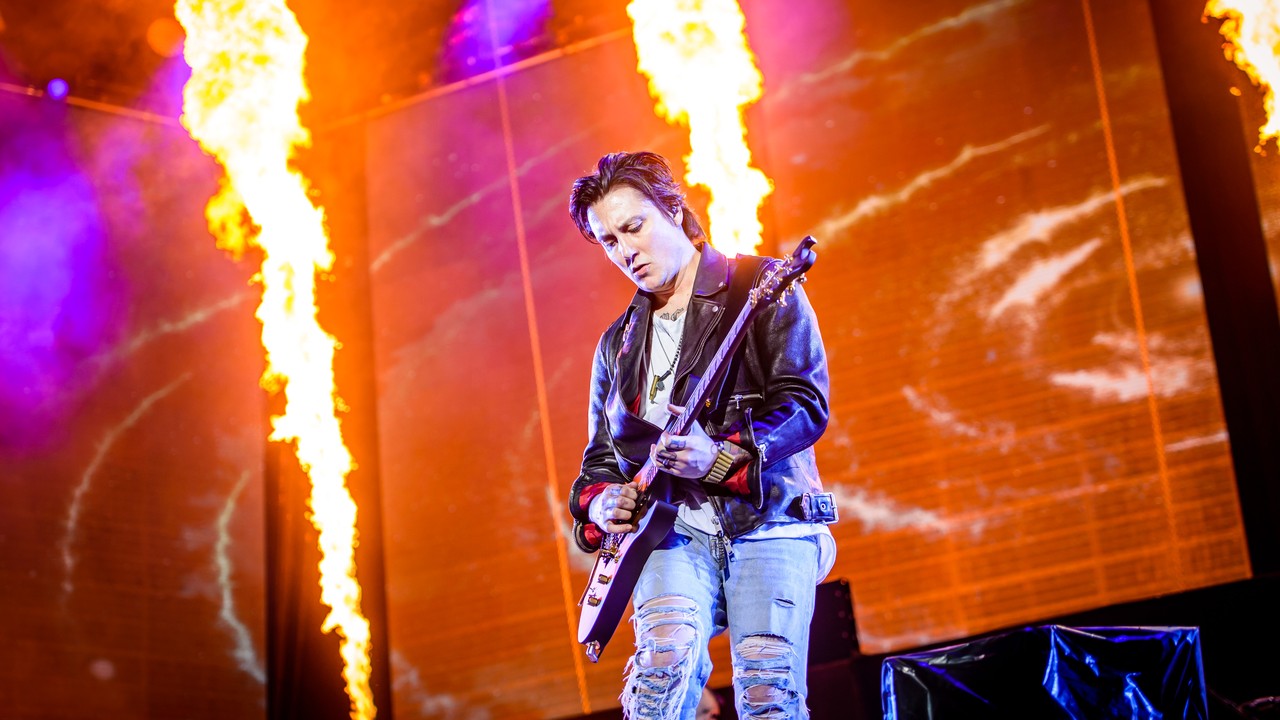
He studied jazz guitar at the Musicians Institute in Hollywood as part of the GIT program.
This fact consistently surprises people who first encounter it. Synyster Gates — the lead guitarist of Avenged Sevenfold, the man responsible for the neoclassical sweep-picking fireworks on “Bat Country” and “Afterlife,” the player whose solos have inspired a generation of metal guitarists — studied jazz at GIT. His father is Brian Haner Sr., a professional guitarist who performs as “Guitar Guy” and who spent years teaching Synyster the fundamentals of music theory, harmony, and technique from childhood.
The jazz foundation explains everything that distinguishes Gates from most of his metal contemporaries: the chord voicings that appear in Avenged Sevenfold arrangements, the harmonic sophistication of his melodic lines, the ability to make technically demanding passages sound musical rather than merely impressive, and the specific approach to phrasing that gives his solos a narrative structure rather than a series of impressive gestures strung together.
He wears his influences openly: Dimebag Darrell, Eddie Van Halen, Zakk Wylde — the tradition of American heavy metal guitar virtuosity absorbed through the filter of jazz music theory education. The result is a player who can sweep-pick at blistering speed and then play a chromatic jazz phrase that resolves into the next bar with harmonic logic, all inside the same solo.
His gear — the Schecter Avenger with Sustainiac and Invader, the Hellwin amp he co-designed, the specific signal chain that produces his live sound — is the delivery system for everything that training built.
Background: Huntington Beach, Guitar Guy’s Son, and the Jazz Foundation of Metal
Brian Elwin Haner Jr. was born July 7, 1981, in Huntington Beach, California — the same Orange County city where Avenged Sevenfold would form eighteen years later. His father Brian Haner Sr. is a professional guitarist who performs as “Guitar Guy,” a combination of comedy and guitar virtuosity that has made him a respected figure in the entertainment world. Growing up with a professional guitarist father who prioritised music education gave Gates access to formal instruction, music theory, and the kind of deep-dive learning that produces genuine musicality rather than just technical facility.
He co-founded Avenged Sevenfold in 1999 with vocalist M. Shadows (Matt Sanders), rhythm guitarist Zacky Vengeance (Zachary Baker), and original drummer Jimmy “The Rev” Sullivan. The band formed at Huntington Beach High School, initially playing a style rooted in metalcore and post-hardcore before evolving through several albums toward the more overtly melodic, neoclassical, and heavy metal-influenced direction that their most celebrated records represent.
His GIT attendance — studying jazz guitar specifically — confirmed the musical seriousness that his father’s teaching had established. Jazz guitar pedagogy requires deep engagement with chord harmony, improvisation theory, and the kind of melodic development that blues-based rock typically skips over. Gates absorbed it and brought it back to metal.
Avenged Sevenfold’s commercial trajectory was impressive: City of Evil (2005) was a genuine breakthrough, going platinum and establishing their mainstream heavy metal credentials. Avenged Sevenfold (2007) and Nightmare (2010) both debuted at number one on the Billboard 200. Hail to the King (2013), The Stage (2016), and Life Is But a Dream… (2023) continued the commercial and critical trajectory of a band that has become one of heavy metal’s most commercially significant acts of the twenty-first century.
The tragedy of Jimmy “The Rev” Sullivan — who died on December 28, 2009, at age 28 from a cardiac arrhythmia related to prescription drugs — is part of the story that contextualises Nightmare, recorded in his memory with Mike Portnoy filling in on drums. Gates and Sullivan had been friends since childhood and had collaborated on the side project Pinkly Smooth. The loss was both personal and professional, and the music of the subsequent period carries that weight.
His side activity extends beyond Avenged Sevenfold: he has collaborated with his father on various projects and guest appearances, and maintains Synner.com as a platform for connecting with fans and sharing educational content about guitar.
Tone note: His father is a professional guitarist who taught him theory from childhood. He then went to GIT to study jazz. He then joined a heavy metal band and became famous for neoclassical shredding. The formal training foundation is visible in every technically demanding passage he plays — the lines resolve harmonically because he knows where they’re supposed to go.
The Rig: Synyster Gates’ Guitars, Amps & Gear — Complete Era-by-Era Breakdown
Gates’ gear evolution tracks Avenged Sevenfold’s artistic development — from the more raw, aggressive metalcore sound of the early albums to the polished, melodically ambitious heavy metal of the classic period. The Schecter relationship has been the constant; the specific instruments, amps, and electronics have evolved to match the increasing sophistication of the music.
Guitars: The Schecter Avenger and Its Many Incarnations
Pre-Schecter Instruments — Waking the Fallen Era
Before the Schecter endorsement that began in 2004, Gates used a range of instruments that reflect the early Avenged Sevenfold’s more straightforward heavy music approach:
- Gibson Les Paul Custom — Primary guitar for the Waking the Fallen era (2003); provided the thick, warm mahogany tone of the band’s early metalcore sound
- Ibanez S470 — Used on the late tour of 2002; an Ibanez Soundgear with a thin, lightweight body and high-output pickup configuration
- Schecter PT Fastback — Used during the Waking the Fallen touring period; Telecaster-shaped Schecter with string-through body; Duncan Designed pickups; a versatile early option before the full signature development
Schecter Synyster Gates Custom Series — The Definitive Instruments (2004–present)
Gates’ relationship with Schecter began in 2004 and has produced one of the most extensive and continuously evolving signature guitar lines in modern metal. The base specifications that define his signature series:
Body and Construction:
- Avenger body shape — Schecter’s specific design that departs from conventional Strat or LP profiles toward something more angular and distinctive, with extended upper cutaway for upper-fret access
- Mahogany body for most models — the warmth and sustain of mahogany complement the high-output electronics
- Mahogany neck with carbon fibre reinforcement rods — stability and sustain; the carbon fibre prevents neck movement across temperature and humidity variations
- Ebony fingerboard — darker, denser character than rosewood or maple; smooth feel and distinctive tonal response
- 24 extra-jumbo frets — full access to the highest register; extra-jumbo size for easier bending and vibrato
- Deathbat inlays (A7X skull logo) — the signature visual identification on every Schecter Gates model
- Glow-in-the-dark side dots — visible under stage lighting
Electronics:
- Bridge pickup: Seymour Duncan SH-8 Invader — Very high output, ceramic-magnet humbucker with a characteristically aggressive, thick character that handles heavy distortion without becoming muddy. The Invader’s output is higher than most passive humbuckers and its tonal character — dominated by the low and upper midrange — suits Gates’ rhythm and lead approach under high gain.
- Neck pickup: Sustainiac FSK-401 (pickup system) — This is the defining technological feature of Gates’ signature guitars. The Sustainiac is an electromagnetic feedback system that sustains any note indefinitely by driving energy back into the strings from the neck pickup position. It can produce violin-like infinite sustain on any note or chord, controlled via the guitar’s controls. Gates uses it extensively for the long, singing sustained lead notes that contrast with his fast picking passages — the combination of Invader attack on bridge and Sustainiac sustain on neck covers an enormous expressive range from percussive to endless.
- 5-way selector (with modified switching for Sustainiac modes)
- 500K volume and tone pots
Bridge: Floyd Rose double-locking tremolo for most models (Custom-S); some versions with Tune-O-Matic for studio stability. The Floyd Rose enables the wide whammy bar technique that Gates uses in live performance and which is visible in his EVH-influenced solo sections.
Tuning: Drop D (D A D G B E) as the primary live tuning, with additional guitars in standard E and Drop C# (C# G# C# F# A# D#). His guitar tech Za confirmed during the Hail to the King tour that multiple guitars in different tunings are available for different songs, and when Gates takes his nightly solo spot, his tech provides him with a guitar on a shorter strap for improved upper-fret access.
Strings: Ernie Ball Skinny Top Heavy Bottom .010–.052 — a hybrid gauge that combines lighter top strings (for lead playing and bending) with heavier bottom strings (for the Drop D and lower tunings that provide the bottom-end heaviness of A7X’s rhythm work).
Tone note: Sustainiac neck, Invader bridge. The combination covers two completely opposite tonal territories in a single instrument: the percussive, cutting attack of the Invader for rhythm and lead passages, and the infinite singing sustain of the Sustainiac for held notes and melodic emphasis. Two instruments in one body.
Key Signature Models
- Schecter Synyster Gates Standard — Entry model; the basic Avenger shape with Invader bridge and Sustainiac neck; simpler hardware than Custom-S
- Schecter Synyster Gates Custom — Mid-level production; full signature specs; multiple colour options
- Schecter Synyster Gates Custom-S — Top production model; the Custom with Floyd Rose tremolo (the S stands for Special/Floyd Rose)
- Schecter Synyster Gates Bat Country Avenger — Limited to 100 pieces; named for the A7X hit; Mother of Pearl Deathbat inlays
- Schecter Synyster Gates Joker Special Edition (2013) — Limited; DC Comics Joker-themed finish; reflects Gates’ comics appreciation
- Schecter Synyster Gates American Flag — Used during 2006–2007; seen in “Critical Acclaim” making-of footage
- Schecter Synyster Gates Confederate Flag (retired) — Inspired by Dimebag Darrell’s confederate flag guitar; Gates retired it and no longer owns it after reconsidering the imagery: he stated on his forum that he “couldn’t be a ‘party to it'” because of “the overwhelming negative symbolism.” This is one of the more thoughtful and mature gear decisions documented in this series.
- Schecter Synyster Gates “Golden Goddess” (White with Gold Pinstripes) — Re-released by fan request around 2011; available with Seymour Duncan Invaders or with Sustainiac
- Schecter Synyster Gates Custom-7 TR Headless (2024) — His newest signature model; headless 7-string design with Hipshot headless tremolo; Schecter USA Synyster Gates Signature Humbuckers; push-pull coil-splits; Graph Tech XL Black Tusq nut; Oak Green Metallic finish. Based on a 7-string he had been using on stage.
- Schecter SYN100 Hellwin Stage 100 Guitar Amp — Not a guitar, but Schecter-branded amp that Gates co-designed (see Amps section)
Other Significant Guitars
- Gibson ES-335 — Seen in behind-the-scenes footage from the City of Evil era (2005); the semi-hollow jazz-oriented guitar appearing in the hands of a player who studied jazz guitar at GIT is not coincidental
- Various custom Schecters — Including Rebel flag (retired), American flag, German flag, Black with Red Stripes, Red with Black Stripes versions; Gates has one of the more extensive custom colour variant collections of any major guitarist
Amps & Cabinets: From Early Marshalls to the Hellwin He Designed
Early Marshall Amplifiers — Waking the Fallen and City of Evil Eras
During the band’s formative period through Waking the Fallen (2003) and into the City of Evil era, Gates used Marshall amplifiers — the standard British high-gain platform for the metalcore and heavy metal scenes of the period. Specific models from this era are not extensively documented, but the Marshall JCM series and JVM series appear in his documented equipment.
The Marshall JVM205H is confirmed by his guitar tech Za during a Premier Guitar Rig Rundown at an intermediate point in his career: “Gates plays through a 50W Marshall JVM205H. I like it, it’s pretty versatile. You can crank them and you can get a lot of gain out of them. Because they are using in-ears, they don’t have to be super loud on stage.” The in-ear monitoring context — where on-stage volume comes from IEMs rather than speaker cabs — means the amp’s volume level is less critical than its character, and lower-wattage heads can provide the tonal quality without requiring stadium-destroying SPLs.
Schecter Hellwin SYN100 — The Custom-Designed Amp
In one of the more significant manufacturer collaborations in his career, Gates co-designed a signature amplifier with Schecter: the SYN100 Hellwin Stage 100. He commissioned amp designer James Brown — who also designed the EVH 5150 for Eddie Van Halen — for the project.
In the Guitar Center promotional video, Gates described the design goals: “great breakup, great resonance.” The Hellwin features two distinct voicings on the USA and UK channels: the USA voice for a “crisp, straightforward sound,” the UK voice for “the more rock type of stuff.” The matching Hellwin cabinets use all-birch wood construction — “fuckin’ thick wood!” as Gates described it — and are loaded with Celestion Vintage 30 speakers.
James Brown’s design pedigree (the EVH 5150) gives the Hellwin genuine credibility in the high-gain amp market. The 100-watt head provides more than enough power for any live context, and the specific voicing choices Gates requested — aimed at the melodic metal sound of A7X’s classic albums — are reflected in the amp’s character.
The Hellwin is used as his primary live and recording amp for the peak Avenged Sevenfold period.
Marshall JVM205H — The Hail to the King Tour Amp
For the Hail to the King touring period (2013), Gates’ tech Za confirmed the Marshall JVM205H as his primary amp — a 50-watt two-channel head with independent channel switching via MIDI, suited to the in-ear monitor stage setup where maximum volume isn’t the goal.
| Amp | Era | Notes |
|---|---|---|
| Marshall amplifiers (various) | Waking the Fallen / City of Evil eras | Standard early career Marshall-based rig; specific models undocumented |
| Marshall JVM205H (50W) | Hail to the King tour (2013) | Confirmed by tech Za in Premier Guitar Rig Rundown; versatile 50W head; suited to in-ear monitor setup |
| Schecter SYN100 Hellwin Stage 100 (100W) | 2013 onward (primary) | Co-designed with James Brown (EVH 5150 designer); USA and UK voicings; Celestion Vintage 30 cabs with all-birch construction |
| Schecter Hellwin cabinets (4×12) | Hellwin era | All-birch construction; Celestion Vintage 30 speakers; Gates: “fuckin’ thick wood, it cranks” |
Pedals & Signal Chain: The Signal Chain of a Modern Metal Touring Rig
Gates’ signal chain is professional and functional — aimed at the specific demands of an arena and stadium touring guitarist with in-ear monitoring. The effects are musical tools rather than experimental choices, selected for what they contribute to the sound within A7X’s context.
Wireless and Core Chain
- Audio-Technica wireless system — Guitar → wireless transmitter → receiver into the amp chain; standard professional touring wireless for cable-free performance
- Schecter Hellwin amp (or Marshall JVM205H, depending on era)
- Schecter Hellwin 4×12 cabinet
Core Effects
- TC Electronic H2O Liquid Chorus and Echo — His primary delay unit; “We use this for echo, H2O” confirmed by tech Za in the Premier Guitar Rig Rundown. The H2O combines analog chorus with digital echo in a single pedal — useful for spatial depth on lead lines without requiring separate chorus and delay units
- Boss NS-2 Noise Suppressor — Noise gate for eliminating hum and hiss between notes; essential when running high-gain amps with active pickups (the Sustainiac is an active system) in a live touring context where ambient noise can be significant
- Dunlop Cry Baby Wah — Wah pedal for expressive filter sweeps; Gates uses wah selectively in solos and specific passages rather than continuously
- MXR Phase 90 — Phaser for modulation effects; the Phase 90 is a classic, simple script phaser that adds movement to lead lines without the complexity of more elaborate modulation units
Earlier Documented Effects
- Boss MT-2 Metal Zone — Used in earlier career; the Metal Zone is one of the most popular budget distortion pedals for metal, with its characteristic scooped EQ and high gain. Gates moved away from pedal-based distortion as his amp setup developed
- Dunlop Dimebag Darrell Signature Wah — Used in early career; reflecting the Dimebag influence that runs through his playing approach and aesthetic choices
Tone note: The H2O for echo and chorus, the Boss NS-2 for noise, the Phase 90 for movement, and the Cry Baby for expression. That’s four pedals serving four specific musical purposes with minimal redundancy. The signal chain is as efficient as the playing is not.
Strings, Picks & Setup
Strings: Ernie Ball Skinny Top Heavy Bottom — .010, .013, .017, .030, .042, .052 gauge. The hybrid gauge provides lighter top strings (.010–.017) for bending and lead work, heavier bottom strings (.030–.052) for the downtuned rhythm work in Drop D and Drop C#. This specific string design was created for exactly this use case: players who want lead facility on the high strings and heavy-gauge chunk on the low strings without the tension mismatch of a uniform heavy set.
Picks: Dunlop Gator Grip 0.96mm — a medium-heavy thermoplastic pick with Dunlop’s Gator Grip surface texture that prevents slipping during aggressive playing. The 0.96mm gauge provides rigidity for fast alternate picking while retaining enough flexibility for comfortable playing across long sets. The Gator Grip texture is specifically designed for players who attack strings aggressively — the grip prevents pick rotation from hand sweat or physical impact.
Guitar setup specifics:
- Floyd Rose (Custom-S models) — tuning stability under wide tremolo use and drop-tuned string changes
- Sustainiac FSK-401 neck — requires battery, active system; specific control setup for switching between sustain modes
- Seymour Duncan Invader bridge — very high output; Gates has acknowledged the Invader in his signature series
- Carbon fibre neck reinforcement — thermal and humidity stability for consistent playability across touring conditions
- Shorter strap for mid-set solo sections — confirmed by tech Za; the shorter strap gives better upper-fret access for the elaborate solo passages
- Extra-jumbo frets — easier bending and vibrato at high positions
Tone note: The shorter strap for the nightly solo section. That’s a practical setup detail that says something about how seriously the solo is taken as a performance event. He changes the instrument’s position on his body to optimise access for the specific technical demands of those passages.
Tunings & Tone Philosophy
Drop D (D A D G B E) for most of A7X’s heavy material — the standard tuning with just the low E dropped to D, giving access to the power chord shapes on the bottom two strings that are the foundation of metalcore and heavy metal rhythm guitar. Standard E for certain songs and recording. Drop C# (one half-step below Drop D) for other material, requiring a separately tuned guitar.
Gates’ tone philosophy explicitly acknowledges the dual heritage of jazz education and metal aesthetics. He has described the importance of music theory to his playing — understanding what notes are available, why certain scale choices work in certain harmonic contexts, how to make a technically demanding line resolve properly. This theoretical awareness is what gives his solos their structural completeness; they’re not just fast, they’re harmonically coherent.
At the same time, his stated influences — Dimebag Darrell, Eddie Van Halen, Zakk Wylde — point toward the visceral, aggressive dimension of his playing: the wide vibrato, the aggressive pick attack, the physical commitment to the instrument that characterises all three of those players. Gates synthesises both: theoretical sophistication in service of aggressive, emotionally direct playing.
Tone note: Jazz theory, metal instincts, formal education, heavy influences. The synthesis is what makes his solos sound melodic rather than just technical — the theory tells him which notes to choose; the metal instinct tells him to hit them as hard as possible.
Playing Style & Tone Philosophy: Jazz Foundation, Metal Application
Synyster Gates is the most formally educated lead guitarist in A7X’s peer group in mainstream heavy metal. The jazz guitar training at GIT, combined with his father’s instruction in theory and technique, gave him a vocabulary that most metal guitarists — who develop through tab, YouTube tutorials, and peer imitation — never fully acquire.
The Jazz Foundation in Metal Context
Jazz guitar training teaches improvisation through the harmonic series of the chord progression rather than through pentatonic scale shapes. This means building melodic lines that respond to each specific chord change rather than relying on a fixed scale shape that “works over everything.” The result, in Gates’ playing, is the ability to move through complex chord changes in A7X’s more ambitious compositions with genuine harmonic tracking — each phrase responding to what the harmony is doing rather than ignoring it.
The “Dear God” acoustic passages, the chord work in “So Far Away,” the melodic development across the “A Little Piece of Heaven” arrangements — all of this reveals a guitarist who is hearing harmony and responding to it, not just following a rock guitar formula.
Tone note: The jazz training means he hears chord tones in improvisation. Every metal guitarist with theory training talks about this — but fewer have actually sat through the GIT jazz guitar curriculum. Gates did.
The Neoclassical Shred Vocabulary
Gates’ lead technique draws heavily on the neoclassical tradition established by Yngwie Malmsteen and developed by Jason Becker, Paul Gilbert, and others: sweep-picked arpeggios derived from harmonic minor and Phrygian dominant scale vocabulary, played at high tempos with maximum precision and sustain. The “Bat Country” solo is the most cited example — a melodic statement that uses neoclassical arpeggio runs embedded in a rock song context, making them accessible to audiences who might not know what a sweep-picked harmonic minor arpeggio is but can feel that the solo sounds epic.
The Sustainiac pickup plays a crucial role here: the ability to sustain notes indefinitely through the Sustainiac system means he can hold melodic tones in between fast passages, creating the contrast between sustained singing notes and rapid arpeggios that gives his solos their dynamic range.
Tone note: The Sustainiac is not just a convenience — it’s a compositional tool. The ability to sustain indefinitely changes what you can do compositionally in a solo, because the decay is no longer a limiting factor. You can hold a note for as long as the musical phrase requires.
The Van Halen Influence — The Mid-Set Solo
Gates includes a nightly mid-set solo spot in Avenged Sevenfold’s live shows — a tradition directly inspired by Eddie Van Halen’s own mid-set solo spots with Van Halen. This is both a tribute to his most celebrated guitar hero and a practical opportunity to showcase the technical dimension of his playing in a focused, unaccompanied context. The shorter strap provided by his tech for these sections — explicitly to improve upper-fret access — confirms that these solos are rehearsed and technically demanding enough to require specific physical preparation.
The Melody-First Approach
Gates has consistently emphasised that melody comes first for him, even in technically demanding contexts. The most admired of his solos — “Afterlife,” “Bat Country,” “So Far Away” — are memorable because they have clear melodic identities, not just because they’re fast. This melody-first sensibility is the jazz training manifesting in metal context: jazz improvisation is fundamentally melodic, driven by the obligation to create something interesting over a chord progression rather than to demonstrate technical facility.
How to Sound Like Synyster Gates: Building the A7X Lead Tone
Gates’ tone is achievable without enormous investment if you approach it systematically. The Schecter signature series provides authentic access to the core setup; alternatives can get you most of the way there at lower cost.
The Guitar
Mahogany body and neck, ebony fingerboard, Floyd Rose, Sustainiac neck, Invader bridge. The Schecter signature series is the obvious starting point; the budget path is any high-output humbucker guitar with a Floyd Rose and the Sustainiac added as an aftermarket modification.
- Schecter Synyster Gates Custom-S — Authentic; full signature spec; Floyd Rose; Sustainiac + Invader configuration
- Schecter Synyster Gates Standard — More accessible price point; same core electronics without Floyd Rose
- Any mahogany guitar + Sustainiac retrofit + Seymour Duncan Invader — The Sustainiac can be retrofitted into many guitars by a competent tech; the Invader is a standard production pickup available everywhere
- Schecter Hellraiser C-1 (with EMG pickups) — Similar body spec at lower price; active EMG instead of Invader/Sustainiac
The Amp
High-gain, British or British-influenced character. The Hellwin’s USA/UK voicing offers both American and British character from a single head.
| Control | Setting (Lead — Hellwin/Marshall style) | Notes |
|---|---|---|
| Gain | 7–9 | High gain but retain note clarity; too much compresses the pick attack that defines his rhythm work |
| Treble | 6–7 | Present for pick-attack definition and sweep-pick articulation |
| Middle | 5–6 | Moderate — the Invader’s character already provides midrange presence |
| Bass | 5–6 | Warm but controlled — Drop D tuning adds natural low end |
| Presence | 5–6 | Enough for string definition in fast passages |
Tone note: The Invader’s character does a lot of the EQ work. The pickup is naturally hot in the low and upper mids; the amp can be set more neutrally than you’d expect for a metal guitarist.
The Essential Effects
- TC Electronic H2O — Chorus and echo in one unit; the specific spatial character of his lead tone comes partly from this combination
- Boss NS-2 Noise Suppressor — Essential for high-gain setups; eliminates the hum and hiss that high-output pickups and high-gain amps generate
- Dunlop Cry Baby Wah — Selective wah use for expressive passages
- MXR Phase 90 — Light phaser for movement on specific passages
Budget vs Pro Rigs
Budget — A7X tone approach:
- Guitar: Schecter Omen 6 with Seymour Duncan Distortion upgrade in bridge; Floyd Rose if budget allows
- Amp: Schecter Hellwin (or Marshall DSL50H for Marshall-only alternative)
- Strings: Ernie Ball Skinny Top Heavy Bottom .010–.052
- Picks: Dunlop Gator Grip 0.96mm
- Effects: Boss NS-2 + TC Electronic H2O
Pro:
- Guitar: Schecter Synyster Gates Custom-S (Sustainiac + Invader + Floyd Rose)
- Amp: Schecter SYN100 Hellwin Stage 100 + Hellwin 4×12 (Celestion Vintage 30)
- Wireless: Audio-Technica pro wireless
- Effects: TC Electronic H2O + Boss NS-2 + Dunlop Cry Baby + MXR Phase 90
Tone note: The Boss NS-2 is the most important pedal in the chain from a practical standpoint. The Invader generates significant hum in high-gain contexts; the NS-2 eliminates it cleanly. Without it, the high-gain tone has a noise floor that obscures the detail of fast technical passages.
The Technique
Three areas to develop simultaneously:
Sweep picking — The foundation of his fast arpeggio passages. Start with three-string sweeps, develop four and five-string, then the full six-string patterns. Practice slowly, with every note exactly the same volume, before gradually increasing tempo. The most common problem is inconsistent note volume — notes at the turning point of the sweep (where the pick direction changes) are typically louder or softer than the rest.
Harmony — Study the harmonic minor scale and the Phrygian dominant mode; these are the two scale types that produce the “neoclassical” flavour of his most dramatic solos. Listen to how specific scale choices produce specific emotional qualities over specific chord progressions.
Vibrato and sustain — The sustained notes in his solos require wide, controlled vibrato. Don’t rely solely on the Sustainiac for expressive sustain — develop the ability to sustain notes through fretting hand technique and vibrato. The Sustainiac is a tool for specific passages, not a substitute for physical technique.
Influence & Legacy: Defining Modern Metal Guitar for a Generation
Synyster Gates’ influence on a generation of metal guitarists who grew up with Avenged Sevenfold in the 2000s and 2010s is as significant as any other player in the contemporary metal scene. He is the guitarist that a specific generation of young metal players aspired to be — and the specific combination of factors that makes him influential is worth understanding.
First: he is genuinely excellent at a very high standard of technical guitar playing, while being commercially accessible through Avenged Sevenfold’s mainstream success. This is the rarest combination in guitar music — technical excellence and commercial accessibility are usually traded against each other. Gates managed both simultaneously.
Second: his specific approach — jazz theory education producing melodic intelligence, applied to the aggressive physical vocabulary of metal — is more musically sophisticated than most of his contemporary metal guitar peers, and this sophistication is audible in the recordings even to listeners who can’t articulate why the solos sound more developed than typical metal guitar work.
Third: the Schecter signature relationship has made his specific instrument specifications available to a huge range of players. The Sustainiac-equipped Schecter Synyster Gates models are among the most widely distributed professional-spec metal guitars at accessible price points — the Standard model makes his core electronics available to players who can’t afford Custom-level instruments. This democratisation of the setup has allowed countless players to develop their playing with the same tools.
The Synner.com platform — where Gates engages with fans, discusses technique, and provides guitar education content — extends his influence beyond the recordings into direct pedagogical engagement with the community of players who aspire to his level.
His co-founding of the Synyster Gates School on the online platform Artistworks, where he provides video lessons and feedback to students, represents the most formal extension of his father’s teaching legacy into his own career — a professional guitarist teaching the next generation how to play, just as his father taught him.
Tone note: He runs an online guitar school. His father taught him guitar. His father’s father was presumably not a guitarist, which means the lineage started somewhere. It starts with Synyster Gates’s own father, who taught him well enough that he then got formally educated at GIT, and is now passing it forward again.
At the Musicians Institute in Hollywood, a young guitarist from Huntington Beach sat through jazz guitar instruction. He learned to hear chord tones, to build melodic lines that tracked harmonic movement, to improvise over complex chord progressions rather than just pentatonic scale shapes. He was already an excellent metal guitarist — the influence of his father’s professional career and home instruction had given him technical facility before he arrived at GIT. The jazz training gave him the harmonic vocabulary to use that facility in service of genuine musical ideas.
He graduated, joined Avenged Sevenfold, played on six albums that sold millions of copies, co-designed an amplifier with the man who built Eddie Van Halen’s 5150, started a guitar school, and established one of the longest-running artist endorsements in modern metal history with Schecter.
The Schecter Avenger with the Sustainiac and the Invader is plugged into the Hellwin. The Boss NS-2 is eliminating the noise floor. The TC Electronic H2O is adding spatial depth to the lead passages. The tech has the shorter-strap guitar ready for the solo spot.
The jazz education is underneath all of it. Invisible in the sound but present in every note choice that makes those solos sound like music rather than exercises.
If Gates’ combination of formal music education and metal technique has you thinking about the value of theory in heavy playing, check out our complete guide to Jason Becker’s guitars and gear — another player who brought classical music vocabulary to heavy metal and produced some of the genre’s most melodically sophisticated solos before circumstances beyond his control ended his playing career.
And for the guitarist whose influence on Gates is most explicitly acknowledged and whose playing philosophy of technical virtuosity in service of melodic expression parallels Gates’ most directly, don’t miss our complete breakdown of Dimebag Darrell’s tone and gear guide.
FAQ: Synyster Gates Guitars & Gear
- What guitar does Synyster Gates play?
- Schecter Synyster Gates signature guitars — primarily the Custom-S model, featuring an Avenger body shape in mahogany, mahogany neck with carbon fibre reinforcement, ebony fingerboard, 24 extra-jumbo frets, Deathbat inlays, glow-in-the-dark side dots, Seymour Duncan SH-8 Invader in the bridge position, Sustainiac FSK-401 neck pickup system, and Floyd Rose double-locking tremolo. He uses several guitars in different tunings (Drop D, standard E, Drop C#) and a shorter strap is provided for his nightly mid-set solo sections for better upper-fret access. His endorsement with Schecter has been continuous since 2004.
- What is the Sustainiac pickup in Synyster Gates’ guitars?
- The Sustainiac FSK-401 is an electromagnetic feedback system installed in the neck pickup position. When activated, it continuously drives energy back into the strings, sustaining any note indefinitely without feedback — producing a violin-like infinite sustain effect. Gates uses it for long, singing sustained notes in solos that contrast with his fast sweep-picked passages. The Sustainiac can be set to different sustain modes (fundamental, harmonic, or blend). The Schecter Synyster Gates Custom-S models all include the Sustainiac as standard.
- What amplifier does Synyster Gates use?
- The Schecter SYN100 Hellwin Stage 100 — a 100-watt guitar amplifier he co-designed with amp designer James Brown (who also designed the EVH 5150 for Eddie Van Halen). The Hellwin features USA and UK voicings for different tonal characters, and the matching Hellwin cabinets use all-birch construction with Celestion Vintage 30 speakers. He has also used the Marshall JVM205H (50W) in certain touring periods, confirmed by his guitar tech Za during the Hail to the King 2013 tour.
- Did Synyster Gates formally study jazz guitar?
- Yes — Gates attended the Musicians Institute in Hollywood as part of the GIT (Guitar Institute of Technology) program, studying jazz guitar specifically. His father Brian Haner Sr. (known as “Guitar Guy”) is a professional guitarist who taught him music theory and technique from childhood, providing the foundation for the more formal jazz instruction at GIT. This education is reflected in his harmonic sophistication, his ability to track chord changes in improvisation, and the structural completeness of his solos.
- What strings does Synyster Gates use?
- Ernie Ball Skinny Top Heavy Bottom (.010, .013, .017, .030, .042, .052) — a hybrid gauge set combining lighter top strings for lead playing and bending with heavier bottom strings for the Drop D and Drop C# tunings that provide rhythm heaviness. He uses Dunlop Gator Grip 0.96mm picks — medium-heavy gauge with the Gator Grip surface texture that prevents slipping during aggressive playing.
- What effects pedals does Synyster Gates use?
- TC Electronic H2O Liquid Chorus and Echo (for delay and chorus — confirmed by tech Za in Premier Guitar Rig Rundown: “We use this for echo, H2O”), Boss NS-2 Noise Suppressor (essential noise gate for high-gain setup with active Sustainiac), Dunlop Cry Baby wah (selective use in solos), and MXR Phase 90 (phaser for movement on specific passages). Earlier in his career he also used a Boss MT-2 Metal Zone distortion and a Dunlop Dimebag Darrell Signature Wah.
- How do I get Synyster Gates’ guitar tone?
- Start with a high-output humbucker guitar capable of Drop D tuning — the Schecter Synyster Gates Standard or Custom-S is the most authentic option, or any mahogany guitar with a Seymour Duncan Invader bridge pickup. Add a Sustainiac pickup system to the neck position for the infinite sustain capability. Run through a high-gain amp (Schecter Hellwin or Marshall equivalent) with gain at 7–9, moderate mids, present treble, and controlled bass. Essential effects: Boss NS-2 Noise Suppressor to eliminate hum from the high-gain setup, TC Electronic H2O for the delay/chorus spatial character. Use Ernie Ball Skinny Top Heavy Bottom strings tuned to Drop D. The Dunlop Gator Grip 0.96mm pick produces the specific attack character of his rhythm work.