Recording King Dirty 30s Series 7 Single 0: The Two-Hundred-Dollar Guitar Wearing a Dead King’s Crown
The Recording King Dirty 30s Series 7 Single 0 explained: real specs, whitewood truth, the John Fahey myth corrected, tone recipes and honest buying advice.
There is a photograph that haunts anyone who cares about American guitar music. It shows a 1939 Recording King — Ray Whitley model, Brazilian rosewood, flat-top jumbo, built by Gibson in Kalamazoo for exactly one year — reduced to a heap of splinters in a cardboard box. That guitar made the sound on Fare Forward Voyagers. That guitar was the Fahey sound. And then it wasn’t a guitar any more.
Now walk into a music shop in 2026 and pick up a Recording King Dirty 30s Series 7 Single 0. Checkerboard purfling. Ivory-button tuners. Tobacco sunburst over a spruce top. Bone nut, bone saddle, twelve frets to the body, stencilled fretboard markers that look like they were lifted straight off a Depression-era catalogue page. It costs about the same as a decent overdrive pedal.
These two instruments share a name and almost nothing else. What follows is an attempt to be honest about both — because the Series 7 is genuinely one of the most interesting cheap guitars on the market, and it deserves better than being sold on borrowed mythology.
Where the name came from: Montgomery Ward’s rented crown
Recording King was never a factory. It was a badge. From roughly 1929 to 1943 it functioned as the house brand of Montgomery Ward, the Chicago mail-order giant, and the instruments carrying it were built by whoever Ward had a contract with that season — Kay, Regal, Gretsch and, at the top of the range, Gibson.
That last name is the reason collectors still care. Gibson’s relationship with Ward began in the spring of 1931 with a deep-bodied flat-top closely related to Gibson’s own Nick Lucas model. Two years later Ward commissioned a squat-bodied flat-top built along the lines of the Kalamazoo KG-11, and hung country singer and songwriter Carson Robison’s name on it. By 1937 the Ward catalogue carried more than a dozen Recording King flat-tops and archtops out of the Gibson plant.
The endorsement roster reads like a who’s who of pre-war popular music: singing cowboy Ray Whitley, Carson Robison, jazz pioneer Nick Lucas, and the multi-instrumental showman Roy Smeck. None of them, it should be said, were “artists” in the modern sense. They were catalogue faces. Ward paid for the association and printed the photographs, and the guitars went out by mail to people who had never seen a music shop.
That business model — a distributor buying instruments from contract factories and selling them under a name it owns — is worth holding onto, because it is exactly the business model of the modern Recording King. The brand did not change what it fundamentally is when it came back. It only changed which factories it uses.
The Fahey guitar, and what actually happened to it
John Fahey played a 1939 Ray Whitley Recording King. It was Brazilian rosewood, a flat-top jumbo, made by Gibson in a single production year, and by Fahey’s own account to luthier Fred Sheppard it was the guitar he used to record Fare Forward Voyagers.
Here is where the internet gets it wrong, and where a gear article has an obligation to slow down. Search for this story and you will be told, confidently and in several places, that Fahey destroyed the guitar by repeatedly jumping on it during a rage. That is not what the man who reassembled it says.
Sheppard — who also trades as Federico Sheppard of Fraulini Guitars, and who holds a board certification in orthopaedics — published his own account of the guitar’s demise and restoration. He describes an argument with Fahey’s then-girlfriend during a bout of flu, an ultimatum along the lines of “what do you love more, me or your guitar,” and then explicitly declines to say what happened next: “The truth of what happened next is known only to those two persons who were present.” His forensic read of the debris was that the point of impact was “consistent with an impact with a rounded, padded, but solid surface,” and he goes out of his way to defend Fahey’s character. That is a considerably more careful and more ambiguous story than the one in circulation.
The rest is remarkable regardless. Fahey handed Sheppard the wreckage the same night. A collector in California had gathered nearly every fragment. The box sat unopened for eighteen years through five house moves and three careers. After Fahey’s funeral, and prompted by news of a tribute record, Sheppard turned off his phone and buried himself in the work. Twelve days later the sides closed up and the top fitted. The rosewood, he wrote, “shattered like glass but had retained its shape.” The neck was “built like a baseball bat” and did not even need the truss rod touched.
Hold that image. A one-year-only Gibson-built Brazilian rosewood jumbo, smashed to pieces, jigsawed back together by an orthopaedic surgeon in Green Bay, Wisconsin. That is a Recording King.
The 2007 revival, and what “Recording King” means now
The trademark now belongs to The Music Link Corporation of Hayward, California, which revived the brand in 2007. Its instruments are designed in America and manufactured overseas, and the company has been straightforward about the strategy: the range leans on vintage designs and replicas of pre-war parts, aimed squarely at players who want the look and feel of a 1930s instrument without a 1930s price.
The Dirty 30s series is the entry point to that idea. It is not a reissue programme in the Gibson Custom Shop sense. It is a styling exercise executed on an inexpensive imported platform — and judged as that, it is unusually well done.
What the Series 7 Single 0 actually is
“Single 0” means the smallest of the traditional Martin-derived body sizes: a 0, not a 00 or 000. Combine that with a twelve-fret neck joint and you get a guitar with a short, deep, boxy voice and a body that sits on the lap like a piece of furniture from a different century. The lower bout measures around 13 1/4 inches, the body depth about 4 inches, and the whole instrument runs roughly 39 inches end to end.
The scale length is the surprise. At 25.4 inches, this small body carries a long scale — the same nominal length you find on a dreadnought. That combination is not accidental. Long scale on a small box means higher string tension for a given gauge, which means more attack, more definition and more cut than a short-scale parlour of similar dimensions. It also means the guitar does not feel slack or toy-like in the hands, which is a common failing at this price.
Specifications
Two documentation discrepancies worth knowing about
Recording King’s own product page for the RPS-7-E-BRB lists the neck as mahogany and the fretboard and bridge as ovangkol. A number of major retailer listings for the same family instead specify a nato neck and a fretboard material called “Revebond” — an engineered, resin-impregnated composite fingerboard stock, not a solid tropical hardwood.
Both things are probably true at different moments. Ovangkol and nato are the sorts of materials that get substituted run-to-run at this price as supply and regulation shift, and Recording King has moved fingerboard materials across its range more than once. The practical advice: if the fingerboard material matters to you, look at the actual guitar in front of you rather than the spec sheet. Composite boards look uniformly dark and slightly plasticky under a raking light; ovangkol has visible open pore structure and brown-to-olive colour variation.
The second slip is smaller and purely editorial. The RPS-7-E-BRB page describes the spruce top as sitting “beneath the Tobacco Sunburst finish” while its own specification table gives the finish as Brownburst. That is a copy-paste artefact from the sunburst version of the page, not two finishes on one guitar.
Whitewood: the honest conversation
“Whitewood” is not a species. It is a trade term for pale, light, inexpensive hardwood — in practice usually poplar, sometimes basswood or a similar utility timber. It is what you use when the budget will not stretch to mahogany or sapele, and it is what almost every guitar in this price bracket uses under a coloured finish, whether or not the manufacturer names it.
Recording King naming it at all is a small point in its favour. Plenty of competitors write “select hardwood” and leave it there.
Tonally, poplar-family timbers are acoustically neutral to the point of anonymity. They do not add the woody warmth of mahogany or the glassy overtone shelf of rosewood. What they do is stay out of the way and reflect what the top produces. On a small-bodied twelve-fret guitar, where the top is doing most of the work anyway and the box is too small to develop much low end regardless of back and side material, this matters far less than it would on a rosewood-versus-mahogany dreadnought comparison. The Series 7 is a top-and-air-volume instrument. Judge it on that.
The sound: boxy, in the good sense
Recording King’s own copy calls it “that boxy vintage sound,” which is refreshingly accurate marketing. This is a midrange guitar. The fundamental sits forward, the bass rolls off early and politely, and the top end has a dry snap rather than a modern shimmer.
Strum a first-position G and it does not bloom the way a dreadnought blooms — it barks, briefly, and then gets out of the way. Fingerpick a Piedmont-style alternating bass and the separation is startling for the money, because there simply isn’t enough low-frequency energy in the box to smear the notes together. Put a slide on it in open D and the compressed, papery quality that would be a liability on a strumming guitar becomes the entire point.
The long scale keeps the whole thing from turning to mush. Where a short-scale parlour at this price often feels floppy and pitch-unstable under a hard attack, the Series 7 holds together. It also means light-gauge strings feel closer to medium in the hand than the packet suggests.
Its limitations are real and should be stated. It has almost no headroom. Dig in with a heavy flatpick and the top saturates and the note collapses — you can hear the guitar hit its ceiling. It will not fill a room against a banjo and a fiddle. Recorded, it needs a close microphone with the low end managed, because there is very little below 120Hz worth capturing and a fair amount of boxy resonance around 200–300Hz that will muddy a mix if you leave it alone.
Famous players: an honest accounting
This is the section where the Recording King story invites the most nonsense, so let us be precise.
John Fahey did not play this guitar. He played a 1939 Gibson-built Brazilian rosewood jumbo that shares a headstock logo with the Series 7 and nothing else — not the maker, not the country, not the body size, not the woods, not the century. Anyone who tells you a $200 twelve-fret 0-body whitewood parlour is “the Fahey guitar” is selling you a decal.
The pre-war endorsers are equally out of reach. Ray Whitley, Nick Lucas, Roy Smeck and Carson Robison endorsed Montgomery Ward catalogue instruments in the 1930s, built by Gibson, Kay, Regal and Gretsch. Their association is with a defunct retail programme, not with a Californian trademark holder that bought the name seventy years later.
The modern brand does have players. Justin Townes Earle is credited on Recording King’s own artists page. Singer-songwriter Caitlin Canty has been documented writing and performing on a 1930s Recording King — again, a vintage instrument, not a current-production one. We were unable to fetch Recording King’s live artists page directly during research for this piece, so we are reporting the Earle credit as a brand claim rather than as an independently photograph-verified rig, and we have found no primary-source documentation placing any professional touring player on an RPS-7 specifically.
That absence is not damning and it is not surprising. It is the same structural fact that applies to every sub-$300 instrument from every brand: artist programmes cluster at the top of a range because that is where the marketing budget lives. On a guitar this cheap, “as played by” is a claim about a logo, not about a serial number.
What the Series 7 is good for is the tradition those names represent. The small twelve-fret box is the native habitat of country blues and Piedmont fingerpicking — the world of Mississippi John Hurt, Elizabeth Cotten, Blind Willie McTell and Robert Johnson. None of them played a modern Recording King, obviously. But if you want to learn what they were doing and why it sounded the way it did, a long-scale twelve-fret 0-body is a far more instructive teacher than a modern dreadnought, and this is the cheapest honest one on the shelf.
Five tone recipes
1. Delta slide, open D
Tune to open D (D–A–D–F#–A–D), fit .012–.053 or heavier, raise the saddle or fit a slide nut extender. Glass slide, no pick, thumb on the bass strings. The guitar’s early bass roll-off is your friend here — it keeps the drone from swamping the melody. Microphone about 20cm off the twelfth fret, angled toward the soundhole, with a high-pass at 100Hz.
2. Piedmont alternating bass
Standard tuning, .011–.052 phosphor bronze, thumbpick and bare fingers. Anchor the thumb on strings 6 and 4, keep the index and middle light. The Series 7’s separation does the work that a compressor would otherwise have to do. Play closer to the bridge than feels natural — the boxiness rewards it.
3. Front-porch strummer
Standard tuning, light .011s, a thin 0.60mm pick held loosely. Strum from the wrist, never the elbow. The moment you hear the note flatten and go papery you have hit the headroom ceiling — back off ten percent and stay there. This guitar rewards restraint more than any other technique adjustment.
4. Layered acoustic in a dense mix
Capo at the fifth or seventh fret and play a simple part alongside a full-size acoustic playing the same chords open. The Series 7 occupies 800Hz–4kHz almost exclusively, so it stacks under a dreadnought without any frequency fight at all. This is the single most useful thing a cheap parlour does in a studio, and it is why a lot of them live in control rooms rather than on stages.
5. Gold foil grit (RPS-7-E)
The electric versions carry a passive gold foil soundhole pickup — no battery, no preamp. Run it straight into a small valve amp rather than a DI: a low-wattage combo with the treble around 4, bass at 6, volume nudged to the edge of breakup. You will not get a natural acoustic tone out of it and you should not try. You will get the honking, midrange-forward, faintly electric sound of a 1960s catalogue guitar, which is a genuinely useful colour and is very hard to fake any other way.
How it compares
Versus the Recording King ROS-626
The ROS-626 is the grown-up version of the same idea: a 000-sized twelve-fret with solid woods and considerably more ambition, and the model that got Recording King taken seriously by the acoustic press after its revival. If the Series 7 convinces you that a twelve-fret small body is your instrument, the 626 is the logical next purchase — same philosophy, real tonewoods, several times the price.
Versus the Martin 000-15M
The Martin 000-15M is what the Series 7 is imitating from a great distance: all-solid mahogany, satin, unadorned, mid-forward. The Martin has depth, sustain and a note bloom the Recording King cannot produce, and it costs roughly seven times as much. The interesting comparison is not quality — that is settled — but character. Both are deliberately midrange instruments in a market obsessed with scooped, hi-fi acoustic tone.
Versus the Taylor GS Mini
The Taylor GS Mini is the default modern answer to “small acoustic,” and it answers a completely different question. The GS Mini is short-scale, layered-back, brightly voiced and engineered to sound like a big guitar shrunk down. The Series 7 is long-scale, twelve-fret and engineered to sound like a small guitar, on purpose. If you want a compact travel guitar that behaves like a normal acoustic, buy the Taylor. If you want the specific voice of a 1930s parlour, the Taylor cannot give it to you at any price.
Versus the Yamaha FG800
The Yamaha FG800 is the other great budget benchmark, and it beats the Series 7 comprehensively on volume, low end and general all-purpose usefulness — solid spruce top, full dreadnought body, similar money. The FG800 is the better first guitar for almost everybody. The Series 7 is the better second cheap guitar, bought for a sound rather than for coverage.
Versus the Yamaha CSF3M
The Yamaha CSF3M is the premium small-body alternative: solid spruce and solid mahogany, short scale, factory pickup, built with Yamaha’s usual immaculate consistency. It is a better instrument in every measurable respect and about triple the money. It is also considerably more polite. The Recording King’s roughness is part of what people buy it for.
Versus a resonator
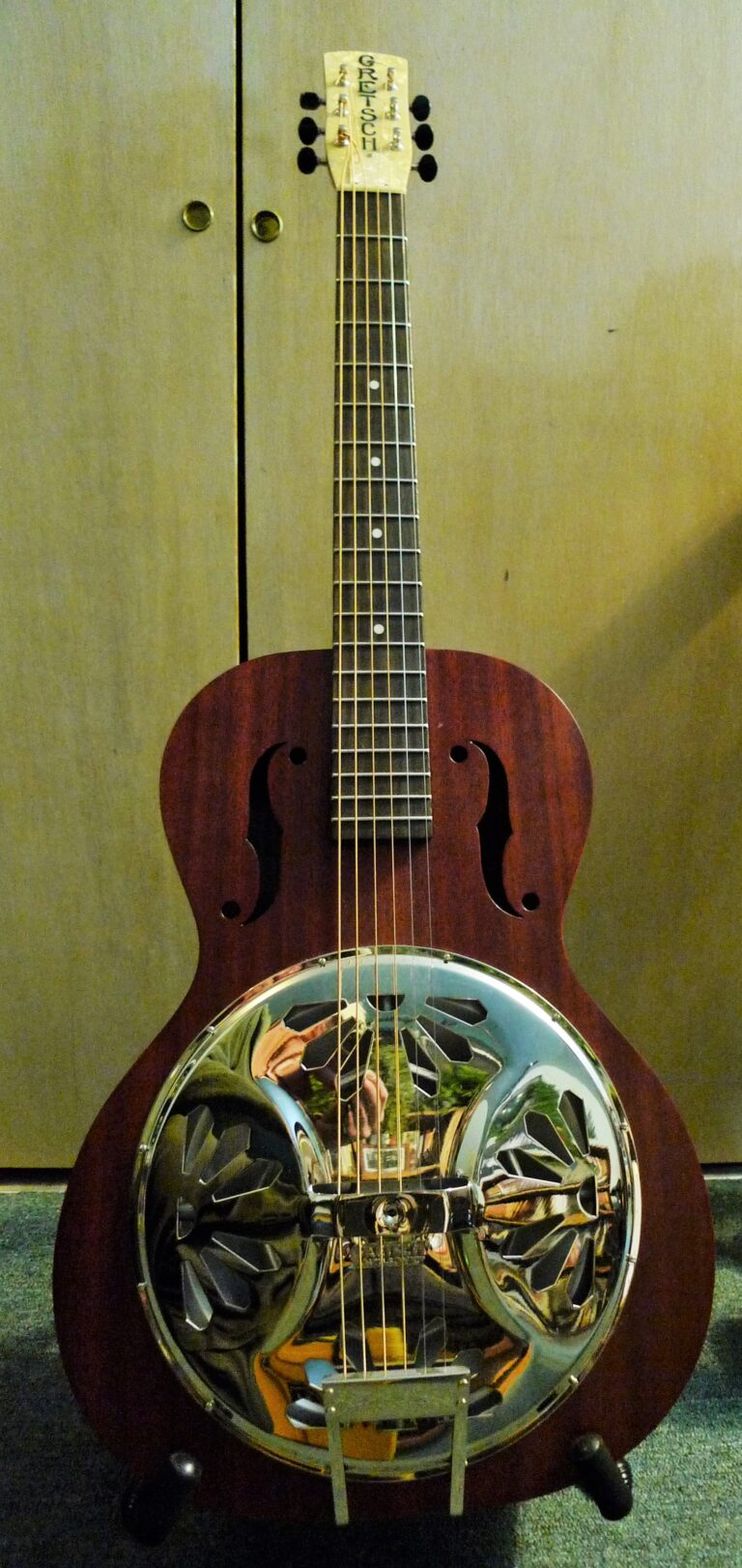
If the appeal here is pre-war blues, it is worth knowing where the alternative road goes. A Gretsch G9200 Boxcar or a Dobro Hound Dog Round Neck sits in similar territory at similar-to-somewhat-higher money and delivers the metallic bark a wooden parlour can only hint at, while the National Reso-Phonic Style O is the real thing at real-thing prices. Many players end up owning a cheap parlour and a resonator, because they do genuinely different jobs.
Buying guide
Which version. The plain acoustic RPS-7 is the value proposition — street pricing has commonly hovered around $200 depending on finish, against list prices in the $267–350 range. The RPS-7-E with the gold foil pickup typically lands nearer $500 street, which is a large premium for a passive soundhole pickup. If you want to amplify a Series 7 and the price gap holds where it has been, buying the acoustic and fitting an aftermarket soundhole pickup yourself is usually the better arithmetic. Buy the E version because you want that gold foil sound, not because you need amplification generally.
Which finish. Tobacco Sunburst is the period-correct choice and the one that makes the checkerboard purfling sing. Matte Black is the sleeper — it hides the whitewood entirely and looks considerably more expensive than it is. Revolution Green and Monarch Orange come and go by production run and are worth grabbing if you find one you like, because they are not always available.
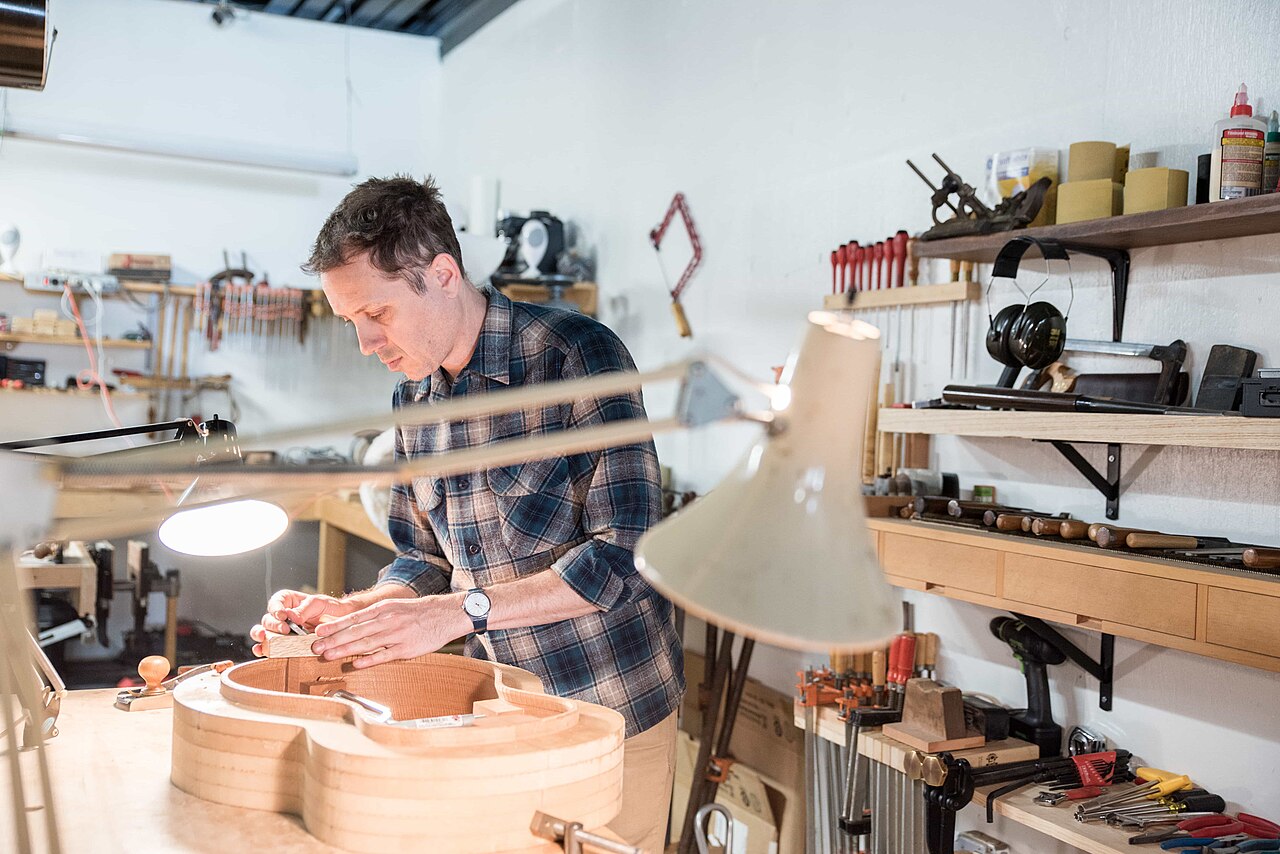
Check before you buy. At this price, unit-to-unit variation is the whole game. In order of importance: neck relief and action at the twelfth fret (a dovetail neck joint is expensive to reset, so a badly angled neck is a dealbreaker rather than a setup job); fret ends, which are the usual weak point on inexpensive imports; whether the bone saddle sits flat and fully seated in its slot; and the seam where the top binding meets at the tail. Play every open string at every fret listening for buzz. If the shop has two, play both — the difference between a good and a mediocre example of this model is larger than the difference between two examples of a guitar costing five times as much.
Budget for a setup. Add $60–100 for a proper setup by someone competent and this guitar transforms. It is the single highest-return money you can spend on it, and it is effectively mandatory. Factory setups at this price point are shipping tolerances, not musical decisions.
Living with one
Humidity. A solid spruce top on a thin, cheap build is more vulnerable than an expensive one, not less — there is less finish, less mass and less margin. Keep it between 40 and 55 percent relative humidity. A cracked top on a $200 guitar is an economic write-off in a way it would not be on a $2,000 one, so the case humidifier is not optional if you live somewhere with real winters.
Strings. The long scale plus small body combination means gauge choice matters more than usual. Light .012s bring out the volume and the bark; custom light .011s make it far more comfortable and lose surprisingly little. Anything heavier than .012s on a guitar this lightly built is asking for bridge and top trouble over time. Phosphor bronze suits it; 80/20 bronze pushes an already-bright, already-dry guitar into harshness.
The bridge. The straight, non-belly bridge is period-correct and slightly less structurally robust than a modern belly bridge under sustained tension. Combined with a light top, this is another argument for staying at or below light gauge. Check the bridge-to-top glue line once a year with a torch and a mirror.
Resale. There is essentially none, and that is liberating rather than depressing. This is a guitar you can take to a campfire, leave in a rehearsal room, hand to a beginner, take on a boat, or refinish on a whim. The freedom to not care is worth something, and expensive guitars cannot give it to you.
Modification. It is a superb modding platform for exactly that reason. A soundhole pickup, a bone bridge-pin swap, a slotted saddle, a different nut, a Nashville-tuned string set, a full open-tuning conversion with a raised nut — all of it is reversible, none of it risks meaningful money, and all of it teaches you something.
Frequently asked questions
Is the Recording King Dirty 30s Series 7 Single 0 all solid wood?
No. The top is spruce and the back and sides are “whitewood,” a trade term for inexpensive pale hardwood, usually poplar or a similar utility timber. Recording King does not describe the top as solid on the Series 7 specification sheets, and at this price point you should assume you are buying construction quality and voicing rather than premium tonewoods.
What does “Single 0” mean?
It is the smallest of the traditional Martin-derived body sizes — smaller than a 00 or 000. On this model it is combined with a twelve-fret neck joint, which moves the bridge further toward the centre of the lower bout and produces the characteristic short, boxy, midrange-forward voice associated with pre-war parlour guitars.
Did John Fahey play this guitar?
No. Fahey played a 1939 Ray Whitley Recording King, a Brazilian rosewood flat-top jumbo built by Gibson for Montgomery Ward in a single production year. It shares a brand name with the Series 7 and nothing else. That instrument was destroyed and later painstakingly restored by luthier Fred Sheppard.
Is the neck mahogany or nato?
Recording King’s own product page for the Series 7 with pickup specifies mahogany, while several major retailer listings for the same family specify nato. Both are likely accurate for different production runs — substitution of this kind is routine at this price. Check the actual instrument if it matters to you.
What is “Cross Lap” bracing?
It is Recording King’s term for its X-bracing execution, using Sitka spruce braces, and the company emphasises the cleanliness of the joinery where the braces cross. It is not a fundamentally different bracing architecture from a standard X pattern — it is a description of build quality within a conventional design rather than a new structural concept.
Is the long 25.4-inch scale a problem on such a small body?
The opposite — it is the model’s best design decision. Long scale on a small box raises string tension, which sharpens attack and improves note definition and pitch stability. It is the main reason the Series 7 does not feel or sound flimsy the way many cheap short-scale parlours do. The trade-off is that a given string gauge feels stiffer than it would on a short-scale instrument.
Should I buy the RPS-7-E with the gold foil pickup?
Only if you specifically want the gold foil sound — a passive, midrange-heavy, faintly electric tone that suits vintage blues and lo-fi recording and does not attempt to reproduce a natural acoustic voice. For general amplification, the price gap between the acoustic and electric versions has typically been large enough that buying the plain RPS-7 and adding an aftermarket soundhole pickup makes more financial sense.
Is it a good first guitar?
Not really, and that is not a criticism. A dreadnought like the Yamaha FG800 is more versatile, louder and better suited to learning a broad range of material. The Series 7 is a character instrument — an excellent second guitar, an excellent recording tool, and an excellent way to understand pre-war fingerstyle and slide playing on their own terms.
How much should I expect to pay?
List prices for the acoustic versions have run roughly $267 to $350 depending on finish, with street pricing commonly landing near $200. The acoustic-electric versions have listed closer to $500 street. Prices move with run and retailer, so treat these as a sighting range rather than a fixed figure, and factor in $60–100 for the setup that this guitar genuinely needs.
Image credits
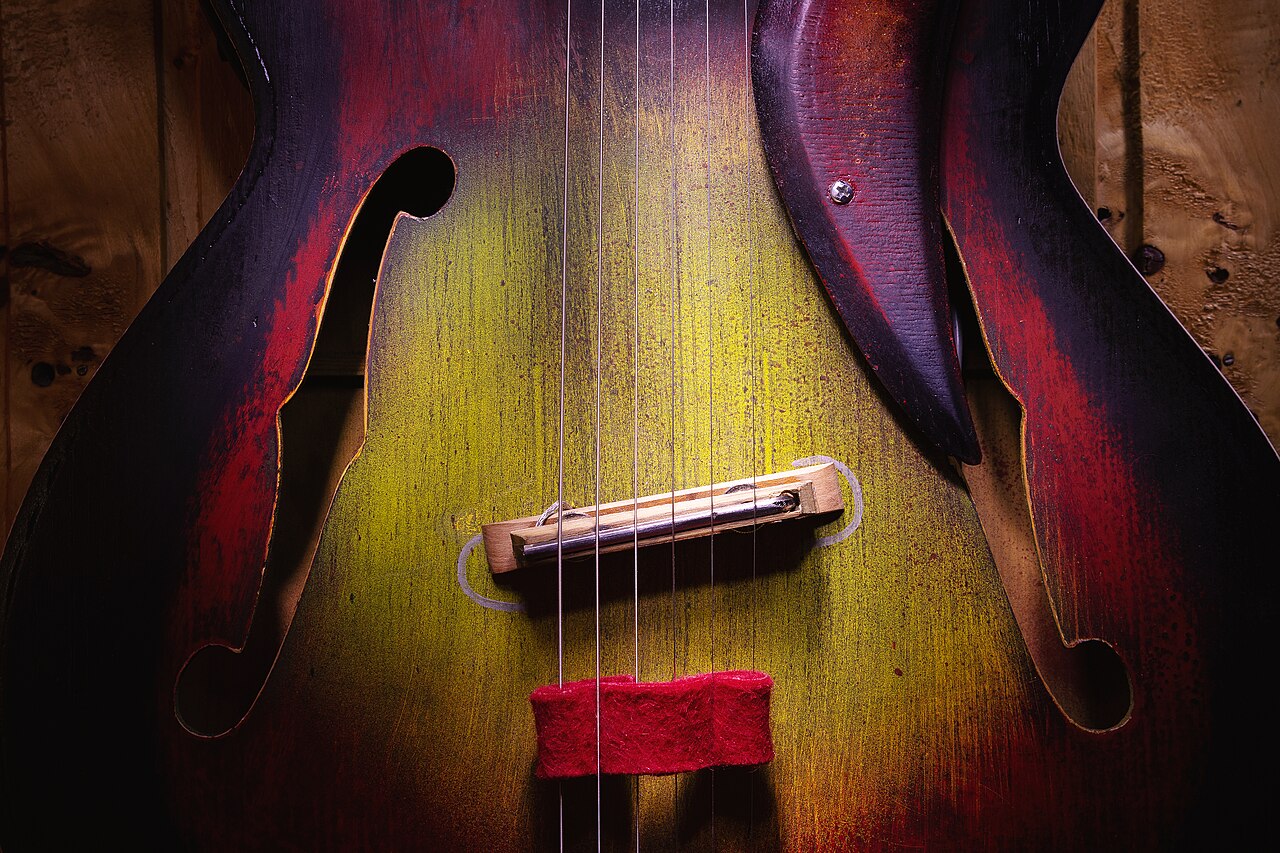
- The body of a colourful archtop guitar: Dejan Krsmanovic, Wikimedia Commons, CC BY 2.0.
- A luthier working at a bench in a workshop: Christian Ericksen, Wikimedia Commons, CC BY-SA 4.0.
- The body of an archtop guitar with a colourful finish: Dejan Krsmanovic, Wikimedia Commons, CC BY 2.0.
Latest News
Related

On This Day
Tuesday 10 November
From this week: