Eight Circuits, One Box: The Mesa/Boogie Triaxis Was the Ultimate Boogie in 1U of Rack Space
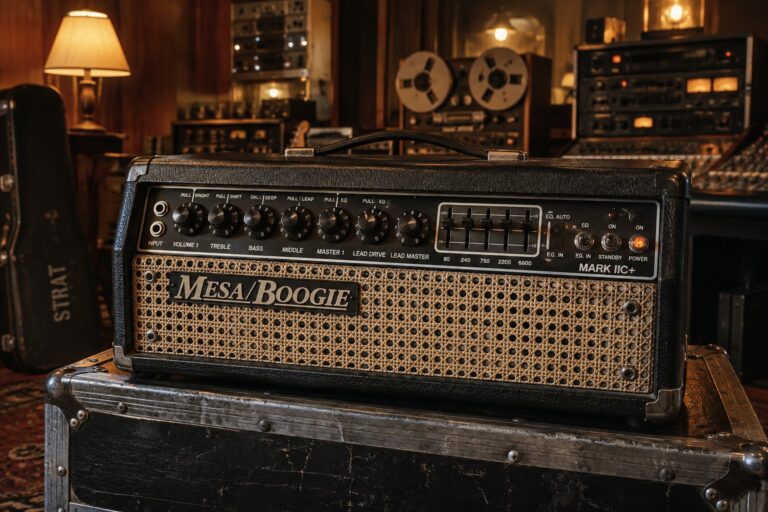
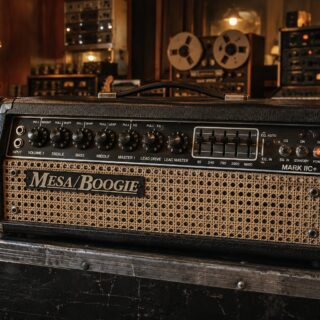
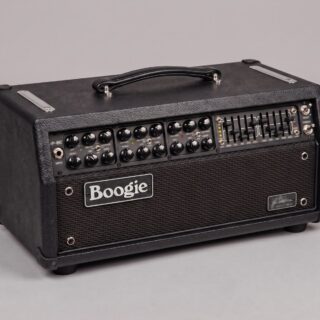
Reference illustration of the model, not a photograph of the player’s equipment.
Eight classic Boogie circuits in one 1U rack preamp. The Mesa/Boogie Triaxis defined the '90s touring rig — Hetfield, Petrucci, specs, settings, buying guide.
In 1991, Randall Smith had already built some of the most influential guitar amplifiers of the 20th century. The Mark I created the high-gain template. The Mark IIC+ defined the sound of a generation of arena metal. The Mark III and IV refined the formula. But every time a touring guitarist wanted two different Boogie sounds in one night, they had to cart two heads, two switching rigs, and hope the guitar tech had a PhD in signal routing.
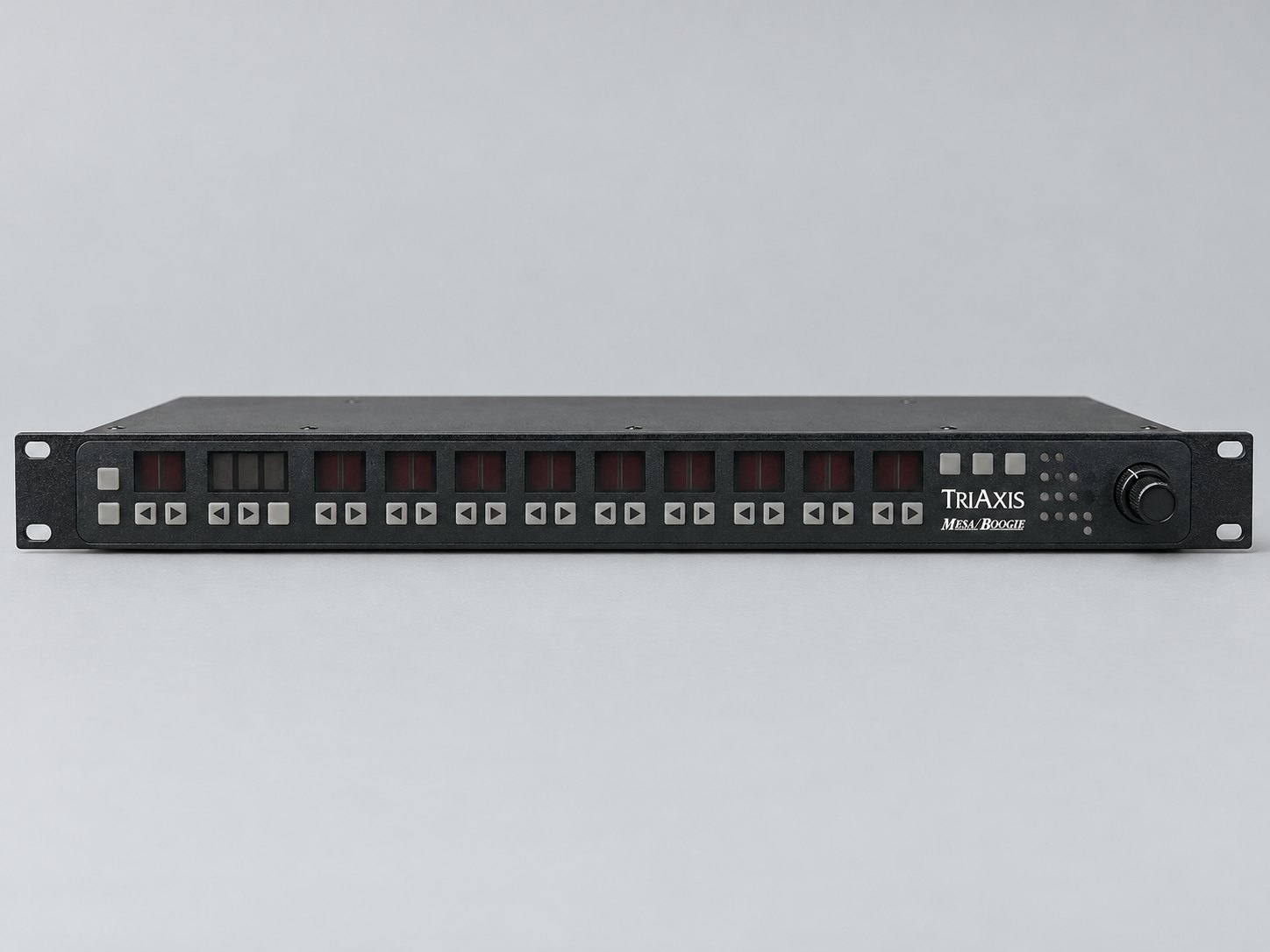
The TriAxis Programmable Pre-Amp was Smith’s answer. Announced in October 1991 and built in Mesa’s Petaluma, California workshop, it distilled eight distinct Mark-series preamp circuits into a single 1U rack module, controlled entirely by MIDI. One box. One rack space. Every clean, crunch, and searing lead tone the Mark lineage had ever produced, recalled in under a millisecond. For a solid decade, the Triaxis was the gold standard of the professional touring rack rig — the box you’d find in the gear of Dream Theater, Metallica, and virtually every working shredder who could afford one.
It is now discontinued, and finding a used example in good shape requires patience and an understanding of which serial number ranges to target. But for players who want the full breadth of Boogie tone in a MIDI-programmable format — and who understand what a rack rig actually demands — the Triaxis remains one of the most coherent pieces of guitar electronics ever made.
Origin: The Encyclopedia of Boogie Tone
To understand what the Triaxis was trying to do, you need to understand the problem it was solving. By the late 1980s, touring guitarists had discovered the rack rig. A preamp, a stereo power amp, an effects processor, and a MIDI controller living in a road case could theoretically replace a wall of heads and provide instant recall of any sound on any song. The trouble was that every preamp in a rack rig was a single instrument: it had one voice, one personality, one circuit topology. If you wanted a Mark IIC+ lead sound and a Mark I clean sound in the same performance, you needed two preamps — or you needed Mesa to build you a single unit that housed both.
That is precisely what the Triaxis became. Smith and his team reverse-engineered the most distinctive-sounding circuits from across the entire Mark lineage and baked them into a 5-tube preamp stage with fully programmable controls. Eight modes spread across three channels — RHY (Rhythm), LD1 (Lead 1), LD2 (Lead 2) — covered clean, crunch, and high-gain territory simultaneously. No pedals, no external switching between preamps, no audio signal degradation from an A/B box. Just MIDI program change and you were there.
The Triaxis launched in 1991 alongside — and was explicitly designed to pair with — the Stereo Simul-Class 2:Ninety power amp. The 2:90 delivered 90 watts per side of Mesa’s Simul-Class topology: two 6L6 pairs running simultaneously in different operating classes, one in Class AB for headroom and punch, the other in Class A for warmth and harmonic richness. Together, the Triaxis and 2:90 became the canonical rack rig of the 1990s. That pairing is what you hear on a substantial fraction of the decade’s most celebrated hard rock and progressive metal recordings.
Specifications
The Eight Modes Decoded
The real architecture of the Triaxis lives in its eight mode voicings, each of which resurrects a specific circuit from Mesa history. Understanding what you’re actually getting in each mode clarifies both the instrument’s genius and its limits.
RHY: MK I Fat Clean is the closest thing the Triaxis has to a pure vintage Boogie clean. The original Mark I — built by Randall Smith in the late 1960s as a hot-rodded Fender Princeton in a custom cab — had a warm, complex clean with a particular organic warmth and a compressed mid-range that sat perfectly under a singing lead. This mode captures that quality: bloom, sustain, and just enough harmonic presence to make chords ring rather than merely play. It is the warmest, most musical clean on the unit.

RHY: MK IV Hyper Clean is a crisper, more defined clean derived from the Mark IV’s more refined circuitry. Where the MK I Fat Clean has compression and body, the MK IV Hyper Clean has headroom and articulation. It handles a wide input dynamic range and translates detailed picking attack rather than smoothing it over. This is the clean mode for players who want to hear every string separately.
LD1: MK I Lead is the Triaxis’s softest gain stage — the overdriven character of the early Mark I preamp, warm and vocal with a midrange focus that pushes through a dense band mix. Lower gain than later Mark circuits, more compressed, more sensitive to pick attack. Blues and classic rock territory.
LD1: MK I Gain Boost is the MK I Lead circuit with additional gain on tap, deepening the saturation while retaining the topology’s warm, mid-forward character. Think of it as the difference between a Mark I pushed gently and the same amp cranked.
LD1: Classic Brit Lead is the Triaxis’s one departure from pure Mesa circuit genealogy — a modified British-voiced lead mode designed to approximate the character of Marshall-style high gain: tighter bass, more presence, less of the compressed mid-focus that defines the American-voiced modes. It is the mode that lets the Triaxis serve as a credible single-box rig for players who move between American and British tonal territory.
LD2: MK IV OD is the Mark IV’s overdrive circuit — tighter, more scooped, and more aggressive than the LD1 modes. The Mark IV redesigned the gain architecture from the IIC+ with wider note separation and a more focused low end. This mode is cleaner-feeling at moderate gain, harder and more precise at higher settings.
LD2: MK IIC+ High Gain is the reason most players bought the Triaxis. The Mark IIC+, produced from approximately 1981 to 1986, is the single most coveted Mesa/Boogie circuit of all time — the preamp that powered the first three Metallica albums and influenced every tube preamp designer who came after it. Its high-gain mode is dense, harmonically saturated, with a singing compressed quality that sustains indefinitely and tracks fast picking with unusual precision. The original Mark IIC+ is now a five-figure collector’s item. The Triaxis’s LD2 IIC+ mode is the most accessible version of that circuit outside of the JP-2C reissue.
LD2: MK III High Gain is the Triaxis’s most aggressive stock mode — the Mark III’s lead circuit, which pushed gain further than the IIC+ in its time and introduced a harder, more contemporary attack. Less compressed than the IIC+, more present in the high-mids, slightly more polarising in character. The Mark III Simul-Class was the transitional amplifier between the IIC+ and the Mark IV, and its inclusion here rounds out the genealogy.
Version History: V1, V2, and the Fat Mod
Because the Triaxis was in production for over a decade, there are meaningful differences between units depending on serial number and firmware version. Understanding them matters if you are buying used.
Version 1.0 firmware — fitted to early units — handles MIDI program change messages only, allowing 90 presets to be mapped to 128 MIDI addresses. What it cannot do is respond to MIDI Continuous Controller messages in real time, meaning you cannot use a MIDI expression pedal to morph a parameter (say, gain) between two stored values while playing.
Version 2.0 firmware added full MIDI CC support, enabling real-time parameter morphing via expression pedal or footswitch. This is the version that serious touring players wanted, and it opened up performance possibilities that V1.0 hardware simply could not match. Within the V2.0 hardware revision, there was a further sub-variant: V2.01 added what the user community calls the “Fat mod” to the LD1 Red mode only — a component-level change that thickened the low-mid response in that specific mode. Units with the Fat mod ran from approximately serial numbers 5,000 to 8,279.
In October 2004, Mesa discontinued the Recto-voiced board that had been part of certain V2 units due to unavailability of specific components. The Triaxis was eventually discontinued entirely, with no direct successor. The JP-2C (launched 2016) addressed the IIC+ circuit specifically and is covered in its own article; it is a complete amplifier, not a rack preamp, and was built for a single specific circuit topology rather than the Triaxis’s multi-circuit approach.
For used buyers: a V2.0 unit with the Fat mod and a verifiable service history is the target. Avoid units with “pops, clicks, or stuttering patch changes” — a common symptom of ageing MIDI hardware that may require the original Mesa Triaxis CPU board, which is no longer manufactured. Budget for a tube refresh if the seller cannot confirm when the 12AX7s were last replaced.
Famous Players: Who Actually Used the Triaxis
John Petrucci — Verified, Extensively
John Petrucci of Dream Theater is the Triaxis’s most publicly documented player across the longest timespan. His relationship with the unit began at the “Images and Words” tour in 1992 — the same year the album was recorded — and continued uninterrupted through the “Along for the Ride” tour in 2014. That is more than two decades of professional live use, documented in Premier Guitar rig rundowns, Mesa’s own Amplitudes blog video series, and multiple published signal-chain diagrams.
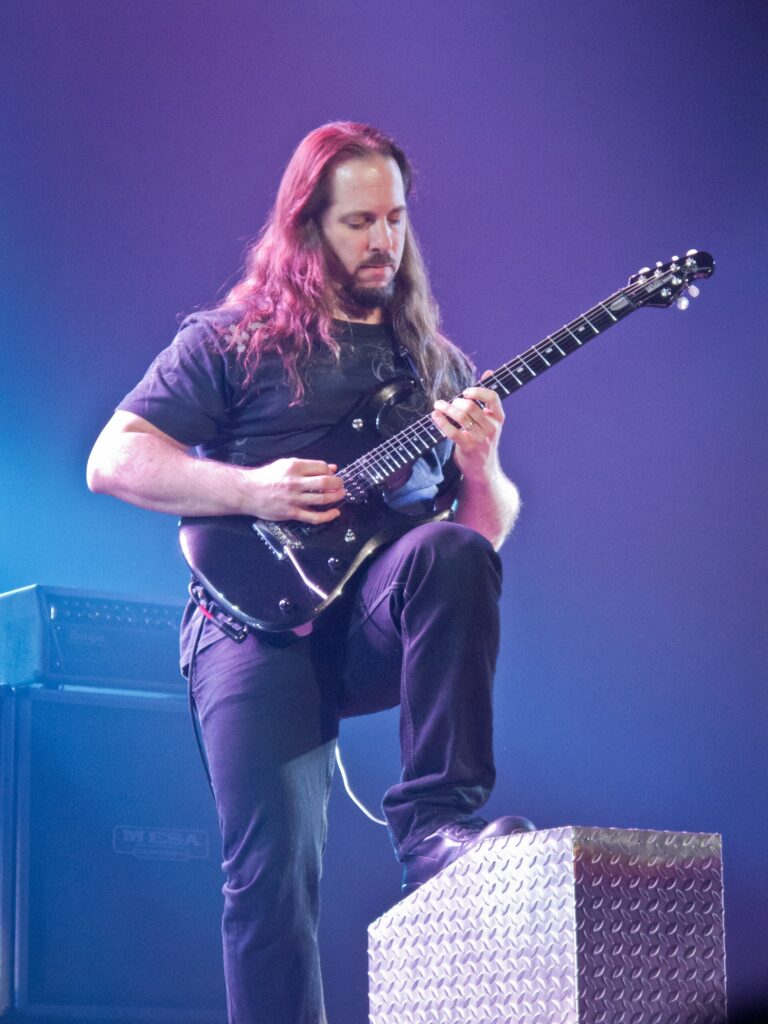
His 2014 touring rig, documented by Mesa themselves, placed the Triaxis at the front of a chain that ran: guitar → A/B switcher → Dunlop Crybaby rack wah → pedal effects drawer → Triaxis → Mesa Five-Band Graphic EQ (in the FX loop) → back to Triaxis → Axe-FX II (for modulation, delays, reverb) → Stereo Simul-Class 2:90 power amp → two Mesa Rectifier 1×12 and two Mini Rectifier 1×12 cabinets, dual-miked with a Shure SM57 and a Shure KSM313 ribbon mic. The whole rig was controlled by an RJM GT22 master MIDI controller.
In 2016, Petrucci’s relationship with the Triaxis architecture was effectively formalised by Mesa in the JP-2C signature head — a standalone amplifier built around the IIC+ circuit specifically, with the programmability and switching features Petrucci had been building into rack rigs for years. The JP-2C is his current touring amp. The Triaxis is its direct conceptual ancestor in Petrucci’s rig history.
James Hetfield and Metallica — Verified, Definitively
James Hetfield‘s Triaxis rig is one of the most thoroughly documented guitar signal chains in rock history, because Metallica’s crew is meticulous and the band had been with Mesa since the Mark IIC+ era of the early 1980s.
The configuration he used for the better part of the 1990s and into the 2000s was two Triaxis preamps — simultaneously, running into the same power section. One Triaxis was set to LD2 Yellow mode (the MK IIC+ High Gain circuit) for his rhythm and lead heavy tones. The second Triaxis was set to RHY MK I Fat Clean for the cleaner passages. Mesa built him a custom unit housing two 5-band graphic EQs — one for each Triaxis — installed at the FX return of each preamp. The power section was the Mesa/Boogie Strategy 400 stereo power amp during the Load and Reload era, providing 200 watts per side of all-tube power. The signal ran out into Marshall cabinets loaded with Vintage speakers.
Mesa’s own Amplitudes blog confirmed this in a 2011 piece documenting Metallica’s live rigs: “Two Triaxis Preamps run into a 2:90 Power amp. One Triaxis is set to the Mark IIC+ mode while the second Triaxis is used for clean sounds in the Green Clean mode.” That post described a rig that had “been delivering the band’s live sound for over 15 years” — placing Hetfield’s adoption of the Triaxis back to approximately the Black Album touring cycle, 1991–1993, which aligns with the preamp’s launch date.
This is unambiguous. The Hetfield Triaxis tone — dense, controlled, articulate under the fastest downpicking rhythms, with a characteristic controlled low-end tightness that distinguishes it from looser Rectifier tones — is among the most recognisable guitar timbres in heavy music. If you have heard Load, Reload, Garage Inc., or any Metallica live show from the 1990s through the mid-2000s, you have heard the Triaxis.
Carlos Santana — The Circuit Reference, Not the Player
The relationship between Carlos Santana and the Triaxis is indirect but historically significant.
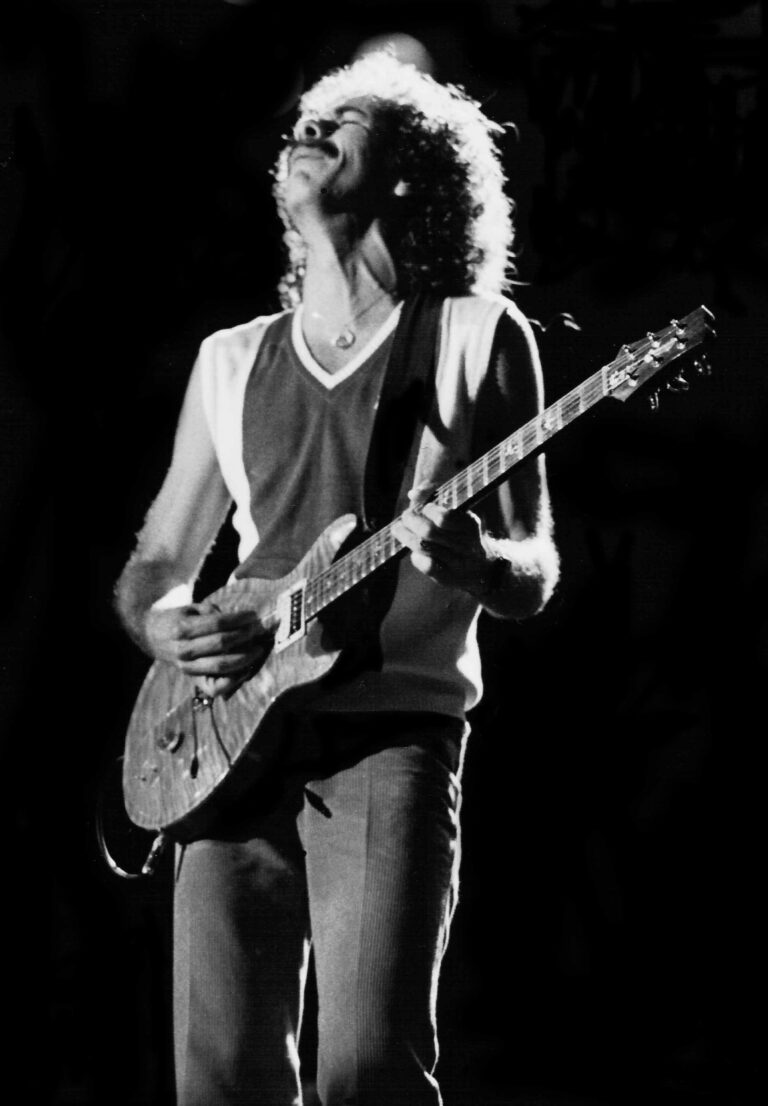
The Triaxis’s MK I Fat Clean and MK I Lead modes trace their circuit architecture directly to the original Mark I amplifier that Randall Smith built in a Fender Princeton chassis in the late 1960s. Smith’s first customer for that amp — the instrument that became the founding product of Mesa/Boogie — was Carlos Santana. Santana played a modified Princeton combo at the Fillmore West in 1969, generating a sound so distinctive that word spread through the San Francisco music community immediately. The “Santana sound” — warm sustain, liquid mid-range, singing tone at controlled volumes — is essentially the character of that early Mark I circuit.
The MK I modes in the Triaxis therefore carry Santana’s DNA in their circuit topology. But Santana himself does not use the Triaxis. His current live rig, documented in Premier Guitar rundowns, is built around a ’70s snakeskin-covered 100-watt Mesa Mark I combo, a pair of Dumble Overdrive Reverbs, and Bludotone Universal Tone heads. He is a vintage-amp player who stays close to the source material. The Triaxis is how other players access the character of the instrument Santana defined — not the instrument Santana plays.
Larry Carlton — The Same Arc, A Different Channel
The logic for Larry Carlton follows exactly the same pattern. Carlton’s defining guitar tone — the sound of “Room 335,” “Neon Sign,” and the Fourplay years — came from a Mark I combo at Studio 55 West Cahuenga Place in Hollywood. His is perhaps the single most influential use of the original Mark I in jazz-fusion and smooth jazz history, and his association with Mesa/Boogie is deep and long-documented.
But Carlton moved away from Mark amps through the 1980s toward Dumble amplifiers, which became his primary voice. He has no documented use of the Triaxis or any rack preamp system. Including him in a Triaxis player roster is the same category error as including Santana: the MK I modes in the preamp are where his influence lives, not his hands.
Andy Timmons — No Primary Source
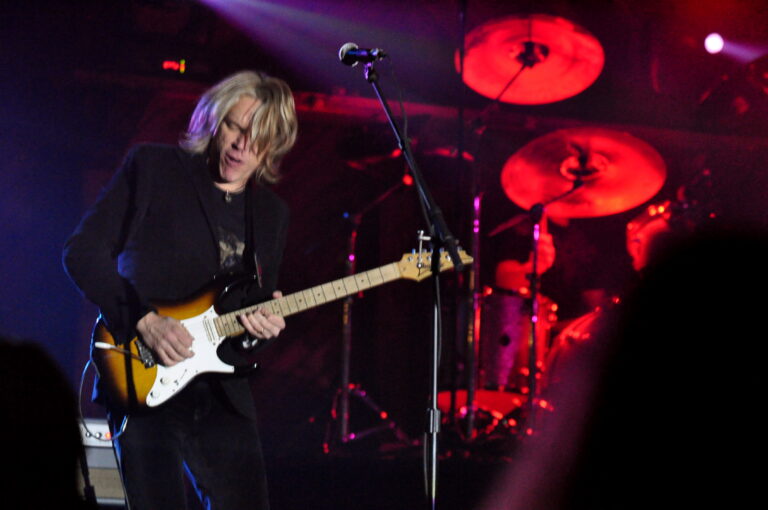
Andy Timmons is a superb guitarist with a long relationship with Mesa/Boogie, but his documented rig centres on the Lone Star and Stiletto head formats — not rack preamps. No primary source — manufacturer feature, Premier Guitar rundown, Equipboard entry, or interview — places him on a Triaxis at any professional stage. He is a case of plausible association that cannot be confirmed and so is not asserted here.
Tone Recipes and Settings
Recipe 1: Hetfield IIC+ Rhythm (LD2 MK IIC+ High Gain)
This is the most studied setting in the Triaxis user community, and it starts with the mode selection. Set LD2 to MK IIC+ High Gain. Gain between 7 and 8 — Hetfield’s downpicking articulation depends on controlled saturation rather than maximum gain. Treble around 6, Mid around 4–5 (the IIC+ mode has a natural mid presence that doesn’t need reinforcement), Bass around 5. Presence at 4. If you have a 5-band graphic EQ in the FX loop — and you should — pull slightly at 250Hz for tightness and add a dB or two at 2kHz for cutting articulation. Run the power section hard: this mode needs the power amp working into the circuit to bloom correctly. Marshall cabs with Celestion Vintage 30s will get you closer to the original reference than Mesa cabs.
Recipe 2: Petrucci Progressive Lead (LD2 MK IIC+ or MK IV OD)
For the singing, sustaining lead tone associated with “Pull Me Under” and “Learning to Live,” start on LD2 MK IIC+ High Gain with gain at 7–7.5. Add a volume boost via the FX loop or an outboard pedal — Petrucci used a Tone-Burst and Flux Drive in series for lead volume and additional harmonic saturation. Presence at 5, Treble at 5.5, Mid at 5, Bass at 4.5. The key is the gate: use a noise gate with a medium threshold after the preamp to clean up between phrases. The IIC+ mode sustains generously enough that the gate will not kill your sustain on held notes but will silence the signal during rests.
Recipe 3: MK I Clean (RHY MK I Fat Clean)
This is the Triaxis at its most organic. Gain just into overdrive at 2.5–3, Treble at 5, Mid at 6 (let the mode’s natural mid-push do the work), Bass at 5, Presence at 4. Volume up until the output level matches your lead channels. This mode benefits from a clean boost pedal or a light overdrive in front — think Ibanez TS9 at unity gain with tone at noon — to fill out the touch response and smooth the transient attack. Works beautifully for single-note lines in a blues or classic rock context.
Recipe 4: Classic Brit Lead (LD1 Classic Brit Lead)
The Triaxis’s one British-voiced mode rewards a different EQ philosophy than the American circuits. Gain at 6, Treble at 6.5 (British circuits want more top-end presence), Mid at 4.5 (slight scoop relative to American modes), Bass at 5, Presence at 5.5–6. The character here is looser and more open than the IIC+ — less compression, more pick noise, a different sustain decay. For players who alternate between American and British tonality within a set, this mode is the bridge that makes the Triaxis a genuinely versatile unit rather than a pure Boogie machine.
Recipe 5: MK IV High Gain (LD2 MK IV OD)
The Mark IV OD mode is the Triaxis’s most articulate gain setting — tight, precise, with better string separation than the IIC+ at equivalent gain settings. Gain at 7–8 for modern metal territory. Treble at 5.5, Mid at 5, Bass at 5, Presence at 5. The Dynamic Voice EQ control is particularly effective in this mode: pull it back for a more scooped “modern Mesa” character, push it forward to bring the mids up for a thicker, more traditional rock voice. The original Mark IV sits at approximately 2–4kHz in its dominant frequency signature; let that guide your FX loop EQ decisions.
Comparisons with Other Rack and Amplifier Options
Mesa/Boogie Mark IIC+ (Standalone Head)
The original Mark IIC+ is definitively better in its IIC+ voice than the Triaxis’s IIC+ mode — the interaction between a power amp and a single-channel preamp circuit that was designed as an integrated unit produces a coherence that a rack preamp extracting one mode from eight cannot fully replicate. But the original IIC+ will cost you four figures minimum, often five, requires finding a working vintage unit, and gives you exactly one circuit. The Triaxis gives you eight and costs a fraction of the price. If you have one sound and want it perfect, find an IIC+. If you need a touring tool that covers everything the IIC+ can do plus seven other stops, the Triaxis is the answer.
Mesa/Boogie Mark IV (Standalone Head)
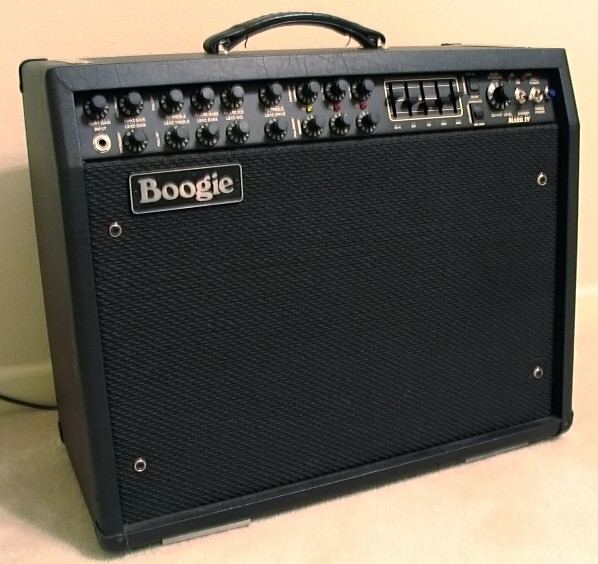
The Mark IV is a complete amplifier with its own power section, reverb, and a more coherent integrated circuit response than the Triaxis’s MK IV modes. Where the Mark IV is the definitive version of that voice, the Triaxis’s MK IV modes are useful approximations. For players who primarily want the Mark IV character with programmability layered on top, the Triaxis is a reasonable compromise. For players who want only the Mark IV sound and want it done as well as it can be done, buy the head.
Mesa/Boogie Dual Rectifier Solo Head
The Dual Rectifier is what most players reach for when they want high-gain Mesa tone today, and for good reason: it is still in production, widely serviced, and its sound has defined two decades of heavy music in its own right. But it has none of the programmability, none of the multi-circuit architecture, and — crucially — none of the IIC+ character. The Rectifier and the Triaxis/IIC+ are adjacent products from the same company with fundamentally different circuit philosophies and sonic personalities. A Dual Rectifier player chasing the Triaxis IIC+ tone will be disappointed; a Triaxis player looking for Rectifier character can approximate it via the Brit Lead mode but will never quite arrive.
Mesa/Boogie JP-2C (Signature Head)
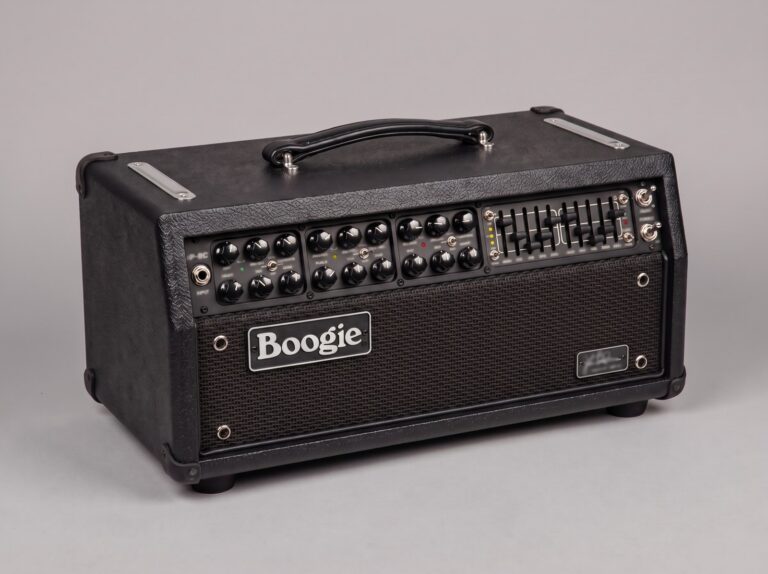
The JP-2C is what happens when you take the Triaxis’s most celebrated circuit — the IIC+ High Gain mode — and build an entire dedicated amplifier around it, adding dual 5-band graphic EQs, a CabClone DI, and all-tube reverb. Where the Triaxis offers eight circuits and one IIC+ mode among them, the JP-2C offers three channels all voiced in the IIC+ flavour. For players who need only IIC+ tones with professional-grade switching, the JP-2C is the superior instrument. The Triaxis is still the right choice for players who need the full Mark family sweep in one unit.
Line 6 Helix / Fractal Axe-FX III
The modern modelling argument is straightforward: a Fractal Axe-FX III models all eight Triaxis circuits with adjustable accuracy, adds hundreds of other amp models, weighs less, costs less than a good used Triaxis, and requires no tube maintenance. Many professional touring players — including Petrucci himself in later years — run Axe-FX units parallel to or in place of physical rack preamps. If you need the Triaxis character for live or studio work and are not committed to all-tube signal chains, a high-end modeller is a rational alternative. If you need the actual physics of tubes interacting with transformers in real time, the Triaxis remains unrepresented by digital means in any way that the players in its lineage universally accept.
Buying Guide: Finding a Triaxis in 2026
The Triaxis has been out of production long enough that the used market has stabilised, and prices reflect its cult status among vintage rack collectors and working professionals who refuse to give up their analogue signal chains. Expect to pay $800–$1,400 for a fully functional example in good cosmetic condition, depending on version and provenance. Units with documented service history and confirmed V2.0 firmware command the upper range; early V1.0 units in unclear condition can be found closer to $600–$700, but verify firmware and hardware before committing.
What to check before buying: pull the tubes and inspect for oxidation or signs of heat damage on the PCB near the tube sockets. Ask for a demo through all eight modes — a Triaxis with failing preamp tubes will produce audibly inconsistent output levels between modes. Test every MIDI preset slot: patch change glitches are early signs of CPU board deterioration. Check the 4-pin Smart Power trigger jacks for bent pins (cosmetic damage often indicates rough handling). Confirm the output level of the Live and Record outputs is balanced with a simple multimeter check or by monitoring both output pairs simultaneously.

Regarding version identification: the firmware version appears on a sticker on the chassis rear. Serial numbers are stamped on a plate on the back panel. The Fat mod in LD1 Red — if present — is audible by comparison: without it, LD1 Red has a slightly thinner low-mid character; with it, the mode thickens noticeably when the gain is set above 6. There is no definitive external visual indicator, so trust your ears or source a forum reference recording for comparison.
Ownership Notes: What Rack Life Demands
The Triaxis is not a plug-and-play amplifier. It is a preamp, which means it requires a power section before it can drive a speaker cabinet. The canonical choice remains the Mesa Stereo Simul-Class 2:90 power amp — two rack spaces, 90 watts per side, Simul-Class topology with 4× 6L6 power tubes. Other Mesa power amps (the Strategy 400, the 2:50 Plus) have been used successfully by various professionals. Non-Mesa power amps work but may require level-matching adjustment at the Triaxis output controls, and the Smart Power Trigger functionality is natively supported only by Mesa power sections.
A complete 2-rack-space touring or studio rig (Triaxis + 2:90) occupies 3U, weighs approximately 45 lbs combined, and requires a 4U case minimum when cabling, power conditioning, and a MIDI controller are added. A practical touring build runs 6–8U to accommodate a noise gate, FX processor, and channel strip, and that rack is going on a dolly regardless of how physically fit you are. This is the engineering trade-off of the rack rig era: unlimited programmability in exchange for a back injury on load-in day.
Tube maintenance on the Triaxis involves five 12AX7 preamp tubes — a straightforward swap available from Mesa directly or any major tube supplier. Re-tubing requires no bias adjustment (the preamp section is fixed-bias by design). Replace all five as a matched set if any shows signs of wear; mismatched 12AX7 tubes produce the mode-to-mode output variance that makes A/B comparisons unreliable. The nominal service interval for preamp tubes under heavy use is approximately two to three years.
MIDI setup requires a controller that sends both Program Change and, for V2.0 units, Continuous Controller messages. Mesa’s proprietary MIDI footcontroller is long discontinued; the RJM Music Technology GT22 (used by Petrucci) and the Fractal Audio MFC-101 are the current professional-grade options. Entry-level MIDI controllers from Behringer or Boss’s MIDI series work for basic program switching and are adequate for players who do not need real-time CC morphing.
The Triaxis in the Studio
The Record output — a separate stereo pair independent of the Live outputs — makes the Triaxis genuinely studio-friendly. Running the Record outputs directly into a DAW bypasses the power amp and cabinet entirely, which loses some of the power-amp interaction that defines the live sound but provides a clean, consistent recorded signal suitable for amp simulation re-amping or DI recording. The Dynamic Voice EQ control shapes the recorded output’s tonal character in a way that a standard guitar DI cannot replicate, making the direct recording sound more organic than a bare preamp direct feed.
For the most accurate studio representation of the Triaxis’s live character, the correct approach is what Hetfield’s engineers have done: run the Triaxis live outputs into a power amp, drive a cabinet hard, and mic it with a combination of a dynamic close-mic (SM57 or equivalent) and a ribbon mic placed 6–8 inches back for room character. The Shure SM57 at the edge of the dust cap and a Royer R-121 or equivalent at 6–8 inches will capture the full frequency range of the circuit, including the low-mid thickness below 200Hz that a single close-mic typically misses.
Frequently Asked Questions
Is the Mesa/Boogie Triaxis still in production?
No. The Triaxis was discontinued, with the final revision changes occurring in October 2004 when a key component for the Recto-voiced board was no longer available. There is no current-production equivalent from Mesa. The JP-2C (launched 2016) addresses the IIC+ circuit specifically but is a complete amplifier head rather than a rack preamp, and it does not replicate the multi-circuit architecture of the Triaxis.
What power amp should I pair with the Triaxis?
Mesa’s Stereo Simul-Class 2:90 is the historically canonical partner — the two units were designed together and the Smart Power Trigger system in the Triaxis is native to Mesa power amps. The Strategy 400 was Hetfield’s choice for the Load/Reload era. Other Mesa power amps, including the 50/50 and 2:50 Plus, work well. Non-Mesa solid-state power amps can work but change the character of the output significantly; the all-tube character of the Triaxis’s preamp stages is best served by an all-tube power section.
What is the difference between the Triaxis V1.0 and V2.0?
V1.0 firmware responds only to MIDI Program Change messages, enabling up to 128 stored presets. V2.0 adds MIDI Continuous Controller support, allowing real-time parameter morphing via expression pedal or footswitch during performance. V2.01 additionally introduced a hardware “Fat mod” to the LD1 Red mode that thickened its low-mid response. The firmware version is printed on a sticker on the rear chassis; serial numbers 5,000–8,279 approximately correspond to the Fat-mod V2.01 units.
What does the Dynamic Voice EQ do, and how is it different from a 5-band graphic EQ?
The Dynamic Voice EQ is a continuous control that sweeps through a range of pre-programmed frequency curves derived from Mesa’s own most-used 5-band graphic settings. Rather than providing discrete frequency sliders, it provides a single knob that morphs the EQ signature of the output from flat/neutral at one end to progressively more coloured curves at the other. It is a shortcut to “the most popular Boogie sounds” in a single parameter, but it does not replace the discrete control of a proper 5-band graphic EQ in the FX loop — both Hetfield and Petrucci used external 5-band EQs in addition to the Dynamic Voice control.
Did James Hetfield use the Triaxis on Metallica recordings?
The Load (1996) and Reload (1997) albums are the most clearly Triaxis-associated studio records, with the Strategy 400 power amp also documented as part of that era’s studio setup. The Black Album (1991) is borderline — the Triaxis launched in late 1991 and recording began earlier that year, so it is possible but not confirmed for that specific album. From Load onward through Garage Inc., S&M, and St. Anger (2003), the Triaxis and Strategy 400 are documented as his primary amplification.
Can I use the Triaxis with a single 1×12 cabinet for home use?
Yes, but the Live outputs expect a power amp input, not a speaker cabinet directly. You need a power amp (any tube or solid-state power amp will work at the level you need for home use) between the Triaxis output and your cabinet. Alternatively, run the Record outputs into a guitar cab simulator or directly into a DAW for silent practice. The Triaxis has no built-in speaker emulation or headphone output — it is strictly a preamp that requires an external power stage for any cabinet-driven use.
Is the Triaxis IIC+ mode as good as the original Mark IIC+?
Not exactly, but it is closer than any other commercially available option outside the JP-2C. The original IIC+ benefits from the complete interaction of its own transformer, power tubes, rectifier, and speaker — a system that was designed as a single integrated circuit. The Triaxis extracts the preamp portion of that circuit and pairs it with a separate power section, which changes the feel and response slightly. Most players describe the Triaxis IIC+ mode as having slightly less “bloom” and power-amp sag than a real IIC+ at similar volumes, but identical preamp tonal character. For live and studio work at professional levels, the difference is academic. For collectors and purists, it is not.
What MIDI controller should I use with the Triaxis?
For V1.0 units where only Program Change is needed, virtually any MIDI floorboard will work — Boss BCB-60 or Behringer FCB1010 at the entry level, RJM Music Technology PBC/6X or Fractal Audio MFC-101 at the professional end. For V2.0 units where CC morphing is part of the workflow, you need a controller with expression pedal inputs capable of transmitting CC messages on the correct channel — the RJM GT22 (Petrucci’s choice) and the Fractal MFC-101 both handle this cleanly. The Triaxis provides phantom power on its MIDI connector for footcontrollers that support it, which simplifies cable management.
Image credits
- Larry Carlton: Kenneth C. Zirkel, Wikimedia Commons, CC BY-SA 4.0.
- Carlos Santana: Heinrich Klaffs, Wikimedia Commons, CC BY-SA 2.0.
- Top image: GuitarGangsters AI-generated reference illustration, not a photograph.
- John Petrucci: Carlos Delgado, Wikimedia Commons, CC BY-SA 3.0.
- Carlos Santana: F. Antolín Hernandez, Wikimedia Commons, CC BY 2.0.
- Andy Timmons: Joe Bielawa from MInneapolis, USA, Wikimedia Commons, CC BY 2.0.
Latest News
Related

On This Day
Monday 9 November
From this week: