National Reso-Phonic Style O: The Guitar That Floated in the Sky and Sold Thirty Million Records
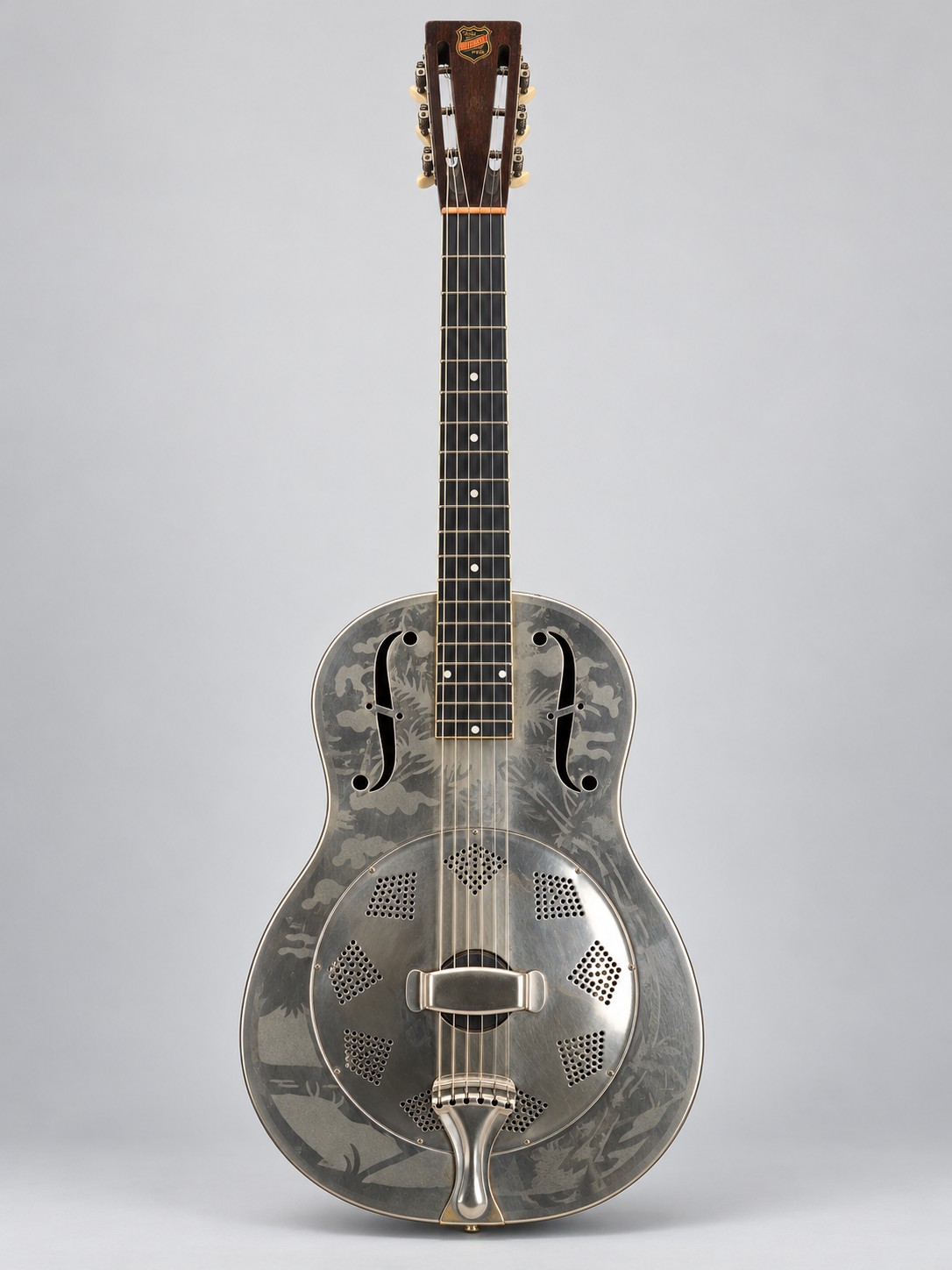
An AI-generated representative illustration of the 1930s National Style O single-cone resonator guitar with etched nickel body, made from reference photos of the model.
The National Reso-Phonic Style O: 1930 origins, brass-body specs, vintage dating, Mark Knopfler's Brothers in Arms guitar, tone recipes and buying advice.
There is a short list of guitars that people who do not play guitar can recognise on sight. A Stratocaster. A Les Paul. A Rickenbacker 4001 if they went to art school. And a shining nickel-plated metal box with palm trees etched into its shoulders and a perforated dinner plate where the soundhole should be — floating, weightless, against a bank of cloud on the cover of the best-selling British album of the 1980s.
That guitar is a National Style O. It has been in continuous cultural circulation since 1930, which makes it older than the electric guitar, older than the Telecaster by two decades, and older than nearly every instrument that people think of as “vintage.” It was designed to be loud in a world without amplification. It was marketed to Hawaiian players who never really wanted it. It was bought instead by Delta bluesmen who could not afford a tricone. And then, fifty-five years after its introduction, a British band put one on an album sleeve and turned a mid-priced Depression-era steel-string into a permanent icon.
Today you can walk into a dealer and order a new one, built by hand in San Luis Obispo, California, by a company that traces its knowledge directly back to the man who invented the resonator guitar. This is the story of that instrument — what it actually is, what it actually sounds like, who actually played one, and where the official record contradicts itself.
Before the Style O: How a Guitar Got a Loudspeaker Inside It
The resonator guitar exists because of a volume problem. In the mid-1920s, dance bands were getting bigger and brass sections were getting louder, and the guitar — a wood box with a hole in it — simply could not be heard. There was no amplification. There was no pickup worth the name. If you wanted more sound, you had to build more sound into the instrument itself.
The solution came from a Slovak-American immigrant named John Dopyera, working in Los Angeles, at the urging of the vaudeville musician and relentless promoter George Beauchamp, who wanted a guitar loud enough to sit inside a full orchestra. Dopyera’s answer was mechanical rather than electrical: put a set of thin spun-aluminium cones inside a metal body, connect them to the strings through a bridge, and let them work like the diaphragm of a loudspeaker running in reverse. String energy goes in, cone movement comes out, and the metal body radiates it.
The first instruments — the tricones, launched in 1927 — used three cones in a body of nickel-plated “German silver,” an alloy of copper, zinc and nickel that National used because it plated beautifully and rang sweetly. Style 1 was plain; Styles 2, 3 and 4 carried progressively more elaborate hand engraving, the Style 3 lily-of-the-valley pattern designed by John Dopyera and his wife Elizabeth, the Style 4 chrysanthemum designed by Beauchamp and privately considered by Dopyera to be actively harmful to the tone. With an endorsement from Sol Hoopii, the biggest Hawaiian guitarist of the day, the tricone made the hollow-neck Weissenborns and the converted Martins obsolete almost overnight.
Then National fell out with itself. Dopyera, the creative engine of the whole enterprise, left the company he had co-founded and started Dobro, which in 1928 introduced a single-cone resonator in a plywood body. One cone is cheaper than three. Plywood is cheaper than German silver. Dobro undercut the cheapest National by nearly 65 percent — $45 against $125 — and National had to answer.
It answered with the Triolian, a single-cone wood-body, in 1928; then moved the Triolian to a steel body in 1929; then added a cheaper steel-body sibling, the Duolian, in 1930. Now National had two ends of a market: steel-body single cones around $37.50 to $45, and German silver tricones from $125. Between those two numbers there was a canyon — in price and in sound. The Style O was built to fill it.
1930: Sixty-Five Dollars and a Brass Body
The Style O debuted in 1930 at $65. The first several hundred had nickel-plated steel bodies, but National changed almost immediately to bell brass, and that change is the whole point of the model.
Brass is denser and softer than steel. In a resonator body it does something specific: it rounds the leading edge off the attack and adds sustain and body without giving up the cut. A Duolian is harsh, barking and glorious in a very narrow way. A tricone is sweet, complex and slow to speak. The brass-bodied single cone lands deliberately between them — more musical than a Duolian, more direct and aggressive than a tricone. National’s own 1930 catalogue promised the model was “sure to win the admiration of everyone because of its beauty of design and marvelous tone quality,” and later advertising called it the company’s “best seller ever.”
For roughly half the price of the cheapest tricone, you got the same nickel shine, a genuinely distinctive voice, and a body decorated with the most recognisable graphic in the history of American fretted instruments: palm trees on the front, a canoe in a lagoon on the back. These scenes were not engraved. They were sandblasted — etched into the plating through a mask — which was substantially cheaper than hand engraving and which produced a completely different visual effect. Engraving is a line you can feel. Sandblast etching is a matte ghost that appears and disappears depending on where the light is. Under stage lights, a Style O appears to be breathing.
The Hawaiian Paradox
Here is the strangest fact about the most Hawaiian-looking guitar ever built: Hawaiian players did not want it.
National’s actual customer base in 1930 was overwhelmingly Hawaiian-style guitarists, and National had barely acknowledged them visually — a volcano decal on the front of a wood-body Triolian, a hula dancer on the back. The Style O corrected that oversight with total commitment, and then failed to serve the audience it was aimed at. Single-cone Nationals are not as well suited to Hawaiian lap playing as the sweeter, more complex tricones, or for that matter the wood-body Dobros. And the model was not even offered in a Hawaiian version, with a square wooden neck, until 1933 — three years after launch, on the most Hawaiian-themed instrument in the catalogue.
Worse, from National’s point of view, the entire Hawaiian market was about to evaporate. By the mid-1930s Hawaiian players abandoned acoustic guitars altogether in favour of electrics, with Sol Hoopii once again leading the exodus he had earlier led everyone into.
So the Style O found a different constituency, one with no relationship whatsoever to Hawaiian music: standard-style guitarists, and specifically bluesmen. Square-neck examples turn up occasionally, but the overwhelming majority of Style Os ever made are round-necks, played in the normal position, mostly with a slide, mostly by people playing music that had nothing to do with palm trees.
Specifications: The Current Production Style O
National Reso-Phonic builds the Style O today in two configurations — a 12-fret with a slotted headstock and a 14-fret with a solid peghead — plus a Deluxe engraving option and a range of finish and body-material choices. The core specification below is drawn from National’s own product pages.
| Specification | Style O (12-fret) | Style O-14 (14-fret) |
|---|---|---|
| Body material | Brass, nickel plated | Brass, nickel plated |
| Body finish | Bright nickel, sandblast Hawaiian etching | Bright nickel, sandblast Hawaiian etching |
| Resonator | Single spun aluminium cone, biscuit bridge | Single spun aluminium cone, biscuit bridge |
| Neck | Hard rock maple, sunburst finish | Hard rock maple, sunburst finish |
| Neck finish | Satin polyester | Satin polyester |
| Fingerboard | Ebony, ivoroid bound | Ebony, ivoroid bound |
| Headstock | Slotted | Solid peghead, ebony veneer |
| Tuners | National, vintage-style engraved | National, vintage-style engraved |
| Nut | Bone | Bone |
| Nut width | 1.82″ | 1.82″ |
| String spacing at bridge (E to E) | 2.31″ | 2.31″ |
| Scale length | 25″ | 25″ |
| Fingerboard radius | 16″ | 16″ |
| Body depth | 3.125″ | 3.125″ |
| Weight | 8 lbs 14 oz | 8 lbs 14 oz |
| Case | National Deluxe hardshell | National Deluxe hardshell |
| Options | 14-fret conversion, Deluxe engraving, Weathered Steel finish, steel body, no Hawaiian etching, National Slimline pickup, National Hotplate, Lollar P-90 | |
| Built | San Luis Obispo, California, USA | |
One Dimension Block, Two Different Guitars
Read that table again and something should bother you. National’s 14-fret page says, in its own marketing copy, that “the smaller, 14-fret body allows versatility and ease of access for reaching those higher notes.” A smaller body. And yet the dimensions block on the 14-fret page is character-for-character identical to the one on the 12-fret page: same 1.82″ nut, same 25″ scale, same 3.125″ depth, same 8 lbs 14 oz.
Both statements cannot be true. Moving the neck joint from the 12th to the 14th fret necessarily changes where the bridge sits on the body and, on the vintage originals, came with a genuinely different body outline. What has almost certainly happened is mundane: the dimensions block was copied from one page to the other and never revised. It is a documentation artefact — a manufacturer’s own website disagreeing with itself because a content management system made it easy to duplicate a table and hard to remember to edit it.
The practical advice that follows is simple and applies to any resonator purchase: the published weight and depth figures are indicative, not contractual. If body size matters to you — and on a nine-pound metal guitar it should — put a tape measure and a set of bathroom scales on the actual instrument before you buy it.
Dating a Vintage Style O: What Changed, and When
The Style O ran from 1930 to 1941, and in that time almost nothing about it stayed still. Popularity is the reason: the sandblasting templates wore out from use and had to be recut, and every recut produced a slightly different Hawaiian scene. Bob Brozman, in The History and Artistry of National Resonator Instruments — still the standard reference — documents five variations of the imagery on the original 12-fret body size and two more after the change to 14-fret necks. Palm trees appear, disappear and swap sides. Clouds fade. Stars in the sky thin out. The ripples in the lagoon change shape. At one point the canoe, along with the entire image, reverses direction.
The hardware moved too:
- Coverplate: the early “sieve hole” pattern grew four radiating ribs in 1932, and began switching to the “diamonds and arrows” pattern around 1935.
- F-holes: straight, flat-cut edges on guitars from 1930 to 1933; rolled-in edges from 1933 to 1941, which look smoother and are less likely to slice a forearm.
- Neck joint: 12-fret bodies 1930–1934, 14-fret bodies 1935–1941. George Gruhn puts the changeover in late 1934.
- Body material: nickel-plated steel for the first several hundred only; bell brass thereafter.
- Neck material: maple in a black-to-clear sunburst throughout, with some mahogany necks appearing after 1936.
- Serial numbers: all 12-fret models and the early 14-fret models carry an “S” prefix, running as high as 6205 — a prefix otherwise used only on the rare round-neck tricones. Later Style O numbers drop the prefix and are mixed in with other models, running into the 7000 range. Gruhn’s estimate from these numbers is that well over 5,000 Style Os were built.
Where the Two Authorities Disagree
If you are dating a specific instrument, be aware that the two best sources on this guitar do not tell the same story about its fingerboard, its inlays or its headstock.
George Gruhn, writing in Vintage Guitar, states that the fingerboard changed from “ebonized” — dyed black — maple to real ebony in 1936; that parallelogram fretboard inlays replaced pearl dots in 1937; and that the headstock received an ebonoid (black celluloid) veneer in 1937.
Brozman’s model breakdown, as reproduced by Guitar Village, says something noticeably different: ebonized maple fingerboard listed without an ebony changeover; slotted parallelogram markers after 1938 rather than 1937; and a four-stage headstock sequence of National decal 1930–1935, arced National logo in a wood overlay 1936–1937, black and white overlay 1939–1940, and a larger headstock with a black overlay and a metal logo 1940–1941.
Neither man is careless. Both are working from surviving instruments, and surviving instruments from a Depression-era factory that was constantly substituting materials and running down old parts bins do not sort themselves into tidy years. The honest conclusion is that Style O features overlap at the boundaries and that a single spec cannot date a guitar on its own. Use several features together, expect at least one of them to be “wrong,” and treat any dealer listing that gives a confident single year based on one detail with polite scepticism.
The Modern National: San Luis Obispo, California
The original National String Instrument Corporation did not survive the war. The name did, and so — remarkably — did the knowledge, through a direct human chain.
Don Young learned to build resonator guitars from John Dopyera himself. In 1989, according to National’s own account, Young and the design engineer McGregor Gaines founded National Reso-Phonic Guitars — Young the guitar man, Gaines the engineer — and ran the operation out of Young’s garage in Long Beach. In 1990 they moved north to California’s Central Coast, and the company has been in San Luis Obispo ever since.
A note on that date: a great many secondary sources, including reference works and retail copy, give the founding year as 1988. National’s own About page says 1989. This series’ standing rule applies — the manufacturer’s own current statement wins over aggregated secondary sources — but the discrepancy is common enough that you will see both numbers in print, and it is worth knowing which one came from the company.
The current owner is Jason Workman, who joined in early 1996 and who, under Don Young’s tutelage, took over the final quality check on every instrument in the mid-2000s. National today is nine or ten people, and the company names them publicly: Craig running the wood department and heading design and development after twenty-two years; Shanon in the office for twenty-one; Ryan supervising assembly and, with Workman, handling restoration of vintage Nationals and Dobros; Jim, nearly twenty years in, performing the setups the brand is known for; Willie hand-painting and finishing every neck; Glenn fretting and prepping necks; Olivia buttoning up guitars and prepping metal parts; Ethan building the metal bodies; Jordan fitting every neck for the last three years.
That level of specificity is unusual and it tells you something structural about the instrument. A metal-body resonator is not a wood guitar with a different skin. It is a sheet-metal fabrication, a plating job, a spun aluminium acoustic component and a wooden neck, and those are four different trades. National’s staffing reflects that: a body man, a plating and buffing operation, a neck fitter, a finisher, a setup specialist. It is the reason these guitars cost what they cost.
Famous Players — And What the Evidence Actually Supports
This is the section where a Style O article normally lists twenty blues legends and moves on. Most of that list does not survive checking, because in the 1930s a “National” could be any of eight or nine models at four price points, and photographs of men holding metal guitars have been captioned optimistically for ninety years.
Mark Knopfler — the one that is beyond dispute
Mark Knopfler‘s Style O is the reason most people under seventy know this instrument exists. The album is Brothers in Arms, released in 1985, and the cover is not a photograph of a band — it is nothing but a Style O suspended against a cloudscape. The record went to number one on the back of “Money for Nothing,” spent nine weeks atop the Billboard 200, and became the first album certified ten-times platinum in the UK. Somewhere north of thirty million copies of that image went into the world.
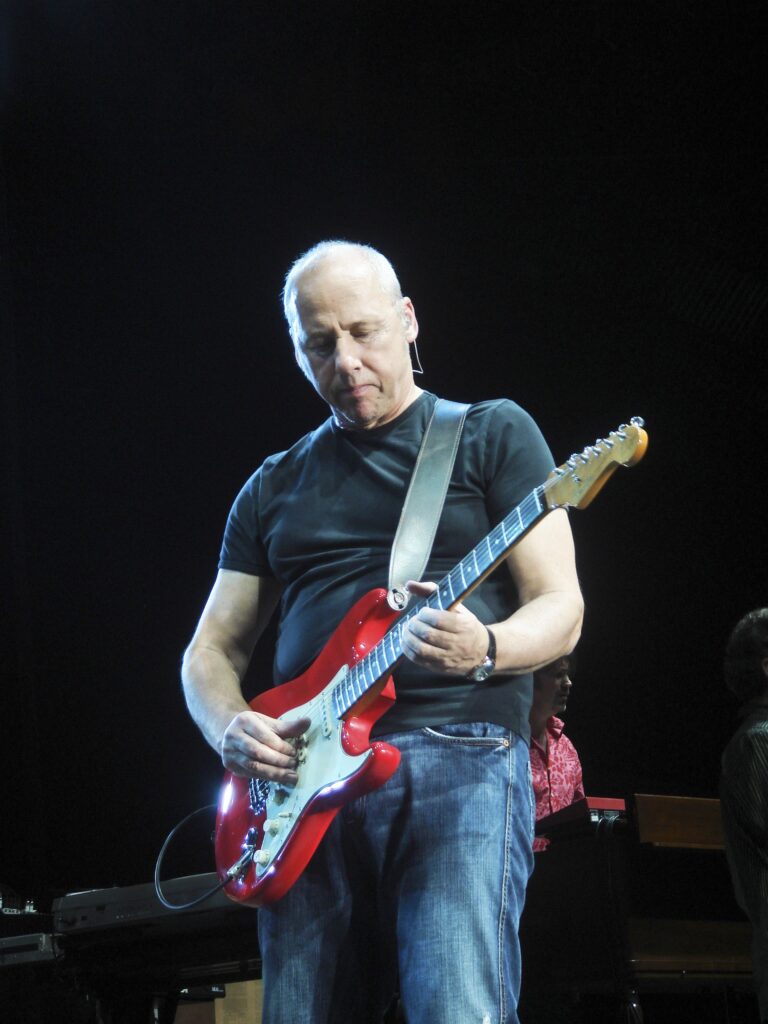
Knopfler bought the guitar from Steve Phillips, the Leeds bluesman and guitar maker he met in 1969 while working as a journalist on the Yorkshire Evening Post. The two became close, played pubs together, and performed under the name The Duolian String Pickers — a detail that is quietly delicious, given that a Duolian is the cheaper steel-bodied cousin of the guitar he ended up famous for. It was Knopfler’s second National; the first was a late-1920s tricone he had bought from an old man in Wales.
On record, the Style O is on “Romeo and Juliet” from Making Movies (1980), on the studio recording of “Telegraph Road” from Love over Gold (1982), and on the title track of Brothers in Arms. It has been retrofitted with an L.R. Baggs transducer for stage use — visible in photographs, and a reminder that even the most famous acoustic instrument in the world eventually gets a pickup drilled into it if its owner has to play arenas.
The dating problem with the world’s most photographed Style O
You will see Knopfler’s guitar described as a 1937 Style O. You will also see it described as a 1936. National’s own website, on the page for the model it sells partly because of him, hedges to “a late 1930s model.” Ground Guitar lists it as a 1937 with the serial number B1844. Ingo Raven’s long-running Mark Knopfler Guitar Site, which has photographed a 1936 Style O in forensic detail, describes that guitar as “very similar to Mark Knopfler’s — which seems to be probably from about 1937 to me.”
Two further wrinkles are worth flagging honestly. First, a “B” serial prefix does not appear in either of the standard schemes: Gruhn documents an “S” prefix on 12-fret and early 14-fret examples and no prefix on later ones. Whether B1844 is a misreading, a different stamping, or something else is not something any published source resolves. Second, at least one widely-circulated gear round-up claims Knopfler bought the guitar in 1985 for $3,500. That flatly contradicts the two better-sourced accounts, which both have him acquiring it from Steve Phillips in the 1970s — and it contradicts the recordings, since the guitar is audibly on a 1980 album.
The lesson generalises past this one instrument: the more famous a guitar becomes, the more confidently it gets described, and the confidence is not correlated with the evidence.
Son House, Bukka White, and the model-versus-brand problem
Gruhn states plainly that Style Os “can be seen in photos of bluesmen Son House and Bukka White.” That is a serious source and it should be taken seriously. But it needs one qualification for anyone trying to reconstruct a specific rig.
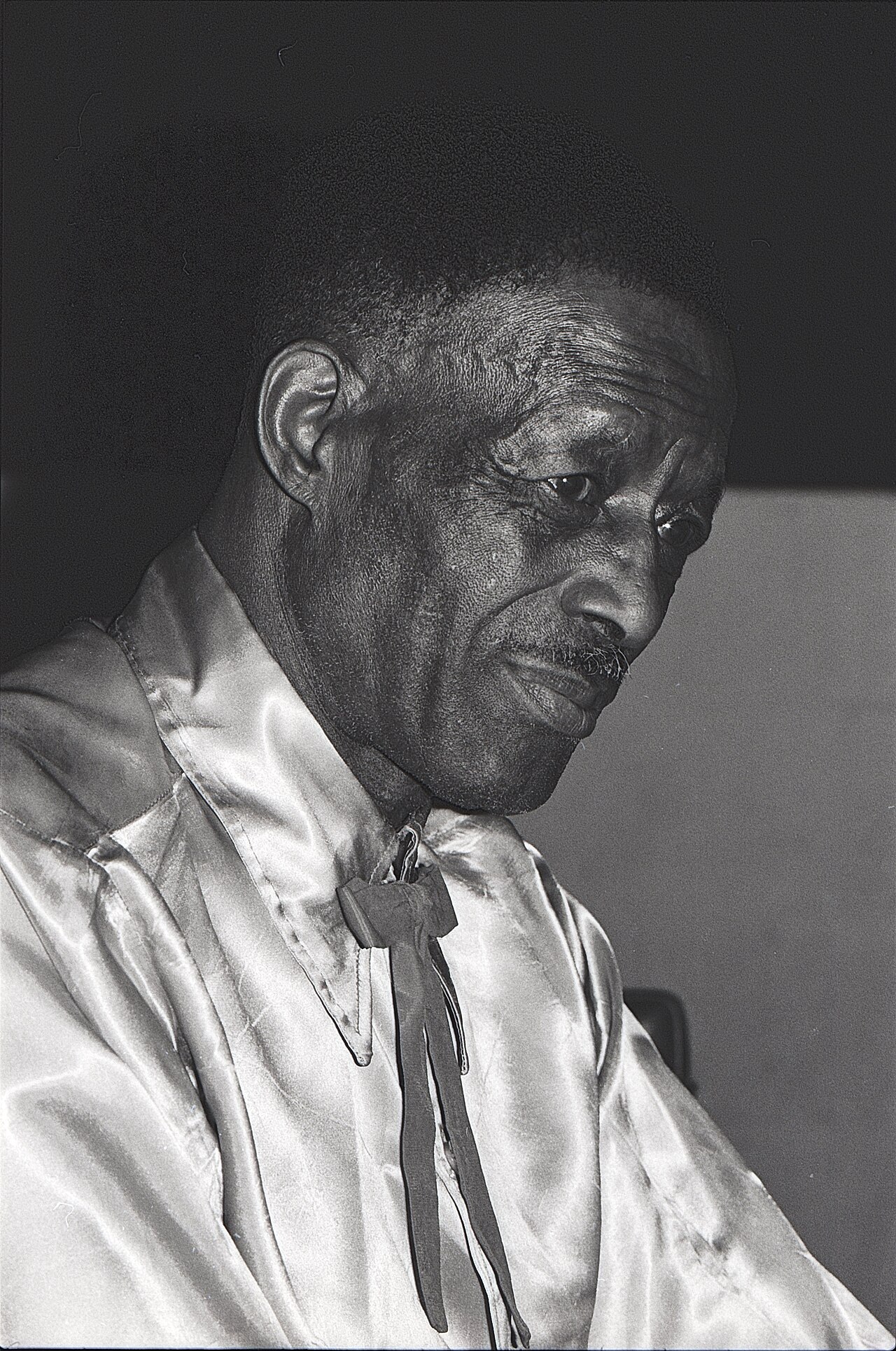
Son House’s most consistently documented instrument is a National Duolian — the cheap steel-bodied one, at $37.50 the guitar a working Delta musician in the Depression could conceivably afford. That is what the surviving photographs are most often identified as, and it is what the model is remembered for. Both things can be true: House played more than one National over a long life, Style Os appear in some photographs, and the Duolian remains the instrument most associated with him. What is not true is the version you will see on gear blogs, where “Son House played a National Style O” gets stated as a settled fact with a single photo caption behind it.
The same care applies to the wider generation of players who used metal-bodied single cones — Blind Willie McTell, Tampa Red (whose famous instrument was a gold-plated tricone, not a Style O), Robert Johnson (photographed with a Gibson L-1 and a Kalamazoo, not a National). These are the reference recordings for the idiom the Style O serves. They are not, individually, evidence about this SKU.
The Paul Simon line, and why it matters
“The Mississippi Delta was shining like a National guitar.” Paul Simon put that in the opening verse of “Graceland” in 1986, one year after the Brothers in Arms sleeve, and between them those two moments moved the National from a specialist instrument to a piece of general cultural furniture. Notice what Simon is describing: not the sound, the shine. That is the Style O’s real cultural function. It is the only acoustic guitar that reads as a photograph.
The modern players
Metal-body single cones remain live working instruments rather than museum pieces, and the modern lineage runs through players like Bob Brozman — who was both the great modern National virtuoso and the author of the reference book everyone still dates these guitars with — along with Chris Whitley, whose Dirt Floor is essentially a National record, Kelly Joe Phelps, Ry Cooder, Bonnie Raitt, Keb’ Mo’, Jack White and Dan Auerbach. As always with a range that includes tricones, Duolians, Triolians, wood-bodies and modern National models, treat “plays a National” as a statement about the brand until you have seen the specific instrument.
The Brothers in Arms effect on the vintage market
Here is the part that collectors find genuinely funny. Before 1985, the 12-fret Style O was the desirable one. It is older, rarer, closer to the original design, and its longer body-to-bridge relationship gives it the deeper, woodier voice that traditionalists prefer. The 14-fret version, made from 1935 onward with the diamonds-and-arrows coverplate, was the later, more common, less interesting one.
Then Dire Straits put a 14-fret on an album cover that sold thirty million copies, and vintage dealers started putting a premium on exactly the version that had previously been second choice. It became “the Dire Straits model.” An album sleeve reversed a valuation hierarchy that had held for decades — and it still holds today, which is why National sells a 14-fret Style O as a separate catalogue entry, headed by a description of Knopfler, rather than as a variant of the 12-fret.
How a Style O Actually Sounds
The single-cone-with-biscuit-bridge design does something very specific to the frequency response, and understanding it explains both why people love this guitar and why they get frustrated with it.
A wooden flat-top spreads string energy across a large, relatively soft radiating surface. A resonator concentrates it into one stiff aluminium diaphragm about nine and a half inches across, coupled to the strings through a small wooden biscuit. The result is a voice with a hard, fast leading transient, a very strong midrange, a fast decay compared with a good spruce top, and a compressed, almost horn-like quality at volume.
In practical terms:
- Fundamental range: roughly 100 Hz to 5 kHz, with the useful character concentrated between 500 Hz and 3 kHz — precisely the band a human voice occupies, which is why a Style O both cuts through a band and fights with a singer if you record them into the same microphone.
- The bark: that famous metallic edge lives around 2–4 kHz. It is a function of the cone and the biscuit, not the body, which is why cone condition matters far more than plating condition.
- The brass difference: against a steel-body Duolian, brass gives you noticeably more low-mid weight and longer sustain, and rounds the harshest part of the attack. Against a tricone, the single cone is louder, drier, more percussive and far more immediate — the tricone’s three-cone system trades attack for a complex, singing sustain.
- Dynamic ceiling: resonators compress themselves. Past a certain input the cone stops giving you proportionally more output, which is why they sound enormous at moderate attack and merely loud when you hit them hard. Play into the compression, not through it.
The 12-fret versus 14-fret question has real acoustic consequences too. A 12-fret joint puts the bridge closer to the centre of the lower bout, on the most active part of the resonator system, which generally means more depth, more low-mid and a slightly slower response. The 14-fret moves the bridge back toward the tail, which tightens and brightens things and gives you access to the upper frets. Neither is better. The 12-fret is the blues-in-open-tuning guitar; the 14-fret is the one you can play chords up the neck on.
Tone Recipes: Five Settings That Work
1. Delta Slide (the default)
Open G (D-G-D-G-B-D) or open D (D-A-D-F#-A-D). Heavy strings — .014 to .056 or thicker — and a high action, at least 3 mm at the 12th fret. Brass slide for weight and midrange, glass if you want it sweeter. Play over the coverplate, near the neck join, and damp behind the slide with the fingers of your fretting hand constantly. The sound you are after is a controlled roar, not a clean note.
2. Ragtime Fingerpicking
Standard tuning, lighter strings (.012 to .054), lower action, and picking position moved back toward the tailpiece. Fingerpicks, not flesh — the cone rewards a hard, defined attack and a bare thumb sounds mushy on this instrument in a way it does not on a wood guitar. This is the setup where the Style O sounds like Mississippi John Hurt rather than like a train.
3. The Knopfler Ballad Sound
Standard tuning, medium strings, played with the fingers rather than a pick, right hand over the fingerboard end of the coverplate for maximum warmth, and a very restrained attack. The Style O has a beautiful quiet register that almost nobody uses because the instrument advertises itself as loud. “Romeo and Juliet” is the reference. If you are amplifying, roll off above 4 kHz — a transducer on a metal body exaggerates exactly the frequencies you want to control.
4. Recording: One Mic, Off Axis
Large-diaphragm condenser, 30 to 45 cm out, aimed not at the coverplate but at the point where the neck meets the body, angled 30 degrees off axis. Pointing a microphone straight at the cone gives you the ice-pick and none of the body. If you have a second channel, put a small-diaphragm condenser near the tailpiece for the metallic detail and blend it in at low level. Expect to need a high-pass around 80 Hz and a dip of 2 to 3 dB somewhere between 2.5 and 3.5 kHz.
5. Live with a Pickup
National offers three amplification routes: the Slimline (a discreet under-biscuit style transducer), the Hotplate (a coverplate-mounted magnetic system) and a Lollar P-90. The Slimline gives you the most acoustic result and the most feedback problems; the Hotplate and the P-90 both give you an electric-flavoured signal that is far easier to control on a loud stage but no longer really sounds like a resonator. Whichever you choose, a notch filter and a decent preamp matter more than the pickup does. A nine-pound metal box on a loud stage is a feedback machine, and the fix is filtering, not volume.
A Style O has no controls, which means every “setting” is a matter of tuning, slide material, string gauge, hand position and, if you are amplifying, what you do at the desk. Here are five starting points.
How It Compares
Style O vs National tricone
The tricone is the aristocrat: three cones, German silver, sweeter, more complex, slower to speak, more sustain, much better for lap-style Hawaiian and single-note melody work. The Style O is louder, harder, drier and more rhythmically immediate. If you play slide blues in open tunings, the Style O is the correct tool; if you play melodic single lines and want something that sings, the tricone is.
Style O vs Duolian
The Duolian is the same basic single-cone architecture in thinner-gauge steel with a painted “frosted duco” finish instead of nickel plating and etching, and a plain dyed-maple fretboard. It is harsher, more raw, lighter and — vintage or reissue — cheaper. Plenty of players prefer it precisely because it is uglier and more aggressive. The Style O is the same instrument with better manners and better clothes.
Style O vs a wood-body resonator
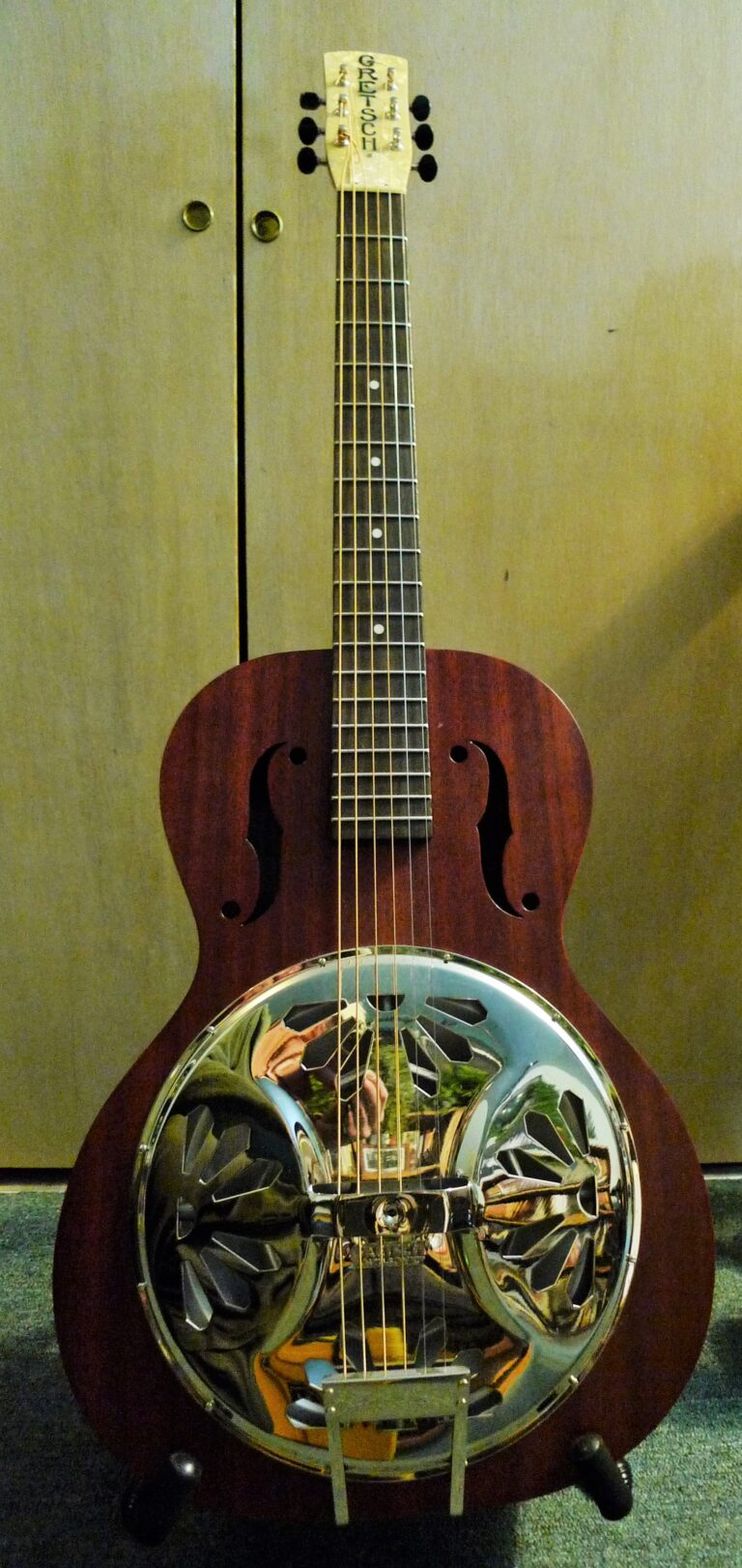
Wood-body resonators — the Dobro lineage, and today the likes of the Gretsch G9200 Boxcar — put the same cone system inside a wooden box. They are warmer, quieter, less metallic and far easier to record. They are also several hundred pounds rather than several thousand. If what you want is resonator function for occasional use in a mostly-flat-top set, a wood-body is the sensible purchase and nobody serious will think less of you.
Style O vs a pre-war-style flat-top
If your interest in the Style O is really an interest in old American music, it is worth asking whether a period-correct flat-top would serve you better. Something like the Recording King ROS-626 or the Recording King Dirty 30s Series 7 Single 0 gets you into the same repertoire at a tenth of the price, with far more versatility and none of the weight. The Style O is not a general-purpose guitar and was never meant to be one. It does one thing that nothing else does.
Style O vs a modern all-solid acoustic
This is the comparison that actually decides most purchases, because the money is similar. For the price of one 12-fret Style O you could buy a Furch Yellow Deluxe Gc-CR and have change, or two Furch Blue Plus D-CMs, or a Maton SRS808 plus a decent amplifier. Those instruments will do ninety percent of what you need a guitar to do. The Style O will do the remaining ten percent that none of them can touch. That is the whole calculation, and it is an honest one: this is a second or third instrument for almost everyone who owns one.
Buying Guide
New
Current National dealer pricing for a new Style O sits in the region of $4,500 for the standard 12-fret, with international pricing landing around the same figure once converted, and Deluxe-engraved examples quoted variously above and below that depending on the dealer and the specification. National also takes direct orders and, notably, requires a $300 deposit against a build slot — which tells you these are made to order rather than pulled from a warehouse. Expect a wait, and expect the setup to be excellent when it arrives; National’s setups are the thing the company is most consistently praised for.
Vintage
Original 1930–1941 examples come up regularly and cost real money, with condition and originality mattering far more than year. Things to check, in priority order:
- The cone. This is the instrument. A dented, corroded or previously-flattened cone kills the guitar, and cone replacement changes the voice. Look down through the coverplate holes with a torch.
- The neck angle and the neck block. Metal bodies are stiff, but the wooden neck joint is not, and a Style O with a collapsed neck angle is an expensive repair. Sight the action at the 12th fret.
- Body corrosion under the plating. Pitting through the nickel into the brass is cosmetic if superficial and structural if it is not. Check the tail block, the strap button area and anywhere the guitar rested on a stand.
- The etching. Sandblast scenes wear off with handling — most heavily on the back, where the canoe sits against the player. Faded etching is normal and does not affect tone, but it affects value.
- Originality of the coverplate and tailpiece. Replacement parts are readily available and readily passed off as original.
- Round neck or square neck. A square-neck is a lap instrument and cannot be converted sensibly. Make sure you know which you are looking at before you bid.
Twelve fret or fourteen?
Choose on playing style, not on collectability. If you play slide in open tunings and want the deepest, most vocal version of this instrument, take the 12-fret. If you want to play chords and melodies above the seventh fret, or you specifically want the guitar off the Brothers in Arms sleeve, take the 14-fret. On the vintage market you will pay the Dire Straits premium for the latter; on the new market they cost effectively the same.
Living With a Metal Guitar
A Style O is a genuinely different ownership proposition from a wooden acoustic, and the differences run both ways.
Humidity is not your enemy. This is the great practical advantage. A brass body does not crack in dry air, does not swell in humid air, and does not care about a hotel room or a poorly heated venue. The wooden neck still moves, so it still needs sane storage, but you can put a National somewhere you would not dare put a Martin.
Temperature is. Metal has a very different thermal mass from wood. A Style O brought in from a cold van will be cold for a long time and will go badly out of tune as it equalises. Give it half an hour before you rely on it.
Weight is real. Just under nine pounds is heavy for an acoustic, and it is concentrated in a small body with hard edges. A wide strap is not optional if you stand up.
The plating needs care, not polish. Nickel plating is thin. Aggressive metal polishes will cut through it and, worse, will erase sandblast etching permanently. A dry microfibre cloth handles almost everything. Fingerprints and sweat are the real enemy — acidic hand sweat pits nickel over years — so wipe it down after playing.
Setup is a specialist job. Action on a resonator is adjusted at the biscuit and the saddle slot, and cone seating affects both tone and intonation. This is not a job for a general guitar tech who has never had a coverplate off. National itself does repairs and restoration, and there are specialists in most countries; use one.
Strings. Resonators want heavier strings than flat-tops — the cone needs driving. Phosphor bronze .013–.056 is a sensible general-purpose set; slide players in open tunings routinely go heavier. Lighter than .012 and the guitar will sound thin and undernourished.
Frequently Asked Questions
Is the National Style O a blues guitar?
In practice, yes — but that was never the plan. It was designed and decorated for the Hawaiian market, which did not want it, and was adopted instead by blues and country players who wanted volume, cut and a mid-priced metal body. Ninety-odd years of use have made it a blues instrument by consensus rather than by design.
Why does it say “Style O” and not “Style 0”?
It is the letter O, pronounced “style oh,” not the number zero. The confusion is old and universal — you will see both spellings in dealer listings, magazine articles and even on fan sites — because National’s other single cones were named (Duolian, Triolian, El Trovador) while its tricones were numbered (Style 1, 2, 3, 4), and the Style O sits awkwardly between the two conventions.
Brass or steel — which should I buy?
Brass is the standard and the historically correct choice: rounder, heavier, more sustain, more low-mid. National offers a steel-body option and a Weathered Steel finish for players who want the harsher, more Duolian-like voice and the aged look. Brass is the safer purchase; steel is the more specific one.
Can I play a Style O without a slide?
Absolutely, and it is underrated. A round-neck Style O set up with normal action plays like any other 25″-scale steel-string and fingerpicks beautifully. The reason most people associate it with slide is that the high action of a vintage example, plus the model’s blues history, pushes buyers in that direction. If you buy new, ask for a fingerstyle setup.
Does the Hawaiian etching affect the tone?
No. Sandblasting removes a microscopically thin layer of plating from the surface of a substantial brass body. It is a decorative process with no measurable acoustic consequence. National offers a no-etching option purely on aesthetic grounds.
Is a new National as good as a vintage one?
By most accounts of players who have owned both, the modern instruments are more consistent, better set up and better finished, while good vintage examples have a broken-in quality and a specific worn character that a new guitar does not have. Since the modern company’s knowledge descends directly from John Dopyera through Don Young, this is not a reissue-versus-original argument in the usual sense. Buy the vintage one for the object and the history; buy the new one for the guitar.
What is the difference between National and Dobro?
Both trace to John Dopyera. National came first, in 1927, with metal-bodied tricones. Dobro — DOpyera BROthers — was the company Dopyera founded after leaving National, and it made single-cone wood-bodies with an inverted cone design. The two companies later merged, split, and passed through several owners; today “Dobro” is a Gibson trademark generally used for wood-body, inverted-cone, square-neck bluegrass instruments, while National Reso-Phonic builds metal-bodied biscuit-cone and tricone guitars in California.
Is a Style O worth the money?
Only if you want the specific thing it does. As a general acoustic guitar it is expensive, heavy, loud, narrow in application and outperformed at a quarter of the price by any decent all-solid flat-top. As a metal-bodied single-cone resonator built by hand in California by the direct inheritors of the design, with a look no other instrument on earth has, it is one of a very small number of guitars with no real substitute. Nobody needs one. A significant number of people are very glad they bought one.
Image credits
- A guitar with an oval sound hole: Dejan Krsmanovic, Wikimedia Commons, CC BY 2.0.
- A luthier workshop with instruments on the wall: Baden de, Wikimedia Commons, CC BY 3.0.
- An acoustic guitar and an old typewriter: Shixart1985, Wikimedia Commons, CC BY 2.0.
- Son House: Jeff Titon, Wikimedia Commons, CC BY-SA 4.0.
- Top image: GuitarGangsters AI-generated reference illustration, not a photograph.
- Mark Knopfler: Christopher Bowley, Wikimedia Commons, CC BY 2.0.
Latest News
Related
On This Day
Tuesday 10 November
From this week: