Two Output Stages, One Box: The Orange Rocker 32 and the Stereo Combo That Changed What Small Could Do
Orange Rocker 32: 30W all-valve stereo 2×10 combo, NAMM 2017. History, specs, the asymmetric stereo trick, famous players, and tone recipes.
In 2010, when Orange’s technical director Adrian Emsley launched the TH30H, the Rocker 30 was quietly retired. The industry moved on. Orange moved on. But the emails didn’t stop. For seven years, players kept writing in to ask whether the Rocker 30 was ever coming back — the compact format, the dual-channel simplicity, the way it sounded enormous for a combo. Emsley took note. And in January 2017, on the floor of the winter NAMM show in Anaheim, he unveiled his answer: not a reissue, but a reimagining. The Orange Rocker 32 kept the name and the concept but changed nearly everything underneath — new power tubes, a completely redesigned output stage, and one engineering decision that no other combo in Orange’s lineup had attempted before: true stereo from a pair of ten-inch speakers in a single box.
That last point is the one that defines the Rocker 32’s position in the catalogue. Every other Orange combo in 2017 was mono. The Rocker 32 wasn’t just stereo capable — it was built from the ground up around two independent output stages, each driving its own Voice Of The World speaker, with its own FX return, and with a deliberate engineering asymmetry between the two sides that makes the amp sound three-dimensional even when you’re running it in mono. That’s not a marketing footnote. It’s the central engineering choice around which everything else in the amp is organized, and it’s what makes the Rocker 32 worth understanding in detail.
From the Rocker 30 to the Rocker 32: What Changed and Why It Matters
The original Rocker 30, launched in the mid-2000s, was a straightforward if well-executed British combo: 30 watts from a pair of EL34 power valves running in Class A, two channels with the same Natural-and-Dirty layout the Rocker 32 would later inherit, and a compact 2×10 or head format that made it genuinely portable for a 30-watt all-valve amp. EL34 tubes are the muscle end of the British valve tradition — stiff attack, complex odd-order harmonic envelope, a lot of girth in the upper mids, and a feel that rewards a player who digs in hard. The Rocker 30 sounded like Orange’s answer to a loud, working-musician combo: authoritative, characterful, and direct.
When the TH30H arrived in 2010, it absorbed the Rocker 30’s market position and added the Thunderverb’s Shape control and a more sophisticated preamp topology. The Rocker 30 was discontinued. That should have been the end of it.
The Rocker 32 is the evidence that it wasn’t. For his 2017 revisit, Emsley made the most consequential change possible: he replaced the EL34 power stage with EL84 valves. Four of them, running the same power section topology that Orange had already refined through the AD30 family, the Tiny Terror, and the TH30. EL84s are a different character entirely — they compress more readily on transients, bloom rather than bite, and produce a richer even-order harmonic content that gives them their characteristic sparkle and warmth. Where the EL34 Rocker 30 hit hard and held its shape, the EL84 Rocker 32 breathes and opens up as you push it. The two amps are spiritual relatives, not the same amp in a different box.
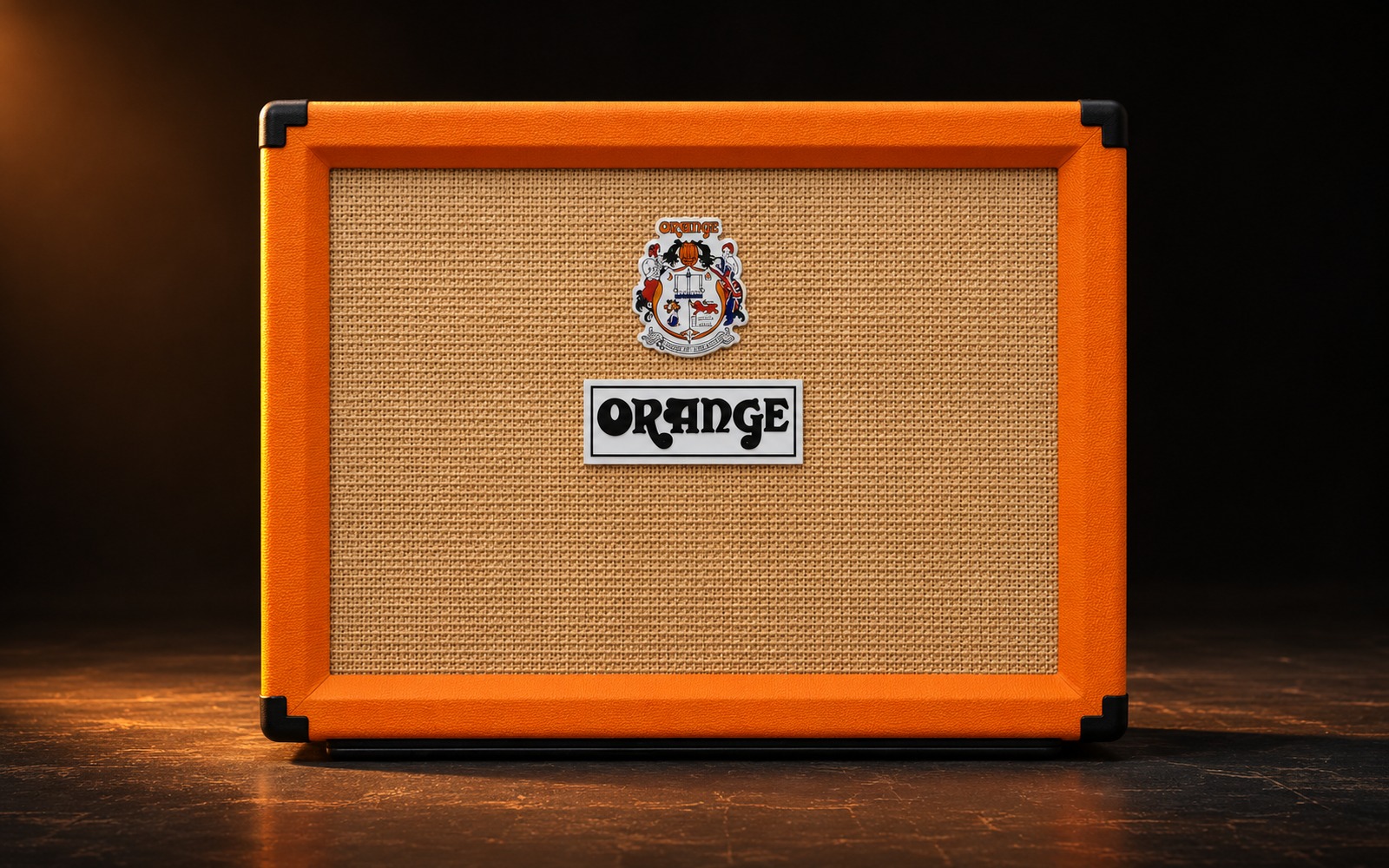
The other change is the output stage architecture. The Rocker 32 doesn’t have one output stage driving two speakers. It has two independent 15-watt output stages, each driving one Voice Of The World Gold Label 10-inch speaker, and each fed from its own return in the FX loop. This is what enables stereo — and it’s also what gives the amp its distinctive mono character, in a way that Guitar.com’s Chris Vinnicombe described from the first reviews: “One side of the Rocker 32 has a cathode follower after the effects return, while the other is anode following. The cathode follower hits its power amp at a lower impedance than the anode follower; what this means in practice is that one side of the 2×10 has a faster and tighter response, while the other is softer and more compressed.” In a standard mono 2×10, both speakers behave identically. In the Rocker 32, they don’t. Even plugging into only the left return, both speakers fire from the same signal but process it through slightly different impedance paths — one tighter and immediate, one softer and rounder. The result is a natural stereo spread and sense of depth that you don’t get from any other combo in this format.
Specifications
How the Stereo System Works
Most players who know about the Rocker 32’s stereo capability understand it as an effects feature — run a stereo delay or stereo chorus pedal into the FX returns and hear it spread between the two speakers. That’s accurate and it’s genuinely excellent. But it undersells the engineering involved.
The FX loop configuration works as follows. There is one send — a signal tap from the preamp — and two independent returns. When you plug into only the left return, the amp runs in mono: both output stages receive the same signal, both speakers fire, but as described above, they behave differently due to the cathode/anode follower asymmetry. You get a 2×10 with more 3D character than any symmetric design. When you plug into both returns — left for your dry signal, right for your wet signal — the two output stages become independent pathways. The dry guitar tone comes from one speaker at you; the modulated, reverbed, or delayed signal comes from the other. The effect is heard as an acoustic phenomenon in the room rather than an electronic simulation of stereo, which is precisely what makes it sound so good.
For the more adventurous configuration: most multi-effects units with stereo outputs can feed both returns simultaneously, sending ping-pong delays, rotating modulation, or lush reverb tails in genuine stereo between the two Voice Of The World speakers. MusicRadar’s Nick Guppy described the effect of a short room-delay technique in his 2017 review: “One of the coolest things you can do with a stereo setup beyond ping-pong clichés is add a very short delay between both channels, in the 10- to 25-millisecond range, which sounds enormous, especially when mixed with a good dose of reverb.”
The FX loop is valve-buffered, which matters for tone purists. A buffered loop maintains signal integrity through longer pedal chains and prevents the high-frequency roll-off that passive loops can introduce with complex impedance loads. It’s a more expensive implementation than an instrument-level passive loop, and Orange put it on the Rocker 32 because the amp is specifically designed to be a platform for effects — particularly the kind of time-based and modulation effects that benefit most from stereo operation.
Famous Players
The Rocker 32’s player list is smaller than some Orange products — it’s a specific tool with specific applications, and it tends to attract guitarists whose live or studio work revolves around stereo effects rigs. That’s a meaningful selection criterion, not a limitation.
Robin Finck — Nine Inch Nails / EYES OUT / Danny Elfman
Robin Finck is one of the most extensively documented Rocker 32 users, with a primary source that makes the distinction between his amps unusually clear. In a 2021 interview with EarthQuaker Devices, conducted when NIN’s fall tour was cancelled due to COVID and Finck was deep in game studio work with his EYES OUT project, he described his touring and studio rig with precision:
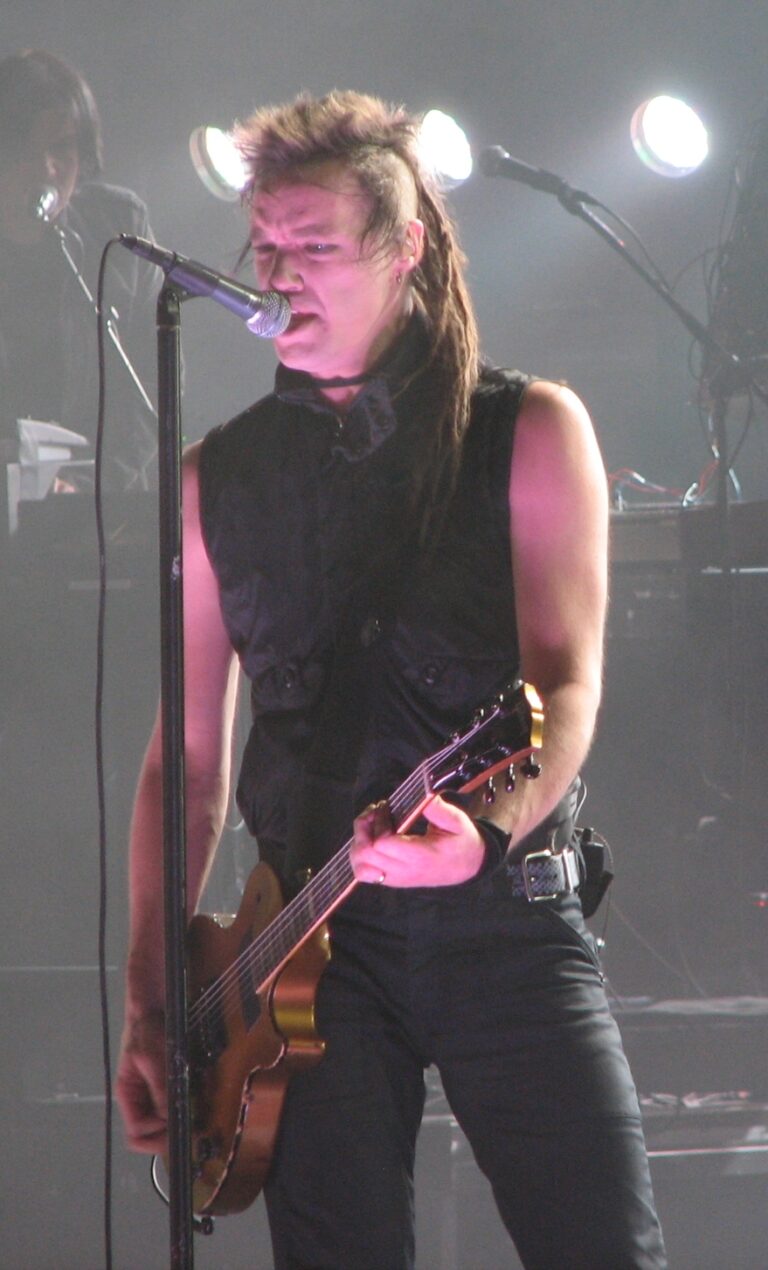
“I was poised to head out with Axe-Fx and a couple of drawers of pedals, RJM switching system, and Matrix power amp and FR cabs. Also, a mic-ed Orange Rockerverb to be blended with the most prominent heavy sound. I built a pedalboard to perform with Danny Elfman at Coachella, which fell to COVID. But the board I used in rehearsal for a bit, and eventually on Danny’s record, Big Mess, went into an Orange Rockerverb 100 for the stage and an Orange Rocker 32 in the studio.”
The stage/studio distinction is explicit in his own words: Rockerverb 100 for the live environment, Rocker 32 in the studio. For the Danny Elfman sessions — Big Mess was released in 2021 — the Rocker 32 was the primary recording amp. Orange also maintains a dedicated artist page for Finck, confirming the relationship is an endorsement rather than a one-off appearance.
Finck’s career gives the Rocker 32 a distinctive character association: high-concept industrial rock (NIN), complex orchestral-adjacent production (Danny Elfman’s cinematic records), and game audio (EYES OUT, whose first game Sleep Awake arrived in 2025). The Rocker 32’s ability to accommodate a complex stereo effects rig while providing a controllable, miked-up valve tone in a compact studio footprint makes it the right tool for all three contexts.
Jonathan Higgs — Everything Everything
Jonathan Higgs, vocalist and guitarist for the Manchester art-rock band Everything Everything, uses the Rocker 32 in both studio and live contexts. In an interview with Orange Amps, he captured the amp’s dual-role appeal directly: “It’s a pretty versatile amp. You can use it in the studio and we have done, but it really comes alive on the road — it’s very resilient and it sounds great on stage.”
Everything Everything’s guitar work involves layered, effects-heavy tones with significant use of ambient and modulation processing — exactly the use case the Rocker 32 was designed to serve. Higgs’s endorsement is documented via Orange Amps and listed on Equipboard with the source citation.
Mary Spender
UK guitarist and content creator Mary Spender used the Rocker 32 as her primary amp before transitioning to the Rocker 15 Terror — the same logical upgrade path that Chuck Ragan made from the discontinued Rocker 30 to the Rocker 15 Terror (documented in our Rocker 15 Terror article). The pattern is consistent: players who love the Rocker’s channel layout and EL84 character find the 15 Terror a more portable option when the Rocker 32’s 23kg weight becomes a consideration. Spender’s Rocker 32 use is documented on Equipboard.
Yvette Young — Covet (caveat applies)
Yvette Young, guitarist for progressive pop-rock band Covet, is listed on Equipboard as a Rocker 32 user, with the evidence being a community-uploaded photo on Imgur. The documentation is community-sourced rather than manufacturer or interview-confirmed, and it conflicts with other primary sources: Young has been a documented Vox player throughout her career, using the AC30 extensively (discussed in her 2019 Gear Talk with Vox and a Truth in Shredding interview), and VOX announced a formal endorsement partnership with her in January 2026, centred on the new hand-wired AC30 Head and V212 Cabinet. It is plausible that she owned and used a Rocker 32 at some point — the two amps serve different purposes, with the Rocker 32’s stereo loop being a natural complement to her extended-range, effects-heavy playing style. But the Vox endorsement is the stronger and more current primary source, and the Imgur evidence is too thin to claim the Rocker 32 as a primary instrument for her. Treat the connection as possible but unconfirmed to primary-source standard.
The Recycled Orange Roster
As with every other Orange amp covered in this series — the Rockerverb 50 MKIII, the Retro 50, the Tiny Terror, the TH30H, and others — a recycled list of five or six names circulates through Orange community forums and gear databases attributed to essentially every Orange product regardless of which specific amp those players actually use. Jimmy Page’s documented Orange history is the OR200 and the AD30 family; no primary source places him on a Rocker 32. Jim Root’s Orange amps are the Rockerverb 100 and his own Jim Root Terror. Brent Hinds’s signature Orange is the Brent Hinds Terror, a different product entirely. Omar Rodríguez-López is an AD140HTC player, documented in that article. Matt Pike uses Dual Dark, Thunderverb, and OR-series heads. None of these players has a documented connection to the Rocker 32.

Tone in Practice: What the Rocker 32 Actually Sounds Like
The Natural channel is the Rocker 32’s most distinctive offering. With a single volume control and no EQ, it’s a pure expression of what 4× EL84 tubes sound like when pushed through Orange’s preamp design and Voice Of The World speakers. At low-to-mid volumes, the Natural channel is crystalline — “glassy treble giving way to an addictive chime at higher volume levels,” as MusicRadar’s Nick Guppy wrote, comparing it to “the EL84-powered AD30R combo that Orange relaunched with in the later 1990s.” Guitar.com’s Vinnicombe put it more evocatively: “If Neil Young had been born just inside the M25, his guitar tone would sound something like this.” EL84 chime, British midrange warmth, and the particular elasticity that comes from cathode-biased push-pull operation.
Above noon on the volume control with single-coil pickups, the Natural channel starts to produce power-stage breakup — the genuinely valve-driven overdrive that comes from the output section running into compression and harmonic saturation rather than from a gain stage in the preamp. This is a different texture from preamp distortion: rounder, more dynamic, and more responsive to right-hand attack. Back off with a humbucker and you get a warm, thick clean with enough headroom for most worship or ambient applications. Dig in with the same guitar and the edge appears immediately.
The Dirty channel moves the sound in a different direction — forward, tighter, more midrange-saturated, with the Orange characteristic “bump” in the 800Hz–2kHz range that allows the amp to cut through a band mix without relying on sheer volume. The gain control sweeps from mild crunch at the bottom to what MusicRadar called “Dark Terror-approved filth at the top of its travel.” At moderate gain with a Telecaster or Stratocaster, the Dirty channel is a classic Brit-rock tone: slightly compressed, mids-forward, with enough upper-harmonic content to give single notes their own personality. With a Les Paul or any humbucker guitar, it gets thicker and more saturated, and the low end fills in with genuine weight. Push the gain past two-thirds with a humbucker bridge pickup and you’re into modern metal territory — not the smoothed-out saturated wall of a Mesa Boogie, but a grittier, more organic distortion with clear note articulation even on detuned chords.
The half-power mode (15W, two output stages running at half their rated output) changes the character of both channels — not just reducing volume, but bringing the output stage saturation onset down to lower volume levels. What this means practically is that at bedroom or small studio levels, you can access genuine power-valve compression that is unavailable at low volumes in full 30W mode. The EL84 response at saturation — the famous “sag” and bloom — is present at a more useful volume when you’re not trying to fill a room.
Tone Recipes
Recipe 1: The AD30 Ghost (Natural Channel, Studio Clean)
Natural channel. Volume at 9–10 o’clock. 30W mode. Single-coil Strat, neck or middle pickup, tone rolled back slightly on the guitar. The amp stays clean but produces the distinctive EL84 harmonic shimmer — chime, sparkle, and a responsive high-mid articulation. Run a long reverb (plate or hall, 3–4 seconds decay) into the stereo loop and let it breathe in both speakers. This is the setting for fingerpicked parts, clean verse sections, or anything where you want the amp to disappear and leave only the texture. Comparable territory to the Vox AC30 Top Boost clean, but with more of the Orange midrange presence pulling the guitar slightly forward in a mix.
Recipe 2: Rocker 30 Spirit (Natural Channel, Power-Stage Crunch)
Natural channel. Volume at 1–2 o’clock. 30W mode for a stiffer, louder version; 15W mode for earlier saturation onset. Les Paul with the rhythm pickup, guitar volume at 8–9. The power stage compresses and the natural harmonic distortion of four EL84 tubes working together produces a singing, sustained crunch tone that responds dynamically to pick attack. Lighten the touch and it cleans up. Dig in and it saturates. This is the Rocker 32’s closest approach to the original Rocker 30 spirit — not the same amp (EL34 vs EL84 is a fundamental difference), but the same working principle of pushing an all-valve output stage into mild saturation for dynamics-responsive rock.
Recipe 3: Brit Rock Authority (Dirty Channel, Classic Drive)
Dirty channel. Gain at 11 o’clock. Bass at 12, Middle at 1, Treble at 11. Master Volume to taste. Humbucker-equipped guitar, bridge pickup. This is the Rocker 32 doing its primary job: forward-midrange British crunch with good note separation and a gritty texture that defines itself in a band mix. Stacks well with an overdrive pedal in front for lead boost — the Rockerverb 50 MKIII comparison: the Rockerverb’s preamp produces more structured, tighter saturation; the Rocker 32’s Dirty channel has more edge and texture but less high-gain refinement.
Recipe 4: Stereo Spatial (Wet/Dry Loop Configuration)
Dirty channel set to a modest gain crunch (9 o’clock gain). Pedalboard with a stereo reverb or delay (Chase Bliss BLOOPER, Strymon BigSky, or any stereo-out reverb). Run the guitar into the amp’s input. Run the FX send to the stereo pedal’s mono input. Run the pedal’s left/dry output to the Rocker 32’s left FX return, right/wet output to the right FX return. In front-of-the-amp position, the guitar drives the preamp for overdrive or crunch; the wet-dry split happens post-preamp in the two output stages. Left speaker: your dry guitar signal, present and direct. Right speaker: the reverb or delay, diffuse and spatial. Standing between the speakers, the effect is a genuine acoustic stereo spread with no artificial panning. This is what Robin Finck describes using in studio situations — one amp, two speakers, the wet and the dry separated without any interference between them.
Recipe 5: Home Studio Heavy (Half Power, High Gain)
Dirty channel. Gain at 3 o’clock (high). Bass at 10 o’clock (trimmed to prevent mud). Middle at 2 o’clock. Treble at 12. Half power mode (15W). Master Volume at a medium-high level that pushes the output stage into gentle saturation. Heavy string gauge, standard or drop tuning. The half-power mode reduces headroom and allows the output valves to contribute their own compression to the distortion character. The result is a more elastic, rounder heavy tone than the 30W setting — less attack, more body, and the EL84 harmonic softness that prevents the aggressive midrange presence from becoming harsh. Suitable for tracking heavy rhythm parts at levels below what a Marshall stack in the same mode would require.

Comparisons
vs. Orange TH30H + Cab
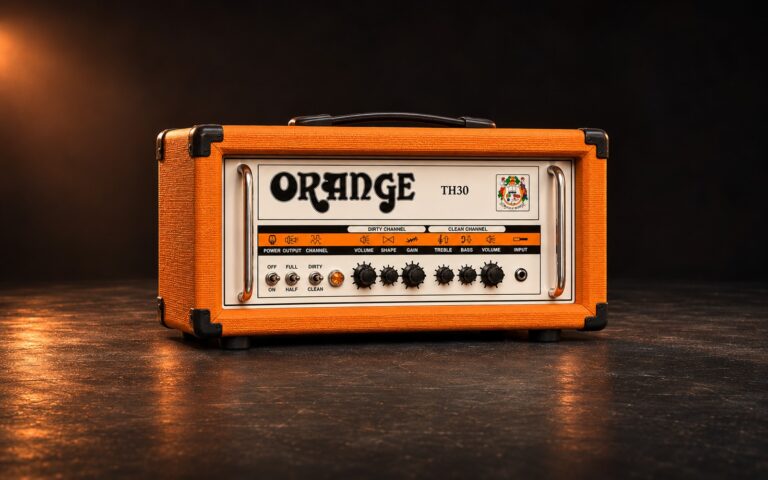
The TH30H is the Rocker 32’s closest sibling in the Orange catalogue — also 30W, also EL84, also two channels with the same Natural/Dirty layout. The differences are meaningful. The TH30H adds a three-band EQ to the Dirty channel’s more complex gain circuit (derived from the Thunderverb Shape preamp), making it more tonally flexible and particularly suited to high-gain applications where the Shape control’s mid contour is an asset. The Rocker 32 has the stereo FX loop and the two-output-stage architecture — the TH30H does not. If your priority is high-gain tone shaping, the TH30H wins on preamp flexibility. If your priority is stereo effects integration or wet/dry operation, the Rocker 32 is the only choice in the Orange range.
vs. Orange Rocker 15 Terror
The Rocker 15 Terror, launched at the same NAMM 2018 show where the Brent Hinds Terror debuted, is the Rocker 32’s little sibling in circuit intent — both trace their DNA to Ade Emsley’s Rocker 30 reconsideration — but the Terror is a different amp at heart: single 10-inch speaker, lunchbox head format, mono operation, no stereo capability. At 15W/7W with a bedroom switch, it reaches lower volumes and weighs a fraction of the Rocker 32’s 23.3kg. The trade-off is total: stereo capability, the asymmetric mono character, and the second output stage don’t exist in the Rocker 15 Terror. Mary Spender’s reported trajectory from Rocker 32 to Rocker 15 Terror reflects the portability priority that many gigging players reach eventually; Rocker 32 buyers who go the other direction are usually those for whom stereo operation is non-negotiable.
vs. Orange AD30HTC
The AD30HTC is the closest ancestral comparison — twin-channel, 4× EL84, Class A operation, GZ34 rectifier for genuine valve sag. The AD30HTC’s character is more vintage and compressed; no effects loop, no reverb, no stereo capability. It’s built around the premise that the amp is the complete signal chain. The Rocker 32 is built around the opposite premise: that the amp is the foundation for a complex effects platform. The AD30HTC produces deeper, warmer sag when pushed (the GZ34 rectifier contributes a specific softness on attack that the Rocker 32 lacks with its solid-state rectification). The Rocker 32 is tighter, more pedal-friendly, and more flexible. Pick the AD30HTC if you want the amp to do everything; pick the Rocker 32 if you want the amp to do everything plus your stereo pedalboard.
vs. Vox AC30 Top Boost
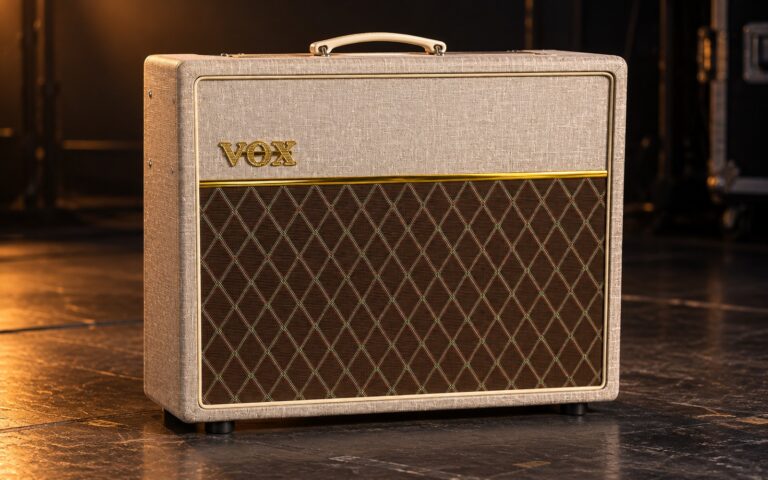
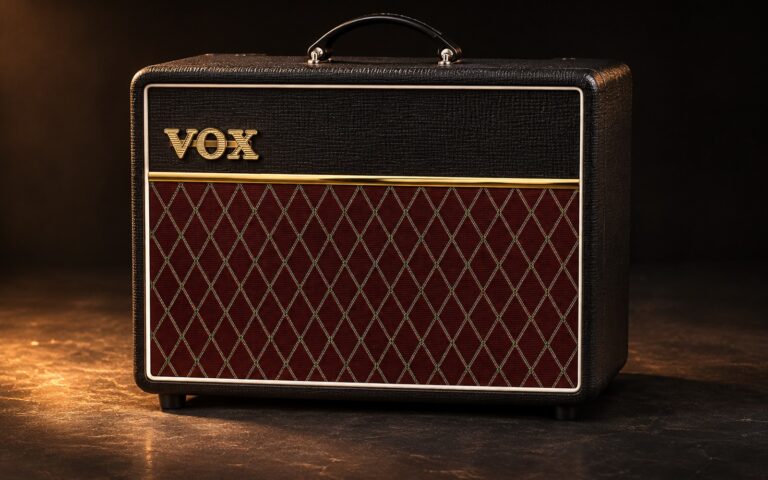
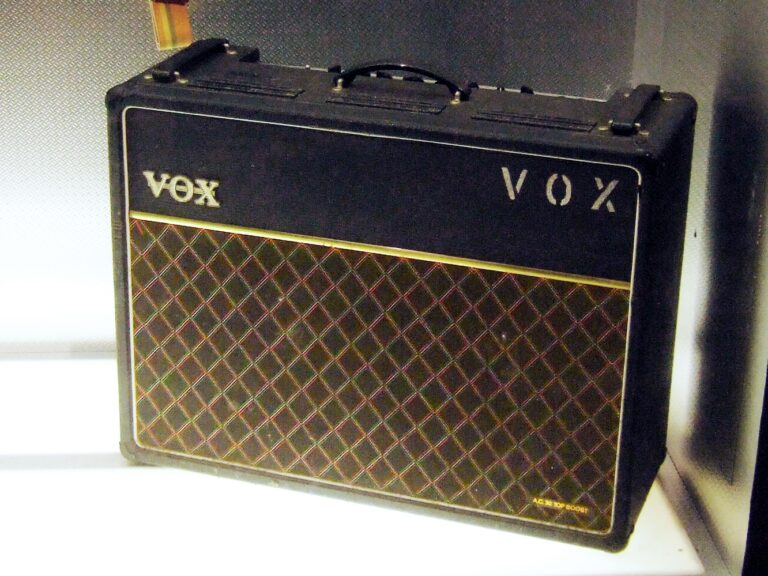
The Vox AC30 and the Rocker 32 occupy similar EL84-powered territory and are often compared directly — both produce the chime and sparkle associated with Class A EL84 operation, both have a clean channel that lives in the natural breakup zone rather than sterile headroom. The differences are profound in practice. The AC30 Top Boost is a famously single-mindedly musical amp: it does its thing, and you play into it. The Rocker 32 has a full three-band EQ on the Dirty channel, a gain control that goes from mild to extreme, a true stereo FX loop, and a half-power mode. It’s significantly more versatile by design. The AC30 wins on organic “plugged straight in” response — the Top Boost’s tone controls and the Cut control interact in a way that no EQ section can fully replicate. The Rocker 32 wins on adaptability, stereo capability, and high-gain range. Yvette Young’s reported use of both amps at different points reflects how naturally the two complement each other rather than compete.
vs. Orange Rockerverb 50 MKIII
The Rockerverb 50 MKIII is where you go when the Rocker 32’s 30W isn’t enough and the priority shifts from stereo integration to pure tonal authority and live stage presence. EL34 power section, switchable between 50W and 25W, the Rockerverb-family dirty channel (the most refined high-gain Orange has produced in a medium-power head), full effects loop. The Rockerverb is Robin Finck’s stage amp for a reason: it fills large rooms with authority and handles the rigours of amplification in arenas and festival stages. The Rocker 32 is Finck’s studio amp for a reason: compact footprint, excellent studio tone, and a stereo FX loop that works perfectly in a recording environment where you can position the two speakers to create genuine acoustic stereo image. The two are complementary, not competitive.
Buying Guide
The Rocker 32 has remained in continuous production since its 2017 launch, available in Orange and Black finishes. It has not been revised or updated; the spec and circuit are the same as the original NAMM announcement, though the pricing has risen from the £829/$1,099 launch figures to £999/$1,199 new. That increase is broadly consistent with general guitar gear inflation post-2020 and doesn’t reflect any specification upgrade.
Used examples are available from around $925 (Reverb, August 2026 market). The Rocker 32 is reliable and straightforward by used-market standards: the PCB construction is sturdy, the valve complement is standard (4× EL84, 4× 12AX7, 2× 12AT7 — all widely available), and the main failure modes are the same as any gigged tube combo: output valve wear and occasional preamp valve crackle. Before buying used, ask the seller to confirm both FX returns are functional independently — the stereo operation requires both to work. Check that the half-power switch functions correctly. Check both speaker voice coils by switching between left and right returns individually.
New buyers should be aware that the footswitch for channel switching is sold separately — Orange’s FS-1 or FS-2 footswitches work with it. If you intend to use channel switching live, factor that cost in. The amp ships with no case; at 23.3kg, a fitted carry bag or wheeled flight case is a significant quality-of-life addition for gigging use.
The Orange finish is the classic and the one most commonly photographed; the Black finish offers the same specs and circuit with a more stage-anonymous appearance. Both are equally well made.
Ownership Notes
The Rocker 32’s stereo FX loop is the most important thing to understand before you buy. There is one send and two returns. If you run a standard mono pedal chain, plug into the left return only — the amp operates in mono with both speakers driven from the same signal, benefiting from the asymmetric cathode/anode follower character. If you run stereo-output pedals, use both returns: left for dry/left, right for wet/right. Do not run a mono signal into both returns expecting a summed stereo effect — you’ll get the same signal twice with no benefit and potential phase issues depending on the pedal output configuration. The stereo capability requires stereo-output effects to function as intended.
The Voice Of The World Gold Label speakers are custom-designed for the Rocker 32 and Rocker 15 and are capable of handling the amp’s full output at 16Ω. Avoid connecting external cabinets unless you are certain about impedance matching — the two independent speaker outputs are each 16Ω and each drives one internal speaker. Connecting an external 8Ω cabinet to a single output is outside the design spec and risks output transformer damage over extended periods. The amp is designed to be used with its internal speakers.
EL84 tube life at 30W is typically 1,000–2,000 hours under gigging conditions; the Rocker 32 uses matched quad EL84s, and the quad should be replaced as a set to maintain bias balance. Orange’s PCB construction means tube sockets are board-mounted rather than chassis-mounted: tube changes are straightforward (no bracket clips, just pull and replace), but re-biasing requires a technician. EL84s are not self-biasing in this design. Budget approximately 18–24 months for a replacement set under regular gigging use.
The 23.3kg weight is the Rocker 32’s most commonly cited real-world limitation. It is not a lightweight gigging combo in the way the Rocker 15 Terror or the Tiny Terror are. At over 50 pounds, it requires two people to load in from a vehicle, particularly given the absence of side grab handles (cited as a con in MusicRadar’s original review). A reinforced carry bag with shoulder straps or a short-sided flight case with wheels is the practical solution for any amp used more than once per month at outside venues. In a studio context, the weight is irrelevant.
Frequently Asked Questions
What’s the difference between the Orange Rocker 32 and the Rocker 30?
The original Rocker 30 (mid-2000s) used EL34 power valves running in Class A. The Rocker 32 (2017) uses EL84 power valves. This is not a minor difference — EL34s produce a stiffer, harder-hitting tone with more odd-order harmonic content; EL84s produce more chime, compression, and even-order warmth. The Rocker 32 also adds true stereo operation via two independent output stages and a stereo FX loop, neither of which existed in the Rocker 30. The Rocker 32 is inspired by demand for the Rocker 30 but is a genuinely different amp.
Can I use the Rocker 32 as a pure mono amp without using stereo effects?
Yes — plug into the left FX return only (or bypass the FX loop entirely with a short patch cable from send to left return). The amp runs in mono with both speakers driven. Even in mono, the cathode/anode follower asymmetry between the two output stages gives the amp a more three-dimensional character than a standard symmetric 2×10. You do not need stereo effects to benefit from the dual-output-stage design.
Does the Rocker 32 have reverb?
No. The Rocker 32 has no onboard reverb or any other built-in effects. Like all Orange amps of this type, it is built around the premise that effects come from a pedalboard. The stereo FX loop is designed for exactly this purpose — particularly reverbs, delays, and modulation effects that offer stereo output.
Is the Natural channel truly clean?
It depends on the volume setting and your guitar’s output. At low volumes with low-output single-coil pickups, the Natural channel is very clean. At higher volumes, or with humbuckers driving the input harder, the power stage begins to compress and produce natural harmonic saturation. There is no gain control — the single Volume knob controls output level, and as the output stage is driven harder, the character moves from clean to lightly saturated. This is the intended behaviour. If you need a static clean tone at all volumes, a low-gain setting on the Dirty channel with the gain at minimum is a more consistent option.
What impedance do I need for external speaker cabinets?
The Rocker 32’s two speaker outputs are each 16Ω. Each output drives one internal Voice Of The World speaker. The amp is not designed for external cabinet use in the standard sense — there is no single combined output for an external 8Ω or 16Ω cab. If you need to run an external cabinet, consult an amp technician who can advise on whether and how the internal speakers can be disconnected and replaced with an appropriate external load. Running mismatched impedances risks damaging the output transformers over time.
How does the half-power mode work on the Rocker 32?
The half-power switch reduces the output from 30W to 15W by changing the operating conditions of the output stage rather than bypassing tubes (unlike the TH30H, which removes two EL84s from the circuit). At 15W, the power stage saturates more readily at lower volume levels — you can access genuine output-valve compression at volumes closer to bedroom or recording levels. The tonal character changes slightly: 15W mode is generally softer on attack and more compressed than 30W. Note that 15W is still very loud through a 2×10 combo; this is not a bedroom solution in the way that the Rocker 15 Terror’s bedroom switch is.
Which guitarists use the Orange Rocker 32?
Robin Finck (Nine Inch Nails/EYES OUT) is the most thoroughly documented primary-source user, confirmed in his own words in a 2021 EarthQuaker interview as his studio amp during the Danny Elfman Big Mess sessions. Jonathan Higgs of Everything Everything has been documented via an Orange Amps interview discussing the amp’s studio and live versatility. Mary Spender is documented on Equipboard as a former Rocker 32 user before transitioning to the Rocker 15 Terror. Yvette Young of Covet is listed on Equipboard from a community photo, though her documented primary amps are Vox AC30-family instruments. The recycled Orange community roster (Jimmy Page, Jim Root, Brent Hinds, Omar Rodríguez-López, Matt Pike) is not documented for the Rocker 32 — those players use other Orange products covered in this series.
Is the Orange Rocker 32 good for recording?
It is genuinely well-suited to recording. The valve-buffered FX loop, the stereo capability, the controllable power scaling, and the compact size all make it practical in studio environments where space is limited and flexibility is needed. Robin Finck’s use of the Rocker 32 specifically as a studio instrument while using the larger Rockerverb 100 for stage work is the most direct primary-source confirmation of this. At 15W in half-power mode, the output stage can be driven into saturation at levels compatible with microphone placement without excessive room volume. The two-speaker stereo capability also allows natural acoustic imaging during tracking — a genuine advantage over mono combos when recording the wet/dry split configuration.
Image credits
- Top image: GuitarGangsters AI-generated reference illustration, not a photograph.
- Jimmy Page: Avda, Wikimedia Commons, CC BY-SA 3.0.
- Yvette Young: Zrubinphoto, Wikimedia Commons, CC BY-SA 4.0.
- Vox AC30 Top Boost: wetwebwork; existing crop and contrast/color adjustments: Clusternote, Wikimedia Commons, CC BY-SA 2.0.
- Robin Finck: mcpancakes, Wikimedia Commons, CC BY-SA 3.0.
Latest News
Related

On This Day
Tuesday 10 November
From this week: