Vintage Blueprint, Hand-Wired Soul: The Orange Retro 50 Head
Orange Retro 50: hand-wired UK Custom Shop 50W EL34 head built ~2002–2012. Verified players include Stephen Malkmus and PJ Harvey. Specs and buying guide.
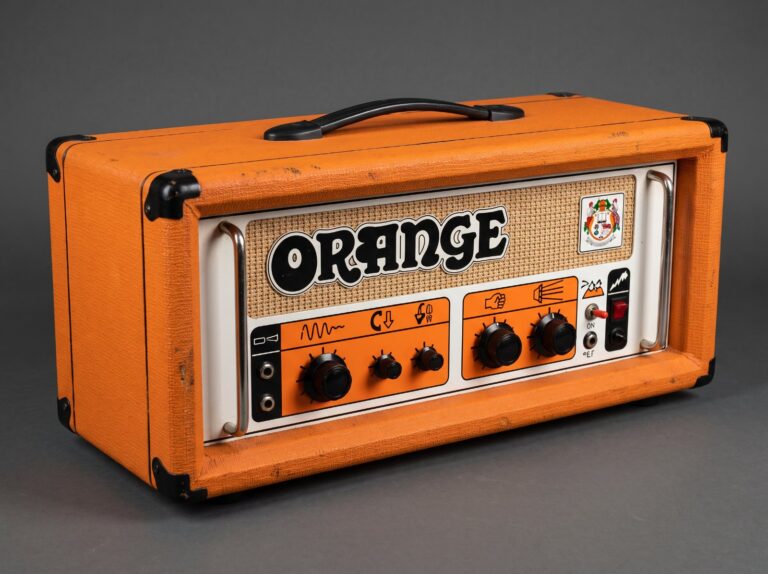
There is a short list of amplifiers that earn the phrase “tone machine” without qualification. The Orange Retro 50 Head is on it. Built in Orange’s UK Custom Shop using point-to-point wiring, a pair of EL34 output valves, and a control layout that owes everything to the brand’s early 1970s pictogram-panel legacy, it delivered 50 watts of pure British rock authority at a time when most boutique manufacturers were chasing complexity. The Retro 50’s answer to complexity was simplicity pushed to perfection — and its circuit became the direct blueprint for its successor, the Orange Custom Shop 50, when the Retro 50 ran its course in 2012.
This is the amp Stephen Malkmus ran through a Marshall 4×12, and he liked it so much he literally removed the “O” from the badge so it read “RANGE” — a reference to Pavement’s own song “Range Life.” PJ Harvey used one alongside a Vox AC30 to achieve the saturated, almost tactile overdrive that defined her live performances through the 2000s. Neither of those facts appears anywhere in Orange’s standard marketing. Both are primary-source confirmed, and both tell you more about what this amp actually does than any spec sheet ever could.
Forty Years of Orange in a Box
Orange Amplification was founded in 1968 by Cliff Cooper in London’s Denmark Street, opening as a music shop and pivoting to amp manufacturing when Cooper noticed that guitarists were more interested in what was behind the counter than the retail stock out front. The earliest Orange amps carried full-text control panels — Gain, Volume, Treble, Bass — until the early 1970s, when the brand made a decision that still defines its visual identity: replace all text labels with hand-drawn pictograms. The philosophy was pure and, in retrospect, brilliant. A graphic of a flame under a control means “it makes things hotter” regardless of what language you speak.
The OR50, launched in the early 1970s as part of a family that included the OR80, OR120, and OR200, was the workhorse of that Pics Only era. Single-channel, nominally 50 watts, four EL34 valves in a Class AB output stage — it was the amp you reached for when you didn’t need 100 watts of headroom but still needed to fill a room. Countless British rock bands of the early-to-mid 1970s ran OR50s and never looked back. The OR120 got the press because Jimmy Page used one; the OR50 got the gigs.

When Orange returned to its Custom Shop roots in the early 2000s — building limited quantities of hand-wired, point-to-point amplifiers representing the absolute pinnacle of what the company knew how to do — the natural reference point was that Pics Only legacy. The result was the Retro 50: a 50-watt head using two ECC83/12AX7 preamp valves and two EL34 output valves, hand-wired in the UK, with a Pics Only graphic control panel and no concessions to modern convenience features. No reverb. No effects loop. No digital anything. Just the circuit, the transformers, and whoever is on the other side of the guitar cable.
The Retro 50 remained in production from approximately 2002 to 2012, appearing under two labeling conventions: “Custom Shop” in boutique and direct channels, and “Vintage Series” at major US retailers including Guitar Center and Musician’s Friend. The circuit is the same across both labels: two ECC83s driving two EL34s, Orange’s characteristic interactive tone stack, a footswitchable gain boost, and a rear-panel switch choosing between 50-watt Class AB and 30-watt Class A operation.
At Winter NAMM in January 2013, Orange announced the Custom Shop 50 as the Retro 50’s direct successor. The press release said it plainly: the Custom Shop 50 “has a vintage flavour much in the same way as its predecessor the Retro 50, of which the circuit is based upon.” The CS50 added an HF Drive presence control and replaced the Retro 50’s footswitchable gain boost with a more refined “EQ Lift” footswitch function. MusicRadar, reviewing the Custom Shop 50 in June 2013, called it “the most satisfying straight-up 50-watt classic rock head we’ve played in decades.” That assessment applies equally to the Retro 50 that preceded it.
Custom Shop vs. Vintage Series: Naming Clarity
The Orange Retro 50 appears in the used market under at least three naming conventions: “Retro 50 Custom Shop,” “Vintage Series Retro 50,” and simply “Orange Retro 50 Head.” Based on available sourcing, these represent the same circuit at different tiers of hand-wiring or across different sales channels rather than meaningfully different products. The fully hand-wired Custom Shop version — point-to-point wiring over turret boards, heavy-gauge copper throughout, full internal powder-coating — is the version most collectors seek. When buying used, request interior photos and compare the wiring layout against established Custom Shop reference examples before committing to a price at the top of the market. A PCB-based “Vintage Series” unit, if such a distinct build level exists, will look visually different inside and should be priced accordingly.
A further naming note: the OR50H (Orange’s production-line reissue of the original 1972 OR50, available through standard retail channels) is a different product from the Retro 50. The OR50H is a PCB-based production amp built to standard commercial spec. The Retro 50 is a Custom Shop hand-wired piece. They share a lineage and general sonic character but are not interchangeable on the used market, and their valuations should reflect that distinction.
Specifications
| Feature | Specification |
|---|---|
| Output Power | 50W Class AB / 30W Class A (rear-panel switch) |
| Channels | 1 (single channel) |
| Preamp Valves | 2× ECC83 / 12AX7 |
| Output Valves | 2× EL34 |
| Speaker Outputs | 8Ω, 16Ω |
| Inputs | 1× instrument input |
| Controls | Volume, Bass, Treble, Master; footswitchable gain boost |
| Effects Loop | None |
| Reverb | None |
| Construction | Hand-wired point-to-point; turret boards; internal powder-coating |
| Panel Style | Pics Only — graphic pictogram symbols, no text labels |
| Production Period | ~2002–2012 |
| Successor | Orange Custom Shop 50 (NAMM 2013) |
| Used Market Price (2026) | From ~$1,545 (Reverb) |
A note on the valve count: the original 1970s OR50 used four EL34 output valves in a standard push-pull Class AB configuration. The Retro 50 uses two, which is the common arrangement in modern 50-watt designs and is not a shortcut. Two EL34s in the right circuit with the right output transformer deliver 50 clean watts and substantially more perceived headroom than the rating suggests, because much of the amp’s character emerges from early preamp-stage saturation rather than power-stage clipping. The output transformer spec matters more than the valve count — and Orange’s Custom Shop transformers are built to survive decades of professional use.
Famous Players
Stephen Malkmus
Stephen Malkmus is not a player who makes conventional amp choices, and the Orange Retro 50 fits his aesthetic precisely. Guitarist, singer, and primary songwriter of Pavement during their 1989–1999 run, and leader of The Jicks since 2001, Malkmus runs the Retro 50 head through a Marshall 4×12 cabinet. The pairing combines Orange’s mid-forward EL34 saturation with the Marshall cab’s efficiency and top-end articulation, landing on a tone that is simultaneously grungey and precise — exactly what Pavement’s recordings implied was happening and what The Jicks’ live performances confirmed.
The detail that got into music press and never left is the badge modification. Malkmus removed the “O” from the “ORANGE” logo panel so the amp reads “RANGE” — a direct reference to “Range Life,” track five on Pavement’s 1994 album Crooked Rain, Crooked Rain. The song’s second verse contains the Smashing Pumpkins jab (“I don’t understand what they mean / And I could really give a fuck”) that generated significant mid-90s press, but the amp modification is the quieter, more durable piece of wit: it turns a piece of gear into a lyric without anyone else having to do anything. No other confirmed Retro 50 player is documented doing anything that specific with the product.
Malkmus typically pairs the Retro 50 with a Fender Jazzmaster — an offset with characteristically aggressive single-coil attack and slight instability in the bridge that the EL34 output stage transforms from a quirk into a feature. The EL34’s natural compression catches Jazzmaster-style pick transients and rounds them while preserving the initial bite, which is exactly why the pairing recurs across the documented Malkmus live rig evidence.
PJ Harvey
Polly Jean Harvey’s amplifier setup for the majority of her live appearances combined a Vox AC30 and an Orange Retro 50 head running into Marshall 4×12 cabinets — a setup documented in Mixdown Magazine’s gear rundown of her rig. The characterization of the result: “an immensely saturated tone.”
That description is acoustically precise. The Vox AC30 runs EL84s in Class A, delivering compressed chime and the top-end bloom the amp is famous for. The Orange Retro 50’s EL34 Class AB section adds low-mid weight, pick definition, and sustain that the AC30 doesn’t naturally generate at its own sweet spot. Running them together — either blended from a splitter or assigned to different frequency responsibilities in the signal chain — produces a layered saturation that sits under Harvey’s vocals rather than competing with them. Her documented live pedalboard adds Boss DS-1 distortions on top of that combination, giving the live sound its characteristic controlled ferocity: dense, physical, and never quite distorted enough to obscure the chord voicing underneath.
Harvey isn’t on Orange’s official artist roster, and no interview places her explicitly naming the Retro 50 as a deliberate amp choice. The Mixdown documentation is an informed gear-rundown observation, not a first-person quote. That is the honest picture: verified equipment, unverified intent.
The Retro 50 Roster
Jimmy Page, Jim Root, Brent Hinds, Omar Rodríguez-López, and Matt Pike are listed as Retro 50 players. None of the five are documented on a Retro 50 by any primary source.
Jimmy Page‘s Orange history is the OR120/OR200 (1971–1973) and the AD30 family from 1999 onward — hand-wired Custom Shop instruments, yes, but not the Retro 50. Brent Hinds’s signature Orange is the Brent Hinds Terror, a separate product on a separate chassis with a separate circuit. Rodríguez-López’s primary documented Orange amp is the AD140HTC, verified with photo documentation through 2011. Jim Root’s documented Orange amps are the Rockerverb 100 and his own #4 Jim Root Terror. Matt Pike is documented on the Dual Dark, Thunderverb, and the OR50/OR80 production reissue series. None of those instruments is a Retro 50.
Equipboard also lists Arturo Arredondo and three additional players against the Retro 50, for a total of six. Arredondo does not have a public profile that confirms a primary-source SKU-level connection; the listing appears to be community-submitted without a linked documentation chain. This article reflects what can be verified.
Tone Recipes and Settings
Malkmus Indie Crunch
Offset guitar (Jazzmaster or Jaguar) into the Retro 50 with Volume at 7, Treble at 6, Bass at 5, Master at 6–7. Gain boost off. The inherent breakup of two EL34s at this master volume level does the work without needing the boost engaged. Pick attack arrives hard and clear; notes bloom into sustain within a beat; midrange is prominent without congestion. Guitar volume at 8 gives you the cleanest version of this setting. Roll to 10 for maximum grit. 50W Class AB mode.
PJ Harvey Saturated Drive
Telecaster or Jaguar into Boss DS-1 (moderate gain, tone at 10 o’clock) into the Retro 50 with Master at 8, Treble at 5, Bass at 6, gain boost on. The amp’s natural compression catches the DS-1’s edge and rounds it while preserving the initial transient. Into a Marshall 4×12, this produces Harvey’s live sound: dense, physical, and never quite distorted enough to obscure the chord voicing underneath. The pairing rewards playing through the attack rather than into it.
Classic British 50-Watt Rock
Les Paul into the Retro 50, Volume at 5, Treble at 7, Bass at 4, Master at 8. 50W Class AB. Guitar volume at 8. This is the template for everything from Free to AC/DC to classic Oasis: pick hard and you get a snarl; back the guitar volume to 5 and you get a clean that still has personality. The EL34 character at this master setting is unmistakably British — warm at the bottom, aggressive at the upper mids, and sustaining into the next bar without becoming compressed noise.
Class A Chime and Touch
Telecaster into the Retro 50 in 30W Class A mode. Volume at 6, Treble at 7, Bass at 3, Master at 7. No gain boost. Class A operation introduces more upper-mid complexity and touch sensitivity, moving the amp character closer to the Vox family at the threshold between clean and broken-up. This is the recipe for early Fleetwood Mac-style sustained lead lines where note decay is as important as the attack. Note: 30W Class A is not simply a quieter version of 50W Class AB — at certain volumes MusicRadar’s CS50 review noted the 30W setting can sound louder in the room, because the character sits differently in the mix.
Stoner and Desert Rock
Humbucker-equipped guitar into a Big Muff or similar fuzz into the Retro 50, gain boost on, Master at 9, Treble at 4, Bass at 7. The Retro 50’s mid-forward EL34 character prevents heavy fuzz from turning into undifferentiated noise: the amp sorts frequency content even when the pedal is not doing so. Into a 4×12, this produces the QOTSA/Sleep zone where you can hear individual string movement inside the chord. Roll the guitar’s tone knob down one increment from full for maximum density without losing articulation.
Comparisons
Orange Rockerverb 50 MKIII
The Rockerverb 50 MKIII is the production-line answer to the same wattage bracket: two channels, built-in reverb, series effects loop, switchable wattage, available new through retailers worldwide. It’s the modern professional workhorse where the Retro 50 is the no-compromise specialist. The Rockerverb’s Clean channel achieves genuine clean tones where the Retro 50’s single channel always has some drive baked in. For touring musicians who need channel versatility without pedal dependency, the Rockerverb is the practical choice. For players who want one great sound and never need a clean safety net, the Retro 50 is the purer instrument — and on the used market, often the less expensive one.

Orange AD140HTC
The AD140HTC shares the EL34 output-stage character and Custom Shop lineage but runs at 140W and a higher plate voltage (~550V). That extra voltage translates to greater tightness, more dynamic headroom, and resistance to power-stage sag. The Retro 50 sags slightly earlier at Class AB master volume, which is precisely what players looking for organic power-amp compression want. If your venue is under 500 people and you’re not mic’ing a 4×12 for FOH, the 50-watt Retro 50 is more than enough. The AD140HTC is for stadium-adjacent applications where the front-of-house feed still needs clean authority at 120dB on the floor.
Vox AC30 Top Boost
PJ Harvey ran these two together, which tells you everything about how they complement each other. The AC30’s EL84 Class A output section produces chime, compression, and top-end bloom. The Retro 50’s EL34 Class AB section produces weight, pick definition, and sustain at the lower end of the midrange. They don’t overlap much spectrally, which is exactly why the combination works. Used alone, the AC30 is the choice for jangle and complex clean tones; the Retro 50 is the choice for when the sound needs to physically push against you. Used together, they cover everything from Buddy Holly to Nick Cave.
Marshall JCM800 2203
Both amps use EL34 output valves and occupy the “single-channel British rock” category. The JCM800 2203 is tighter in the low end, more aggressive in the upper midrange, and reaches its classic sound at higher master volume settings. The Retro 50 is warmer and more compressed at lower master volumes, with less of the JCM800’s pronounced upper-mid bite. Malkmus chose the Retro 50 specifically, and his guitar tone — loose, slightly smeared, responsive to pick dynamics — is consistent with the Retro 50’s lower-tension character compared to the JCM800’s more forensic clarity. Players who want clean-to-mean discipline lean JCM800; players who want the amp to breathe lean Retro 50.
Orange AD30HTC
The AD30HTC is the EL84 30W sibling in Orange’s hand-wired Custom Shop lineage. EL84s at 30W produce a higher-frequency saturation character — faster, more jangly, less physically heavy — compared to the Retro 50’s EL34 50W. The AD30 is the better choice for chimey, Vox-adjacent tones with pick sensitivity that suits single-coil playing. The Retro 50 is the better choice for the heavier, more saturated end of the same family, especially with humbuckers. Both are discontinued; both appear on the used market at broadly comparable price points; the choice between them comes down to whether EL84 or EL34 character is closer to the sound in your head.
Buying Guide: The Used Market
The Orange Retro 50 is discontinued and has been since 2012. Current used pricing on Reverb (August 2026) starts around $1,545, with hand-wired Custom Shop examples in excellent condition typically commanding more. The Custom Shop 50 — the direct circuit-based successor — also appears on the used market and offers a measurable spec upgrade (HF Drive presence control, refined EQ Lift footswitch, more developed gain architecture) for comparable or sometimes slightly higher prices. If you find a Custom Shop 50 at a price similar to a Retro 50 in equivalent condition, the CS50 is the harder amp to replace and arguably the more complete product.
When evaluating a used Retro 50, verify the following before committing:
- Interior photos. Point-to-point hand-wired examples have visually distinct wiring — neat, heavy-gauge copper runs between components on turret boards with full internal powder-coating. A PCB-based unit will look entirely different inside. Know which version you are buying before agreeing on a price.
- Output valve condition. EL34s wear predictably over time. Ask when they were last replaced and by whom. A tech sign-off with measured bias points is ideal for a used purchase at this price level.
- Impedance matching. The Retro 50 offers 8Ω and 16Ω outputs. Running an 8Ω cab into the 16Ω tap (or vice versa) does not blow the amp immediately, but sustained impedance mismatch shortens output transformer life. Match the tap to the cab and document which tap is connected so you do not have to guess during a load-in.
- Speaker output socket behavior. Older Custom Shop examples may have UK-spec switching speaker jacks that disconnect the speaker when a second load is plugged into the parallel socket. Understand how the output section is wired before gigging the amp for the first time.
- Footswitch cable. The gain boost requires a standard latching footswitch with a standard TRS or TS cable (verify the jack spec on the unit before purchase). A missing footswitch is a minor inconvenience but worth noting in price negotiations.
Ownership Notes
The Retro 50 has no effects loop, which means time-based effects — reverb, delay, chorus — go in front of the amp. This is not a compromise; many engineers prefer the character of reverb run into a driven preamp input. The saturation thickens the reverb tail rather than treating it as a separate event, which produces a more cohesive sound at moderate gain settings. Place reverb last in your pedal chain and set it to a shorter decay than you think you need; the amp’s natural sustain adds length to the note that long reverb tails only congeal.
The 30W Class A mode is not a volume reduction from the 50W Class AB setting — it changes the fundamental character of the output section. In Class A operation you get more upper-mid complexity, more touch sensitivity at the threshold between clean and broken-up, and a slightly different harmonic profile in the upper register. Some players prefer Class A for recording because the extra complexity translates well to digital capture; others prefer Class AB live because it is more linear and physically present in a band mix. Run both settings for at least ten minutes each in an actual playing context before deciding which one is “your” sound. Several players who purchased the Retro 50 expecting to stay in Class AB permanently find they never leave Class A once they hear it in a band.
The Pics Only panel means there are no printed control positions to reference between sessions. Develop a clock-face notation for your go-to settings (for example: “Treble 2 o’clock, Bass 10, Volume 2, Master 3”) and keep it taped to the inside of your road case until you have internalized the amp’s response by feel. This takes roughly a month of regular use, after which the panel graphic becomes invisible because your hands know where everything lives. This is exactly how the original 1970s OR50 players navigated the same interface — which is also why the Pics Only philosophy worked then and still works now.
Frequently Asked Questions
Is the Orange Retro 50 still in production?
No. The Retro 50 was produced from approximately 2002 to 2012 and was succeeded by the Orange Custom Shop 50 (announced NAMM January 2013), which shares the same circuit architecture but adds an HF Drive presence control and a revised EQ Lift footswitch function. Both are now out of production; both appear regularly on the used market.
What is the difference between the Orange Retro 50 and the Custom Shop 50?
The Custom Shop 50 is the direct circuit successor — Orange’s own press release stated it “has a vintage flavour much in the same way as its predecessor the Retro 50, of which the circuit is based upon.” The CS50 added an HF Drive (presence) control and refined the gain architecture into a more interactive Gain, Bass, Treble, Master, HF Drive layout. The Retro 50 uses a simpler control set with a footswitchable gain boost in place of the EQ Lift. The fundamental EL34 British rock character is the same in both; the CS50 gives you more front-panel control over it.
What is the difference between the Orange Retro 50 and the OR50H reissue?
The OR50H is Orange’s production-line reissue of the original 1972 OR50, built to standard commercial spec — PCB-based construction, available through regular retail channels, and priced accordingly. The Retro 50 is a Custom Shop hand-wired product built in limited quantities to a higher spec. Both share a lineage and general tonal character, but they are not the same amp at the same build level, and their used-market valuations should reflect that. When evaluating either for purchase, an interior photograph is the fastest way to distinguish between a point-to-point hand-wired build and a PCB-based production unit.
Does the Orange Retro 50 have an effects loop?
No, and neither does its successor the Custom Shop 50. This is a deliberate design decision consistent with Orange’s no-compromises philosophy for these Custom Shop instruments. Every added circuit path introduces some tonal interaction, and these amps were built to minimize that. Run effects in front of the amp. If post-preamp time-based effects are non-negotiable in your rig, consider a power-soak/reactive load device with a direct out that feeds back into an effects return on a second amp — an unusual but functional workaround that preserves the Retro 50’s signal chain integrity.
What speaker cabinets work best with the Orange Retro 50?
Both Malkmus and Harvey ran the Retro 50 into Marshall 4×12 cabinets, which are the natural pairing for EL34-based British heads. Celestion Vintage 30s and G12T-75s match the amp’s mid-forward character without fighting it in the 1–4kHz range where the EL34 does most of its work. Celestion Greenbacks can also work well in a 4×12, but verify that your total cab impedance matches one of the amp’s two output taps (8Ω or 16Ω) before connecting. For smaller configurations, a 2×12 at 16Ω total is a practical and well-matched alternative that brings the amp into a more manageable volume range for rehearsal and club-size venues.
Should I re-bias the EL34s myself?
Only if you are a qualified electronics technician. The Retro 50 is a hand-wired Custom Shop amplifier operating at professional plate voltages. EL34 replacement and biasing require measurement of plate current and correct bias point adjustment for whichever replacement variant you are using (JJ EL34, TAD EL34B, Mullard reissue, Electro-Harmonix, and so on — all bias slightly differently). Incorrectly biased EL34s in a hand-wired amp at these voltages will shorten valve life at best and damage the output transformer at worst. Budget a tech fee into your valve replacement cycle; it is cheap insurance on an amp that cannot be replaced from new stock.
Is the Orange Retro 50 good for metal?
It depends on the metal. The Retro 50 does British hard rock extremely well — AC/DC, Black Sabbath Volume 4 onward, classic QOTSA. It will not do tight, scooped modern high-gain metal the way a Mesa Dual Rectifier or ENGL Powerball does, because its low end is inherently warm and its gain character is smooth rather than surgical. Players who want heavier material from the Retro 50 typically place a high-gain fuzz or overdrive in front, which gives the density needed while preserving the amp’s midrange character in the note decay. The EL34 output stage sorts fuzz into something articulate in a way that EL84 amps rarely do.
What replaced the Orange Retro 50 in Orange’s current lineup?
The Custom Shop 50 succeeded it directly (2013), and that in turn has run its course. As of 2026 Orange’s lineup centers on the production Rockerverb and TH Series for the full-featured professional market, the Terror Series for lunchbox heads, and the OR series (OR15H, OR50H reissue, OR120H reissue) for players who want Pics Only simplicity in a production build. None of those amps are hand-wired Custom Shop instruments. The Retro 50 and Custom Shop 50 represent a specific period of Orange’s history — the early 2000s through mid-2010s — when the company built its most exclusive instruments in limited quantities that were never widely distributed. That scarcity is now permanent.
Image credits
- An empty stage with an amp, drums and a guitar case: Keith, Wikimedia Commons, CC BY-SA 2.0.
- A guitarist on stage with an amp behind: Bex.Walton, Wikimedia Commons, CC BY 2.0.
- Jimmy Page: Avda, Wikimedia Commons, CC BY-SA 3.0.
Latest News
Related
On This Day
Monday 9 November
From this week: