Four Amps in One Box: Why the Marshall JCM2000 DSL100 Became the Working Guitarist’s Secret Weapon
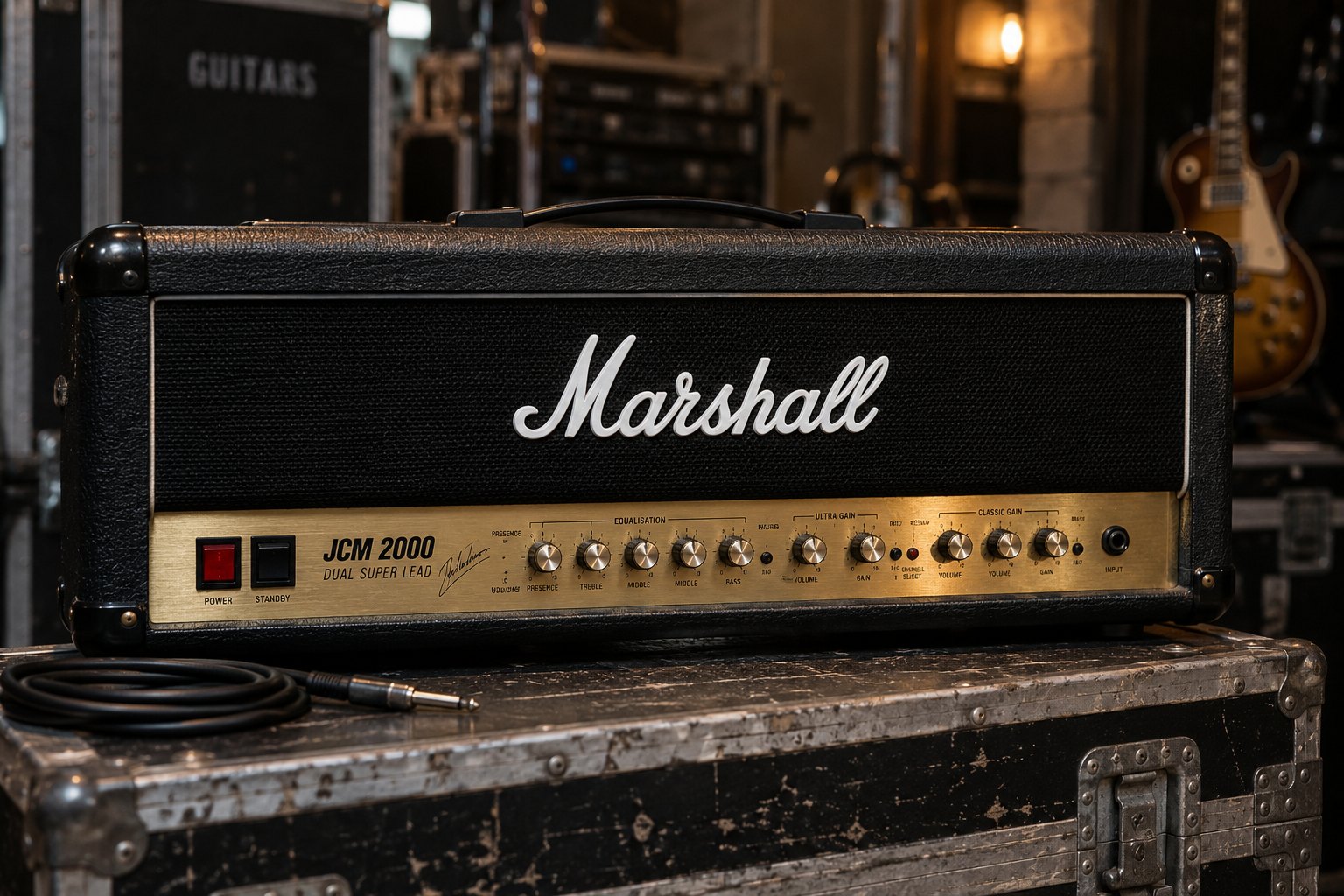
Marshall JCM2000 DSL100. AI-generated reference illustration, not a photograph.
Marshall JCM2000 DSL100: specs, verified players, tone recipes and buying guide for the Dual Super Lead — the British tube head that defined working-pro rock.
There are amplifiers that define a decade, and then there are amplifiers that quietly power that decade from behind the scenes — showing up on major stages night after night without the fanfare of their more celebrated ancestors. The Marshall JCM2000 DSL100 is firmly in the second category. Launched in 1997 as Marshall’s first serious attempt to build a truly versatile, multi-mode all-tube head for the modern era, the DSL100 never quite earned the mythological status of the JCM800 or the vintage Plexi. It didn’t need to. It just worked — delivering crushing British crunch, smooth lead tones, and cleaner headroom than any Marshall had managed at high gain before it, all from a single chassis running four EL34 power tubes through a preamp that actually used tubes to generate its distortion instead of cheating with diode clipping.
Two decades on from its debut, the DSL100 remains one of the most misunderstood amps in the Marshall catalog. Dismissed by tone purists who prefer single-channel simplicity, overlooked by high-gain addicts who want more gain than it can deliver stock, and perpetually undersold on the used market — it has become one of the great bargains in British amp history. This is the story of the amplifier that kept Marshall relevant through a period when the brand faced its fiercest competition, and why it’s still earning its place in serious rigs from bedroom setups to major headlining tours.
The Context: Why Marshall Needed the JCM2000
By the mid-1990s, Marshall’s position as the default choice for rock and metal was under genuine threat. The Mesa/Boogie Dual Rectifier had arrived in 1992 and was being adopted at an astonishing rate by everyone from thrash metal acts to grunge bands who wanted something heavier than a Plexi could deliver without a Tube Screamer in front of it. Peavey’s 5150 — designed with Eddie Van Halen and released in 1992 — gave players a tight, aggressive, surgically precise high-gain sound that the Marshall lineup simply could not match. Even within the Marshall catalog, the JCM900, released in 1990 as the intended successor to the legendary JCM800, had proven divisive: its use of diode clipping in the preamp path gave it a harder, more compressed character that many players found thin or buzzy compared to the older all-tube designs.
Marshall’s answer was the JCM2000 series, announced in 1997 and arriving in two configurations: the Dual Super Lead (DSL) in 50- and 100-watt heads and matching combos, and the Triple Super Lead (TSL) in 100-watt head form with a third channel. The DSL100 was the flagship of the DSL range — 100 watts, two channels, each with two modes, four ECC83 preamp tubes, four EL34 power tubes, and a comprehensive set of controls that put genuine tonal sculpting in the player’s hands without requiring a rack full of outboard gear. The “JCM2000” name was a marketing statement of intent: this was Marshall’s amp for the new millennium, built on the engineering vocabulary of the classic range but reimagined for a generation of players who demanded more from a single head.
Critically, Marshall’s engineers made a decision that would define the DSL’s character: they went back to all-tube gain generation. Where the JCM900 had leaned on op-amp circuitry and diode clipping, the DSL’s preamp used additional 12AX7 gain stages to build up distortion organically, the same basic philosophy as the great Plexis and JCM800s. The result was warmer, more dynamic, and — especially at higher gain settings — richer in harmonics than the 900 had managed. It wasn’t a vintage amp in modern clothing; it was a genuine attempt to evolve the Marshall sound forward while keeping its soul intact.
Architecture and Controls: Four Amps in One Head
The DSL100 is built around two independent footswitchable channels — Classic and Ultra — with each channel offering two distinct modes. This architecture gives the amp what Marshall’s marketing team called “four amps in one head,” and for once that hyperbole is largely justified.
The Classic channel operates in Clean and Crunch modes. At lower gain settings on Clean, with the volume pushed, the DSL delivers the kind of warm, touch-responsive British clean that the vintage 1959 Plexi was famous for — not crystal-clear American clean, but airy, slightly musical, and responsive to pick attack. Push the gain on the Crunch mode and you’re into JTM45-meets-JCM800 territory: a rich, harmonically complex breakup that responds to your picking dynamics and rewards the right picking technique with extraordinary note separation even in distortion. This is the channel that Gary Moore famously lived on, and for blues-inflected rock work it remains one of the great sounds the DSL produces.
The Ultra channel runs significantly hotter. Lead 1 delivers a compressed, singing high-gain voice well-suited to melodic lead work — creamy sustain, smooth pick attack, and a midrange character that sits in a band mix without becoming harsh. Lead 2 opens the gain structure further, delivering the most aggressive sound the DSL100 can make stock: tight, punishing, and with a characteristic British midrange honk that separates it from the more scooped American high-gain sound of the Recto or 5150. Both Ultra modes have a Tone Shift switch that cuts midrange in a similar fashion to the presence of American high-gain amps, useful for players who find the DSL’s natural voicing too mid-heavy for their pickup or guitar combination.
Each channel has its own independent Gain and Volume controls, and both share a single three-band EQ (Treble, Middle, Bass) along with a Presence control — the shared EQ is one of the DSL’s most frequently cited limitations, as dialing in a tone that works for both channels simultaneously requires careful compromise. A Deep switch on the Classic channel adds low-end emphasis, useful for heavier rhythm work. The amp also includes a series/parallel effects loop and spring reverb, with independent reverb level controls for each channel.
Power output is selectable between 100 and 50 watts via a switch on the rear panel, allowing players to run at reduced power for recording or smaller venue situations without sacrificing the EL34 tube character. The power section runs four EL34 pentodes, the tube type that has defined the British rock sound since the 1960s — warmer in the upper midrange and more compressed in the top end than the 6L6s used in most American designs, with a distinctive sag and bloom that rewards players who understand how to interact with power amp dynamics.
Technical Specifications
Verified Famous Players
The DSL100 was a working professional’s amplifier, and its user base reflects that — it shows up consistently in the rigs of players who needed reliable, high-quality tone night after night rather than the amp of a single iconic guitarist who used nothing else. Identifying players who specifically used the DSL100 requires some care, because the JCM2000 name covers both the DSL and TSL series, and Marshall’s broader artist roster spans multiple amp generations.
Gary Moore — The DSL100’s Most Famous Advocate
The most confirmed and documented high-profile user of the JCM2000 DSL100 is Gary Moore, the Belfast-born guitarist who was already established as one of rock and blues’s greatest voices by the time the amp debuted. From the late 1990s onward, Moore became one of the DSL100’s most prominent users, integrating the amp into a rig that also included vintage Plexis and custom-hotrodded units. His personal first-production JCM2000 DSL100 (serial number M-1997-37-1416-A, built in 1997 and housed in a Calzone flight case with his name stenciled on it) was sold at Bonhams auction — physical evidence of how seriously he regarded the amp.
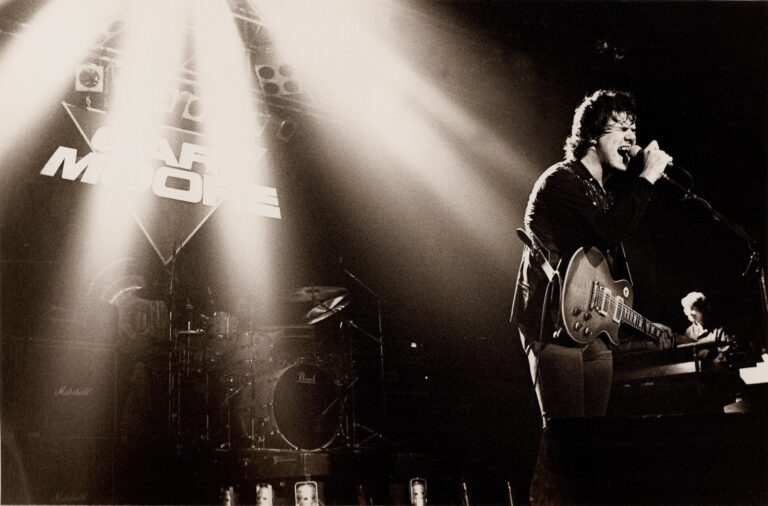
Moore’s preferred approach to the DSL100 was rooted in the Classic channel: he favored the Crunch mode with the gain set moderately, using the amp’s natural compression and an overdrive pedal — he experimented constantly with different options, including a Guv’nor — to push the front end and generate his distinctive woman-tone sustain. For his famous endless-sustain-note passages, he’d switch to the Ultra channel’s Lead modes. The DSL100 suited his playing style because its Classic channel responded to pick attack and touch dynamics the way a vintage Marshall does — the harder you pick, the more it opens up — while giving him the option of serious gain on tap when the song demanded it. For players trying to approximate Moore’s tone with modern equipment, the DSL100 is one of the more accessible starting points: a boosted green channel into the Classic Crunch mode with a Tube Screamer in front covers a lot of ground.
Joe Bonamassa — Clean Channel Master
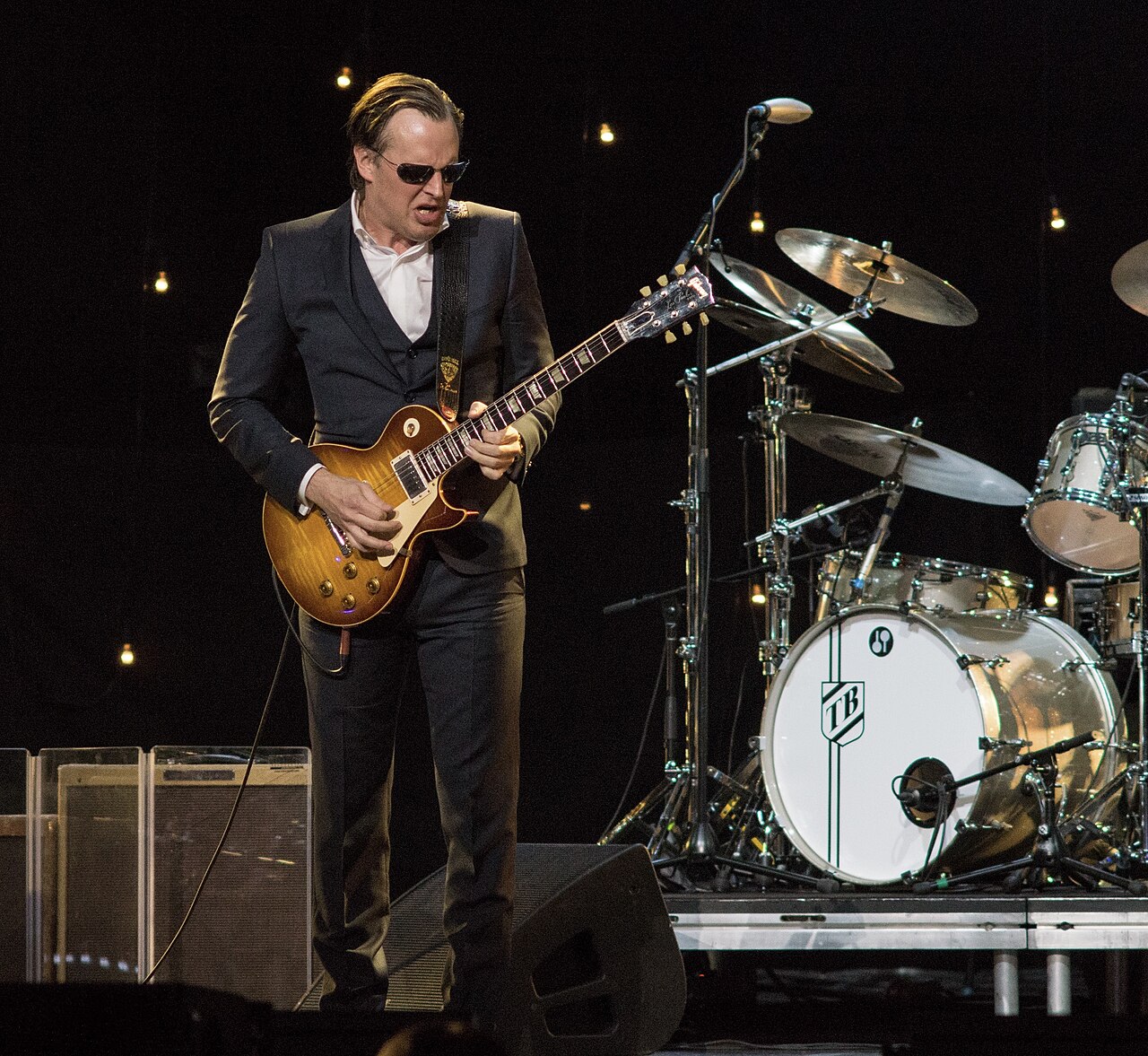
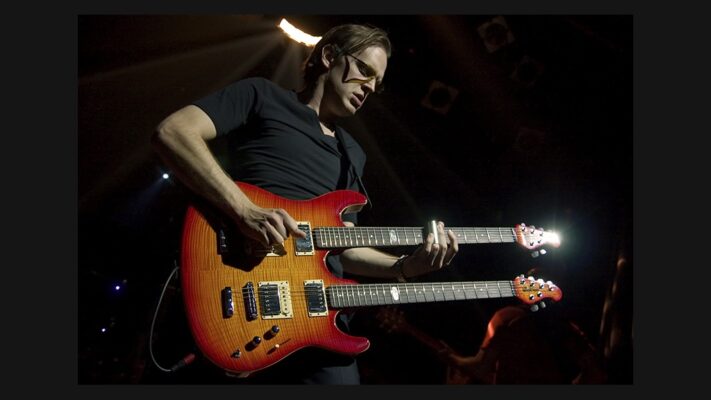
Joe Bonamassa has been open about his DSL100 use in the context of his elaborate multi-amp live rig. According to a Premier Guitar Rig Rundown, Bonamassa’s guitar tech described the DSL100 as “the secret” to his live tone — specifically, Bonamassa runs the amp on the Clean channel with effects including delay and rotary in the loop, sending signal out to four 1968 Marshall cabs loaded with original Celestion Greenbacks. It’s a counterintuitive use of an amp with a reputation for high-gain work, but it illustrates the DSL100’s underappreciated versatility: its clean headroom, when combined with the character of those original Celestions, delivers the kind of woody, touch-sensitive clean that works as the foundation of a layered effects-driven lead sound.
Bonamassa’s approach is worth understanding for anyone building a similar rig: he uses the DSL’s clean channel as a platform rather than a destination, letting his signal chain shape the tone rather than leaning on the amp’s gain structure. The DSL100’s clean headroom at performance volumes — particularly at 100 watts — is substantial enough to support this approach even at high stage volumes, which is exactly why it works for a player of Bonamassa’s caliber who demands consistency at arena scale.
Jeff Beck and Ritchie Sambora
Jeff Beck has been cited by multiple credible sources in the guitar community as a DSL series user, consistent with his well-documented history of using Marshall amplification throughout his career while remaining open to new tools that delivered the British character he was after. Beck’s fluid, feedback-laden playing style benefits from an amplifier with responsive touch dynamics and controllable sustain — characteristics the DSL Classic channel delivers. Ritchie Sambora of Bon Jovi has similarly been identified as a DSL user, consistent with his professional-grade Marshall-centric rig across the band’s touring history. Both connections are plausible given their long-standing Marshall relationships, though neither has been documented in a dedicated Rig Rundown with specific DSL100 reference.
Iron Maiden, Nile, and the Heavy Metal Underground
Iron Maiden used DSL100 heads as power amps in their rig — running preamp signals through the DSL’s power section to drive their cabinets. This configuration illustrated the amp’s reputation for having a particularly strong and musical EL34 power section: if you’re using the amp purely as a power amplifier for your tone, you’re saying a lot about how good that power section sounds. Karl Sanders and Dallas Toller-Wade of death metal act Nile were documented DSL users, finding in the Ultra channel’s gain structure a usable metal tone that could be processed without the character disappearing. Gary Holt used three DSL100 heads with Slayer during a period of his career, again pointing to the amp’s ability to deliver heavy gain tones in a live metal context.
A Note on Other Claimed Users
The DSL100 is sometimes listed alongside the names of players whose primary Marshall connections are to other models. Slash is most specifically associated with the Marshall Silver Jubilee and his signature AFD100 (the amp modeled on the modified JCM800 that produced the Appetite for Destruction sound). Tom Morello‘s entire RATM and Audioslave career ran on a Marshall JCM800 2205 — a choice he has discussed at length and not deviated from across three decades. Zakk Wylde‘s signature tone is built around modified JCM800s and his signature models. Kerry King‘s rig is centered on Mesa/Boogie Dual Rectifiers and his signature models. Listing these players alongside the DSL100 conflates the broader Marshall brand with the specific amp — understandable given Marshall’s ubiquity, but worth being precise about when the actual gear that shaped their recorded sounds is under discussion.
The DSL100’s Role in Late-90s and 2000s Rock
Even without a single superstar avatar, the DSL100 made an enormous collective impact on the sound of rock music from 1997 through the mid-2000s. It was the amp that appeared on countless Guitar World back-page ads, that populated the backlines of mid-level touring acts who needed professional Marshall tone without the fragility and expense of vintage units, and that enabled a generation of working guitarists to access convincing British rock sound in a reliable, repairable, readily available package.
For the cohort of rock guitarists who came of age between 1997 and 2008 — who were drawn to Marshall but needed more than a cranked single-channel amp for live work — the DSL100 was often the amplifier that bridged the gap. It appeared routinely in the pages of Guitar World and Guitar Player during this period not because it was the most glamorous Marshall, but because it was the most practical one: it could do clean, crunch, and high gain without requiring three separate heads or a sophisticated preamp system. For a working band doing 200-night tours, that versatility had genuine economic and logistical value that the vintage purists rarely acknowledged.
The used-market evidence tells the story clearly: the DSL100 was manufactured in large quantities because it was purchased in large quantities by professional and serious amateur players who needed what it could do. Its prevalence on the used market today is a consequence of how many were sold, not of how quickly players abandoned it — a distinction that matters when assessing its legacy.
Tone Recipes and Settings
The DSL100 rewards careful EQ management and benefits significantly from quality tubes in the preamp positions. Because the amp’s tone is substantially generated in its preamp — a consequence of the multiple gain stage design — swapping the first two preamp tube positions (V1 and V2) has a more dramatic effect on sound character than in a simpler design. The factory tubes are functional but not exceptional; upgrading to a quality 12AX7 in V1 (Mullard reissue, Tung-Sol, or JJ ECC83) will noticeably improve the amp’s detail and touch response.
For classic rock rhythm tones on the Classic channel (Crunch mode): Gain at 5-6, Volume to taste (higher for more power amp saturation), Treble 6, Middle 6, Bass 5, Presence 6-7, Deep Switch off. Pair with a Les Paul or SG for maximum British character.
For Gary Moore-style blues-rock lead tone on Classic Crunch: Gain 5-7, Treble 6, Middle 7, Bass 5, Presence 6. Add a Tube Screamer TS9 in front — Level high, Tone at noon, Drive low. This boosted-green-channel approach was Moore’s documented method and remains one of the most effective uses of the DSL100.
For aggressive rhythm on the Ultra channel (Lead 1): Gain 6-7, Treble 6, Middle 5, Bass 5, Presence 7, Tone Shift off (try on for more American flavor). A Boss SD-1 or RAT 2 in front will tighten the low end and add attack clarity to the inherently mid-heavy British character.
For high-gain lead on Ultra Lead 2: Gain 7-8 (beyond 8 things can get flubby without a tight low-end pedal in front), Treble 5-6, Middle 6, Bass 4, Presence 7-8. Tone Shift on often helps cut through in a band mix. The shared EQ is the main limitation at this setting: if your Classic channel sounds perfect, the Ultra may need a pedal to fine-tune without touching the shared controls.
One of the most practical solutions to the shared EQ limitation is using an overdrive or EQ pedal in front of the Ultra channel specifically to compensate — boosting mids with a Tube Screamer or cutting treble with a Boss GE-7 in the signal chain before the Ultra gives effectively independent tonal adjustment per channel without touching the shared controls.
Power Tube Choices and Common Issues
The stock EL34 tubes in most production DSL100s are functional but not exceptional. The EL34 power section is the amp’s greatest asset, and feeding it quality glass makes a meaningful difference. Among the most commonly recommended choices in the DSL100 community: JJ E34L tubes deliver tighter low end and more articulate character than a standard EL34, adding punch and clarity to the Ultra channel — the most popular upgrade choice among heavier players. Groove Tubes GT-EL34M tubes give a warmer, chewier midrange character particularly effective for Classic channel crunch tones. Mullard EL34 reissues deliver balanced, authoritative power with a hint of extra top-end air and work well across both channels.
Beyond tubes, the most common maintenance issue on pre-2004 DSL100 units is bias drift — early circuit boards had a design flaw where the bias could shift over time, causing tonal inconsistency and accelerated tube wear. The Revision 20 PCB update (post-2004 units) corrected this. Owners of early units should have the amp checked and biased by a qualified tech. A second common issue is relay-based channel and loop switching developing crackle or dropout — this is a known point of failure and usually a straightforward relay replacement by a technician familiar with the circuit.
How the DSL100 Compares to Its Marshall Siblings
Against the JCM800: The 800 is a fundamentally simpler amp — single channel, all-tube, with a more immediate and raw character that rewards being cranked into a cabinet and left to do its work. The DSL100’s Classic channel is a credible approximation of that experience, but it’s an approximation: the gain structure is more complex, the preamp has more stages, and the result is slightly more controlled and modern-sounding than the real 800 at the edge. If vintage simplicity and pure power amp saturation are the goal, the 800 wins. If versatility, channel switching, and modern features matter, the DSL100 is the more practical choice for the working player.
Against the JCM900: The 900’s reputation has suffered from the diode clipping in its preamp, and the DSL100 is widely regarded as the superior-sounding amp in the current used market. The DSL100 is typically the more recommended choice when players ask which 90s Marshall to pursue for all-tube British gain character.
Against the TSL100: The Triple Super Lead adds a third channel but is consistently regarded by DSL100 advocates as less focused tonally — more options, but the individual channels not as polished or usable as the DSL’s. The TSL has its supporters, but the community consensus generally holds the DSL in higher regard for straight-ahead rock and lead work.
Against the JVM410H: Marshall’s JVM series, introduced in 2007, took the multi-channel concept further with four channels each having three modes and independent EQs per channel — addressing the DSL’s main limitation. For new buyers, the DSL100HR reissue or the JVM are both worth considering. For used-market buyers, the original DSL100 offers extraordinary value at its current pricing.
Buying Guide
The original JCM2000 DSL100 production run ended around 2011. Marshall reintroduced a revised version, the DSL100HR (with separate EQs per channel), in 2018 — a significant improvement on the shared-EQ design, though the reissue is assembled offshore. For players specifically seeking the original English-made units, the 1997-2011 production run is the one to pursue.
On the used market, original DSL100 heads typically trade in the $500-$850 range depending on condition, era (post-2004 Revision 20 boards command a small premium), and whether the footswitch is included. This represents extraordinary value for a 100-watt all-tube professional Marshall head.
When buying used, verify: when the amp was last biased (pre-2004 boards can drift), whether the tubes have been recently replaced (budget for a fresh set of EL34s and preamp tubes if not), whether the effects loop relay switching is operating cleanly without crackle or dropout, and whether the original two-button footswitch (channel and reverb) is included. The DSL100HR (2018 reissue) is the recommended route for players who want independent EQs per channel in a new-production unit.
The DSL100 in the Studio
For recording purposes, the DSL100’s 50-watt mode and effects loop provide practical entry points for capturing its tone at manageable volumes. Running the amp at 50 watts allows the output transformer to work harder at lower master volume settings, introducing power amp compression that contributes to the amp’s organic response without requiring room-shaking volumes.
Direct recording through a load box is a viable option that has become increasingly popular for working musicians who can’t treat a room for loud amp recording. The DSL100’s preamp character comes through well in these configurations, particularly with modern speaker simulation software that accurately models Celestion speaker response. For traditional miking, a Shure SM57 on-axis to a G12T-75 in a 1960A cabinet is the reference starting point — moving it off-axis toward the cone edge rolls off top-end harshness and adds body to the Ultra channel’s lead tones. Adding a ribbon mic blended with the SM57 provides additional warmth and three-dimensionality on the recorded signal.
Guitar and Cabinet Pairings
The DSL100 responds beautifully to humbucking pickups — particularly PAF-style units as found in the Gibson Les Paul Standard and Gibson SG Standard. The amp’s midrange character complements the warmth of a mahogany-bodied guitar with humbuckers in a way that single-coil guitars don’t achieve to the same degree. Players who primarily use single-coil guitars may want to run a buffer or overdrive in front of the Classic channel to compensate for lower output and add warmth that the ECC83 preamp stages can then work with.
For cabinet pairing, the DSL100 was factory-recommended with Marshall’s 1960A and 1960B 4×12 cabinets loaded with Celestion G12T-75 or Vintage 30 speakers. The G12T-75 delivers a classic mid-focused British character with excellent projection. The Vintage 30 adds a sharper midrange presence that suits lead tones and cuts through dense mixes. Celestion Greenbacks — as documented in Bonamassa’s DSL100 rig with four 1968 cabs — provide a rounder, more vintage-flavored character that works especially well for blues-rock and classic rock playing where pure projection is less critical than tonal warmth.
Legacy and Why the Price Will Rise
The Marshall JCM2000 DSL100’s legacy is one of professional reliability rather than iconic status — and there’s genuine honor in that. While the JCM800 gets the magazine covers and the auction house attention, the DSL100 was quietly doing the actual work of keeping British amp tone accessible, reliable, and usable across two decades of professional activity.
Gary Moore’s personal unit selling at Bonhams. Joe Bonamassa’s tech calling it “the secret.” Iron Maiden using it as a power amp backbone on stadium tours. These aren’t the stories of an iconic amp in the traditional sense — they’re the stories of a professional tool so reliable and tonally consistent that serious players trusted it for serious work without making a fuss about it. In a culture that often equates prestige with impracticality, that’s worth recognizing as its own kind of excellence.
The current used-market pricing of $500-$850 for an original English-made 100-watt all-tube professional Marshall head with this level of tonal range is, frankly, an anomaly that won’t last indefinitely. As the generation of players who came up with the DSL100 enters its nostalgia phase — the same mechanism that has pushed early 80s JCM800 prices to stratospheric levels — the DSL100 will benefit. The amp that was always better than its reputation is slowly being discovered for what it always was: one of the best working-player rock heads Marshall ever built.
FAQ: Marshall JCM2000 DSL100
What does DSL stand for in the JCM2000 DSL100?
DSL stands for Dual Super Lead — a reference to the amp’s two-channel architecture and its descent from Marshall’s classic Super Lead Plexi designs of the 1960s and 1970s. The “100” denotes 100-watt power output. The companion model in the range, the DSL50, runs 50 watts from the same basic circuit topology.
When was the JCM2000 DSL100 produced?
The original JCM2000 DSL100 production run began in 1997 and ended around 2011. Marshall reintroduced a revised version, the DSL100HR, in 2018. Units from the original run produced before approximately 2004 use an earlier PCB design (pre-Revision 20) that can experience bias drift; later units addressed this with the Revision 20 board redesign.
Is the DSL100 suitable for metal?
The DSL100’s Ultra channel, particularly Lead 2, delivers tight, aggressive high-gain tones in the British rock and hard rock range. For modern metal requiring extreme gain and very tight low end, the stock DSL100 benefits from a tight overdrive pedal in front — a Boss SD-1 or Tube Screamer set to boost with low drive is the classic pairing. It is not in the same category as a Mesa/Boogie Dual Rectifier or Peavey 5150 for pure high-gain metal, but with appropriate pedal support it’s a credible metal amp with a distinctively British character that Gary Holt and Karl Sanders put to effective use.
What is the main difference between the DSL100 and the TSL100?
The TSL100 (Triple Super Lead) adds a third channel to the DSL100’s two-channel architecture. However, the DSL100 is generally regarded by the Marshall community as having more focused, usable tones on its individual channels than the TSL100, which some players find less refined across its broader channel selection. The DSL100 is typically the more recommended choice for players who want the best raw tone from the JCM2000 range.
Did Slash use the JCM2000 DSL100?
Slash is primarily associated with the Marshall Silver Jubilee (used on Appetite for Destruction and GN’R’s classic recordings) and the Marshall AFD100 signature model based on that sound. While Slash has used many Marshall amps across his career, the DSL100 is not specifically documented as a primary part of his recorded or touring rig. Claims linking him specifically to the DSL100 appear to conflate his broader Marshall association with this particular model.
What is the shared EQ limitation and how do players work around it?
The original JCM2000 DSL100 uses a single shared Treble/Middle/Bass/Presence EQ that applies to both channels simultaneously. Setting up the perfect tone on the Classic channel may not work equally well for the Ultra channel without compromise. Common workarounds: place an EQ pedal or overdrive with EQ-shaping capability in front of one channel to compensate; use the amp’s per-channel gain and volume controls to create as much tonal difference as possible within the shared EQ constraint; use the Tone Shift (Ultra) and Deep (Classic) switches to partially differentiate channels. The DSL100HR (2018 reissue) resolved this with fully independent EQs per channel.
What speakers pair best with the DSL100?
Celestion G12T-75 speakers (as found in the standard Marshall 1960A cabinet) deliver a classic British rock character with strong projection and mid-focused punch. Celestion Vintage 30s add a sharper midrange and treble presence that suits lead tones and cuts through dense mixes. Celestion Greenbacks — as used by Joe Bonamassa with his DSL100s — provide a rounder, more vintage-flavored character that works especially well for blues-rock playing where tonal warmth is prioritized over raw projection.
How does the DSL100 compare in used market value to a JCM800?
An original JCM800 2203 or 2204 can command $1,500-$2,500 or more depending on year and condition. An equally clean original JCM2000 DSL100 typically sells for $500-$850. For players who need channel switching, reverb, and modern features alongside British EL34 tone, the DSL100 offers objectively more functionality at a significantly lower price. The JCM800’s premium reflects its vintage status and iconic artist associations — legitimate reasons for the differential, but not necessarily reasons to prefer the 800 for practical gigging use where the DSL100’s versatility has real value.
Image credits
- Joe Bonamassa: Dmileson, Wikimedia Commons, CC BY-SA 4.0.
- Top image: GuitarGangsters AI-generated reference illustration, not a photograph.
- Joe Bonamassa: Raúl Ranz, Wikimedia Commons, CC BY 2.0.
- Gary Moore: Harry Potts, Wikimedia Commons, CC BY-SA 2.0.
Latest News
Related
On This Day
Monday 9 November
From this week: