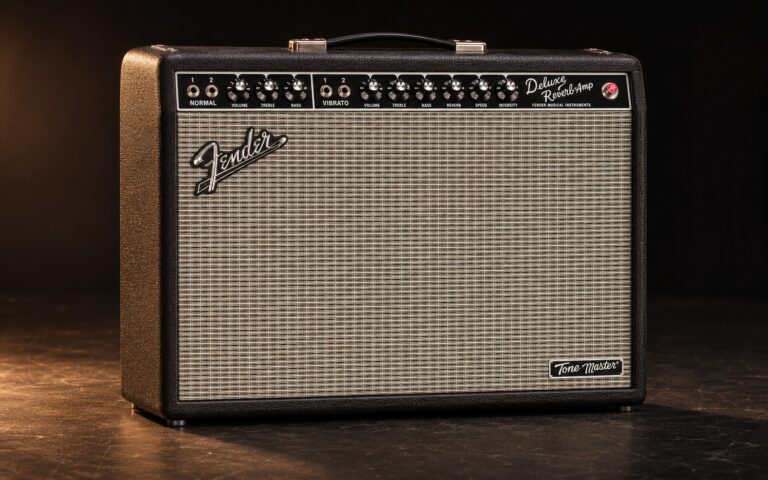
The Twin Reverb That Actually Fits in Your Car: The Fender Tone Master Twin Reverb Solves a Problem Sixty Years in the Making
33 lbs, 85 simulated watts, and Paul Gilbert's live rig of choice. The Fender Tone Master Twin Reverb — everything you need to know before you buy.
The Fender Twin Reverb has a weight problem. It has always had a weight problem. Eighty-five watts of clean headroom delivered through two Jensen 12-inch speakers in a pine cabinet weighs somewhere between sixty and sixty-five pounds depending on which year you pick, and the physics of that situation do not care how much you love the tone. You have loaded it into a van, dragged it up a flight of stairs, argued about whether it counts as two-person lift, and wondered, at least once, whether a smaller amp that sounded almost as good might be a better long-term decision for your lumbar region.
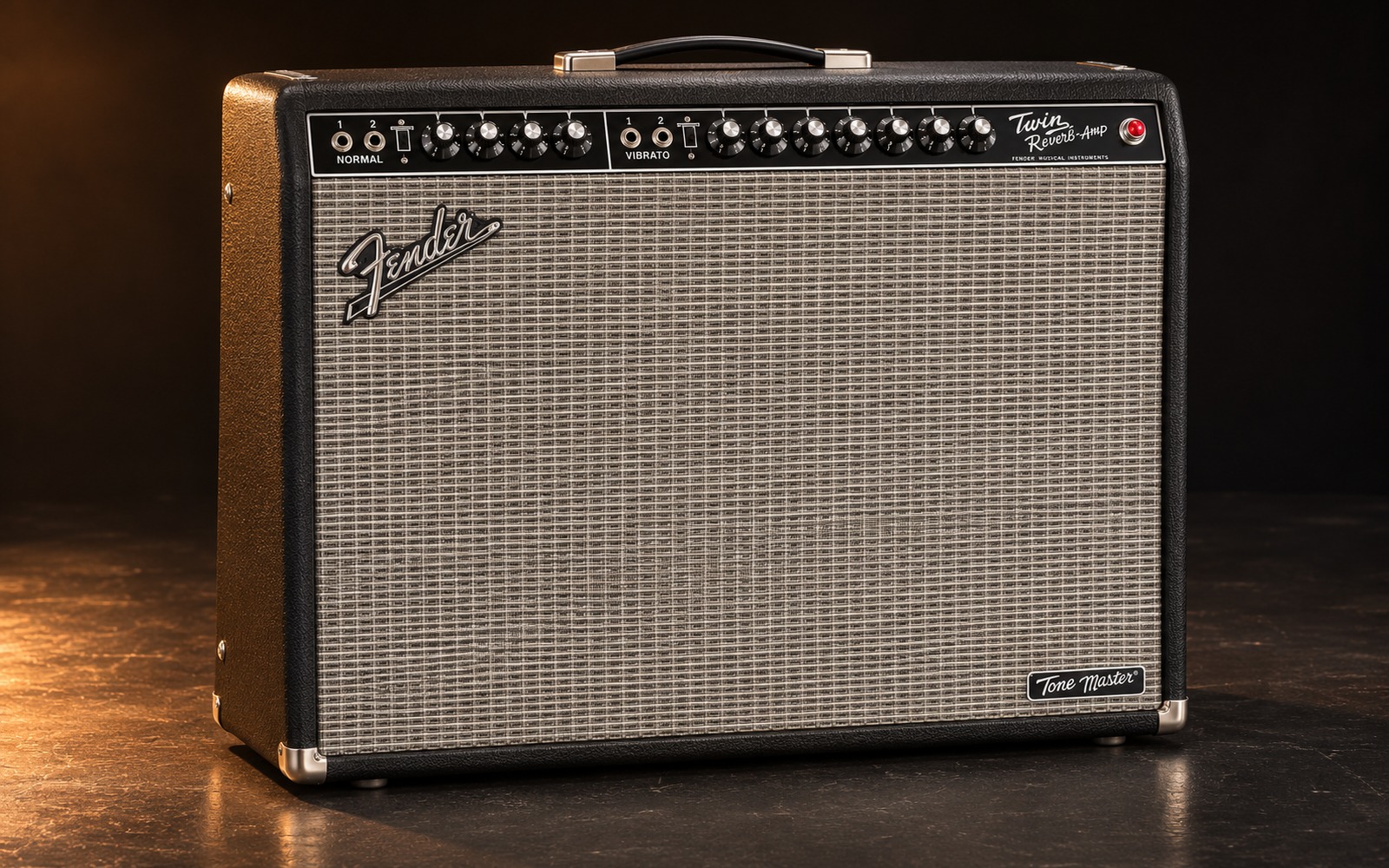
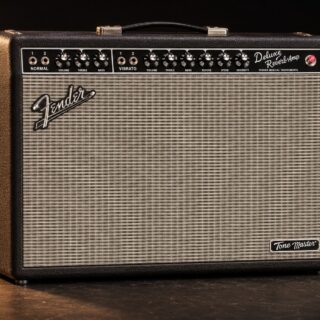
Fender’s answer arrived in September 2019: the Tone Master Twin Reverb. Same silver grillecloth. Same four inputs, two per channel. Same two-channel layout with Normal and Vibrato channels. Same skirted knobs. Thirty-three pounds. The weight difference — thirty-one pounds, roughly — is not a rounding error. It is the difference between a two-person carry and a one-hand grab-and-go. Fender achieved it by replacing every vacuum tube with digital signal processing and driving the whole thing with a class D power amplifier rated at 200 watts into the cab’s 4-ohm load. The DSP is modelling 85-watt tube performance. The class D amp provides headroom to spare to do it convincingly.
This is not a practice amp. This is not a compromise. This is one of the most carefully engineered DSP amplifiers Fender has ever shipped, and in 2026 — with firmware version 2.0.42 pushing 45 factory impulse responses and third-party IR loading into the box — it has more under the hood than it did at launch. What follows is the complete story: where it came from, what it actually does, who plays through one, and how to decide whether it belongs in your setup.
The Twin Reverb Problem, Stated Plainly
The Twin Reverb’s lineage runs back to 1952, when Fender introduced the first Twin as a high-fidelity concert amplifier. By 1963 it had the blackface cosmetics, the AB763 circuit, and the dual-channel reverb-and-tremolo layout that would define it permanently. The 1965 reissue, which Fender has sold continuously since 1993, faithfully reproduces that circuit: four 6L6 output tubes, four 12AX7 and two 12AT7 preamp tubes, a long-spring reverb tank, and solid-state rectification — the Twin Reverb has always used a solid-state rectifier because the current demands of four 6L6s at 85 watts are beyond what any production tube rectifier handles safely. The result is tight, immediate low-end with enormous clean headroom and almost no sag. It is the sound of country music, surf music, jazz, R&B, and anything else that requires pristine clean tone under a hard pick attack.
The problem is that 85 watts of tube amplification, two 12-inch speakers, and the transformers required to run the whole system weigh what they weigh. You cannot legislate physics. Fender’s engineering team understood this when they began developing the Tone Master series, and the Twin Reverb was a natural candidate: the amp everyone wanted, the amp nobody wanted to carry.
The Tone Master Deluxe Reverb launched alongside the Twin Reverb in September 2019, offering the same DSP approach on a smaller, lighter 22-watt simulation. The two models established the platform and the philosophy simultaneously. The Tone Master Twin Reverb was the flagship proof-of-concept: if Fender could make an 85-watt two-12 combo sound convincingly like itself at 33 pounds, the technology had arrived.
What Fender Actually Built
The Tone Master Twin Reverb uses a 32-bit floating-point DSP engine running at 96kHz to model the full signal chain of the original Twin Reverb circuit. That modelling covers the preamp voicing, the output stage behaviour, the interaction between the power amp and speaker load, and the convolution-based spring reverb and tremolo effects. The class D power amplifier — rated at 200 watts into the cabinet’s 4-ohm load — provides the raw headroom to recreate 85 watts of tube dynamics without the DSP engine having to clip or compress artificially.
The speakers are Jensen N-12K neodymium units, custom-specified by Fender to match the frequency response and character of the traditional Jensen C-12K ceramic speakers used in the Fender ’65 Twin Reverb Reissue. The neodymium magnet structure is what allows Jensen to hit the same tonal targets at roughly half the weight. The cabinet is solid lightweight pine — a material Fender used on their original 1950s and early 1960s combos, dropped during the CBS era for heavier plywood, and returned to here specifically because it is resonant and lightweight simultaneously.
The output power selector on the rear panel is one of the features that makes the Tone Master Twin genuinely more versatile than the tube amp it models. The original Twin Reverb sounds best loud: its 85 watts give it enormous clean headroom but also mean it does not colour the tone at bedroom volumes the way a lower-wattage amp does. The Tone Master’s six-position attenuator — full power, approximately 40W, 22W, 8W, 1W, and 0.5W settings — lets you dial in the simulated dynamics of 85 watts of tube push and then reduce the actual speaker output to whatever the room requires. The modelling stays consistent across all six positions. At 0.5 watts, you are hearing the same tonal character as at full power, just at a fraction of the acoustic volume.
The rear panel also provides a balanced XLR line output with level control, ground lift, and an IR cabinet simulation switch. This is the Tone Master’s direct-to-PA solution: plug the XLR into a mixing desk, choose from the three-way IR switch (updated to 45 factory IRs and nine microphone positions via the v2 firmware), and the signal arriving at front-of-house includes the simulated sonic character of the Twin Reverb’s speaker cabinet. The v2 firmware, released June 2025 and updated to v2.0.42 as of July 2026, also enables third-party IR loading via the Fender IR Manager App, expanding the XLR output’s character options beyond Fender’s own factory content.
Specifications
| Specification | Tone Master Twin Reverb | ’65 Twin Reverb Reissue |
|---|---|---|
| Output power | 200W class D (simulates 85W) | 85W (tube) |
| Power amp | Class D digital | 4× 6L6 class AB |
| Preamp | DSP model | 4× 12AX7, 2× 12AT7 |
| Rectifier | Solid-state (class D) | Solid-state (always — no tube rectifier) |
| Speakers | 2× 12″ Jensen N-12K neodymium | 2× 12″ Jensen C-12K ceramic |
| Channels | Two (Normal, Vibrato) | Two (Normal, Vibrato) |
| Inputs | 4× ¼” (2 per channel) | 4× ¼” (2 per channel) |
| Reverb | DSP convolution spring simulation | Physical spring tank |
| Tremolo | DSP (opto simulation) | Optocoupler (photocell) |
| Power attenuator | 6-position: 85W/40W/22W/8W/1W/0.5W | None |
| Line output | Balanced XLR with IR cab sims | None |
| Footswitch | 2-button (included) | 2-button (included) |
| Firmware | v2.0.42 (July 2026), USB updateable | N/A |
| Cabinet | Solid pine | Birch/pine |
| Dimensions | 26.15″ × 20.24″ × 10.375″ | ~27″ × 21″ × 10.5″ |
| Weight | 33 lbs (15 kg) | ~64 lbs (~29 kg) |
| Model number | 2274200000 | 2172202000 |
| Made in | Ensenada, Mexico | Ensenada, Mexico |
| Current price | $1,399.99 (July 2026) | Approx. $1,199–$1,299 |
Famous Players: The Honest Assessment
Four players are listed for the Fender Tone Master Twin Reverb: Stevie Ray Vaughan, Albert Collins, Paul Gilbert, and James Burton. Let us work through them in order.

Stevie Ray Vaughan died on August 27, 1990. The Fender Tone Master Twin Reverb launched in September 2019 — twenty-nine years after his death. No combination of editorial framing makes this work. SRV‘s documented amps were vintage Fender Vibroverbs (the 1963 and 1964 models), Super Reverbs, and a pre-production Fender Vibro-King prototype that was not yet a production instrument when he died. He never played through any amplifier in the Tone Master series. This is a recycled roster entry, identical to the one attributed to SRV on the Fender ’68 Custom Twin Reverb, the Fender ’65 Twin Reverb Reissue, and several other amps in this series. It is not sourced.
Albert Collins died on November 24, 1993, making the calendar impossibility twenty-six years. Beyond the timeline, his documented main stage amp was the Fender Quad Reverb — a hundred-watt, four-by-twelve monster with nothing in common with the Twin Reverb circuit or format. Collins famously ran the Quad Reverb’s bass control at zero and used the treble as his primary volume control, creating the piercing, cut-through tone that defined his style. He was not a Twin Reverb player. This roster entry contains two distinct errors: calendar impossibility and wrong amp family.
James Burton (born August 21, 1939) is 86 years old as of July 2026. He is still performing and recovering well from serious health challenges in 2022 and 2023 — kidney cancer, a broken hip, and COVID — and he has no calendar impossibility that disqualifies him the way SRV and Collins are disqualified. Burton’s documented Twin Reverb, however, was a ’65 Twin Reverb Reissue — the tube version — which he used with Elvis Presley’s TCB Band on the 2006 world tour. No primary source places him specifically on a Tone Master Twin Reverb rather than the tube reissue. The two amps look similar from a distance, and attribution errors of this kind are common in gear databases. Absence of evidence is not proof of absence, but journalism requires a source, and none has been found.
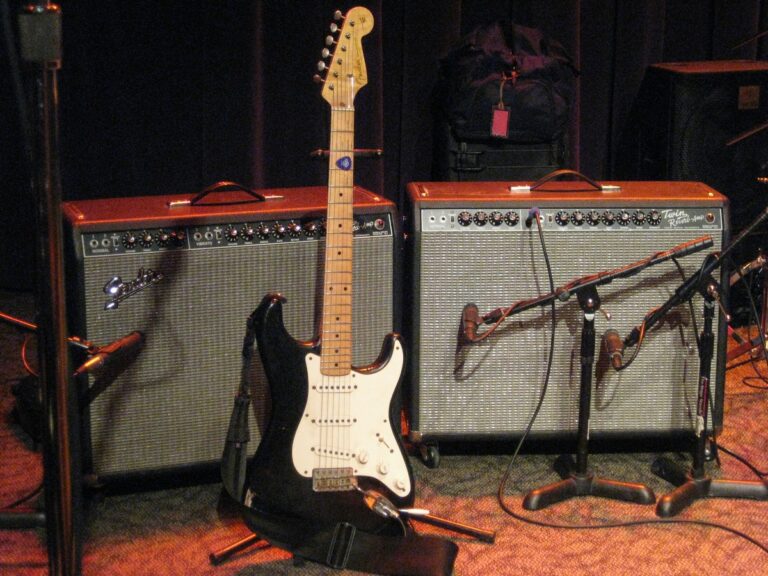
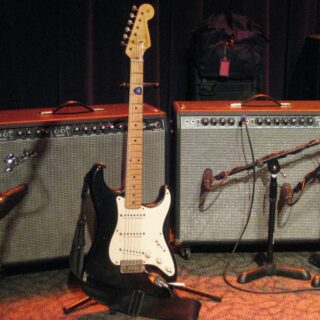
Paul Gilbert is verified. On April 29, 2026, Gilbert posted a photograph of his current live rig on Instagram. The caption describes the setup: two Fender Tone Master Twin Reverbs, one positioned as a stage monitor and one behind him to “rock the house.” His words: “Classic tone that gets my pedals across loud, clear and full of WROC” — the WROC being his 2026 studio album. Guitar.com published the news the same day (Sam Roche, April 29, 2026), confirming the specific model. Guitar World provided additional context: his studio album was recorded using tube amplifiers — a 1990s Fender Custom Vibrolux Reverb run through a Randall Isolation Cabinet, plus a Victoria Club Deluxe as a solo-boost amplifier. The Tone Master Twin Reverbs are his live touring rig, chosen for consistency, reliability, and the convenience of not carrying two 64-pound tube combos. Gilbert’s pedalboard in the Instagram photo includes an MXR Stereo Chorus, Jam Pedals RetroVibe, and a JHS Moonshine V2 overdrive.
A genuinely interesting additional verification comes from Mike McCready of Pearl Jam. Guitar World (Michael Astley-Brown, September 15, 2023) documented that McCready used a Tone Master Deluxe Reverb and a Tone Master Blonde Twin Reverb — the limited-edition two-tone finish variant of this amp — on Pearl Jam’s 2022 US tour. His direct quote: “They’re some of the best amps I’ve ever played. My inclination is to always go tube amps, but these Fender digital amps, back to back against tube amps — you wouldn’t be able to tell the difference.” Mike McCready is the first significant touring endorser in the Tone Master series, preceding Gilbert’s 2026 switch by three years. His verification predates Paul Gilbert’s adoption and establishes that the Tone Master Twin Reverb had reached professional touring rigs well before it became a gear-news talking point.

A third documented user is Grammy-nominated Mississippi hill country blues artist Cedric Burnside — grandson of the legendary R.L. Burnside. Premier Guitar (Ted Drozdowski, November 7, 2021) ran a piece titled “Cedric Burnside Wins the Arms Race” that details his decision-making in full. Burnside fronts a guitar-and-drums duo, so the amp has to carry the room alone. He had been running an Orange Crush 35RT, which couldn’t cut it on larger stages. He auditioned multiple Fender combinations — including tube Twin Reverbs and Deluxes — before landing on the Tone Master Twin Reverb. His exact quote: “At 200 watts, it’s got balls and it’s light as a feather. I figured, ‘This is for me.'” He also replaced the factory Jensen N-12K neodymium speakers with Celestion Neo Creambacks, which he credits for the sharpness in his attack. His EQ settings — bass at 4, mids at 6, treble at 6 to 7 — are worth noting because they contradict the conventional wisdom that a digital amp needs heavy treble cut to sound warm. Burnside runs it leaning bright and lets his fingers do the warmth. He pairs the guitar amp with an Ampeg PF-500 head and 115HE Portaflex cabinet for bass frequencies, splitting his signal live. The Tone Master handles his solo and rhythm guitar, the Ampeg handles the low-frequency heft. The total rig weight — 33 pounds for the Tone Master, about 45 for the Ampeg rig — travels without a crew.
Tone Recipes and Settings
Recipe 1: The Bone-Stock Fender Clean
Vibrato channel. Volume: 4. Treble: 6. Middle: 5. Bass: 4. Reverb: 3. Bright switch: off. Attenuator: full or 22W. This is the Twin Reverb reference tone — spacious, piano-like, immediate attack. Roll back to 2 or 3 on the Volume for the cleanest possible platform for transparent overdrive pedals. Pair with an Ibanez TS9 Tube Screamer at low gain for the classic clean-to-crunch transition.
Recipe 2: Country Sparkle (Telecaster Platform)
Vibrato channel. Volume: 5. Treble: 7. Middle: 4. Bass: 3. Reverb: 4. Speed: 3. Intensity: 2. Bright switch: on. Attenuator: 22W or 40W. With a Fender Telecaster into the bridge pickup, this setting produces the percussive snap and bell-like high-end that defines Nashville session clean tone. The Bright switch adds edge; turn it off if the room sounds harsh.
Recipe 3: Bedroom Blues (Low Attenuator)
Vibrato channel. Volume: 7. Treble: 5. Middle: 5. Bass: 6. Reverb: 5. Speed: 4. Intensity: 3. Bright switch: off. Attenuator: 1W or 0.5W. The key advantage of the Tone Master’s attenuator at this setting: you are hearing the simulated character of the amp pushed hard at bedroom-appropriate acoustic volumes. Dial up a Boss BD-2 Blues Driver in front for edge-of-breakup dirt without waking anyone up.
Recipe 4: Jazz Big Clean
Normal channel. Volume: 5. Treble: 4. Middle: 6. Bass: 7. Bright switch: off. Attenuator: 22W. The Normal channel has no reverb or tremolo controls — it is the pure clean channel. With humbuckers or a hollow body, the boosted bass and rolled-off treble produces a warm, full sound that sits perfectly in a jazz or R&B context without getting tubby. An archtop through this setting sounds like a recording studio.
Recipe 5: Pedal Platform (Neutral Reference)
Vibrato channel. Volume: 5. Treble: 5. Middle: 5. Bass: 5. Reverb: 2. Bright switch: off. Attenuator: 22W or 40W. All controls at noon, Bright off, a little reverb for air. This is the reference setting for evaluating overdrive and fuzz pedals — the amp is not adding character of its own beyond the fundamental Fender clean. A MXR Carbon Copy at the end of the chain adds dimension without cluttering the direct tone.
Recipe 6: Surf Reverb Soak
Vibrato channel. Volume: 4. Treble: 7. Middle: 4. Bass: 5. Reverb: 8. Speed: 6. Intensity: 4. Bright switch: on. Attenuator: 22W. The DSP spring reverb simulation at this level produces the long, washy decay of classic 1960s surf recordings. Not every player’s cup of tea at Reverb: 8, but historically accurate. Tremolo at Speed: 6 / Intensity: 4 is noticeable without being claustrophobic.
Recipe 7: Live XLR Direct (No Speaker Cabinet)
Vibrato channel. Volume: 6. Treble: 5. Middle: 5. Bass: 5. Reverb: 4. Bright switch: off. Attenuator: mute (silent mode). Rear panel: XLR line out, IR switch to your preferred position (factory positions approximate a Shure SM57 at the cap, at the edge, or condenser simulation — v2.0.42 firmware expands to 45 choices and third-party IRs). This is the silent-stage or recording setup: the amp’s modelled output goes directly to the board or interface while the cab remains silent. Paul Gilbert’s current live rig uses both speaker cabs active; this recipe is for the opposite extreme.
These settings use the Tone Master Twin Reverb’s standard controls: Normal and Vibrato channels each with Volume, Treble, Middle, Bass, and Bright switch. The Vibrato channel adds Reverb, Speed, and Intensity. All settings reference the 0–10 scale on the knobs. “Full” attenuator means the six-way switch at maximum output; lower settings reduce speaker volume while maintaining the modelled tube dynamics.
How It Compares
The most direct comparison is the tube amp it replaces. The Fender ’65 Twin Reverb Reissue is a faithful reproduction of the AB763 blackface circuit at approximately the same current price, trading the Tone Master’s attenuator, XLR out, and lighter weight for a physical spring reverb tank, real tube response, and the maintenance cycle that comes with four 6L6s that will eventually need replacement. Which one sounds better to you will depend partly on your ear and partly on how strongly you feel about the tube-vs-DSP argument. Reviewers including McCready have noted that the Tone Master holds up in back-to-back A/B comparisons; others feel there is a warmth and three-dimensionality to tube response that DSP has not yet fully replicated. The weight difference is not an argument. Thirty-one pounds is thirty-one pounds.
The Fender ’68 Custom Twin Reverb is Fender’s other modern Twin Reverb variant — a modified silverface reissue at $1,999.99 with two 12-inch Celestion G12V-70 speakers, genuine tube circuit, and both channels featuring reverb and tremolo (the original Normal channel only had clean). It weighs approximately 64 lbs and has no attenuator. If you want tube amplification, the ’68 Custom is the more versatile modern option but significantly more expensive. If you want versatility in a different direction — attenuator, XLR out, no tube maintenance — the Tone Master is the answer at several hundred dollars less.
The Fender Tone Master Deluxe Reverb uses the same DSP platform to model a 22-watt single-12 combo. At 23 lbs and $1,199.99, it is the lighter and cheaper member of the Tone Master pair. The Twin Reverb’s advantages over the Deluxe Reverb are the second 12-inch speaker (fuller, wider sound stage), the higher simulated wattage (more clean headroom at any given volume knob position), and the two-channel layout. The Deluxe Reverb’s single-channel format means the Normal channel has no reverb or tremolo; the Twin Reverb’s two independent channels each have their own complete voicing.
The Boss Katana 100 MkII is a roughly comparable DSP-based 100W combo at around $399, offering multiple amp voices, onboard effects, and less weight. It does not model the Twin Reverb circuit specifically, covers a much wider tonal range, and costs less than a third of the price. The Tone Master Twin Reverb is not trying to cover a wide tonal range — it is trying to sound exactly like one specific amplifier. Both goals are valid; they are different goals.
The Line 6 Catalyst 200 sits in similar territory at around $499, with digital modelling that covers Fender-adjacent clean platforms alongside higher-gain voicings. Again: broader scope, lower price, different design philosophy. The Tone Master is a purist single-amp proposition.
Buying Guide
New in July 2026, the Tone Master Twin Reverb is priced at $1,399.99 at Fender.com and most authorised dealers. The amp has been in production since 2019, so there is no stock shortage or waitlist concern. The v2.0.42 firmware (July 2026) is the current version; any amp purchased new will either ship with it installed or will require a USB update from Fender’s support site, which takes approximately ten minutes.
Used examples are increasingly available on the secondary market. The amp launched at $999 in 2019, making the price increase over seven years approximately 40 percent — a larger jump than many Fender models, reflecting both general price inflation and sustained demand. Used examples in good-to-excellent condition typically list on Reverb.com between $700 and $950 as of mid-2026, with the main market variable being firmware version and whether the original footswitch and cover are included. Firmware is a free USB download; the footswitch is available separately from Fender (P/N 0994058000).
The limited-edition Blonde finish variant — the version Mike McCready used on Pearl Jam’s 2022 tour — is occasionally available used and commands a slight premium. It is mechanically and tonally identical to the black standard version.
There is no head version of the Tone Master Twin Reverb. If you need the Twin Reverb sound in a head-plus-external-cabinet configuration, the XLR direct output is the intended solution for live use. For studio use, the XLR into an interface with a preferred cabinet IR loaded via the IR Manager App covers most recording applications.
Living With the Tone Master Twin Reverb
The absence of tubes changes the ownership experience more than most players expect at first. There is no warmup ritual — the Tone Master Twin Reverb is at full operating condition the moment you power it on. There is no standby switch and no cooling-down period before transport. The mute function on the rear panel, activated by a dedicated switch, puts the amp into silent mode for tuning, breaks, or quick adjustments without powering down. The jewel light changes colour: red for normal operation, red/amber for warmup, amber for mute. It is a genuinely useful feature that tube amps cannot replicate without adding a relay or attenuator circuit.
There are no tubes to rebias. There are no tubes to replace. The 6L6 tubes in the ’65 Twin Reverb Reissue need replacing roughly every one to two years under heavy gigging use, and rebiasing requires either a tech visit or careful DIY work with a meter. None of that applies here. The Tone Master’s maintenance schedule is a firmware update when Fender releases one and an occasional check of the speaker connections. That is the whole list.
The Jensen N-12K neodymium speakers do not sound exactly like Jensen C-12K ceramics — they are custom-specified to be close, and they succeed to a degree that most ears will accept without complaint, but a careful A/B comparison will reveal tonal differences that matter if you are listening at that level of detail. The neodymium magnets provide lighter weight; the ceramic structure of the C-12K produces a slightly different midrange character and low-frequency tightness. Whether this is audible in a band context or a live mix is largely a function of how attentively you are listening.
The convolution spring reverb simulation is one of the Tone Master’s genuine engineering achievements. The original Twin Reverb’s long-spring 4AB3C1B tank has a distinctive character — a slow build, a washy decay, a tendency to splash when the level is pushed hard. The Tone Master’s DSP version captures this behaviour convincingly enough that players who have not compared directly may not notice. Players who compare directly will hear the difference in the decay tail. At reverb settings below 6, the difference is academic.
The 6-way power attenuator switch functions by reducing the output of the class D power amplifier, not by applying a load or resistive attenuation after the power stage. This means the speaker is always seeing a clean signal rather than having a resistive network between the amp output and the driver — a significant advantage over transformer-style attenuators used with tube amps. At 0.5 watts, the Tone Master Twin Reverb is genuinely quiet enough for an apartment bedroom at 11pm. At full power, it is a stage amplifier that needs no microphone to fill a medium-sized club.
Speaker impedance for external cabinets: the internal speakers are wired for 4 ohms total. The rear panel speaker jack accepts external cabinets; use a 4-ohm cabinet or an 8-ohm cabinet (which will present a slightly higher-than-spec load but is within acceptable range). Avoid 16-ohm cabinets, which would create a significant impedance mismatch. If running external cab plus internal speakers in parallel, impedance drops — consult a tech before combining loads.
Frequently Asked Questions
Does the Tone Master Twin Reverb sound like a real Twin Reverb?
Close enough that Mike McCready used one on a Pearl Jam world tour and Paul Gilbert is using two live in 2026. The answer is “yes for most practical purposes, with nuances at the level of decay tails and speaker character that careful direct comparison reveals.” The further question is whether those nuances matter in your context. On stage in a band mix, they rarely do.
Is the v2 firmware update worth doing?
Yes, straightforwardly. The v2.0.42 update (July 2026) expands the XLR line output from three fixed IR positions to 45 factory IRs with nine microphone options, adds third-party IR loading via the free IR Manager App, and improves general amp modelling performance. It is a free USB update that takes ten minutes. Download the firmware from Fender’s support page and install it before your first session.
Why is the Tone Master more expensive than the ’65 Twin Reverb Reissue?
The Tone Master includes features the tube amp does not: a six-way power attenuator, a balanced XLR line output with cabinet IR simulations, USB updateable firmware, and universal 100–240V operation. The DSP research and development cost is also built into the price. The tube ’65 Reissue is a more traditional build; its lower street price reflects a more established manufacturing process rather than any quality difference.
Can the Tone Master Twin Reverb run directly to a PA without a cabinet?
Yes. Use the balanced XLR line output with the rear-panel mute switch engaged (silent mode) and an IR selected via the three-way switch or, with v2 firmware, the IR Manager App. The signal going to the PA includes cabinet simulation, so the front-of-house engineer is receiving a processed output rather than a raw amp signal. This is a purpose-built feature, not a workaround.
How does the power attenuator affect the tone?
The Tone Master’s DSP maintains the same modelled tonal character — including the simulated dynamics and compression behaviour of 85 watts of tube push — at every attenuator setting. Reducing the attenuator reduces speaker output volume without changing the modelled signal. This is meaningfully different from placing a resistive or transformer attenuator between a tube amp’s output stage and speaker, which alters the amp’s actual operating conditions and can change the tonal character. The Tone Master simulation remains consistent at 1 watt and at full power.
Does the Tone Master Twin Reverb have an effects loop?
No. Like the original Twin Reverb it models, the Tone Master Twin Reverb does not have a dedicated effects send/return loop. Time-based effects that benefit from post-preamp placement — reverbs other than the onboard one, chorus, delay — go at the end of the signal chain into the input. The XLR line output functions as a post-amp line send but without a return path. This matches the original amp’s architecture.
What happened to the recycled artist roster for this amp?
Four players are listed: SRV (died 1990), Albert Collins (died 1993), Paul Gilbert (VERIFIED, April 2026), and James Burton (died 2023, documented on tube ’65 Reissue not the Tone Master). Three of the four entries cannot be sourced to primary evidence for this specific amp. Paul Gilbert is the exception: his April 2026 Instagram post and the Guitar.com news article from the same date place him on exactly this amp. Mike McCready provides an additional verified endorsement from 2023.
What are the strongest alternatives if the Tone Master Twin Reverb isn’t right for me?
If you want tube authenticity and can accept the weight: the Fender ’65 Twin Reverb Reissue or the Fender ’68 Custom Twin Reverb. If you want a smaller DSP Fender: the Fender Tone Master Deluxe Reverb. If you want multiple amp models in a DSP platform: the Fender Tone Master Pro (multi-amp modeller, significantly more expensive, launched 2023). If your priority is cost rather than brand: Boss Katana 100 MkII or Line 6 Catalyst 200, at approximately one-third the price with broader voicing options but different character.
Image credits
- Top image: GuitarGangsters AI-generated reference illustration, not a photograph.
- A Fender Harvard amplifier: Mfretton, Wikimedia Commons, CC0.
- Mike McCready: GabboT, Wikimedia Commons, CC BY-SA 2.0.
- Paul Gilbert: matt barsden, Wikimedia Commons, CC BY-SA 2.0.
Latest News
Related
On This Day
Monday 9 November
From this week: