The Smallest Fireball in the Room: Fender Tone Master Princeton Reverb Decoded
DSP-modelled blackface Princeton Reverb at 20 lbs. Six attenuation levels, XLR cab-sim output, v2 firmware. No tubes, no maintenance, pure Fender tone.
Sixty years ago, working musicians bought Princeton Reverbs because they couldn’t afford a Deluxe. The Princeton was the entry-level blackface—lighter, quieter, cheaper—and nobody thought much of it beyond that. Then the studios discovered something peculiar: a Princeton cranked to the edge of its 12-watt envelope sounded better on tape than a Twin at half-power. The compression was tighter, the harmonic detail was richer, and the small 10-inch speaker broke up in exactly the right places. The Princeton went from budget practice amp to secret weapon, and it has been one ever since.
The Fender Tone Master Princeton Reverb—announced via UK retailer Andertons in September 2022 and shipping from November of that year—lands at the tail end of Fender’s four-amp Tone Master rollout. The Twin came first (Summer 2019), then the Deluxe Reverb (Summer 2019), then the Super Reverb (Winter 2021), and finally this: the smallest of the blackface icons, weighed, measured, and reassembled in software. Current price is $1,099.99. Launch price was $899.99. Either way it is, as Guitar World’s Nick Guppy pointed out in his March 2023 review, “expensive for a digital combo—until you compare it with the equivalent valve versions in Fender’s catalogue.”
That is the entire argument in one sentence. Everything else is detail. And the detail, on a box this historically loaded, is worth getting exactly right.
From the K&F Radio Shack to the Pre-CBS Holy Grail: Princeton History
Leo Fender began selling amplifiers under his own name in 1946—a full five years before the Telecaster—after parting ways with Clayton Orr “Doc” Kauffman and dissolving their K&F Manufacturing partnership. The first three Fender-branded combos were the Princeton, the Deluxe, and the Professional, collectively nicknamed the “woody” amps for their hardwood cabinets and fixed wooden handles. Leo was a radio repairman first and a guitar manufacturer second; these early amps reflected that. They were solid, pragmatic, and cheap to build. The Princeton sat at the bottom of the trio: the most basic, the lowest power, the student amp.
By the mid-1950s the Princeton had been through several circuit revisions—tweed cosmetics, a changing roster of preamp tubes, evolving output stages. It was never quite still. But the pivotal moment came in 1964, when Fender redesigned its entire line under what collectors now call the “blackface” era. The chrome control panel was replaced by a matte black anodised aluminium faceplate. The circuits were reworked around a cleaner, higher-headroom topology. And the Princeton got something it had never had before: built-in reverb and tremolo. The model became the Princeton Reverb, catalogued under circuit code AB764, and it has never looked back.
The blackface Princeton Reverb produced from 1964 to 1967 is the amp the Tone Master models. Twelve watts from two 6V6GT output tubes, running fixed bias through an output transformer that was deliberately undersized relative to the power section—a compression artefact that nobody designed and everybody loved. The preamp chain runs through a 7025 (essentially a quiet 12AX7), two 12AX7s, and a 12AT7 for the reverb driver. The rectifier is a 5AR4—a tube rectifier, which introduces a characteristic “sag” when the output is driven hard, as the rectifier momentarily droops under load and the power supply voltage dips. That dip is the cushion you feel under big chords, the organic give that makes a 12-watt Princeton feel like it is breathing. A 10-inch Jensen C10R or Oxford driver, depending on production date, went into a pine cabinet about the size of a carry-on bag. That was it.
In 1968 Fender—now post-CBS acquisition—changed the cosmetics to the “silverface” look: a silver-and-black control panel with a distinctive drip-edge aluminium trim around the grille cloth. The circuit was largely the same through 1969; the drip-edge years (1968-1969) are considered transitional and often undervalued on the used market relative to true blackface examples. After 1969 the rectifier changed from the 5AR4 to a solid-state 5U4GB equivalent, the bias resistor values shifted, and the sag dynamics softened. A pull-boost was added to the volume pot in 1977. The amp continued until 1981, when it was discontinued. A completely unrelated “Princeton Reverb II” appeared in 1982 under Paul Rivera’s design direction—a 22-watt PCB-based amp with an overdrive channel that had nothing in common with the blackface circuit—and was itself dropped in 1986.
The blackface returned in 2008 when Fender reissued the Princeton Reverb as the ’65 Princeton Reverb, retaining the tube rectifier and tube reverb driver but moving to a printed circuit board instead of the original point-to-point eyelet construction. A ’64 Custom Princeton Reverb followed later, using a hand-wired board and 6G2 tweed-adjacent voicing. The ’68 Custom Princeton Reverb (2013) provided the silverface cosmetics with a modified blackface circuit and a Celestion G10 Greenback speaker. All three tube versions remain in production today. The Tone Master version is the fifth member of this family—and the first without a single tube inside.
The Digital Proposition: What the Tone Master Actually Does
The Tone Master Princeton Reverb is not a modelling amp in the usual sense. There are no amp banks, no presets, no menus, no MIDI, no Bluetooth, no app pairing (beyond the IR Manager for loading impulse responses). The Tone Master approach—across all four models in the range—is to take one amplifier, model it as accurately as current DSP allows, and put it in the original cabinet format with original cosmetics. That is the entire brief. The result either sounds like a Princeton Reverb or it doesn’t.
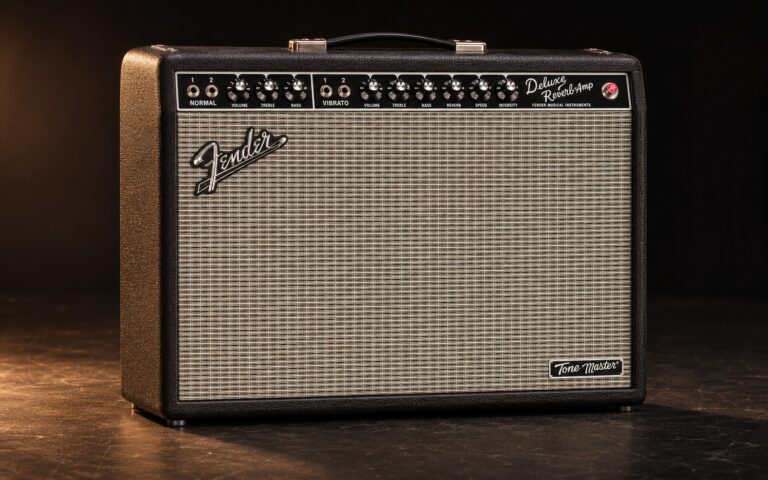
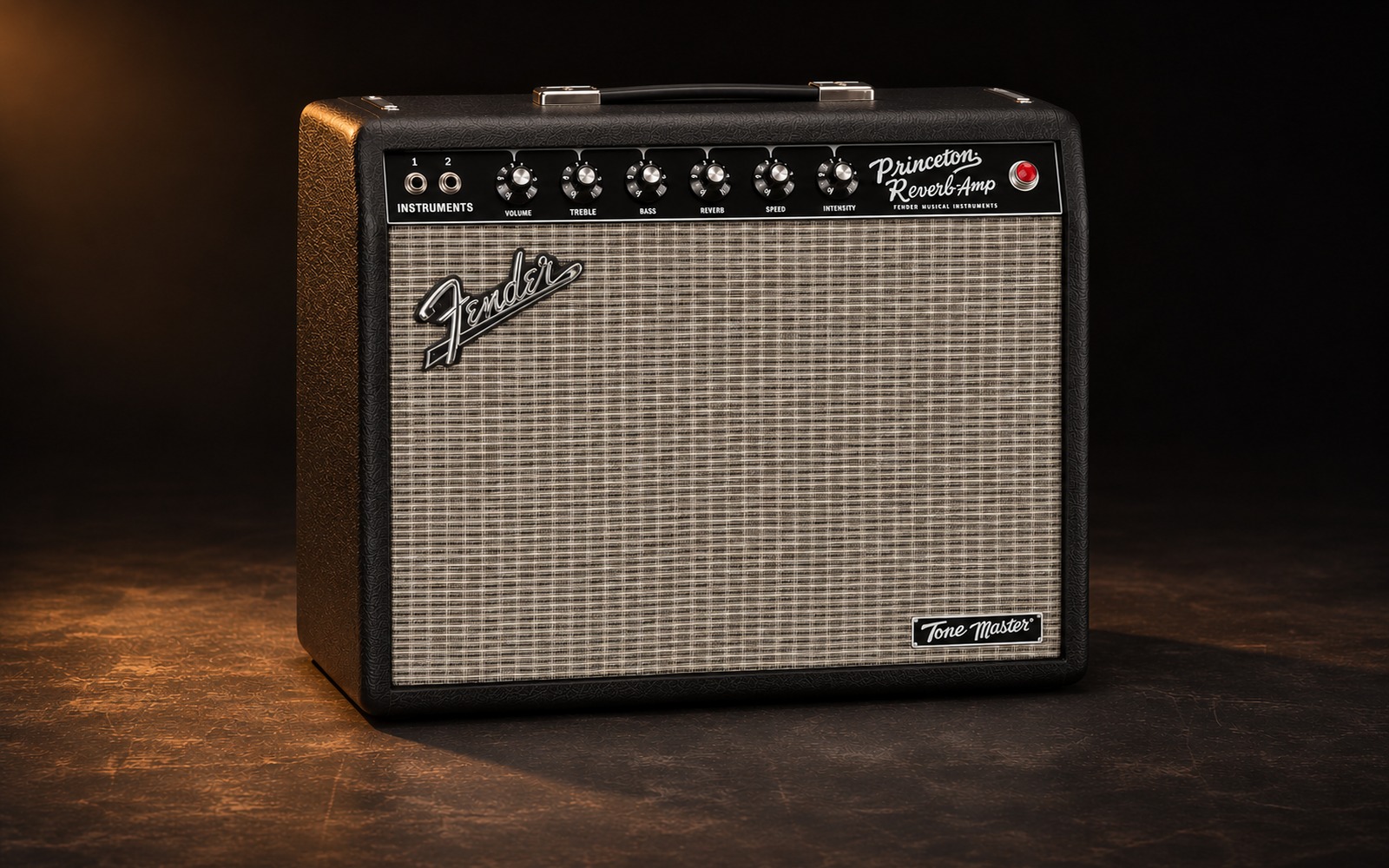
From the front, the Tone Master Princeton Reverb is functionally identical to a ’65 Princeton Reverb reissue: same black textured vinyl covering, same silver sparkle grille cloth, same skirted black plastic knobs, same chrome handle with nickel-plated caps, same black anodised front panel, same two 1/4-inch inputs (Input 2 runs at -6dB, as on the original), and the same six controls—Volume, Treble, Bass, Reverb, Speed, Intensity. The only external giveaway is a small “Tone Master” nameplate in the lower-right corner of the grille. The jewel lamp runs through a startup sequence: flashing red/amber while the DSP boots (a few seconds), then solid red for normal operation, solid amber for mute mode.
The rear panel is where the Tone Master diverges from its tube counterpart. No heavy iron transformers. No dangling output tubes. Instead: a power switch, a mute switch (DI stays active in mute mode, useful for silent recording), and a six-position output power selector rotary that steps the simulated tube output power through 12W / 6W / 3W / 1.5W / 0.75W / 0.3W. There is a balanced XLR line output with independent level control and ground lift switch, plus a three-position cabinet simulation selector (ribbon mic sim / dynamic mic sim / bypass). A USB port handles firmware updates. The two-button footswitch (included) toggles reverb and tremolo. Universal voltage operation covers 100-240VAC, 50-60Hz—one less thing to worry about on international tours.
The computing grunt required to do all of this faithfully is not trivial. Guitar World’s Nick Guppy noted that Fender allocated half of a high-specification quad-core DSP just for the convolution reverb—a computationally expensive algorithm that analyses the frequency-domain response of an actual spring reverb tank and convolves incoming audio against it in real time. A second full processor core handles the amp simulation itself. The remaining core manages cabinet simulations and ancillary functions. That is more dedicated processing than many workstation DAW systems ran at the time the Princeton Reverb was first designed. The result, per Guppy: “spookily accurate—you can almost hear the notes ping-pong between transducers in the virtual spring.”
Speaker is a Jensen C10R ceramic—not the neodymium N12K drivers that Fender fitted to the Tone Master Deluxe and Twin Reverbs to reduce weight. The Princeton’s pine cabinet is small enough that weight was never the critical concern it is with a 2×12″ combo; the engineers fitted the historically correct ceramic-magnet Jensen instead, which is also what the original ’64 and ’65 tube reissues use. Weight comes in at 19.9 lbs / 9.03 kg. A vintage blackface Princeton Reverb typically runs 28-32 lbs. A ’65 Princeton Reverb reissue weighs 30 lbs. The Tone Master shaves roughly a third off that, which across a long night of gigging adds up to a meaningful quality-of-life improvement.
Firmware v2.0.42 (July 2026) is the current release, downloadable from Fender’s support site. The v2 firmware added the IR Manager App (Mac and Windows), 45 factory impulse responses with nine microphone position options, and third-party IR loading—expanding the XLR line output into a serious direct-recording tool. The firmware is free and retroactive to all units. You need a standard USB-A to USB-B cable.
Specs at a Glance
Famous Players: The Honest Version
The Princeton Reverb is one of the most documented small-combo tones in American guitar history. The problem—for this article’s purposes—is that almost every verified example involves the vintage tube amp, not the Tone Master digital version announced in 2022. The gap is not subtle. Five names are attached to the Tone Master Princeton Reverb: Stevie Ray Vaughan, John Mayer, Eric Johnson, Mike Campbell, and Paul Gilbert. All five require scrutiny. The results are instructive.
Stevie Ray Vaughan died on August 27, 1990. The Tone Master Princeton Reverb was announced on September 8, 2022. That is a thirty-two-year gap. His actual amps—documented exhaustively by the SRV Archive, Guitar World, and multiple interview sources—were a pair of Fender Vibroverbs (his primary live rig for most of the 1980s), a 1967 Fender Vibro-King (sometimes listed as Vibrasonic), a Dumble Steel String Singer, and various Marshalls in rotation. No Princeton Reverb of any era was central to his documented rig.
Eric Johnson is one of the guitar world’s most documented amp obsessives, and his preferences are publicly known in exhaustive detail. His primary rig for the Ah Via Musicom era and beyond runs a pair of vintage 1966 Fender Twin Reverbs (cut down to heads), a Two-Rock Traditional Clean, and various Marshall cabs. Premier Guitar’s 2018 Rig Rundown confirms the Twin Reverb heads as his clean-tone foundation. A Princeton Reverb does not appear in any documented version of his rig. The Princeton and the Twin share a family resemblance in voicing—both use the same AB763/AB764 blackface topology, same treble-bass stack—but they are different amplifiers.
Mike Campbell does have a genuine Princeton connection, which makes this one the most interesting debunk in the set. His primary studio and stage amp is a 1963 Fender Princeton Brownface—a pre-reverb model from the brownface era (1961-1963), before the black panel and before reverb were added. It is a Princeton. It is not a Princeton Reverb. And it is definitively not a Tone Master. Campbell’s amp is one of the most recorded small-Fender sounds in rock and roll—you can hear it all over Tom Petty and the Heartbreakers records—but it has no operational relationship to a 2022 digital combo.

John Mayer’s documented amp life runs through Custom Shop tube Deluxe Reverbs (built by Fender master builder Chris Flemming), Two-Rock Coral heads, Dumble SSS amplifiers, and various boutique builds. No source places him on a Tone Master Princeton. The Tone Master Deluxe Reverb article in this series documented Mike McCready as a verified Tone Master user (Guitar World, September 2023)—but on the Deluxe and Twin models, not the Princeton.
Paul Gilbert is genuinely verified on a Tone Master amp: Guitar World (Jonathan Horsley, April 27, 2026) confirmed he uses dual Tone Master Twin Reverbs as his entire live touring rig for the WROC 2026 tour. Direct quote: “I’ve got one in front of me for a monitor, and one behind me to rock the house.” That verification is specific to the Twin Reverb format. No source places him on a Princeton.
The honest conclusion: no famous professional player has been independently verified on a Tone Master Princeton Reverb via primary-source documentation as of July 2026. This is partly a function of the amp’s recency—it shipped in late 2022 and rig rundowns lag the market—and partly a function of the Princeton Reverb’s traditional positioning as a studio and recording tool rather than a touring backline. A Princeton-format amp at 12 watts is not what most touring pros put behind them on large stages. They appear on home studio YouTube channels, in apartment-bedroom recordings, in small-venue residencies. Their user base is real and large; it just doesn’t generate Rig Rundown videos.
For the record: the vintage Fender Princeton Reverb’s verified professional users include Mike Bloomfield (Chicago blues and Dylan’s electric Judas band, studio recordings), Clarence White (Byrds session work, early 1970s), Jim Campilongo (signature country-jazz Texas chromatic approach), and various Nashville session players who used Princetons as room-mic or “air” amplifiers in conjunction with larger backline. Ry Cooder, Lowell George, and Richard Thompson all have documented history with small Fender combos in studio contexts, though primary-source evidence for each specifically on a Princeton Reverb (rather than a Deluxe or Champ) requires case-by-case verification that falls outside the scope of this article. They are named here as tonal context, not confirmed endorsers of this SKU.
What the Princeton Reverb Tone Actually Is: Physics and Frequency
A blackface Princeton Reverb, tube or Tone Master, occupies a specific acoustic real estate. The 10-inch speaker in a small pine box operates in a frequency window that starts rolling off meaningfully below 120Hz and peaks somewhere between 1kHz and 4kHz depending on drive level. The cabinet is too small to move significant air below 200Hz—this is a feature, not a flaw. The Princeton’s tone is midrange-forward and slightly scooped through the upper bass, which is exactly why it sits under a vocal or cuts through a full band mix without fighting the kick drum and bass guitar for low-frequency space.
The 6V6 output tubes—in both the original and the digital simulation—run hot and compressed relative to 6L6-based amps. A 6V6 at full tilt is fatter, more harmonically complex, and has a distinctive softness to the attack that a 6L6 does not. The Princeton’s fixed-bias output stage and undersized output transformer create a characteristic compression response under playing dynamics: play lightly and the amp is clean with a ring-out quality; dig in and the transformer briefly saturates, producing a musical compression that sustains notes in a way that linear amplification cannot. The Tone Master models this transformer saturation behaviour—Guitar World confirmed Fender’s engineers specifically targeted the Princeton’s “valve-rectified squash and sag dynamics when the amp is played at higher volume levels.” Whether the model captures it to three decimal places of accuracy is a subjective question. Whether it captures it well enough to be useful in a mix is, according to multiple reviewers who A/B’d the digital against the tube version, yes.
The reverb on the original is a two-spring Accutronics tank driven by a 12AT7 tube—a design that Fender introduced on the Princeton in 1964 and that immediately became a defining element of the sound. The spring delay and reverb decay character varies by drive level: at low volumes it is clean and washy; driven harder, the tank compresses and the reverb tails develop a slightly metallic bloom. The Tone Master uses convolution to capture this behaviour, devoting half a quad-core DSP to the task. Guitar World’s reviewer found it “maybe a little brighter than some ’60s Fenders we’ve used”—which is consistent with a model derived from a well-maintained example rather than a vintage unit with aged springs and a tired reverb driver tube.

The tremolo on the original is a bias-modulated effect: the circuit varies the bias voltage on the output tubes at the speed and intensity set by the front panel controls, producing a volume and harmonic variation that is subtler and more complex than a simple gain-modulation tremolo. The Tone Master’s digital tremolo “was arrived at after comparing many vintage originals,” according to the Guitar World review, targeting an ideal waveform, amplitude, and speed range composite. At slow, deep settings it produces the chest-rocking throb of “Shake, Rattle and Roll”-era rock and roll; at fast, light settings it blends into a subtle vibrato-like shimmer. One criticism in Guitar World: “The intensity fades somewhat as the speed rises”—which is actually consistent with the original, where the bias-modulation depth is partly a function of the fixed circuit parameters.
Tone Recipes
1. Single-Coil Country Clean (Bakersfield/Tele)
Set the power selector to 12W. Volume at 4, Treble at 7, Bass at 5, Reverb at 3, tremolo off. Input 1. This is the clean-room tone: chiming, glassy, with the characteristic Fender high-end sparkle and just enough lower-mid body to keep it from sounding thin. A Telecaster through this setting is approximately what the studio versions of 1960s California country records were built on. For more snap, add a TS-type overdrive at unity gain—the Princeton’s 10-inch speaker tightens low-mids in a way that flatters a slightly gritty Tube Screamer. The Ibanez TS9 is the canonical choice.
2. Compressed 6-Watt Drive (Club Stage / Small Room)
Power selector to 6W. Volume at 7-8, Treble at 6, Bass at 4, Reverb at 2. This is where Charles Saufley (Premier Guitar, June 2023) found his favourite Tone Master Princeton sounds: “slightly quieter but more compressed, fatter, and toothy.” At 6W the amp is still producing stage-usable volume in a small room, but the simulated output stage compression kicks in earlier in the volume sweep, and the character shifts from clean-sparkle toward a singing, touch-sensitive crunch. A Les Paul or semi-hollow humbucker absolutely sings here. Keep the reverb restrained—at high reverb plus high volume the PG review noted some digital artifacts creeping into the tails.
3. Surf / Reverb Wash (Recording or Small Venue)
Power selector to 3W. Volume at 5, Treble at 5, Bass at 6, Reverb at 7, tremolo Speed at 4, Intensity at 3. The convolution spring reverb at high settings produces a distinctive wash that sits between vintage surf and Americana. The 3W attenuator setting keeps stage volume to a polite level while still allowing the simulated output stage to contribute some musical compression. A BOSS BD-2 Blues Driver before the amp adds harmonic density without muddying the spring reverb tails. Use Input 1 for this recipe.
4. Bedroom Blue-Hour (0.3W / XLR Direct)
Power selector to 0.3W. Volume at 6, Treble at 5, Bass at 4, Reverb at 5. Switch to cabinet sim (ribbon mic position on the rear panel IR switch). At 0.3W the speaker is barely moving air, but the XLR output carries the full convolution-processed signal straight into your interface. Saufley noted this setting sounds “discernibly thin” through the speaker—but through the XLR with the cabinet IR engaged, you get a more complete frequency picture because the cab simulation compensates for the thermal rolloff of a nearly-idle speaker. This is the apartment-at-midnight recipe: headphones, silent studio, and a Princeton sound that would have required a proper isolation booth twenty years ago.
5. Gentle Delay Wash (MXR Carbon Copy + Princeton Reverb)
Power selector to 3W. Volume at 4, Treble at 6, Bass at 5, Reverb at 4, tremolo Speed at 7, Intensity at 2. Run an MXR M169 Carbon Copy at 300-400ms, mix around 30%, into Input 1. The fast tremolo at low intensity reads in the mix as an organic shimmer rather than a pronounced effect; the analog delay adds dimension without fighting the convolution reverb. This stacks particularly well with a wound-string melody on the B and high-E strings of a Stratocaster. Keep the Carbon Copy’s modulation engaged for additional texture.
Comparisons
Fender ’65 Princeton Reverb Reissue
The tube version. PCB-based, with a real 5AR4 tube rectifier and a real spring reverb tank. Street price substantially higher than the Tone Master. Sounds different: genuine rectifier sag, real tube harmonic complexity, and the weight that comes from real iron—30 lbs against the Tone Master’s 20. If you A/B both blindly through a PA at matched volumes, many experienced players cannot reliably distinguish them on clean settings. The tube version wins on touch response and lower-gain dynamics in the hands of players who have spent years calibrating their attack to work with tube compression. The Tone Master wins on consistency, reliability, and the fact that it will never need a bias adjustment.

Fender ’64 Custom Princeton Reverb
Hand-wired board, 6G2-inspired tweed-adjacent voicing, and a celestion speaker option. Significantly more expensive than either the ’65 reissue or the Tone Master. The ’64 Custom has a brighter, more open-back early-blackface character with a less compressed top end than the AB764 circuit. Choose it if you want vintage wiring and are willing to pay for it. The Tone Master models the AB764 blackface topology specifically—not the earlier tweed-into-blackface transition voicing of the ’64 Custom.
Fender ’68 Custom Princeton Reverb
The silverface-cosmeticed, modified-blackface-circuit model with a Celestion G10 Greenback speaker. The Greenback changes the character significantly: more midrange shove, earlier breakup, less of the glassy high-end extension that defines the Jensen C10R sound. The ’68 Custom is a better platform for vintage British sounds overlaid on an American amp topology. The Tone Master Princeton is a purer blackface machine.
Fender Tone Master Deluxe Reverb
The bigger sibling: 22W simulated, 1×12″ Jensen N-12K neodymium speaker (lighter than the ceramic C10R), $100 more at current pricing. The Deluxe Reverb has more headroom at clean settings, a larger lower-midrange presence from the 12-inch driver, and performs better in louder band contexts where the Princeton’s 12W envelope runs out of clean headroom. The Princeton wins on portability—20 lbs against the Deluxe’s 23 lbs—and on the specific compressed character of the 10-inch/small-cabinet combination that studio engineers have been reaching for since 1964.
Fender Tone Master Twin Reverb
The flagship: 85W simulated, 2×12″ Jensen N-12K, 33 lbs, $300 more. The verified amp choice of Paul Gilbert on the WROC 2026 tour (dual setup: one as stage monitor, one firing at the audience). The Twin is a large-stage, high-SPL, full-headroom machine. The Princeton is a club, studio, and home amp. They share the Tone Master DSP architecture and the v2.0.42 firmware; beyond that, the use cases barely overlap.
Buying Guide
The Tone Master Princeton Reverb ships new at $1,099.99 in the US as of July 2026, available at all major guitar retailers and direct from Fender. No variants exist within the Princeton Tone Master line—unlike the Twin and Deluxe which also come in a Blonde finish with wheat grille cloth, the Princeton Tone Master ships in one configuration only: black vinyl, silver grille.
Used Tone Master Princetons are appearing on Reverb and Guitar Center’s used inventory in the $650-$850 range for excellent examples. There is no production year preference within the used pool: the only meaningful variable is firmware version, and every unit can be updated to v2.0.42 for free via the USB port. Check that the XLR line output and cab sim switch function correctly—these are the features most susceptible to connector wear in a used amp. The footswitch is a standard TRS jack; any replacement 2-button TRS footswitch works if the original is missing.
For context on tube vs Tone Master pricing: a ’65 Princeton Reverb reissue runs $999-$1,149 new depending on retailer, vintage blackface originals start at $1,800 for well-used examples and climb past $4,000 for clean, original-speaker, original-transformer examples. A Tone Master Princeton at $1,099.99 new occupies essentially the same price point as the tube reissue while eliminating tube replacement costs—roughly $40-$80 for the output 6V6s every few hundred hours of gigging, plus periodic 12AX7 rotation. Over a five-year working gigging life, the maintenance delta is real money.
Ownership Notes
The most practically important advice for Tone Master Princeton owners concerns pedal pairing. The amp performs well with light and medium overdrives, and the convolution reverb stacks beautifully with analog delay and modulation. Where it requires attention: high-output fuzzes and heavily clipping distortion pedals can produce digital artifacts in the preamp simulation—a raspiness that goes slightly beyond what a tube Princeton would produce under the same input. Charles Saufley (Premier Guitar) documented this explicitly: “Fuzzes…tend to sound raspier than they would with an equivalent tube amp…any digitalness you might sense in overtones at clean settings will be a lot more overt with a buzzing ’60s-style fuzz out front.” The solution is not to avoid fuzz entirely, but to set the amp’s input trim conservatively and engage the power attenuator to let the simulated output stage compress before the fuzz’s clipping adds to the stack. Experiment at 3W or 6W settings first.
The XLR direct output is more useful than it might appear on a practice or recording session. With the v2.0.42 firmware and IR Manager App loaded, you have 45 factory cabinet simulations with nine microphone placement options, plus the ability to load third-party IRs. This turns the Princeton into a credible direct-recording platform that can sound like a close-mic’d C10R through a Royer R-121 ribbon without the room bleed, the room resonance, or the landlord complaint. Use the ribbon position on the rear panel IR switch for the warmer, slightly rolled-off high end that ribbon mics introduce; use the dynamic position for the tighter, more present sound of an SM57 at the speaker cone edge.
The power attenuator scale is asymmetric. The difference between 12W and 6W is modest—about 3dB of SPL reduction, perceivable but not dramatic. The difference between 6W and 3W is more useful. The difference between 1.5W and 0.75W is the apartment-bedroom zone. Below 0.75W, as Saufley noted, the speaker starts to sound “discernibly thin”—this is physics: a 10-inch speaker at its thermal minimum doesn’t have enough excursion to reproduce the full frequency range that its motor structure is designed for. If you need truly silent operation, engage mute mode and use the XLR output with cab sims engaged rather than pushing the speaker at 0.3W.
Cabinet resonance: the solid pine box contributes meaningfully to the Tone Master’s acoustic character when the speaker is running at working volume. Pine rings differently from the birch plywood that Fender used on blackface Twins and Deluxes; it is lighter, slightly more resonant, and rolls off slightly earlier in the low end. This is why Princeton owners—tube and Tone Master alike—often describe the amp as “tight” or “focused”: the cabinet is deliberately limiting in the bass register, which is part of why the amp cuts through a mix without fighting the low end. Do not mistake this tightness for a weakness; it is a precision tool.
FAQ
Is the Tone Master Princeton Reverb a true modelling amp, or does it do other amps too?
It does one amp only: the mid-1960s blackface Princeton Reverb (AB764 circuit). There are no amp banks, no presets, and no way to load alternative amp models. The entire architecture is a single-target model. If you want to switch between different Fender voices, you need different Tone Master units or a conventional modelling platform like the Axe-Fx III.
How does it compare to the ’65 Princeton Reverb reissue in actual use?
Multiple reviewers who A/B’d both in studio settings found them difficult to distinguish on clean and low-gain settings through a PA or interface. The tube version has genuine rectifier sag and real spring reverb, which some players find more organically responsive. The Tone Master has better consistency across sessions and venues (digital doesn’t drift with temperature or tube aging), eliminates maintenance costs, and weighs 10 lbs less. Neither answer is wrong; it depends whether you value authenticity of materials or consistency of result.
Can I use it direct to FOH without a speaker cabinet?
Yes. The mute function silences the speaker while keeping the XLR output active. With v2 firmware and cab sims engaged, the direct signal includes convolution cabinet and microphone simulation that is ready to go into a PA or interface without additional processing. This is the intended direct-recording workflow.
What is the power attenuator actually doing?
It is adjusting the virtual output watt level of the modelled tube power stage, not a post-processing volume reduction. At 6W the simulation models the Princeton’s output section running with less headroom and earlier onset of tube compression than at 12W. At 3W the simulated output stage is running hotter relative to its headroom, producing more compression and harmonic saturation at lower SPL. Below 1.5W the thermal floor of the real speaker becomes the limiting factor.
Does it work with a fuzz pedal?
Yes, with caveats. Light and medium fuzzes work reasonably well. High-gain, heavy-clipping silicon fuzzes can produce some digital artifacts in the preamp simulation—a raspiness that goes slightly past what a tube Princeton would produce. The workaround: reduce amp volume slightly to lower the input level entering the simulated preamp stage, and compensate with the power attenuator to get output compression at a lower volume setting.
Is there a reverb tank to replace, or springs to break?
No. The reverb is entirely DSP-based convolution. There is no physical spring reverb tank, no reverb driver tube, and nothing to fail in transit. One of the consistent practical complaints about gigging with vintage and reissue Princeton Reverbs is that the spring tanks are shock-sensitive—a dropped amp can knock the springs out of their hangers, and shipping requires careful padding. The Tone Master eliminates this entirely.
When will the firmware need updating, and how hard is it?
Fender updates the Tone Master firmware as needed (v2.0.42 is current as of July 2026). Updates require a USB-A to USB-B cable (not included), the IR Manager App from Fender’s support site, and a Windows or Mac computer. The process takes a few minutes. Fender has never charged for firmware updates. There is no subscription, no app pairing, and no cloud dependency—once the firmware is loaded, the amp operates fully independently.
What’s the warranty situation?
Fender’s standard 2-year limited warranty covers manufacturing defects in materials and workmanship. The warranty covers the electronics and speaker; the cabinet and cosmetics have the standard consumer-goods provisions. Keep your purchase receipt; warranty service is through authorised Fender service centres. The DSP boards are not user-serviceable.
Image credits
- Top image: GuitarGangsters AI-generated reference illustration, not a photograph.
- A Fender Champion II 50 amplifier: TheSaturnLover, Wikimedia Commons, CC0.
- Eric Johnson: Jud McCranie, Wikimedia Commons, CC BY-SA 4.0.
- Mike Campbell: Brian R. Grubb, Wikimedia Commons, CC BY-SA 3.0.
- Paul Gilbert: matt barsden, Wikimedia Commons, CC BY-SA 2.0.
Latest News
Related
On This Day
Tuesday 10 November
From this week: