The Amp That Named Itself After Its Rival: Inside the Orange AD30HTC
Orange AD30HTC: 30W Class A EL84 tube amp head specs, history, tone guide, and verified famous players including Jimmy Page.
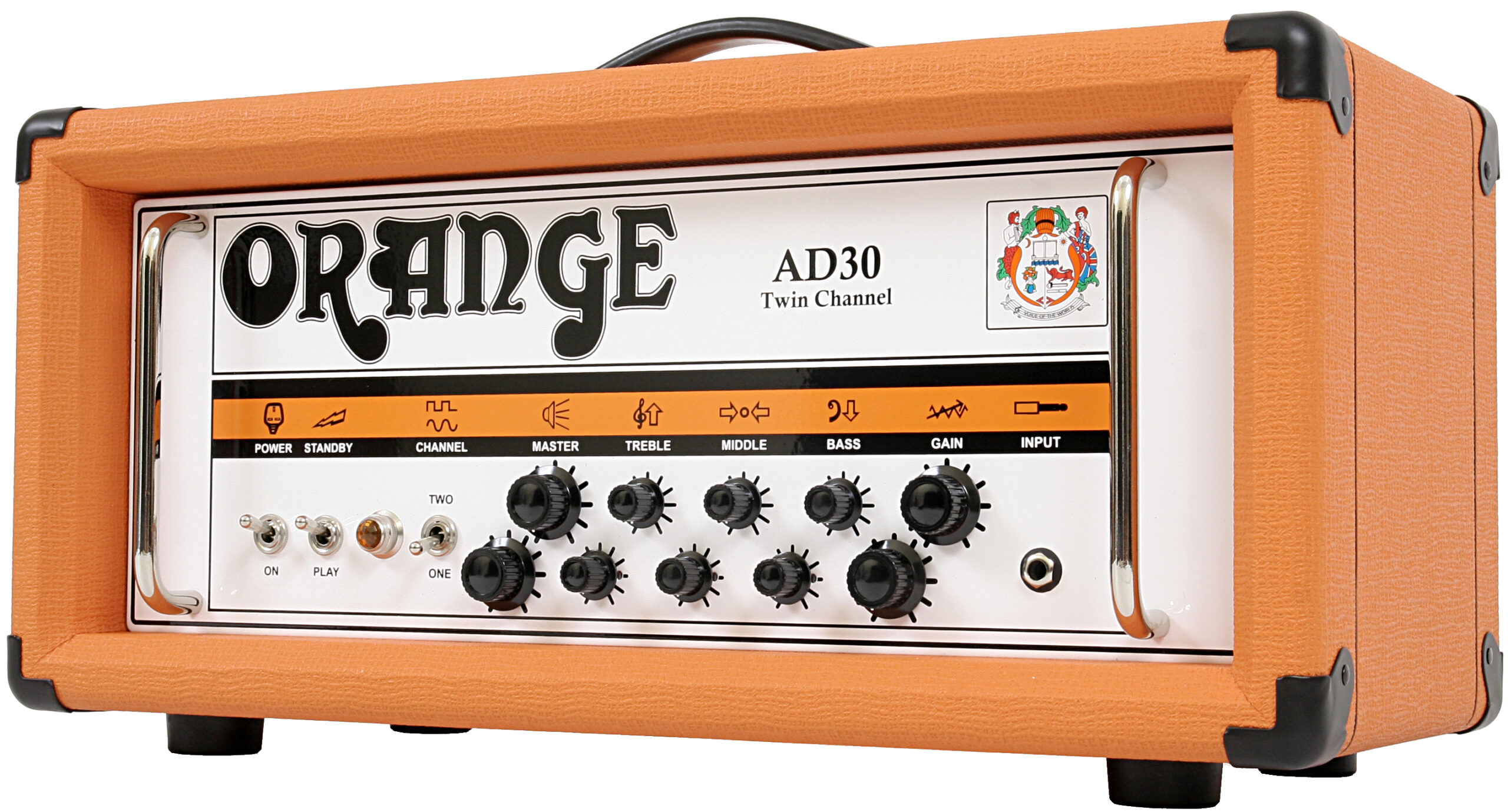
In the guitar world, you don’t often see a company name a product after a competitor’s most famous design. But when Adrian Emsley sat down to build the centrepiece of Orange’s twenty-first century lineup, he called it the AD30 — a name that rhymes with the Vox AC30, runs the same EL84 output tubes and the same GZ34 valve rectifier, and still arrives sounding nothing like one. That’s the AD30HTC in a sentence: it borrows the architecture of a British classic, then runs it through the filter of forty years of Orange mythology until something completely different comes out the other end.
The twin-channel head version — HTC stands for Head Twin Channel — arrived in 2001, two years after the original single-channel AD30 head had already found its way onto Jimmy Page’s 1999 Black Crowes tour. Since then, its specification has remained essentially unchanged. In an industry that produces a new limited edition every six months, an amp that doesn’t need revision is either so bad nobody cares or so correct nobody argues. The AD30HTC is the second kind. It is the defining thirty-watt amplifier of the British rock revival era, and its production run is now long enough to have developed its own secondary-market folklore.

This article covers the full story: where the AD30HTC came from, how the circuit actually works, what it sounds like and why, who has reliably used it (and who has been wrongly credited), how to set it for five different sounds, how it compares with the main alternatives, and what to watch for if you’re buying one used. No review-score numerics, no marketing paraphrase. Just gear journalism in the rock magazine tradition.
The Origins: Ade Emsley and the AD Series
When Cliff Cooper hired Adrian Emsley as Orange’s technical director in the late 1990s, the brief was simple: design a range of amplifiers that would pull the company back into the market conversation after two decades of reduced output and corporate drift. Orange had been famous in the early-to-mid seventies — the pictograms-only control panels, the basket-weave grille cloth, the violent orange vinyl — but the brand had gone quiet during the eighties and the early nineties, surviving on reputation and a small number of reissue heads rather than genuine new development.
Emsley’s AD series, released in stages from 1998 onwards, was the answer. The AD designation meant “Analog Design” and the original lineup included the AD30 single-channel head, the AD30R combo with built-in reverb, and the smaller AD15. These were all-valve designs around EL84 power tubes — a choice that aligned the circuit with the Vox AC30 tradition rather than the Marshall EL34 / Fender 6L6 mainstream, and produced a warm, harmonically rich character that sat in a distinct tonal pocket of its own.
The twin-channel version, the AD30HTC, followed in 2001. Emsley’s intention was to preserve the original AD30’s single-channel voice in Channel A while adding a second independent signal path in Channel B with more gain available and a slightly different character — tighter, more mid-forward, more suited to lead playing. Unlike some twin-channel amps of the era where both channels share a tone stack and differ only in gain staging, the AD30HTC gives each channel its own separate Bass, Middle and Treble controls as well as independent Gain and Master Volume. Two completely independent preamp paths, each with its own voicing, before the signal reaches the shared power section.
The name is not coincidental. “AD30” is not quite “AC30” — but it is close enough that no one writing about the amp for the first time fails to notice. Emsley knew what he was doing. The Vox AC30 is the apex of the EL84-in-a-box tradition, beloved of every Britpop-era guitarist from Jonny Greenwood to Bernard Butler, and aligning the new Orange against it was a positioning statement as much as a design brief. But the AD30HTC uses the architecture as a starting point, not a blueprint. Orange’s preamp voicing, transformer design and overall gain structure produce something that rhymes with the AC30 tonally while sounding emphatically its own.
Specifications
A few specification points worth unpacking. First, the GZ34 valve rectifier. Most modern high-gain amps use silicon diode rectifiers because they respond faster, deliver tighter bass, and hold voltage more consistently under load. The GZ34 does the opposite: it sags under high-demand playing — particularly hard-strummed chords, big pick attacks, and sustained low notes — because the tube’s internal resistance causes the supply voltage to briefly dip and recover. That dip is felt by the player as compression and dynamic warmth. The AC30 used a GZ34 in the original full-AC30 configuration, and Emsley’s choice to include one in the AD30 is a deliberate sonic commitment: this amp breathes with your playing rather than locking down under it.
Second, the Class A operation. In strict technical terms, Class A means all four output tubes are conducting current at all times throughout the full audio cycle. The practical consequence is that even-order harmonic distortion is preserved symmetrically rather than cancelled, which produces a characteristic warm, slightly compressed, musically coherent overdrive character. It also means the amp runs hotter than an equivalent Class AB design and the tubes wear faster — this is not an amp to leave on for four-hour sessions without reason.
Third, and most practically important for live use: no effects loop. The AD30HTC has no send-and-return for rack effects or delay units — everything goes into the front of the amp. For players who rely on time-based effects placed after the preamp, this is a constraint. For players who want a direct signal chain and are comfortable running delays and modulation in front of the input, it is not a problem at all. The amp’s front end responds well to drive pedals and overdrives placed before it, and the EL84 power section has enough harmonic complexity that you don’t need a loop to get a big sound. But if your rig requires a buffered loop — for parallel routing, rack units, or noise reduction — this isn’t your amp.
How the Two Channels Actually Differ
The marketing language around Channel A and Channel B on the AD30HTC can be imprecise, so it’s worth being specific. Channel A is voiced more like the original single-channel AD30: the midrange is slightly scooped relative to Channel B, giving it a slightly more open, airy quality when clean and a less aggressive character when pushed. It is the “cleaner and less saturated” channel, which on this amp means anything from a crystalline clean at low Gain settings through a warm breakup at moderate Gain to a full-on crunch at Gain maxed. Because the AD30HTC runs EL84s in Class A, “Channel A clean” still has more harmonic texture than a solid-state or Class AB amp set to the same apparent clean volume. The sparkle and touch response are always present.
Channel B has more midrange presence baked in and reaches saturation earlier for a given Gain setting. Where Channel A barks, Channel B growls. The character is tighter in the upper midrange, which is why it is typically used for leads and rhythm parts that need to cut through a mix rather than sit in it. The additional gain on tap takes the amp from crunch into genuine high-gain territory without a boost pedal, although most players who have owned an AD30HTC for more than a few months will tell you that stacking a mild overdrive in front of Channel B — a Tube Screamer-style circuit with the drive low and the level high — is the move that unlocks the amp’s best rock and lead sound.
Both channels run into the same EL84 power section and GZ34 rectifier, which means the fundamental character — the sag, the compression, the harmonic complexity — is shared. What changes is the preamp voice and the available gain structure. Because each channel has its own Master Volume, you can also set one channel loud (for stage volume) and one lower (for bedroom practice), or set radically different levels for a clean-to-loud footswitch jump during a performance.
Famous Players: Honest Assessment
Five artists are listed in connection with the AD30HTC: Jimmy Page, Jim Root, Brent Hinds, Omar Rodríguez-López, and Matt Pike. Each one requires per-SKU verification, because “uses Orange” and “uses the AD30HTC” are not the same claim.
Jimmy Page
Jimmy Page‘s connection to the Orange AD30 family is documented and substantial — but requires a model-specific clarification. Page first encountered the AD30 during his 1999 tour with The Black Crowes (the shows that became the Live at the Greek album). At that point he was using the original single-channel AD30 head, which had been introduced in 1998–99. He was “smitten,” in the words of the period coverage, and incorporated it into his touring setup from that point forward.
By the time of the celebrated Led Zeppelin O2 Arena reunion concert on 10 December 2007 — filmed and released as Celebration Day — the AD30HTC twin-channel head had been available since 2001. Page had two AD30s on stage that night, alongside two custom AD50s and two Petersburg P-100s. Mick Hughes, the live engineer for the reunion, described Page’s Orange AD30 head as “the loudest 30 watts I have ever heard” — a statement that became one of the most-quoted endorsements in the AD30HTC’s history.
The nuance: forum discussion and close reading of the 2007 sourcing suggests the AD30s in Page’s 2007 rig may have been single-channel heads (the same configuration he used in 1999) rather than the twin-channel HTC. Orange’s own communications use Page’s name in connection with the AD30 broadly without always specifying the variant. The honest position is this: Page’s documented and verified connection is to the AD30 family generally, the single-channel model specifically for 1999, and the 2007 setup likely included a mix of configurations that remains imprecisely documented in primary sources. What is beyond dispute is that Orange’s AD30 — in some form — was Jimmy Page’s primary amp for one of the most-watched concert events of the 2000s. That is a legitimate and genuinely significant connection.
Jim Root (Slipknot)
Jim Root is an Orange brand artist with his own signature amp — the #4 Jim Root Terror, a lunchbox-format head in Orange’s Terror series. His documented live setup consists of Orange Rockerverb 100 heads (the original and MKII versions) running into isolated Orange 4×12 cabinets loaded with Celestion Vintage 30s. More recently, he has used a Neural DSP Quad Cortex for modelling alongside traditional heads. No primary source — manufacturer documentation, Premier Guitar rig rundown, guitar tech interview, or confirmed photograph — places Root on an AD30HTC. He is an Orange artist; he is not documented as an AD30HTC user.
Brent Hinds (Mastodon)
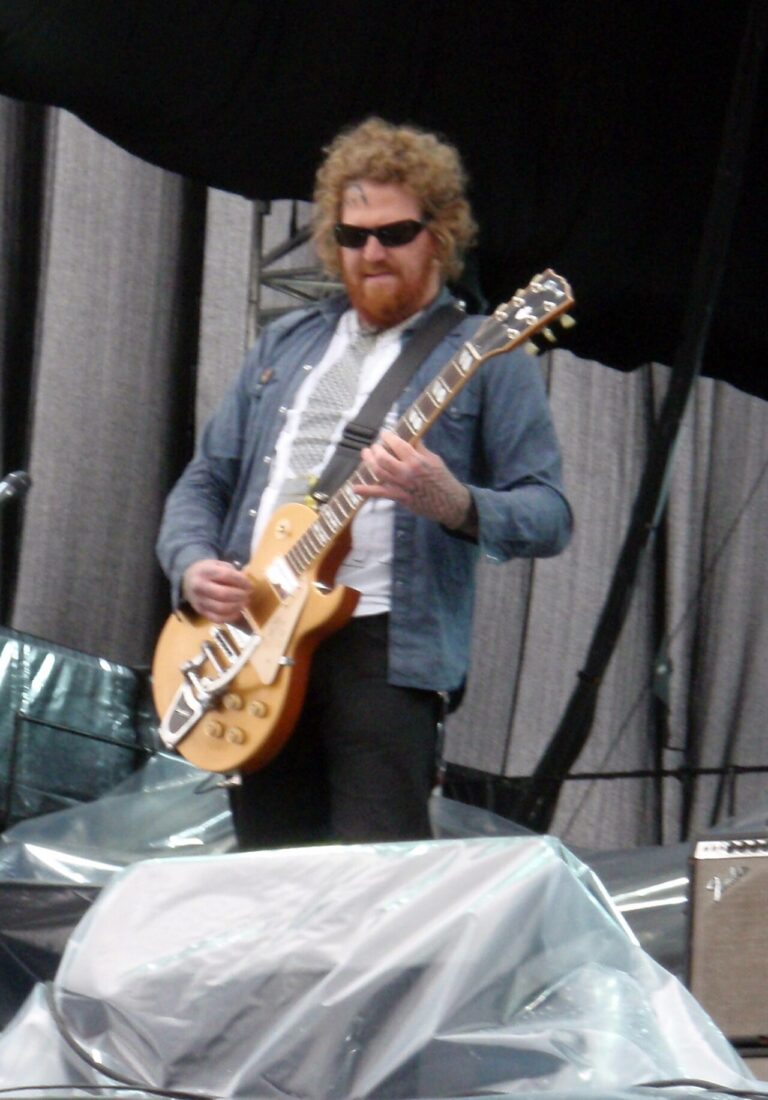
Brent Hinds of Mastodon is, like Root, a genuine Orange artist — but his signature instrument is the Brent Hinds Terror, a 15W two-channel lunchbox head with a “Natural” clean/overdrive channel and a “Dirty” high-gain channel. It was designed specifically, in Hinds’s own words, to “play Mastodon riffs loud.” It has no relationship to the AD30HTC circuit or EL84 power section. No primary source documents Hinds using an AD30HTC.
Omar Rodríguez-López
The Omar Rodríguez-López situation was covered in the article on the Orange OR120: his documented rig from the At the Drive-In era through the Mars Volta years shifted through Orange AD140 heads and later Rockerverb 50 heads, not AD30HTCs. The AD140 is a 140W solid-state-preamp head in a completely different product family from the EL84/GZ34 AD30. Equipboard community attribution and search snippet recycling have repeatedly connected his name to Orange generally; no primary source has placed him specifically on an AD30HTC. Not documented on this SKU.
Matt Pike (Sleep, High on Fire)
Matt Pike is the most genuinely embedded Orange artist. Orange signed Sleep’s reunion and sponsored their equipment; Pike has spoken warmly about the brand in multiple interviews. But his documented amp preferences, as expressed in his own words at Desertfest in an interview with Ade Emsley published on Orange’s own website, run to “Dual Dark Oranges,” Thunderverbs (specifically the 200-watt versions), and the OR50/OR80 micro-head series which he uses in an isolation cabinet as a studio blend source (the old Frank Zappa Pignose trick). His 2010 Premier Guitar rig rundown — the primary documented source for his live setup — lists a Marshall JCM800 Kerry King head and a Soldano SLO100 through three 4×12 Emperor cabinets. No AD30HTC appears in any primary-source rig documentation for Pike. He is a great Orange story; just not an AD30HTC story.
The honest summary for all five names: the AD30HTC is associated with its era rather than with a single landmark player the way some amps are. That is not a weakness. It is an amp played by enough people in enough important recordings that it has become part of the infrastructure of British and British-influenced rock — something in the background of records you’ve heard, running at the back of stages you’ve watched, appreciated more by the engineers and players who know it than by the gear journalists who need a hero name to write the headline. Jimmy Page’s connection to the AD30 family is the most substantial and documented; the rest are either brand associations credited to the wrong model, or anecdotal proximity rather than confirmed usage.
Tone Recipes
1. Classic Orange Crunch (Blues-Rock and Indie)
Use Channel B. Set Gain to 5, Master at 6, Bass 6, Middle 7, Treble 5. Les Paul or humbucker guitar, bridge pickup. This is the tone that defined the AD30HTC’s reputation: mid-forward, singing on the attack, with a smooth top end that doesn’t razor your ears off. The GZ34 does its best work here — strum a hard E chord and you’ll feel the supply voltage briefly dip, then the sustain opens up. Dial gain up or down one notch either way depending on your guitar’s output. Roll guitar volume to 7 for cleaner rhythm; back to 10 for lead. No pedals required.
2. Vox-Adjacent Sparkle (Channel A, Clean)
Channel A, Gain 2, Master 8, Bass 5, Middle 4, Treble 7. Single-coil guitar, neck or middle position. This is the AD30HTC’s AC30 impression — chimey, light, slightly compressed, with a shimmer on picked notes that makes arpeggios sound expensive. The amp never goes fully sterile because the GZ34 and the Class A power section always have some gentle compression in play. For clean indie or post-punk rhythm work, this is where the amp lives. Add a Room verb from a pedal if you need it; the amp itself does not have one.
3. Recording Lead (Channel B, Output Saturation)
Channel B, Gain 8, Master 3–4. Bass 5, Middle 8, Treble 4. Run the amp at low master volume into a well-matched 16Ω cabinet (a single 12 or a quality 2×12 with Celestion Vintage 30s or Creambacks) and mic close. The EL84s at this setting are beginning to saturate the output stage as well as the preamp — you get a softer onset, more compression, and a characteristic EL84 “bounce” on the note attack that suits sustained lead lines. This is the approach to record a 30W Class A amp without destroying the room. The frequency centre is around 1–2kHz, which translates cleanly through a single SM57 at the speaker dust cap with no low-end mud.
4. Page-Inspired Hard Rock (Channel B + Treble Boost)
Channel B, Gain 6, Master 7, Bass 7, Middle 6, Treble 5. Add a Dallas Rangemaster-style treble booster — or a germanium-voiced fuzz unit — in front of the input. The treble boost drives the preamp into a different saturation character: harder attack, more defined pick transient, less smooth than the amp’s natural overdrive voice. This combination is the closest you’ll get to the tone Page was chasing when he brought the Orange into his 1999 Black Crowes rig. It’s also the combination that made Mick Hughes say what he said. Les Paul Standard through the bridge humbucker, guitar volume on 10.
5. Stoner / Doom Saturation
Channel B, Gain 9, Master 5, Bass 9, Middle 7, Treble 3. Stack a mild low-gain overdrive (Tube Screamer with drive low, level high) in front of the input. Large guitar — baritone, or standard-scale tuned to C or B. The bass knob at 9 on the AD30HTC is assertive but not muddied; the amp’s GZ34-based sag turns a heavy chord into a slow, compressed bloom rather than a smear. This is the character that made the AD30 attractive to the doom and stoner community that gathered around Orange from the mid-2000s onwards. Keep the Treble control low to avoid harshness at high gain, and let the mids do the work of cutting through a mix.
Comparisons
vs Vox AC30 Top Boost (Rank 381)
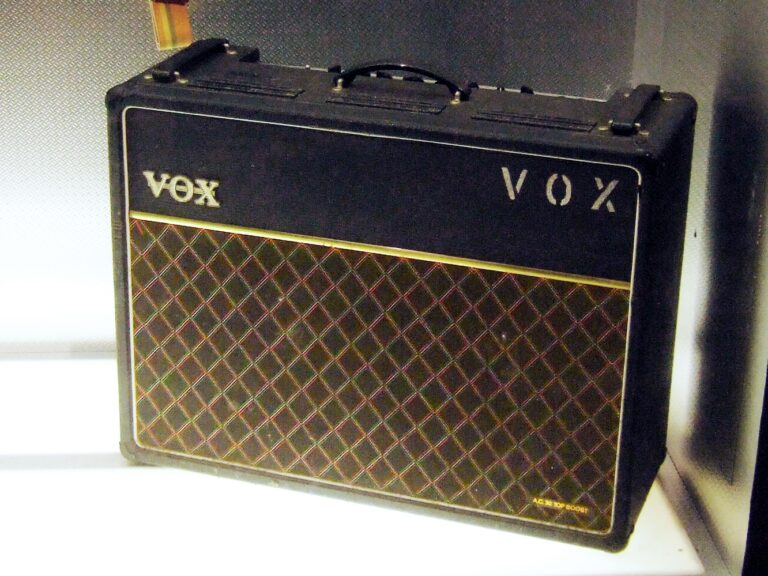
The obvious comparison. Both run EL84 output tubes, both use a GZ34 valve rectifier (in the original AC30 configuration), both are nominally 30 watts and unmistakably British. The differences are real and significant. The AC30 Top Boost uses a cathode-biased, fixed Class A output section with a distinctive tremolo and vibrato circuit in the original; the AD30HTC is a clean two-channel design with no built-in modulation. The AC30’s Top Boost preamp is famous for its mid-scoop character — the “jangle” of Rickenbacker-and-AC30 combinations is built on a relative absence of aggressive mids. The AD30HTC, particularly Channel B, is deliberately more mid-forward. The result: the AC30 sounds more open and springy; the AD30HTC sounds thicker and more assertive under distortion. Both compress beautifully. The AC30 is the choice for jangle and chime; the AD30HTC is the choice when you want EL84 character with more muscle.
vs Orange Rockerverb 50 MKIII (Rank 391)
Within the Orange range, the AD30HTC and the Rockerverb 50 MKIII are the two most influential models. The Rockerverb runs EL34 output tubes, is Class AB, has a built-in effects loop, a reverb circuit, and a master volume per channel — and delivers substantially more gain, lower noise floor, and better compatibility with a modern rig. The AD30HTC’s Class A EL84 circuit produces a more dynamic, touch-sensitive response; the Rockerverb is tighter, cleaner under distortion, and better suited to high-gain applications and modern production contexts. If you want to run a pedalboard through a loop and play metal, the Rockerverb is the answer. If you want the amplifier itself to be the instrument, the AD30HTC is the answer.
vs Orange OR120 (Rank 490)
The OR120 is the mythological Orange — the single-channel Baxandall-voiced EL34 beast from the 1972–79 era, associated with the early British hard rock and progressive scene and confirmed on stage with Billy Corgan and Tim Sult among others. It is four times the wattage, a different output tube family, a completely different circuit topology, and costs considerably more on the used market. The AD30HTC is the modern, controllable, two-channel descendant of the Orange sound philosophy. The OR120 will be louder, thicker in the low end, and more aggressive in a full-band mix without help; the AD30HTC will be more musical at recording volumes, more versatile across two channels, and far more cooperative with the rest of a signal chain.
vs Marshall JCM800 2203 (Rank 378)
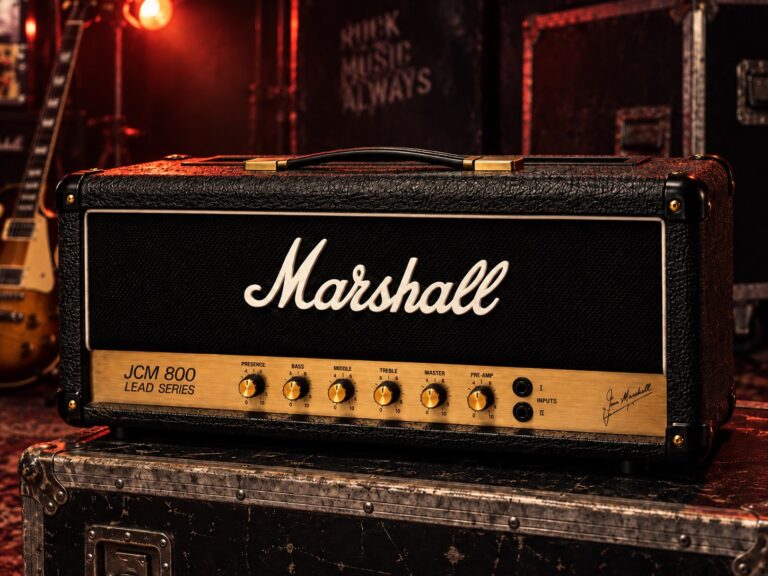
The JCM800 2203 and the AD30HTC represent genuinely different philosophies of what a rock amp should do. The JCM800 is loud, hard, EL34-powered, and deliberately aggressive — built for stages and studios where you need maximum power and minimum give. The AD30HTC is thirty watts of Class A EL84 with a tube rectifier, intentionally designed to breathe and sag. In a high-volume live context the JCM800 wins on sheer projection; in a recording context or a mid-volume gig, the AD30HTC’s ability to generate usable, harmonically complex overdrive at lower master volumes gives it the edge. Page famously used both in his career — the Orange for the reunion era, the Marshalls for the original Zeppelin recordings — and the combination makes sense: each does something the other can’t.
vs Marshall 1959 Super Lead Plexi (Rank 377)
The Plexi is the amp Jimmy Page used before the Orange entered his setup, and the comparison illuminates what drew him to the AD30 family. The Plexi requires enormous volume to reach its best natural overdrive — the EL34s at 100W only begin to saturate the output stage when the amp is genuinely loud. The AD30HTC reaches a comparable texture at a fraction of the stage volume, because 30W of Class A EL84 with a tube rectifier has sag and harmonic character built into the power section regardless of how hard the preamp is being pushed. For Page — who by 1999 was playing theatres and large venues rather than 1975 arenas — the ability to have that saturated, complex Orange character at a controllable master volume was likely part of the appeal. For the working guitarist who plays clubs and studios, it remains the argument for the AD30HTC over the Plexi today.
Buying Guide
The AD30HTC’s unchanged specification is both a strength and a minor complication for used buyers. Because the circuit has not been revised since 2001, every example you’ll encounter runs the same basic topology. But there are production-era differences worth knowing.
Early 2001–2005 units were built in the UK and carry the hand-wired-through-board construction that Orange used during this period. These are the most desirable to collectors and often command a modest premium on the used market. Later production moved to China while maintaining the same circuit and component specification — the component quality has been consistent, but the assembly approach shifted from through-hole hand wiring to PCB-based construction. Either version will sound like an AD30HTC; the UK-built examples are historically interesting but not functionally superior for most players.
Key used-market checks: test both channels independently with a known-good guitar and cable. EL84 tubes age towards harshness and loss of headroom — if the amp sounds thin or fizzy on Channel B with the gain set only to 5–6, the power tubes are likely past their best. The GZ34 rectifier tube is a single-envelope component that fails definitively rather than gradually; if the amp has no output at all or has intermittent crackling unrelated to the input, the GZ34 is the first thing to check. Both EL84 sets and the GZ34 are widely available and inexpensive — budget for a retube if you’re buying used.
The AD30HTC has no shared component between channels in the preamp path, which means a failed preamp tube in one channel leaves the other functioning. This is diagnostically useful: if one channel works and one doesn’t, the problem is almost certainly a preamp tube in the dead channel. Pull and reseat all four ECC83s as a first diagnostic step before spending money on anything else.
Used price range in 2025–26: approximately $700–$950 for clean examples in working condition; UK-built examples may reach $1,000–$1,100 in good markets. New, the amp lists at approximately $1,379–$1,437 street depending on retailer and territory.
Ownership Notes
The AD30HTC runs hot — hotter than a Class AB amp of comparable wattage — because Class A operation keeps all four EL84s conducting all the time. Allow 15–20 minutes of warm-up before playing at volume. After the session, allow the same period to cool before transport, particularly in cold weather. Do not cover the amp while tubes are hot.
The 16Ω mono output is the correct load for a single standard 16Ω cabinet. If you run two cabinets, use the two 8Ω outputs. Running the amp into a mismatched load — particularly a lower-impedance load than specified — stresses the output transformer and can eventually cause failure. The transformer is a critical component in what makes the AD30HTC sound like itself; replacing it is not cheap and not straightforward. Match your impedance.
There is no effects loop. Reverb, delay, and modulation go in front of the input. For time-based effects particularly, the interaction with the amp’s natural gain structure is audible — a delay running into a gainy Channel B will smear more than a delay running into a clean Channel A. This is a sound in itself; many players prefer it. But if precise sterile trails behind a distorted guitar are essential to your rig, the AD30HTC will require workflow adjustment or an external effects system that doesn’t depend on a loop.
The amp is specified as 16Ω or 2×8Ω. It is not rated for 4Ω. Many modern speaker cabinets are available in 8Ω, and a single 8Ω cabinet will work through one of the 8Ω outputs, but you will be running one output with no load on the other. A proper 16Ω cabinet — or a pair of 8Ω cabinets in parallel — is the correct configuration for full output and optimal transformer operation.
FAQ
Is the Orange AD30HTC still in production?
Yes. As of 2025–26, the AD30HTC remains in Orange’s active catalogue with the same specification it has had since 2001. It is one of the few amplifiers of its generation that has continued without a MKII revision, a new colour option, or a cosmetic update. Cliff Cooper and Ade Emsley have consistently cited this as a deliberate choice — the amp was correct from the start and changing it would be marketing, not engineering.
What is the difference between the AD30HTC and the AD30TC?
The HTC is the head (no speakers); the TC is the 2×12 combo version of the same circuit. Electronically identical. The combo includes an Orange-branded 2×12 cabinet as part of the unit; the head requires a separate cabinet. Both run the same tubes, the same channels, the same control layout. The combo is slightly more practical for players who gig without a backline; the head is the standard choice for studio and touring use where cabinets are variable.
Does the AD30HTC have a boost function or series effects loop?
No to both. There is no effects loop, send/return, or series loop of any kind. There is no boost switch or built-in level jump function. Effects go in front of the input. If you want to add a solo boost, a volume pedal placed before the amp’s input is the standard approach; many AD30HTC players also use a Tube Screamer-style pedal with the gain low for this purpose, which simultaneously boosts level and modifies the frequency character into the amp’s input.
Can the AD30HTC run at lower wattage for smaller venues?
No. Unlike some amps, the AD30HTC has no half-power, triode or wattage reduction switch. It is always 30W of Class A EL84. An external attenuator (a device placed between the amp’s output and the speaker cabinet that absorbs power before it reaches the cone) can reduce volume while keeping the amp’s power section saturated — this is the standard solution for AD30HTC users who need to get the amp sounding its best at bedroom or small studio volumes. A reactive load such as a Two-Notes Torpedo Reload or a Rivera RockCrusher is the most common approach.
What speakers work best with the AD30HTC?
The most commonly cited pairing is Celestion Vintage 30s (16Ω, 60W) in a 2×12 or 4×12 cabinet. The V30’s mid-forward character complements the amp’s own midrange emphasis without compounding it excessively. Players looking for more top-end clarity often use Celestion G12H-75 Creambacks, which add warmth and a slightly rolled-off top end compared to the V30. Greenbacks (Celestion G12M, 25W rating) are also a classic EL84 pairing — they break up earlier under the output transformer’s drive, which adds another layer of harmonic complexity to the amp’s natural voice.
Why is the amp so loud for 30 watts?
Because 30W of Class A is not the same acoustic experience as 30W of Class AB. Mick Hughes’s famous quote about “the loudest 30 watts I have ever heard” is not hyperbole; it reflects a real measurement phenomenon. Class A amps produce substantially more even-order harmonic content at lower power levels, and human perception of “loudness” is heavily influenced by harmonic richness as well as raw SPL. The AD30HTC at 30W Class A sounds subjectively as loud as many 50W Class AB designs, particularly in the midrange frequencies where most guitar energy sits. It will not fill an arena unaided, but for clubs, bars, and studios it is a genuinely gig-capable head.
Is the AD30HTC good for metal?
It is good for the kind of metal that runs on natural amp overdrive, dynamic picking, and harmonic richness rather than tight, high-gain, low-noise modern production. Early Black Sabbath territory, stoner rock, doom, early proto-metal all sit naturally within what the AD30HTC can do without modification — particularly Channel B with a Tube Screamer stacked in front. Contemporary djent, tight drop-tuned rhythms, or the controlled high-gain sound of modern extreme metal production are better served by the Rockerverb 100, the Orange Thunderverb, or a non-Orange high-gain design altogether. The AD30HTC has no noise gate loop, no tight silicon-diode rectifier, and no modern voicing switch. It is not designed to compete in the high-gain arena; it is designed to be excellent on its own terms.
What is the used-market sweet spot for buying an AD30HTC?
Any example in the $700–$900 range in verified working condition is a fair buy in the 2025–26 market. Budget $100–$150 for a full retube (a matched quad of EL84s, four ECC83 preamp tubes, and a new GZ34) as an immediate service cost, then consider that a new amp costs approximately $1,400. You are saving over $300 even after the retube, and if you buy a UK-built early example you have a piece of amp history. The main caveat: verify both channels function before buying, verify the GZ34 rectifier is not failing, and check the output transformer by playing at volume through a correctly rated cab — transformer issues present as low output with excessive heat, which the seller will not disclose voluntarily.
The Orange AD30HTC has been in continuous production for over two decades without needing a MKII. That is not an accident. It found its specification and stayed there while everything around it changed — amp modellers arrived, boutique builders multiplied, high-gain metal heads grew a new generation of subdivisions. The AD30HTC did not update its firmware, drop an app, or add a Bluetooth channel. It kept running four EL84s through a GZ34 into two independent channels with no effects loop, and the market kept buying it. Some gear earns its reputation by association with famous names. Some earns it by simply being correct. The AD30HTC is the second kind.
Image credits
- Jimmy Page: Avda, Wikimedia Commons, CC BY-SA 3.0.
- Top image: Orange AD30HTC twin-channel amplifier head. Photo: muzyczny.pl, Wzmacniacz gitarowy AD30HTC firmy Orange, CC BY-SA 4.0. Full original frame retained; displayed at reduced size. No crop or retouch by GuitarGangsters. Adaptations must use the same or a compatible license.
- Brent Hinds: kallerna, Wikimedia Commons, CC BY-SA 3.0.
- Vox AC30 Top Boost: wetwebwork; existing crop and contrast/color adjustments: Clusternote, Wikimedia Commons, CC BY-SA 2.0.
- Marshall JCM800 2203: GuitarGangsters AI-generated reference illustration, not a photograph.
Latest News
Related
On This Day
Tuesday 10 November
From this week: