
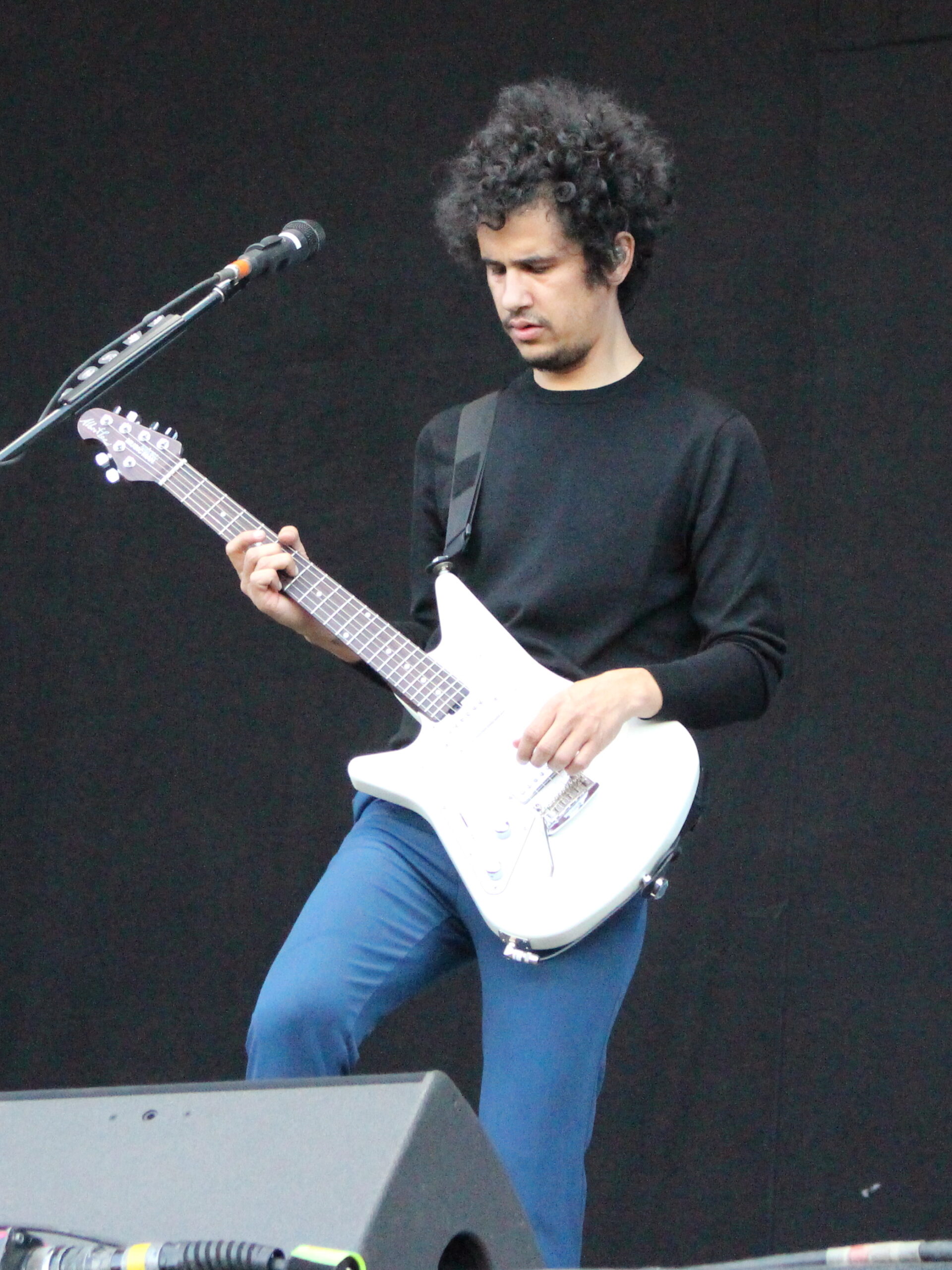
Gear Timeline
“I’ve never considered myself a guitarist, and I’ve never liked the guitar.” Omar Rodriguez-Lopez said this to Guitar World — and then, in the same period, produced six Mars Volta albums, twice as many solo albums, produced more than twenty albums, generated a Grammy Award for Best Hard Rock Performance (“Wax Simulacra,” 2008), and was identified by multiple critics and fellow musicians as one of the most distinctive and innovative guitarists of his generation. The disconnect between self-assessment and external assessment is total. His Rolling Stone quote adds the emotional texture: “I feel like an imposter in a really beautiful, magical place. And I feel like any minute somebody’s gonna go, ‘That guy!’ and I’m gonna have to leave.” He is still there. No one has pointed. He is also on 13-gauge strings — the heaviest gauge most electric rock guitarists would consider — because “he first acquired them by accident, and ended up being more comfortable than thinner strings.” The accidents are significant in his story. His Squier Supersonic with At the Drive-In was “a limited production by the Korean Squier factory in the late ’90s, designed after a photo of Jimi Hendrix playing an upside-down Fender Jaguar — which, ironically, Rodriguez-Lopez flipped again to suit his own preferred left-hand playing.” An upside-down guitar designed after an upside-down Hendrix photo, then flipped back upside-down. The modifications he made: removed the neck pickup, removed the toggle switch. A stripped-back beast for aggressive Texan hardcore. His Orange AD140 amp: the heavy, saturated, aggressive British tonality for both the hardcore aggression of At the Drive-In and the psychedelic prog complexity of the Mars Volta. His Boss DD-5 delay: “another cornerstone — the Digital Delay, the DD-5, had that since I can remember, since it came out.” He doesn’t like the guitar. He is an icon in front of an amp. He makes it sound like wrestling.
Omar Rodriguez-Lopez was born on September 1, 1975, in Bayamón, Puerto Rico. His family moved to El Paso, Texas, where he began his musical career in 1990 singing for the El Paso punk band Startled Calf. After a period of traveling, he returned to El Paso to join vocalist Cedric Bixler-Zavala in At the Drive-In — the post-hardcore band whose commercial breakthrough album Relationship of Command (2001) led to their appearance on several international festival stages before the band fractured. Rodriguez-Lopez and Bixler-Zavala subsequently formed The Mars Volta, whose seven studio albums (De-Loused in the Comatorium, Frances the Mute, Amputechture, The Bedlam in Goliath, Octahedron, Noctourniquet, Octahedron) represent the most ambitious, most complex, and most prolific body of work in 21st-century progressive rock. He has also released dozens of solo albums under his own name and in various configurations. He is fifty years old. He still doesn’t like the guitar. He is still one of the most distinctive guitar voices in rock.
Background: Bayamón Puerto Rico, El Paso Texas, At the Drive-In Post-Hardcore, Mars Volta Progressive Rock, Grammy 2008, John Frusciante Collaboration, “Reluctant Guitar Hero”
Rodriguez-Lopez’s specific career trajectory — from Puerto Rican-born, El Paso-raised punk vocalist through At the Drive-In’s post-hardcore aggression to Mars Volta’s sprawling, jazz-influenced, psychedelic progressive rock — is the most dramatically genre-spanning in this section of the guide. At the Drive-In’s specific contribution to post-hardcore: the combination of the band members’ Mexican-American and Puerto Rican backgrounds with the specific cultural energy of the El Paso, Texas music scene produced a post-hardcore sound that was simultaneously more frantic and more emotionally complex than the American and British post-hardcore that preceded it. Relationship of Command (2001) is its document.
The Mars Volta’s ambition was explicitly progressive: the John Frusciante collaboration documented in Rodriguez-Lopez’s own Guitar World interview (“He came in and was literally the guitar player for the album. I’m just playing all the guitar solos and parts that needed to be doubled… John’s a true guitar player. He makes it look so simple. I just spend most of my time wrestling with it.”) reveals both the specific creative dynamic of the Frusciante collaboration and Rodriguez-Lopez’s characteristic self-assessment: Frusciante is “a true guitar player”; he is just “wrestling with it.” Guitar Player adds the specific technical detail: “Most of the time I’m so much of a brute that I pull the strings out of tune. My mixing engineer always says that he can tell when he’s hearing a Mars Volta record because the guitar is always out of tune.” 13-gauge strings, played as a brute, pulled out of tune. Grammy Award. Icon.
His characterization as “reluctant guitar hero” is the most specifically honest self-assessment in this guide. He is reluctant (does not identify as a guitarist, does not enjoy the instrument per se). He is a hero (Grammy, iconic status, immediately recognizable playing vocabulary). The guitar is the medium he wrestles with. The music is what emerges from the wrestling match.
The Rig: Omar Rodriguez-Lopez’s Guitars, Amps, and Effects
Guitars
Rodriguez-Lopez’s guitar during At the Drive-In’s active period was the Squier Supersonic — a limited production Korean Squier from the late 1990s, designed after a photo of Jimi Hendrix playing an upside-down Fender Jaguar. Mixdown Magazine: “Rodriguez-Lopez flipped again to suit his own preferred left-hand playing.” The guitar was thus: originally a right-hand guitar → designed after an upside-down (left-hand) Hendrix → then flipped right-side up again by Rodriguez-Lopez (who plays left-hand but re-strung a right-hand guitar). His modifications: removed the neck pickup, removed the toggle switch. Mixdown: “resulting in a stripped back beast perfect for his aggressive playing style in the Texan hardcore act.” The description of his relationship to the Supersonic: “Omar Rodriguez-Lopez abused this guitar more than he actually played it.” Not played — abused. The guitar as the medium of a physical argument.
During The Mars Volta’s formative years, Rodriguez-Lopez played a customized Ibanez AX120 — “once again simplified to include a single Artcore Humbucker Blade pickup and master volume control knob.” The simplification pattern — as with the Squier Supersonic — is the same: remove the neck pickup, remove the switching complexity, reduce the guitar to its most direct signal path. A single blade humbucker in the bridge, one volume knob. Everything else removed. The Ibanez AX120’s specific character (a mahogany-body, hardtail solidbody with humbuckers) provides a warm, thick-single-pickup character through his Orange AD140 for the Mars Volta’s specific heavy progressive approach.
The Equipboard documentation: “The ORM-1 guitar is the artist signature guitar for Omar Rodriguez-López which was first introduced in 2008. He has frequently used this guitar live. He says the guitar was made small and simplistic to suit his hand size and standards. He uses 13 gauge, first acquired by accident, and ended up being more comfortable than thinner strings.” The ORM-1’s “small and simplistic” specification reflects the same reduction philosophy as the Squier and Ibanez AX120 modifications: eliminate complexity, keep what’s essential. His 13-gauge string choice — extraordinary for an electric rock guitarist (most use 9-10 gauge light strings; 13-gauge is what many acoustic or jazz guitarists use) — arrived by accident and stayed because heavy strings suited both his playing approach (aggressive enough to pull strings out of tune regularly) and his physical relationship to the instrument.
Mixdown: “His signature Jet-King became one of his most used guitars while touring with The Mars Volta, as well as his various other live projects including Antemasque and Bosnian Rainbows.” The Ibanez Jet-King — a semi-hollow/hollow-body Ibanez guitar with vintage-inspired styling — provides a different tonal character from the solidbody instruments: the hollow resonance and the specific character of its pickups suited certain Mars Volta material’s more atmospheric passages.
Mixdown: “Rodriguez-Lopez has owned this vintage Mustang since 2000, however, he began using it as his main guitar with Antemasque for their 2015 shows. Previously, he has discussed its use as a studio weapon in a 2010 interview with Guitar Player, claiming he only used it because ‘the album rejected everything else.'” The vintage Fender Mustang — a short-scale student guitar not typically associated with progressive rock — as the guitar the album “demanded” is one of the most Ribot-esque instrument choices in this section: use whatever the music requires, regardless of convention.
Mixdown: “Purchased from Chicago Music Exchange and used to write, record and tour Bosnian Rainbows’ first LP, Rodriguez-Lopez’s Supro Super features a unique 3/4 short scale, as well as an unusually short and thick neck.” The Supro Super — a vintage 1960s Supro instrument — connects him to the same budget-vintage guitar tradition that Dan Auerbach and Marc Ribot explore through their collections of Supro, Harmony, and similar instruments.
Mixdown: “2019 saw the release of Omar’s own signature model with Ernie Ball Music Man.” The Music Man signature guitar represents his most recent instrument collaboration — a production signature model that makes his specific requirements available to other players, in the tradition of his earlier Ibanez ORM-1 signature.
The Equipboard documentation includes a Vox Starstream in his At the Drive-In gear — the 1960s-era Vox semi-hollow with its specific bright, jangly pickup character providing an alternative tonal palette from the Squier Supersonic.
Amps
Mixdown: “For the majority of his tenure with both At The Drive In and The Mars Volta, Rodriguez-Lopez endorsed Orange AD140 heads, savouring the heavy saturated overdriven tones provided by the aggressive tonality of the amp.” The Orange AD140 — a 140-watt all-tube amplifier head using EL34 output tubes — provides the specific Orange character: heavy, warm, harmonically rich British saturation with exceptional note separation at high gain. The AD140’s “aggressive tonality” suits both At the Drive-In’s post-hardcore aggression and Mars Volta’s complex progressive rock, providing the specific sustained, harmonically dense tone that his approach requires. Orange amplifiers have a specific midrange character — warmer and more “woolly” than the crisp, tight Marshall — that gives sustained notes a vocal, singing quality appropriate for both the aggressive and the atmospheric passages of his playing.
The Equipboard documentation: “At 0:10 Omar is playing through a Vox AC30 combo amp.” The Vox AC30 — the EL84 British combo that appears throughout this entire guide — provides a cleaner, more chimey alternative to the Orange AD140’s saturated aggression. Used in specific live contexts where the song requires a brighter, cleaner character than the Orange provides.
Effects
Equipboard: “And then, for me, another cornerstone is the Digital Delay, the DD-5, had that since I can remember, since it came out.” The Boss DD-5 — a specific early 2000s Boss digital delay pedal in the DD series — is Rodriguez-Lopez’s primary delay, present in his rig “since I can remember, since it came out.” Delay is the foundational effect of his sonic approach: the specific echo-repeats that give his wah solos their dimensional, spatial quality and that add rhythmic complexity to his melodic lines. The DD-5’s specific delay-time range and tone character define the “Mars Volta delay” sound.
Guitar World’s characterization of his Mars Volta guitar moments includes “hurricane wah pedal solos” — the wah as a primary expressive effect for lead playing. The specific wah model is not documented as consistently as other pedals, but its role in his playing is central: the wah’s frequency sweep, applied to sustained single-note lines over the Orange AD140’s saturation, produces the specific vocal, expressive character of his most celebrated Mars Volta solos.
Equipboard: “In this video Omar Rodríguez-López of The Mars Volta talks about his pedalboard and equipment he is using, containing an EarthQuaker Devices Rainbow Machine Polyphonic Pitch Mesmerizer.” The EQD Rainbow Machine — a polyphonic pitch shifter that can track chords (not just single notes) and add harmony voices — provides the specific complex, shimmering, sometimes out-of-control pitch-shifting character appropriate for Mars Volta’s psychedelic passages.
Equipboard: “A Line 6 M9 Stompbox Modeler can be seen on Omar’s pedalboard at about 5 minutes into the video.” The Line 6 M9 — a multi-effects pedal offering dozens of different effect types in a single floor unit — provides the flexibility to access multiple effects types without carrying individual pedals for each.
UberProAudio: “This guy has a pretty extensive guitar rig. He has a ton of effects pedals!” Rodriguez-Lopez’s effects approach is the most expansive in this section — consistent with Guitar Player’s characterization of his “love of effects” and the Guitar World description of his Mars Volta guitar moments as combining “angular riffs, tricky time signatures, disturbingly warped tonalities, torrid solos, and brilliantly effected tones.” The effects are not decorative but compositional — the specific textures, timbres, and harmonic dimensions that the effects provide are integral to the Mars Volta’s music in ways that would not be reproducible by another guitarist playing the same notes through different effects.
Playing Style & Tone Philosophy
Omar Rodriguez-Lopez’s playing style is the most self-contradictory in this guide — the approach of a musician who doesn’t like the guitar and is technically a “brute” who pulls strings out of tune, but who produces some of the most inventive, emotionally powerful, and harmonically distinctive guitar playing of the 21st century. Guitar World: “there’s an intriguing disconnect between his perception and the public’s: he’s an icon in front of an amp, like it or not.” The key word is “wrestling”: his Guitar World quote about Frusciante making it “look so simple” while he “spends most of my time wrestling with it” captures the specific relationship between his approach and the guitar. He does not have easy facility. He has intention. He has effects. He has the Orange AD140’s aggressive tonality, the DD-5’s delay, the wah’s expressiveness. He wrestles the guitar into producing what the music requires.
His tone philosophy is the effect-as-composition philosophy — the specific effects he deploys are not tonal colors added to a guitar signal but compositional tools that determine what musical ideas are possible in a given moment. The Orange AD140’s saturated aggression enables the specific character of his most intense passages; the DD-5’s delay enables the rhythmic complexity of his melodic lines; the wah enables the vocal expressiveness of his solos; the Rainbow Machine enables the specific harmonic dissonance of his more psychedelic moments. Each effect enables specific musical possibilities. Together, they enable the Mars Volta.
How to Sound Like Omar Rodriguez-Lopez
Guitar: Ibanez ORM-1 signature (small, simplistic, single humbucker) or any single-humbucker solidbody reduced to its most essential signal path — one pickup, one volume knob, nothing else. String with 13-gauge electric strings (heavy gauge, reducing high-frequency brightness and increasing physical resistance). Tune correctly; let the aggressive playing take care of the rest.
Amp: Orange AD140 (140W EL34 British saturation) — the aggressive, warm, “woolly” Orange character is essential. Vox AC30 for cleaner contexts.
Amp Settings (Orange AD140 — Mars Volta Heavy Prog):
| Control | Setting (0–10) | Notes |
|---|---|---|
| Gain | 7–9 | Heavy saturated overdriven tone — “aggressive tonality of the amp” |
| Bass | 5–6 | Present — the 13-gauge strings’ natural warmth needs bass support |
| Mid | 6–7 | Forward — Orange’s “woolly” midrange is the character |
| Treble | 5–6 | Moderate — the heavy strings reduce natural brightness |
| Volume | 7–8 | Loud — the Orange’s power-amp saturation needs volume |
Essential effects: Boss DD-5 (long delay, medium feedback, for rhythmic complexity). Wah pedal (expressive, lead solos — “hurricane wah”). EQD Rainbow Machine (polyphonic pitch shifting for Mars Volta psychedelia). Play aggressively enough to pull the strings out of tune. This is correct. This is the sound.
Influence & Legacy
Omar Rodriguez-Lopez’s influence on post-hardcore, progressive rock, and experimental rock is the influence of a musician who proved that the most ambitious, most compositionally complex music of his generation could be made by someone who doesn’t enjoy playing the instrument he plays. The Mars Volta’s catalog — seven studio albums of extraordinarily complex, structurally ambitious, emotionally overwhelming progressive rock — is his document. He won the Grammy. He remains an icon. He is still wrestling.
His connection to Eddie Hazel as a fellow guitarist who played from a specific emotional rather than technical orientation — Hazel playing “as if his mother just died,” Rodriguez-Lopez wrestling with an instrument he doesn’t like — reflects the shared principle that emotional directness matters more than technical facility. His connection to Steve Hillage as a fellow guitarist whose music is simultaneously psychedelic, progressive, and effect-saturated reflects the shared aesthetic territory. His connection to Matthew Bellamy as a fellow progressive rock guitarist whose recording output has been prolific and whose compositional ambition is central to his identity reflects the shared 21st-century progressive rock context.
Frequently Asked Questions: Omar Rodriguez-Lopez At the Drive-In Mars Volta Guitars & Gear
What guitars does Omar Rodriguez-Lopez use?
Key documented instruments: Squier Supersonic (At the Drive-In primary — flipped upside-down for left-hand playing, neck pickup and toggle switch removed), Ibanez AX120 (Mars Volta formative years — modified to single Artcore Humbucker Blade pickup and master volume only), Ibanez ORM-1 signature (2008, small and simplistic), Ibanez Jet-King (Mars Volta touring), vintage Fender Mustang (studio — “the album rejected everything else”), Supro Super (Bosnian Rainbows — 3/4 short scale), Ernie Ball Music Man signature (2019). He uses 13-gauge strings, first acquired by accident.
What amplifier does Omar Rodriguez-Lopez use?
“For the majority of his tenure with both At The Drive In and The Mars Volta, Rodriguez-Lopez endorsed Orange AD140 heads, savouring the heavy saturated overdriven tones provided by the aggressive tonality of the amp.” The Orange AD140 is his primary live and touring amplifier — 140 watts, EL34 tubes, the specific “woolly,” harmonically rich British saturation character of Orange amplifiers. He also uses a Vox AC30 for specific contexts.
Why does Omar Rodriguez-Lopez say he doesn’t like the guitar?
“I’ve never considered myself a guitarist, and I’ve never liked the guitar. I feel like an imposter in a really beautiful, magical place.” Despite being Grammy-awarded and universally recognized as one of the most distinctive guitarists of his generation, Rodriguez-Lopez consistently describes his relationship to the guitar as uncomfortable, wrestling-like, and improper. Guitar Player documents: “Most of the time I’m so much of a brute that I pull the strings out of tune.” He identifies more as a composer and producer than as a guitarist — the guitar is the medium he uses because the music requires it, not because he has a natural affinity for the instrument.
What is the Squier Supersonic guitar?
The Squier Supersonic was a limited production guitar made by the Korean Squier factory in the late 1990s, designed after a photo of Jimi Hendrix playing an upside-down Fender Jaguar. Rodriguez-Lopez used it as his primary guitar with At the Drive-In, flipping it upside-down again for his left-hand playing, and modified it by removing the neck pickup and toggle switch. Mixdown: “Rodriguez-Lopez abused this guitar more than he actually played it.” It was a “stripped back beast” for his aggressive playing style.
What is Omar Rodriguez-Lopez’s connection to John Frusciante?
Frusciante collaborated with Rodriguez-Lopez on several Mars Volta albums, most substantially on Amputechture (2006), where “He came in and was literally the guitar player for the album. I’m just playing all the guitar solos and parts that needed to be doubled.” Rodriguez-Lopez’s characterization: “John’s a true guitar player. He makes it look so simple. I just spend most of my time wrestling with it.” Frusciante also added guitar and synth to Cicatriz ESP and solos to Frances the Mute’s L’Via L’Viaquez.
What effects does Omar Rodriguez-Lopez use?
Primary documented effects: Boss DD-5 Digital Delay (“a cornerstone — had that since I can remember, since it came out”), wah pedal (for “hurricane wah pedal solos”), EarthQuaker Devices Rainbow Machine Polyphonic Pitch Mesmerizer, Line 6 M9 Stompbox Modeler. He has “a ton of effects pedals” (UberProAudio) and his approach to effects is compositional rather than purely tonal — the specific effects enable specific musical possibilities.
When did At the Drive-In reform and what guitar did Rodriguez-Lopez use?
At the Drive-In reformed for live shows starting around 2011 and more fully in 2016. For the 2016 reformation, Equipboard documents Rodriguez-Lopez using a St. Vincent signature guitar (the Annie Clark-designed Ernie Ball Music Man angular design) and an Albert Lee signature Ernie Ball guitar (photographed in The Guardian). He has also used various Ibanez signature models during the reformed At the Drive-In period.
Related stories
Tosin Abasi Guitars & Gear: The Complete Guide to Animals as Leaders’ Guitar Innovator’s Rig
Tosin Abasi's guitars, amps, and effects — the complete guide. Abasi Concepts Larada 8, Fractal Axe-FX, Fishman Fluence, thumping technique, and how to nail that Animals as Leaders progressive metal tone.
Vernon Reid Guitars & Gear: The Complete Guide to Living Colour’s Guitar Genius’s Rig
Vernon Reid's guitars, amps, and effects — the complete guide. Parker MaxxFly, PRS Vela VR, Mesa Dual Rectifiers, Roland VG-99, Eventide H9, Living Colour gear guide.
Warren DeMartini Guitars & Gear: The Complete Guide to Ratt’s Torch Guitarist’s Rig
Warren DeMartini guitars & gear: Ratt's Torch guitarist. Charvel Bomber, snakeskin, Jose-modded Plexi, Fender Super Champ, RTM pickup, slapback echo — the complete rig.