The Orange OR120: How a Bexleyheath Factory Rewired the British Sound
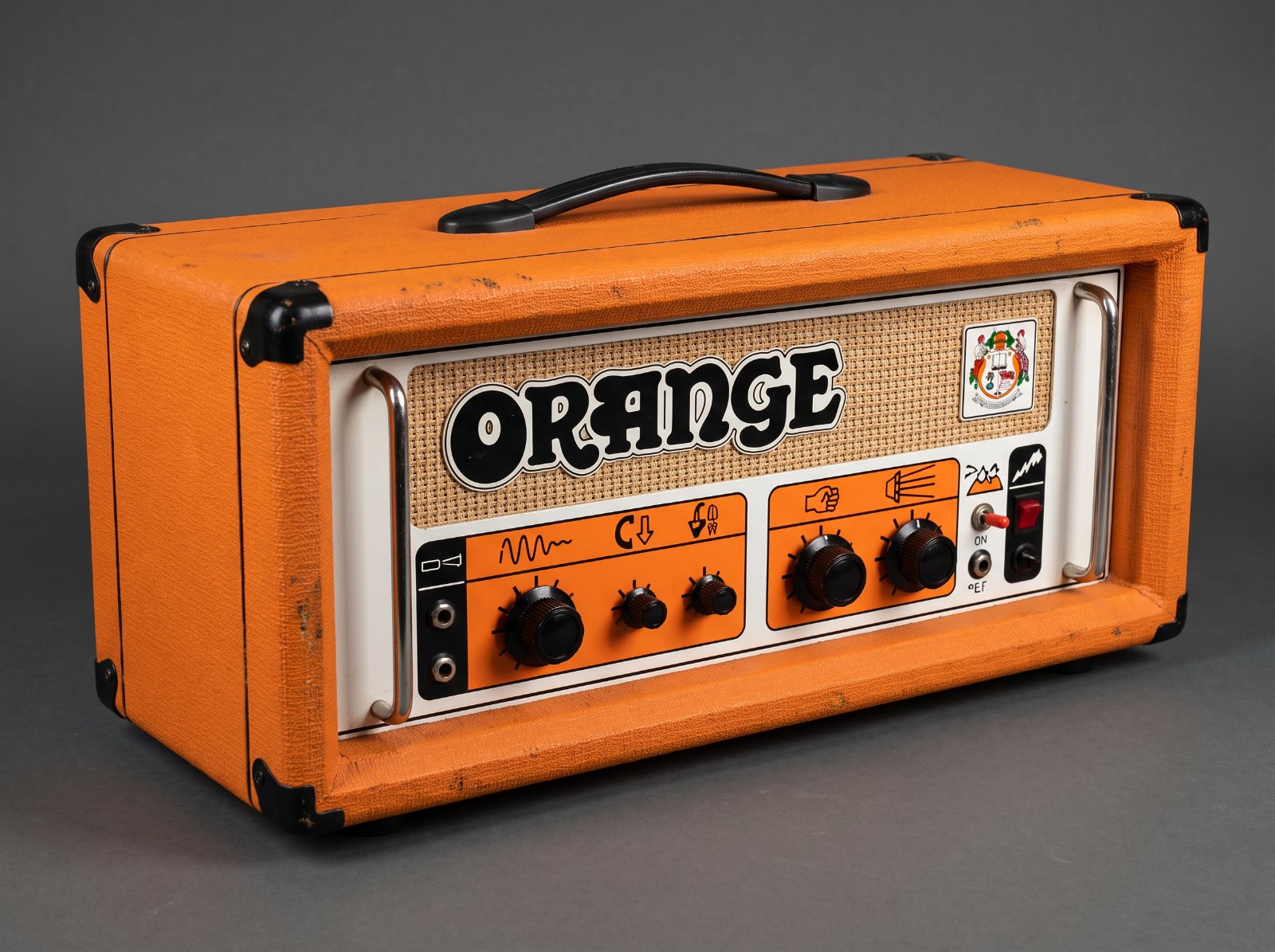
Reference illustration of the model, not a photograph of the player’s equipment.
The Orange OR120 defined British tube amp tone in the 1970s. Full guide to its unique FAC circuit, specs, verified famous players, and used buying tips.
In the summer of 1997, when Oasis shot the video for “D’You Know What I Mean?”, they surrounded Noel Gallagher with two bright orange monoliths: a pair of reissued OR120 heads, each running into two Orange 4×12 cabinets. The fastest-selling rock album in British chart history, a helicopter, crowd riots, aerial photography — and right there, holding the line against all that beige concrete and khaki parkas, two amplifiers that had first appeared a quarter of a century earlier. It was the most expensive music video a UK band had ever made, and Gallagher chose to fill the frame with gear from 1974. That is the OR120’s peculiar authority: it doesn’t need updating, it needs witnessing.
The original Orange OR120 is a single-channel, 120-watt, all-tube head with no master volume, no built-in reverb, and a control panel that Orange themselves struggle to fully explain. It ran in continuous production from roughly 1972 to 1979, was revived in reissue form in the 1990s and again in the current era, and has sat at the centre of British rock, doom metal, Britpop, post-hardcore and alternative rock in ways that its simple circuit has never fully accounted for. This is the full story.
Origins: From Huddersfield to Bexleyheath
Cliff Cooper opened the Orange Shop on Denmark Street in London’s West End in 1968 — a secondhand instrument store with a psychedelic orange shopfront designed to catch the eye of passing guitar players. When vendors refused to supply him with amplifiers at trade prices, Cooper decided to build his own. He had studied electronics at college, and he found a collaborator in Mat Mathias of Radio Craft, a radio repair workshop in Huddersfield, West Yorkshire. The earliest Orange amplifiers were assembled at Mathias’s workshop and sold under a dual brand: the instruments were sometimes labelled Matamp, sometimes Orange, depending on the market and the retailer. This Matamp connection is why the Huddersfield-built Matamp GT120 is still considered the OR120’s closest spiritual sibling — the two companies shared a common ancestor before they diverged.
Those earliest Orange amps had a conventional circuit topology: the volume control sat in front of the EQ circuitry, and the phase inverter used a DC-coupled concertina design. They sounded good but not yet distinctively Orange. That changed in 1972, when Cooper hired a designer named John James. James reworked the schematic in ways that would define the brand for the next five decades: he moved the Baxandall tone stack ahead of the gain stages, switched to a capacitor-coupled concertina phase inverter, and let the output stage run at unusually high plate voltage — around 500 volts, far above what most contemporary amps used. The result was that the four EL34 power valves were driven harder by the phase inverter, compressing and saturating in a way that was simultaneously smooth, warm and harmonically dense. This was the birth of what people would come to call the “Orange sound.”
The first generation of these new amps — built in 1972 and into early 1973 — carried control panels labelled entirely in Orange’s now-famous hieroglyphs: no text, no numbers, just symbols. A clenched fist for the low-end emphasis (“punch”), a reversed bass clef for the bass control, mountain peaks for the external effects loop. These became known as “Pics Only” amps, and they are the rarest and most coveted examples today. In late 1973 and definitively by 1974, Orange introduced text alongside the symbols — the “Pics and Text” generation, which is the OR120 most people encounter. Production moved from Matamp’s Huddersfield workshop to a brief spell near the Orange shop itself, then to a purpose-built factory in Bexleyheath, a suburb to the south-east of London. That Bexleyheath factory ran from 1973 until 1979, when the collapse of the UK music retail market and broader economic difficulties forced Orange to wind down domestic production. The brand went into a long dormancy through much of the 1980s before being revived — and it was during that revival that the reissued OR120 appeared in Noel Gallagher’s rig.
Pics Only vs Pics and Text: What Actually Changed
For buyers entering the used market, the “Pics Only” vs “Pics and Text” distinction matters beyond collector status. The circuit of the Pics Only is slightly different from the 1974 Pics and Text version: the original used a pair of 12AX7 (ECC83) preamp valves driving the phase inverter; the later version added a third ECC83, giving the OR120 a more elaborate preamp gain structure. Both designs share the essential Baxandall-first topology and the high-voltage EL34 output stage, so the core character is the same — but the Pics and Text OR120 has slightly more preamp voicing flexibility, and the later models benefited from improved manufacturing consistency as the Bexleyheath factory hit its stride.
Serial numbers date the units: early Pics Only heads run from approximately 1972 to early 1973; Pics and Text heads from late 1973 onward. A 1974 ad in the trade press shows them retailing at £140 — equivalent to roughly £1,200 in today’s money. Orange’s own workshop technicians, when they restored a 1974 OR120 in 2022, found the circuitry “perfectly clean” and “a textbook example of how to construct an amp in 1974.” What needed replacement after 48 years was exactly what you’d expect: ten electrolytic capacitors (including two can capacitors in the first filtering stage) and the power valves, which had become unmatched over the decades.
Specifications
The Circuit Explained: Why the OR120 Sounds Like Nothing Else
To understand the OR120, you have to understand what makes it structurally different from the amps it competed with. Most guitar amplifiers of the 1970s — Marshalls, Fenders, Hiwatts — placed their EQ circuits either after the gain stages or in an interactive mid-bass-treble configuration derived from the Baxandall passive network. Orange flipped the order. On the OR120, the Baxandall tone stack sits before the gain stages, which means the EQ controls shape the signal going into the amplification chain rather than the signal coming out of it. The sonic consequence is that EQ changes have an exponentially larger effect on the output: cutting bass on the FAC control doesn’t just remove some low end, it also reduces the amount of low-frequency energy feeding into the power stage, changing how the EL34s saturate and respond. This is why OR120 players who fiddle with the controls in isolation — comparing knob positions at low volume — often find the results confusing. The amp reveals its character under load, not on the bench.
The FAC (Frequency Attenuating Control — though Orange’s own blog admits uncertainty, having also used “Frequency Adjustment Circuit”; MusicRadar calls it “Frequency Analysing Control”) is the control that confuses people most. It is a six-position notched rotary dial, not a continuously variable pot. Each click removes a progressively larger amount of low-mid and bass content from the signal feeding the gain stages. Position 1 retains the most low end and produces the fattest, warmest tone; position 6 is the brightest and most scooped. The practical effect is that the FAC functions as a combined presence and low-end density control with six distinct operating points. On the OR120, the mid-bass interaction is particularly sensitive because of where the Baxandall network sits in the chain.
The phase inverter is the other crucial difference. Where early Orange amps used a DC-coupled concertina phase inverter (the same basic topology as most British valve amps), the OR120’s John James redesign switched to a capacitor-coupled concertina. The coupling capacitor means the phase inverter drives the output valves harder, pushing the EL34s into saturation at a lower effective volume than they would otherwise reach. Combined with the approximately 500V plate voltage — unusually high by modern amp standards, which typically run 400–450V — the result is that the OR120’s power stage has enormous headroom but hits its saturation zone with a particular density and warmth that low-voltage, lightly loaded EL34 rigs can’t replicate.
The matching Orange speaker cabinets contribute to the characteristic sound in a way that’s often overlooked. The distinctive basket weave grille cloth used on original Orange cabs is not acoustically transparent: it rolls off frequencies above approximately 4kHz, meaning that the extreme high-frequency content that can make a cranked valve amp fatiguing to listen to at volume is naturally attenuated before it reaches the listener. This is part of why the OR120 can be played at full volume for extended periods without becoming harsh — the cab is doing acoustic work that a modern, open-weave grille cloth setup would leave to the speaker and room alone.
The “Orange fizz” is a topic of endless forum debate. Some players love it — a characteristic high-presence sheen, part harmonic, part EL34 character, that sits above the fundamental tone and gives the OR120 its distinctive three-dimensional quality. Others find it fatiguing and look for ways to tame it (primarily through speaker choice and HF Drive position). What’s not debated is that the OR120 is not a high-gain amplifier by design. Without external gain — a fuzz pedal, a treble booster, an overdrive at the front end — the OR120 runs relatively clean until you push the volume control into double digits. Billy Corgan famously ran an OR120 as a second head behind cranked Marshalls, using a fuzz to feed it and treating it as an upper-harmonic overtone generator rather than a standalone amplifier. That is perhaps the most candid summary of what the amp does naturally: it provides massive, dynamic, touch-sensitive clean headroom with organic saturation at the top end of its volume range, and it rewards external gain staging rather than replacing it.
Famous Players
The OR120’s player roster requires some separation between Orange-the-brand and OR120-the-model. In the early 1970s, Orange amps were widely used by British musicians who appear in archive photographs of the era — Paul Kossoff, Peter Green — and MusicRadar invokes Jimmy Page in the context of OR120 tones, noting that “for many of his years on the road, his live rig has usually included at least one Orange head.” These are well-documented associations with Orange amplification in general. Whether any of those associations was specifically an OR120 (vs an OR80 or an early Matamp-built variant) is harder to confirm per SKU. The players below are documented on the OR120 specifically.

Noel Gallagher is the most publicly documented OR120 player, and the connection is to the reissued OR120, not the vintage original. The 1997 video for “D’You Know What I Mean?” — Oasis’s first single from Be Here Now — shows Gallagher’s rig throughout: two OR120 reissues, each running into two Orange 4×12 cabinets. Orange’s own website reproduces screengrabs from the video on their OR120 history article. This is as clean a primary source as exists for an amp association: manufacturer-confirmed, video-documented, and repeatedly cited by Orange themselves as the amp’s most memorable public moment. The Equipboard documentation notes the same source.
Billy Corgan‘s connection is verified through a Reverb listing of his personal OR120, sold from his private collection with a Reverb Certificate of Authenticity. The listing description (evidently written with knowledge of the provenance) states: “This Orange OR120 is from the private collection of Billy Corgan. This was purchased around the time of Siamese Dream, and was used on the Siamese Dream tour and Mellon Collie tours as a boost. Billy would run a fuzz pedal through this head so he could get an extra boost for volume. It was, by all accounts, hellaciously loud. That said, it wasn’t used particularly for solos, but rather as an upper overtone. With the gain dimed on his Marshalls, this would be an extra harmonic overtone over the top.” Equipboard confirms the OR120’s presence on both Siamese Dream (1993) and Mellon Collie and the Infinite Sadness (1995) as album-level documentation. See also the Billy Corgan gear guide for his broader rig history.
Billie Joe Armstrong (Green Day) is documented via a photo that clearly shows an OR120 in the background of his setup. This is a secondary source — photo identification rather than a direct statement from the artist — but Equipboard treats it as confirmed. It is consistent with the OR120’s position as a prestige vintage British head in the post-Britpop era.
Daron Malakian (System of a Down) appears in a photo with an OR120 visible behind him. Again, this is background-photo documentation — meaningful as confirmation that he owned or was using the amp, but not a detailed account of how or when it appeared in SOAD recordings.
Omar Rodríguez-López (At the Drive-In, The Mars Volta) is listed on Equipboard as having used the OR120 as “main amp during ATDI eras.” However, independent primary-source verification for the OR120 specifically during the ATDI period is limited — documented gear rundowns from 2003 onward show him running Orange AD140 heads, and by the mid-2000s he had moved to the Rockerverb 50. The connection to the OR120 during the 1999–2001 ATDI era is plausible (the band’s raw, roaring live sound is consistent with a cranked OR120), but should be treated as community-documented rather than manufacturer or artist confirmed.
Tim Sult (Clutch) has one of the most thoroughly documented OR120 connections in rock. The CD insert of Clutch’s 1995 self-titled album credits the OR120 in the rig list, and the music video for “The Soapmakers” (from The Elephant Riders, 1998) shows two OR120 heads in the background at approximately the 1:13 mark. Two albums, one video — the OR120 was central to Clutch’s guitar sound through the mid-to-late 1990s.
Frank Iero (My Chemical Romance) posted about a custom OR-120 preamp unit on Instagram, crediting Jessup Amps with building it: “just want to send a long overdue shout out and thank you to @jessupamps for sending me this OR-120 pre amp.” The Jessup Amps description confirms the circuit: “This is the exact circuit found in the Orange OR-120 and retains the same tonal characteristics as the original Orange pre amp.” Note that this is a preamp circuit in a custom enclosure, not an original head — but Iero’s deliberate choice of this specific circuit for recording and demoing speaks to the OR120’s tonal authority even in standalone preamp form.
Wata (Boris) is confirmed via a MusicRadar rig tour article as using a vintage Orange OR120 head. Boris’s wall-of-sound approach — extended drone structures at extreme volume — is one of the most literal applications of what a cranked, non-master-volume OR120 actually does.
Matt Talbott and Tim Lash (Hum) are both documented using OR120 heads — Talbott via a Flickr photo from a 2008 Double Door Chicago performance, Lash via an Instagram post about a customised OR120. Hum’s dense, shoegaze-adjacent guitar tones on You’d Prefer an Astronaut (1995) are a textbook example of what an OR120 sounds like in a recording context: thick, midrange-forward, harmonically saturated, with that characteristic presence sheen sitting above the fundamental.
Mike Scheidt (YOB) uses a vintage OR120, documented in an Exclaim! feature. YOB’s doom metal — slow, crushing, harmonically complex — is another end of the OR120 spectrum from Gallagher’s Britpop wall: same amp, completely different musical application, both equally valid.
Tone Recipes
Tone Recipe 1: Brit Blues (Peter Green / Paul Kossoff Territory)
The OR120 entered history as a blues amp in the late 1960s and early 1970s, favoured by the British blues boom musicians who could be seen in period archive photographs with Orange cabinets behind them. This setting keeps the FAC fat, the HF Drive modest, and lets a Les Paul or SG do the rest. Use the Echo loop with an outboard spring reverb tank set to short decay (approximately 1.5 seconds).
- Volume: 6–7
- FAC: Position 2 (fat, warm)
- Bass (Hz): 6
- Treble (kHz): 5
- HF Drive: 5
- Guitar: Les Paul, bridge pickup, tone at 7
- External reverb: Spring, ~1.5s decay
Tone Recipe 2: Britpop Wall (Noel Gallagher Style)
Gallagher ran OR120 reissues as part of a large rig stack. The key is clean but massive headroom with a light overdrive pedal driving the front end. The Tube Screamer gains about 7, volume at 5, into an OR120 at Vol 8 produces the mid-forward pushed rhythm sound that defined Be Here Now‘s guitar tones.
- Volume: 8
- FAC: Position 3
- Bass (Hz): 5
- Treble (kHz): 6
- HF Drive: 6
- Guitar: Gibson Les Paul Standard, neck pickup
- Drive pedal: Tube Screamer, gain 7, volume 5
Tone Recipe 3: Harmonic Overtone Boost (Billy Corgan Method)
This is not an attempt to replicate Corgan’s full Smashing Pumpkins rig — that requires Marshalls. Rather, it is the OR120’s role in that rig: a second amplifier running in parallel or in series, fed through a fuzz, producing upper harmonic content that sits above the main rig’s fundamental tone. Run the OR120 at near-full volume through a sensitive 4×12, blend to taste against a parallel Marshall or recording source.
- Volume: 9
- FAC: Position 4
- Bass (Hz): 4
- Treble (kHz): 7
- HF Drive: 7
- Guitar: Humbucking pickup, full volume
- Fuzz pedal: Big Muff or silicon fuzz, sustained, run into Hi input
Tone Recipe 4: Doom and Stoner (Tim Sult / Mike Scheidt Territory)
The non-master-volume OR120 at full volume through a 4×12 is one of the defining sounds of stoner rock and doom metal. Keep the FAC fat, the bass high, and the treble restrained to prevent harshness — the basket weave cloth is doing work here too. The sound naturally compresses and blooms under a chord; let it breathe. Use a heavy fuzz for additional gain, or push the Hi input with a treble booster for a more organic, mid-forward saturation.
- Volume: 9–10
- FAC: Position 1 (maximum bass retained)
- Bass (Hz): 8
- Treble (kHz): 4
- HF Drive: 4
- Guitar: SG, Les Paul, or Tele, bridge pickup, open tuning
- Gain staging: Fuzz or treble booster into Hi input
Tone Recipe 5: Studio Clean
At lower volume settings, the OR120 is surprisingly articulate and clean — especially through the Lo input. The Baxandall tone stack gives genuinely usable tonal shaping at clean levels, and the EL34s, not being pushed by the phase inverter at low volumes, produce a smooth, warm clean with just enough harmonic complexity to sit well in a mix. Use a room microphone alongside the close-mic to capture the early room reflections, which at low volume become an important part of the character.
- Volume: 4
- FAC: Position 3
- Bass (Hz): 6
- Treble (kHz): 5
- HF Drive: 4
- Guitar: Any; clean Strat or Telecaster particularly effective
- Microphone: SM57 at cone edge + room mic blended
All settings below assume the Hi input. The Lo input is noticeably darker and lower-output, and is primarily useful for active pickups or unusually hot guitars. Volume positions refer to positions on the dial (10 = maximum). The OR120 has no channel switching or effects loop in the conventional sense — all processing is external, and the “Echo” jacks on the front panel are a series send/return for an external reverb unit, not a true buffered effects loop. Run them in that spirit: an outboard spring reverb tank (Fender, Gibbs, or a standalone unit) placed in that loop is the historically correct application.
How the OR120 Compares
The Marshall 1959 Super Lead Plexi is the OR120’s great contemporary rival and the most useful comparison point. Both are non-master-volume British 100W (or 120W) EL34 heads with no built-in reverb, both defined an era of studio and live sound, and both require high volume to reach their natural saturation. The key differences: the Plexi uses an interactive mid-bass-treble tone stack placed after the first gain stage, giving it more inherent midrange scoop and a more aggressive response at volume. The OR120’s Baxandall-first circuit is warmer, more compressed, more “boxy” in the lower midrange — closer to a thick blanket of harmonics than the Plexi’s cutting, open roar. Players who find Plexis too bright or too aggressive often prefer the OR120; players who want more midrange cut and clarity tend toward the Plexi.
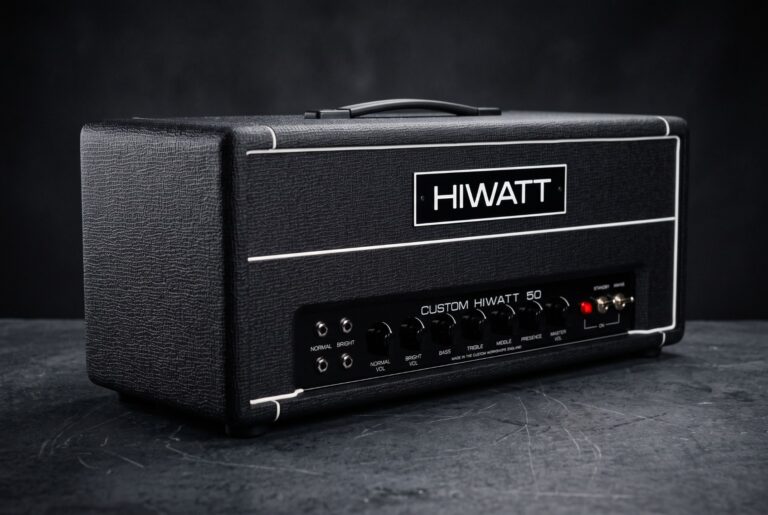
The Hiwatt DR103 Custom 100 is the third great vintage British 100W head, and the contrast with the OR120 is instructive. The Hiwatt is high-fidelity where the OR120 is coloured: the DR103 uses custom Dave Reeves transformers, hand-wired turret board construction, and a circuit designed for maximum headroom and clarity — it’s the amp Pete Townshend and David Gilmour favoured for its ability to stay clean at levels where a Plexi or OR120 would be breaking up. The OR120 is more organic and forgiving under a pick attack; the DR103 is more accurate and demanding. Different tools for different personalities.

The Vox AC30 Top Boost is the OR120’s EL84-powered counterpart in the British amp story, and the two represent opposite ends of a spectrum. The AC30 is touch-sensitive, midrange-emphasising, and saturates early — the classic “chime” to the OR120’s “crunch.” At 30 watts versus 120, the Vox is a studio and small-venue amp where the OR120 is a stadium head. The AC30 rewards fingerstyle playing and light picking dynamics; the OR120 rewards a heavy pick attack and heavy strings. The two together — as some players have run them, split stereo — cover an enormous tonal range.
The Marshall JCM800 2203 is the OR120’s most useful modern comparison. The JCM800 has a master volume, a dedicated presence control, and genuine high-gain capability in a way the OR120 does not. Players who want OR120 character but need master-volume level control often use JCM800s as a practical substitute — the EL34 power stage and British midrange DNA are shared, even if the preamp topology differs significantly. The trade-off: the JCM800 can dial in its saturation zone at any volume; the OR120 can only find its natural sound by being loud.
The Orange Rockerverb 50 MKIII is the obvious within-brand comparison: a modern Orange with a master volume, channel switching, spring reverb, and the classic Orange midrange DNA. The Rockerverb gives you most of what the OR120 offers tonally — the Baxandall-influenced tone stack, EL34 power stage, Orange character — while letting you control the volume independently of the saturation level. The cost is some of the OR120’s raw, non-negotiable honesty. When you have to be at volume 9 to get the sound right, every string bends the room; you can’t approximate that at bedroom levels, and no master volume control changes that physics.
Buying Guide
The used OR120 market is genuinely complicated by three overlapping populations: original Pics Only heads (1972–early 1973), original Pics and Text heads (1973–1979), and the 1990s reissue heads (which were built by Matamp and are sometimes labelled “OR120 Overdrive” or “OD120”). These are not equivalent instruments.
The Pics Only heads are the rarest and most sought after, commanding the highest prices on the collector market ($3,000–$5,000+ for clean examples). The key identification point is the control panel: no text, only hieroglyphs. The “Echo” sockets are labelled with the mountain-peaks symbol only. Serial number documentation is inconsistent for this era; examine the component dates inside (original Plessey capacitors marked “British Made” are a positive sign, though most have had caps replaced by now). These are rewarding but high-maintenance instruments; budget for a full recap and valve replacement on purchase.
The Pics and Text heads (1974–1979) are the most commonly found vintage originals and the sweet spot for players who want authentic OR120 character without the collector-grade price premium. Look for the clean, well-executed “British Made” Plessey capacitors in photos (though again, most have been recapped). Original Mullard XF2 EL34 power valves — often marked with the Blackburn plant code — are highly prized but almost never original to a working amp at this point. A full recap (ten capacitors: two can caps in the first filtering stage, two bypass caps, two in the bias circuit, four in the remaining filtering stages) is standard first-purchase maintenance. Prices: $1,500–$3,500 depending on condition and originality.
The 1990s Overdrive OR120 reissue (OD120) was built by Matamp in Huddersfield — a return to the original builder — and differs from the vintage original in adding a master volume control on some configurations. The master volume substantially changes the character: you can now access preamp saturation at lower volume levels, but you lose the fully natural power-stage saturation of the original non-MV circuit. Many players prefer the non-MV vintage original for this reason; others prefer the reissue’s practical volume control. Prices: $1,500–$1,800 for clean used examples.
For any of these, specific things to check:
- Transformer condition: The original output and power transformers are large, quality units and should be intact. A replaced transformer is a significant departure from the original circuit character.
- Filter capacitors: If not recently recapped, budget $150–$300 for a tech to replace all ten filter caps. Blistered can caps are a sign of long storage; they cause flat, undynamic response and increased hum.
- Power valve matching: Four EL34s should draw equal current. Unmatched valves cause inconsistent saturation and increased wear on the output transformer. Factor in a quad of matched EL34s on purchase.
- Weight: Original OR120s are heavy — heavier than many full-size Marshalls, owing to the large 1970s-spec transformers. If the unit feels lighter than expected, investigate the transformer situation.
- Input jack oxidisation: The front-panel input jacks on 50-year-old amps can oxidise to the point of adding noise; clean with contact spray before condemning the circuit.
Living With an OR120
The absence of a master volume is the central fact of ownership. The OR120 is at its best between volume 7 and 10 — that is where the EL34 power stage contributes meaningfully to the saturation and harmonic content. At volume 4, it sounds like a pleasant but unremarkable 120-watt clean amp. At volume 9, it sounds like one of the most compelling guitars sounds ever produced in a British factory. The problem is that volume 9 on a 120-watt EL34 head into an efficient 4×12 is a genuinely large amount of sound pressure, and using it at that level in a recording studio, rehearsal room, or small venue is not always practical.
Practical solutions, in order of historical authenticity:
- External fuzz or treble booster into the Hi input: Corgan’s approach. You can run the amp at a moderate volume setting and let external gain staging do the harmonic work. The result is different from the naturally saturated power stage, but it is workable at any volume.
- Power attenuator between head and cabinet: A reactive load such as the THD HotPlate or UAD OX allows you to run the output stage at high power and then attenuate before the speaker. You lose some of the speaker-interaction component of the sound but retain the power stage saturation. Modern IR-based attenuators (like the Mesa CabClone, though that’s a Mesa product) are increasingly sophisticated in their handling of the reactive load. This is not period-correct but is practical.
- Efficient, sensitive speaker cabinet: A 4×12 loaded with Celestion Greenbacks (97dB/W/m sensitivity) reaches stage-usable levels at significantly lower volume settings than a modern 8Ω cab. Sensitivity matters more than any other single cabinet spec when working with a non-MV amp at volume.
- Lo input: The Lo input reduces the input sensitivity significantly. This means you can run the volume control higher (getting more power-stage contribution) at a given guitar output level. The resulting tone is darker and less bright than the Hi input, but sometimes usefully so.
Tube life on the EL34 power stage is approximately 1,000–1,500 hours under normal use. The high plate voltage (~500V) accelerates tube wear compared to lower-voltage designs — budget for a new matched quad of EL34s every two to three years of regular gigging. The bias is set by trim pots inside the chassis and requires a tech; it is not player-adjustable. The 500V plate voltage makes self-biasing dangerous for anyone without electronics experience.
Frequently Asked Questions
What does FAC stand for on the Orange OR120?
It depends on which source you trust. Orange’s own blog uses “Frequency Attenuator Control” but acknowledges uncertainty, also mentioning “Frequency Adjustment Circuit.” MusicRadar uses “Frequency Analysing Control.” All three sources agree on the function: a six-position notched rotary dial that progressively removes lower midrange and bass content from the signal before it reaches the gain stages. Position 1 = most bass retained; position 6 = most bass removed/brightest. Orange themselves admitted the acronym’s meaning was uncertain even in 1974 — it was a control labelled for engineers who already spoke the language.
Is the Orange OR120 a high-gain amp?
No. The OR120 is a single-channel, non-master-volume amp with no dedicated preamp gain stage beyond the standard ECC83 voltage amplification. Without external gain — a fuzz pedal, treble booster, or overdrive — it runs clean until cranked to high volumes, where the EL34 power stage produces natural saturation. The amp’s reputation for “heavy” tone in modern contexts (doom, stoner rock) comes from its massive EL34-driven power stage at high volume, not from preamp gain.
What are the differences between Pics Only and Pics and Text OR120s?
The Pics Only heads (1972–early 1973) have hieroglyph-only control panels with no text, and a two-ECC83 preamp driving a slightly different phase inverter stage. The Pics and Text heads (1973/1974–1979) added text labels alongside the hieroglyphs and a third ECC83 preamp valve. The essential circuit character — Baxandall-first topology, capacitor-coupled concertina phase inverter, four EL34s at ~500V — is the same in both. Pics Only heads are rarer and more expensive on the collector market, but the Pics and Text OR120 is the version most players encounter and the one covered by this article.
Can the Orange OR120 be used for bass guitar?
Players do use it for bass — and community reports suggest it works particularly well with flatwound strings for a vintage, warm, slightly overdriven bass tone. However, the or120’s output transformer and circuit are designed for guitar-frequency loading, and running a bass through it into a vintage guitar 4×12 at band volume risks cone excursion damage. If you use an OR120 for bass, pair it with a bass-rated cabinet (such as the Orange OBC410) that can handle low-frequency excursion at full output, and keep the bass control conservative.
How does the OR120 relate to the Matamp GT120?
The Matamp GT120 is built around the same fundamental tonestack architecture as the OR120, tracing the same genealogical root back to Mat Mathias’s Huddersfield workshop. The component values differ — giving the GT120 a slightly different character that Equipboard’s community describes as “a close match to the early ’70s OR120 circuits, especially in achieving the classic ‘prickly breakup’ sound.” The 1990s OR120 reissue (OD120) was itself built by Matamp, completing a full circle back to the original maker. Players who cannot find or afford an original OR120 often find the Matamp GT120 the closest available alternative.
What did Billy Corgan use the OR120 for on Siamese Dream?
According to the Reverb provenance listing of his personal OR120 (sold from his collection with Certificate of Authenticity), Corgan used it “as a boost” on the Siamese Dream and Mellon Collie tours, running a fuzz pedal through it “so he could get an extra boost for volume.” It was not his primary amp — his main sound was built on cranked Marshalls — but he ran it in parallel as “an upper harmonic overtone over the top.” The combined Corgan method: primary Marshall(s) at full gain, OR120 at high volume through a fuzz as a harmonic crown. The result was “hellaciously loud,” per the listing.
Is there a current reissue of the Orange OR120?
Yes. Orange has produced both the 1990s Overdrive OR120/OD120 reissue (built by Matamp) and more recent reissue versions at different points. The current reissue (as of 2026) commands approximately $2,700+ new. The 1990s Matamp-built OD120 reissue added a master volume control that the vintage original did not have; some players prefer this for practical volume management, while purists prefer the non-MV original for its uncompromised power-stage character. Always confirm whether a reissue has a master volume before purchasing if this distinction matters to your use case.
What amp models in modelling software simulate the OR120?
Several amp modelling platforms include OR120-derived models: Line 6 calls theirs the “Mandarin 80”; IK Multimedia AmpliTube Orange includes models based on OR-family circuits; Yamaha THR10’s “Lead” model draws on Orange voicing; and Native Instruments Guitar Rig includes a “Citrus” model in the same vein. For pedal-based approximation, the Tech 21 Character Series Oxford is explicitly based on vintage Orange circuits including the OR120, and the Crazy Tube Circuits Orama pairs an OR-120 preamp emulation with a clone of the Frantone Peachfuzz.
Image credits
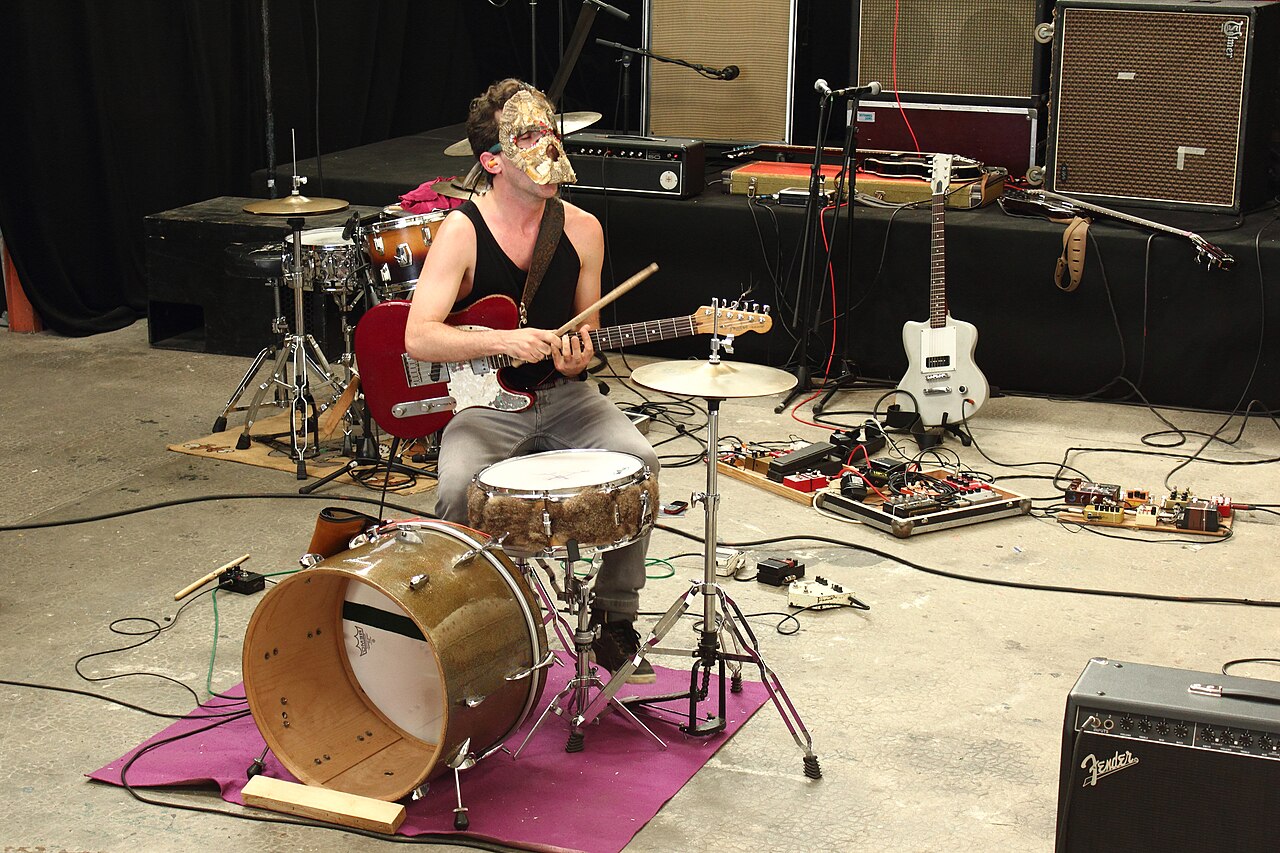
- A drummer and guitarist on a small stage: Xi WEG from Poitiers, France, Wikimedia Commons, CC BY 2.0.
- A tube combo amp: Teisco & Framus.jpg: DeLerkim derivative work: User:Clusternote, Wikimedia Commons, CC BY-SA 3.0.
- Peter Green: Tony Hisgett, Wikimedia Commons, CC BY 2.0.
- Noel Gallagher: Freddyballo, Wikimedia Commons, CC BY-SA 4.0.
- Top image: GuitarGangsters AI-generated reference illustration, not a photograph.
Latest News
Related
On This Day
Monday 9 November
From this week: