Hiwatt DR103 Custom 100: The British Amplifier That Refused to Distort
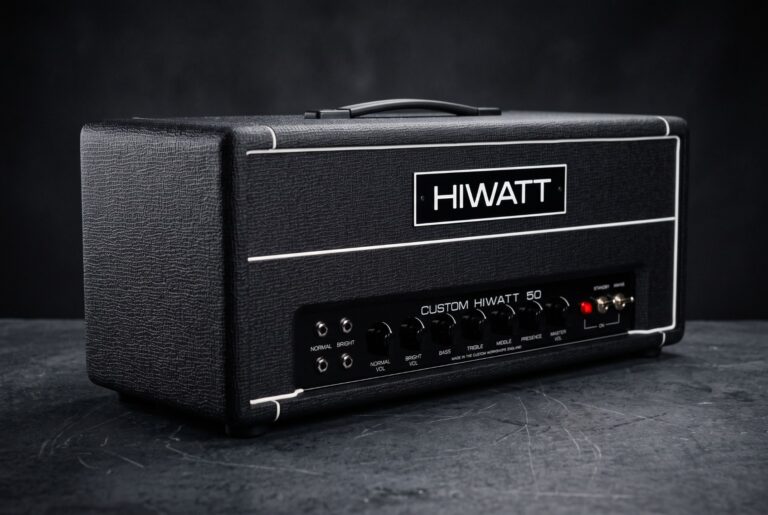
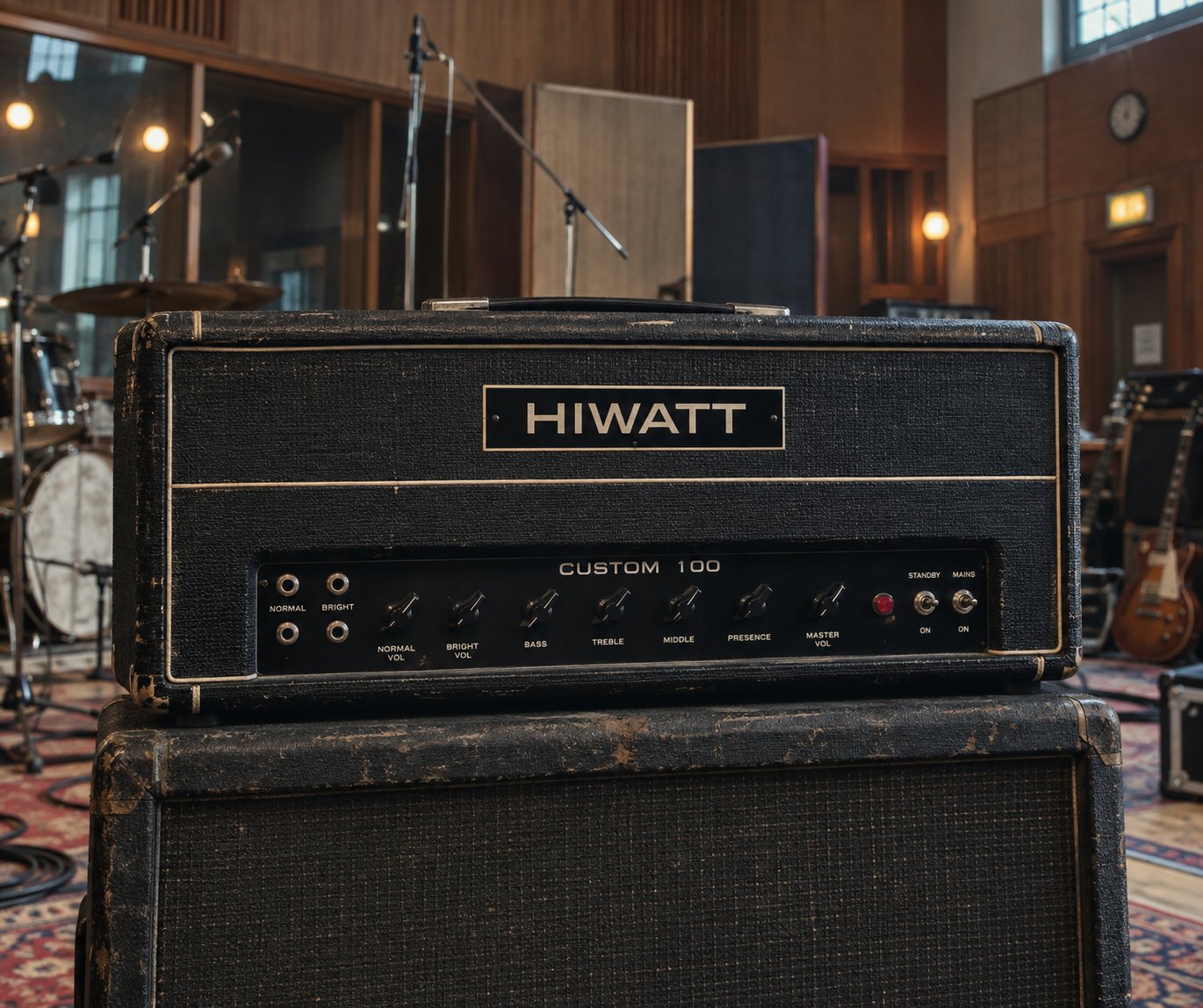
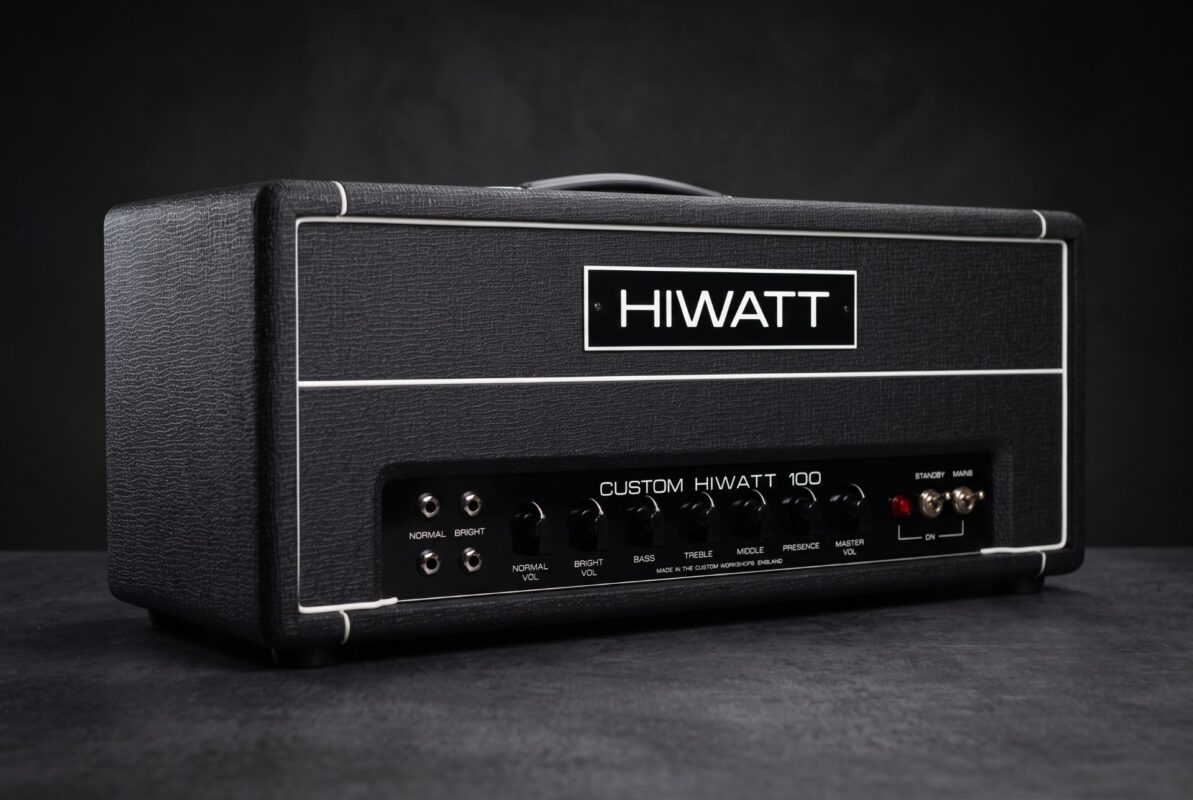
Hiwatt DR103 Custom 100 Head. AI-generated reference illustration, not a photograph.
Inside the Hiwatt DR103 Custom 100: Dave Reeves' history, Partridge iron, Harry Joyce wiring, verified player facts, tone settings and buying tips.
Every other legend in the British amplifier canon is a story about breaking up. The JTM45 is a Bassman that learned to snarl. The Super Lead is the sound of four EL34s being asked to do something they were never designed to do, night after night, at volumes that made the question academic. The AC30 Top Boost chimes because cathode-biased EL84s start compressing before the drummer has finished counting in.
And then there is the Hiwatt DR103 Custom 100, which sat on the same stages, in the same decade, wearing roughly the same black-and-white livery — and did the exact opposite. It stayed clean. It stayed clean at volumes that would have had a Plexi screaming, and it stayed clean because a former Mullard engineer named Dave Reeves built it that way on purpose, out of transformers the size of house bricks and wiring loomed to British Navy standards.
That single design decision is why the DR103’s discography sounds nothing like a Marshall’s. It is the amplifier under Live at Leeds, under Pink Floyd at Pompeii, under A Farewell to Kings, and — still, in 2026, at 104 decibels a night — under The Cure. It is also, as we will see, an amplifier whose two most famous alleged users were mostly not playing a DR103 at all.
This is the full story: who built it, why it behaves the way it does, which of the famous-player claims survive contact with primary sources, how to set one, how to buy one, and what it is actually like to own 47 pounds of English steel that has no reverb, no effects loop and no channel switching.
Origins: A Garage in New Malden, and a Man Who Would Not Compromise
David Reeves was not a musician who taught himself electronics. He was an electronics man who happened to land in music. He went through technical school in the late 1950s and served apprenticeships at Marconi Electronics and at Mullard — the valve manufacturer whose EL34s and ECC83s would end up inside almost everything he ever built. That is the single most important biographical fact about him: the components that define the Hiwatt sound were not chosen from a catalogue. They were chosen by someone who had worked at the factory that made them.
The origin story has a specific date attached to it. In 1963, according to the family-sourced history maintained by Mark Huss at hiwatt.org, a local band called The Hylights blew up their amplifier, and Reeves said he could build a better one. He then did. He was living at 3a Cotswold Road in Belmont, Surrey; in March 1964 he moved to Morden, and from 1964 to 1968 he worked evenings in a small room above Potter’s Music, fixing hi-fi sets, televisions and instrument amplifiers while holding down a day job.
The earliest amps bearing the hi-watt name — lower case, cursive, on a black and gold plate — appeared from that bench around 1964. They looked more like Vox and Selmer products of the day than the tank-like Hiwatt everyone pictures now: split-chassis 50-watt heads with the control panel mounted on top of the cabinet. Critically, those first designs already used ultralinear taps for the screen grids, a hi-fi power-amplifier technique aimed squarely at low distortion and high fidelity. Reeves’ priorities were visible in his very first product, and they never really changed.
Two redundancies funded the company. In early 1966 Reeves was made redundant from Mullard and used roughly £800 of separation pay to buy himself time to develop the Hiwatt idea. The Hylight Electronics name — borrowed from that band whose amp had exploded — was registered in September 1966. Then, in late 1967 and early 1968, came the order that made everything possible and nearly cost him the company: Ivor Arbiter’s Sound City music store commissioned a line of amplifiers.
The Sound City Lawsuit, and Why It Matters to This Article
The so-called Sound City “Mark I” amps were, in essence, Reeves’ own current design re-badged with someone else’s name. Many still carry Hylight Electronics stickers on the chassis inside. He was paid around £800 for the batch, put a deposit on a house at 171 Malden Way in New Malden, moved in during March 1968, and started building Hiwatts in the garage.
Arbiter subsequently took Reeves to court, claiming Sound City owned the design. The proceedings produced the best anecdote in British amplifier history: Reeves pointed at some unused holes in the amp chassis and asked Arbiter’s engineers what they were for. They could not answer, because they were simply copying a chassis that Reeves himself had originally laid out. The case was decided in his favour.
Keep the Sound City connection in mind. It is not trivia — it becomes the key to the single biggest correction in the famous-players section below.
What a DR103 Actually Is
“DR” is generally read as Dave Reeves’ own initials; the current manufacturer glosses it more prosaically as the designation for “Hiwatt’s original circuit,” which amounts to the same thing in practice. The 103 denotes the 100-watt head. Its siblings were the 50-watt DR504, the 200-watt DR201 and the genuinely alarming 400-watt DR405. Early Gilmour-era heads carry an additional “AP” designation, for All Purpose — a deliberate statement that this was an amplifier for guitar, bass, keyboards and anything else you cared to plug in.
The front panel is famously spartan: four inputs (high and low sensitivity for each of the Normal and Brilliant channels), a volume for each channel, then a shared tone stack of Bass, Middle and Treble, plus Presence and a Master Volume. Standby and Mains. That is the whole amplifier. No reverb, no tremolo, no effects loop, no channel switching, no boost.
| Specification | Vintage DR103 (Hylight era, c. 1969–1980) | Current Hiwatt Custom Shop DR103 (2026) |
|---|---|---|
| Output power | 100 W RMS | 100 W RMS |
| Output valves | 4 x EL34 (Mullard, period units) | 4 x EL34 |
| Preamp valves | Commonly 3 x ECC83 + 1 x ECC81 phase inverter on vintage-correct examples | 4 x ECC83 (12AX7) |
| Rectification | Solid state | Solid state |
| Channels | Normal and Brilliant, individually voiced, jumpable | Normal and Bright, individually voiced, jumpable |
| Inputs | 4 (Hi/Lo per channel) | 4 (Normal Hi/Lo, Bright Hi/Lo) |
| Controls | Normal Vol, Brilliant Vol, Bass, Middle, Treble, Presence, Master Volume | Normal Vol, Bright Vol, Bass, Middle, Treble, Presence, Master Volume |
| Transformers | Partridge (Drake and Sowter on later Biacrown units) | Original Partridge-spec English transformers |
| Wiring | Hand-wired point to point; Harry Joyce Electronics from 1971 | Hand-wired point to point to Harry Joyce’s standards |
| Speaker outputs | 2 x 1/4″, switchable 4 / 8 / 16 ohm | 2 x 1/4″ parallel, switchable 4 / 8 / 16 ohm |
| Mains | Voltage selector | World voltage selector (100 / 115 / 230 / 240 V) |
| Effects loop | None | None |
| Cabinet | Birch ply, black Tolex, Hiwatt grille cloth | 18 mm birch ply |
| Weight | c. 22 kg / 48 lb | 21–22.65 kg / 47–50 lb |
| Where built | New Malden, then 16 Park Road, Kingston-upon-Thames | Hiwatt Custom Shop, Doncaster, England |
One source caution worth stating plainly: at least one major dealer’s DR103 product page lists “2 x EL34 output valves” in its technical bullet list while correctly stating “4 x EL34” in the full spec block on the same page. It is a copy error, not a variant. Every DR103 ever built is a quartet of EL34s. If a listing tells you otherwise, the listing is wrong.
Why It Stays Clean: Four Reasons
The DR103’s reputation for headroom is not marketing. It is the arithmetic of four specific engineering choices, and understanding them tells you exactly how to use the amp.
1. The Iron Is Absurdly Oversized
Reeves specified Partridge transformers to his own requirements — the same brand he knew intimately from Mullard. Hiwatt output and mains transformers are physically enormous relative to the power rating, and an output transformer that is not being asked to work hard does not saturate, does not compress, and does not add the low-order harmonic mush that people call “amp feel.” Where a Marshall’s iron is part of the distortion recipe, a Hiwatt’s iron is deliberately kept out of the signal’s way. Original Partridge units are now among the hardest Hiwatt parts to source, which is precisely why they dominate the value of any vintage example.
2. Ultralinear DNA and a Hi-Fi Design Philosophy
Reeves’ very first 1964 designs used ultralinear screen taps — a topology lifted straight from high-fidelity power amplifiers, where the goal is measurable linearity rather than musical breakup. Even where later production circuits departed from strict ultralinear operation, the mindset persisted. The DR103 was designed to reproduce what you put into it. That is a hi-fi engineer’s goal, applied to a 100-watt guitar head.
3. A Low-Gain Preamp with a Master Volume at the End
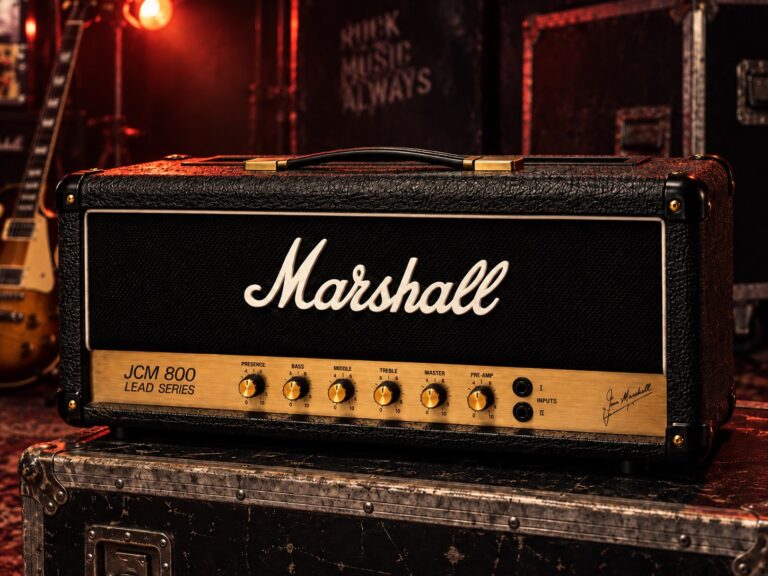
The signal path is short. There is no cascaded gain structure of the kind the JCM800 2203 introduced, and no fourth-and-fifth-stage stacking of the kind that made the Soldano SLO-100 famous. The Master Volume on a Hiwatt is not there to let you make preamp distortion at low volume — there is barely any preamp distortion to make. It is there to control how hard a very clean front end drives the power section.
4. Substantial Negative Feedback, with Presence as the Escape Valve
The DR103 runs a healthy global feedback loop, which flattens response, lowers distortion and tightens the low end — and which the Presence control partially defeats at the top of the spectrum. This is why Presence on a Hiwatt is a far more consequential knob than the same control on many amps: it is the one place where you are allowed to take some of the engineering discipline back out.
The consequence for the player is simple and non-negotiable. A DR103 is a pedal platform, and it was one before that phrase existed. The manufacturer says so outright in its own current copy — “the premiere pedal platform prized for clarity and headroom… presents pedals true to your sound.” Every classic Hiwatt guitar tone in the canon is a Hiwatt plus something in front of it: a Fuzz Face, a Colorsound Power Boost, a Univox Super-Fuzz, a Big Muff, an MXR Dyna Comp. If you plug a Strat straight in and turn everything up expecting a Plexi, you will get a very loud, very detailed clean tone and a headache.
Harry Joyce, and the Reason Hiwatts Look Like That Inside
Open a Hylight-era Hiwatt and the wiring looks like aerospace hardware: right angles, laced bundles, absolute geometric order. The legend credits this entirely to Harry Joyce. The truth is slightly more interesting, and hiwatt.org is careful about it: the trademark “right angles and neat bundles” approach was already in use in Hiwatts by 1969, before anyone external was brought in. Reeves invented the house style. Joyce industrialised it.
By 1971, Peter Webber — a former band road manager working as Hiwatt’s first sales manager, and the man who put Hiwatts into the hands of The Who, Pink Floyd, Jethro Tull, The Moody Blues and Manfred Mann, and who made them the house amps at London’s Roundhouse — was selling them faster than a garage could build them. Reeves went through the phone book looking for a wirer who could reproduce his standard, and found Harry Joyce Electronics in Walton-on-Thames.
Joyce was, at that moment, under contract to Gravesby Instruments producing wiring for the British Navy, using a hand-picked crew of technicians he had trained himself in military-spec methods. He was sceptical. He agreed only on one condition: no more than forty units a month, so quality control would not slip. Reeves reluctantly accepted. That single negotiated constraint is the reason vintage Hiwatts are both extraordinarily well built and comparatively scarce.
Joyce’s company wired Hiwatts from 1971 until early 1984. Current production still invokes his name and his standards, which is unusual honesty in an industry where “hand-wired” often means very little.
The Cabinets: 14 Plies, Nine Braces, and Fane
Once production moved to a converted bakery complex at 16 Park Road, Kingston-upon-Thames — the move happened between 26 January and 1 February 1972 — Reeves turned the same obsessiveness on the speaker cabinets. Mike Allen and Danny Edwardson were brought in to develop them; Henry Glass and Co., trading as BEESKIT, built them.
The specification was deliberately excessive: 14-ply Baltic birch, heavier and denser than anything comparable in the UK trade, internally braced at no fewer than nine points, assembled with tongue-and-groove joints, covered in Brymor vinyl and finished with the black, white and grey fret cloth that is as much a Hiwatt signature as the logo. The SE4123 4×12 that partnered the DR103 was loaded with cast-frame Fane speakers built to Reeves’ own series specification — the other half of what people mean by “the Hiwatt sound.”
This matters for tone-chasers: a DR103 through modern Celestion Vintage 30s is a legitimate and common rig, but it is not the record. Fanes are stiffer, drier and less mid-forward than Vintage 30s and considerably less compressed than Greenbacks. If your DR103 sounds glassy and unforgiving through V30s, that is the amp doing its job and the speaker refusing to soften it.
The Four Eras: How to Read a Hiwatt Badge
Hylight Electronics (to early 1981) — The Real Thing
Everything discussed so far. Partridge transformers, Harry Joyce wiring from 1971, Fane speakers, built in New Malden and then Kingston. Design details drifted through the decade — Reeves experimented with oddities including the footswitchable “SAP” model and the barely documented DR118 — and in a concession to modern manufacturing, printed circuit boards appeared at the end of the 1970s, though built to the same standards. This is the era collectors mean when they say “a real Hiwatt.”
Biacrown (1981–1984) — The Complicated Years
In early 1981, Dave Reeves died after a fall down a flight of steps. He was divorced and had not remarried; despite his stated intention that his three children inherit the business, control passed to solicitors. Mary Clifford, the company administrator, and other remaining employees formed Biacrown Ltd. and kept building.
Two things happened to the product. First, some genuine innovation: the “OL” (overload) circuit added an extra gain stage, sometimes badged OL and sometimes not, occasionally with an extra front-panel “overdrive” control — Hiwatt’s belated answer to a market that by 1981 wanted what a JCM800 did. Second, decline: as bills went unpaid, suppliers refused to ship, and the transformers were re-sourced from Drake and Sowter rather than Partridge. Harry Joyce eventually stopped wiring chassis for non-payment. The company closed in early 1984.
Practical buying consequence: a Biacrown-era amp can be a very good amplifier and is usually cheaper, but check the transformers. Drake or Sowter iron is not a defect, but it is not Partridge, and the market prices accordingly.
Music Ground, and the Overseas Years
Mary Clifford sold the Hiwatt name to Rick Harrison of Music Ground. In the United States the badge subsequently reappeared in partnership with Fernandes Guitars on a line of Asian-built amplifiers, including solid-state models in the Bulldog series. Nothing about those products connects to Dave Reeves’ circuit, and they should not be priced as though they do.
The Modern Custom Shop (current)
Today’s DR103 is built in Hiwatt’s Custom Shop in Doncaster, England, hand-wired point to point, using original Partridge-spec English transformers and 18 mm birch ply construction, and marketed explicitly as a faithful reproduction of Reeves’ late-1960s circuit. Amps are soak-tested before shipping and carry world voltage and impedance selectors. The current spec runs 4 x ECC83 in the preamp — worth knowing if you are chasing period-correct behaviour, since vintage-correct examples typically used 3 x ECC83 with an ECC81 in the phase inverter position. Swapping the phase inverter to an ECC81 is a five-minute, fully reversible experiment and it does audibly reduce preamp grit at the top of the master’s travel.
Famous Players: What Survives Verification
The Hiwatt artist list is one of the most frequently copy-pasted in the amplifier world, and it contains one genuinely large error that has been repeated for fifty years. Here is what the primary and near-primary sources actually support.
Pete Townshend — The Biggest Correction in This Article
Pete Townshend is the face of Hiwatt. He used the brand almost exclusively on stage from 1969 to 1982, and by the time of Live at Leeds in February 1970 the Who’s stage was a wall of them. All of that is true.

But Townshend was not playing DR103s. The exhaustively documented Whotabs equipment archive is unambiguous: between 1969 and 1973, in at least three batches, Dave Reeves custom-built seven CP103 heads for him, and from 1973 he used the closely related DR103W. The CP103 was not a modified DR103. It was a different tone circuit altogether — a recreation of the earlier Sound City design, which is why the Arbiter story earlier in this article matters.
The differences are structural, not cosmetic:
- No Middle control and no Presence control in the circuit at all — Bass and Treble only, plus Master Volume.
- Four inputs with four independent volume controls, numbered one through four on the “The Who” faceplate models, rather than the DR103’s two-channel Normal/Brilliant layout. Inputs 1 and 2 are voiced brighter than 3 and 4. Townshend typically used input 1.
- Five preamp valves — four ECC83 plus one ECC81 — inherited from the Sound City SC105, versus the DR103’s four.
- Four EL34s and Partridge transformers, as per Hiwatt house standard.
Whotabs also demolishes, point by point, a set of myths that still circulate: the inputs were not boosted by 10 dB, the inputs were not internally linked, the Middle and Presence controls were not “removed” or “disabled” (they were never in that circuit), and the output stage was not uprated to 120 watts — the CP103 output transformer is identical to the 100-watt DR103’s.
Townshend’s own account, from Sound International in April 1980, is the best possible confirmation and the best possible tone lesson: “The ones I use are actually four-input amplifiers; each one with its own volume control and master volume at the end and they’ve only got treble and bass controls. They’re really basic valve amps… I use the input full up to get the distortion and then turn the guitar down to control the amount of distortion from the guitar. And the master volume about half up. They’re only rated at 95 watts but they’re really good and reliable.”
His documented 1969–73 settings are worth stealing wholesale. With SG Specials: volume 1 at 10, volumes 2–4 off, bass at 0, treble at 9–10, master at 5–7. With Les Paul Deluxes: identical except bass at 5–6. Overall overdrive was controlled entirely from the guitar’s volume knob. A 1976 report by Alan Smith describes him starting a show with the master two-thirds up and the channel module full, and finishing with the amps flat out.
He plugged into one or two Hiwatt SE4123 4x12s per head, loaded with 50-watt Fanes voiced for extra bass, switching to 50-watt JBL K120s from 1976 for extra punch and a cleaner sound. Effects were minimal: a Univox Super-Fuzz through 1978, an MXR Dyna Comp from 1979 to 1985.
And the honest framing, from the same 1989 Guitar Player interview in which he says he never liked Marshalls: “when I heard Hiwatt I was over the moon, because they sounded to me much more like a really good, top-line mid-’60s Fender amp.” That is a remarkable thing for the loudest guitarist in Britain to say about a 100-watt British stack — and it is exactly right. Spiritually, a Hiwatt is closer to a Fender Twin Reverb than to a Super Lead.
The takeaway: if you buy a DR103 to sound like Townshend on Live at Leeds, you have bought a closely related but genuinely different amplifier. You can get remarkably close — jump the channels, run the Normal volume flat out, master around halfway, bass low, treble high, Presence used sparingly to stand in for the CP103’s absent voicing — but you are approximating, not reproducing. Hiwatt UK issued a signature Townshend CP103 in 2000, which Pete himself used briefly on stage in early 2006.
David Gilmour — Verified, and the Purest DR103 Rig in Rock
David Gilmour is the DR103 reference. From around 1969 to 1973 he used two AP (All Purpose) DR103 heads through WEM Super Starfinder 200 cabinets loaded with 4×12 Fane Crescendo speakers — not Hiwatt cabs, a detail almost everyone gets wrong.

Around 1974, Pink Floyd’s backline tech Phil Taylor bought more. His account, from Guitarist magazine in January 1995, is the closest thing to a primary source we have: “One of the first jobs I did in the band was to go out and buy him some new Hiwatt amplifiers. I went down to Hi-Watt in Kingston (in 1974) and saw Dave Reeves and bought two 100 watt heads which are still in Dave’s rack today. He had WEM 4×12 cabinets with Fane Crescendo speakers in, identical to the ones he uses now…”
Two modifications matter. First, Gilmour’s heads were factory-modified so the Normal and Brilliant channels were linked internally and run from a single volume pot — stage photographs from around 1974 show the two left-hand inputs taped over, which is the visual tell. Hiwatt’s own history explicitly lists “David Gilmour’s linked-input models” alongside Townshend’s CP103 as the two great custom jobs of the era. Second, from around the early 1990s the Hiwatts were modified so the preamp could be bypassed entirely, with a mid-1970s Alembic F-2B bass preamp feeding the power stage of six 100-watt Hiwatt heads. Per Gilmourish.com, that arrangement ran until the early 2000s, when he returned to using the Hiwatt preamps.
The lesson buried in that is the whole thesis of the amplifier: Gilmour’s most famous tones are a Stratocaster, a fuzz or a Big Muff, a Binson Echorec, a Uni-Vibe — and then a clean 100-watt window that shows you all of it without editorialising. When he wanted an even cleaner window, he removed the preamp altogether and kept the Hiwatt power amp. Nobody does that to a Marshall.
Alex Lifeson — Verified, But Only for About Four Years
Alex Lifeson‘s Hiwatt period is real, well documented and narrower than most lists imply. He told Guitar World in November 1981: he started on a Traynor 410, tried a solid-state Canadian GBX around 1974 and hated it, “then I got Marshalls and I used them right up until about 1976, when I switched to Hiwatts.”
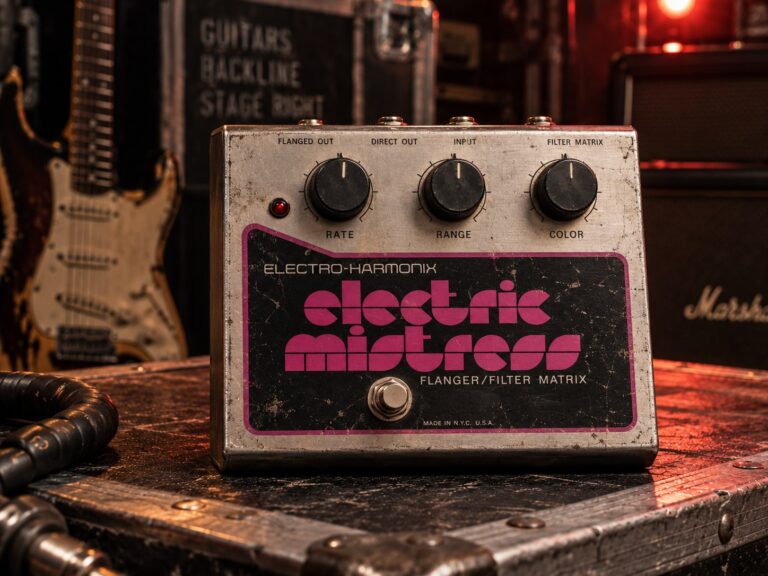
That places the Hiwatt era across A Farewell to Kings (1977), Hemispheres (1978) and Permanent Waves (1980) — the exact stretch where Rush’s guitar sound became articulate, chordally transparent and stacked with a Roland Jazz Chorus-style chorus, an Electric Mistress and an MXR Distortion+. A clean, high-headroom platform is the only way that layered approach holds together, and Lifeson’s own assessment names the trade-off precisely: “The Hiwatts are inefficient but they push and they have a particular sound which I liked at the time.”
He is equally honest about the downside, and it is the single most useful sentence any player has said about this amplifier: “Especially the Hiwatts have a mean top end after you got about twenty feet in front of the amps.” By the Moving Pictures sessions he had heard Allan Holdsworth playing Marshall 2×12 combos with Bill Bruford, rented one, and switched back to Marshall for that tour. Anyone telling you Lifeson is a lifelong Hiwatt player has not read the interview.
Reeves Gabrels — Verified, But Not for the Era Everyone Assumes
Reeves Gabrels is routinely listed as a Hiwatt player on the strength of his David Bowie years. The primary-source picture does not support that. In the Tin Machine period his rig was a Mesa/Boogie Quad preamp into a Simul-Class 2:90-family stereo power amp and two 4x12s, with a DigiTech IPS33B and a Roger Mayer-modified Dunlop fuzz wah.
The Hiwatt connection is entirely real, but it belongs to his tenure with The Cure. Speaking to James Volpe Rotondi for Line 6 in January 2022, Gabrels said it verbatim: “For a long time, I was using three Hiwatt D103s with three 4×12 cabinets with The Cure. It may surprise some people, but The Cure is an incredibly loud band. My volume on stage is around 104 decibels coming out of the cabinet. For my rhythm volume! Boosted up 5 dB for solos, I can literally feel my trousers vibrate against my skin.” Later reporting has him keeping a 100-watt Hiwatt in the touring rig specifically for his Bass VI, alongside custom amps he nicknames Thing One and Thing Two.
Three DR103s at 104 dB, in 2026, driving a band whose signature sound is reverb slammed into overdrive, is arguably the strongest living argument for this amplifier’s continued relevance — and a neat demonstration that its natural home is beside Robert Smith‘s layered cleans rather than in a gain-stacked metal rig.
The Others, Honestly Assessed
The earliest famous user was probably not a guitarist at all: Glenn Cornick of Jethro Tull, who played regularly at the Toby Jug near Reeves’ workshop and whose demands drove Hiwatt to build its first 200-watt and later 400-watt heads. Photographs from the Toby Jug in January 1969 and the Royal Albert Hall that May document Hiwatt stacks in the wild. Ronnie Wood owned a 1969 DR103, documented by Vintage Guitar. Beyond that, Hiwatt’s original sales manager placed the amps with The Moody Blues, Manfred Mann and the Roundhouse’s house backline, and their presence on 1970s British stages was general rather than genre-specific.
What you will not find is a persuasive metal or hard-rock lineage. That is not an accident. When the market wanted saturation, Hiwatt’s answer was a bolted-on extra gain stage in the dying Biacrown years, and it never caught on. The DR103 is a clean-platform amplifier used by players who bring their own dirt, and the artist list reflects that with unusual consistency.
Seven Tone Recipes for a DR103
1. The Gilmour Window (clean platform for fuzz)
Jump Normal and Brilliant with a short patch lead. Normal volume 7, Brilliant volume 4, Bass 5, Middle 5, Treble 6, Presence 3, Master to taste. The point is to build a flat, wide, undistorted canvas. Put a Ram’s Head Big Muff or a Fuzz Face in front and let the pedal be the voice. If the fuzz sounds harsh, drop Presence before you touch Treble.
2. Townshend Approximation (power-chord rhythm)
Brilliant volume 10, Normal off, Bass 0–2, Middle 3, Treble 9, Presence 4, Master 5–7. Yes, bass at zero. This is the documented CP103 approach with an SG, and it is counter-intuitive until you hear it: on a 4×12 at volume, cutting the amplifier’s low end is what stops the chords turning to porridge. Control the grit from the guitar’s volume knob, not the amp.
3. Lifeson Layered Cleans
Normal volume 6, Bass 5, Middle 6, Treble 5, Presence 2, Master high. Chorus and a mild flanger after the guitar, a light overdrive for sustained single notes only. The Middle control doing real work is what separates this from a Fender-style scoop and lets chorused arpeggios stay legible in a dense mix.
4. Pedal-Platform Neutral (the default you should start from)
Everything at 5, Presence 3, jump the channels, Master at whatever the room allows. A DR103 set flat is genuinely close to flat, which is unusual. Use this as your reference point before deciding the amp needs anything.
5. Bass Guitar / Keyboards (the “AP” setting)
Normal channel only, Low input, Bass 7, Middle 6, Treble 4, Presence 1, Master conservative. Reeves badged early heads All Purpose for a reason, and 100 clean watts through big Partridge iron is a perfectly credible bass amp — this is what Gabrels’ Bass VI setup exploits. Use a cabinet rated to take it.
6. Edge-of-Breakup (as far as this amp will go alone)
Jump the channels, both volumes at 10, Master at 7 or beyond, Bass 4, Middle 6, Treble 6, Presence 5. You will get a firm, grainy, low-compression overdrive with the transient completely intact — and you will get it at a volume that is genuinely impractical indoors. This is the setting that convinces people the DR103 “doesn’t distort.” It does. It simply asks for the whole 100 watts first.
7. Studio Small-Room Trick
Normal volume 8, Master 2, Presence 2, Bass 4, Middle 6, Treble 5, into a single 1×12 or 2×12 rather than a 4×12. Reducing cabinet area is far more effective than reducing volume for taming this amp, because the top end that Lifeson complained about is largely a beaming, on-axis 4×12 phenomenon. A DR103 into one speaker at conversational volume is a revelation to people who have only heard it through a full stack.
All settings on a 0–10 scale. The Master Volume is the master; channel volumes set character, not loudness. Every recipe assumes a 4×12 unless stated.
How the DR103 Compares
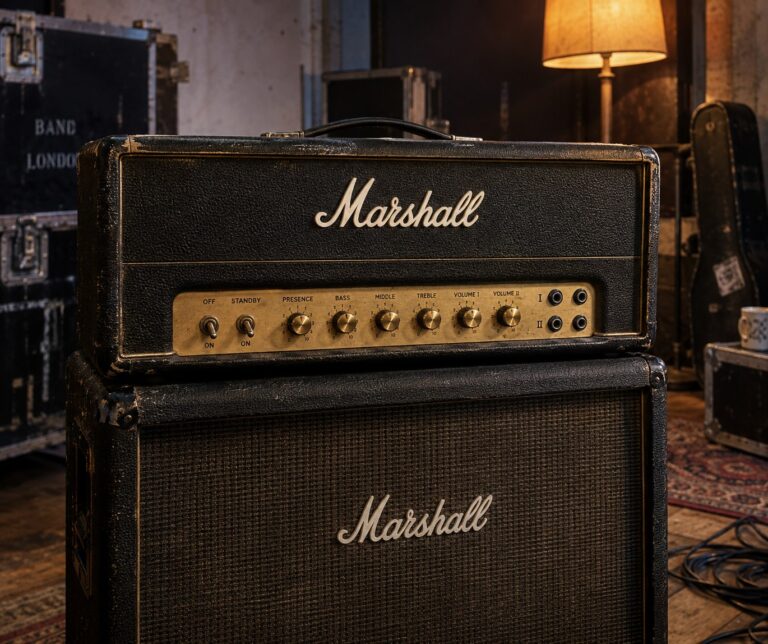
vs. Marshall 1959 Super Lead
The definitive comparison, because they look almost interchangeable and behave like opposites. Same four EL34s, same 100-watt rating, completely different design intent: the Super Lead uses smaller iron, less feedback and a preamp that is happy to misbehave, so it compresses and sings past halfway. The Hiwatt holds its shape. Choose the Marshall if the amp is your distortion; choose the Hiwatt if your pedals are.
vs. Marshall JCM800 2203
The 2203 solved the loudness problem by adding gain before the master. Hiwatt never accepted the premise: its master exists to control clean power, not to make bedroom distortion. If you want usable saturation at low volume from the amp alone, this is not a fair fight and the DR103 loses badly.
vs. Fender Twin Reverb
Philosophically the closest relative, and Townshend said as much. Both are big clean pedal platforms with solid-state rectification and oversized transformers. The differences are voicing and features: the Twin is 6L6-scooped with spring reverb and a built-in speaker cab; the Hiwatt is EL34-forward in the mids, has a genuinely useful Middle control, no reverb, and expects you to choose your own cabinet.
vs. Vox AC30 Top Boost
Total opposites of the British spectrum. The AC30 is cathode-biased, sags, compresses early and chimes; the DR103 is fixed-bias, refuses to sag, and reproduces. If you want the amp to add character, buy the Vox. If you want the amp to disappear, buy the Hiwatt.
vs. Orange OR120
The other 1970s British 100-watter, and the interesting middle case. The OR120 is thicker, woollier and more midrange-humped, with more amp-generated character at lower settings. Hiwatt is tighter, cleaner and considerably more literal. Doom and stoner players almost universally prefer the Orange for exactly that reason.
vs. Hiwatt DR504 Custom 50
The in-house alternative and, for most people in 2026, the more sensible purchase. The DR504 is the same design language at half the power, which means the same clarity arriving perhaps 4–5 dB earlier. You still will not get power-amp distortion at a civilised volume — but you will get closer, and the head weighs less.
vs. Roland JC-120
Both are famous for uncompromising cleanliness, but they get there differently: the JC-120 is solid-state, brittle at the top and comes with the best stereo chorus ever built in; the Hiwatt is valve-driven, warmer through the mids, and needs external modulation. Players who found the JC-120 too clinical often land on a Hiwatt.
Buying Guide
New: Current Hiwatt Custom Shop DR103
Street prices in mid-2026 sit around $4,799–$4,900 in the United States, with a UK RRP in the region of £2,669. That is Custom Shop money, and it buys hand-wired point-to-point construction, Partridge-spec English transformers, 18 mm birch ply and a world voltage selector, built in Doncaster. In pure component terms it is defensible; in market terms it is a lot of money for an amplifier with no reverb, no loop and no channel switching, and you should audition it against a boutique clean platform before committing.
Vintage: What to Look For
The vintage market is unusually spread out, and condition matters less than originality of the iron. Reference points: Premier Guitar valued a DR103 head plus an SE4123 4×12 at $3,000–$3,500 in excellent condition in 2013, and 2026 listings for 1970s heads alone cluster around and above the $3,000 mark, with a 1970 example carrying a replacement power transformer trading at roughly $3,095. Earlier is generally worth more, and any documented association with The Who adds a premium that has nothing to do with tone.
A checklist:
- Verify the transformers first. Partridge units are the value. A replaced power transformer is common and survivable; a replaced output transformer materially changes both the sound and the price.
- Establish the era. Hylight (to early 1981) versus Biacrown (1981–84, often Drake or Sowter iron, possibly an OL gain stage) versus later name-licensed products that share nothing but a badge.
- Open it and look. This is one of the few amps where visual inspection tells you almost everything: Harry Joyce-era looms are unmistakable, and any hacked, drooping or re-routed wiring is a red flag precisely because the original standard was so high.
- Ask about the filter caps. A 50-year-old amplifier that has never been recapped is a liability, not patina. Get a dated receipt naming the technician.
- Check for gain mods. Period owners frustrated by the lack of distortion sometimes had extra stages added. Reversible modifications are tolerable; a drilled chassis is not.
- Confirm the valve complement. Four EL34s, and either 4 x ECC83 or 3 x ECC83 plus an ECC81. Anything else has been changed.
- Play it loud before you buy. A DR103’s faults only appear above the volume where most amps have already broken up.
Alternatives Worth Considering
If the goal is Hiwatt-style headroom rather than a Hiwatt badge: the Hiwatt T40/20 offers the family voice in a manageable combo; a Twin Reverb covers similar clean-platform duty with reverb included; and for the digital route, Line 6’s Helix contains a model called “WhoWatt 100,” which Gabrels — a man who has owned three of the real ones — describes plainly as “basically a Hiwatt Custom DR103.” A Strymon Iridium with a Fane-loaded impulse response gets remarkably close for direct recording.
Living With One
Weight and volume are the two real problems. At roughly 47–50 lb the head alone is a two-hands-and-a-straight-back proposition, and a full SE4123 stack is a van, not a car. More importantly, the DR103’s design goal and modern stage volumes are in open conflict: an amplifier engineered to deliver 100 undistorted watts is an amplifier that must be loud to be itself. An attenuator helps with volume but cannot manufacture the power-stage compression the amp was built to avoid, so the honest answer is to use a smaller cabinet, use pedals for gain, and accept that this is a big-room instrument.
There is no effects loop, and the manufacturer treats that as a feature — time-based effects go in front, which is what everyone from Gilmour to Gabrels has always done anyway, and the amp’s headroom means a delay pedal in front does not turn to mush.
Retubing is not cheap. A matched quartet of good EL34s plus a bias adjustment is a real expense, and because this is a fixed-bias amplifier, the bias must be set by someone competent after any power-valve change. The upside is that valves in a Hiwatt live comparatively easy lives: an amp designed for headroom is not running its output stage into abuse the way a flat-out Plexi is.
Impedance discipline matters. Two parallel speaker jacks and a rear-panel selector make it easy to get this wrong. Set the selector to the actual combined load and never run the amp without a speaker connected.
Frequently Asked Questions
Does the Hiwatt DR103 distort at all?
Yes — but only at the top of a 100-watt power stage, and the distortion when it arrives is firm, grainy and low in compression rather than saturated and singing. In practical terms, treat it as a clean amplifier and supply your own overdrive. That is how every famous DR103 tone was made.
Did Pete Townshend actually use a DR103?
Not primarily. Between 1969 and 1973 Dave Reeves built him seven CP103 heads — a different circuit derived from the earlier Sound City design, with four inputs, four volumes, no Middle and no Presence — and from 1973 he used the related DR103W. A stock DR103 gets you close to those sounds but is not the same amplifier.
What speakers should I use with one?
Historically, Fanes: Hiwatt’s own SE4123 cabs used cast-frame Fanes built to Reeves’ specification, and Gilmour ran WEM Super Starfinder cabs with Fane Crescendos. Modern Vintage 30s work and are the common default, but they are brighter and more mid-forward than the original recipe; G12H-75 Creambacks are a softer landing if the amp feels too aggressive on axis.
Is a modern Hiwatt the same as a vintage one?
The current Custom Shop DR103 is built in England, hand-wired point to point, and uses Partridge-spec transformers to Reeves’ original late-1960s design — considerably closer to the original than most “reissue” amplifiers are to their ancestors. The main documented spec difference is the preamp complement: current amps run 4 x ECC83, while vintage-correct examples typically used 3 x ECC83 and an ECC81 phase inverter.
Why is there no effects loop or reverb?
Because the design predates the assumption that an amp should provide either, and because the amp’s headroom makes a front-of-amp effects chain work properly. Hiwatt has never added a loop to the DR103, and the current maker markets that omission as part of the amp’s purity of signal path.
What does “AP” mean on some Hiwatt heads?
All Purpose. It reflects Reeves’ intent that the amplifier serve guitar, bass and keyboards equally — 100 clean, high-headroom watts is genuinely full-range. Gilmour’s earliest heads carried the designation, and the current maker still describes the DR103 as a truly all-purpose amplifier.
Is a 50-watt DR504 a better buy than a 100-watt DR103?
For most players in 2026, probably yes. The DR504 shares the family voice, the construction standard and the transformer philosophy, and it is lighter, cheaper and marginally more approachable at realistic volumes. The DR103 is the right choice if you play large rooms or need the last few decibels of clean headroom.
Are Biacrown-era Hiwatts worth buying?
Often yes, at the right price. They can be excellent amplifiers, but the 1981–84 period saw transformers re-sourced from Drake and Sowter as supplier relationships broke down, Harry Joyce eventually stopped wiring chassis, and some units carry an added “OL” overdrive stage. None of that is disqualifying — but it should be reflected in the price relative to a Hylight-era example with original Partridge iron.
What is the fastest way to make a DR103 sound bad?
Stand directly in front of a 4×12 with Presence and Treble up and the bass control high. Alex Lifeson diagnosed it in 1981 — “the Hiwatts have a mean top end after you got about twenty feet in front of the amps” — and the fix is the same as it was then: pull the Presence down, keep the bass modest, and get off axis or use fewer speakers.
Image credits
- Pete Townshend: Heinrich Klaffs, Wikimedia Commons, CC BY-SA 2.0.
- Top image: GuitarGangsters AI-generated reference illustration, not a photograph.
- Hiwatt DR103 Custom 100: AI-generated illustration by GuitarGangsters, based on the manufacturer’s product design (not a photograph).
- David Gilmour: Jan Hagelskamp, Wikimedia Commons, CC BY 4.0.
- Marshall 1959 Super Lead Plexi: GuitarGangsters AI-generated reference illustration, not a photograph.
- Marshall JCM800 2203: GuitarGangsters AI-generated reference illustration, not a photograph.
Latest News
Related
On This Day
Monday 9 November
From this week: