The Mesa/Boogie Mark IV: Eighteen Years of the Most Trusted Amp in Progressive Metal
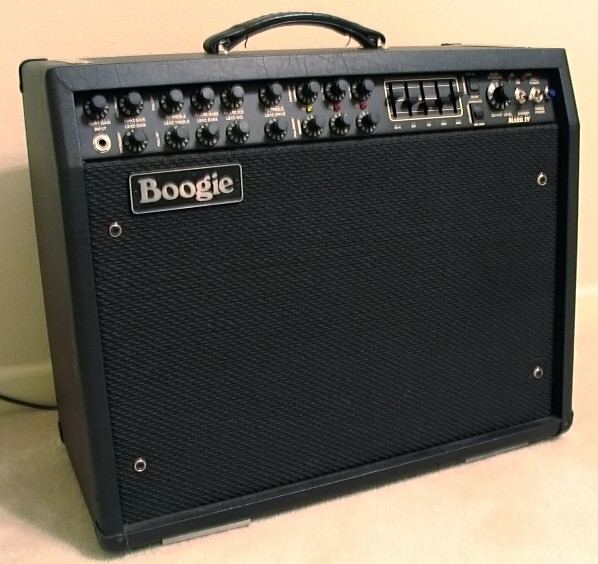
Mesa/Boogie Mark IV combo, photographed in 2006. Photo: Fatty Pubis; existing 2008 color, noise and sharpening revision: Iainf. Worldwide public-domain dedication with unrestricted fallback permission where needed. Existing source version used unchanged. Source and rights: https://commons.wikimedia.org/wiki/File:MarkIV.jpg
Mesa/Boogie Mark IV: 18 years of Simul-Class power behind John Petrucci, Lamb of God, and the tones that defined progressive metal.
In 1992, John Petrucci walked into a studio with two Mesa/Boogie Mark IV heads racked side by side and laid down the guitar tones that would define an entire generation of progressive metal. The album was Images and Words. The sound was surgical, massive, and capable of turning on a dime between shimmering clean passages and blistering lead lines without touching a single knob mid-song. The amp did all of it — three independent channels, an assignable graphic EQ, and Mesa’s patented Simul-Class power section delivering 85 watts of punch with the sweetness of Class A tubes mixed in. That was the Mark IV. It stayed in production for eighteen years, from 1990 to 2008, and it never stopped being relevant.
The Mark IV is not the most hyped amp in the Mesa/Boogie catalogue. That crown belongs to the Mark IIC+, a model produced in tiny numbers from 1983 to 1985 that Metallica used on Master of Puppets and which now sells for five figures on Reverb. The Mark IV is more practical, more feature-complete, and more versatile — and it has been quietly running the rigs of progressive metal, heavy rock, and fusion players since George H.W. Bush was in the White House. This is the story of how it got built, why it sounds the way it does, and who actually played it.
From Princeton to Petaluma: The Mark Series Comes of Age
The entire Mesa/Boogie story begins with a joke. Randall Smith was co-owner of Prune Music in San Francisco in the early 1970s, and one of his hobbies was hot-rodding Fender amplifiers for local musicians. He modified a Fender Princeton belonging to Barry Melton of Country Joe and the Fish — stuffing a Fender Bassman power section into the tiny Princeton chassis and replacing the speaker with a 12-inch JBL — as a kind of experiment. Then he showed it to his frequent customer Carlos Santana. Santana plugged in, played a few notes, and said: “Man, that little thing really boogies.” Smith had stumbled into the amplifier business.
Those early Boogies pioneered what became known as a cascading gain circuit: multiple gain stages wired in series and configured to push distortion through the preamp regardless of how hard you hit the output section. That was new. Every other amp of the era relied on cranking the power amp to get distortion — which meant playing loud. The Boogie let you get saturated, sustaining lead tones at any volume. The design became the Mark I, then Mark II, then IIA, IIB, and eventually the IIC+ — each iteration refining the formula, adding channel switching, effects loops, and Simul-Class power.
The Mark III arrived in 1985 and introduced a third channel — a crunch rhythm sound sitting between the clean and the lead. It ran through five stripe revisions (Black through Green) before Mesa retired it. But the Mark III’s channel architecture had proven the concept: three independent sounds with individual gain and master volume controls, selectable by footswitch. The Mark IV took that architecture and rebuilt it from scratch with better switching, more independent EQ shaping per channel, and a power section that refined the Simul-Class design developed on the IIB.
The Mark IV launched in 1990 as Mesa’s new flagship. It would remain that flagship — surviving the Rectifier craze of the mid-1990s, the boutique amp boom of the 2000s, and the modeller revolution — until Mesa finally discontinued it in 2008 after an eighteen-year production run. By the time it left production, over fifty thousand Mark IIs, IIIs, and IVs were estimated to be in active use worldwide. Mesa’s own legacy page cites that number with quiet pride.
Mesa/Boogie Mark IV Specifications
Version A vs. Version B: What Actually Changed
Mesa produced the Mark IV in two distinct circuit revisions. Understanding the differences matters a great deal on the used market, because the two versions are priced the same but sound and behave differently in meaningful ways.
Version A runs from the beginning of production in 1990 through approximately September 1993. The most important characteristic of the A version is its lead channel, which is voiced closely to the IIC+. If you are specifically chasing that 1984–85 IIC+ character — tight, focused, harmonically rich, with that distinctive compressed snarl in the mids — a Mark IV Version A is the more affordable path to something in that neighbourhood. Version A also runs two mono effects loops rather than one stereo loop, which some players prefer for routing flexibility. It has no footswitchable reverb; the reverb is panel-controlled only. Early Version B units (late 1993 to early 1994) retained the attached power cord of the A version, making them easy to misidentify.

Version B runs from approximately late 1993 through the end of production in 2008. The power transformer is slightly larger. The lead channel is voiced darker and has marginally more gain available. Rhythm II also has more gain on tap than the A version. The effects loop is now a single stereo loop (one send, two returns), and reverb became footswitchable. Mesa also added an output to drive a second power amplifier from the Version B chassis, making it easier to use the Mark IV as a preamp in a larger rack system — which is exactly how Petrucci was running his rig during this era.
Both versions are genuinely excellent and both are highly regarded. The A version is for players who want that IIC+ lead flavour baked in; the B version is for players who want the full modern feature set and a slightly more aggressive overall character.
Famous Players: Who Actually Used the Mark IV
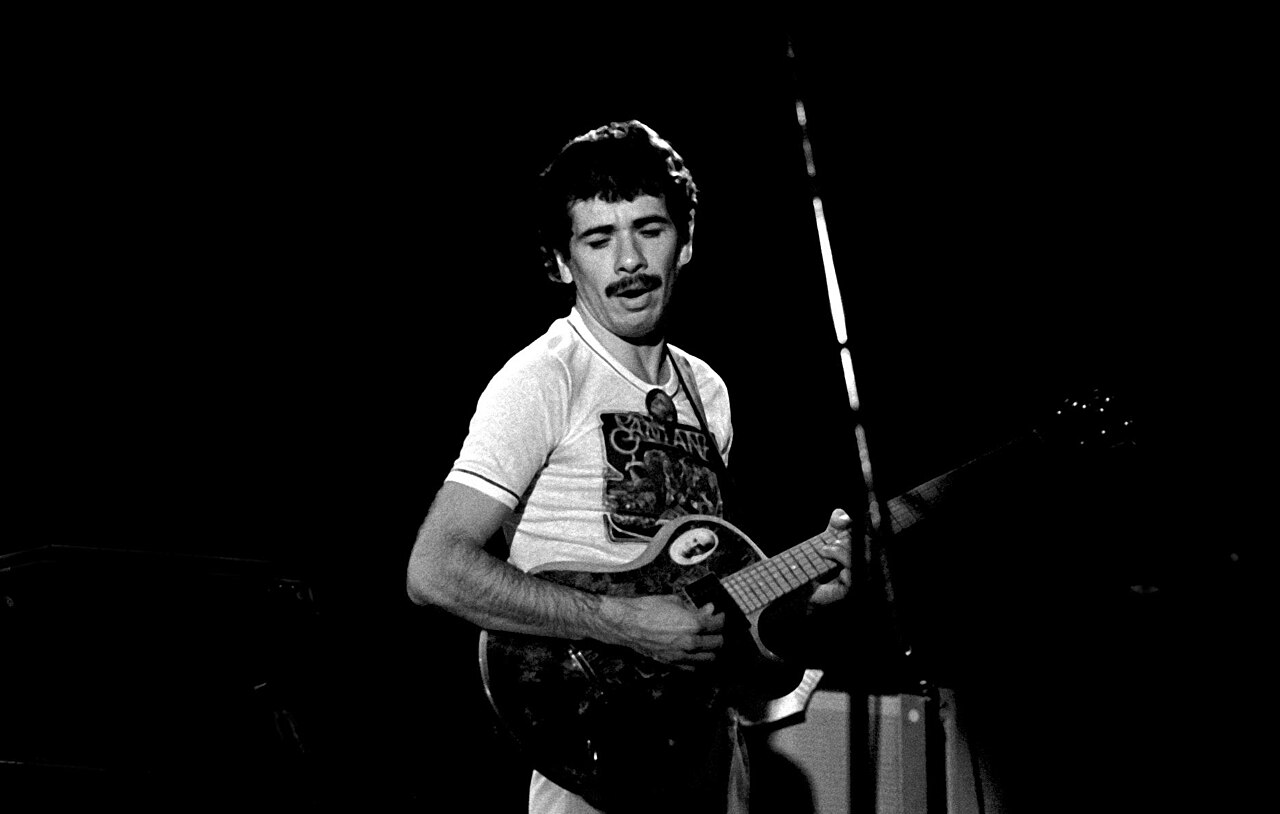
Carlos Santana: Santana is the origin story of Mesa/Boogie — but his amp was the Mark I, not the Mark IV. Randall Smith’s modded Princeton, which Santana played at Prune Music and reportedly declared “really boogies,” was the prototype that became the Mark I. Santana used that early Boogie sound extensively throughout the 1970s. The Carlos Santana connection to Mesa is real and historically central, but it belongs to a completely different model produced two decades before the Mark IV existed.
James Hetfield / Metallica: Metallica’s legendary Mesa/Boogie relationship is with the IIC+, not the Mark IV. Hetfield and Kirk Hammett used Mark IIC+ heads on Master of Puppets (1986), and that album is widely cited as the primary reason the IIC+ is now a five-figure collector piece. See the Mark IIC+ article for the full story. James Hetfield had moved to a heavily modified setup by the time the Mark IV entered production, and no primary source documents him using a Mark IV in the studio or on stage.
Larry Carlton: Carlton helped establish the Mark I’s reputation as a premium studio head in the 1970s through his session work and his recordings with the Crusaders. He is a genuine and important part of the early Boogie story. But by the time the Mark IV arrived in 1990, Carlton had long since moved to Dumble amplifiers, which became the defining sound of his solo career. His Mesa story ends well before the Mark IV begins.
Andy Timmons: Timmons is a longtime Mesa/Boogie artist and an important figure in documenting what the brand can do. His documented primary amps are the Lone Star and the Stiletto Deuce Stage II. Multiple rig rundowns and the Mesa artist page consistently show those models. No primary source — no rig rundown, no interview, no Equipboard documentation — places Timmons specifically on a Mark IV. He is a Mesa man, but not specifically a Mark IV man based on available evidence.
That leaves the genuinely verified players, who are worth talking about in detail.
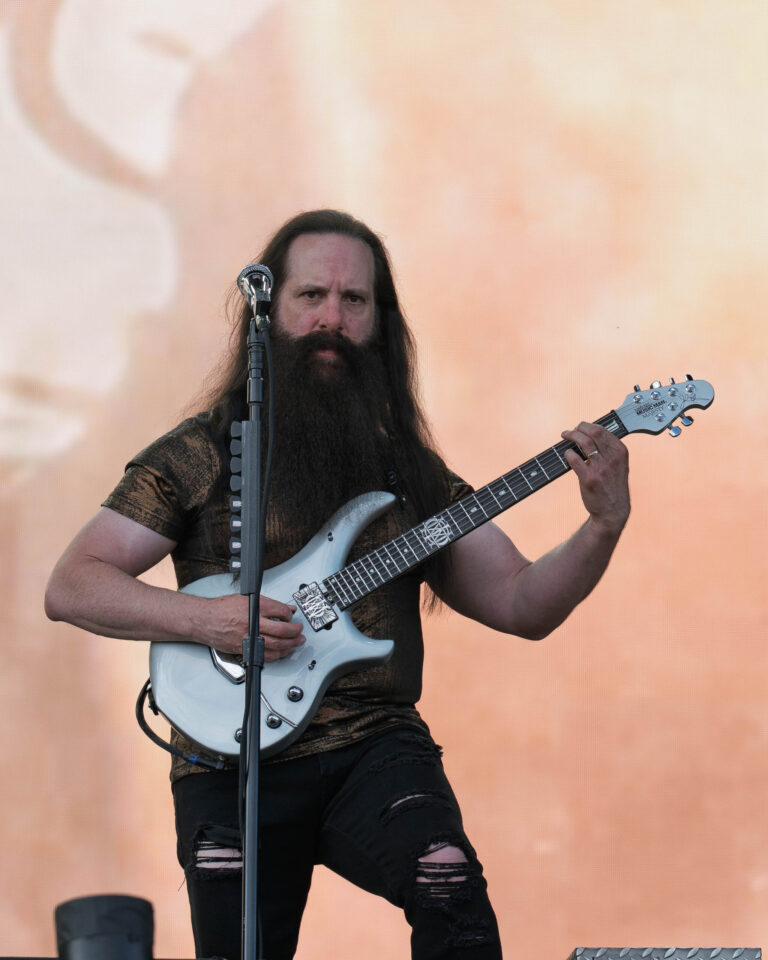
John Petrucci (Dream Theater): The strongest and most extensively documented Mark IV relationship in the professional guitar world. Petrucci ran two Mesa/Boogie Mark IV heads as his primary stage amplifiers across multiple Dream Theater touring cycles, a setup extensively documented in gear profiles and interviews. His rig during the Falling Into Infinity era and through the 2000s included the Mark IV as a centerpiece, alongside a Mesa Triaxis preamp and 2:90 power amp for clean and stereo lead sounds. He later described the Mark IIC+ as his “Holy Grail” amplifier — a distinction that explains both the JP-2C signature model and why the JP-2C was built — but his working touring rig for much of his career was built around the Mark IV. Two heads: one running the lead channel for rhythm chug and the other configured for cleaner passages. Rack-controlled by his tech Mark Snyder. Cabinets were Mesa 4×12 and 2×12 units loaded with Celestion Vintage 30 speakers. That combination — two Mark IVs into Vintage 30s — is still the closest you can get to a stage-authentic Petrucci tone without spending five figures on a IIC+.
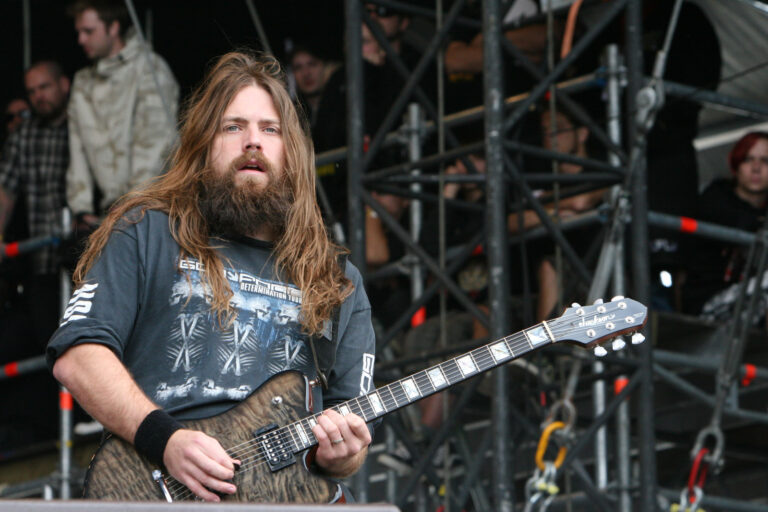
Mark Morton (Lamb of God): The Premier Guitar rig rundown from December 2012, shot on location in Des Moines, Iowa, documented Morton’s stage rig in detail: two Mesa/Boogie Mark IV heads, one powering Stiletto 4×12 cabinets on stage and one running to FOH, with a third Mark IV head on top of the rack as a backup. Morton subsequently transitioned to Mesa Royal Atlantic RA-100 heads to match the tone he’d found on Resolution, but the Mark IV was the backbone of Lamb of God’s recorded and live sound for years before that. Mark Morton‘s Mark IV settings leaned into the Lead channel with the graphic EQ engaged, sculpting the low-mid frequency around 371 Hz to control the boxy frequency pile-up that the Stiletto cabinets’ loaded V30s could create in a dense live mix.
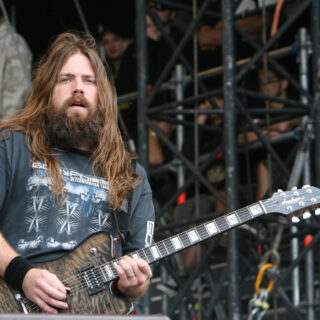
Willie Adler (Lamb of God): Running the same setup. The same 2012 Premier Guitar rundown documented Willie Adler‘s rig as two Mark IV heads — one for stage cabs, one for FOH — plus a third in the rack as a spare. His signal chain was simple: rackmount dbx 266XL compressor/gate, Boss TU-2 tuner, Boss NS-2 noise suppressor, and an MXR Stereo Chorus engaged only for clean passages. No frills. The Mark IV did the heavy lifting. Adler’s settings on the Lead channel were characteristically scooped in the midrange with the GEQ, producing the low-mids-out groove metal roar that defines Lamb of God’s rhythm attack.
Clint Lowery (Sevendust): The Premier Guitar rig rundown for Sevendust confirms that Lowery used the Mesa/Boogie Mark IV for all of his studio recordings. His live rig later shifted to Diamond Phantom heads, but the Mark IV was the amp on every Sevendust record during his tenure. The documentation is clean and comes from a primary source interview.
Tone Recipes: Five Settings to Map the Mark IV’s Range
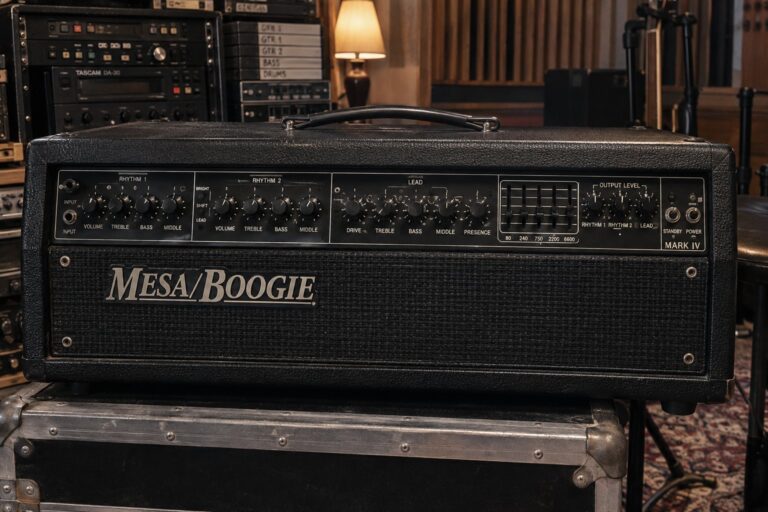
Recipe 1: Petrucci Dream Theater Lead (Mark IV Lead Channel)
Lead Gain at 7, Lead Drive at 5-6, Bass 4, Mid 5, Treble 6, Presence 6. Lead Voicing Switch to Harmonics. GEQ: 87Hz at flat, 371Hz cut 2dB, 723Hz cut 1dB, 1575Hz flat, 4822Hz boost 2dB. Pull Shift Presence engaged. Master at performance level. Into Mesa 4×12 with Celestion Vintage 30s. A Tube Screamer at low drive (gain near zero, level boosted) in front of the lead channel to tighten the pick attack. This is as close as you get to the Scenes from a Memory lead tone without a IIC+.
Recipe 2: Lamb of God Groove Metal Chug (Mark IV Lead Channel)
Lead Gain at 6-7, Lead Drive at 7, Master at stage level. Bass 5, Mid 3 (scooped), Treble 6, Presence 7. GEQ: 87Hz flat, 371Hz cut 3dB, 723Hz cut 2dB, 1575Hz flat, 4822Hz boost 1dB. Pull Fat engaged. NS-2 noise gate in the effects loop — the Mark IV’s lead channel at this gain level picks up hum, and a gate is not optional. This is the Morton/Adler low-mid-scooped rhythm wall. Sounds enormous on stage, sounds even bigger mic’d — aim SM57 at the dust cap and the Sennheiser MD421 at the cone edge and blend.
Recipe 3: Crunch Blues (Rhythm II, Pull Fat)
Rhythm II Gain at 5, Rhythm II Master at 4-5. Bass 5, Mid 6, Treble 5, Presence 5. Pull Fat engaged on Rhythm II. GEQ off. The Mark IV’s Rhythm II with Pull Fat is one of the most underappreciated overdriven tones in the amp — not high-gain, not clean, but that elusive barking blues-crunch that sits between them. Playing with a lighter touch goes almost clean; digging in with a hard pick attack pushes into broken-up grit. This is the channel that Rhythm II was designed for, and it is often overlooked in favour of the lead channel.
Recipe 4: Clean Shimmer (Rhythm I, Tweed Switch)
Rhythm I Gain at 3, Rhythm I Master at 5-6. Pull Bright on. GEQ: small 2dB boost at 1575Hz, everything else flat. Tweed “Variac” switch engaged (reduces supply voltage slightly, adding sag and harmonic softness to the clean). Single-coil guitars shine here — Stratocaster through this setting with a spring reverb pulled up to 3 is studio-ready. The Rhythm I clean is the most Fender-flavoured sound the Mark IV offers, and the Tweed switch pushes it further in that direction.
Recipe 5: Instrumental Rock Lead (Lead, Low Gain, GEQ Engaged)
Lead Gain at 4, Lead Drive at 3, Master at room level. Bass 5, Mid 5, Treble 5, Presence 6. GEQ: 87Hz cut 1dB, 371Hz flat, 723Hz flat, 1575Hz boost 2dB, 4822Hz boost 2dB. Lead Voicing to Mid Gain. This is a singing, voice-like lead tone — enough gain for smooth sustain and legato, clear enough to articulate every note individually. The upper-mids boost on the GEQ (pre-distortion) adds harmonic glassiness. Works exceptionally well into the Widebody Combo’s C90 speaker, which has a smoother top end than a Vintage 30.
The Mark IV’s five-band graphic EQ is placed pre-distortion — that is critical. Unlike a post-distortion EQ (which changes frequency balance after the saturation happens), the Mark IV’s GEQ changes what gets saturated. Boosting 87 Hz pre-distortion emphasises bass harmonics in the gain structure. Cutting 723 Hz pre-distortion tightens the midrange clutter before it gets amplified. This is why the Mark IV rewards EQ experimentation in a way that most amps do not.
Comparisons: Where the Mark IV Sits in the Landscape
The Mark IV occupies a specific position in the amplifier world: complex, feature-rich, and somewhat demanding to dial in, but ultimately capable of sounds that simpler amps cannot produce.
The Mesa/Boogie Mark IIC+ is the predecessor that everyone reaches for on the used market. The IIC+ has two channels — clean and lead — and a simpler control layout. Its lead channel is legendary for a specific reason: the tone has a quality that engineers describe as “focused compression” — a mid-forward, tight, almost vocal quality that the Mark IV’s lead channel approximates in Version A but does not identically replicate in Version B. The IIC+ costs significantly more on the used market (often $5,000–$10,000 for a clean example) and offers far fewer features. If you need two sounds and have the budget, the IIC+ is the better-sounding option for those two sounds. If you need three fully independent channels with EQ shaping, effects loop, and footswitchable reverb, the Mark IV is the correct choice — at a fraction of the price.
The Mesa/Boogie Mark III Simul-Class is the Mark IV’s immediate predecessor, produced 1985–1997. The Mark III went through five circuit revisions and its lead channel evolved from a near-IIC+ clone (Black/Purple Stripe) to something brighter and more aggressive (Blue Stripe). The Mark III lacks the Mark IV’s fully independent lead EQ — bass and mid are shared across the rhythm channels, and the lead channel inherits that shared EQ. The Mark IV fixed this with a completely independent EQ for the lead channel, making channel-to-channel tonal separation much cleaner. If you find a used Mark III at the right price, it is a legitimate choice; the Mark IV is simply more refined and more flexible.
The Mesa/Boogie Mark V:90 is the Mark IV’s successor, introduced in early 2009. The Mark V has nine modes across three channels (three modes per channel, each reproducing a different vintage Mark circuit), a channel-assignable graphic EQ, MultiWatt power switching, and significantly more complexity. It is a more powerful tool for studio players who need multiple amp flavours from one chassis. It is also more difficult to dial in, and many players find that the Mark IV’s simpler control set makes it faster to navigate on the fly. The Mark V is the more modern choice; the Mark IV is the more intuitive one.
The Mesa/Boogie Dual Rectifier is the other major Mesa platform from the same era. Where the Mark IV is surgical and articulate, the Rectifier is bold, thick, and saturated — a different philosophy entirely. The Rectifier took over from the Mark series as Mesa’s flagship in the early-to-mid 1990s because it matched the production aesthetics of alternative and nu-metal. Mark IV players tend to find the Rectifier too loose; Rectifier players tend to find the Mark IV too tight. Both assessments are accurate. The Mark IV rewards precise picking; the Rectifier rewards power and weight.
The Marshall JCM800 2203 is the key British alternative. One channel, master volume, the classic 1959/2203 topology. The JCM800 is simpler, louder in perceived midrange, and requires pedals or channel switching from an external device to do what the Mark IV does internally. In a comparative studio session, the Mark IV wins on flexibility; the JCM800 wins on feel — the way it responds to pick attack and volume pot variations is more immediately physical. Many professional rigs run both: Mark IV for programmed tones, JCM800 for an always-on raw channel.
Buying Guide: Finding a Mark IV in 2026
The Mark IV has been out of production since 2008, so every example on the market is used. Reverb is the primary marketplace; combos start around $1,300 and heads start around $1,650, with well-preserved examples and desirable versions (particularly Version A heads) reaching $2,500 or more. The Widebody Combo with the C90 speaker is less common and commands a premium for its smoother-voiced bottom end.
The first practical decision on the used market is Version A or Version B. If you are a lead-focused player chasing that IIC+ mid-character, Version A is worth the search. If you want the full feature set — stereo loop, footswitchable reverb, second power amp output — Version B is the right call. To identify the version: Version A has two mono FX loop jacks on the rear panel; Version B has a stereo loop (one send, two returns). The reverb on a Version A is panel-controlled only; on Version B there is a reverb footswitch jack.
Inspect the following on any used Mark IV:
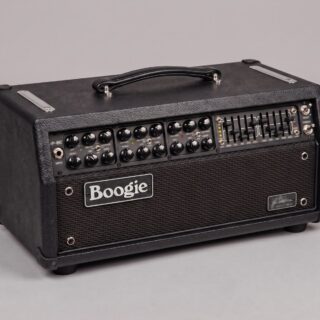
Tubes first. The Mark IV has 4× 6L6 power tubes and 5× 12AX7 preamp tubes. Budget for a full retube if you cannot confirm when it was last done — expect to spend $80–$150 on tubes plus biasing labour. Mesa runs fixed bias (factory set), which means the power section requires professional measurement to re-bias correctly after tube replacement; this is not a self-biasing design.
The spring reverb tank is a common weak point on aged examples — spray out easily, tank can rattle, and reverb circuits sometimes develop noise. Power the amp through its full warm-up cycle and test reverb at low, medium, and high settings before committing to a purchase. A noisy reverb circuit is not expensive to repair but should be factored into the price.
The channel switching and footswitch system should be tested with the actual 6-button footswitch. Mesa’s footswitch is a proprietary unit; running the Mark IV without it means manually switching channels at the panel, which is not viable in a live context. Verify the footswitch is included or priced into the deal. Used Mesa Mark IV footswitches appear on Reverb and eBay for around $40–$80.
Check the fan. Mesa built fan cooling into the Mark IV because the Simul-Class power section runs the outer pair of 6L6s in Class A triode, which runs hotter than Class AB pentode. The fan should spin on power-up. A seized fan is an inexpensive fix but left unaddressed it shortens tube life significantly.
If the amp has been modded — and some have been, particularly “IIC+ mods” that attempt to bring Version B’s lead channel closer to the IIC+ circuit — demand a full disclosure of what was done and whether the work was performed by a qualified tech. Sloppy mods are more common in this price range than clean ones.
Ownership Notes
The Mark IV is not a set-and-forget amplifier. Its feature density — three independent channels, assignable GEQ, assignable FX loop, multiple power switching options — means it rewards systematic programming before a gig or session. Experienced users spend an afternoon building their three channel sounds, engaging the GEQ in its assigned state for each channel, and then documenting the settings photographically. The front panel is busy enough that recreating a favourite tone from memory under time pressure is unnecessarily difficult.
The pre-distortion placement of the 5-band graphic EQ deserves repeated emphasis because it is counterintuitive. Most players encounter post-distortion EQs (Boss GE-7 on a pedalboard, FX loop EQ in a rack rig) and assume the Mark IV’s GEQ works the same way. It does not. Boosting 4822 Hz on the Mark IV’s GEQ pre-distortion adds harmonic brightness before the gain structure — you are changing what gets saturated, not just what comes out the speaker. This is powerful but requires a different mental model.
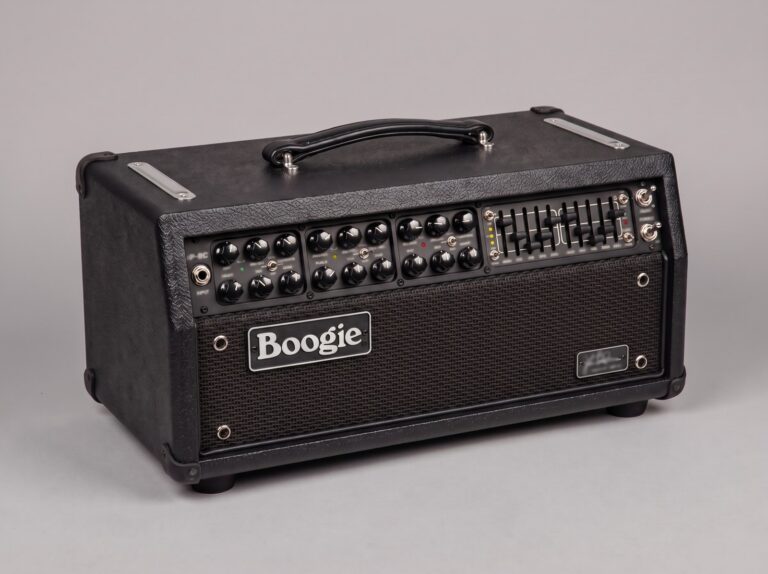
The Simul-Class power section pairs the inner two 6L6s in Class AB pentode (high power, high efficiency) with the outer two in Class A triode (lower power, sweeter, harmonically richer). Running all four produces 85W. The Simul-Class/Class A toggle switches to the outer pair only — 15W of pure Class A. The Pentode/Triode toggle changes the outer pair’s operating point. These switches sound dramatic in description; in practice, the most useful switch is the Full Power/Tweed toggle, which reduces supply voltage (simulating a slightly sagging power supply), adding warmth and touch sensitivity to the clean channel. Record at lower volumes and engage the Tweed switch.
The Mark IV runs cool relative to its rated output because of the fan, but it does need a speaker load at all times when powered. Do not power it up without a cabinet connected. The record out and slave out allow direct recording, but these outputs still require a speaker load on the speaker output unless the Silent Record Mute switch (the pull function on the Output Level knob) is engaged.
Frequently Asked Questions
What years was the Mesa/Boogie Mark IV in production?
The Mark IV was produced from 1990 to 2008 at Mesa’s factory in Petaluma, California — an eighteen-year run that makes it one of the longest-produced Mesa/Boogie models. Production ended when the Mark V was introduced in early 2009.
What is the difference between the Mark IV Version A and Version B?
Version A (1990 to approximately September 1993) has a lead channel voiced closely to the IIC+, two mono effects loops, and panel-controlled reverb only. Version B (late 1993 to 2008) has a single stereo effects loop, footswitchable reverb, an output for driving a second power amplifier, and a slightly darker/higher-gain lead channel voicing. The Version B power transformer is also marginally larger. Early Version B units retained the Version A’s attached power cord and can be misidentified without checking the rear panel loop jacks.
Did Metallica use the Mark IV?
No. Metallica’s Mesa/Boogie connection is specifically with the Mark IIC+, which James Hetfield and Kirk Hammett used on Master of Puppets in 1986 — four years before the Mark IV was introduced. The IIC+ is a different amplifier with a two-channel layout and a significantly different circuit. The confusion is understandable given that both carry the “Mark” name, but they are distinct designs from different eras of the brand’s history.
What is Simul-Class power and what does it do?
Simul-Class is Mesa/Boogie’s patented power section design where two different sets of power tubes operate simultaneously in different classes. In the Mark IV: the inner two 6L6s run Class AB pentode (the conventional high-efficiency mode), while the outer two run Class A triode (lower power, running at full current draw, producing a sweeter and more harmonically complex response). The combined output is 85W. The theory is that you get the punch and headroom of Class AB and the sweetness of Class A in the same power section. In practice, the Mark IV’s Simul-Class power section has a characteristic tightness and harmonic density that single-class designs of equivalent wattage typically lack.
Can I assign the graphic EQ to specific channels?
The graphic EQ is assignable via the footswitch — the 6-button unit includes a dedicated EQ toggle that engages or bypasses the GEQ regardless of which channel is active, and a Lead+EQ button that switches to the lead channel and activates the EQ simultaneously in a single press. You can also programme the EQ’s on/off state into the amp’s memory for each channel. The EQ is placed pre-distortion in all channels, which means it shapes the tone before the gain structure acts on it rather than after.
What tubes does the Mark IV use?
Four 6L6 power tubes and five 12AX7 preamp tubes. The Mark IV uses fixed bias, which means tube replacement requires professional re-biasing with test equipment — you cannot self-bias this amp with a bias probe kit designed for cathode-biased circuits. Budget for tech time alongside tube costs when planning a retube.
Is the Mark IV competitive for modern metal in 2026?
Yes, with an important qualifier. The Mark IV’s lead channel is a high-gain cascading design from the era of progressive metal and groove metal — it is voiced for tight, articulate saturation rather than the compressed wall-of-sound that characterises modern djent and black metal tones. Players who want the Mark IV to sound like a contemporary high-gain modeller will be frustrated. Players who want a amp that rewards precise technique and scales between crunchy and searing based on pick attack will find it entirely modern. Petrucci’s progressive metal tone remains aspirational in 2026; the amp that built it is still available on the used market for a fraction of the price of new boutique alternatives.
Which format — head or combo — is better for the Mark IV?
The head formats (Short Head at 18¾” or Medium/Wide Head at 22½”) offer flexibility in cab pairing and are the format Petrucci, Morton, and Adler all used. The Compact Combo (1×12 with the C90 speaker) is a legitimate studio option — the Celestion C90 has a smoother, more midrange-balanced character than the Vintage 30, which can work in its favour for recording. The Widebody Combo is rarer and typically commands a premium. For live use, the head with a 4×12 cabinet is the professional standard.
Image credits
- Willie Adler: Stefan Brending (2eight), Wikimedia Commons, CC BY-SA 3.0.
- Carlos Santana: Heinrich Klaffs, Wikimedia Commons, CC BY-SA 2.0.
- Top image: Mesa/Boogie Mark IV combo, photographed in 2006. Photo: Fatty Pubis; existing 2008 color, noise and sharpening revision by Iainf. Source photograph · Worldwide public-domain dedication, with unrestricted fallback permission where needed. Existing source version used unchanged.
- Mesa/Boogie Mark IV Head: GuitarGangsters AI-generated reference illustration, not a photograph.
Latest News
Related
On This Day
Tuesday 10 November
From this week: