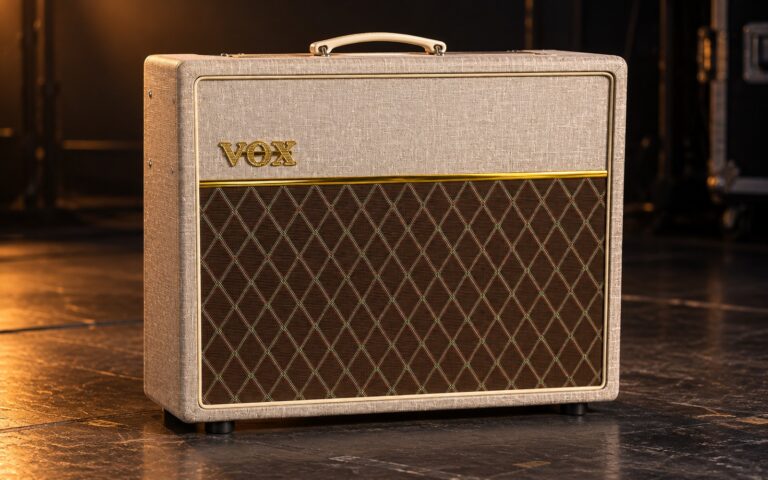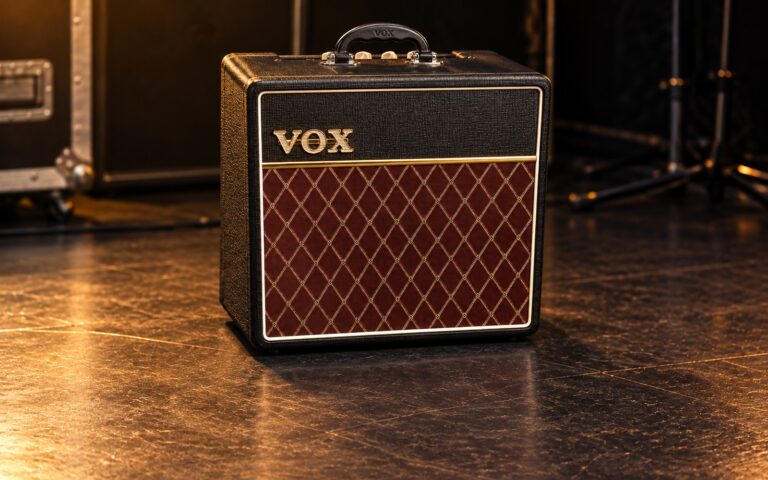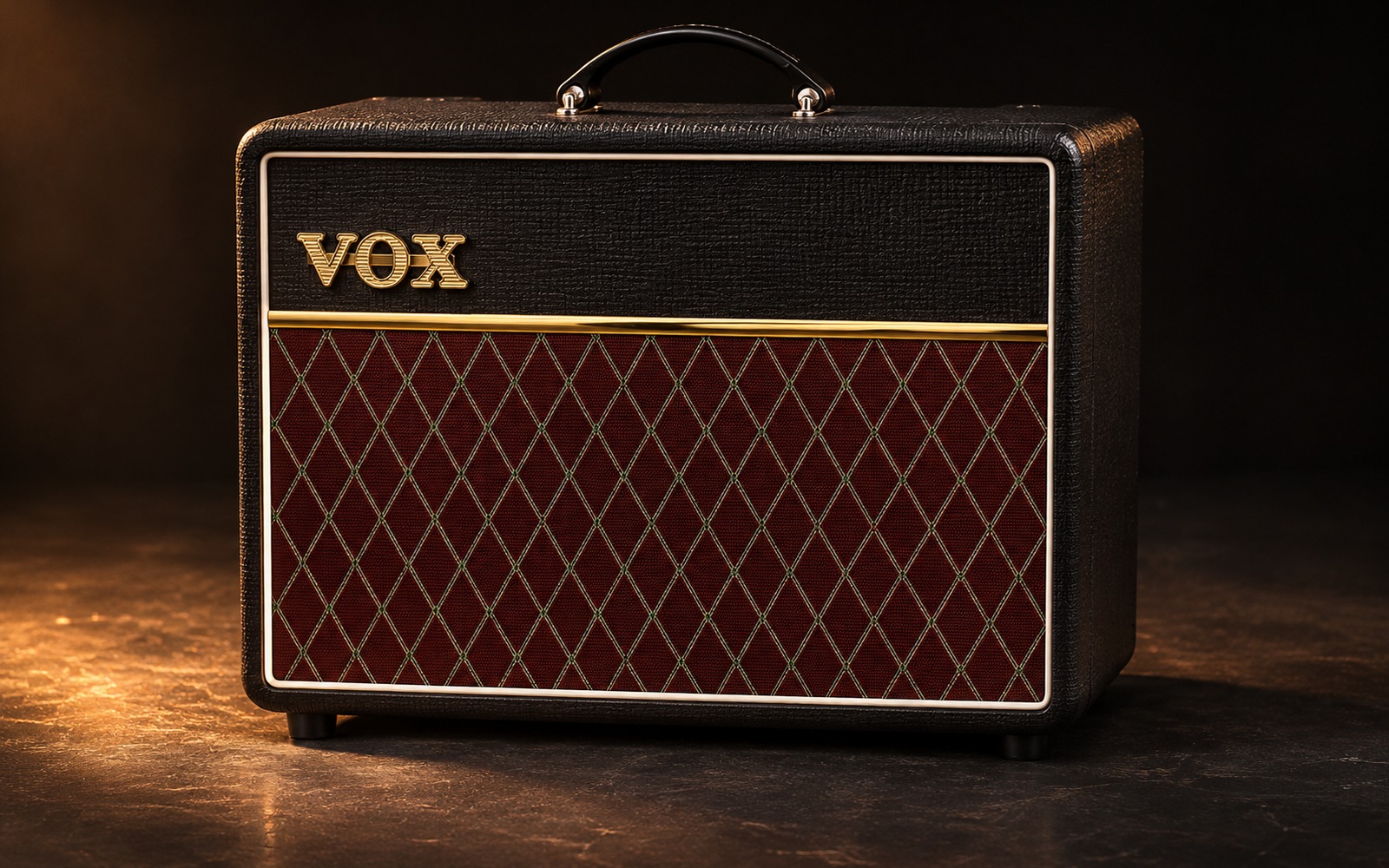
The Smallest Vox That Doesn’t Compromise: Inside the AC10C1
The Vox AC10C1 packs genuine EL84 tube chime into a 27-pound combo. Here's what makes it special, who uses one, and whether it's worth the price.
There’s a brutal triage that happens every time a working guitarist tries to go smaller. You want the tone of an AC30 — that unmistakable chimney of EL84 harmonics, the compressed mid-push that makes chords feel alive, the way a Telecaster just blooms through the circuit — but you don’t want to fly it to a festival gig. So you try an AC4 and find the output section doesn’t breathe the same way at low volumes. You try a modeller and it gets you 90% of the way there until you’re on stage and you know in your gut it’s not quite right.
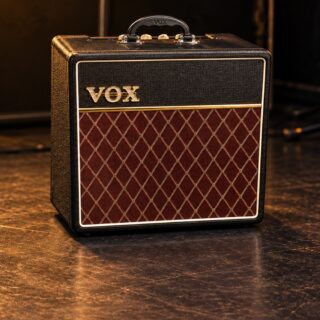
The Vox AC10C1, launched in May 2015, is the answer Vox came up with: a genuine dual-EL84, cathode-biased 10-watt combo with the full Top Boost tone stack, a proper preamp gain control, a closed-back Celestion-loaded cabinet, and a street price that, at launch, sat right around $499. The AC10C1 became one of the most word-of-mouth beloved small tube combos of its decade — not because of a headline spec, but because it simply sounds like a Vox. At a size and weight that a single adult can carry in one hand.
This article covers the AC10C1’s place in Vox history, what the original JMI AC-10 actually was and how the C1 differs from it, the full spec picture, honest artist attribution, five tone recipes from experience and published reviews, and a frank buying guide for the 2026 used market.
A Fifty-Year Footnote, Revived
Vox launched the AC10C1 in May 2015 — exactly fifty years to the month after the original Vox AC-10 last appeared in a Jennings Musical Instruments price list, in 1965. The timing was deliberate. The anniversary marketing wrote itself. But here’s what the press releases quietly glossed over: the AC10C1 is not a reissue of the JMI AC-10. Vox’s own materials call it a “modern take on a classic design,” which is doing a lot of diplomatic work.
The original JMI Vox AC-10 debuted in 1959 as an affordable step between the student AC-4 and the professional AC-15. That amp used six tubes — an EF86 and ECF82 alongside an ECC83 in the preamp, two EL84 power tubes, and an EZ81 rectifier — and featured two channels with four inputs, a tremolo circuit, and a simple passive tone cut control. Its 1959 incarnation wore a TV-front tweed vinyl cabinet; by 1961 it had the split-front speaker panel; by 1963 the basket-weave black we associate with classic Vox. The 1961 JMI catalogue suggested the AC-10 was ideal “for the smaller group,” which in 1961 Britain meant a four-piece doing dances in village halls, not stadium shows.
The 2015 AC10C1 shares a power output figure (10W) and the EL84 power section topology with that ancestor — and very little else. The preamp is built around two ECC83/12AX7 tubes rather than the original’s EF86/ECF82/ECC83 combination. There is no EZ81 rectifier; solid-state diodes handle rectification. There is no tremolo. There are no two channels and no four inputs: just one channel, one input, and a straightforward five-knob control layout. The tone circuit is the full “Top Boost” active bass-and-treble stack — which is actually a step up from the original, since the JMI AC-10 only had a passive treble cut. The reverb is digital rather than spring. The cabinet is closed-back MDF rather than the split-front design of the vintage instrument.
None of this is criticism. The AC10C1 is a well-made modern amp that sounds excellent. It just isn’t a reissue, and anyone expecting a faithful recreation of a 1962 split-front AC-10 will be looking at a completely different animal. What the AC10C1 actually is, is a single-channel AC15C1 circuit fitted into a smaller, lighter, closed-back enclosure with a 10-inch driver. The closest living relative is the AC15C1 — but with a closed back, a smaller speaker, and ten rather than fifteen watts of output power.
Full Specifications
One important note on the preamp tube count: the Vox Showroom and some third-party sources list “3× 12AX7” preamp tubes for the AC10C1, while Vox’s official spec sheet and the VoxShowroom.com detailed breakdown confirm 2× ECC83. The discrepancy appears to stem from some retailers copying AC15C1 spec descriptions. Inspect any AC10C1 you’re buying: the chassis houses two preamp tube sockets, not three. Vox’s own schematic is the final word.
Who Actually Uses an AC10C1
Five artists are commonly listed for the Vox AC10C1: Brian May, The Edge, George Harrison, Tom Petty, and Rory Gallagher. This is the same rotating roster of Vox association that appears on every model in the Custom Series — and the calendar collapses it immediately.
George Harrison died on 29 November 2001. The Vox AC10C1 was announced in May 2015 — fourteen years after Harrison’s death. There is no universe in which he used a 2015 amplifier. His real Vox history is genuine and substantial: AC30 Top Boosts through every iteration of The Beatles’ career, an ongoing relationship with the brand through the 1970s. But not this amp.
Rory Gallagher died in June 1995. The AC10C1 would have required a twenty-year gap in mortality. His Vox story — JMI-era AC30s, a documented love of vintage Vox circuits — is real and well-documented. But his name on an AC10C1 spec sheet is brand association dressed up as player endorsement.

Brian May‘s documented rig is built around AC30 Normal channel input pairs, driven through a Rangemaster treble booster, with multiple AC30 combos running in stereo or quadrophonic arrays. His Vox signature product is the MV50-BM NuTube head. No primary source — not a Rig Rundown, not an interview, not a promotional photo — places him behind an AC10C1. He’s a Vox artist in the truest sense, and the AC10C1 is a Vox amp, but that’s where the documentation ends.
The Edge runs AC30TBs — original Vox AC30 Top Boost combos — alongside modified 2016 AC30 combos as documented in multiple Premier Guitar Rig Rundowns. The AC10 is a different model, a different decade, and a different use case entirely. No primary source confirms AC10C1 use.
Tom Petty died in October 2017, which technically leaves a 29-month window (May 2015 to October 2017) when he could have encountered the AC10C1. He was a documented user of vintage AC30 combos — his “old brown AC30” was a reference point in more than one interview. No interview, Rig Rundown, or live photo places him behind an AC10C1 specifically.
The Equipboard page for the AC10C1 lists six documented pro users. These are the artists where actual evidence exists:
Billie Joe Armstrong (Green Day) is the highest-profile documented user. A YouTube video captures him using a Vox AC10 — the visual is confirmed at the 0:34 mark — and his history of deploying small Vox combos for writing and studio work is consistent with this. Armstrong‘s main touring rig runs high-gain Marshall setups for arena rock, but his smaller-venue and studio work frequently involves vintage-voiced low-wattage combos. The AC10C1 is exactly the amp a player in his position reaches for when they want chimey Top Boost tones without a 65-pound AC30 on the bus.

Dallas Green (City and Colour) is documented specifically in the CBC Music live concert video “City and Colour — A Pill for Loneliness,” where a Vox AC10 amplifier is visible in the back right of the stage. The 2019 album of the same name is also credited on Equipboard as recorded with this amp. Dallas Green’s songwriting style — clean-to-light-crunch acoustic-influenced indie rock — is a natural fit for the AC10C1’s clean chime and restrained overdrive palette.
Hester Chambers of Wet Leg is documented in a Guitar World interview naming the AC10C1 among the gear that defines the band’s sound. Wet Leg’s jagged indie-pop guitar approach — choppy rhythms, some controlled dirt, a lot of top-end aggression — suits the AC10C1’s character well. Its tendency to get bright and compressed in the upper midrange, combined with a closed-back cabinet’s natural low-end punch, is a compelling combination for that style.
Pomme, the French singer-songwriter, is documented on a 2019 YouTube video (at 13:23) playing a sunburst Epiphone Casino Coupe through a Vox AC10. The Casino’s humbucker-voiced P-90 equivalent pickups through the AC10C1’s Top Boost circuit produces the kind of warm, semi-clean tone that defines her intimate live performances.
David Berman (Silver Jews, Purple Mountains) appears in a user-uploaded Equipboard photo using a Vox AC10. The evidence quality is lower here — a single user photo, described as “suggests” usage — but it’s worth noting that Berman’s studio setups often ran small, characterful amplifiers, and the AC10C1’s window of overlap with his career (May 2015 to his death in August 2019) is real.
Dan Vickrey (Counting Crows) is listed on Equipboard without a source note visible in the available page excerpt.
What unites this player roster is instructive: these are songwriters, studio craftspeople, and indie-rock performers — not high-gain arena acts. The AC10C1’s sweet spot is clean chime and light natural overdrive at studio or small-venue volumes. It’s not a stage amp for large rooms. The artists who actually reach for it are making a specific tonal and practical choice, and the legacy-association artists (Harrison, Gallagher, May, Petty, Edge) are pointing at the Vox family sound, not this specific instrument.
How It Actually Sounds
The AC10C1’s character is defined by three things working together: ten cathode-biased EL84 watts, a closed-back enclosure, and the active Top Boost tone circuit.
Cathode bias means the amp operates in Class A — all four output tube elements are conducting at all times, producing a particular kind of compression and harmonic saturation as the output section clips. Class A amps don’t get louder when you push them; they get fatter and warmer. The EL84 power tube’s characteristic midrange spike around 3kHz is the origin of Vox’s “chime” — that glassy, almost vocal upper-mid presence that makes clean chords sound like they’re ringing in a church rather than a backline.
The closed-back cabinet changes the personality compared to the open-back AC15C1. Open-back cabinets project from front and back, giving a wide, airy sound with less defined low end — ideal for recording at distance. Closed-back cabinets contain the low-frequency energy inside, producing a tighter, punchier bottom end and a slightly more focused, direct sound in the room. Premier Guitar’s Charles Saufley noted in the 2015 review that “the closed-back cabinet adds just the right amount of low-end weight — a soft but sturdy and substantial underpinning for the familiar Vox top-end presence.” For small-room and home recording use, closed-back often translates better in a mix.
The Top Boost circuit — an active EQ originally developed by Vox in 1960 to extend the AC30’s treble response — adds real interactive bass and treble controls. This matters because you’re not just cutting treble or boosting bass; the active circuit shapes the gain structure of the preamp stages. More bass, more headroom in the low frequencies; more treble, more harmonic crunch in the upper registers. The combination of independent Gain and Volume controls is the other modern addition that the original AC-10 didn’t have: you can push the preamp hard (Gain up) while keeping the output stage relatively restrained (Volume down), or roll off the Gain for cleaner tones and let the Volume control the stage level. This is the mechanism that makes the AC10C1 genuinely usable at bedroom levels without losing its essential character.
The 10″ Celestion VX10 speaker is the weak link in the chain — a budget driver that does the job without distinguishing itself. Upgrading to a Celestion Blue Alnico or a Greenback, which requires only a speaker swap and a grille removal, is the single modification that most dramatically transforms the amp’s top-end response and breakup character. The Blue Alnico turns it into something approaching an early-60s AC-15 in miniature; the Greenback adds mass and warmth without sacrificing definition.
The digital reverb, as PG noted, is serviceable in small quantities but reveals its limits when pushed. Light settings (Reverb below 3) blend naturally with the amp’s organic tones. Past 5, the digital character becomes audible — a slight thinness and artificiality that clashes with the warmth of the tube output section. Players who depend heavily on reverb should route a quality stompbox reverb into the AC10C1 rather than relying on the internal circuit.
Five Tone Recipes
Recipe 1: Clean Jangle — The AC10 at Its Simplest
The AC10C1’s natural home. Rickenbacker 360/12 or a bright single-coil Telecaster at full volume into the AC10C1 with Gain at 4, Bass at 5, Treble at 7, Volume at 4, Reverb at 2. The circuit stays clean but the Top Boost brings out that upper-mid shimmer that makes open-voiced chords sparkle. Pick harder for natural accent; the cathode-bias compression smooths the attack without killing the pick transient. This is the sound of Dallas Green’s simpler City and Colour passages — clean, direct, voice-forward.
Recipe 2: British Rhythm at Home — Edge-of-Breakup Chords
Gain at 6, Bass at 5, Treble at 6, Volume at 3, Reverb at 1. Humbucker or P-90 equipped guitar (Casino, LP Junior). The preamp starts to colour at Gain 6 — not full overdrive, but a subtle sweetening of chord harmonics that makes power chords sound bigger than they are. This is the sweet spot for recording rhythm tracks: enough harmonic density to sit in a full mix, clean enough not to crowd a vocal. Billie Joe Armstrong’s writing-room Vox tone lives somewhere near here. Roll the guitar volume to 7 and you’re clean; push it to 10 and the amp responds.
Recipe 3: Jangly Little Thug — Natural Overdrive
Gain at 8, Volume at 5–6. Bass at 5, Treble at 7. This is the AC10C1 at the edge of its output section — 10 watts hard into a closed-back box, the EL84s running warm, the top end getting that “lacerating, feral” quality Premier Guitar described when they praised the amp’s lead capability. Works best with single coils — a Strat or Tele — and the guitar’s own volume as the primary gain control. Back the guitar off to 6 and you have a jangly crunch. Full up you’re in Jeff Beck/Yardbirds territory. The compressed nature of the Class A circuit means this overdrive never gets harsh; it just gets more saturated.
Recipe 4: Germanium Fuzz and the AC10C1 — Getting It Right
The AC10C1 is famously unfriendly to high-impedance mid-gain dirt pedals. Overdrive boxes that load the input or add significant midrange clutter tend to muddy the amp’s already mid-forward character. The solution: germanium fuzz. A Fuzz Face-style germanium circuit (Dallas Arbiter, BC108, or any low-gain clone) or a Tonebender into the AC10C1’s clean channel (Gain at 3, Volume at 4) produces a cutting, singing lead tone that exploits the amp’s compression rather than fighting it. A low-volume Big Muff at the very edge of its sustain works for rhythm — the Muff’s midrange scoop actually helps the otherwise mid-heavy amp sit better in a dense band context. High-gain modern overdrives with EQ peaks in the 1–3kHz range should be used with caution or avoided.
Recipe 5: Studio Recording — Intimate Miking
Gain at 5–7, Volume at 3–4, Bass at 5, Treble at 6, Reverb off (use external reverb in the mix). The AC10C1’s closed-back cabinet and modest output make it ideal for room miking at low levels. A ribbon mic or condenser placed 8–12 inches off-axis at the speaker edge captures the amp’s harmonic complexity without the room spill that troubles open-back combos. The internal digital reverb should be bypassed for any serious recording — its character doesn’t match the warmth of the output section, and a quality plate or room reverb in the DAW will sound vastly better. The signal the AC10C1 sends to a mic is genuinely excellent at these volumes.

Comparisons and Context
The AC10C1’s natural rival within the Vox family is the AC15C1: five more watts, a 12-inch Celestion G12M Greenback speaker, an open-back birch-ply cabinet, and a spring reverb rather than digital. The AC15C1 is louder, airier, and takes pedals more graciously — the spring reverb interacts with overdrive in a way that adds bloom rather than clutter. But it’s also heavier (22 kg vs 12 kg), larger, and at $699 new (2026), only slightly more expensive. The question is purely practical: if you need to carry the amp in one hand to a gig, the AC10C1 wins by 10 kilos. If you’re setting up once and leaving it there, the AC15C1 is the more complete amplifier.
The AC30C2 is the reference point for the entire Custom Series — two 12-inch Greenbacks, 30 watts, spring reverb, the full two-channel Normal + Top Boost architecture with jumperable inputs. The AC10C1 is a single-channel edit of the AC30 family’s DNA: you lose the Normal channel and its unique character, you lose the jumpering option, and you lose the headroom and speaker area that make the AC30C2 the industry-standard choice for professional touring. What you gain is portability, playability at home volumes, and price.
The direct competitor outside the Vox family is the Fender Blues Junior: 15 watts, EL84 power section, 12-inch Jensen C-12N or Celestion driver, spring reverb, and a FAT switch for extra preamp gain. The Blues Junior is American where the AC10C1 is British — less chime, more midrange warmth, a slightly less compressed feel. The Blues Junior also has spring reverb and the FAT switch. For players who want clean American sparkle rather than British chime, the Blues Junior wins. For players who specifically want the EL84 Class A compression and Top Boost character, the AC10C1 is the answer.
The Fender Princeton Reverb reissue (12 watts, 10″ Jensen, 6V6 output tubes, genuine spring reverb) is the other natural comparison: similar power rating, similar portability goals, genuine spring reverb, and a characteristically American clean tone. The Princeton’s 6V6 tubes produce a warmer, slower breakup than the EL84s — more blues and jazz than rock and pop. For a player who plays primarily clean with occasional compression pedals, the Princeton may be the better instrument. For the player who wants the Vox chime and natural tube saturation, the AC10C1 wins.
The AC30CH head and its companion cabinet is the ceiling of the same family — 30 watts, four EL84s, spring reverb, tremolo, effects loop, and Vox’s Reactor Technology attenuator. If you need stage volume but want the same family voice as the AC10C1, the AC30CH with its attenuator brought down to its lowest setting (approximately 1/3 watt) can approximate the AC10C1’s domestic behaviour. But it costs roughly twice as much and requires a separate cabinet. The AC10C1 is the more self-contained and economical choice for players whose ceiling is small to medium rooms.
Buying Guide
New in 2026, the AC10C1 lists at $799.99 at Sweetwater and the Vox Official Shop — a substantial inflation from the 2015 launch price of $499. The used market is where the value sits. Reverb consistently shows clean examples in the $350–$500 range, depending on condition and whether the original box and papers are included. Equipboard shows best prices from $468 for used examples. At $400 for a clean used AC10C1, you’re paying roughly $400 less than a new unit for a circuit that has no wear-related aging on the essential components.
What to check on a used example: the digital reverb circuit. Unlike spring reverb tanks, which are mechanical and can be visually inspected, the digital reverb board has discrete components that can fail silently or intermittently. Test the reverb control across its full range before buying — it should produce a smooth, consistent wet signal with no crackling from the pot and no artifacts at any position. Next, check the preamp tubes. The ECC83s will show their age in increased noise floor and microphonic ringing if they’re original to a heavily-gigged unit from 2015. Replacement ECC83s from quality manufacturers (Mullard, JJ, Tung-Sol) cost $15–$25 each and transform a noisy used amp into something that behaves as well as a new unit.
The speaker swap question comes up in every forum thread about the AC10C1. The stock Celestion VX10 is a budget driver that limits the amp’s dynamic ceiling. A Celestion Alnico Blue (£130, the speaker in the vintage AC30 Top Boost) or a Celestion Greenback (£60–80) will each transform the top-end response and saturation character significantly. The Blue Alnico is the authoritative choice for “vintage Vox”; the Greenback is warmer, louder, and more versatile for overdriven tones. Either upgrade is more cost-effective than buying a more expensive amp: even adding a $120 Greenback to a $400 used AC10C1 gives you a $520 combination that sounds better than most new combos at that price point.
Variants: Sweetwater has historically sold exclusive finishes and configurations of the AC10C1 at various price points. The core circuit is identical across all versions — what varies is cosmetics, occasionally the grille cloth colour, and whether a cover is included. There is no substantive tonal difference between a standard black AC10C1 and any retail-exclusive colourway.
Living With the AC10C1
The AC10C1 requires no unusual maintenance beyond standard tube-amp discipline. The closed-back cabinet means that humidity and temperature changes will cause the MDF to expand and contract — in dry climates, the side panels occasionally creak or show minor edge separation at high temperatures. This is cosmetic rather than structural and has no effect on sound or reliability.
The amp has no standby switch — power on, wait 30 seconds, play. This is consistent with vintage Vox design philosophy and is not a fault. The EL84 tubes are cathode-biased, which means bias adjustment is automatic and does not need professional intervention when replacing tubes. Replace both output tubes simultaneously as a matched pair; replace both preamp tubes if either shows signs of noise or microphonics.
At 10 watts into a closed-back 10-inch speaker, the AC10C1 is genuinely usable at domestic volumes — especially with the Gain control doing the preamp work and the Volume controlling output. At Volume levels below 5, the amp is quiet enough for a shared living space in the evening. At Volume above 7 with Gain above 6, it will carry in a small rehearsal room without reinforcement. It will not fill a 200-capacity venue unamplified, but it will mic up beautifully through a DI and PA system if the room requires more volume than the amp provides acoustically.
The single input with no Low input option means the Hi input is the only entry point for your guitar signal. On larger Vox combos, the unused Hi input can be jumpered to the Top Boost channel for a blended dual-channel tone. The AC10C1’s single-channel, single-input architecture eliminates that option entirely — what you hear is what the circuit produces, unblended.
FAQ
Is the Vox AC10C1 a reissue of the original 1959 JMI AC-10?
No, and Vox’s own materials don’t claim it is. Vox calls the AC10C1 a “modern take on a classic design.” The original JMI AC-10 had two channels, four inputs, six tubes including an EF86 and EZ81 rectifier, a tremolo circuit, and a passive tone cut. The AC10C1 has one channel, one input, two ECC83 preamp tubes and solid-state rectification, no tremolo, and an active Top Boost EQ. It’s a contemporary design inspired by the heritage of the name, not a faithful reproduction.
How does the AC10C1 compare to the AC15C1?
The AC15C1 has five more watts, a 12-inch Celestion G12M Greenback (significantly better speaker), an open-back birch-ply cabinet, a spring reverb rather than digital, a second preamp tube, and a substantially different spatial character — airier, with less low-end emphasis. It also weighs roughly 10kg more. If portability is not the priority, the AC15C1 is the more complete instrument. If you need to carry the combo one-handed to gigs, the AC10C1 is the only practical choice in the Vox Custom Series.
Why is the reverb digital when the AC15 and AC30 have spring reverb?
The choice appears to be a combination of physical space constraints (a spring reverb tank needs physical room) and cost management to hit a competitive price point. The internal digital reverb is functional in modest amounts but reveals its digital character above 5 on the Reverb control. Players who depend on reverb as a primary effect are better served by a quality stompbox reverb — Boss RV-6, Strymon Flint, TC Electronic Hall of Fame — run into the AC10C1 rather than relying on the internal circuit.
Is the AC10C1 loud enough to play with a band?
In a low-to-medium volume rehearsal context, yes — particularly with a drummer who plays at similar dynamic awareness. In a full band context with a heavy-handed drummer, 10 watts into a closed-back 10-inch speaker will likely struggle to be heard unmiked. The AC10C1 excels as a recording amp, a living room amp, and a stage amp when miked through a PA. It is not a stage monitor for large rooms.
Can I upgrade the speaker?
Yes, and it’s the single most effective modification available. The Celestion Alnico Blue and Celestion Greenback are both direct replacements for the stock VX10 — both are 10-inch drivers available in 8Ω (match the cabinet’s impedance). The Blue Alnico adds vintage top-end sparkle and dynamic headroom; the Greenback adds warmth and mass with a slightly lower efficiency ceiling. Either transforms the upper frequency response and saturation character of the amp. Installation requires only a screwdriver to open the cabinet back, remove the baffle screws, and swap the driver.
Does it take pedals well?
It depends on the pedal type. The AC10C1 excels with: transparent boost pedals, germanium fuzz circuits (Fuzz Face family, Tonebenders), modulation effects (tremolo, chorus, phaser), and quality reverb stompboxes. It is less forgiving of: high-gain mid-range-boosting overdrive pedals, silicon fuzz with heavy clipping stages, wah pedals placed after other high-impedance effects. The amp’s naturally bright, compressed character means it’s easily overwhelmed by gain stacking. The approach that works is using the amp itself as the primary gain stage and using the guitar volume to manage the saturation level.
What tubes should I replace the stock tubes with?
The stock ECC83s are adequate but mid-tier. For preamp upgrade: JJ ECC83S for a darker, warmer character; Mullard Reissue 12AX7 for more headroom and clarity; Tung-Sol 12AX7 for a brighter, livelier response that suits the Top Boost circuit’s treble-emphasis tendency. For power tubes: replace the EL84 pair with matched JJ EL84s or Mullard Reissue EL84s. Cathode-bias amplifiers like the AC10C1 are self-biasing — no bias adjustment is required after a tube swap, making tube rolling an accessible upgrade even for non-technical owners.
Is the AC10C1 still worth buying new in 2026?
At $799.99 new, the price-to-specification ratio is harder to justify than it was at the 2015 launch price of $499. The used market offers the same amplifier in excellent condition for $350–$500. If the new-unit warranty and peace of mind matter, Sweetwater’s two-year warranty covers the purchase. If the goal is maximum value per dollar of Vox tube tone, a used AC10C1 with a speaker upgrade — total outlay under $600 — is the better proposition for most buyers.
Image credits
- Top image: GuitarGangsters AI-generated reference illustration, not a photograph.
- Billie Joe Armstrong: David Lee, Wikimedia Commons, CC BY-SA 2.0.
- Rory Gallagher: Heinrich Klaffs, Wikimedia Commons, CC BY-SA 2.0.
- The Edge: iinchicore, Wikimedia Commons, CC BY-SA 4.0.
Latest News
Related

On This Day
Monday 9 November
From this week: