Open and Alternate Guitar Tunings Explained: Drop D, Open G, DADGAD, Nashville and More
Standard tuning (E A D G B E, low to high) is a compromise. It puts a lot of common chords and scales within reach of four fingers, and every other tuning gives something up in return for something else. Alternate tunings change the open strings, which changes which chords fall under one finger, which notes ring as drones, and how tight or loose the strings feel. They also change what a guitar needs from its strings, which is where most of the practical trouble starts.
This page covers the tunings you meet most often: drop D, open G, open D, DADGAD, half step down and Nashville tuning. For each we give the notes, how to get there from standard, and what the manufacturer and magazine sources we checked say about it. Where a player is tied to a tuning, we name the source that says so, and where two sources disagree we say that instead of picking a winner. Tunings that sit lower than these, such as baritone tunings, have their own page: see our baritone guitar explainer.
Quick Facts
The Tunings Compared
Drop D
Drop D leaves five strings alone and lowers the sixth string from E to D, a whole step. The result is D A D G B E. D’Addario’s drop D guide says to match the open sixth string to the open fourth string, one octave lower, and to approach the target note from slightly flat for stability.
The practical appeal is simple. The three lowest strings now form a D, A, D stack, so a power chord can be played with one finger barred across them. Guitar.com’s introduction to alternate tunings says a D chord gets noticeably fuller, and Martin makes the same one-finger power chord point. Most standard-tuning shapes stay where they were, because only one string has moved. In our view, that makes drop D the least disruptive place to start.
Guitar.com names Tom Morello and Kurt Cobain as players who have used drop D. It does not tie either of them to a particular song, and we have not found a source in this research that does, so we leave songs out.
Open G
Open G is D G D G B D: lower the sixth string and the first string from E to D, and the fifth string from A to G. Premier Guitar’s open G lesson by Shawn Persinger, Acoustic Guitar’s beginner guide by Doug Young and D’Addario all describe the same route. Strummed with no fingers down, the strings sound a G major chord, with the fifth of the chord (D) in the bass. That is why slide players favour it: a straight bar across any fret gives a major chord.
Guitar.com describes open G as suited to blues and rock and roll, and says it produces chords that are hard to reproduce in standard tuning.
Open D
Open D is D A D F# A D. From standard, the sixth, second and first strings go down a whole step and the third string goes down a half step. Strummed open it sounds a D major chord. Acoustic Guitar’s beginner guide notes that shapes learned in open G move across by one string in open D, and gives a minor version of each: D A D F A D for open D and D G D G Bb D for open G.
D’Addario’s guide puts Joni Mitchell’s “Big Yellow Taxi” and Mumford and Sons’ “The Cave” under open D. That attribution conflicts with another source, covered below.
DADGAD
DADGAD is D A D G A D. From standard, lower the sixth, second and first strings by a whole step; Al Petteway’s Acoustic Guitar lesson gives that route. The open strings are roots and fifths of D, with the fourth (G) on the third string, so strumming them gives a suspended chord, Dsus4. Both Guitar.com and Petteway describe it as neither major nor minor. That ambiguity is the reason people like it for fingerstyle: whether a passage sounds major or minor depends on which notes you add.
Petteway also points out a side effect: with the two highest strings lowered, string bends are easier than in standard tuning. Martin describes DADGAD as drone-like and open, and as popular in folk, acoustic and Celtic-inspired music.
Half Step Down
Half step down (also called Eb standard) lowers every string one semitone to Eb Ab Db Gb Bb Eb. Nothing changes about the shapes. A chord fingered as G sounds as F#, and a song in E sounds in Eb. D’Addario’s tuning guide says this tuning loosens string tension and slightly deepens the sound. It is the least disruptive way to get a lower, softer-feeling guitar, because no fingering has to be relearned.
The sources we opened do not name players for half step down, so we do not. That is a gap rather than a claim that nobody used it. For gauges, see the section on strings below.
Nashville Tuning
Nashville tuning, also called high-strung tuning, is a restring more than a retune. The pitches of the top two strings stay as standard, and the four lower strings are replaced with lighter strings that sound an octave higher. D’Addario’s high-strung sets make this visible: its tension chart for the EXL150H electric set lists the six notes as E3, A3, D4, G4, B3 and E4, against a standard low E2, A2, D3, G3, B3 and E4. D’Addario says the set uses the higher “octave” strings of a 12-string set, positions it as a way to get a 12-string sound from a six-string guitar, and says studio musicians often use it to double six-string parts. Its acoustic equivalent, the EJ38H phosphor bronze set, is described as designed for a jangly, 12-string-style effect when recording, layering or double-tracking.
Naming varies by source; D’Addario’s own product pages use “High Strung” and “Nashville” together for the same sets. What matters in practice is to look at the exact set you are buying. Our Kristin Hersh guide covers a Nashville-strung acoustic that is doubled against a standard six-string, which is the usual studio use.
Who Used Which Tuning
We have kept this section to claims we could read in a named source.
Keith Richards and Open G
Premier Guitar’s Persinger says Richards simply removes the sixth string in open G, and adds that anyone copying the style will want it back eventually. The article credits him with many classic open-G riffs and says two chord shapes it teaches are the foundation of more than a dozen Rolling Stones songs, but it does not name them. Guitar.com calls open G famously one of Richards’ favourite tunings and says that, for open G, you can mute the sixth string with the thumb or leave it out as Richards does. D’Addario’s tuning guide credits the Rolling Stones, especially Richards, with popularising open G, and names “Can’t You Hear Me Knocking” as an example.
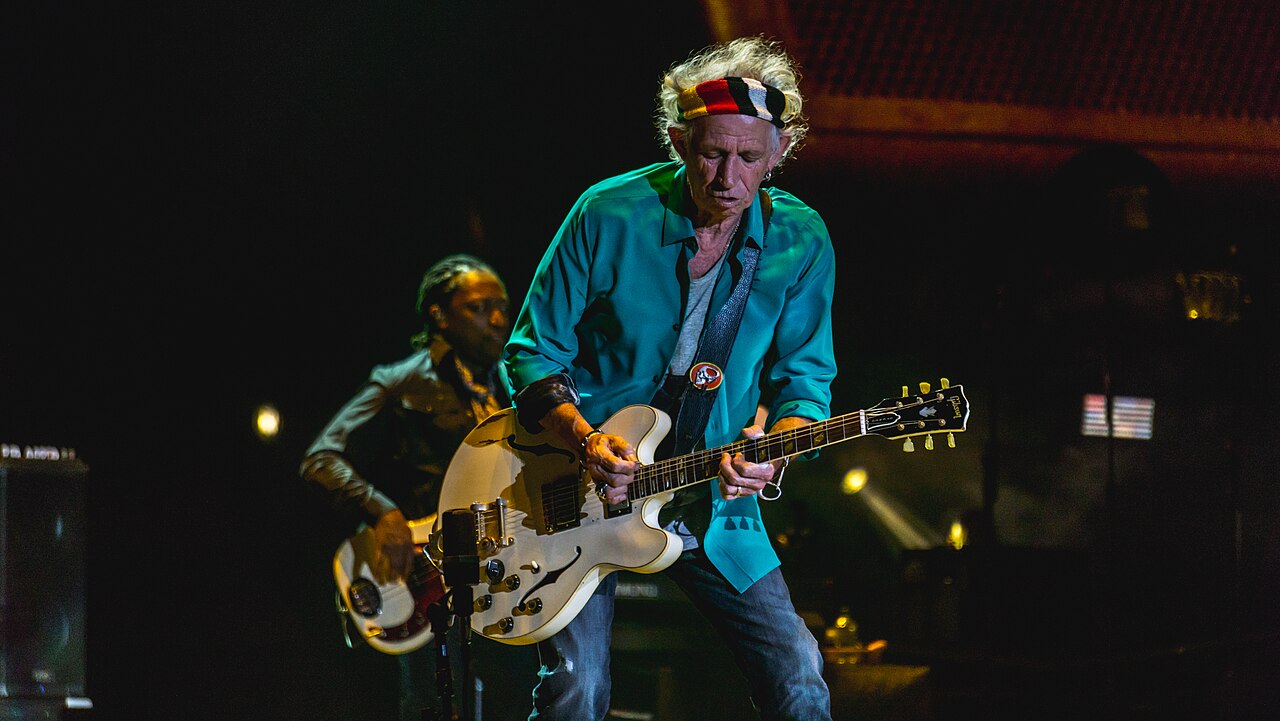
Take the string off the open G tuning described above and what remains is five strings tuned G D G B D. Which guitars Richards uses with it, and since when, are questions our Keith Richards guide covers; this page only draws on the sources above for the tuning itself.
D’Addario also lists Muddy Waters’ “Walkin’ Blues” as an example of open G, and describes the tuning as a favourite of blues and slide players. Our Muddy Waters page covers his gear.
Davey Graham, Pierre Bensusan and DADGAD
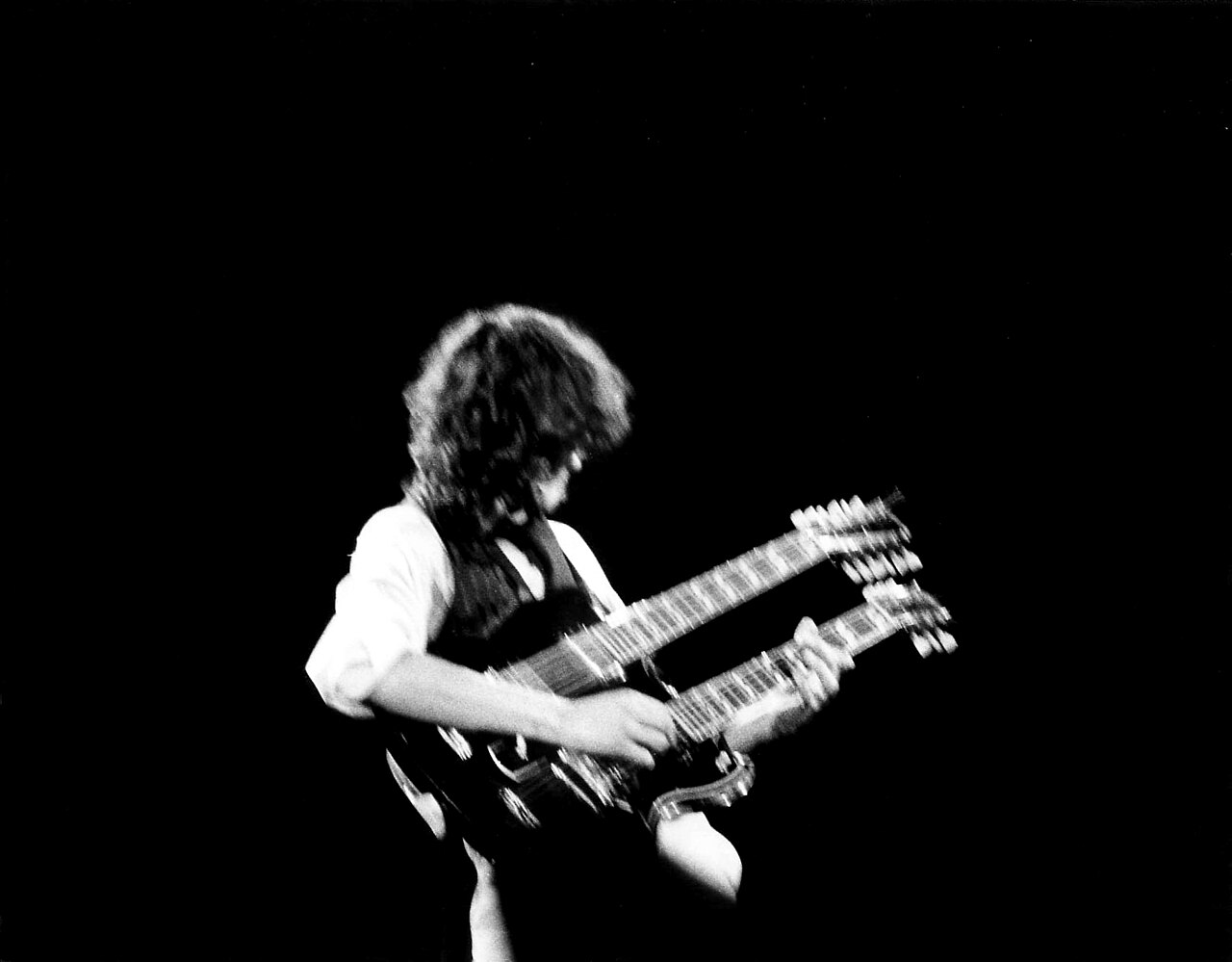
Guitar.com says DADGAD was discovered in the 1960s by Davey Graham and has been used by Jimmy Page, Jeff Tweedy and Slipknot; none of the three is tied to a song in that article. A Hot Press obituary from 16 December 2008 says Graham is widely credited with introducing the tuning to popular usage. The wording is about popularising, not inventing, and the obituary gives no date for it and cites no sources. Stories about how he arrived at it circulate, but we could not confirm them from a source we opened in full, so we leave them out. Our Davy Graham guide goes into his career and gear, and our Jimmy Page page covers Page’s rig.
Acoustic Guitar’s 2024 video feature on Pierre Bensusan says he specializes in DADGAD tuning. That is the magazine’s description, not Bensusan’s own claim about himself. The page we read is a teaser for a video and a lesson, so we cannot say more about how he uses it. Our Pierre Bensusan guide covers his playing and gear in more detail.
Joni Mitchell and the Problem of Counting Tunings
Ted Drozdowski’s 2012 Gibson article says Joni Mitchell used more than fifty different tunings on her recordings since her 1968 debut, and that she rarely recorded in standard tuning, naming “Urge for Going” and “Tin Angel” as exceptions. It lists specific tunings for specific songs: “Big Yellow Taxi” in open E (E B E G# B E), “Free Man in Paris” in D A D G B D (which it says is sometimes called D modal tuning), and “The Circle Game” in open E with a capo at the fourth fret.
This is where sources disagree. D’Addario’s guide places “Big Yellow Taxi” in open D (D A D F# A D), not open E. We have not found a source that settles which tuning the original recording uses, so treat any single-song attribution as that source’s claim. The Gibson article itself cites no interview for its tuning list, and a reader comment under it disputes some of the details. Our Joni Mitchell guide treats her tunings as a compositional system and covers them at length.
Other Players Who Used Alternate Tunings
Our guides to Thurston Moore and Curtis Mayfield each cover a player whose tuning choices are part of the story, and the DigiTech Drop page looks at a pedal that shifts a whole guitar down through nine tuning positions without touching the pegs.
Strings, Gauges and Tension
A string tuned lower is a looser string. Slackening the sixth string from E to D, for example, is a drop of a whole step on the heaviest string on the guitar. D’Addario’s drop D guide says the sixth string loses roughly 20 to 25 percent of its original tension in drop D, and notes that this can feel floppy under hard picking. That figure comes from D’Addario’s own guide with no method or source, so treat it as an approximation.
The manufacturer advice is cautious rather than prescriptive:
- Drop D, casual use: D’Addario says a standard .010-.046 electric set works. For players who palm-mute and chug on the low string it suggests a hybrid set with a heavier sixth string (.048 to .050 in one section, .048 to .052 in another).
- Drop D, acoustic: D’Addario suggests medium sets (.012-.053 or .013-.056) to keep the low D focused.
- Heavier sets for lower tunings: D’Addario’s drop tuning guide points to its XL Nickel 11-56 (EXL117) for D standard or drop D, the 12-54 (EXL145) for tuning down without losing much tension, and the 12-60 (EXL148) for C standard. That guide’s table lists a different electric set (EXL140, 10-52) for drop D than its body text does, so D’Addario’s pages do not fully agree with each other on drop D.
- DADGAD on acoustic: the same guide recommends the EJ24, a 13-56 phosphor bronze true medium set.
- Nashville tuning: use a dedicated set. D’Addario’s EXL150H electric set is 10-26 and its EJ38H acoustic set is 10-27.
D’Addario’s tuning guide gives a more general warning: be mindful of string tension in alternate tunings to avoid breaking strings, and heavier gauges can help prevent buzz in lower tunings. Martin’s guide says dialled-in action and the right string gauge help keep feel and tuning stable, and suggests asking a local Martin dealer or service centre if a guitar does not respond well.
Every tuning on this page except Nashville only lowers strings, so tension falls rather than rises, and the sixth string is the one affected most often. Nashville tuning swaps strings instead of retuning them. D’Addario’s string tension calculator, String Tension Pro, is the manufacturer’s own tool for checking a set against a tuning. We have not used it for this article, so we cite no figures from it.
Setup after a tuning change
Guitar.com says a guitar can take a while to settle after a change, especially one with a locking or floating vibrato, and that high-quality strings help it stabilise faster. For drop D alone, D’Addario’s guide says minor truss rod or intonation changes are usually not needed; it says drop C and lower may need a full setup. It suggests locking tuners, a lubricated nut and fully stretched new strings for stability.
Capos and Alternate Tunings
A capo is the cheapest way to change a guitar’s sound without retuning, and it works with alternate tunings too. Martin’s beginner guide gives a simple example: stay in standard tuning and clamp a capo on the second fret across the top five strings only. The open low E stays open, so a familiar D chord shape sounds as E major with the open sixth string acting as a pedal tone. A second capo higher up the neck, Martin adds, can move the key while keeping the drone.
Drozdowski’s Gibson article names the capo in the context of tuning too: he says “The Circle Game” is in open E with a capo at the fourth fret, and says blues players call the capo a “cheater”. A capo shortens the vibrating length of the strings, which raises every open string by the same number of semitones, so the interval pattern of the tuning stays the same while the key changes.
Frequently Asked Questions
What is the easiest alternate tuning to start with?
Drop D. Only the sixth string changes, from E to D, and Martin and Guitar.com both note the one-finger power chord it allows. Most other chord shapes stay where they were.
Do I need heavier strings for drop D?
Not always. D’Addario says a standard .010-.046 set works for casual use, and recommends a heavier sixth string for heavy palm-muted playing. Its own pages disagree slightly on which set it names for drop D, so check the product listing before buying.
Is Nashville tuning the same as high-strung tuning?
Often, though usage varies. D’Addario sells its octave-string sets under both names. Check the specific set’s pitch list if you need to know exactly which strings are raised.
Can alternate tunings damage a guitar?
Martin’s guide says they do not, provided the changes are standard pitch changes such as tuning down or slightly up within a normal range. D’Addario warns that string tension matters, and that heavier gauges can help with buzz in lower tunings.
Image credits
- Jimmy Page: Andrew Smith, Wikimedia Commons, CC BY-SA 4.0.
- Keith Richards: Raph_PH, Wikimedia Commons, CC BY 2.0.