DigiTech Drop: One Knob, Nine Tunings, and the End of the Second Guitar
DigiTech Drop guide: how the polyphonic drop-tune engine works, full specs, verified players, nine tone recipes, rivals compared and honest buying advice.
Every guitarist who has ever played a set list with more than one tuning on it knows the specific, low-grade misery of the problem. Song three is in E standard. Song four is in drop C. You have two options, both bad: carry a second guitar and a second tech and a second case, or stand in front of a room full of people twisting machine heads while the singer improvises banter about the weather.
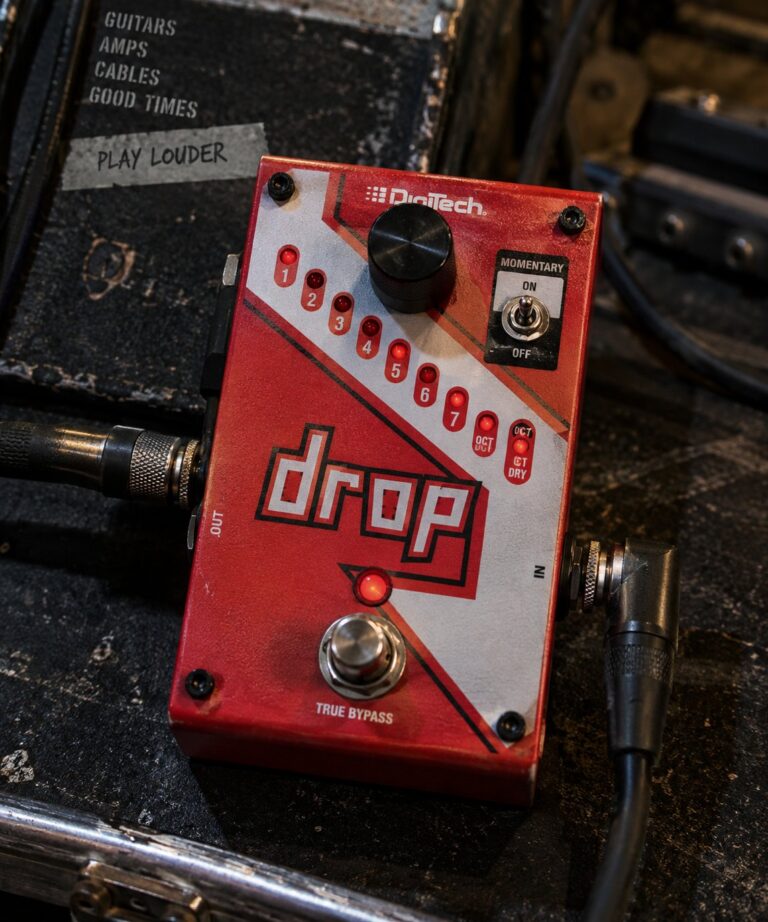
The DigiTech Drop’s entire reason to exist is that it turns that problem into a footswitch. One rotary knob, nine positions, half a step down to a full octave. Step on it and the guitar hanging off your shoulder is, as far as the audience is concerned, tuned somewhere else. It does not do harmonies. It does not pitch up. It does not have presets, MIDI, an expression input, or a screen. In a pedal market that has spent a decade adding features to everything, the Drop is a device defined almost entirely by what it refuses to do.
That refusal is why it is still on pedalboards twelve years after launch, and it is also why, in 2026, it finally has real competition. This guide covers what the Drop actually is, where the engine inside it came from, what the specs really say (including a power figure that three first-party and press sources cannot agree on), which players have been documented using one, how to set it up so it sounds like a detuned guitar rather than a detuned computer, and whether it is still the right buy.
Housekeeping: three things worth stating before the history
This guide runs on primary sources. On this SKU the sources contradict each other in three specific places, and it is more useful to name those contradictions than to quietly pick one number and move on.
1. Nobody can agree what the Drop draws
DigiTech’s own owner’s manual gives the figure as “2.3 Watts (< 250 mA @ 9VDC)”. The same manual’s Recommended Power Adapter section then lists the supplied PS0913DC brick as “Output: 9V DC 1.3A” — a supply rated at more than five times the pedal’s stated maximum. Guitar World’s 2026 review of the Black Edition splits the difference and reports “300mA (included) — technically 250mA but 300 is recommended to be on the safe side.” Meanwhile the DigiTech product page’s own specification table lists no current figure at all.
None of these are wrong, exactly. The 250 mA is a ceiling; the 1.3 A is the adapter’s capability, not the pedal’s appetite; the 300 mA is a practical recommendation. But the practical consequence for you is unambiguous and it is the single most important buying-and-owning fact about this pedal: budget 300 mA of isolated, regulated 9 V DC for the Drop and do not try to daisy-chain it. This is a genuinely hungry pedal by compact-pedal standards. For scale, Guitar World notes the Boss XS-1 and the Electro-Harmonix Pitch Fork Plus each draw around 120 mA.
2. The dimensions differ depending on which page you read
DigiTech’s product page says 4.75″ (120 mm) L × 2.875″ (73 mm) W × 1.75″ (44 mm) H, 0.36 lb (163 g). Guitar World’s review lists 121 × 73 × 45 mm, 160 g. These are the same pedal measured to different tolerances and rounded differently — a millimetre here, three grams there. Nothing sinister, but if you are planning a pedalboard to the millimetre, use the larger figures and give yourself a margin.
3. A well-regarded review contains an arithmetic slip, and it is worth knowing about
Guitar World’s Black Edition review, published 31 March 2026 and otherwise the single most useful modern assessment of this pedal, says in one paragraph that the Drop “still holds up very well 12 years on” and then, four paragraphs later, that “it’s been 14 years since the Drop emerged.” Both sentences are in the same article. Only the first can be right: the Drop launched in 2014, MusicRadar reviewed it in October 2014, and 2026 minus 2014 is twelve.
We flag this not to score a point off a good publication — every outlet on earth, this one included, ships the occasional stray number — but because it is a useful demonstration of the house rule this whole guide series runs on. Check the arithmetic even in sources you trust, and check it even when the source contradicts itself rather than contradicting somebody else. A date that appears twice in one article and disagrees with itself is the easiest kind of error to catch and the easiest kind to repeat.
Where the Drop came from: DOD, DigiTech, and a company in Victoria, British Columbia
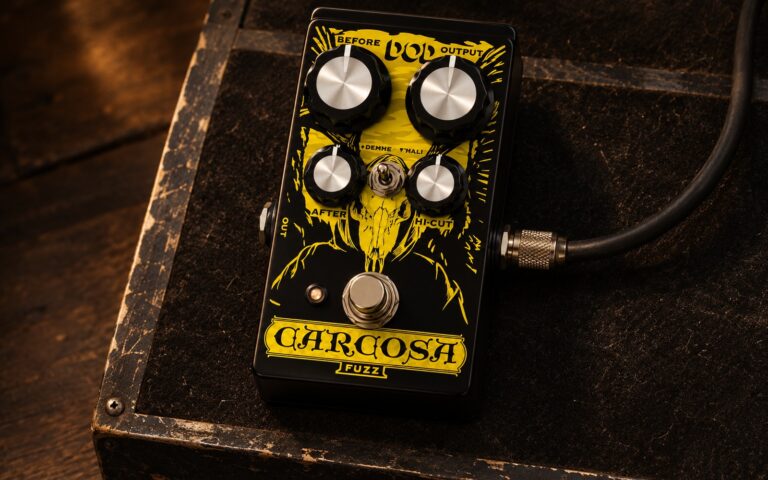
DigiTech began in 1984 as the digital effects arm of DOD Electronics, the Salt Lake City pedal company founded a decade earlier — the same corporate lineage that produced the DOD 250 Overdrive Preamp, the DOD Rubberneck analog delay and the DOD Carcosa fuzz. Where DOD made the analogue dirt, DigiTech made the boxes with converters in them.
The part of the story that matters for the Drop is that the clever bit was never entirely DigiTech’s. As Guitar World’s Rob Laing puts it, DigiTech and IVL Technologies — the Canadian pitch-processing specialists whose algorithms DigiTech has licensed for years — “have got serious product mileage out of their partnership.” That partnership is the through-line connecting every DigiTech pitch box: the original Whammy, every Whammy revision since, the compact Ricochet, the HammerOn, and the Drop.
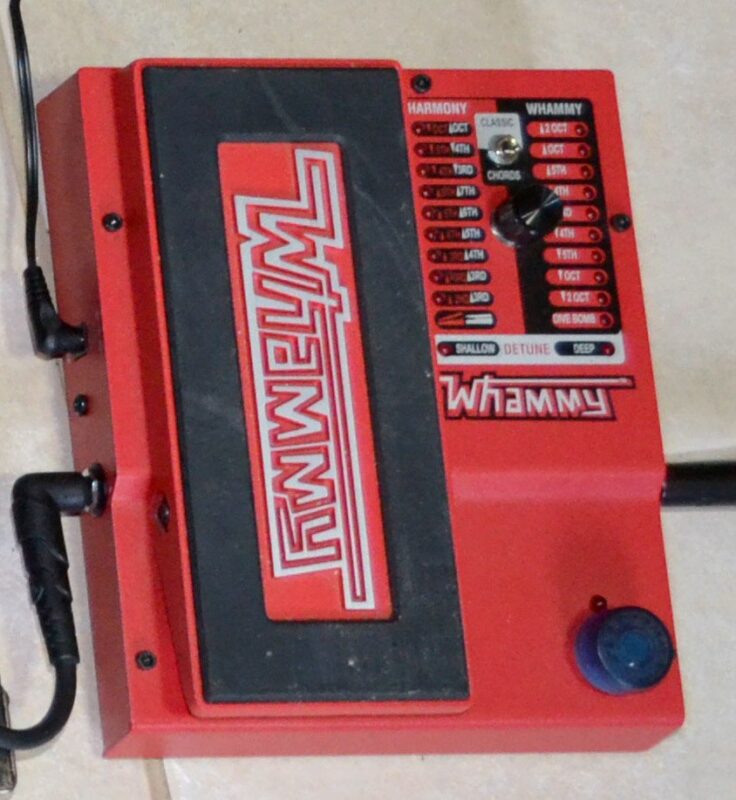
The specific ancestor is the Whammy DT. The DT added a dedicated drop-tune section alongside the classic treadle-driven Whammy pitch bend, and it is the DT’s polyphonic algorithm — the one that can transpose a full chord without the smeared, warbling mess that monophonic pitch shifters produce on anything but a single note — that DigiTech extracted and put in a small red box. DigiTech’s own manual is unusually blunt about the ancestry, opening with the line that the Drop “takes the powerful polyphonic pitch transposing (drop tune) effect from the Whammy DT and offers it in a compact, pedalboard-friendly package.” If you want the full treadle-and-harmony version of the same family, that is the DigiTech Whammy (5th Gen).
The Drop was introduced at Summer NAMM 2014 and reviewed by MusicRadar’s Michael Astley-Brown on 22 October 2014, at £129 / €188 / $249. His verdict has aged remarkably well: “the most convincing, not to mention compact, drop-tuner we’ve used”, with the one reservation that “we wish DigiTech would drop the price — you can bag a Whammy DT for not much more.”
There is then a gap in the story that explains a great deal about why the Drop has never been meaningfully updated. As Guitar World notes, DigiTech was “effectively dormant in terms of design as a brand from 2018 until Cort-Tek acquired the brand alongside DOD in 2022.” Four years of no new development at exactly the moment when pitch-shifting DSP in multi-effects units was improving fastest. The Drop did not stand still because DigiTech thought it was perfect; it stood still because for a while there was nobody there to move it.
What the Drop actually does to your signal
Polyphonic pitch shifting is the whole trick, and it is worth understanding why it is hard. A monophonic shifter only ever has to track one note: find the fundamental, work out the target frequency, resynthesise. A polyphonic shifter has to take a full six-string chord — a dense, constantly-changing spectrum with beating overtones and no single fundamental — and move every component of it down by exactly the same musical interval while keeping the relationships between them intact. Get it slightly wrong and the chord goes seasick.
The Drop’s engine runs at 44.1 kHz with 24-bit A/D/A conversion, and the specification that tells you the most about how it sounds is the one buried in the manual and absent from the marketing: frequency response 20 Hz – 11 kHz with the effect enabled. Eleven kilohertz is not full-bandwidth audio. That single number explains the most consistent criticism of the pedal in every review and forum thread ever written about it — the top end goes away as you go down.
It is also, arguably, the reason the thing works at all. Bandwidth is processing budget. Spending it on the region where a detuned guitar actually lives, rather than on air above 11 kHz that a cranked 4×12 was never going to reproduce anyway, is a defensible engineering trade — and note that the 20 Hz – 11 kHz figure applies only when the effect is engaged. Bypassed, the Drop is genuinely true bypass: the manual lists the bypassed input and output impedance simply as “True Bypass” rather than giving a figure, because the signal is not going through anything.
The nine settings, in DigiTech’s own words
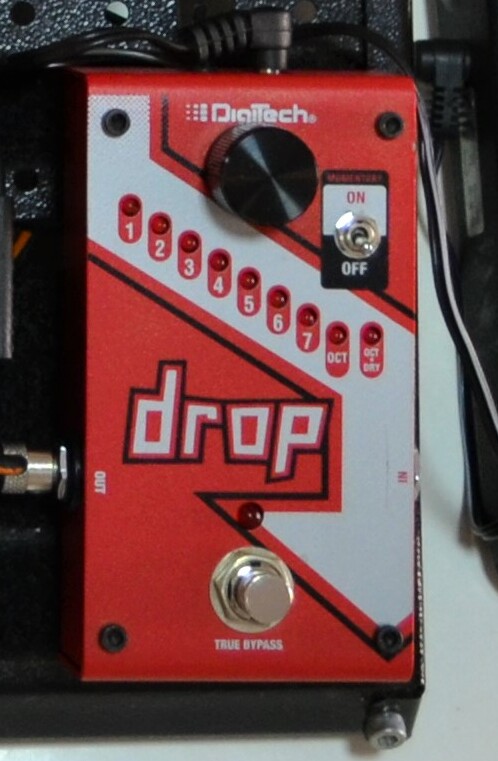
- 1 — down 1 semitone (E standard becomes E♭ standard)
- 2 — down 2 semitones (D standard)
- 3 — down 3 semitones (C♯ standard)
- 4 — down 4 semitones (C standard)
- 5 — down 5 semitones (B standard)
- 6 — down 6 semitones (B♭ standard)
- 7 — down 7 semitones (A standard)
- OCT — down one full octave
- OCT + DRY — down one octave, with your dry signal mixed back in
Two things to note. First, the interval is applied to the whole instrument, so whatever tuning you start in, the relationships stay: a guitar in drop D with the Drop set to 2 is in drop C. The pedal transposes; it does not retune individual strings. Second, OCT + DRY has a fixed blend that you cannot adjust. This is the single most-requested feature the Drop has never had, and it is the thing its 2020s rivals all offer.
Momentary mode, and the one behaviour that confuses everybody
The mini toggle marked Momentary changes what the footswitch means. Off, it is a normal latching bypass switch: press to engage, press to disengage. On, it is momentary — the state changes only while your foot is down.
Here is the part that catches people out, straight from DigiTech’s manual: momentary mode inverts around whatever state the pedal was in when you flipped the toggle. If the effect was on when you set Momentary to ON, then holding the footswitch bypasses the drop. If the effect was off, holding the footswitch engages it. That is not a bug and it is not undocumented — it is the note on page 3 of the manual — but it is the reason for a lot of “my Drop is working backwards” forum posts. Decide which way round you want it, set the effect state first, then flip the toggle.
Used deliberately, this is the Drop’s most musical feature and the one MusicRadar singled out: “the momentary mode makes for awesome rhythmic stutters.” Set it to OCT, set momentary on, and you can drop a riff into the basement for one bar and snap back — a trick that is essentially impossible with a physical tuning change and awkward on a treadle Whammy.
Full specifications
All figures below are from DigiTech’s owner’s manual (document 5049647-C, © 2022 CORTEK Corp.) and product page unless marked otherwise.
| Specification | Figure |
|---|---|
| Type | Polyphonic drop-tune pitch shifter |
| Drop tune range | 1–7 semitones down, octave down, octave down + dry |
| Controls | Effect Selector rotary (9 positions), Momentary On/Off toggle, bypass footswitch |
| Sample rate | 44.1 kHz |
| A/D/A conversion | 24-bit |
| Frequency response | 20 Hz – 11 kHz (effect enabled) |
| Signal-to-noise ratio | > −105 dB (A-weighted), ref = max level, 22 kHz bandwidth |
| THD | 0.004% @ 1 kHz, ref = 1 dBu with unity gain |
| Input type | 1/4″ unbalanced TS |
| Max input level | +5 dBu |
| Input impedance | 1 MΩ (effect enabled); true bypass when off |
| Output type | 1/4″ unbalanced TS |
| Max output level | +10 dBu |
| Output impedance | 1 kΩ (effect enabled); true bypass when off |
| Bypass | True bypass |
| Power consumption | 2.3 W (< 250 mA @ 9 V DC) per manual; 300 mA recommended (Guitar World) |
| Power requirement | 9 V DC external adapter, no battery option |
| Supplied adapter | PS0913DC-01 / -02 / -04 by territory; rated 9 V DC 1.3 A |
| Dimensions | 4.75″ × 2.875″ × 1.75″ (120 × 73 × 44 mm); 121 × 73 × 45 mm per Guitar World |
| Weight | 0.36 lb (163 g); 160 g per Guitar World |
| Jack placement | Side-mounted |
| Finishes | Standard red; Sweetwater-exclusive white; limited Black Edition (2026) |
| Launch price | $249 / £129 / €188 (2014); $249.99 / ~£130–150 (2026) |
| Manufacturer | DigiTech, a registered trademark of CORTEK Corp. |
One spec that is conspicuously absent everywhere: latency. DigiTech has never published a figure, and neither has any reviewer measured one. What we have instead is comparative listening — Guitar World’s A/B against the Boss XS-1 concluded that “any latency differences between the two are less apparent to my ears at this stage,” which is a carefully hedged way of saying they are close. Owners consistently report that the latency is inaudible at stage volume and becomes noticeable only when playing quietly, for a reason we will come back to.
Famous players: what actually checks out
This section needs a warning before it starts, because the DigiTech Drop is a textbook case of a phenomenon this guide series runs into constantly.
The names that do not survive contact with a calendar
The Drop is routinely credited to a roster of guitarists who are, in fact, Whammy users. The two pedals share a brand, a family and an algorithm licensor, and the association has bled across in gear listings, forum posts and AI-generated summaries until it reads as fact. It is not.
Dimebag Darrell is the cleanest disproof available. Dimebag was a defining Whammy player — the WH-1 is inseparable from Pantera’s sound — but he died in December 2004. The DigiTech Drop was announced in 2014. A pedal cannot have been used by a man who died a decade before it existed. Any source that lists Dimebag as a Drop user has told you, in one line, exactly how much checking it did.
The same correction applies, less dramatically, to Tom Morello, Jonny Greenwood and Jack White. All three are extensively documented Whammy users — Morello’s treadle work is arguably the single most influential Whammy performance in rock — and none of them has a documented DigiTech Drop credit. They belong in an article about the Whammy family, and they are linked here as lineage, not as owners. None of these four players is known to have used a DigiTech Drop.
The credit that does check out, in full
★★ Mike Sullivan (Russian Circles) is the strongest verified Drop user available, because the evidence is a filmed, dated, first-party magazine feature rather than a photo of a stage. Premier Guitar’s Chris Kies shot a Rig Rundown with Sullivan at the band’s Chicago practice space, published 10 December 2025, and the write-up lists the contents of Sullivan’s first pedalboard explicitly: a Peterson tuner, Shure P9HW, Dunlop CBM95 Cry Baby Mini, DigiTech Drop and Whammy Ricochet, and an MXR Phase 95.
What makes this credit genuinely instructive rather than just a name to drop is the context around it. Sullivan runs Dunable guitars strung with .011–.056 sets, with the low E swapped for a .058 on one and a .062 on the other, and — this is the key line — “uses a number of different down tunings, all with D-A-D-G-A-D as a starting point,” with the second guitar reserved for drop A. In other words, a player who already carries heavy strings and multiple physically-detuned guitars still finds a use for the Drop. That is a much stronger endorsement than a player who uses it instead of tuning down, because it means the pedal is earning its board space on musical grounds rather than logistical ones. Russian Circles are also a post-metal band built on long-form, riff-driven instrumental writing — precisely the context where a mid-song octave shift is a compositional device.
Sullivan’s rig also has a note of hard-luck history attached: the bulk of Russian Circles’ gear was stolen on tour in 2021, and the current setup is a rebuild assembled partly from instruments loaned by tourmate Chelsea Wolfe. The Drop is on the board he chose to rebuild with.
The aggregate picture, honestly labelled
Equipboard, which aggregates artist gear from photos, videos and interviews, lists the DigiTech Drop as used by 146 artists, among them Graham Coxon, Chris Shiflett, Mark Tremonti, Steve Stevens, Ola Englund, Lee Malia, Matthew Followill, Matt Tuck, Mk.gee, Nick Reinhart, Rob Scallon and Jared Dines.

These are aggregate database entries, and this guide grades them below the Sullivan credit. We were not able to independently confirm the Drop on a dated, first-party rundown for any of them within this article’s research window — a search for the pedal in Lee Malia’s Premier Guitar rundowns, for example, surfaced the rundowns but not the pedal. That does not make the entries wrong; Equipboard’s contributor process requires photographic or video evidence and its Drop page is well populated. It means only that they are one evidential tier down, and this guide says so rather than laundering a database row into a claim.
What the aggregate is good for is showing the shape of the userbase, and the shape is the interesting part. Ola Englund, Matt Tuck and Lee Malia are metal players — the audience you would predict. But Graham Coxon is Blur. Matthew Followill is Kings of Leon. Mk.gee makes some of the most texturally strange guitar-pop of the decade. Chris Shiflett spends half his professional life in stadium rock and the other half in country. The Drop is not a metal pedal that indie players occasionally borrow; it is a utility that spread outward from metal into anything where a set list changes key.
Guitar World’s reviewer makes exactly this point from the other direction, and it is the most quotable line in the whole modern reassessment: “anyone who needs to tune down for cover versions for the sake of a vocalist will find this a huge help. I’d argue this is an essential kind of pedal if you’re in a function band.” The Drop’s largest constituency is probably not on any Equipboard page at all. It is the working musician playing weddings, and the vocalist whose range moved two semitones since 2011.
One record-specific sound worth naming
The OCT + DRY setting has a documented sonic reference point: Guitar World describes it as “a sound reminiscent of the band CKY’s early signature sound” — that thick, doubled, guitar-and-fake-bass texture where a single-note riff arrives with an octave underneath it. It is the one Drop setting that is an effect rather than a transposition, and it is why guitarists in three-pieces buy this pedal.
Tone recipes: nine settings that actually work
1. The half-step drop (setting 1) — the invisible one
Knob on 1, momentary off, pedal first in chain. This is the setting nobody can hear working. E♭ standard is where an enormous amount of rock lives — Hendrix, Guns N’ Roses, Alice in Chains, Slash’s entire career — and one semitone is well within the range where the Drop’s artefacts are inaudible. If you buy this pedal for one thing, buy it for this.
2. The full-step drop (setting 2) — the workhorse
Knob on 2. D standard, or drop C if you start in drop D. Guitar World’s testing found the Drop “still holds up very well” moving between a semitone and a full step, and both Equipboard’s owner data and forum consensus agree that everything up to about two and a half steps is essentially transparent. This is the pedal’s home range.
3. The baritone illusion (settings 3–4) with the amp pushed
Knob on 3 or 4, and — critically — turn the gain up. MusicRadar’s original review nailed this: “although there’s a slight loss of treble the lower you go, if you kick your amp into overdrive, you won’t be able to tell — the Drop makes a guitar in standard tuning sound colossal for baritone parts and seven-string-alike sounds.” Distortion is a compressor and a harmonic generator; it fills back in exactly the high-frequency information the 11 kHz ceiling took away. The Drop sounds better dirty than clean, and that is a physics fact, not a preference.
4. The B-standard riff machine (setting 5) with an EQ behind it
Knob on 5, and put an EQ pedal after the Drop with a presence lift around 3–5 kHz, or simply reach for the amp’s presence control. Owner reports collected by Equipboard specifically recommend this for the deepest drops: “for downtuning to B flat, a good EQ pedal or amp presence knob can counteract the dullness.” A Boss GE-7 after the Drop is one of the highest-value pairings on this pedal.
5. Fake bass (OCT), for three-pieces and demos
Knob on OCT, neck pickup, tone rolled back, played on the bottom two strings only. This is the setting that makes a guitar do a passable bass impression for a demo or a song intro. It is also the setting where the Drop’s limitations are most audible — the algorithm is working at maximum transposition — so keep the part simple. Owners specifically compare the Drop’s octave-down favourably to the EHX Pitch Fork family and note it lands close to a Nano POG in character, minus the octave-up and the blend control.
6. The CKY texture (OCT + DRY)
Knob on OCT + DRY, single-note riff, mid-gain. The fixed blend does the work. Play the riff on the D and G strings rather than the low E — the octave-down of an already-low note lands in territory where a guitar cab simply cannot reproduce it, and the result is flap rather than weight.
7. Momentary drop-bombs
Knob on OCT, momentary ON, effect set to off before you flip the toggle so that holding the switch engages the drop. Now you have a one-foot pitch dive that returns exactly to pitch — the thing a whammy bar cannot do repeatably and a Whammy treadle takes both hands of concentration to do cleanly.
8. The stutter (momentary, setting 5 or 7)
Same setup, but a mid-range interval and rhythmic stabs on the footswitch against a held chord. MusicRadar’s “awesome rhythmic stutters.” This is a genuinely modern, almost electronic effect, and it is free with a pedal most people buy for admin reasons.
9. The headphone-practice fix
Not a tone so much as a survival tactic, and it is the highest-value tip on this page. Owners consistently report that the Drop’s latency and pitch feel worse when practising quietly, and the reason is not the pedal: it is that you are hearing your acoustic, undropped guitar at the same time as the processed signal, and your ear is trying to reconcile two pitches a semitone or more apart. Closed-back headphones, or simply stage volume, make the problem vanish. If your Drop sounds latent and out of tune on the sofa and fine at the gig, this is why.
The Drop has one knob, so “settings” here means the knob position plus what you do around it. That surrounding context is where all the real gains are.
How the Drop compares in 2026
vs. the Boss XS-1 Poly Shifter
The elephant in the room, and Guitar World says so in those words. Boss’s compact poly shifter pitches up as well as down, offers an adjustable dry blend, adds an expression input, and draws around 120 mA against the Drop’s 250–300. In direct A/B on tricky high-register arpeggios, Guitar World found the XS-1 “a little clearer in the high end,” while noting the Drop has “a slightly darker tonality” at the first two settings that you would not notice without the comparison. On features the XS-1 wins outright. On price it depends entirely on which side of the Atlantic you are standing.
vs. the EHX Pitch Fork and Pitch Fork Plus
The Pitch Fork is the more versatile creative tool — up and down, detune and harmony modes, and on the Plus, two independent shifters plus 100 presets. The Drop is the more convincing straight drop-tuner; Guitar World’s reviewer says the Pitch Fork “sounds a little less natural than the Drop to me when tuning down.” Choose by intent: creative pitch play versus set-and-forget transposition.
vs. the POG family
The POG2 and Nano POG are octave generators, not transposers — they add octaves to what you are playing rather than moving your instrument’s pitch. Owners note the Drop’s octave algorithm is “highly similar to the Micro POG, though it lacks octave up and blend functions.” If you want organ-like stacks, buy a POG. If you want your guitar to be in a different key, buy a Drop.
vs. the Whammy family
The Whammy (5th Gen) and the Whammy DT are the parents. The DT does everything the Drop does and the treadle work, at a price MusicRadar in 2014 thought made the Drop look expensive. What the Drop offers against them is footprint and simplicity: no treadle means a fraction of the board space and no chance of nudging the pedal mid-song.
vs. doing it in a modeller
This is the comparison that has changed most. Line 6’s Helix has Poly Pitch and Poly Capo; Neural DSP’s Quad Cortex has Transpose. Guitar World’s take is more nuanced than “buy the pedal”: against the Helix, the argument is about processing headroom, since poly-pitch blocks are expensive on pre-Stadium units. Against the Quad Cortex, the reviewer says outright “compared to the Transpose feature on a Neural DSP Quad Cortex (that isn’t truly polyphonic like the Drop but is impressive with chordwork considering) I’d prefer to use the Drop,” citing “a little more clarity and less warble for cleaner tones.” If you already run a modeller, try its own transpose first — but do not assume it wins.
vs. the Mooer Pitch Box
The budget option, at roughly a third of the price, with a ±2 octave range and detune and harmony modes. Guitar World’s verdict is short and useful: “it does suffer from more audible latency than the Drop.”
For roughly six years the Drop had the compact drop-tune category almost to itself. XP Audio’s Morpheus DropTune was discontinued by 2013; the Electro-Harmonix Pitch Fork arrived the same year as the Drop and aimed at a different job. That is no longer the situation.
Buying guide
Who should buy one
Buy the Drop if your set list crosses tunings and you play the same guitar all night; if you are in a covers or function band and songs get moved for a vocalist; if you want to write and demo in heavy tunings without committing a guitar to a heavier string gauge and a setup; or if you want a simple, reliable octave-down with an honest dry-blend option and do not need octave-up.
Who should not
Do not buy the Drop if you need to pitch up — it is in the name. Do not buy it if you need a variable dry blend, because OCT + DRY is fixed and there is no other blend anywhere in the pedal. Do not buy it if your only need is a single song a night in one alternate tuning and you already own a second guitar. And do not buy it expecting studio-grade transparency at seven semitones down; that is not what a $249 compact pedal is for.
The price situation, which is genuinely strange right now
This is the most volatile thing about buying a Drop in 2026. Guitar World, writing in March 2026, was explicit: the pedal is “much better deal for players in Europe than the US,” seen “around $249.99” in the States against “around £130 or lower” in the UK for the Black Edition, with tariffs named as a factor. Retail listings at the time of the review spanned $173.98 to $249.99 for the same pedal. Check three retailers before you buy, and if you are in the UK or the EU, the Drop is currently the value pick in its category; if you are in the US, price it against the XS-1 and Pitch Fork Plus, both of which were coming in under $200.
Which finish
Three exist: the standard red, a Sweetwater-exclusive white, and the limited Black Edition of 2026. The circuit is identical in all three. The only functional difference Guitar World identified is that the black finish “makes the semitone number reading far less easy to read” — a real if minor consideration on a dark stage, mitigated by the fact that you can read the LED position instead.
Used market
The Drop has been in continuous production since 2014 and sells in volume, so used examples are plentiful and cheap. There is no collector premium, no revered early version, and no known circuit revision to hunt for. The one thing to check on a used unit is that the original PS0913DC adapter is included, since the pedal has no battery option and a generic 9 V brick may not have the current headroom.
Living with a Drop
Put it first. Actually first.
DigiTech’s manual is unambiguous: “The Drop should be the first pedal in your effects chain. Placing any effect in front of it can impact the pitch shifting performance.” This is not a preference; a pitch-tracking algorithm needs the cleanest, most harmonically simple version of your signal it can get. Compression, drive and fuzz in front of the Drop all add harmonic content the tracker then has to interpret. The one exception most players make is a tuner, which is not in the signal path in any meaningful sense.
The corollary is that everything else goes after. Your Big Muff, your HM-2, your delays and reverbs are all downstream, reacting to an already-transposed signal — which is exactly what you want, because that is what they would be doing if the guitar were physically detuned.

String tension is your problem, not the pedal’s
Owner reports are consistent on this: the Drop tracks best on tight strings. A guitar already tuned down and strung slack, then dropped further by the pedal, gives the tracker a floppy, pitch-unstable input to work from. If you plan to use the Drop for the deep settings, string up, not down.
Sustain and reverb
Several owners report a slight reduction in perceived sustain with the effect engaged, and the common fix is to add a little reverb after the pedal. This is worth knowing before you conclude your guitar has developed a problem — a Boss RV-6 or an Oceans 11 downstream at a low mix will restore the tail.
The jacks are on the side
Guitar World’s one build complaint, and it is fair: “I wish they were top-mounted.” On a crowded board, side jacks cost you real estate. Plan for right-angle plugs.
It has no battery option
Worth repeating because it is a genuine gigging constraint. No power, no pedal — there is no fallback. If the Drop is load-bearing in your set, the power supply feeding it is load-bearing too.
Frequently asked questions
Does the DigiTech Drop work on bass?
Yes, and it is a documented use case. Equipboard’s owner data lists “useful for both guitar and bass players” and “can simulate lower string bass on a 4-string” among the pedal’s most-cited strengths. Bear in mind the 20 Hz – 11 kHz response is generous at the bottom, so the low end is not the limiting factor; the issue on bass, as on guitar, is tracking at extreme settings.
How much latency does the DigiTech Drop have?
DigiTech has never published a figure and no reviewer has measured one, so any specific number you see quoted is someone’s guess. What is documented is comparative: Guitar World’s direct A/B against the Boss XS-1 found latency differences between the two “less apparent to my ears,” and owners overwhelmingly report the delay is inaudible at performance volume. If it bothers you at low volume, see the headphone note above — you are probably hearing your acoustic guitar, not the pedal.
How far down can I go before it sounds bad?
Consensus across reviews and owner reports puts the transparent range at roughly up to two and a half steps, with a noticeable change beyond that and the most obvious artefacts at the full octave. Guitar World’s more precise finding is that the problems show up first in a specific place: “runs and bends up higher on the neck,” tested on the arpeggios of The Killers’ “Mr Brightside” between frets 15 and 19. Low riffing holds together much further down than high melodic playing.
Can the DigiTech Drop tune up?
No. It only transposes downward, which is both the pedal’s name and its whole design philosophy. If you need to pitch up, look at the Boss XS-1, the Pitch Fork family, or a Whammy.
Can I adjust the octave/dry blend?
No. The OCT + DRY setting has a factory-fixed balance and there is no blend control anywhere on the pedal. This is the Drop’s most significant feature gap against its modern rivals, and Guitar World argues DigiTech “probably should have addressed by now” across both the Drop and the similarly-sized Whammy Ricochet.
What power supply does the DigiTech Drop need?
9 V DC, centre-negative, from a regulated isolated supply, with at least 300 mA of headroom. DigiTech’s manual states 2.3 W / under 250 mA; Guitar World recommends budgeting 300 mA to be safe. There is no battery option. The supplied PS0913DC adapter is rated 9 V DC 1.3 A, which is the adapter’s capacity rather than the pedal’s draw. If your supply offers 500 mA isolated outputs, as Guitar World notes, “it won’t sweat with this.”
Where does the Drop go in the signal chain?
First, per DigiTech’s own instruction. Anything in front of it — compression, drive, fuzz, wah — degrades pitch tracking by adding harmonic content the algorithm has to work through. Everything else goes after.
Is the Drop still worth buying in 2026?
Guitar World’s answer, after direct comparison against the current field, is a qualified yes: “the Drop might be showing its age against the more recent competition in some ways… but it still gets the job done well, especially if you’re regularly going a half and full step down and want to save yourself guitar changes.” The qualification is mostly about features and price region, not sound. If you want a simple, reliable, one-knob drop-tuner and you are buying in Europe, it remains the value pick. If you want dry blend, pitch-up and lower current draw, the field has moved past it.
What is the difference between the Drop and the Whammy DT?
The Whammy DT contains the Drop’s function plus the full treadle-controlled Whammy pitch bend and harmony modes. The Drop is that drop-tune section alone, in a compact enclosure, with a momentary switch added. Same algorithmic family, licensed from IVL Technologies; different scope. The DT costs more and takes far more board space; the Drop does one job and takes up almost nothing.
Image credits
- Graham Coxon: XoxoHell, Wikimedia Commons, CC BY 2.0.
- Graham Coxon: XoxoHell, Wikimedia Commons, CC BY 2.0.
- Top image: DigiTech Drop on a pedalboard, photographed 3 February 2022. Photo: marcelodonati. Source photograph · CC BY 2.0. Existing Commons crop by Skimel, 16 November 2022, used unchanged by GuitarGangsters.
- DigiTech Whammy V: marcelodonati, Wikimedia Commons, CC BY 2.0.
- DigiTech Drop: GuitarGangsters AI-generated reference illustration, not a photograph.
Latest News
Related
On This Day
Monday 9 November
From this week: