Gibson Les Paul Standard: The Complete Guide to Rock’s Most Powerful Guitar
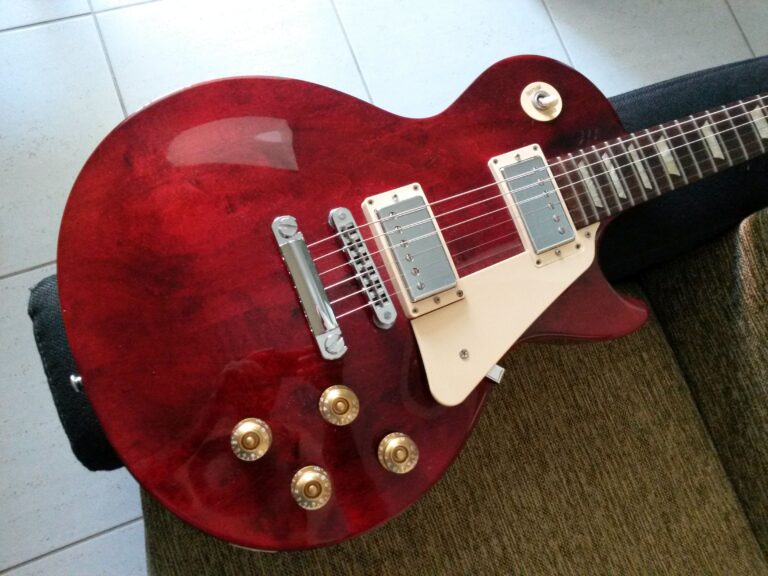
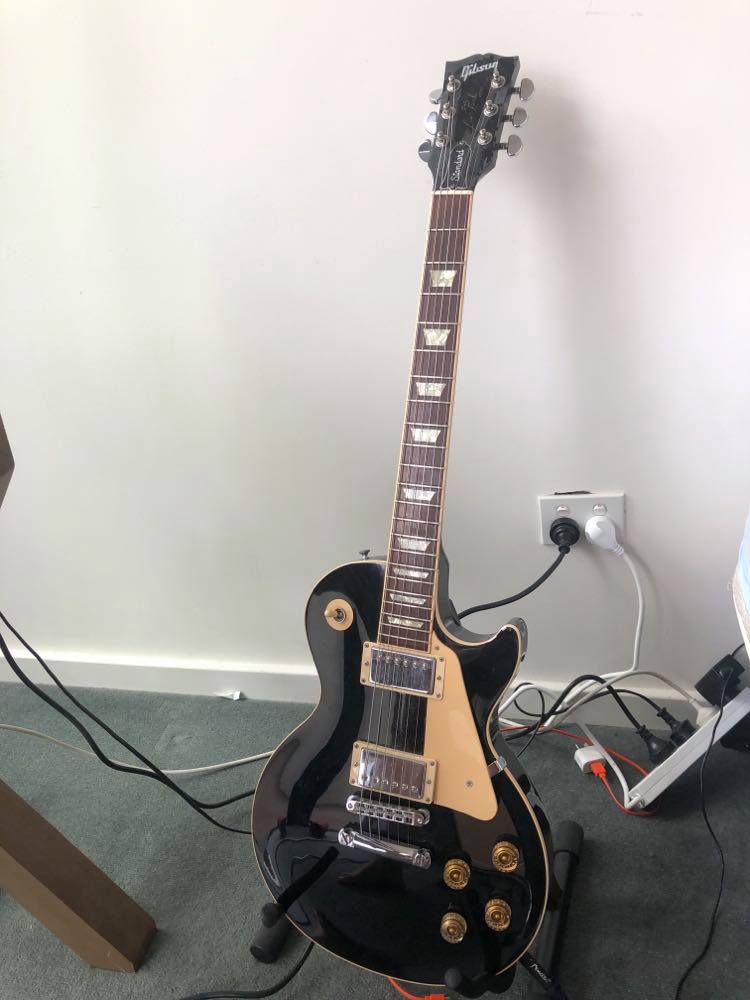
Gibson Les Paul Standard, photographed 18 October 2020. Photo: DonnyBurger1974. CC BY-SA 4.0 (https://creativecommons.org/licenses/by-sa/4.0/). Source image unchanged; automatically resized web versions: CC BY-SA 4.0. Source: https://commons.wikimedia.org/wiki/File:Les_Paul_Standard.jpg
Gibson Les Paul Standard — the complete deep-dive into the Burst, the PAF, and the guitar that defined rock tone. History, legendary players, settings, buying guide, and gear pairings.
If the Fender Stratocaster is the Swiss Army knife of electric guitars, then the Gibson Les Paul Standard is the sledgehammer. And we mean that as the highest compliment imaginable. Since 1952, this mahogany-and-maple slab of pure intent has been the instrument that guitarists reach for when subtlety can go to hell — when the song demands thick sustain, crushing power chords, singing leads that hang in the air like smoke, and a midrange presence that can crack foundations.
The Les Paul Standard is the guitar of Jimmy Page‘s descending riff on “Whole Lotta Love.” It is the sound of Slash stepping out of the darkness with that cigarette-dangling intro to “Sweet Child O’ Mine.” It is Gary Moore‘s fingers wringing every atom of emotion from “Still Got the Blues,” and Duane Allman‘s slide cutting through the Georgia heat on “Statesboro Blues.” No other guitar in history has produced more iconic rock riffs, and no other guitar has commanded higher prices on the vintage market.
This is the GuitarGangsters deep-dive into the Gibson Les Paul Standard — its origins, its sound, its legends, and how to get the most from one.
Origin Story: The Log, The Goldtop, and The Burst
The Les Paul story begins not with Gibson, but with a restless inventor named Lester William Polsfuss — better known as Les Paul. Throughout the 1930s and 1940s, Paul was obsessed with solving the feedback and sustain problems inherent in hollow-body electric guitars. His solution was radical: build a guitar from a solid plank of wood. He called his prototype “The Log” — a four-by-four block of pine with an Epiphone body sawn in half and glued on either side for cosmetic purposes, fitted with a neck, bridge, and pickups.
In 1941, Les Paul brought The Log to Gibson’s offices in Kalamazoo, Michigan. They laughed him out of the building. “They called me the kid with the broomstick with the pickups on it,” Paul later recalled. It wasn’t until Leo Fender started selling his solid-body Telecaster in 1950 that Gibson president Ted McCarty suddenly wanted to find “that guy with the broomstick.”
The first Gibson Les Paul appeared in 1952 — a solid mahogany body with a carved maple cap, finished in gold (hence the “Goldtop” nickname), with two P-90 single-coil pickups and a trapeze tailpiece that was quickly abandoned because it prevented palm muting. By 1953, Gibson had switched to a wraparound stopbar bridge, and by 1955, the adjustable ABR-1 Tune-o-Matic bridge arrived — a Ted McCarty innovation that allowed individual string intonation adjustment and remains the industry standard for set-neck guitars to this day.
The PAF Revolution: 1957
The single most important upgrade in Les Paul history came in 1957, when Gibson engineer Seth Lover’s humbucking pickup replaced the P-90. The “Patent Applied For” — or PAF — pickup used two coils instead of one, wired to cancel the electromagnetic hum that plagued single-coils. But it did far more than just reduce noise. The PAF produced a fatter, warmer, more compressed tone with greater output and a singing quality that P-90s couldn’t match. The humbucker became the defining sonic characteristic of the Les Paul, and its impact on rock, blues, and metal cannot be overstated.
The Burst: 1958–1960
In 1958, Gibson replaced the Goldtop finish with a cherry sunburst, and the guitar was officially renamed the “Les Paul Standard.” These sunburst Standards — produced for just under three years before being discontinued in favor of the thinner, double-cutaway SG design in 1961 — are universally known as “Bursts” and are considered by many to be the greatest electric guitars ever built.
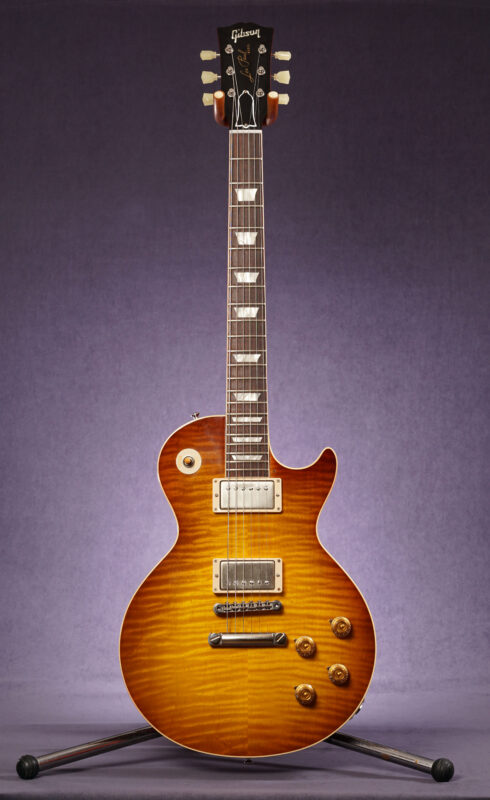
The cruel irony is that Bursts were a commercial failure. Gibson produced fewer than 1,700 sunburst Standards between 1958 and 1960, and many ended up in pawn shops. When British blues-rockers like Eric Clapton, Peter Green, and Keith Richards discovered them in the mid-1960s, the Les Paul’s second life began — and it has never looked back. Today, original Bursts routinely sell for $250,000 to $500,000, with exceptional examples reaching well over a million.
The Sound: Anatomy of Thunder
The Gibson Les Paul Standard sounds fundamentally different from a Stratocaster, and the reasons are structural. Everything about the Les Paul’s construction is designed — intentionally or not — to produce a thick, warm, sustained tone with powerful midrange and controlled highs.
The Body
A mahogany back with a carved maple top. This is the defining combination. The mahogany provides warmth, depth, and a rich low-midrange character, while the hard maple cap adds brightness, attack, and focus to the top end. Together, they produce a balanced but fundamentally “dark” tone compared to the alder or ash bodies of Fender guitars. The solid construction — no routing cavities, no tremolo springs, no bolt-on joints — means maximum energy transfer and sustain. A properly set-up Les Paul Standard will sustain a note longer than almost any other production guitar.
The Neck
The Les Paul’s mahogany neck is glued into the body — a “set neck” construction that creates a tight, resonant joint where energy transfers freely between neck and body. The shorter 24.75″ scale length (compared to Fender’s 25.5″) produces lower string tension, which contributes to easier bending, a slightly “slinkier” feel, and a warmer fundamental tone with more prominent harmonics. The neck profiles on vintage Les Pauls are substantial — the ’50s models feature fat, rounded profiles that feel like baseball bats, while the ’60s models are slimmer and faster. Both Gibson and Epiphone offer modern Les Pauls in both profiles.
The Pickups
Two humbucking pickups — a lower-output unit at the neck and a hotter one at the bridge — each with independent volume and tone controls, selected by a three-way toggle switch. This gives the Les Paul fewer distinct positions than a Stratocaster’s five-way switch, but each position is a powerhouse:
Bridge Pickup (Treble): Aggressive, biting, and cutting. This is the sound of hard rock and metal rhythm — James Hetfield‘s downpicking, Angus Young‘s searing leads, Slash’s grinding power chords. Bright enough to cut through a wall of Marshall distortion, but with a warmth and compression that single-coils can’t touch.
Middle Position (Both): The blend of both pickups produces a more open, slightly hollow tone that’s rounder and more complex than either pickup alone. Jimmy Page used this position extensively — the clean arpeggios on “Stairway to Heaven” and much of Led Zeppelin III were played here. With the individual volume knobs, you can blend the two pickups in any ratio, creating a staggering range of sounds from a seemingly simple control layout.
Neck Pickup (Rhythm): Deep, warm, and impossibly smooth. Roll the tone knob down and you get Eric Clapton‘s legendary “woman tone” — all midrange cream with the highs rolled off, as heard on Cream’s Disraeli Gears. Leave it wide open and you get fat, jazzy cleans or creamy blues leads. Gary Moore‘s “Still Got the Blues” solo is neck-pickup Les Paul tone at its most emotionally devastating.
The Four-Knob System
The Les Paul’s two volume and two tone controls are far more powerful than they appear. Unlike the Strat‘s single master volume, the Les Paul lets you preset each pickup at a different volume and switch between them — a clean rhythm tone on the neck and a boosted lead tone on the bridge, all without touching a pedal. Joe Bonamassa, one of the instrument’s most vocal modern advocates, has demonstrated at least ten distinct tones achievable from a Les Paul with nothing but its onboard controls.
The Legends: Players Who Made the Les Paul Standard Immortal
Jimmy Page — The Architect of Hard Rock
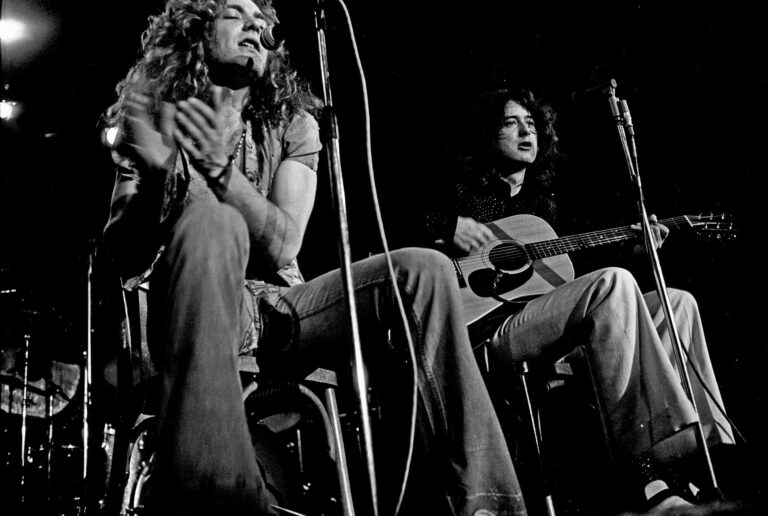
Jimmy Page‘s 1959 Les Paul Standard “Number One” — bought from Joe Walsh in 1969 for a few hundred dollars — became the most important rock guitar of the 1970s. Through Marshall Super Lead amplifiers, Page crafted the riffs that defined Led Zeppelin: “Whole Lotta Love,” “Black Dog,” “Rock and Roll,” and the epic “Stairway to Heaven.” His use of a violin bow on the Les Paul’s strings pushed the instrument into avant-garde territory that no one had imagined.
Slash — The Les Paul’s Second Coming
Slash‘s 1987 debut with Guns N’ Roses on Appetite for Destruction did for the Les Paul in the late ’80s what Hendrix had done for the Stratocaster twenty years earlier — it made the guitar cool again at a time when superstrats with Floyd Rose bridges and active pickups dominated. His tobacco sunburst Les Paul through a cranked Marshall created one of the most recognizable tones in rock, and the image of Slash — top hat, cigarette, Les Paul — became the visual symbol of rock guitar for an entire generation.
Peter Green & Gary Moore — The Greeny Lineage
Peter Green’s 1959 Les Paul Standard is arguably the most tonally unique Les Paul ever made. A quirk — possibly accidental — reversed the polarity of the neck pickup’s magnet, producing an out-of-phase “quack” in the middle position that no other Les Paul could replicate. Green used this guitar to define the early Fleetwood Mac sound before selling it to Gary Moore, who wielded it on devastatingly emotional blues recordings throughout the 1990s and 2000s. The guitar was later acquired by Kirk Hammett of Metallica, and Gibson now produces the “Greenybucker” pickup to replicate its unique tone.
Duane Allman — Slide Guitar’s Gold Standard
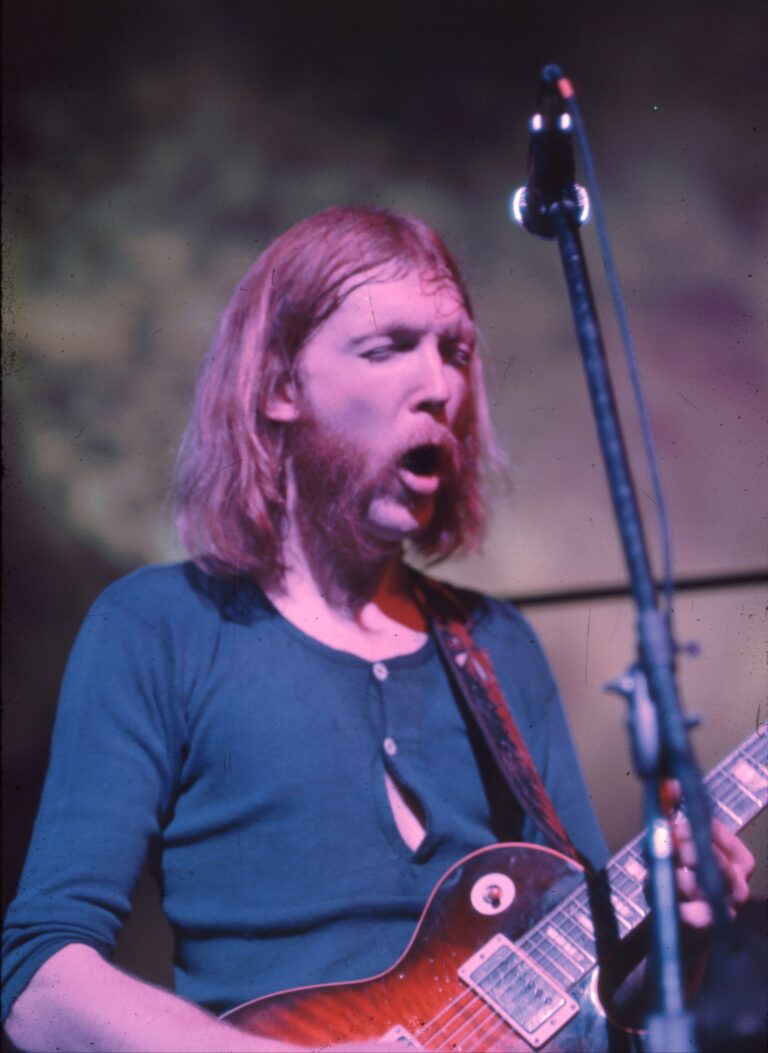
Duane Allman‘s 1957 Goldtop (later trading up to a cherry sunburst ’59) through a cranked Fender tube amp produced some of the most soulful slide guitar ever recorded. His work on the Allman Brothers’ At Fillmore East and his contributions to Derek and the Dominos’ “Layla” remain untouchable milestones. The Les Paul’s sustain and thick tone made it the perfect platform for Allman’s open-tuning slide style.
The Heavy Brigade
Tony Iommi tuned his SG down and invented heavy metal, but the Les Paul Standard has been the genre’s primary weapon ever since. Zakk Wylde‘s bullseye Les Paul through a Marshall JCM800 produces the crushing rhythm tones of Ozzy Osbourne’s band. Joe Perry‘s Les Paul defined Aerosmith’s blues-drenched hard rock. And Randy Rhoads, though associated with Jackson and flying V shapes, cut his teeth on a Les Paul Custom before reinventing metal guitar with Ozzy.
The Eras: A Production Timeline
The Goldtop Era (1952–1957)
P-90 pickups, gold finish, various bridge designs as Gibson iterated toward the ideal hardware configuration. These are collectible and sonically excellent instruments, but they’re a different animal from the humbucker-equipped Standards.
The Burst Era (1958–1960)
The holy grail. Cherry sunburst finish, PAF humbuckers, Tune-o-Matic bridge, stop tailpiece. Fat ’50s neck profiles on 1958–1959 models, slimmer ’60s profiles from late 1959 through 1960. Fewer than 1,700 built. If you find one in an attic, you can retire.
Discontinuation & The SG Years (1961–1967)
The original Les Paul shape was replaced by the thinner, double-cutaway SG design. Les Paul himself disliked the new shape and eventually asked for his name to be removed. Meanwhile, British guitarists were discovering the magic of discarded Bursts in pawn shops and music stores.
The Reissue (1968–Present)
Gibson brought back the Les Paul Standard in 1968 after demand from players and collectors surged. The early reissues had some differences from the originals — including a thicker maple cap, chrome hardware (vs. nickel), and “pancake” multi-piece bodies in the 1970s — but the core design was restored. Quality varied throughout the Norlin era (1969–1986) but recovered steadily after Gibson’s management buyout in 1986. The Custom Shop, established in 1986, began producing historically accurate reproductions of Bursts, and the modern production line has steadily improved to its current high standard.
Popular Settings and Tone Recipes
The Classic Rock Crunch
Pickup: Bridge | Volume: 7–8 | Tone: 6–7
Amp: Marshall JCM800 or Plexi, gain at noon
Pedals: None needed — just guitar into amp
This is the sound of AC/DC, Aerosmith, and early Guns N’ Roses. The Les Paul’s bridge humbucker through a cranked Marshall produces a thick, crunchy rhythm tone with enough clarity for individual notes to ring through even in dense power chords. Rolling the volume back to 5–6 cleans it up for verse sections.
The Woman Tone
Pickup: Neck | Volume: Full | Tone: 0–2
Amp: Marshall or Vox AC30, pushed into overdrive
Pedals: None
Clapton‘s signature Cream-era sound. Rolling the tone knob all the way down on the neck pickup removes the highs entirely, leaving a thick, vocal, almost saxophone-like midrange that sustains indefinitely. This is the tone of “Sunshine of Your Love” and “White Room” — one of the most imitated sounds in rock history.
The Blues Weeper
Pickup: Neck | Volume: 8–10 | Tone: 5–7
Amp: Fender Deluxe Reverb or Marshall Bluesbreaker combo
Pedals: Light overdrive — Tube Screamer or Blues Driver with gain low
Gary Moore‘s “Still Got the Blues” territory. The neck humbucker with the tone rolled back slightly produces a creamy sustain that sings under the fingers. A touch of overdrive adds grit without losing the Les Paul’s natural warmth and compression. This setup rewards vibrato and bending more than any other combination.
The Page Epic
Pickup: Middle position (both pickups) | Volume: Both full | Tone: Both 7–8
Amp: Marshall Super Lead, cranked
Pedals: Electro-Harmonix Big Muff or Tonebender for heavy sections
Jimmy Page‘s Zeppelin tone lived in the middle position — both pickups blended for a complex, open sound that could handle everything from clean arpeggios to searing leads. Page also used a Telecaster on many early Zeppelin tracks, but the Les Paul became his primary weapon from Led Zeppelin II onward.
The Metal Chug
Pickup: Bridge | Volume: Full | Tone: Full
Amp: Marshall JCM800 or high-gain head, heavily saturated
Pedals: Tube Screamer as a boost (gain low, level high) in front of the amp
The Les Paul’s thick, compressed bridge humbucker through a boosted high-gain amp produces the tight, focused rhythm tone that defined 1980s and 1990s metal. The Tube Screamer’s mid-hump tightens the low end and pushes the amp harder, producing palm-muted chugs that sound like a freight train.
Perfect Pairings: Gear That Complements the Les Paul
Amps
The Les Paul’s natural partner is a Marshall. This combination has produced more classic rock tones than any other guitar-amp pairing in history. The JCM800 for tight, focused crunch; the Plexi for raw, ragged overdrive; the Silver Jubilee for modern versatility. But the Les Paul is equally at home through a Vox AC30 (think Peter Green’s early Fleetwood Mac), a Fender Deluxe Reverb (blues players love the humbucker-into-Fender combination for its warmth), or a Mesa/Boogie Dual Rectifier for modern high-gain applications.
Pedals
The Les Paul needs fewer pedals than a Stratocaster. Its humbuckers provide enough output to drive most amps into overdrive without assistance. That said, the Ibanez Tube Screamer as a clean boost is legendary with a Les Paul — its mid-hump complements the guitar’s natural voicing perfectly. For fuzz, a Tonebender or Big Muff Pi through a Les Paul produces a wall of sustain that was essential to 1970s rock. And a good wah pedal — like the Cry Baby that Slash uses on virtually every solo — unlocks vocal expressiveness that the Les Paul’s thick midrange handles beautifully.
Les Paul Standard vs. The Competition
The Les Paul vs. Stratocaster debate is as old as rock itself, and it’s a false dichotomy. The Strat’s single-coils offer clarity, note separation, and bell-like shimmer; the Les Paul’s humbuckers deliver thickness, sustain, and crushing power. Most professional players own both because they do fundamentally different things.
Within Gibson’s own lineup, the SG Standard offers a thinner, lighter body with easier upper-fret access and a more aggressive midrange bite, while the ES-335 provides semi-hollow warmth and resonance that sits between the Les Paul’s density and an acoustic guitar’s airiness. The Les Paul Custom adds binding, ebony fretboard, and visual flash, while the Les Paul Studio strips away cosmetic extras for a working-player’s instrument at a lower price.
Against the PRS Custom 24, the Les Paul is the more extreme instrument — heavier, thicker-sounding, less “modern” in feel, but with a raw character and vintage vibe that PRS guitars, for all their refinement, don’t quite replicate. It’s a matter of personality, not quality.
Buying Guide: Which Les Paul Standard Is Right for You?
Budget Tier ($400–$600)
The Epiphone Les Paul Standard ’50s and ’60s models are the entry point — and they’re shockingly good. ProBucker pickups, set mahogany neck, maple-capped mahogany body, and CTS electronics. For the money, nothing else comes close to genuine Les Paul tone and feel.
Mid-Range ($1,500–$2,500)
The Gibson Les Paul Standard ’50s and ’60s are the modern workhorses — Burstbucker pickups, period-correct neck profiles, nitrocellulose lacquer finish on some models, and all-mahogany construction with a maple cap. These are the guitars most working musicians will reach for. The ’50s offers the fat, baseball-bat neck and warm Burstbucker 1/2 pickups; the ’60s features a slim-taper neck and hotter Burstbucker 61 pickups.
Professional ($2,500–$4,000)
The Gibson Les Paul Custom adds multi-ply binding, ebony fretboard, and premium appointments. The Les Paul Modern offers contemporary features like push-pull coil-splitting, asymmetrical slim-taper neck profiles, and weight relief for players who want Les Paul tone without the back problems.
Custom Shop ($4,000–$15,000+)
The Gibson Custom Shop produces historically accurate “1959 Standard” and “1958 Standard” reissues using period-correct construction methods, hand-wired electronics, hide-glue neck joints, and Custombucker PAF-replica pickups. The Murphy Lab “aging” process produces instruments that look and feel decades old. These are the closest you can get to a vintage Burst without the six-figure price tag.
Iconic Les Pauls: The Guitars That Changed Music
“Number One” — Jimmy Page: A 1959 Burst bought from Joe Walsh that became the primary recording and touring guitar for Led Zeppelin’s entire career.
“Greeny” — Peter Green / Gary Moore / Kirk Hammett: The out-of-phase ’59 that defined three generations of blues-rock tone.
The “Appetite” Les Paul — Slash: A 1959 replica built by Kris Derrig that Slash used to record Appetite for Destruction — an album that sold 30 million copies and made the Les Paul the guitar of the late 1980s.
“Lucille” — B.B. King: Though technically a Gibson ES-355, B.B. King’s naming convention and emotional bond with his guitars perfectly illustrates the Gibson mystique that the Les Paul embodies.
The Allman Burst — Duane Allman: A 1959 cherry sunburst that produced the slide guitar tones on At Fillmore East and “Layla.”
Tips, Mods, and Setup Secrets
Pickup height matters enormously on a Les Paul. Gibson’s recommended starting point is 3/32″ (2.4mm) on the bass side and 1/16″ (1.6mm) on the treble side for the bridge pickup, with the neck slightly lower. But experimentation is key — lowering the bridge pickup can remove harshness, while raising the neck pickup can add clarity to an overly dark sound.
The “50s wiring” mod changes the way the tone capacitor is connected in the circuit. Stock Les Pauls typically use “modern” wiring, where rolling down the tone knob also reduces output. With ’50s wiring, the tone control operates independently of volume — so you can roll off treble without losing volume. This is a simple, reversible soldering change that dramatically improves the guitar’s usability.
Nut material has a noticeable effect on sustain and brightness. Gibson’s standard Corian or plastic nuts can be upgraded to bone, brass, or Graph Tech TUSQ for improved resonance and tuning stability.
Weight relief: Modern Gibson Les Pauls use various weight-relief methods (chambered, ultra-modern weight relief, or nine-hole traditional weight relief) to reduce the guitar’s notoriously heavy weight. Purists prefer solid bodies for maximum sustain and traditional tone. If weight is a concern, try before you buy — some weight-relieved models sound slightly different in the low end.
FAQ
Why are Gibson Les Paul Standards so expensive?
Gibson Les Pauls use premium tonewoods (mahogany, maple), set-neck construction that requires precise hand-fitting, nitrocellulose or high-quality finishes, USA-made pickups, and extensive quality control. The Epiphone Les Paul Standard offers the same basic design at a fraction of the cost for budget-conscious players.
What is the difference between a Les Paul ’50s and ’60s?
The ’50s has a thick, rounded “Vintage 1950s” neck profile and Burstbucker 1 (neck) and 2 (bridge) pickups for a warmer, more vintage tone. The ’60s has a slimmer “SlimTaper” neck profile and Burstbucker 61 pickups with higher output and a more modern edge. The tonal difference is subtle; the neck feel is dramatic.
Is a Les Paul good for metal?
Absolutely. The Les Paul’s thick humbucking tone through a high-gain amp is the foundation of classic metal. Zakk Wylde, Slash, Randy Rhoads, Adam Jones (Tool), and countless others have used Les Pauls for heavy music. For modern extreme metal with extended-range tunings, purpose-built instruments may be more practical, but for traditional heavy rock and metal, the Les Paul is king.
Why is the Les Paul so heavy?
The solid mahogany body with a dense maple cap typically weighs 9–12 pounds (4–5.4 kg). Gibson has introduced weight-relief routing on many modern models to reduce this. If weight is a concern, the Gibson SG offers a similar humbucker tone in a much lighter body.
What are the most sought-after Les Paul years?
1958, 1959, and 1960 “Burst” Standards are the most valuable. The 1959 is generally considered the pinnacle due to its combination of fat (but not too fat) neck profile, mature PAF pickups, and exceptional craftsmanship. These guitars sell for $250,000 to over $1,000,000.
Can I get a Les Paul Standard tone from an Epiphone?
You can get remarkably close. The Epiphone Les Paul Standard ’50s uses the same basic construction (mahogany body, maple cap, set neck, humbuckers) and sounds convincingly Les Paul-like. The differences — in wood quality, hardware, and finishing — become apparent at high volumes and in studio settings, but for most players and most situations, an Epiphone delivers 90% of the experience at 30% of the price.
What strings work best on a Les Paul?
The shorter 24.75″ scale length means lighter gauges feel comfortable — .010–.046 is the most popular choice for rock and blues. Players who tune down (like Slash, who tunes half-step down) may prefer .011–.048 for added tension and fuller tone. For standard tuning, .009–.042 works well for faster playing styles.
What is the difference between a Les Paul Standard and a Les Paul Custom?
The Custom is the “tuxedo” version — ebony fretboard (vs. rosewood), multi-ply binding on body and neck, block inlays, and typically a slightly different pickup voicing. The Standard uses a rosewood fretboard, single-ply binding, and trapezoid inlays. Sonically, the ebony fretboard on the Custom can add a touch of brightness and snap compared to the rosewood Standard.
The Verdict
There is a reason that the Gibson Les Paul Standard has survived commercial failure, corporate mismanagement, ownership changes, and seven decades of competition from every guitar maker on the planet. It is not the most versatile guitar. It is not the lightest, the most comfortable, or the most affordable. It does not do everything.
But what it does, nothing else can touch. When you plug a Les Paul Standard into a Marshall and hit a power chord, something happens that defies rational explanation. The room fills with a sound that is thick, warm, aggressive, and undeniably alive — a sound that has defined the vocabulary of rock guitar for over sixty years.
From the Bursts of 1958 to the Murphy Lab reissues of today, from the juke joints of Chicago to the arenas of the world, the Les Paul Standard has been the guitar that says one thing louder than any other: this means business.
Image credits
- Top image: Gibson Les Paul Standard, photographed 18 October 2020. Photo: DonnyBurger1974. Source photograph · CC BY-SA 4.0. Source image unchanged; automatically resized web versions use CC BY-SA 4.0.
- Gibson Custom Shop 1959 reissue (R9) Les Paul, 2016: photo by Lightburst, via Wikimedia Commons, CC BY-SA 4.0.
- Jimmy Page: Heinrich Klaffs, Wikimedia Commons, CC BY-SA 2.0.
- Duane Allman: Ed Berman, Wikimedia Commons, CC BY 2.0.
Latest News
Related
On This Day
Tuesday 10 November
From this week: