Ibanez S6570SK Prestige: The Blade Nobody Famous Was Supposed to Play
Ibanez's S6570SK skipped Vai and Satriani entirely — its real players were Sabaton's Tommy Johansson and August Burns Red bassist Dustin Davidson.
Every gear list needs its shred royalty. Steve Vai, Joe Satriani, Paul Gilbert, Nita Strauss, Tim Henson — five names that show up on spec sheet after spec sheet like a house band that never gets a night off. And on paper, the Ibanez S6570SK Prestige looks exactly like the kind of guitar that would earn a spot in their rigs: a Japanese-built, DiMarzio-loaded, Lo-Pro Edge-equipped flagship built for exactly the kind of fast, dynamic playing all five of them are known for. It would make a tidy story. It’s also, as far as any verifiable record shows, not true. None of those five players has a documented connection to this specific model.
What the S6570SK actually got instead is arguably a better story: a Swedish power metal guitarist who played it under a battlefield-camo finish on tour with one of Europe’s biggest metal exports, and a Grammy-nominated metalcore band’s bassist who quietly modded one with EMGs and used it as his go-to six-string on the side. Neither is a name that moves units the way Vai’s does. Both are real, both are documented, and both tell you more about who actually buys a $2,000 Ibanez Prestige than any recycled artist list could.

An S-Body Guitar Built to Disappear on Your Shoulder
The S series has been part of the Ibanez lineup since 1987, when it launched as the “Saber” — a name Ibanez had to shorten within its first year after Ernie Ball revived its own “Sabre” bass line and asked Ibanez to avoid the collision. What survived the rename was the shape: an offset double-cutaway body with a sculpted, blade-thin edge where the contoured top and back meet, designed from day one to be the lightest, most ergonomic solidbody in the catalog. If you’ve read the Ibanez S570AH piece from earlier in this project, you already know the S-series backstory — Herman Li’s custom S-based build, Chris Broderick’s mid-2000s S conversion for Megadeth, Nita Strauss’s pre-JIVA years on S-series Prestiges. The S6570SK sits at the top of that same family tree, in the tier where Ibanez stops compromising on materials and starts building instruments almost entirely for the export/boutique-adjacent player rather than the entry-level shopper.
Introduced for the 2017 model year and built in Japan by FujiGen, the S6570SK’s whole reason for existing is a single design choice: take the S body’s featherweight sculpting and dress it in genuinely striking tonewood instead of the plain painted finishes most S-series guitars wear. That’s the “SK” doing the work in the model name — it designates the silky oak top, a wood better known by its other common name, lacewood, prized for a wild, almost reptilian grain pattern that looks like nothing else in the Ibanez catalog.
Anatomy of the S6570SK
Body and Top
The body is African mahogany — Ibanez specified this more precisely starting in 2018, after launching the model simply as “mahogany” in 2017 — chosen because it’s light enough to keep the S-series feel intact while still delivering the warmth mahogany is known for. On top sits that silky oak veneer with white binding tracing the contour, the closest thing this guitar has to jewelry. Weights in the field run consistently around 7 to 7.4 lbs, genuinely light for a guitar with this much hardware bolted to it, and multiple listings note the body holds its sustain surprisingly well for something this thin — a detail owners specifically call out as a pleasant surprise given how little wood there actually is under that top.
Neck and Fretboard
The Super Wizard HP neck is the S Prestige line’s signature feature: a five-piece maple and walnut laminate reinforced with KTS titanium rods running through the length of the neck, engineered for maximum stability with a minimum of mass. It’s a bolt-on neck, not set, which keeps costs and weight down without sacrificing the ultra-thin profile shredders expect from anything wearing a Wizard name. The fretboard started life as marbled rosewood in 2017 and switched to bound Macassar ebony in 2019, still carrying the offset white dot inlays and 24 jumbo frets that have defined the S Prestige look since the beginning. Every fret gets Ibanez’s Prestige Fret Edge Treatment, a machine process that rounds off the very ends of the frets more precisely and consistently than hand-filing can manage — the result is a neck that plays like it’s already had years of gigs put into it, right out of the case. At a 16.9-inch fretboard radius, it’s a genuinely flat board built for single-note runs and low action rather than chord-heavy rhythm work, though it handles both without real complaint.
Electronics
Three DiMarzio pickups in an H-S-H layout do the tonal heavy lifting: an Air Norton humbucker at the neck for a deep, warm, remarkably clean voice that stays articulate even under heavy gain; a True Velvet single-coil in the middle for bright, glassy in-between tones built for soloing; and a Tone Zone humbucker at the bridge, a hot, wide-dynamic-range pickup that’s become one of DiMarzio’s most-used bridge units across the entire high-output guitar market. A five-way blade switch runs the combinations, paired with just a single master volume and master tone — a deliberately simple control layout that puts the emphasis on the pickup switching rather than active EQ shaping.
Bridge and Hardware
The Lo-Pro Edge is Ibanez’s own double-locking tremolo, widely regarded among Ibanez owners as the best trem the company makes — praised specifically for its low profile, which makes palm muting comfortable in a way taller bridges don’t, and for holding tune reliably even decades into a guitar’s life. It pairs with a locking nut and Gotoh tuning machines, and the whole system is finished in Cosmo Black hardware that sets off the silky oak top nicely without fighting for attention.
2017 to 2025: The Life and Quiet Retirement of a Model Number
The S6570SK ran for eight full model years, from its 2017 introduction through 2025, with two real spec revisions along the way: the mahogany designation getting more specific in 2018, and the fretboard wood changing from rosewood to Macassar ebony in 2019. It was discontinued after the 2025 model year and replaced for 2026 by a successor model — the family tree below covers exactly how that transition, and the rest of this platform’s siblings, break down. If you’re shopping the used market for an S6570SK right now, you’re shopping a genuinely closed chapter: Ibanez has moved on to the next model number, and what’s left in circulation is what’s left in circulation.
The S6570 Family Tree
The silky oak top isn’t the only direction Ibanez took this platform. The S6570Q is the closest sibling, built on the exact same body, neck, and electronics recipe but wearing a quilted maple top instead — it launched slightly earlier, in late 2016, and was pulled from most international markets after 2021 while lingering longer in the USA and Canada, a good example of how unevenly Ibanez winds down a model depending on region. The S6521Q takes the quilted-top idea and drops the tremolo entirely in favor of a fixed bridge with a straight humbucker pair, aimed at players who want the look without the maintenance of a double-locking system. Extended-range players get the S6527SKFX, a seven-string built around the same silky oak top and HH pickup configuration on a fixed bridge, trading the middle single-coil for lower-end headroom. And the line didn’t end with discontinuation — the 2026 S6670SK picks up exactly where the S6570SK left off, keeping the silky oak top and DiMarzio trio intact while swapping the ebony board back to rosewood, which Ibanez markets as delivering a slightly more focused midrange than the outgoing model. None of these siblings carry a documented celebrity connection any stronger than the S6570SK’s own — this pocket of the S Prestige catalog has always sold on spec sheet and looks first, artist endorsement a distant second.
Who Actually Played It — and Who Definitely Didn’t
Setting the Record Straight on the Shred-List Defaults
Steve Vai, Joe Satriani, Paul Gilbert, Nita Strauss, and Tim Henson are all genuine Ibanez artists — that part isn’t in dispute. But each one built their entire signature identity around their own dedicated model lines: Vai’s JEM and PIA series, Satriani’s JS line, Gilbert’s PGM and FLATV guitars, Strauss’s JIVA series (documented in her full gear guide), and Henson’s KRYS and AZ-based signature instruments covered separately here. Cross-referencing Ibanez’s own artist rosters, Wikipedia’s list of Ibanez players, and Equipboard’s item-level artist tracking turns up zero documented connections between any of the five and the S6570SK specifically. It’s not that they’re wrong for Ibanez — they’re wrong for this particular model.
Tommy Johansson: Two Bands, Two Finishes, One Guitar
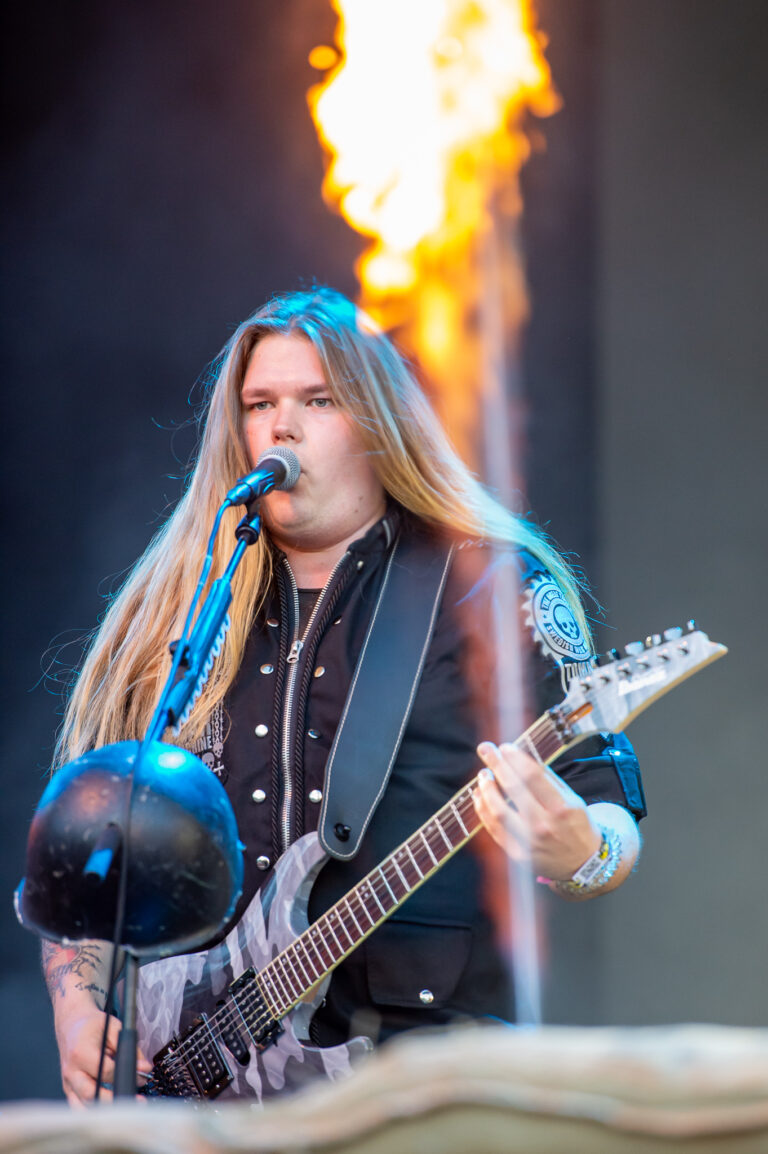
The real story belongs to Tommy Johansson, the Swedish multi-instrumentalist who fronted the power metal band Majestica (formerly ReinXeed) and, from 2016 until stepping down in early 2024, played guitar for Sabaton — one of the biggest names in European power metal, known for stadium-scale historical war anthems and a rabid international touring fanbase. Documented footage shows Johansson playing an S Prestige in Sunset Burst during his time with Majestica, and the same guitar reappears in an Urban Camo finish during Sabaton touring years, visible in editorial photography from a 2019 Sabaton show in Florida. Johansson has been open about the split loyalties that eventually led him to leave Sabaton — juggling two active bands with international schedules for years before choosing to focus on his own project — which makes the S6570SK a nice symbol of a guitarist genuinely dividing his time between two very different corners of the metal world, from historical war-ballad power metal to Sabaton’s stadium bombast, on the same instrument in two different paint jobs.
Dustin Davidson: The Bassist Who Also Plays One
The second documented player flips the usual script entirely. Dustin Davidson is the bassist of August Burns Red, the Grammy-nominated metalcore band from Lancaster, Pennsylvania — his main gear identity runs through Ibanez SR-series basses and a signature Kiesel model, not six-string guitars. But in a YouTube video titled “Pangea ending August Burns Red,” Davidson specifically references using his own Ibanez S Prestige 6570, modified with EMG pickups in place of the stock DiMarzio set. It’s a small but genuine detail: a full-time bass player who keeps a shred-grade Prestige S-series guitar around and has talked about it on camera, which is a different — and arguably more interesting — kind of endorsement than another guitarist adding one more Ibanez to a wall of them. August Burns Red’s actual guitarists, JB Brubaker and Brent Rambler, both play RGA and FR-based Ibanez Prestige models with EMG 81/85 sets of their own, which likely explains where Davidson’s own EMG swap came from — a bit of shared band gear culture bleeding across instruments.
Tone Recipes for the S6570SK
Power Metal Rhythm and Lead (Johansson Territory)
Bridge humbucker (Tone Zone), amp gain around 6-7 on a high-headroom tube head, mids pushed slightly forward rather than scooped — power metal rhythm work needs to cut through a wall of keyboards and double bass, and a fully scooped metal tone gets buried. Kick in a Tube Screamer-style overdrive (see the Ibanez TS9 for the archetypal choice) for lead breaks, riding the neck pickup for the singing, sustained melodic lines this style leans on.
Metalcore Drop-Tuned Rhythm (ABR-Adjacent)
Bridge humbucker only, gain higher, low end tightened at the amp rather than boosted, palm mutes doing most of the rhythmic work. This is where the Lo-Pro Edge’s low profile genuinely earns its reputation — comfortable palm muting at speed is a real, tangible playability difference over taller trem systems.
Clean and Fusion Tones
Middle single-coil (True Velvet) alone, or blended with the neck humbucker in position 2, amp clean channel with a touch of compression and a warm spring reverb — the True Velvet’s brightness keeps clean arpeggios from turning muddy, a genuinely underused voice on a guitar most people buy for its bridge pickup.
The H-S-H layout and the Lo-Pro Edge trem make this guitar genuinely flexible across a wider stylistic range than its shred-adjacent looks suggest. Three starting points:
The S Prestige Against Its Own Family
Set next to the RG-family Prestige models already covered in this project, the S6570SK’s identity comes into focus mostly through what it isn’t. The RG652AHMFX Prestige and the RG8570Z J.Custom both chase a similar HSH/HH tonal territory but wrap it in the RG body’s more angular, longer-established superstrat silhouette — heavier, more traditional-feeling in the hand, and in the J.Custom’s case, built to an even higher and pricier tier. The S6570SK’s whole pitch is the opposite: less weight, a shorter list of ornamental flourishes, and a body shape that disappears against the player rather than announcing itself. Against the entry-tier S570AH from earlier in this same S-series run, the difference is almost entirely about materials and origin — Indonesian-built basswood-adjacent construction and Quantum pickups on the S570AH versus FujiGen-built African mahogany, a genuine tonewood top, and DiMarzio electronics here. Outside Ibanez, a Gibson Les Paul Standard or a Fender Stratocaster represent the two poles this guitar sits between tonally — closer to a Strat’s brightness and switching flexibility than a Les Paul’s dark humbucker-only sustain, but with none of either guitar’s vintage-inspired construction philosophy.
Buying Guide for a Discontinued Prestige
Since the S6570SK is no longer in production, every purchase now is a used-market purchase, and a few things are worth checking before buying:
- Fretboard wood tells you the year. Marbled rosewood means 2017 or 2018 production; Macassar ebony means 2019 or later. Neither is objectively better, but it affects resale expectations and lets you date a listing that doesn’t specify a year.
- Check the trem for setup, not damage. The Lo-Pro Edge has a strong reputation for longevity, but any double-locking tremolo needs occasional attention — verify the fine tuners move freely and the locking nut clamps evenly before buying sight unseen.
- Stock pickups hold value. Unlike a lot of budget-tier guitars where swapping pickups is the first move, owners specifically note that even a fully re-pickuped S6570SK retains solid resale value, since the DiMarzio set is itself a desirable, sought-after combination rather than something buyers expect to immediately replace.
- Compare against the S6670SK if buying new. If the used-market price on an S6570SK creeps close to what a brand-new S6670SK costs, the newer model gets a warranty and Ibanez’s current build tolerances for similar money — worth cross-shopping before committing to a nine-year-old used guitar.
- Weight varies more than you’d expect. Listed weights across different individual examples range from about 7.1 to 7.4 lbs — not a huge spread, but worth confirming on heavier listings if a featherweight feel is the whole reason you’re looking at this guitar.
Living With One: Ownership Notes
Owners consistently describe the neck as extremely flat and fast — a genuine asset for lead playing but something rhythm-focused or chord-heavy players may need a short adjustment period to get comfortable with. The thin mahogany body doesn’t cost sustain the way its light weight might suggest, and the guitar is frequently recommended even for home practice use, where its low weight and comfortable neck profile make longer sessions genuinely easier on the body. The most common complaint across owner forums isn’t about tone or build quality at all — it’s cosmetic, centered on the fretboard binding color on certain finish combinations not matching every player’s taste. That’s a remarkably short list of gripes for a nine-year production run, and it says something about how dialed-in the Prestige tier’s build process generally is by the time a model reaches this price point.
Frequently Asked Questions
Is the Ibanez S6570SK still in production?
No. It was discontinued after the 2025 model year and replaced for 2026 by the S6670SK, a very similar guitar that swaps the Macassar ebony fretboard for rosewood. Any S6570SK purchase today is a used or new-old-stock purchase.
Did Steve Vai or any other famous Ibanez signature artist play this guitar?
There’s no documented connection between the S6570SK and Steve Vai, Joe Satriani, Paul Gilbert, Nita Strauss, or Tim Henson. All five have their own dedicated Ibanez signature lines built around different specs entirely. The documented players on this specific model are Tommy Johansson (Sabaton, Majestica) and Dustin Davidson (August Burns Red).
What’s the difference between the S6570SK and the S6570Q?
They’re nearly identical guitars built on the same platform, differing mainly in top wood — the S6570SK wears a silky oak (lacewood) top, while the S6570Q uses quilted maple. The Q version was discontinued earlier in most markets outside the USA and Canada.
What pickups come stock in the S6570SK?
A DiMarzio Air Norton humbucker at the neck, a DiMarzio True Velvet single-coil in the middle, and a DiMarzio Tone Zone humbucker at the bridge, wired to a five-way blade switch with a single master volume and master tone.
Is the Lo-Pro Edge tremolo reliable for heavy dive-bomb use?
Yes — it’s widely regarded by Ibanez owners as the company’s best tremolo system, praised for its low profile and long-term tuning stability. Like any double-locking trem, it benefits from a proper initial setup, but it’s built specifically for aggressive whammy use.
How much does an Ibanez S6570SK cost on the used market?
New pricing before discontinuation ran roughly $1,999 to $2,399 depending on retailer and finish. Used prices vary with condition and year, generally landing somewhat below that range.
Image credits
- Steve Vai: Wojciech Pędzich, Wikimedia Commons, CC BY 4.0.
- Tommy Johansson: Stefan Brending ( 2eight ), Wikimedia Commons, CC BY-SA 4.0.


Latest News
On This Day
Tuesday 10 November
From this week: