ESP E-II Eclipse: The Single-Cutaway Shape Two Metallica Guitarists Both Call Home
James Hetfield's Truckster and Kirk Hammett's KH-3 Spider both trace back to ESP's Eclipse shape — the real story behind this single-cutaway. (147 characters)
The ESP E-II Eclipse is one of the rare cases where digging into the history actually strengthens the celebrity connection rather than debunking it — because two-fifths of Metallica’s guitar section, James Hetfield and Kirk Hammett, both have genuine, well-documented, decades-apart relationships with this exact single-cutaway shape. One used it to define the sound of a comeback tour in the early 2000s; the other built his most iconic 1990s stage guitar directly on top of it. This is the story of how one ESP body shape ended up embedded in Metallica’s history twice over, from two completely different directions.
What Is the ESP Eclipse Shape
The Eclipse is ESP’s take on the classic single-cutaway solidbody format — the same broad category of guitar that includes the Gibson Les Paul, but reworked with ESP’s own priorities: a slimmer, lighter body, a sharper cutaway for upper-fret access, and a build philosophy geared toward high-gain rock and metal rather than vintage blues tones. The Eclipse body is noticeably thinner than a traditional 1950s-style single-cutaway, weighing in at just under eight pounds compared to ten or more for a non-weight-relieved Les Paul, with a re-profiled cutaway and none of the pickguard or extra tone control clutter of the original format. One reviewer described it as the result of ESP hot-rodding a Les Paul: stripping weight, sharpening the cutaway, and simplifying the electronics, while keeping the tonal DNA that made the format popular in the first place.
The specific tier covered in this article — E-II — sits in the middle of ESP’s three-way product hierarchy. The E-II line replaced the former “ESP Standard” range back in 2014, positioning itself between the brand’s more affordable LTD guitars and its considerably more expensive USA-built models. Crucially, that rebrand matters for the artist history here: several of the Eclipse-shaped guitars played by famous metal guitarists in the 1990s and early 2000s were built under the old “ESP Standard” name, years before “E-II” existed as a label — but the shape, and the Tokyo factory building it, never actually changed.
Metallica and ESP: A Three-Decade Partnership
Before getting into the specifics of each guitarist’s connection to this shape, it’s worth understanding just how deep the Metallica-ESP relationship runs. Following a recommendation from Anthrax’s Scott Ian in 1987, Hammett has been using ESP instruments for nearly four decades, making it one of the longest-running artist-manufacturer relationships in metal. That partnership has produced a genuinely enormous catalog of Hammett signature guitars over the years — horror-movie-themed models nicknamed “The Mummy” and “White Zombie” among them — spanning V-shapes, S-styles, and the single-cutaway KH-3 Spider covered in detail below. Hetfield’s own ESP relationship, which began slightly later in the band’s history, has similarly spanned Explorer-derived shapes, custom Iron Cross designs, and the Eclipse-based Truckster that anchors this article. Between the two guitarists, ESP has built an entire wing of its signature catalog directly around Metallica’s stage requirements — which makes it less surprising, and more fitting, that this particular shape shows up meaningfully in both of their individual histories.
James Hetfield and the Truckster’s Eclipse Origins
James Hetfield’s relationship with ESP dates back to the late 1980s, and across more than three decades he’s had guitars built for him in shapes ranging from Explorer-derived (the “EET FUK” MX-220) to his own custom Iron Cross design. But one of his most iconic and recognizable stage instruments — the Truckster — has a direct lineage back to the plain, unmodified Eclipse shape. According to ESP’s own account of the guitar’s origin, Hetfield simply took a black ESP Standard model and painted over it himself, building up the guitar’s now-famous distressed, multi-layered finish by hand. That customized black Eclipse became his primary stage guitar for Metallica’s St. Anger tour in 2003, and the demand from fans to own something close to it eventually led ESP to formalize the guitar as an official signature model.
Nicknamed the Truckster and officially released in 2004, the guitar remains in ESP’s catalog to this day, manufactured to the exact specifications of Hetfield’s original modified Eclipse — right down to the deliberately distressed, hand-sanded finish and the inactive upper-horn toggle switch that Hetfield kept purely because he wanted the guitar to retain as much of its original Gibson Les Paul-inspired vibe as possible. Spec-wise, the Truckster isn’t too far removed from a standard Eclipse at all, running a similar EMG 81/60 active humbucker pairing, a solid mahogany body, and the same flag-shaped fingerboard inlays. In other words: strip away the aged paint job and the Truckster is, at its core, still an Eclipse.
Kirk Hammett’s KH-3 Spider: The Original Black Album Eclipse
If Hetfield’s connection to the Eclipse shape came through customization, Hammett’s came through direct request. In 1991, Hammett approached ESP asking for a new guitar built with a single-cutaway design, but carrying over the features of his existing KH-2 signature model. Metallica’s longtime graphic artist Pushead designed a spider motif specifically for the new instrument’s lower bout, and the resulting guitar — dubbed the KH-3 — became one of the most recognizable instruments in metal history. Hammett played the KH-3 throughout the 1990s on tours supporting Metallica’s self-titled “Black Album,” the record that turned the band into a stadium act.
The crucial detail for this article: when ESP revisited the guitar decades later for a 30th-anniversary reissue, the company’s own announcement referred to it explicitly as “Kirk Hammett’s KH-3 Spider Eclipse” — confirming that Hammett’s single-cutaway signature guitar was, and remains, built on the Eclipse platform. The reissue carries an alder body, an extra-thin U-shaped three-piece maple neck with neck-through construction, and a 24-fret Macassar ebony fingerboard with skull-and-crossbone inlays and scalloped frets from position 17 to 24, alongside Hammett’s own signature EMG Bone Breaker pickups and a Floyd Rose 1000 bridge. So while Hetfield’s Eclipse connection runs through a stage guitar he modified for a 2003 tour, Hammett’s runs through a shape he requested from ESP over a decade earlier, for an album that remains the best-selling of Metallica’s career.
Alex Skolnick: The Player Who Actually Owns a Stock Eclipse
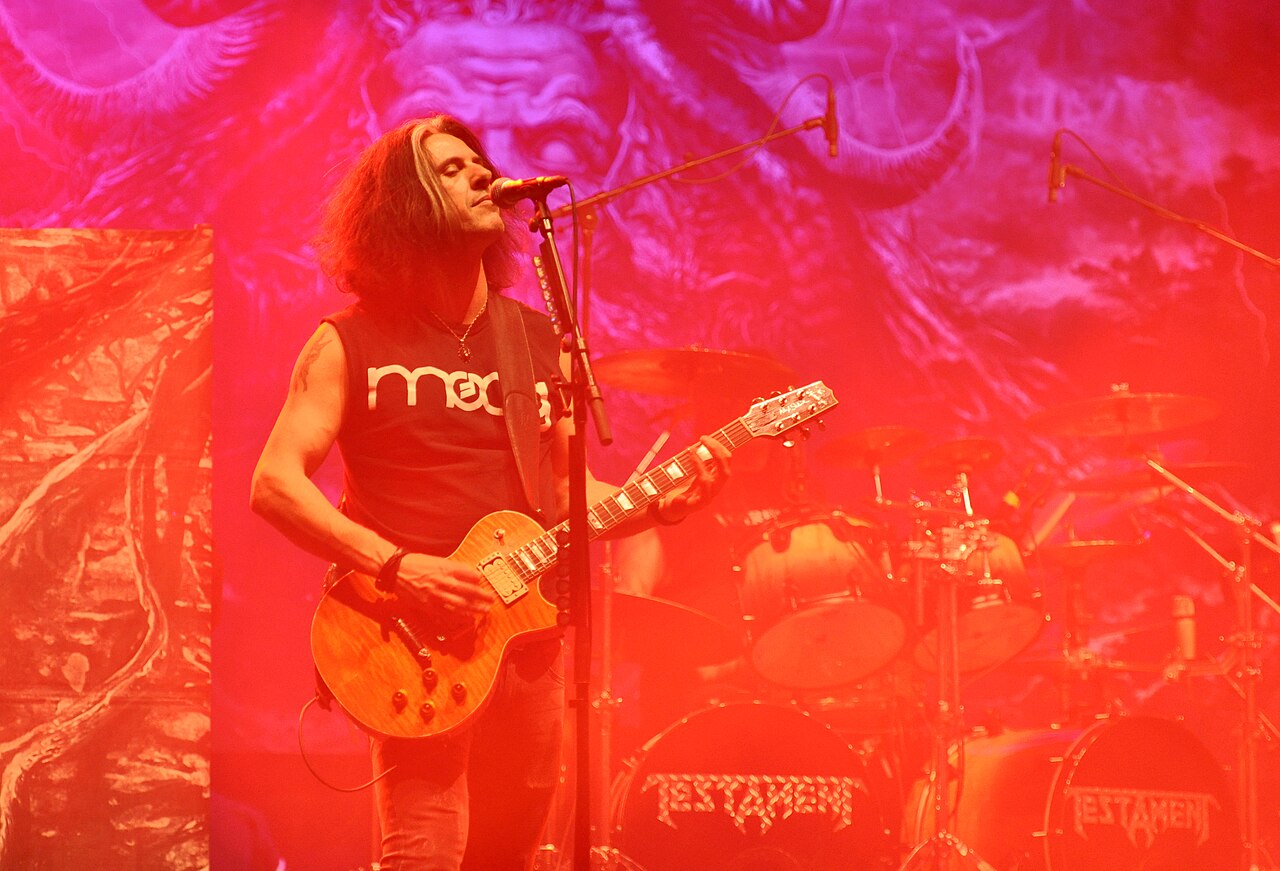
Neither Hetfield’s Truckster nor Hammett’s KH-3 is technically an off-the-shelf E-II Eclipse — both are personalized signature variants. For a player who genuinely uses the stock platform, look to Testament’s Alex Skolnick. When Skolnick signed with ESP in 2014, the company built him a signature model explicitly described as “based on ESP’s popular Eclipse body style,” featuring a full-thickness mahogany body at 24.75-inch scale, a custom headstock, and TonePros hardware. But Skolnick’s Eclipse story goes further than just a signature variant: an ESP promotional video from 2022 shows him unboxing a brand-new ESP USA Eclipse — the genuine, non-signature version of this exact model — suggesting he plays the stock platform directly, not just a personalized descendant of it.
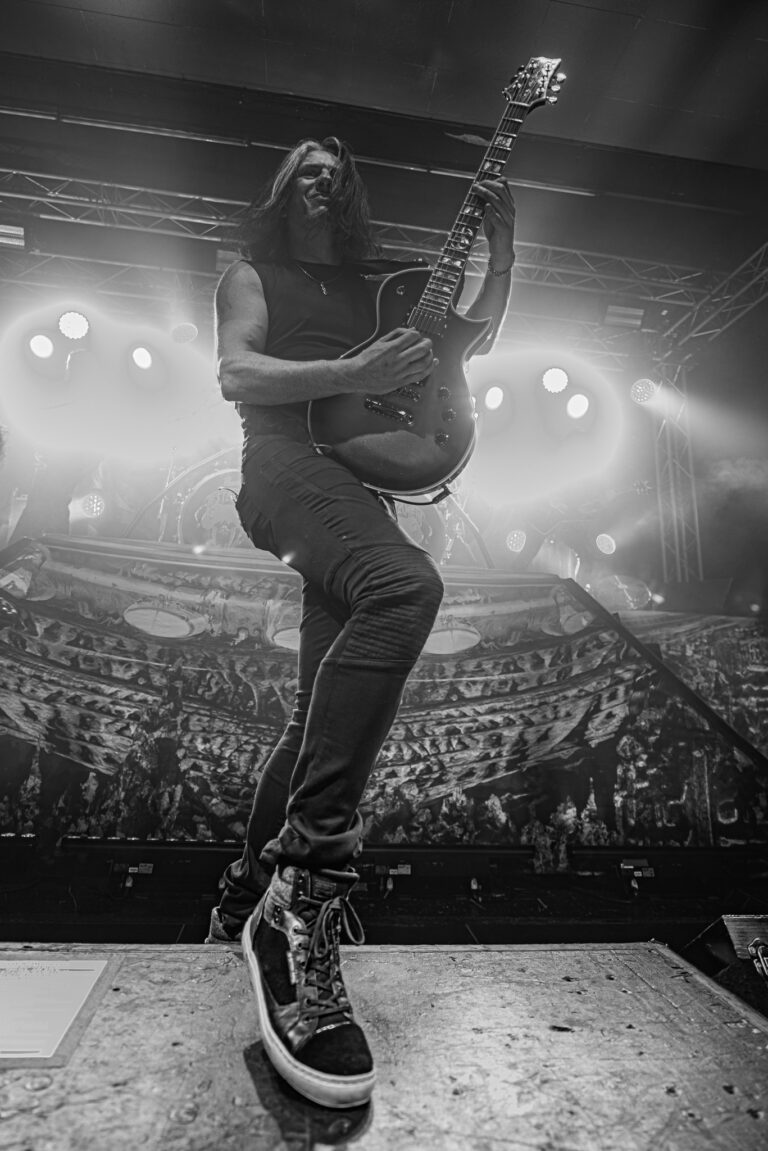
Skolnick’s own career arc adds useful context here: he first found fame as a teenage prodigy in Bay Area thrash pioneers Testament, later left to pursue jazz (forming the genre-crossing Alex Skolnick Trio), and has spent the years since moving fluidly between thrash metal and jazz improvisation — a versatility that maps neatly onto the Eclipse’s own reputation as a metal-associated shape that, in the right hands, works just as well for cleaner, more traditional playing. On the amplification side, Skolnick has favored Budda amplifiers (including his own signature AS Preceptor model) alongside vintage Marshall JCM 800 and Mode Four heads over the years, running a relatively simple pedal chain built around an overdrive, a noise suppressor, and a delay — not far removed from the understated rigs favored by several other guitarists in this article.
ESP’s Manufacturing Philosophy
Part of what makes the Eclipse a credible alternative to the American single-cutaway guitars it visually echoes comes down to where and how it’s built. All ESP E-II instruments are created at the company’s own factory in Tokyo, Japan, and are designed specifically for professional players rather than as a budget stand-in for a more expensive American original. That Japanese manufacturing base is shared across ESP’s E-II line, and reviewers have repeatedly drawn direct comparisons to Gibson’s own Custom Shop output when discussing build quality — occasionally favoring the ESP on fit, finish, and consistency at a comparable or lower price point. It’s a reminder that “single-cutaway metal guitar” doesn’t have to mean a compromise version of the format Gibson popularized decades earlier; in ESP’s case, it’s a genuinely parallel design lineage refined specifically for high-gain rock and metal playing.
The Names That Don’t Fit This Shape
None hold up under scrutiny for the Eclipse specifically. Stephen Carpenter of Deftones has an extensive and genuinely important ESP signature lineage, but it runs through his own dedicated SC series of extended-range baritone guitars — a distinct body shape from the Eclipse, built around his specific needs as a 7- and 8-string riff architect, not a single-cutaway descendant. Alexi Laiho’s ESP signature models were built on an asymmetric V-shaped body, not a single-cutaway platform at all. And George Lynch’s decades-long ESP partnership is built entirely around his own distinctive Kamikaze shape, one of the first ESP signature designs ever created, dating back to 1985 — again, nothing to do with the Eclipse. All three are legitimate ESP artists with real history at the company; they simply belong to different corners of the catalog than this particular guitar.
Construction and Specs
The current E-II Eclipse lineup spans several variants built around a shared core formula. Standard E-II Eclipse models are built in Japan from a mahogany body and neck in a set-thru construction, typically topped with quilted or flame maple, paired with an ebony fingerboard and 22 extra-jumbo stainless steel frets. All E-II Eclipse models include multi-binding on the body, neck, and matching headstock, along with an ESP hardshell case as standard.
Pickup Configurations Across the Range
Pickup configurations vary meaningfully across the range and are worth knowing before buying. The E-II Eclipse DB runs a passive EMG 60/81 pairing in a set-neck configuration, favoring straightforward, aggressive output. Other Eclipse variants use EMG 57TW/66TW pickups wired for coil-splitting via push-pull controls on both volume knobs, adding tonal versatility without extra switches. The standard E-II Eclipse instead runs a passive Seymour Duncan pairing — an SH-4 JB in the bridge (the same pickup nicknamed the “Jeff Beck” model) and an SH-1 ’59 in the neck — a more vintage-voiced, less overtly metal option that reviewers have praised for its versatility into blues and classic rock territory.
The Full Thickness Variant
The Full Thickness variant deserves its own mention: where the standard Eclipse measures 50mm through the body, the Full Thickness version bulks up to a genuinely vintage-spec 60mm, built from mahogany, a maple cap, and a flamed maple veneer, giving it noticeably more mass and a correspondingly different resonant character. This model uses Fishman Fluence active pickups offering three selectable voicings per pickup — a vintage PAF voice, a modern high-output voice, and a coil-split single-coil voice — accessible via push-pull controls on the neck volume and master tone knobs. An EverTune-bridge-equipped Full Thickness variant is also available for players who prioritize constant-tension tuning stability over a traditional vibrato-free tune-o-matic setup, running Fishman Fluence Classic humbuckers with similar multi-voicing controls.
Hardware and Pricing
Hardware across the range typically includes Gotoh locking tuners, a bone nut, ESP strap locks, and a Gotoh tune-o-matic-style bridge with tailpiece (except on EverTune-equipped models). Scale length sits at the classic 24.75 inches associated with single-cutaway guitars, and finishes range from gloss quilted or flame maple tops to satin see-through colors. Pricing for the E-II Eclipse tier generally runs in the $2,000–$2,800 range depending on configuration and finish.
Tone Recipes
Vintage blues and classic rock: Bridge pickup (SH-4 JB) rolled back slightly on volume, moderate amp gain. The JB pickup sparkles on clean settings and comes into its own with some old-school overdrive dialed in — a genuinely versatile starting point despite the Eclipse’s metal-associated reputation.
High-gain rhythm: Bridge humbucker (EMG 81 or equivalent active voicing), amp pushed hard. This is the classic Metallica-adjacent tone this shape has carried since Hammett’s KH-3 days — tight, compressed, and built for palm-muted precision.
Coil-split cleans: On Fishman Fluence or EMG TW-equipped models, engage the coil-split voicing via the push-pull control for a genuinely convincing single-coil quack, useful for funk or lighter clean textures without needing a second guitar.
Comparisons and Family Tree
Within ESP’s own catalog, the Eclipse sits alongside other classic single-cutaway-adjacent shapes at different tiers: the budget-focused LTD EC series offers the same silhouette at a more accessible price point with simplified hardware, while the USA Series Eclipse (the model Alex Skolnick was seen unboxing) sits above E-II as ESP’s premium American-built tier. Signature variants built on this same platform include both Hetfield’s Truckster and Hammett’s KH-3 Spider, discussed above, plus Alex Skolnick’s own EC signature — making the Eclipse shape one of the most artist-populated single-cutaway designs in modern metal, once you account for signature variants built on top of it.
Buying Guide
The E-II Eclipse suits players who want Les Paul-style tonal territory — thick, sustaining, humbucker-driven — without the weight or vintage-vibe compromises of an actual vintage-spec single-cutaway. Players chasing specifically Metallica-adjacent tones should look toward EMG-loaded variants for that tight, compressed high-gain character; those wanting more tonal range for blues, classic rock, or session work should favor the passive Seymour Duncan JB/’59 configuration or a Fishman Fluence multi-voice model. Anyone drawn to constant-tension tuning stability for drop tunings should specifically seek out the EverTune-equipped Full Thickness variant.
Players considering a drop-tuned setup should also weigh body thickness carefully. One reviewer found the standard-thickness Eclipse handled lower tunings comfortably, taking it down to drop C without tuning stability issues even with factory strings, but the added mass and sustain of the Full Thickness variant may appeal more to players prioritizing a heavier, more resonant low end for extended-range or heavily downtuned material. Hand size is also worth considering: the notably slim neck profile that reviewers consistently praise for speed and comfort may feel undersized to players with larger hands who are used to a chunkier vintage-style Les Paul neck.
Ownership Notes
Reviews consistently praise the E-II Eclipse’s fit and finish. One reviewer called the fit and finish as good as anything available around the £2,000 price point, while another noted the factory setup on the Full Thickness model arrives with action low enough to satisfy the most demanding legato players out of the box. The most common critique across reviews is the notably slim, thin neck profile, which won’t suit every player’s hand — one reviewer specifically flagged the super slim neck as potentially not for everyone despite otherwise praising the guitar’s build quality and playability. A handful of owners have also noted that ESP’s reversed volume-control layout (designed around the assumption that players will spend most of their time in the bridge position) takes some adjustment for players used to a standard Les Paul-style layout.
Read our guide to Kirk Hammett’s tone and gear for a wider view of his Metallica guitar history.
FAQ
Do James Hetfield and Kirk Hammett actually play the E-II Eclipse?
Not the exact current-production E-II Eclipse, but both have deep historical ties to the underlying shape. Hetfield’s Truckster began as a personally modified ESP Standard Eclipse used on Metallica’s 2003 St. Anger tour, and Hammett’s KH-3 Spider — played throughout the Black Album era — is officially described by ESP as an “Eclipse,” built on the same platform with his own signature specs.
What’s the difference between E-II and ESP Standard?
They’re the same product line under a different name. ESP renamed its “Standard” range to “E-II” in 2014; the Japanese factory, construction quality, and general shape lineup remained continuous through the rebrand.
What’s the difference between the standard Eclipse and the Full Thickness version?
The Full Thickness model has a body roughly 60mm deep, compared to 50mm on the standard Eclipse, closer to a vintage-spec single-cutaway guitar’s dimensions, giving it more mass and a different resonant character.
Which ESP artists are NOT connected to the Eclipse shape despite sometimes appearing on Eclipse-related lists?
Stephen Carpenter (Deftones), Alexi Laiho, and George Lynch all have significant ESP signature histories, but each on entirely different body shapes — Carpenter’s own extended-range SC series, Laiho’s V-shaped signatures, and Lynch’s Kamikaze design.
Image credits
- Alex Skolnick: Achim Raschka, Wikimedia Commons, CC BY-SA 4.0.
- Alex Skolnick: Stefan Brending (2eight), Wikimedia Commons, CC BY-SA 3.0.
Latest News
Related
On This Day
Tuesday 10 November
From this week: