The British Invasion in a Box: Universal Audio UAFX Ruby ’63 Top Boost Amplifier
UA UAFX Ruby '63 puts a 1963 Vox AC30 in a stompbox—three channels, Dallas Rangemaster boost, Celestion speaker sims, and studio-grade direct tones.
In 1963, a copper-panelled 2×12 combo amplifier built in Dartford, Kent, was quietly becoming the defining voice of British rock and roll. The Vox AC30 Top Boost — with its quartet of EL84 power tubes, alnico blue Celestion speakers, and a deceptively simple treble-boost circuit bolted to the rear panel — had already rewired the sound of the Beatles, seduced Hank Marvin into jangle immortality, and was about to propel a generation of musicians into rooms far louder than anything Dartford had previously imagined. Six decades later, Universal Audio has taken that copper-panelled 1963 unit apart at the molecular level and compressed everything it knows into a stompbox the size of a sandwich.
The UAFX Ruby ’63 Top Boost Amplifier is not a distortion pedal with a Vox filter slapped on top. It is a dual-engine digital emulation of all three channels of a real 1963 AC30 Top Boost — Normal, Brilliant, and Vibrato — complete with emulations of two period-correct boost pedals, six virtual speaker cabinet configurations, Dynamic Room Modeling derived from UA’s OX Amp Top Box, and Bluetooth connectivity to a mobile app that lets you swap speakers, archive presets, and download tones from studio pros. At the time of its 2022 launch it cost $399. By 2026 the price had risen to $499. Either way it is one of the most complete single-amp emulations ever placed into a stompbox, and Premier Guitar called it a Premier Gear Award winner in September 2022.
This is the deep guide: where it came from, what it does, who plays one, how to set it up, and whether the price tag is justified in a world that already has the Kemper, the Neural DSP Quad Cortex, and the Fractal Axe-FX III. Spoiler: it depends entirely on whether you need an AC30 or everything else.
Universal Audio: From Hollywood Studio to UAFX Pedal Line
Universal Audio was founded in 1958 by Bill Putnam Sr. — the recording engineer who invented the modern recording console, pioneered direct-to-multitrack recording, and designed the reverb chambers at United Western Recorders in Hollywood. Putnam built the 610 console that recorded Frank Sinatra, Ray Charles, and the Beach Boys. He died in 1989, and the company went dormant. In 1999, his sons Bill Jr. and Jim Putnam revived the UA name in Santa Cruz, California, initially to manufacture hardware reissues of classic outboard gear — the 1176 compressor, the LA-2A limiter — and UAD DSP plug-ins for recording studios.
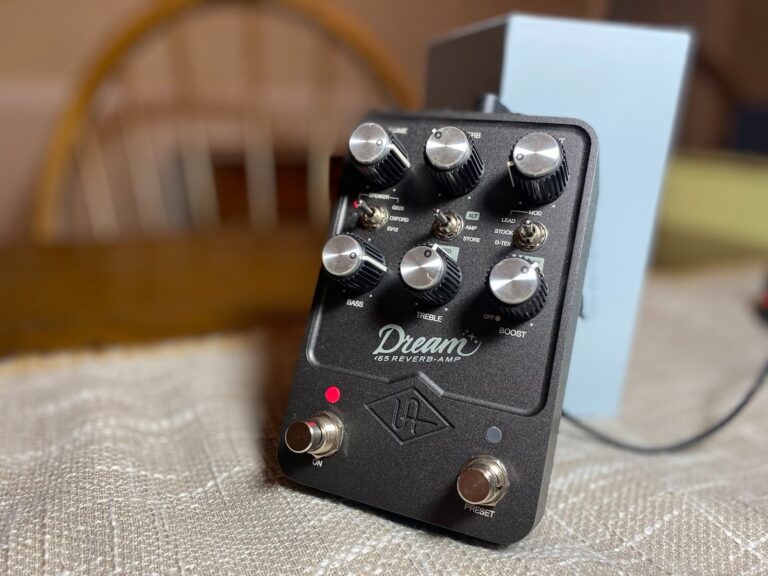
The UAFX guitar pedal line arrived in 2022 as UA’s first consumer guitar products: three amp emulators launched simultaneously. The Ruby ’63 (Vox AC30 Top Boost), the Dream ’65 (Fender Deluxe Reverb), and the Woodrow ’55 (Fender Tweed Deluxe) were UA’s argument that studio-grade amp modeling now fit on a pedalboard. UA had relevant credentials: the OX Amp Top Box, their loadbox and cab-sim unit, had already demonstrated that their IR and Dynamic Room Modeling could capture a miked tube amp with unusual accuracy. The UAFX pedals carry that same technology into stompbox form, running a dual-DSP engine that UA claims is doing computations no single-engine box can match.
The Ruby ’63 was reviewed by guitar.com on June 23, 2022 (9/10: “the ultimate Vox in a box”) and by Premier Guitar on September 11, 2022 (4.6/5, Premier Gear Award). Both drew the same conclusion: UA had done something most amp-in-a-box pedals fail to do, which is capture not just the EQ curve but the feel and dynamic response of the original amp.
The 1963 Vox AC30 Top Boost: The Amp Behind the Ruby
The AC30 was born in 1958 at Jennings Musical Industries (JMI) in Dartford, Kent, designed by Dick Denney at the request of Hank Marvin and Cliff Richard, who needed a louder version of the AC15. The original AC30 used EL84 power tubes, ran at 30 watts, and had a tweed-style circuit with fixed bias. In 1960, JMI introduced an optional external Top Boost unit — a small add-on chassis containing an extra gain stage plus independent Bass and Treble controls — which clipped to the rear of the amplifier. It proved so popular that by 1961–1962 the Top Boost circuit was integrated into the main control panel, creating the variant now known as the AC30TB.
The 1963 copper-panel Top Boost is the version the Ruby emulates. It had three channels sharing a common output stage: Normal (warm, slightly dark, best for clean headroom), Brilliant (the classic Top Boost voice, brighter with more midrange cut and shimmer, the source of the iconic “chime”), and Vibrato (the Normal channel run through the AC30’s onboard tremolo/vibrato circuit). The speakers were Celestion alnico “Blues” — 12″ drivers with alnico magnets, rated at 15 watts, whose breakup character at moderate volume is a large part of why the AC30’s clean-to-crunch transition sounds so musical. The cabinet was a birch-ply open-back 2×12, contributing lower-mid warmth and natural room coupling that closed-back designs cannot replicate.
The Vox AC30 Top Boost has since appeared on more classic records than any other British amplifier. The Beatles used AC30s at the Cavern Club and on early EMI sessions. Brian May of Queen built much of his early tone around modified AC30s pushed through a Dallas Rangemaster treble booster. The Edge of U2 used AC30s on every record from Boy through The Joshua Tree. Tom Petty toured AC30s. Pete Townshend used them. Andy Summers of The Police ran them. Johnny Marr of The Smiths is a documented AC30 user. Tom Verlaine of Television used AC30s to build the intertwined-guitar sound of Marquee Moon. The AC30’s frequency signature — a pronounced upper-mid presence peak around 3–5 kHz, controlled low-end from the open-back cab, and EL84 power-stage compression that rewards a heavy pick attack — is one of the most imitated sounds in rock history.

Specs at a Glance
Famous Players: The AC30 Roster the Ruby Inherits
No single headline guitarist has named the UAFX Ruby ’63 specifically in a verified Rig Rundown, manufacturer product page photo, or published interview as of 2026. Universal Audio’s own product page carries a testimonial from David Ryan Harris — a session guitarist who has worked with John Mayer, Dave Matthews Band, and Carlos Santana — but his quote (“I put all three on my studio board!”) refers to all three UAFX amp pedals collectively, not the Ruby specifically. Butch Walker, the producer behind records by Green Day, Weezer, and Taylor Swift, also appears in UA’s UAFX marketing. Both are brand-level associations confirmed on the manufacturer’s page, not SKU-specific endorsements verified through independent primary sources.
The honest editorial framing for a Ruby ’63 Famous Players section is therefore the same one used at Ranks 641–643: amp emulator pedals are infrastructure. They do not carry a guitarist’s name. They appear on pedalboards because they solve a practical problem — touring without a real AC30, recording direct into a DAW without a miked cab — and working professionals who use them are not generally photographed pointing at a stompbox and saying “that one, specifically, is my favourite.”
What the Ruby does have is the most famous indirect player roster in the history of guitar amplification: the AC30’s own legend, which the Ruby explicitly inherits.
Brian May is the most direct connection the Ruby can claim, because his instrument chain at its most essential was: Brian May Red Special guitar → Dallas Rangemaster treble booster → modified Vox AC30. The Ruby ’63 emulates both the AC30 and the Dallas Rangemaster (on its Normal channel boost mode). The Rangemaster is not a footnote — it is the reason May’s AC30 tones have the searing, harmonically saturated quality they do. The germanium transistor in a Rangemaster rolls off the low end while adding gain to the upper midrange, which takes an AC30’s natural presence peak and sharpens it into something close to violin-like sustain at high volumes. The Ruby packages this exact pairing in a single box.
The Edge of U2 built the sonic language of Boy (1980) and War (1983) around AC30 clean tones. The jangle of “I Will Follow,” the shimmer of “Sunday Bloody Sunday,” and the open-chord architecture of “Where the Streets Have No Name” were all assembled on Brilliant-channel AC30 foundations before the delay pedals arrived. The Edge’s relationship with the AC30 is so well-documented that it is the primary reason the AC30 has remained in production continuously for over 65 years. The Ruby’s Brilliant channel is the closest digital equivalent that has appeared in a stompbox format.
George Harrison and John Lennon used AC30s at the Cavern Club and during the earliest EMI sessions. The chimey, compressed clarity of early Beatles recordings — the way rhythm guitar parts cut through without ever dominating — is a direct product of the AC30’s voiced character. Harrison’s use of the Normal channel for cleaner rhythm tones while Lennon’s Rickenbacker jangle pushed into AC30 Brilliant territory is audible on records from With the Beatles forward.
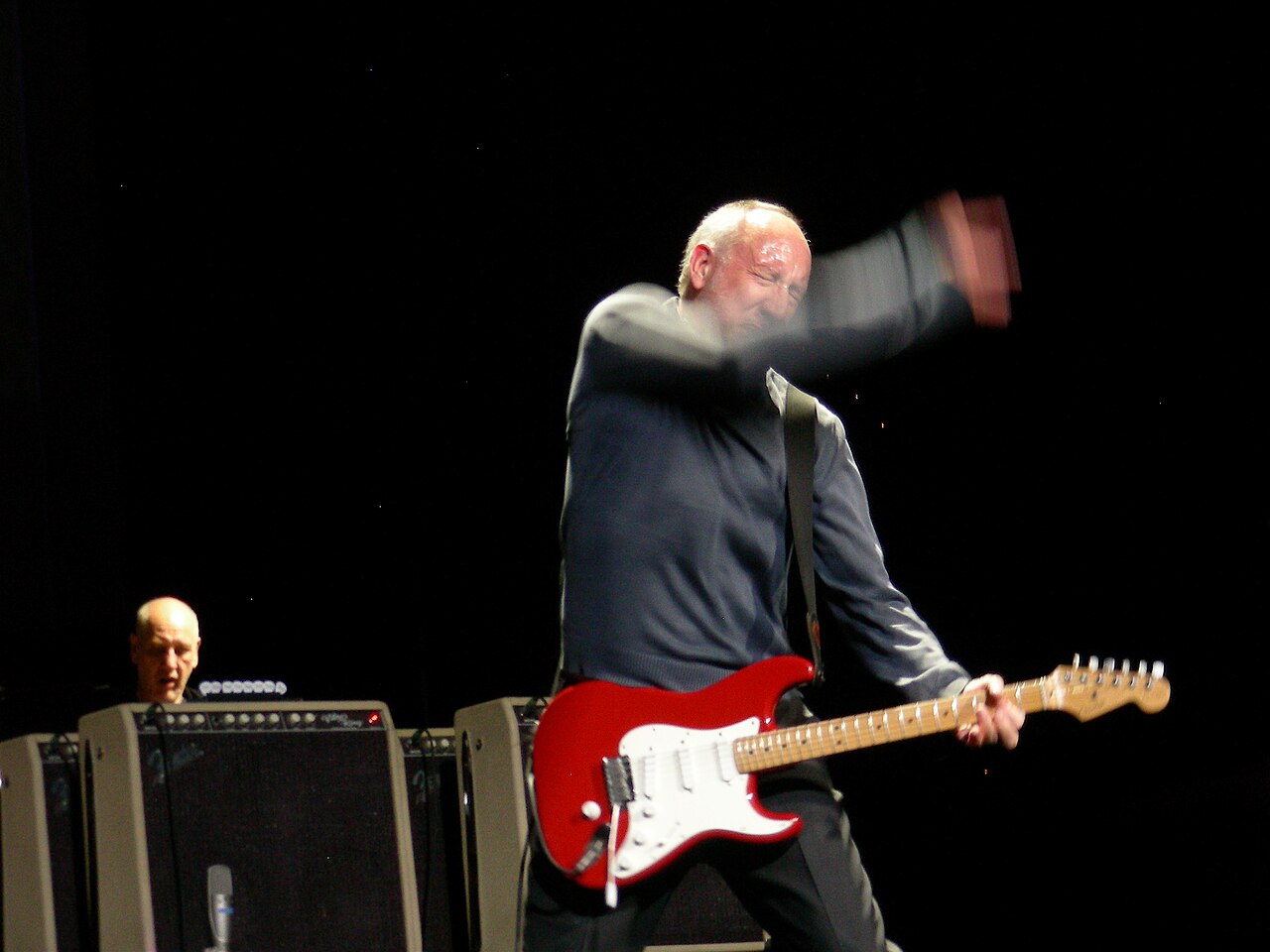
Pete Townshend of The Who began his career on AC30s before migrating to Marshall stacks as venues grew. His early recordings, including the backing tracks on My Generation (1965), carry AC30 DNA — the boxy mid compression and the way the amp responds to pick attack with a slight bite before bloom.
Andy Summers of The Police used AC30s throughout the band’s career, with their clean, open harmonic quality suited to the open-voiced chord shapes Summers favoured. Johnny Marr of The Smiths is a documented AC30 user whose 12-string Rickenbacker-into-AC30 sound is a textbook demonstration of what the Brilliant channel does when you play clean arpeggiated chords on a bright guitar. Tom Verlaine of Television and Graham Coxon of Blur both extended the AC30 jangle tradition into post-punk and Britpop respectively.
All of these are players on the real amplifier — not on the UAFX Ruby ’63, which is a recent product that postdates most of their formative work. The Ruby is explicitly an emulator. But when a pedal emulates an amp this well, and when the amp being emulated has a player roster this deep, the connection is not a marketing claim. It is a fact about what sounds are now available in a 1.24-pound stompbox.
Tone Recipes and Settings
1. Brilliant Channel Jangle (The Edge / Johnny Marr)
Channel: Brilliant. Boost: EP-3 Echoplex preamp, set to about 9 o’clock (low engagement — you want the preamp colour without added gain). Volume: 12 o’clock. Cut: 10 o’clock (a little high-frequency rolloff removes digital edge). Bass: 11 o’clock. Treble: 1–2 o’clock. Room: 11 o’clock (a touch of room air without reverb character). Speaker: Celestion Blue. Play open A-shape and D-shape chords with a clean touch — this is where the AC30 Brilliant channel sings. Run into a clean amp with the cab sim active, or direct into a DAW channel. With a delay pedal placed after the Ruby, this setting produces the delay-into-AC30 chain that defines U2’s early sound.
2. Normal Channel + Rangemaster (Brian May Stack)
Channel: Normal. Boost: Dallas Rangemaster, set to 12–1 o’clock (the Rangemaster gets bright fast — control it with the Treble knob). Volume: 12–1 o’clock. Cut: 12 o’clock. Bass: 10 o’clock. Treble: 11 o’clock. Room: 10 o’clock. Speaker: Celestion Silver. Pick hard on single-note lines on the upper strings — the Rangemaster’s low-end roll-off and mid-focus make everything sharpen as you push. Use your guitar’s volume knob to clean up: from 10 down produces singing clean tones; from 10 up introduces compressed harmonic saturation. Red Special humbuckers or PAFs recommended, but single-coils work with the Treble pulled back.
3. Vibrato Channel Surf and Shimmer
Channel: Vibrato. Boost: clean boost, 8–9 o’clock (just adding a touch of volume push, no gain). Volume: 11 o’clock. Cut: 12 o’clock. Bass: 12 o’clock. Treble: 1 o’clock. Room: 12 o’clock. Speaker: Celestion Blue. Hold the Alt switch to access vibrato speed (Treble knob) and depth (Boost knob): set speed to 10 o’clock (gentle), depth to 9 o’clock (barely perceptible). The result is the phasey wobble that 1960s British instrumentalists used on ballads — not the fast tremolo of a Fender, but a slower, more harmonic movement. Combine with reverb after the Ruby for vintage surf territory.
4. Brilliant Channel Hard-Picked Overdrive (Townshend / Power Pop)
Channel: Brilliant. Boost: EP-3 at 1–2 o’clock (more preamp drive). Volume: 1 o’clock. Cut: 11 o’clock. Bass: 11 o’clock. Treble: 12 o’clock. Room: 11 o’clock. Speaker: G12H (heavier speaker, more low-mid focus, controls the brightness). This pushes the Brilliant channel into its natural overdrive zone — the compressed, slightly grainy crunch of an AC30 pushed by a P-90 or humbucker. Not high-gain, but a convincing approximation of what Pete Townshend got from his AC30s at stage volumes. Run a fuzz or overdrive in front of the Ruby for additional saturation — the Ruby reads and responds to pedal gain like a real amp preamp would.
5. Studio Direct, Tone Reference Clean
Channel: Normal. Boost: off entirely. Volume: 11 o’clock. Cut: 12 o’clock. Bass: 12 o’clock. Treble: 12 o’clock. Room: 1–2 o’clock (more room character). Speaker: Celestion Gold (via app). This is the Ruby as a studio DI reference — the most neutral, accurate representation of a miked 1963 AC30 Normal channel at moderate volume. Use for acoustic-style fingerstyle electric, clean R&B chording, or as a foundation track before printing effects. The Gold speaker adds warmth and low-mid weight that the Silver lacks; it is the most “vintage hi-fi” of the speaker options.
How It Compares
The Ruby ’63 is a dedicated single-amp emulator. It does one amplifier — the 1963 Vox AC30 Top Boost — with exceptional depth and authenticity. Everything below is the competitive context buyers need to understand before spending $499 on one AC30 channel.
The Kemper Profiler Head and the Neural DSP Quad Cortex are full amp-modeling platforms that can host hundreds of amp profiles, including AC30 profiles captured from real units. If you need an AC30 plus twelve other amplifiers, a Kemper or Quad Cortex at two to three times the Ruby’s price is more versatile. The Ruby is the better choice if you want one specific amplifier done with obsessive accuracy, no profile-management workflow, and a physical interface you can adjust without a screen.
The Line 6 Helix Floor includes AC30 models among its library and costs more than the Ruby as a floor unit. It is a routing platform first and an amp emulator second — the Ruby is the opposite. Helix wins on routing flexibility and total amp count; the Ruby wins on single-amp authenticity and direct-to-front-of-house simplicity.
The Fractal Audio Axe-FX III Mark II is a studio-grade modeler at several times the Ruby’s price. Its AC30 model is excellent. The comparison is less “which one is better” and more “which format fits your workflow” — the Axe-FX III is a studio/rack processor; the Ruby is a pedalboard stompbox.
The Walrus Audio ACS1 Amp + Cab Simulator MKII ($449.99) includes a Dartford model that emulates the AC30 among its six amp voices. The ACS1 MKII is the direct competitor: similar price, similar use case, similar stereo direct capability. The ACS1 wins on versatility (six amp models vs. one); the Ruby wins on AC30-specific depth — three AC30 channels vs. one, built-in period-correct boosts, Dynamic Room Modeling from OX cab technology, and a more faithful vibrato circuit. If you play exclusively Vox-territory music, the Ruby is the better dedicated tool. If you also need Marshall, Fender, Orange, Mesa, and Peavey 5150 sounds, the ACS1 MKII wins.
The Strymon Iridium includes a Rounds model loosely based on Vox character, but it is one of three amp voices and lacks the Normal/Brilliant/Vibrato channel distinction, the Rangemaster boost, and the vibrato circuit. The Ruby is significantly deeper on AC30 specifically.
Buying Guide
The current MSRP for the Universal Audio UAFX Ruby ’63 is $499 USD as of 2026, up from its $399 launch price in 2022. Sweetwater, Guitar Center, and Musician’s Friend all carry it at the standard UA price; UA occasionally bundles it with UAD plug-in credits. The pedal has no formal lower-tier or higher-tier variant — unlike some pedal lines, the Ruby is a single SKU with no MKI/MKII version split as of the time of writing, though UA has issued multiple firmware updates that added features including USB MIDI control.
On the used market, expect to pay $200–$300 for a Ruby ’63 in excellent condition, depending on firmware status and whether the original box and manual are included. Buy from a seller who has updated the firmware via the UAFX Control app — firmware updates add features (USB MIDI was a notable post-launch addition) and the process requires a desktop computer running UA Connect.
Power supply: the Ruby requires an isolated 9V DC center-negative supply capable of 400mA. Standard pedalboard supplies at 100mA or even 250mA will not power it. Many popular isolated power bricks have at least one 400mA+ high-current output — verify before buying. The power supply is not included in the box.
The UAFX Control mobile app (iOS and Android) is free and unlocks three additional speaker cabinet configurations, artist preset downloads, deep footswitch customization, and four onboard preset slots. Register the pedal via UA Connect on a computer to confirm firmware and activate the warranty. The app connection is Bluetooth; it is stable but requires keeping your phone nearby during initial setup and preset saves.
Ownership Notes
The Cut knob is your most important control. On a real AC30 Top Boost, “Cut” is a high-frequency rolloff control — not a treble boost. Turning it clockwise cuts the high end, which is the opposite of most amp tone controls. The Ruby replicates this behaviour faithfully. Beginners frequently leave Cut at maximum and wonder why the tone is harsh. Start with Cut at noon and adjust left for the standard AC30 voiced response.
Speaker selection matters more than channel selection. The difference between Celestion Silver and Blue is the difference between the AC30 of the 1970s–80s (Silver, slightly brighter and more articulate) and the AC30 of 1961–1965 (Blue, warmer, earlier breakup, more “vintage”). The G12H brings a heavier low-mid character that is less historically accurate but works better for crunchier playing. The app-unlocked Gold is the most balanced option for studio direct recording. Experiment with all before settling.
There is no footswitch for the vibrato effect. Premier Guitar flagged this in their review and it remains a real limitation — if you want to stomp the vibrato on and off mid-song, you cannot. The Vibrato channel is selected by the three-way channel toggle, not a footswitch. Workaround: use the preset footswitch to jump between a Vibrato-channel preset and a non-vibrato preset, which requires saving presets in advance via the app.
4-cable method bypasses your amp’s preamp. If your amp has an effects loop, you can wire the Ruby so that when it is engaged, your amp’s preamp is bypassed and the Ruby’s AC30 emulation takes over — going amp power section + Ruby cab sim → direct to PA. When bypassed, signal runs through your real amp’s full chain. This is the most powerful use of the Ruby live: two complete rigs on one set of strings with a single footswitch.
Mono use with no cab sim. The “no cab” toggle removes the speaker simulation, sending a raw amp-only signal. Use this when running into a real cabinet on stage — you get the Ruby’s AC30 preamp character into your own power amp and speaker, rather than a double-coloured signal through both the digital cab sim and a physical cab.
Firmware update early. USB MIDI control — one of the Ruby’s most useful live features — was added in a post-launch firmware update and is not active on early-production units out of the box. Connect to UA Connect on a desktop computer before your first session to ensure you have current firmware.
Frequently Asked Questions
What amp does the UAFX Ruby ’63 emulate?
The Ruby ’63 is based on a 1963 Vox AC30 Top Boost — the “copper panel” version of the iconic British 2×12 combo amplifier, running four EL84 power tubes and two Celestion Alnico Blue 12″ speakers, with the Top Boost treble-boost circuit integrated into the main control panel. It is the same amp associated with the Beatles, Brian May, The Edge, and The Shadows.
What is the Dallas Rangemaster and why does the Ruby include it?
The Dallas Rangemaster Treble Booster was a germanium-transistor pedal produced in Britain from around 1965. It rolls off bass frequencies and adds gain to the upper midrange, and it was used by guitarists including Brian May to push AC30s beyond their natural clean headroom into singing overdrive. The Ruby includes a digital emulation of the Rangemaster on its Normal channel boost mode — the same pairing May used to create his Queen lead tones — making it one of the few pedals to honestly model both the amplifier and the period-correct booster that defined its most famous sonic application.
Can I use the Ruby in front of a real amp?
Yes. There is a “no cab” mode that bypasses the speaker simulation. In this configuration you use the Ruby’s AC30 channel and boost emulation as a preamp shaper in front of your real amplifier and cabinet, without the cab sim doubling up with your physical speakers. This is useful on stages where a real cab is already present and you want AC30 character without direct-to-FOH operation.
Does the Ruby work in stereo?
Yes. The right input accepts a stereo source (or the send loop in 4-cable method), and the right output carries the second stereo channel. In stereo mode the cab simulation creates a realistic wide image of a 2×12 cabinet — useful for direct recording or direct-to-front-of-house at venues with a stereo PA. Most live applications use mono, but the stereo option is genuinely usable for studio and IEM monitoring work.
What power supply does the UAFX Ruby ’63 need?
An isolated 9V DC center-negative supply providing at least 400mA of current. Standard 100mA or 250mA outputs will not work. The power supply is not included in the box. Many popular isolated pedalboard power bricks include at least one high-current output — verify that your specific unit has a 400mA or higher output before purchasing.
Is the UAFX Ruby ’63 better than a real Vox AC30?
For the specific application of recording direct into a DAW or running direct to a PA at a venue without miking a cabinet, the Ruby is more practical and more consistent than a real AC30 — it produces a studio-quality miked AC30 tone without a mic, a room, a stand, or a high-SPL speaker cone vibrating in a venue’s acoustic environment. For playing in a room at volume with a real 2×12 cabinet at your back, a real AC30 does things the Ruby cannot: actual air movement, power-tube sag at stage volume, and the physical feedback of a speaker coupling with your guitar. The Ruby is not better or worse — it is a different tool for a different context.
Can I use MIDI with the UAFX Ruby ’63?
Yes, via USB MIDI — connect a USB-C cable from the Ruby’s rear panel to a MIDI host (a computer, a MIDI interface, or a compatible pedalboard switcher), and the Ruby receives preset changes and real-time control of boosts, EQ, and other parameters. This feature was added in a post-launch firmware update and requires updating the pedal via UA Connect before it is active. Traditional 5-pin DIN MIDI is not supported.
How does the Ruby compare to the Walrus Audio ACS1 MKII for Vox sounds?
The Walrus Audio ACS1 MKII includes a Dartford model (Vox AC30) among six amp voices, priced at $449.99. The ACS1’s Dartford model is one channel only — it does not separate Normal, Brilliant, and Vibrato; it does not include a Dallas Rangemaster or EP-3 boost; and its vibrato circuit is not an AC30 Vibrato channel emulation. The Ruby is a significantly deeper AC30 emulation. The ACS1 MKII wins if you also need Marshall, Fender, Orange, Mesa, and Peavey 5150 sounds from the same box. The Ruby wins if AC30 tones are your primary or sole requirement.
Image credits
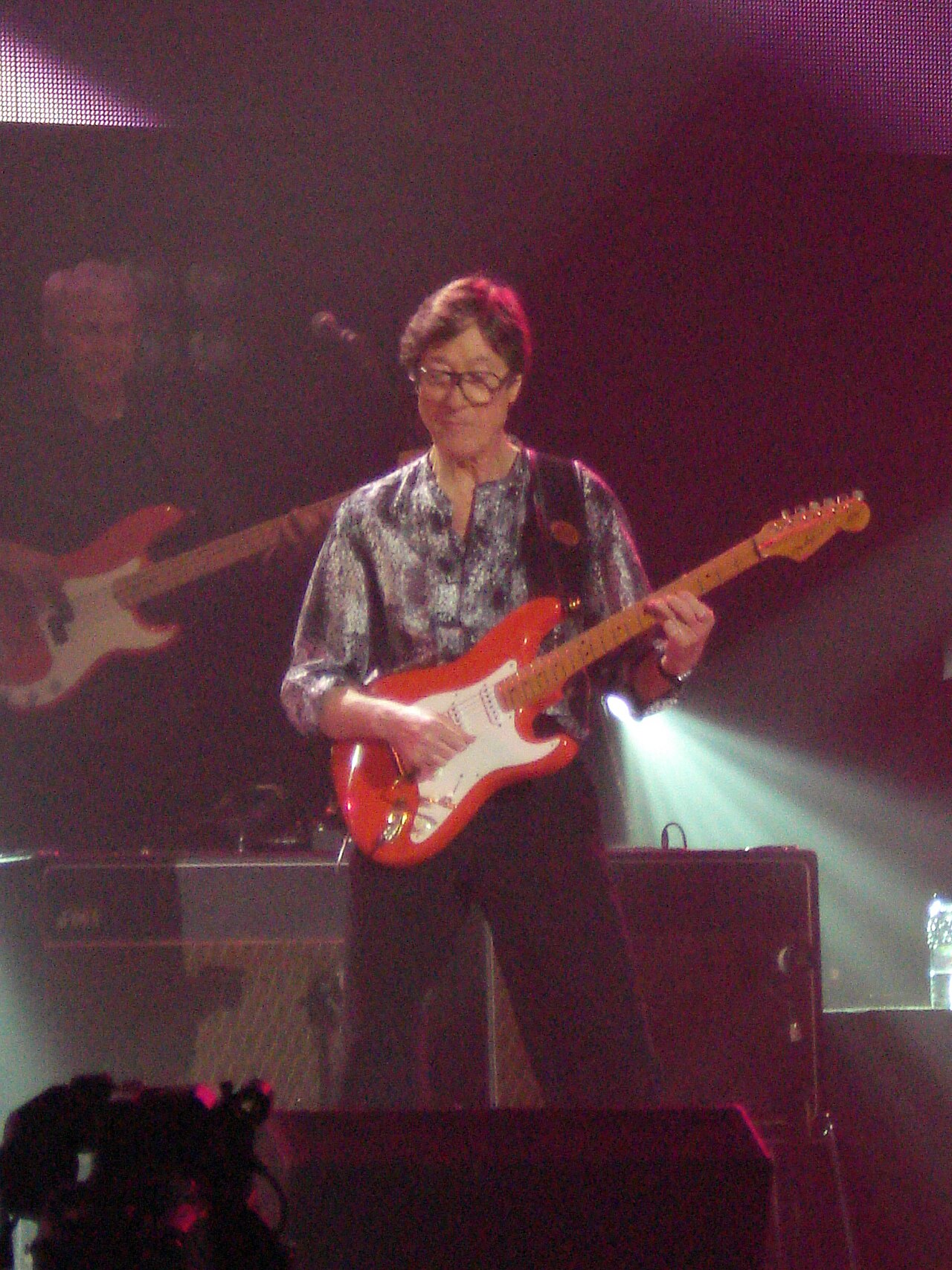
- Hank Marvin: Jpmawet, Wikimedia Commons, CC BY-SA 3.0.
- Pete Townshend: Kubacheck, Wikimedia Commons, CC BY 2.0.
- The Edge: iinchicore, Wikimedia Commons, CC BY-SA 4.0.
Latest News
Related
On This Day
Tuesday 10 November
From this week: