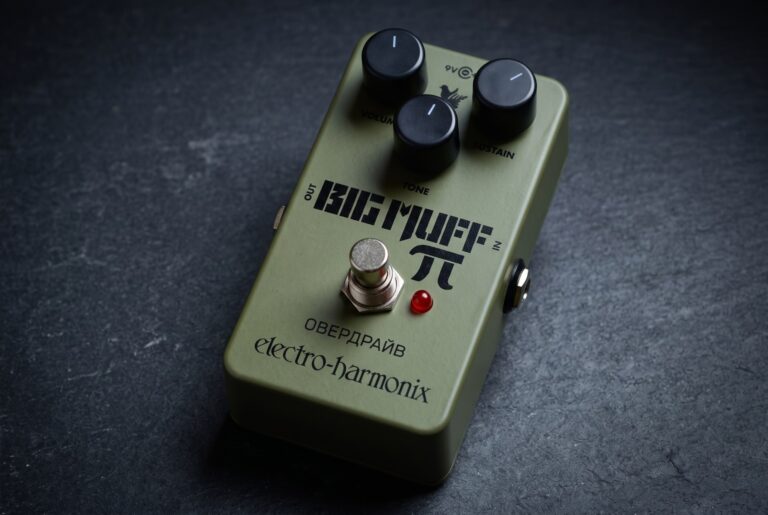
The Wicked Wicker: How Two Switches Turned the Big Muff Pi Into Four Different Fuzz Pedals
EHX Big Muff Pi Tone Wicker review: two switches, four fuzz voices. Tone bypasses the filter; Wicker opens treble. Full guide to modes, settings, and use.
By 2008, the Big Muff Pi had been a fixture of guitar rigs for nearly four decades. It had defined the sound of psychedelic solos, grunge records, and shoegaze walls of noise across a dozen variants spanning transistors, op-amps, and Russian CMOS chips. Electro-Harmonix could have left it alone. Instead, they asked a simple question: what if players could reach inside the circuit and turn off the bits they didn’t want?
The Big Muff Pi with Tone Wicker is the answer. Released in 2008, it takes the full-size NYC Big Muff circuit — the same four-stage transistor topology that has driven the family since its return in the early 1990s — and adds two toggle switches that fundamentally alter how the circuit behaves. Flip the Tone switch and the passive tone control network drops entirely out of the signal path. Flip the Wicker switch and three high-frequency filters that normally suppress the pedal’s top end are opened up, letting raspy, defined treble bloom through. Use both together and you get something that barely resembles a conventional Big Muff at all.
That’s four distinct tonal voices from one pedal at one price point. In a Big Muff family crowded with reissues of specific vintage variants, the Tone Wicker stands apart as an instrument of tonal exploration rather than historical recreation. It doesn’t pretend to be 1973. It asks what a Big Muff could be if you stopped constraining it to what it has always been.
From Knobs to Switches: The Tone Wicker’s Place in Big Muff History
The standard full-size Big Muff Pi — the US BM, the pedal that sits at the center of the EHX lineup — is a direct descendant of the original 1969 circuit. Its architecture is simple and elegant: a Volume knob, a Sustain knob, and a Tone knob, all working through four transistor gain stages with a passive tone network positioned between the clipping stages. The passive tone network is the Big Muff’s characteristic shaper — it produces the deep mid-scoop centered around 1kHz that gives the pedal its distinctive frequency signature, and it rolls off the highest treble frequencies, producing the warm, sustaining character players associate with the classic sound.
For most of the pedal’s history, those characteristics were baked in. You got the mid-scoop and the treble rolloff as part of the deal. The EHX team understood that different players in different contexts wanted different amounts of these qualities — and that the passive tone network was the place to intervene.
The Op-Amp Big Muff Pi (covering the 1977–1979 V4/IC variant reissued in 2017) had already introduced a Tone Bypass switch to the Big Muff family in its original vintage form, allowing players to remove the tone control entirely for a broadband assault. Billy Corgan used exactly this trick on the 40-layer guitar stacks of Siamese Dream. The Tone Wicker takes that concept and adds a second dimension: the Wicker switch, which doesn’t bypass the circuit but instead modifies it, opening high-frequency filters that the standard design keeps closed.
EHX released the Big Muff Pi with Tone Wicker in 2008, presenting it as the most adaptable version of the standard Big Muff circuit ever produced. The enclosure is the traditional full-size Big Muff chassis — 4.75 inches by 4 inches by 2.25 inches — in the familiar black-and-white colorway, but with two small toggle switches added between the knobs and the footswitch. Those two switches are the entire story of this pedal.
Specifications
The 5mA current draw is low enough for any standard 9V output on a pedalboard supply. The absence of an included adapter is consistent with EHX’s standard packaging for pedals in this price range — plan accordingly if you’re running this without a battery. No power adapter is included.
Understanding the Two Switches: What They Actually Do
Before getting into famous players and tone settings, it’s worth explaining the two switches precisely, because the Tone Wicker is easily misunderstood as an “add treble” pedal when it’s really a “remove filtering” pedal.
The Tone switch addresses the passive tone network. In the standard Big Muff circuit, this network is a frequency-shaping filter positioned between the clipping stages — it determines which frequencies get amplified and sustained and which get cut. With the Tone switch in the off position (the standard Big Muff mode), the tone knob is active and the network is in the circuit. With the Tone switch engaged, the entire network is bypassed. The signal flows straight through without the frequency shaping. The result is broader, rawer, and more mid-present — you lose the familiar sculpted Big Muff voice but gain a massive wall of undifferentiated fuzz that can genuinely shake a room.
The Wicker switch is different in character. Rather than bypassing the tone control, it modifies what the circuit does with high frequencies. The standard Big Muff circuit includes high-frequency filters that limit how much treble content makes it through the saturation stages. The Wicker switch opens three of these filters, allowing significantly more upper-frequency content into the driven signal. The result EHX describes as “raspy and defined” — the fuzz takes on a more aggressive, articulate edge without losing the fundamental sustain that makes the Big Muff identifiable. This is not a treble boost in the conventional sense. The Wicker doesn’t add highs that weren’t there; it removes the filtering that was suppressing them.
Together, the two switches create four distinct operating modes:
- Mode 1 — Standard Big Muff (Tone off, Wicker off): The tone network is active, the high-frequency filters are in place. This is the classic NYC Big Muff sound — familiar, warm, mid-scooped, with the Tone knob fully functional.
- Mode 2 — Tone Bypass (Tone on, Wicker off): The tone network is removed from the circuit, but the high-frequency filters remain. A broader, rawer fuzz with significant mid-presence; the Tone knob does nothing. This is the “devastating broadband Big Muff slam” EHX describes.
- Mode 3 — Wicker Mode (Tone off, Wicker on): The tone network is active and the Tone knob functions, but the high-frequency filters are open. A brighter, more raspy Big Muff with increased definition in the top end; the Tone knob now shapes a wider frequency range.
- Mode 4 — Full Wicker + Tone Bypass (both on): Both the tone network and the high-frequency filters are removed. This is the most open, brightest, and least filtered Big Muff sound possible from this circuit — a full-spectrum transistor fuzz with nothing holding back the top end.
Knowing which mode you’re in is important for dialing settings. The Tone knob behaves differently depending on whether the Tone switch is engaged — when the switch is on (tone bypassed), the Tone knob does literally nothing, so don’t waste time adjusting it. Similarly, the Wicker switch interacts with the Tone knob when both are active, making the effective frequency range of the Tone sweep wider than in standard mode.
Famous Players
Any Big Muff article risks inheriting the same list of legendary names — Gilmour, Corgan, Mascis, Auerbach — and applying them broadly. The Tone Wicker is a full-size NYC circuit variant released in 2008.
David Gilmour used the 1973–1977 Ram’s Head Big Muff Pi, confirmed via Phil Taylor’s Guitar Player statement and Pete Cornish’s board records. Billy Corgan used the Op-Amp Big Muff Pi V4, confirmed by Mike Matthews directly on the EHX product page. J Mascis used the Ram’s Head variant so definitively that EHX created a J Mascis Signature Ram’s Head Big Muff. Dan Auerbach was documented using a 1994 Sovtek Green Russian V7C. None of these connections applies to the Tone Wicker.

The Tone Wicker has its own user base, and it’s worth presenting them honestly.
Jack White appears on Equipboard as a Tone Wicker user, with the notation that visual identification of the Tone Wicker graphic on his pedalboard places it in his White Stripes era. The 2008 release date is important context here — the White Stripes’ final album, Icky Thump, came out in 2007, meaning the Tone Wicker would have entered his rig in the final years before the band’s 2011 dissolution. Jack White’s 2024 Premier Guitar Rig Rundown confirms a “rehoused Electro-Harmonix Big Muff” in his current touring setup, but the specific variant is not identified in that primary source. The Tone Wicker identification comes from visual analysis of photos, which is the nature of Equipboard’s documentation. White’s broader relationship with the Big Muff family — he’s used multiple variants across different rigs — is well established even if the Tone Wicker connection specifically rests on secondary visual evidence rather than a manufacturer statement or tech interview.
Matthew Bellamy of Muse also appears on Equipboard’s artist list for the Tone Wicker. Bellamy’s gear has gone through substantial evolution across Muse’s career — from conventional guitar rigs through the heavily modified guitar/synth hybrids of The Resistance and Drones eras to the Fractal Audio-based modern setup. The Big Muff Pi is documented as part of his earlier pedalboard configurations, and the Tone Wicker appears in Equipboard submissions without a clearly identified primary source to confirm the specific variant. Bellamy’s characteristic sound on Muse records — the aggressive, defined fuzz of tracks like “Hysteria” and “Plug In Baby” — is consistent with a Big Muff in Wicker mode, where the opened high-frequency filters add the kind of raspy articulation that cuts through dense arrangements. But this remains documented at the secondary level.
For both artists, the honest characterization is: Equipboard secondary source, visual identification, not confirmed by manufacturer statement or published tech interview. The Tone Wicker’s user base of 42 documented pro artists on Equipboard represents genuine working musician adoption, even if it lacks the primary-source confirmations that link specific variants to their most famous historical users.
Tone Recipes and Settings
Classic Big Muff Wall of Sound (Mode 1: Standard)
Tone switch: off. Wicker switch: off. Volume: 12 o’clock (adjust to unity with amp, then push slightly above). Sustain: 3 o’clock. Tone: 11–12 o’clock. This is the conventional Big Muff approach — the mid-scoop is present, the top end is filtered, and the Tone knob shapes the character between warm bass-forward and a brighter edge. For single-coil guitars (Stratocaster, Telecaster), back the Tone down to 10 o’clock to avoid harshness. For humbuckers, noon or slightly above delivers fuller sustain without muddiness.
Corgan-Style Broadband Slam (Mode 2: Tone Bypass)
Tone switch: on. Wicker switch: off. Volume: 2 o’clock. Sustain: maximum. Tone: (irrelevant — bypassed). This is the mode that replicates what Billy Corgan achieved by turning off the tone network on the Op-Amp Big Muff for the Siamese Dream guitar stacks. The signal is broad, mid-present, and harmonically dense. Best into a clean-to-edge-of-breakup amp (Marshall JCM800 at moderate master, Fender Deluxe Reverb cranked) rather than an already-saturated high-gain channel — the broadband fuzz has enough harmonic content on its own.
Wicker Lead Tone (Mode 3: Wicker Only)
Tone switch: off. Wicker switch: on. Volume: 12 o’clock. Sustain: 2–3 o’clock. Tone: 10 o’clock. The opened high-frequency filters give the fuzz more definition and bite. This mode cuts better in a full-band mix than standard mode because the upper harmonics are present enough to give notes their own space. The Tone control is active here, and because the Wicker opens additional filter bandwidth, a lower Tone setting than usual is recommended to prevent the combination from becoming too piercing. This is the mode for single-note leads that need to speak through a dense band arrangement.
Maximum Filter-Open (Mode 4: Both Switches On)
Tone switch: on. Wicker switch: on. Volume: 12–1 o’clock. Sustain: 3 o’clock. Tone: (irrelevant — bypassed). The most extreme mode: all high-frequency filters opened, tone network removed entirely. The fuzz is bright, raspy, raw, and comprehensive across the frequency spectrum. This is not for all applications — it requires careful amp matching (avoid bright amplifiers; a darkened amp like a Vox AC30 into a closed-back 4×12 works better than an already-bright combo) and is most powerful in contexts where you want the guitar to dominate a mix rather than blend into one. In punk, noise rock, or experimental music, this mode is the whole argument for why the Tone Wicker exists.
Low-Gain Edge Setting (Mode 1: Standard, Low Sustain)
Tone switch: off. Wicker switch: off. Volume: 2 o’clock. Sustain: 9 o’clock. Tone: 12–1 o’clock. Standard Big Muff circuits at low Sustain settings can be musical but often feel inconsistent — the Triangle Big Muff handles low-gain behavior better than most. In the Tone Wicker’s case, a low Sustain in standard mode produces a gritty, warm overdrive character with some Big Muff bloom preserved. Works better with a humbucker guitar into a warm amp. Single coils at low Sustain can feel thin; compensate with more Tone and a slight Volume increase.
The Tone Wicker’s four modes call for different approaches to the three knobs. Here are settings calibrated for specific applications.
How the Tone Wicker Fits in the Big Muff Family
By the time the Tone Wicker arrived in 2008, the GuitarGangsters Big Muff series had already covered the foundational variants. Each serves a different primary purpose, and understanding where the Tone Wicker fits requires knowing what it’s not.
The Nano Big Muff Pi is the compact, pedalboard-optimized version of the same current NYC circuit. It has identical core tone character to the Tone Wicker in Mode 1 (standard), but none of the switching options. If you want the classic Big Muff in the smallest possible enclosure and have no interest in tonal variation, the Nano is the more logical purchase. If you want to explore what the circuit can do beyond its factory configuration, you need the Tone Wicker.
The Op-Amp Big Muff Pi offers a Tone Bypass switch in an IC-based 3-stage op-amp circuit. Its Tone Bypass is the same concept as the Tone Wicker’s Tone switch — removing the tone network from the signal path — but the underlying circuit character is completely different. The Op-Amp is tighter, more compressed, and crunchier at high Sustain; the Tone Wicker in Mode 2 is more expansive and harmonically open. They share the Tone Bypass philosophy but diverge completely in circuit topology and feel.
The Ram’s Head Big Muff Pi is a faithful circuit recreation of the 1973 V2 Violet variant — darker, more compressed, with the mid-scoop that defined Gilmour’s Animals-era tone. It offers no switching options but delivers a specific vintage tonal character the Tone Wicker’s current NYC circuit won’t replicate. If you want the Ram’s Head sound specifically, the Tone Wicker is not a substitute. If you want flexibility rather than historical accuracy, the Tone Wicker wins on options.
The Triangle Big Muff Pi covers the 1969 original V1 circuit — the most open and dynamic of the transistor family, warm and articulate at low Sustain settings, historically connected to Hendrix and Santana. Again, it’s a specific circuit character with no switching. The Tone Wicker can approach a brighter, more open sound via the Wicker switch, but it starts from a different base circuit and the approximation is imperfect. The Triangle’s character comes from its transistor voicing, not just from filter settings.
The Green Russian Big Muff Pi , based on the mid-1990s Sovtek V7 circuit, is bass-forward and warm with reduced mid-scoop compared to the NYC Nano. The Tone Wicker’s Wicker mode moves in the opposite direction — toward more defined treble — making these two pedals serve complementary rather than overlapping applications.
Where the Tone Wicker earns its singular position is in the combination of the current NYC circuit’s reliability and broad support with the ability to fundamentally alter its filtering behavior. Players who want one pedal that can approximate multiple Big Muff voices within a single price point will find the Tone Wicker more versatile than any single-mode variant.
Pedalboard Placement and Signal Chain Notes
The Tone Wicker is a true bypass pedal, which means no buffer is active when the effect is disengaged. This is the correct bypass approach for a fuzz pedal in most signal chains — fuzzes, particularly those sensitive to input impedance, generally perform better when placed before buffered pedals rather than after them. Place the Tone Wicker first in your chain or immediately after a wah (fuzzes work differently before and after a wah — experiment with your specific wah to determine which placement suits your needs).
The 5mA current draw is genuinely low — any standard 9V output on a Voodoo Lab, Strymon Zuma, MXR DC Brick, or comparable supply can handle it without issue. The battery option is available for players who prefer to run without a supply, though the standard EHX 9V battery included with the pedal should be swapped for a fresh alkaline before gigging if you’re relying on it.
The Tone Wicker is particularly well-suited to being paired with the Electro-Harmonix Deluxe Memory Man in the effects chain — Wicker mode into a tape-style delay produces an articulate, defined fuzz that holds note identity through the delay repeats better than standard Big Muff mode, where the mid-scoop can cause delay repeats to blur together.
A clean boost or transparent overdrive placed after the Tone Wicker works well to add presence and push the signal into the amp’s front end. The Soul Food and East River Drive are natural companions for Big Muff-family pedals in this role. In Wicker mode especially, a transparent boost after the pedal can help control the brightness if the opened filters are producing more top end than the amp and room can manage.
Buying Guide: New vs. Used and Value Considerations
The Big Muff Pi with Tone Wicker sits at $108.90 MAP/MSRP new, with street prices typically ranging from $79 to $109 depending on the retailer. Used market for excellent condition examples runs roughly $50 to $75. At any of these prices, the Tone Wicker competes differently than the single-mode variants in the family.
Against the Nano Big Muff Pi (street ~$60–75 new), the Tone Wicker costs more but offers four times the tonal configurations. If you know you want exactly the classic NYC Big Muff sound and nothing else, save the money and buy the Nano. If you’re curious about what the circuit can do with filters removed, the premium is justified.
Against the Ram’s Head ($90–110 new) or Triangle ($79–90 new) reissues, the comparison is tonal character vs. tonal flexibility. Neither reissue can be switched between modes; the Tone Wicker cannot replicate their specific vintage circuit characters. Different tools, different applications.
Used Tone Wicker examples are common on the secondary market. This has been an in-production EHX pedal for over fifteen years, which means parts and service are available and the circuit is consistent across production runs. No significant circuit revisions have been documented. Inspect the toggle switches when buying used — the Tone and Wicker switches are the pedal’s defining features, and confirming they actuate cleanly is worth the thirty-second check before completing a purchase.
For players on a strict budget who want Big Muff versatility, the Tone Wicker used at $50–65 is one of the stronger value propositions in the NYC Big Muff family.
Ownership Notes: Living With the Tone Wicker
The two toggle switches are a genuine functional asset but require physical attention. Unlike a knob that can be set and forgotten, the switches need to be deliberately managed — accidentally bumping either switch during a gig will change your sound in ways that may not be immediately obvious above stage volume. Some players address this by using a small piece of velcro or gaffer tape to lock the switches in their preferred position once a mode is chosen. This isn’t elegant, but it’s practical.
The standard Big Muff enclosure is larger than the nano variants — the 4.75″ × 4″ footprint is notable on tight pedalboards. Players who prioritize space efficiency may find the Nano Big Muff a better fit, accepting the loss of the switching options in exchange for the saved real estate.
In single-coil contexts (Stratocaster, Telecaster), the Wicker switch’s opened high-frequency filters can push the fuzz into overly bright territory depending on the guitar, strings, and amp combination. Starting with the Tone control low (9–10 o’clock) when engaging Wicker mode gives a better baseline than working up from noon. Humbucker pickups handle the Wicker switch more gracefully due to their natural warmth and reduced high-frequency content relative to single coils.
Bass players who want to explore the Tone Wicker should note that the full-size NYC circuit does not specifically filter the bass fundamental before clipping, but the mid-scoop in standard mode can cause bass to thin out in a full-band mix. The Tone Bypass mode (Tone switch on, Wicker off) is the most bass-compatible configuration, removing the tone network’s frequency shaping and preserving more low-end content through the gain stages. Pairing with an EQ pedal or a blend control (wet/dry) after the Tone Wicker is advisable for bass applications.
Frequently Asked Questions
What is the Wicker switch actually doing to the circuit?
The Wicker switch opens three high-frequency filters within the circuit that normally limit how much treble content passes through the transistor gain stages. These filters aren’t added to the signal chain — they’re part of the existing Big Muff circuit, normally working to suppress the top end and give the pedal its warm character. Engaging the Wicker switch removes that suppression, allowing more high-frequency content to be amplified and saturated. The result is a brighter, more raspy, more defined fuzz with increased articulation in the upper register.
Is the Big Muff Pi with Tone Wicker discontinued?
As of 2026, the Big Muff Pi with Tone Wicker appears on the EHX official website as a current product, though it is listed as “not available” for direct purchase via the EHX store, directing customers to authorized dealers. It has been in continuous production since its 2008 release. The new Big Muff Pi 2 with Tone Wicker (using a dual op-amp circuit) is a separate product and a different circuit.
How does the Tone Wicker differ from the standard full-size Big Muff Pi?
The base circuit is identical — same four-stage transistor topology, same NYC Big Muff configuration. The Tone Wicker adds two toggle switches that weren’t present in the standard full-size Big Muff: the Tone switch, which bypasses the passive tone control network entirely, and the Wicker switch, which opens high-frequency filters to allow more treble content through the gain stages. In standard mode (both switches off), the Tone Wicker sounds identical to the regular Big Muff Pi.
Can I use the Tone Wicker for bass guitar?
Yes, with adjustment. In standard mode, the tone network’s mid-scoop can thin out the bass signal in a full-band mix. The Tone Bypass mode (Tone switch on, Wicker off) is the most suitable for bass, removing the tonal filtering and producing a broader frequency response that preserves more low-end content. Adding an EQ pedal after the Tone Wicker to boost the sub-bass frequencies, or using a parallel blend with the dry signal, addresses the limitation directly. The Wicker mode is less suited to bass — the opened high-frequency filters emphasize treble content that bass instruments don’t particularly benefit from.
Does the Tone switch make the Tone knob completely useless?
Yes — when the Tone switch is engaged (tone bypassed), the Tone knob is entirely removed from the signal path. Turning it does nothing. The Wicker switch, by contrast, doesn’t affect the Tone knob’s function — it changes the frequency range that the Tone knob shapes, but the knob remains active. Only the Tone switch renders a control functionless.
How does the Tone Wicker compare to the Op-Amp Big Muff Pi’s Tone Bypass switch?
Both the Tone Wicker’s Tone switch and the Op-Amp Big Muff’s Tone Bypass switch remove the tone control network from the circuit. The key difference is in the underlying circuit. The Op-Amp Big Muff uses a 3-stage IC (integrated circuit) op-amp topology that produces harder, more compressed clipping with stronger midrange presence — the sound Billy Corgan used for Siamese Dream. The Tone Wicker uses the 4-stage silicon transistor circuit, which is warmer, more harmonically open, and less compressed. Both pedals offer a Tone Bypass mode, but they sound distinctly different because the circuits being bypassed are fundamentally different.
What’s the difference between the Big Muff Pi with Tone Wicker and the Big Muff Pi 2 with Tone Wicker?
These are significantly different pedals despite sharing a name. The original Big Muff Pi with Tone Wicker (this article’s subject) uses the 4-stage silicon transistor NYC circuit — the same transistor-based topology as the standard full-size Big Muff. The Big Muff Pi 2 with Tone Wicker uses a dual op-amp circuit, giving it a different fundamental character closer to the IC-based Big Muffs. If you specifically want the transistor Big Muff with added switching options, confirm you’re buying the original BM WICKER, not the BM2 WICKER.
Is the Tone Wicker worth buying if I already own a Nano Big Muff Pi?
That depends entirely on how much you use Mode 1 (standard) exclusively. If your Nano Big Muff sounds perfect for everything you play, adding the Tone Wicker is redundant — you’re paying a premium for switching options you won’t use. But if you’ve ever wished your Big Muff could cut through a mix better (Wicker mode), or wondered what it would sound like without the mid-scoop and tonal filtering (Tone Bypass mode), the Tone Wicker provides those options without requiring multiple pedals. Players who gig in different musical contexts — from bedroom playing to dense band arrangements — often find the Tone Wicker more useful than the Nano over time.
Image credits
- An orange overdrive pedal: Andrés Galeotti, Wikimedia Commons, CC BY 2.0.
- A mint green distortion pedal: Danelectro French Toast octave distortion rehouse on metal case (2011-10-03 by Andrés Galeotti).jpg: Andrés Galeotti fro, Wikimedia Commons, CC BY 3.0.
- J Mascis: Bene Riobó, Wikimedia Commons, CC BY-SA 3.0.
Latest News
Related
On This Day
Monday 9 November
From this week: