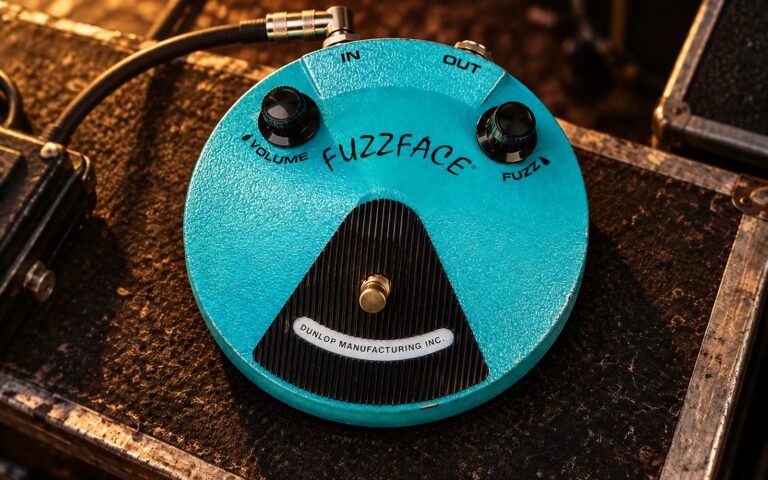
Where It All Started: The Electro-Harmonix Triangle Big Muff Pi
EHX reissues the original 1969 Triangle Big Muff Pi — the V1 circuit Jimi Hendrix and Carlos Santana played. Specs, tone recipes, and buying guide inside.
There is a moment in the late summer of 1969 — Woodstock just finished, the counterculture at its peak — where a young guitarist walks into Manny’s Music on West 48th Street in New York City and picks up one of the first pedals Electro-Harmonix has ever placed in a retail store. That guitarist is Jimi Hendrix. He takes the Big Muff home. Shortly after, Mike Matthews — EHX founder — gets an invitation to hang out at a recording session. When he arrives, the Big Muff is sitting on the floor, plugged in. That is a primary-source confirmation from the man who built the pedal and witnessed the scene, documented in a Guitar World feature published September 2020. It does not get more authoritative than that.
The pedal on that floor was what we now call the Triangle Big Muff Pi: the original V1 circuit, named for the triangular layout of its three knobs — Volume, Sustain, Tone — arranged in a wide arc across a simple metallic chassis with plain black lettering. No ram’s head graphic. No color scheme. Just the circuit that started one of the longest-running fuzz dynasties in guitar history.
EHX reissued this original circuit in 2018 to mark the company’s 50th anniversary. Mike Matthews himself explained the decision: “The Big Muff Pi is the pedal we are best known for so I wanted to commemorate EHX’s 50th Anniversary by re-releasing V1, the very first Big Muff. Original pedals are now selling for hundreds of dollars and this reissue absolutely nails that creamy, violin-like sustain and musical tone at a price a working musician can afford.” The Triangle Big Muff Pi reissue lives in the same compact nano-sized die-cast chassis used across EHX’s current lineup, with the same analog circuit inside and one key modern upgrade: true bypass switching. This is the one that started it all.
The First Muff: From Workshop to Woodstock (1969–1972)
The Big Muff Pi did not appear from nowhere. Mike Matthews had been working with fuzz circuits since the late 1960s, having taken over Guild’s Foxey Lady fuzz production — a two-transistor design — and selling it through Electro-Harmonix from 1968. But the Foxey Lady was a relatively simple circuit with limited sustain range. What Matthews wanted next was something richer, more sustained, more controllable. The answer was to add transistor gain stages: rather than two, the Big Muff would use four silicon transistors, each contributing gain and shaping to produce a wall of fuzz that could bloom and sustain almost indefinitely without the spitting, gating artifacts that plagued earlier fuzzes.
The first Big Muff Pi appeared in late 1969. Its circuit arranged four NPN silicon transistors in cascade: an input buffer into a first clipping stage, then a passive tone control network feeding a second clipping stage, then an output buffer. This four-stage architecture has remained the defining topology for every transistor Big Muff variant ever since — Triangle, Ram’s Head, current NYC production — differing in transistor selection, bias points, component values, and tone stack tuning, but sharing the fundamental four-stage cascade structure.
The “Triangle” name came later, as the community began cataloguing the different versions. It refers simply to the layout of the three controls — when you connect the three knobs with an imaginary line, they form a triangle. The name is not from EHX; it is a collector shorthand that has been adopted universally. EHX itself uses the name today to identify the reissue. Inside the original pedals, the circuit board layout has the transistors arranged in a triangular pattern as well, which reinforces the nickname.
Production of the original V1 Triangle continued through approximately 1971–1972, when the circuit evolved into what is now called the V2, featuring slightly different component values and eventually leading to the Ram’s Head version by 1973 (covered in our Ram’s Head Big Muff guide). The originals are now rare and expensive — working examples sell for $400 to $900 or more depending on condition, originality of components, and cosmetic state. The 2018 reissue was built to address that gap.
Two men above all others are associated with the original Triangle Big Muff Pi, and both connections are confirmed at the highest possible level of evidence: the EHX founder himself, who sold them the pedals and in one case watched it being used in the studio.
What “Triangle” Actually Means: The Circuit Explained
Understanding why the Triangle Big Muff sounds the way it does requires understanding what changed between it and later Big Muff variants — and what stayed the same. The four-stage silicon transistor topology is shared across all transistor Big Muffs. What differs is how that topology is tuned.
In the Triangle V1, the circuit is generally described by technicians and players as the most open and dynamic of the production Big Muff versions. The tone stack — the passive filter network between the two clipping stages — has a less pronounced mid-scoop than the Ram’s Head and significantly less than the current NYC production units. While all Big Muff circuits produce some degree of mid attenuation (it is inherent to the passive tone network’s interaction with the gain stages), the Triangle version attenuates mids less aggressively. The result is a warmer, more harmonically complex fuzz with more natural low-frequency content and better touch sensitivity at lower Sustain settings.
The transistors in V1 units were silicon NPN types of the era, with values that produced a relatively soft, organic clipping character. They do not gate the signal the way germanium-based fuzzes do, and they do not compress as hard as op-amp-based circuits (like the V4 Op-Amp Big Muff). The sustain rises and falls more naturally, with the individual attack of a note audible before the fuzz blooms in — especially at medium Sustain settings, where the pedal behaves more like a thick, saturated overdrive than a full-wall fuzz.
Mike Matthews described the target sound in terms that have become the standard description for the Triangle: “creamy, violin-like sustain and musical tone.” That phrase is deliberate. The violin comparison refers to how the Triangle behaves under a bow — the sustain rises, hangs at a steady amplitude, then decays gracefully, with the fundamental and first few harmonics staying defined throughout. This is distinct from the Ram’s Head’s more compressed, flatter sustain plateau, and very different from the Op-Amp’s tighter, punchy, compressed attack.
The Tone control in the Triangle operates the same way as in other Big Muffs — it is a passive shelving filter positioned between the two clipping stages. At noon, it produces a roughly flat frequency response at the output. Rolled fully counterclockwise, it emphasizes lows and cuts highs; rolled clockwise, it brightens the top end. Because the tone network sits between the two gain stages rather than at the output, its position affects not just the final frequency response but the harmonic character of the second gain stage — what frequencies go into that stage get clipped, not just filtered. This is why turning the Tone control on any Big Muff is a more dramatic, character-changing move than turning a simple output EQ would be.
Specs and Controls
| Feature | Spec |
|---|---|
| Controls | Volume, Sustain, Tone |
| Circuit | Analog, 4-stage silicon transistor (V1 Triangle 1969 circuit) |
| Bypass | True bypass |
| Power | 9V battery included; 9.6VDC-200mA adapter NOT included; standard center-negative |
| Current Draw | 3mA |
| Dimensions | 4.5″ × 2.75″ × 2.1″ (nano die-cast chassis) |
| Street Price (new, 2026) | ~$79–90 USD |
| Street Price (used excellent, 2026) | ~$40–60 USD |
| Vintage Originals (2026) | $400–900+ USD working examples |
| Year Released (reissue) | 2018 |
Three milliamps of current draw puts this among the most efficient pedals you can run. Any isolated 9V output handles it without a second thought. The battery ships included; an adapter does not, which is consistent with EHX’s nano enclosure product policy. No adapter jack to keep costs and chassis size down — plan to use a supply or buy the 9.6VDC-200mA EHX adapter separately.
True bypass switching was added for the reissue. Original V1 units used a different bypass scheme; the reissue improves on that with clean bypass signal path and no tone suck when disengaged. There is a status LED — something the original never had — which is the single most visible difference between a 1969 Triangle and the 2018 version at a glance.
Famous Players: The Originals
Jimi Hendrix — The Most Important Big Muff Sale in History
The Guitar World September 2020 feature on the Big Muff Pi included a direct quote from Mike Matthews, EHX founder, describing what happened with the very first generation of Big Muffs sold through Manny’s Music in New York City. Matthews stated: “Jimi Hendrix used a Big Muff in 1969. Manny’s was the first store I sold Big Muffs to and he bought one of the first ones from there. He invited me to hang out at a recording session and there on the floor he had the Big Muff he bought at Manny’s!”
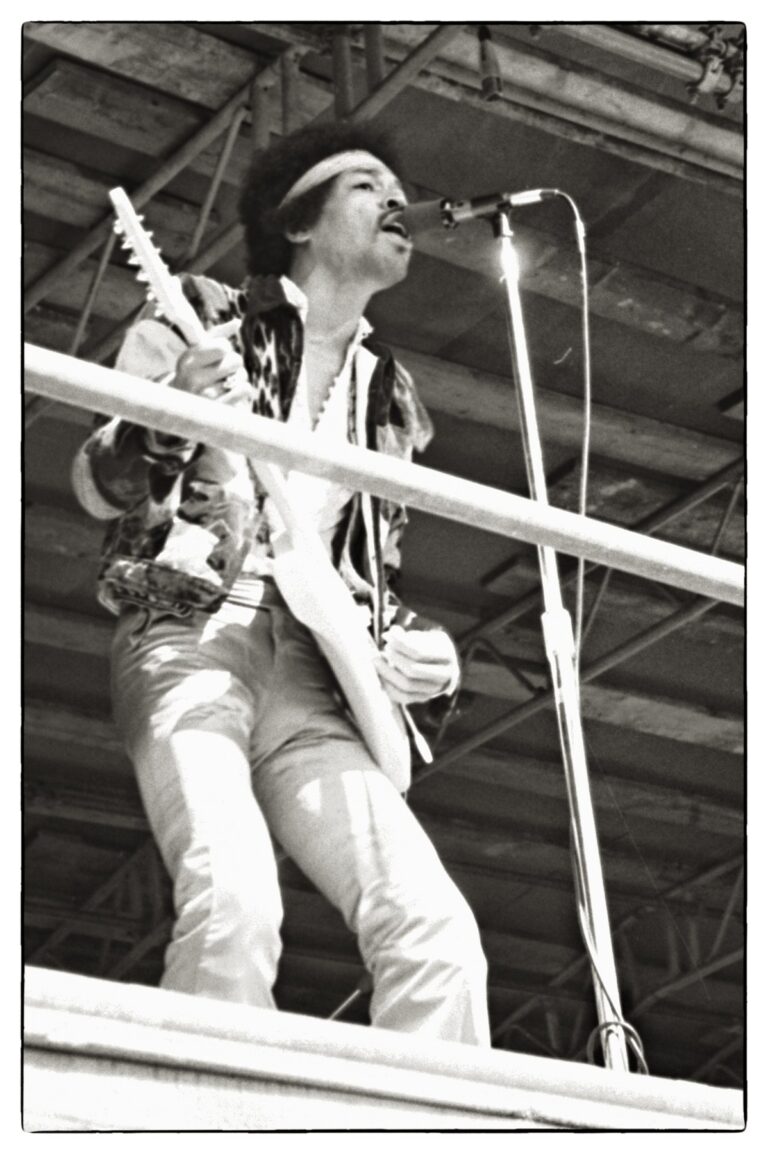
This is the strongest possible primary-source confirmation. The person who built and sold the pedal personally witnessed it in use at a recording session by the artist in question. There is no intermediary — no rig rundown conducted years later, no Equipboard aggregation, no secondhand gear technician claim. Mike Matthews was in the room. The Big Muff was on the floor. That happened in 1969, which places it firmly in the Triangle V1 era — the Ram’s Head would not exist until 1973, four years later. Jimi Hendrix used a Triangle Big Muff Pi.
What did Hendrix use it for? The recording session Matthews visited is not identified by album or song, and the Big Muff’s presence in Hendrix’s discography is difficult to trace precisely because his studio technique was famously layered and varied. What is documented is that by 1969 Hendrix was experimenting actively with new fuzz and sustain devices — the Octavia, the Fuzz Face, and now the Big Muff — seeking longer sustain and more complex harmonic texture than any single earlier device could deliver. The Big Muff’s capacity for violin-like sustain that bloomed and held without dying off was audibly different from the Fuzz Face’s more aggressive, sputtering attack. For a player known for using sustain as a compositional element — letting notes sing and evolve over seconds — the Triangle’s behavior would have been immediately useful.
Hendrix died in September 1970, less than a year after the Triangle Big Muff appeared. His window of access was short, which makes the Matthews story simultaneously more significant (it is one of only a handful of documented Big Muff interactions in his life) and harder to trace in recordings. But the confirmation exists and it is primary-source iron.
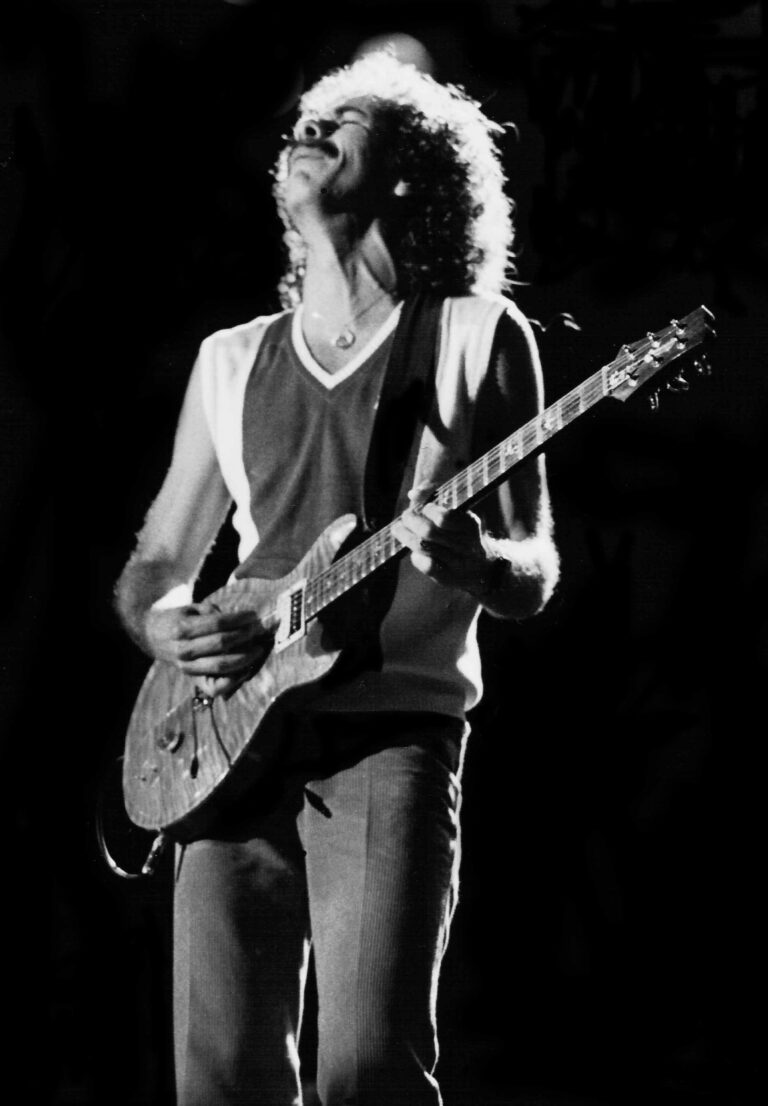
Carlos Santana — A Check and a Letterhead
The same Guitar World feature that confirmed Hendrix included another Matthews statement that is equally authoritative: “Santana bought a Big Muff from me using mail order with a Santana cheque and letterhead back in 1971!”
A personal check with Santana’s name and official letterhead is documentary evidence — not a verbal recollection, but a physical artifact that Matthews retained. The transaction was direct: Santana mailed an order with payment to Electro-Harmonix in 1971. The year is significant. The Ram’s Head was still two years away. The Triangle V1 was still in production. Carlos Santana bought a Triangle Big Muff Pi.
The Guitar World article also noted that the Big Muff “became popular among guitarists of the day, including Woodstock legends Carlos Santana and Jimi Hendrix” — connecting both artists explicitly to the Triangle era. A Harmony Central review of the 2018 reissue, quoted on the EHX official product page, described the Triangle as ideal for “the smooth, stringed-instrument bloom of classic soloists like Gilmour and Santana,” positioning Santana’s tonal style as the reference point for the Triangle’s character.
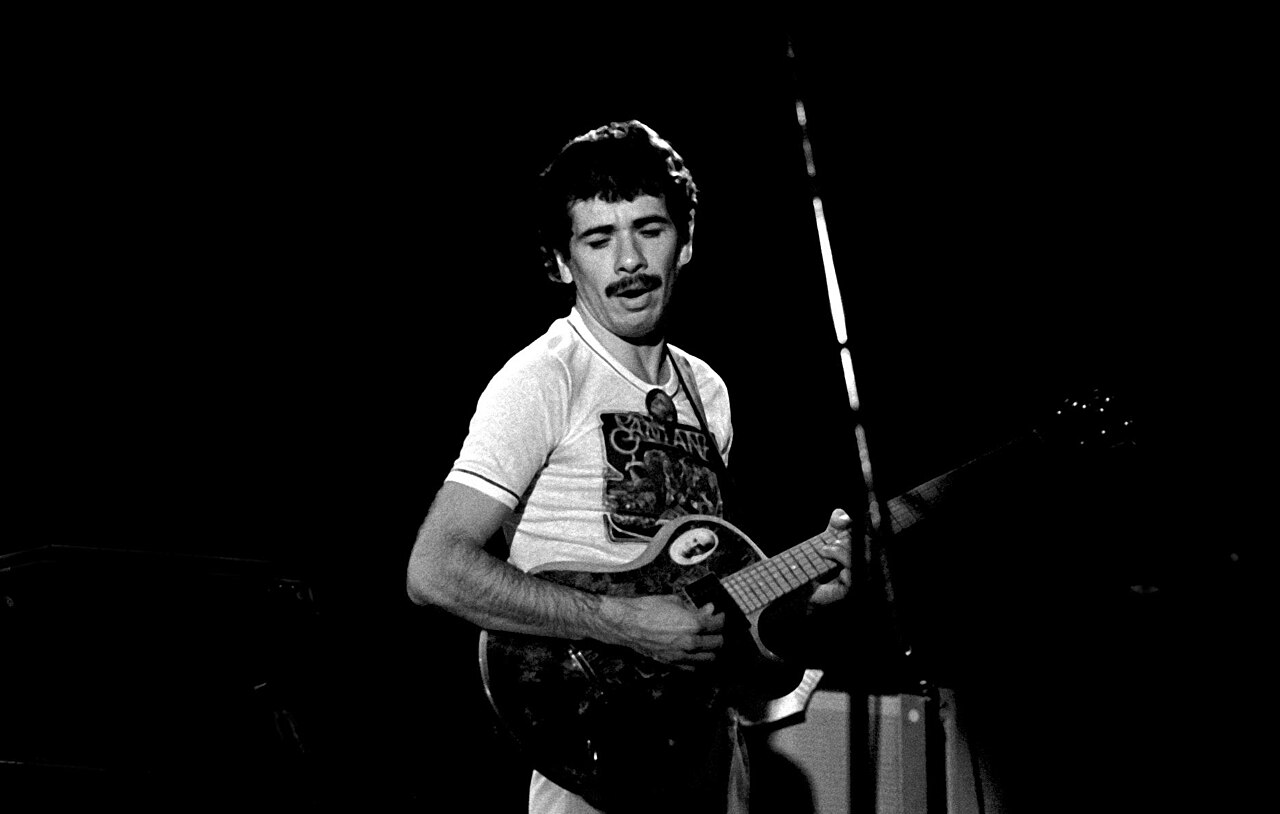
Santana’s playing vocabulary has always leaned toward legato, sustained leads with vocal, singing quality — tones that the Triangle’s less-scooped, more open circuit reproduces particularly well. His preference for smooth, held notes with rich harmonic content aligns precisely with what the Triangle delivers compared to later, more compressed or more mid-scooped variants. Whether specific recordings in his early 1970s catalog feature the Triangle remains unverified at song level, but the purchase is documented by the seller himself. The connection is confirmed.
What About Gilmour, Corgan, White, Mascis, and Auerbach?
David Gilmour, Billy Corgan, Jack White, J Mascis, and Dan Auerbach are Big Muff family associations, not Triangle-specific confirmations, and the picture is clear:
David Gilmour’s Big Muff use is confirmed and documented extensively — but his variant was the Ram’s Head, not the Triangle. As covered in depth at rank 741, guitar tech Phil Taylor confirmed in Guitar Player (January 2009) that Gilmour was introduced to the Big Muff in 1974 — three years after the Triangle era ended — and used Ram’s Head units throughout his career. The Triangle tonal comparison in the Harmony Central review is about character, not confirmed use. Gilmour is Big Muff family, not Triangle specifically.
Billy Corgan’s Big Muff is an Op-Amp, as confirmed by EHX founder Mike Matthews and Corgan himself at the 2017 reissue launch event (see our Op-Amp Big Muff guide). Corgan used the V4 IC circuit for Gish and Siamese Dream and stopped using Big Muffs after 1993. Not Triangle.
Jack White’s fuzz of record is the Civil War Russian Big Muff — a Sovtek-era variant with its own warmer, woollier character distinct from any US-production circuit. Jack White: Big Muff family, not Triangle.
J Mascis is confirmed as a Ram’s Head user — EHX gave him the first-ever Big Muff signature model based on the Ram’s Head circuit in 2022. Mascis: Ram’s Head, not Triangle.
Dan Auerbach’s documented Big Muff use centers on a Sovtek Green Russian V7C — confirmed through rig documentation and gear photography. Auerbach: Green Russian, not Triangle.
All five are legitimate Big Muff family artists. None is a confirmed Triangle user.
The Triangle Sound: How It Compares to Other Big Muff Variants
With the Nano, Op-Amp, Ram’s Head and standard Big Muff Pi variants as reference points, the Triangle’s position in the family is clearer by comparison than in isolation.
Against the Ram’s Head (the next variant in historical order): the Triangle is warmer, more open, and less compressed. The Ram’s Head’s mid-scoop is deeper and its sustain plateau more flat and even. The Triangle has better note articulation at lower Sustain settings and more harmonic complexity throughout its range. If the Ram’s Head is a wall, the Triangle is a curtain — thick, but you can see shapes through it. Players who find the Ram’s Head’s compression slightly suffocating often prefer the Triangle for complex chord voicings or single-note passages that need to breathe.
Against the current NYC/Nano Big Muff (documented at rank 739): the Triangle is warmer and darker. Current NYC production has more upper-mid presence and a slightly brighter top end. The ~13dB mid-scoop at ~1kHz in the NYC circuit is more pronounced than in the Triangle. For players who find the current production units too bright or thin-sounding in the high-mids, the Triangle is a meaningful step toward warmth without going all the way to the woolliness of the Russian variants.
Against the Op-Amp Big Muff: completely different topology. The Op-Amp uses a three-stage IC-based circuit that produces harder clipping, tighter low end, and more compressed attack. The Triangle is far more dynamic and touch-sensitive; the Op-Amp is tighter, punchier, more compressed — better for multi-track layering, worse for single-note sustain work. These are not interchangeable sounds.
Against Russian Sovtek variants (Civil War, Green Russian): the Russian circuits are warmer and woollier than the Triangle, with a more diffuse, less-defined sustain character. The Triangle has better note separation and a more precise attack than any Sovtek variant. Russian Big Muffs are often described as sounding like the notes are wrapped in felt; the Triangle is more like wrapped in velvet — warmer than NYC, but with better definition than the Russians.
Tone Recipes and Settings
Hendrix-Style Sustained Fuzz Lead
The goal here is long, violin-like sustain with musical note decay — the behavior Matthews described and that Hendrix was drawn to. Start with Sustain at 2 o’clock (roughly 70%), Volume matched to bypassed level (typically 10 o’clock to noon depending on amp), Tone at noon. This produces the fundamental Triangle character: full sustain with harmonic richness retained. Roll guitar volume to about 7 to add touch sensitivity — the pedal cleans up significantly. For Hendrix-context tones, a clean or slightly breaking-up amp is essential; the Triangle does not need amp distortion to sound good and stacks badly with heavily distorted amp input. Single-coil neck pickup into a Fender-style amp at moderate volume is the canonical chain.
Santana Violin Sustain — Singing Lead
Santana’s lead tone at its most characteristic is not high-gain; it is long, warm, vocal sustain with the fundamental clearly defined and harmonics rolling off naturally. Set Sustain between 1 o’clock and 2 o’clock — enough for continuous bloom, not so much that dynamics disappear. Tone back slightly from noon, to about 10 o’clock, which pulls the brightness down and adds the warmth his Garcia/Mesa rig naturally provided. Volume slightly above unity to push the amp into its natural saturation zone. Use the neck pickup. If you have a slightly overdriven amp channel available, run the Triangle into it at low to moderate input gain — the combination of the Triangle’s harmonic richness and the amp’s natural saturation produces the compound sustain and vocal quality that defines Santana’s early 1970s lead tone. Gibson SG or Les Paul will get you closest to the voicing, but a Stratocaster on the neck pickup gives the brighter, glassier version he used in some contexts.
Wall-of-Sustain Shoegaze Setting
Maximum Sustain, Tone at noon, Volume elevated significantly above unity (12 to 2 o’clock). This is the Triangle as a wall rather than a voice — sustained, immersive, less note-defined and more texture. The Triangle’s more open character compared to the Ram’s Head means this setting retains more low-frequency content and less compression plateau flatness than the same setting on a Ram’s Head. Good for ambient lead layers where definition matters less than bloom and sustain duration. This setting will disappear in a dense mix without a TS-style overdrive before it (to push mids into the Triangle’s input) or a mid-boost EQ after it.
Edge-of-Breakup Setting
Where the Triangle genuinely separates from later Big Muff versions: low Sustain settings. Set Sustain to 9 o’clock or below. Tone at noon or slightly bright (1 o’clock). Volume above unity to compensate for lower gain output at low sustain. The result is a thick, harmonically saturated overdrive with excellent note definition — closer to a well-broken-up amp than to a fuzz pedal. This setting is essentially useless on the Op-Amp or Ram’s Head, which require high Sustain to function well, but the Triangle’s more linear gain curve allows genuinely musical tones at lower saturation. Good for rhythm work or chord playing where fuzz warmth is wanted without wall-of-fuzz texture.
Comparisons
Within the Big Muff family, the Triangle occupies the warm, open, touch-sensitive end of the spectrum. If you need more compression and a more pronounced mid-scoop with David Gilmour associations, the Ram’s Head is the next stop. For Billy Corgan’s tighter, multi-layered wall sound, the Op-Amp Big Muff is the only confirmed choice. For a budget-accessible current-production Big Muff in the same nano package, the Nano Big Muff Pi delivers the NYC circuit at a similar price point.
For transparent overdrive stacking before the Triangle — to compensate for any mid-attenuation and add front-end definition — the MXR Timmy Overdrive or EHX Soul Food are natural partners. A TS-style pedal before any Big Muff is a time-tested solution for cutting through a dense mix; the Soul Food’s clean-blend architecture handles this without adding the Tube Screamer’s characteristic mid-hump, which can interact with the Triangle’s own frequency response in unpredictable ways.
For extended sustain after a Triangle — adding infinite sustain and feedback control — a volume swell pedal or sustainer like the EHX Superego can extend what the Triangle starts. For reverb that responds to the Triangle’s sustain bloom rather than cutting across it, longer decay spring or plate reverbs work well; the MXR M300 Reverb handles this without congesting the Triangle’s low-mid content.
The Triangle works into clean amps — Fender Twin Reverb, Deluxe Reverb, Vox AC30, Princeton Reverb — better than into already-saturated channels. Running a Triangle into a heavily driven channel produces muddiness; the circuit contributes its own harmonic saturation and does not need amp gain to function. At the input of a clean or slightly breaking-up amp, it delivers the maximum difference between bypassed and engaged tones, which is the point.
Buying Guide: New, Used, and Vintage
The 2018 reissue is the working player’s obvious choice at $79–90 street new. Sweetwater and EHX’s own store both stock it; used market prices run $40–60 for examples in excellent condition, which makes it one of the most affordable ways into any Big Muff circuit. At $40–60 used, if you decide the Triangle character is not for you, resale is painless. Buy the reissue, not a clone or a boutique interpretation, unless you have specific reasons to deviate.
Original V1 Triangle Big Muff Pi units from 1969–1972 are collector items. Current market pricing for working examples in original condition runs $400–900+ USD. Non-working examples for parts or restoration are less; examples with original paperwork or provenance command more. The reissue’s circuit is faithful to the original — EHX built it specifically to “nail that creamy, violin-like sustain and musical tone” — so the premium on vintage originals is not sonic but historical and collectible. For playing purposes, the reissue is the rational choice.
There is no adapter included with the reissue — same policy as the Nano, Ram’s Head, and Op-Amp reissues in EHX’s nano lineup. A 9V battery ships in the box. If you are adding this to a pedalboard with a supply, you need a standard center-negative 9V output — any isolated or daisy-chained supply works fine at 3mA draw, which is negligible. The Nano Big Muff (also 3mA) and Triangle Big Muff can run off the same inexpensive supply without interaction issues.
Living With the Triangle Big Muff Pi: Ownership Notes
True bypass means no buffer in bypass mode. If you are running long cable runs — more than 15–20 feet from guitar to first pedal — and the Triangle is first in chain with true bypass, consider a dedicated buffer before it to preserve high-frequency pickup character on the cable run. Alternatively, flip the routing order: a buffered pedal first (the EHX Soul Food set to its buffered bypass mode, for instance), then the Triangle, eliminates the cable-capacitance problem without adding a separate buffer.
Vintage germanium fuzz fans: do not put the Triangle before a germanium Fuzz Face or Tone Bender if you want the germanium circuit to behave predictably. Germanium fuzzes require a high-impedance source (like a guitar’s passive pickups); the Triangle’s low-impedance output changes the input character of the germanium stage. Run germanium fuzzes first in chain, then the Triangle after, for parallel texture — or use the Triangle alone and keep the germanium on a separate routing path.
The Triangle’s edge-of-breakup behavior at low Sustain settings makes it genuinely useful as a rhythm texture pedal, not just a solo lead device. This is an underexplored application: Sustain low, Tone bright, Volume up, guitar on rhythm position, attack controlled by picking force. The pedal responds to dynamics in a way that the Ram’s Head and Op-Amp do not at equivalent Sustain settings. Worth exploring before dismissing the Triangle as a leads-only tool.
The current draw of 3mA is shared with the Nano Big Muff and is the lowest current requirement of any transistor Big Muff variant in current production. On a large pedalboard, having two or three Triangle-draw pedals makes essentially no difference to supply headroom calculations. It is a non-issue.
FAQ
What does “Triangle” mean — is it about the circuit or the controls?
Both, in different ways. The name “Triangle” refers primarily to the triangular layout of the three knobs — Volume, Sustain, and Tone — on the original 1969 enclosure. The knobs form a wide triangular arrangement rather than the linear row used in later Ram’s Head and NYC production versions. The circuit board inside original V1 units also has the transistors arranged in a triangular pattern. The name is not official EHX terminology from 1969; it is collector shorthand adopted universally to identify the V1 version, and EHX uses it now for the reissue.
Did Jimi Hendrix actually use this pedal on recordings?
Hendrix used a 1969 Triangle Big Muff Pi — confirmed by EHX founder Mike Matthews who personally witnessed it at a recording session. Whether specific songs feature the Big Muff is harder to verify at the track level; Hendrix’s studio technique was complex and varied. The confirmed fact is that he owned and used one in 1969. His death in September 1970 limited the window, but the connection is primary-source documented.
Is the Triangle Big Muff different from the standard Big Muff Pi?
Yes, meaningfully. The Triangle uses the 1969 V1 circuit, which is warmer, more open, and less mid-scooped than current NYC production Big Muff Pi pedals. The current production units (Nano, standard Big Muff Pi) are brighter with a more pronounced ~13dB mid attenuation at ~1kHz. The Triangle has better note definition at low Sustain settings and more harmonic complexity throughout its range. They share the four-stage silicon transistor topology but differ in transistor selection, bias points, and tone stack tuning.
Is the reissue circuit accurate to the 1969 original?
EHX built it specifically for fidelity. Mike Matthews stated explicitly that it “absolutely nails that creamy, violin-like sustain and musical tone.” The company has strong commercial and reputational incentive to get this right — they have been making Big Muffs continuously since 1969 and retain original design knowledge. The same circuit-capture approach was confirmed for the Ram’s Head reissue by Guitar World’s Trevor Curwen A/B test against a 1973 original (verdict: “nailed it”). The Triangle reissue has been received similarly by the player community.
Should I get the Triangle or the Ram’s Head?
Depends on what you want from a Big Muff. Triangle: warmer, more open, better note articulation, more touch-sensitive at low Sustain, Hendrix and Santana history. Ram’s Head: more compressed, deeper mid-scoop, flatter sustain plateau, David Gilmour and J Mascis history. If you want a guitar to sound like a violin, Triangle. If you want a guitar to sound like it is disappearing into a fog of fuzz with excellent sustain extension, Ram’s Head. Both are valid. Both are different enough that owning both is justifiable.
Can I use this for bass guitar?
The Triangle Big Muff Pi passes low frequencies better than most later Big Muff versions due to its less-pronounced mid-scoop. It works on bass — the open, warm character preserves more low-end weight than the Ram’s Head or current NYC production. That said, EHX makes a dedicated Bass Big Muff Pi with frequency response specifically optimized for bass instruments; that is the technically correct tool. The Triangle on bass is a viable workaround and sounds good; the Bass Big Muff is built for it.
Does the true bypass switching affect tone compared to original units?
In engaged mode, no — true bypass and buffered bypass both route signal through the same active circuit when the pedal is on. In bypass mode, the original 1969 units used a different bypass scheme that introduced some passive loading on the signal; the reissue’s true bypass is a cleaner bypass with lower impedance than the original in bypass. For practical playing purposes, the reissue’s bypass behavior is an improvement on the original.
What guitars and amps work best with the Triangle Big Muff Pi?
Single-coil guitars — Stratocaster, Telecaster, SG with P-90s — bring out the Triangle’s harmonic complexity most clearly. Humbuckers (Les Paul, ES-335) add warmth and body but can thicken the low-mid content to the point of congestion at maximum Sustain settings; roll the Sustain back slightly with humbuckers to maintain definition. For amps, clean or lightly breaking-up platforms work best: Fender Twin Reverb, Deluxe Reverb, Princeton Reverb, Vox AC30. The Triangle provides its own saturation; it does not need or benefit from a heavily driven amp input.
Image credits
- Carlos Santana: Heinrich Klaffs, Wikimedia Commons, CC BY-SA 2.0.
- Carlos Santana: F. Antolín Hernandez, Wikimedia Commons, CC BY 2.0.
- Jimi Hendrix: Detlef Hansen, Wikimedia Commons, CC BY-SA 4.0.
Latest News
Related
On This Day
Tuesday 10 November
From this week: