Good Grief, That Crunch: The JHS Charlie Brown V4 and the Sound That Built British Rock
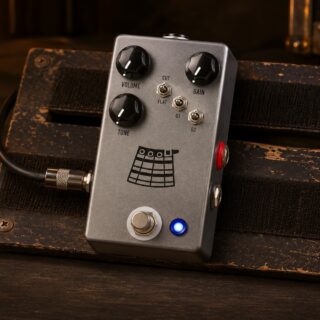
JHS Charlie Brown V4 puts the legendary Marshall JTM45 on your pedalboard. Five controls, true bypass, 9mA draw — the definitive vintage British overdrive.
There is a specific moment in guitar history when everything changed. It happened on a London session in 1965, then again on a recording in 1966, then a hundred thousand times on stages across the world for the next six decades. A guitar plugged into a Marshall, the amp pushed hard, and out came a tone so warm and alive and bristling with harmonic complexity that it redefined what electric guitar could sound like. That tone — thick, chewy, slightly woolly, dynamically responsive as a breathing organism — came from the Marshall JTM45. And the JHS Charlie Brown V4 is, in the most literal sense, an attempt to put that exact amplifier on your pedalboard.
Not a simulation. Not an approximation. An analog circuit built to behave the way a vintage JTM45 behaves: voltage sag, interactive EQ, gain that responds to how hard you hit the strings and how far back you roll the guitar’s volume knob. The Charlie Brown V4 is a Marshall-style channel drive pedal that, in JHS’s words, “turns any amp into a gritty JTM45 stack.” After four hardware revisions spanning from the early days of JHS Pedals to the current yellow-enclosure V4, it remains one of the most honest and uncompromising JTM45-style pedals you can buy for under two hundred dollars.
This article covers what the Charlie Brown V4 actually does in a signal chain, how it evolved across four versions, the legendary British tone tradition it represents, and what you need to know before it lands on your board.
The Amp That Started Everything: Marshall JTM45 History
To understand the Charlie Brown V4, you need to understand the amplifier it’s chasing — and why that amplifier matters so much.
In 1962, Jim Marshall ran a drum shop in Hanwell, West London. Young guitarists kept coming in asking where they could buy loud American amplifiers like the Fender Bassman. Transatlantic shipping made those amps expensive and hard to service when they broke. Marshall, sensing an opportunity, partnered with engineer Ken Bran and Dudley Craven to reverse-engineer the Bassman circuit and build something domestically. The result was the JTM45 — Jim’s first production amplifier.
The JTM designation has been interpreted variously as “Jim’s Tone Machine” and as an abbreviation for Jim and Terry Marshall (Jim’s son). The 45 refers to the nominal wattage, though early units often produced closer to thirty to thirty-five watts in practice. The crucial engineering difference from the Fender Bassman blueprint was the output tube choice: the JTM45 used KT66 valves, which sounded warmer, more harmonically complex, and slightly looser in the low end than the Bassman’s 6L6s. That looseness — that controlled bloom on the low strings — became the signature of early British rock guitar tone.
The turning point came in 1966. Eric Clapton recorded John Mayall’s Bluesbreakers album — the one commonly known as the “Beano” album because Clapton is photographed reading a Beano comic on the cover — plugging a 1960 Gibson Les Paul Standard directly into a JTM45 combo, cranked to the point of natural power-amp saturation. The resulting tone was so singular, so violently present and musical, that it’s been chased ever since. Clapton’s Beano Les Paul–into–JTM45 rig remains the reference point for what vintage British amp overdrive sounds like at its peak: compressed, sustaining, harmonically rich, singing on the top end, with a mid-forward presence that cuts through any band mix.
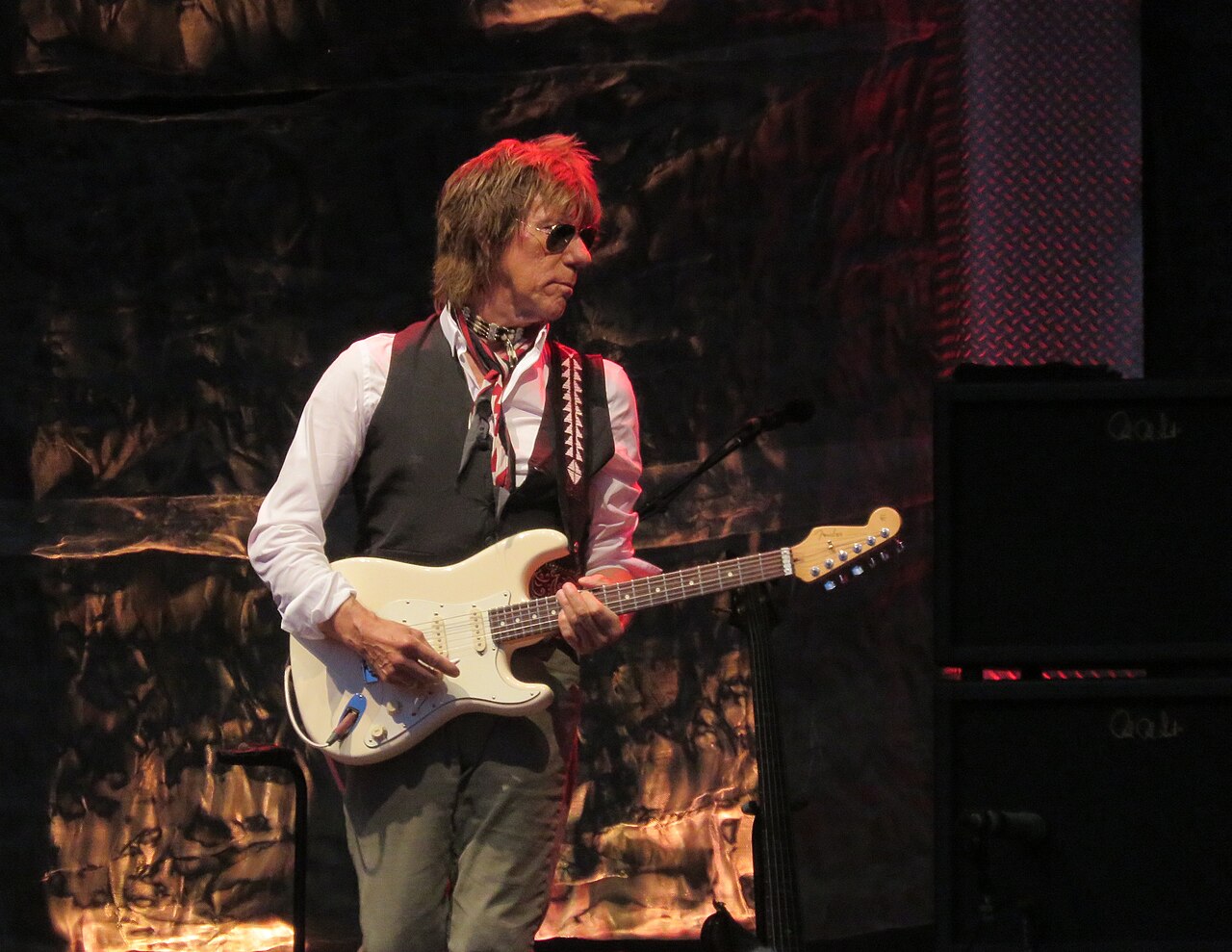
Pete Townshend was using Marshalls before Clapton’s record was even released — he’s credited by Jim Marshall himself as one of the earliest high-profile players to use the brand. Jeff Beck’s early Yardbirds tone came through Marshalls of the same era. Jimi Hendrix, famously, stacked them: walls of 100-watt Marshalls driving four-by-twelve cabinets, the sheer volume forcing the output stage into compression and saturation that no attenuator-tamed modern rig has fully replicated. Jimmy Page tracked the first Led Zeppelin album through a Telecaster into a Supro, but his live rig quickly moved to Marshalls, and the JTM45 lineage was in his DNA by the time he was recording Stairway.
The JTM45 was eventually replaced in Marshall’s lineup by the JTM50, then the Plexi series (so called for the Plexiglas control panels of the late 1960s), and ultimately the JMP and JCM series of the 1970s and 1980s. Each evolution added gain and tightened the low end. The JCM800 — which the JHS Angry Charlie V3 is modeled after — is a different beast entirely: higher gain, tighter, more modern. The JTM45 is the opposite of all that. It’s looser, warmer, more vintage, more responsive to dynamics. Less gain, more character. That distinction defines what the Charlie Brown V4 is designed to deliver.
JHS Pedals and the Charlie Brown: Four Generations
JHS Pedals emerged from Kansas City’s DIY guitar community in the late 2000s. Josh Scott, the company’s founder, initially built his reputation on pedal modifications before moving into original designs. The Charlie Brown is one of the company’s longest-running original pedals, predating many of JHS’s better-known products.
The version history tells the story of the design maturing toward its current form:
V1 used a larger enclosure and lacked the Charlie Brown cartoon icon that would later become the pedal’s visual identity. It was simpler in control set — the foundation of the JTM45 circuit in a box, but without the tonal refinements that came later.
V2 moved to the current compact enclosure size — the same 2.6″ × 4.8″ footprint used across much of the JHS lineup — and adopted the diamond knob layout used on other JHS pedals of that era. This is the version most frequently seen in older online discussions and used markets.
V3 retained the V2 enclosure and layout but made changes to the Drive control’s taper and gain structure. The difference between V2 and V3 is subtle but real: V3’s gain range sits slightly differently, and the Drive control’s response feels more linear at lower settings.
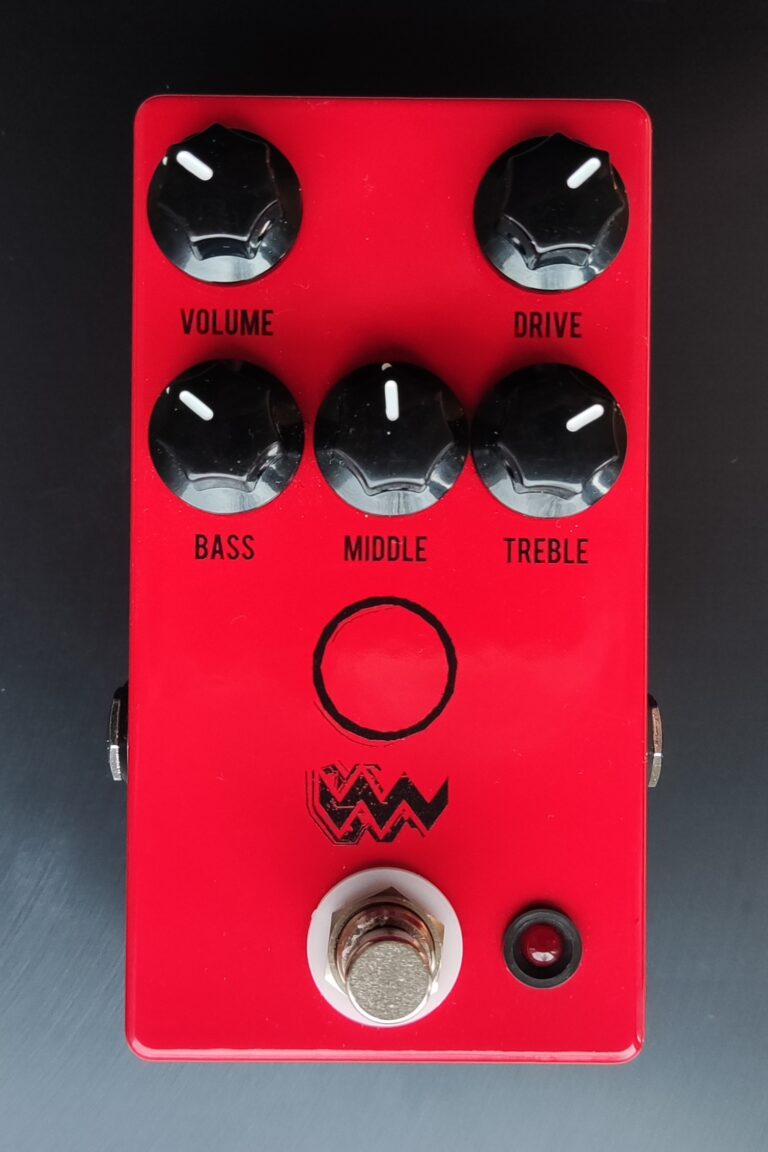
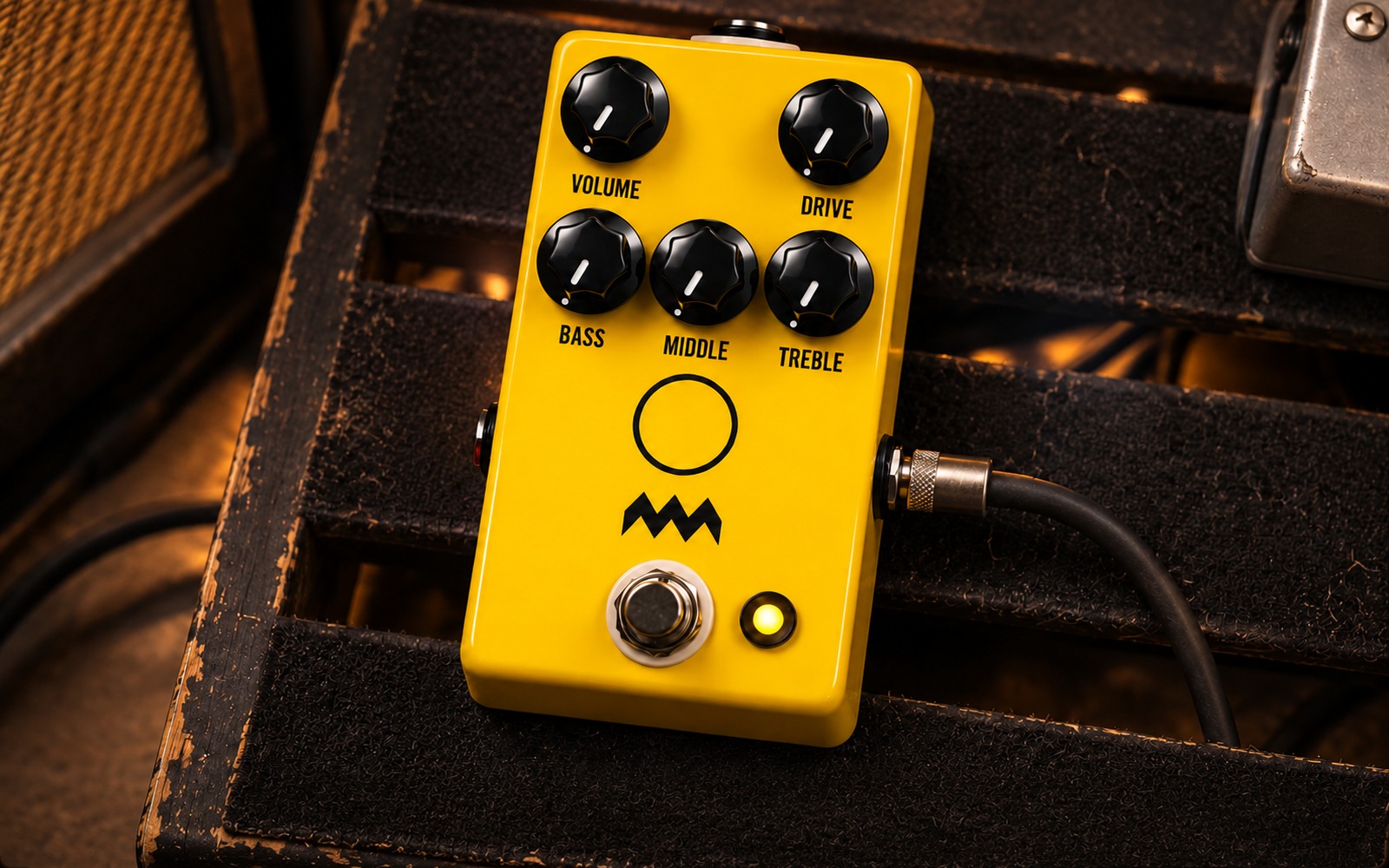
V4, the current production version, is the most significant update in the pedal’s history. JHS changed the enclosure color to yellow (consistent with the cartoon Charlie Brown reference), redesigned the knob layout from diamond to U-shaped, and most importantly added a full Marshall-style three-band tone stack — Bass, Middle, and Treble — replacing the single Tone control that earlier versions used. V4 now has five controls total: Volume, Drive, Bass, Middle, Treble. The three-band EQ is calibrated to interact the way Marshall amplifier tone stacks do, with controls that are genuinely interactive rather than independent. This is the most sonically flexible and authentic version of the pedal, and it is the current production unit at $199 MSRP.
Inside the Charlie Brown V4: What It Does and How It Works
The Charlie Brown V4 is an analog overdrive. No digital processing, no modeling chips. The circuit is built around the same principles that govern a real JTM45: voltage stages, clipping characteristics, and EQ behavior designed to replicate what that specific amplifier does to a guitar signal.
In a signal chain, the Charlie Brown V4 functions as an amp-in-a-box: it changes the fundamental character of whatever amplifier it’s running into. A clean Fender Deluxe Reverb, a clean Vox AC30, a clean Twin Reverb — the Charlie Brown V4 in front of any of them adds the JTM45’s gain character, its frequency shaping, and its dynamic compression, making the downstream amp feel and sound like it’s been pushed into British-style overdrive.
The Drive and Volume controls interact in a specific way that JHS is explicit about: they work like a master volume amp head. Volume is the master output level; Drive is the gain depth. At low Drive settings with Volume compensated upward, the pedal delivers edge-of-breakup tones — warm, slightly compressed, with natural harmonic bite on attack and clean decay. At higher Drive settings, the compression deepens, sustain extends, and the character moves into classic crunch territory. Rolling back your guitar’s volume knob cleans up the gain without losing tonal integrity, exactly the way a real tube amp responds.
The three-band tone stack (V4) is where the pedal gets genuinely powerful. Marshall-style EQ is not simple treble-cut-and-bass-boost. The three bands interact: boosting the Middle knob affects Bass and Treble perception; cutting Treble allows Bass to open up further. The Middle knob is, practically speaking, the most impactful tone shaping control for most playing contexts — mid-forward settings are what give the JTM45 its cutting, present character, while scooped Mids produce a scooped, scooped, more modern sound that drifts away from the vintage JTM45 voice.
Specifications
The 9mA current draw is worth pausing on. Most amp-in-a-box overdrive pedals draw significantly more: the JHS Angry Charlie V3 draws 11mA (already among the lowest in its class), the Boss BD-2 draws 6mA, but complex analog circuits with extensive EQ often land in the 20–50mA range. The Charlie Brown V4’s 9mA means it will run happily off virtually any isolated 9V output on a pedalboard power supply — a single 100mA output could theoretically power eleven of them simultaneously. On a dense pedalboard with power-hungry digital pedals competing for supply outputs, the Charlie Brown V4 is effectively a non-issue for current budgeting.
Famous Players and the JTM45 Tradition
The JHS website references Eric Clapton, Jimi Hendrix, and Gary Moore when describing the Charlie Brown V4’s tonal targets — and those are exactly the right references for understanding what this pedal sounds like. However, honesty is required here: JHS is citing those players as sonic lineage, not as confirmed users of the Charlie Brown V4 itself. None of the primary-source rig rundowns or magazine interviews consulted for this article confirmed any major touring artist using the Charlie Brown V4 specifically in their live signal chain. The pedal sits in a gear category populated by dedicated JTM45 enthusiasts who often prefer not to advertise their specific stompbox choices, and with only five documented pro users on Equipboard, confirmed associations are limited.
Evan Stephens Hall, the singer and guitarist of indie rock band Pinegrove, has been documented using the Charlie Brown V4 — Equipboard places it on his pedalboard from a live performance at the Gothic Theatre in Denver on October 14, 2017. Hall’s guitar work in Pinegrove is notable for its emotional directness and clean-to-crunch dynamic range, which aligns naturally with what the Charlie Brown V4 does at low-to-medium Drive settings. He is not, however, a primary-source confirmation via a Premier Guitar rig rundown or a published interview — it’s documented from live observation. Treat it as a real-world player association rather than an artist endorsement.
The players whose names genuinely belong in any JTM45 article are the architects of the tone the pedal is built to recreate. Eric Clapton‘s Beano-album tone — Les Paul into JTM45, everything cranked — remains the definitive reference for what a pushed JTM45 sounds like at its best: sustaining, singing, harmonically saturated without losing note clarity. Jimi Hendrix took that same amplifier lineage and multiplied it, stacking Marshalls in a way that created a wall of controlled power-amp saturation no studio recreation has ever fully equaled. Jeff Beck‘s early period with the Yardbirds and on his first solo albums lived in the same Marshall territory, with a touch sensitivity and dynamic range that the JTM45’s interactive character enables naturally.
Jimmy Page‘s early live rig leaned on Marshalls through the same JTM45 lineage — the crunch on “Communication Breakdown,” the controlled warmth of “Babe I’m Gonna Leave You,” the explosive dynamics of live Zeppelin in 1969 and 1970. Pete Townshend was Marshall’s first famous champion, using the brand before most players had even heard of it, driving his Stratocasters and Les Pauls through Marshalls with a rhythmic aggression that the JTM45’s dynamic responsiveness enabled perfectly.
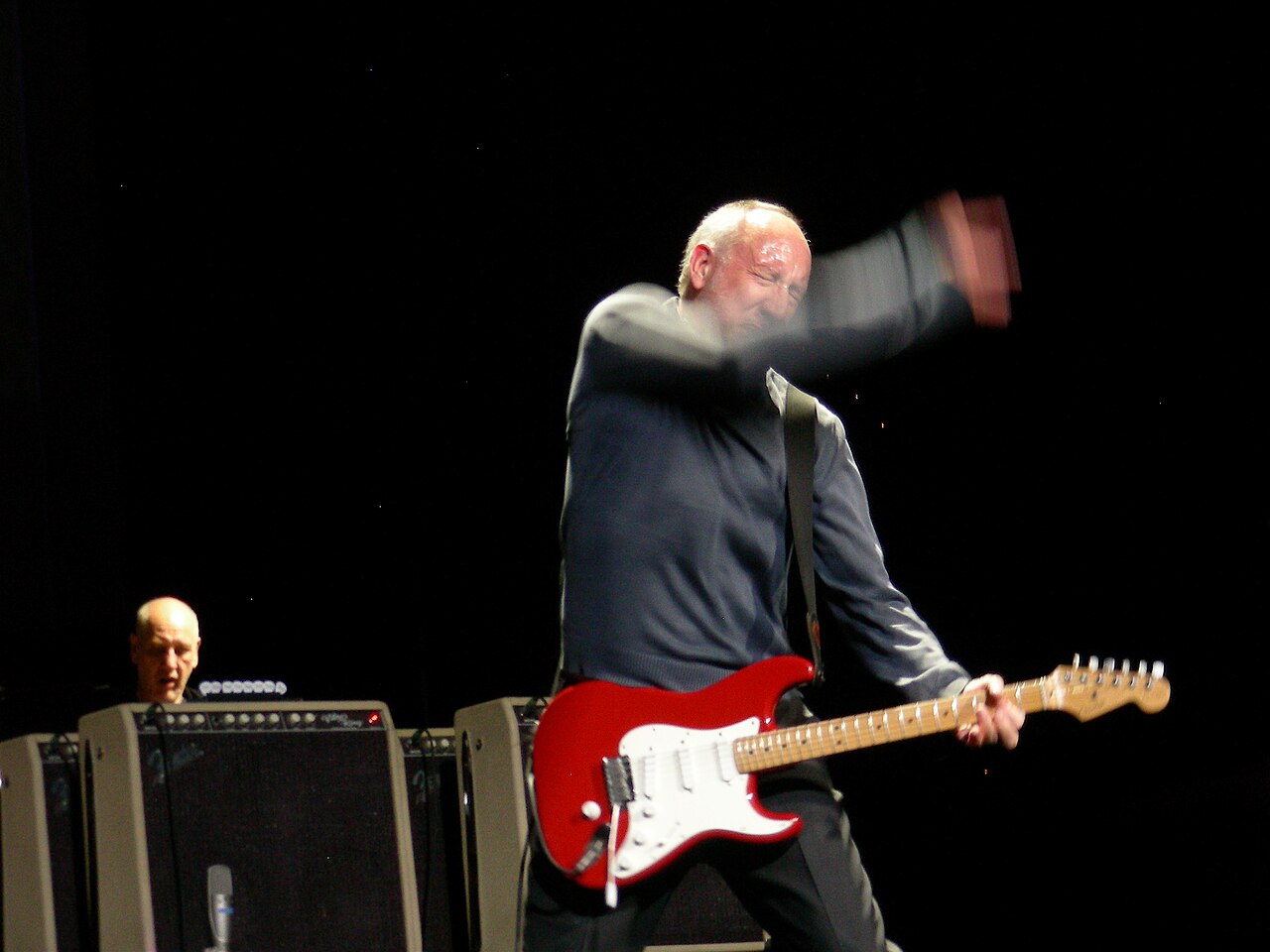
None of these players use the Charlie Brown V4. They are the players whose amplifier tone this pedal exists to reference. Understanding that lineage tells you everything about what the pedal sounds like and what it’s capable of — which is, ultimately, what matters.
Tone Recipes and Settings
Clapton Beano Edge-of-Breakup
The classic Les Paul into JTM45 sound — warm, compressed, naturally biting without being heavy or aggressive. Drive at 9 o’clock, Volume compensated to unity or slightly above, Bass at noon, Middle at 1–2 o’clock (boosted), Treble at 11 o’clock (slightly cut). Roll your guitar’s volume back to 7 or 8 and let the picking dynamics do the work. This setting rewards playing hard on attack — the pedal opens up and compresses naturally, just like the real amp.
Classic British Crunch
Mid-gain British rock — the Yardbirds, early Zeppelin, early Townshend. Drive at noon, Volume at unity, Bass at 11 o’clock (slightly cut for articulation), Middle at 1 o’clock (forward-present), Treble at noon. This is the setting that covers classic rock rhythm playing most accurately — chords sound full but defined, power chords have weight, single notes sing without mush.
Gary Moore High-Gain
The Charlie Brown V4 can push into higher-gain territory by running the Drive past 2 o’clock. This is still not a high-gain pedal in the modern sense — it won’t do metal — but at Drive 3 o’clock with Middle boosted and Treble at noon, you’re in the territory of Moore’s blues-rock lead tone: thick, sustaining, singing on the upper frets, with that characteristic British vocal quality in the midrange. Treble can be pushed to 1–2 o’clock for more presence.
Always-On Foundation Tone
Many players use the Charlie Brown V4 as an always-on “foundation” pedal that runs continuously to add JTM45 character to a clean amplifier. Drive at 8–9 o’clock (just below breakup), Volume at unity, all EQ controls at noon. The pedal adds harmonic texture and mild compression without audibly “turning on” as an effect. Kick on a Tube Screamer for leads and the interaction pushes the Charlie Brown’s circuit deeper into saturation, exactly the way a TS9 pushed into a cranked Marshall works in classic setups.
Stacked Rhythm Lead Combination
Run the JHS Morning Glory V4 (at low Drive, Volume slightly boosted) into the Charlie Brown V4 (Drive at noon). The Morning Glory’s transparent character adds presence and sustain to the Charlie Brown’s British EQ shaping. Turn the Charlie Brown off for clean passages; the Morning Glory alone carries warm, pushed-clean rhythm tone; both together delivers full British lead sound. This is a highly functional two-pedal British tone system at a fraction of the cost of the actual amplifiers it’s emulating.
The following settings provide starting points for common applications of the Charlie Brown V4. Controls are given as approximate clock positions (12 o’clock = noon = middle).
Charlie Brown V4 vs Angry Charlie V3: The Two JHS Marshalls
JHS makes two Marshall-voiced overdrive pedals, and the confusion between them is common. The distinction is important:
The JHS Angry Charlie V3 is a Marshall JCM800 in a box. The JCM800 is a 1980s Marshall — higher gain, tighter low end, more present and aggressive, the sound of AC/DC, Slash, and modern British hard rock. The Angry Charlie delivers gain from classic crunch through lead distortion. It is louder, tighter, and more compressed at equivalent settings than the Charlie Brown.
The JHS Charlie Brown V4 is a Marshall JTM45 in a box. The JTM45 is a 1960s Marshall — lower gain, warmer, looser in the low end, more dynamically responsive, the sound of Clapton’s Beano album, early Jeff Beck, and classic British blues-rock. The Charlie Brown is quieter, warmer, and more open at equivalent settings.
The two pedals share the same enclosure size and the same five-knob control layout in V4 and V3 respectively, but they are not interchangeable in application. The choice comes down to decade and genre: 1960s blues-rock and early British rock → Charlie Brown V4. 1980s hard rock, high-gain British crunch → Angry Charlie V3. Players who need both — and many do, as they cover fundamentally different Marshall-derived tonal territory — can run them on the same board, switching between them to cover Clapton through Slash in a single rig. The JHS Double Barrel V4 approaches a similar dual-circuit concept from the overdrive-stacking angle, but with entirely different circuits (Morning Glory + Moonshine) targeting different sonic territory.
Buying Guide
The Charlie Brown V4 is current production at $199 MSRP. Street pricing from authorized retailers typically runs $169–$199 new, depending on dealer and any promotional pricing. This is the version to buy if you’re purchasing new — the three-band EQ of the V4 is a genuine improvement over all previous versions, and the U-shaped control layout is ergonomically better for pedalboard use than the earlier diamond layout.
Used market pricing for V4 in excellent condition runs approximately $105–$155 as of 2026. Excellent condition means fully functional, no scratches through the finish, original rubber feet intact. Good condition (minor cosmetic wear) typically runs $85–$115. Used V3 units, which are visually identical in enclosure size but typically lack the three-band EQ, sell for $75–$110 and offer the same basic Marshall-voiced overdrive with less tonal control. V2 units are older still and generally found at $60–$95 when they appear; the V2 lacks the V3’s gain structure refinements and the V4’s EQ expansion.
When buying used, verify: the enclosure is yellow (V4 identifier), five knobs in U-shaped layout (Volume, Drive, Bass, Middle, Treble), single ¼” input and output jacks, no Red Remote or other auxiliary jacks, single footswitch. Confirm power draw: the Charlie Brown V4 runs on 9V DC center negative only — no 18V option, no battery. Any used unit being sold with battery operation claims is either a different version or has been incorrectly described.
For pedalboard placement: the Charlie Brown V4 is universally placed before modulation, delay, and reverb. Most players run it after tuner and before any other drives. If running with a Tube Screamer-style overdrive, place the TS-style pedal before the Charlie Brown — the TS’s mid-hump and gain boost push the Charlie Brown’s circuit into deeper saturation exactly the way it was pushed in the original Clapton rig (a TS before a Marshall is one of the oldest stacking techniques in the book).
Living with the Charlie Brown V4
The 9mA current draw is the first thing most players notice when setting up the power supply. It means the Charlie Brown V4 imposes essentially no constraint on pedalboard power planning. You can run it off any isolated output without a second thought, at any position in any multi-output power supply configuration.

True Bypass means the pedal is completely out of the signal path when disengaged — no buffering, no passive high-frequency loading. If your signal chain uses long cable runs that would benefit from buffering, place an appropriate buffer before or after the Charlie Brown V4 rather than depending on the pedal to provide one when active. For most standard pedalboard configurations with short cable runs and a buffered tuner at the front of chain, this is not a practical concern.
The Middle knob is the most important control for fitting the Charlie Brown V4 into different band contexts. At noon, it delivers the historically accurate JTM45 mid-forward character. In band settings where a keyboard player is occupying the same midrange frequency space, dropping Middle to 10–11 o’clock reduces the competition without losing the pedal’s essential British character. In solo applications — no band, just guitar into amp — the Middle can go to 1–2 o’clock for maximum presence and cut.
Rolling back the guitar’s volume knob while the Charlie Brown is active is not a workaround for a limitation — it is the intended playing technique. The pedal responds to input level the way a real tube amp responds: less signal in, less compression and gain, cleaner and more dynamic output. A Drive setting that’s pushing hard crunch with the guitar at full volume will clean up to warm edge-of-breakup with the guitar at 6 or 7. Using this technique turns the Charlie Brown V4 from a one-sound stomp into a dynamic range tool, exactly as intended.
Stacking the Charlie Brown V4 with other drives follows the same logic as stacking drives into a real Marshall. Transparent overdrives (Morning Glory, Timmy-style pedals) before the Charlie Brown add sustain and presence without dramatically changing the EQ character. A Tube Screamer before the Charlie Brown adds midrange push and tightens the low end slightly. Running the Charlie Brown into a second drive pedal rather than the other way around produces a different result: the second pedal’s character dominates, and the Charlie Brown’s JTM45 voicing becomes the foundation rather than the final sound.
Frequently Asked Questions
What is the difference between the JHS Charlie Brown V4 and the JHS Angry Charlie V3?
They model different Marshall amps. The Charlie Brown V4 is based on the Marshall JTM45 — the original 1962 Marshall, low-to-medium gain, warm and dynamic, the sound of 1960s British blues-rock. The Angry Charlie V3 is based on the Marshall JCM800 — the 1980s Marshall, higher gain, tighter low end, the sound of 1980s British hard rock. Both use the same enclosure size and a five-knob control layout, but they are voiced very differently.
Can the Charlie Brown V4 run on 18V for more headroom?
No. The Charlie Brown V4 is specified for 9V DC center negative only. Running 18V into it risks damaging the circuit. This differs from the Angry Charlie V3, which JHS explicitly supports at 9V or 18V. If you want higher headroom from a JHS overdrive, the Angry Charlie V3’s 18V option is the route; the Charlie Brown V4 is a 9V-only pedal.
Does the Charlie Brown V4 work well with single-coil pickups?
Yes. The JTM45 was historically paired with both humbuckers (Clapton’s Les Paul on the Beano album) and single-coils (Jimi Hendrix’s Stratocasters). The Charlie Brown V4 handles both pickup types effectively. With single-coils, the Bass control becomes particularly important — mid-noon on Bass keeps single-coil articulation without thinning the sound. The Treble control may benefit from being pulled back slightly compared to humbucker settings, as single-coils have more high-frequency content naturally.
Does the Charlie Brown V4 take a Tube Screamer well?
Yes — and it is one of the most historically grounded stacking combinations in the book. A Tube Screamer-style overdrive (low Drive, Volume boosted) before the Charlie Brown pushes the JTM45 circuit harder, tightens the low end, and adds midrange focus. This is essentially the pedalboard version of the classic studio trick of running a TS808 before a cranked Marshall. The TS9 before the Charlie Brown is a recommended combination that many players use as their primary gain system.
How does the Charlie Brown V4 interact with guitar volume rolloff?
Exactly the way a real JTM45 does. As you reduce the guitar’s volume knob, the signal level hitting the Charlie Brown V4’s input decreases, which reduces the gain and compression the circuit produces. A full-crunch setting at full guitar volume becomes warm edge-of-breakup at 6 or 7 on the guitar’s volume. This means the Charlie Brown V4 effectively gives you a continuous gain range from the Drive knob alone plus the guitar volume — far more useful in practice than a single fixed gain setting would be.
What is the Charlie Brown V4 named after?
The Charlie Brown name is a reference to the Peanuts character, consistent with the yellow color of the V4 enclosure and the cartoon styling JHS has used on this pedal since early versions. Josh Scott at JHS has a history of giving pedals playful names (the Bonsai, the PackRat, the Kilt) that are memorable without necessarily being explanatory. Whether there’s a deeper connection to the character beyond the visual branding is not something JHS has elaborated on publicly.
How does the V4 compare to buying an actual Marshall JTM45?
A real vintage Marshall JTM45 in playable condition costs roughly $3,000–$8,000 depending on provenance, condition, and configuration. It requires a four-by-twelve cabinet to sound right, which adds further cost, weight, and size. It requires regular tube maintenance. It produces a sound only at high volume. The Charlie Brown V4 costs $199, weighs a few ounces, runs off a 9V power supply drawing 9mA, and sits on your pedalboard in a 2.6″ × 4.8″ footprint. It does not sound identical to a real JTM45 — no pedal does — but it captures the essential character of the JTM45’s gain structure and EQ response in a practical, affordable, reliable format. For the vast majority of players who will never own or gig a real JTM45, the Charlie Brown V4 is the most accessible path to that tone.
Is the Charlie Brown V4 discontinued?
No. As of 2026, the JHS Charlie Brown V4 remains current production and is available from authorized JHS dealers at $199 MSRP. This is in contrast to some other JHS pedals like the Double Barrel V4, which has been discontinued. The Charlie Brown has been in continuous production across its four versions since the original JHS days and shows no signs of being phased out.
Image credits
- Top image: GuitarGangsters AI-generated reference illustration, not a photograph.
- Jimmy Page: Avda, Wikimedia Commons, CC BY-SA 3.0.
- Pete Townshend: Kubacheck, Wikimedia Commons, CC BY 2.0.
- Jeff Beck: Shannon Kringen, Wikimedia Commons, CC BY-SA 2.0.
Latest News
Related
On This Day
Monday 9 November
From this week: