Sixty Years of Chime, Soldered by Hand: The Vox AC30HW2 Hand-Wired
The Vox AC30HW2 Hand-Wired brought turret board construction back to the AC30 in 2010. Discontinued but legendary — specs, tone, and buying guide.
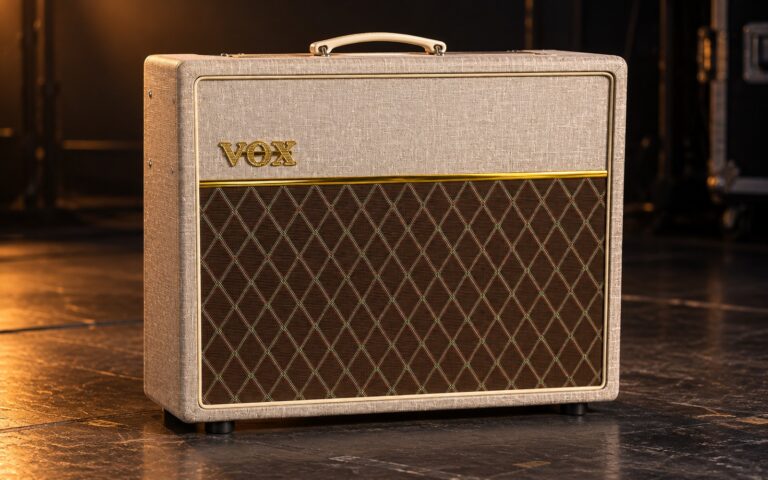
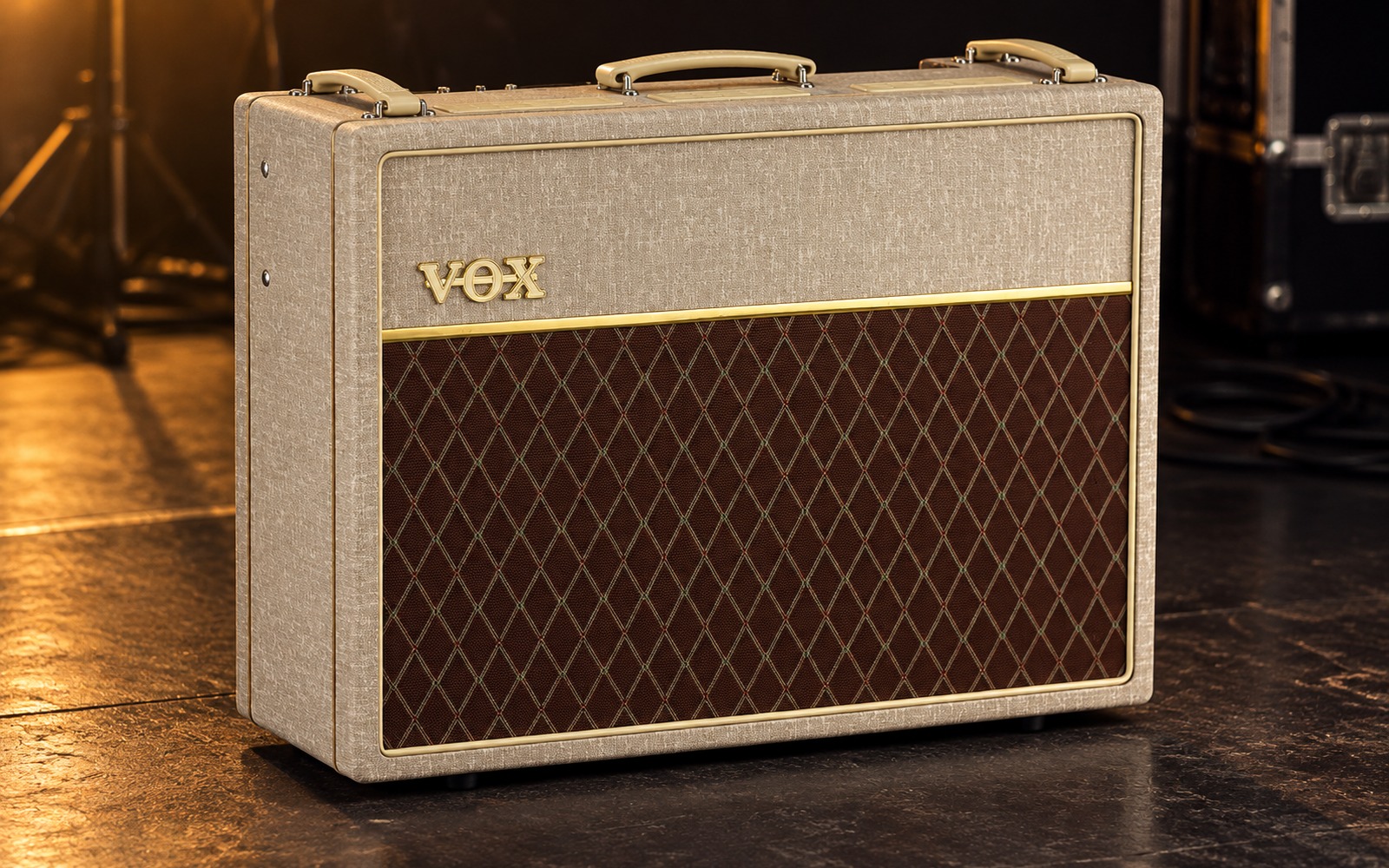
Some amps become legends because of who played them. The Vox AC30 became a legend for both reasons — for the players who chose it and for the circuit that rewarded every one of them. By 2010, the AC30 had been in continuous production for more than five decades under a succession of owners, and for most of that run it had been built on printed circuit boards. That changed on September 2, 2010, when Vox announced the Hand-Wired Series: a line of all-tube amplifiers built the way the originals were, with every component hand-soldered to a turret board, point to point, no PCB shortcuts. The Vox AC30HW2 Hand-Wired — two Celestion G12M Greenback speakers, 30 watts, full EL84/GZ34 tube complement, fawn vinyl finish, birch-ply cabinet — was the flagship of that announcement. It began shipping in October 2010 with a US MSRP of $2,200.
This is that amp’s story. The AC30HW2 is now discontinued — Sweetwater’s listing reads “no longer available” and secondary market prices run $900–$1,500 for clean examples — but the instrument it represents is as relevant as it has ever been. Vox has since introduced a deeper vintage reconstruction under the AC30HWR2X name, and understanding what the HW2 was, what it wasn’t, and what it sounded like gives any buyer navigating those choices a reliable map.
The AC30 Before the HW2: A Brief History of Compromise
The AC30 story begins with Dick Denney, a British engineer who designed the AC15 for JMI (Jennings Musical Industries) in 1957 and followed it with the AC30 in 1959 after Hank Marvin and The Shadows demanded something louder. Those original JMI instruments were hand-wired by necessity — printed circuit boards were not yet a practical manufacturing option at scale. The circuit that resulted, class-A cathode-biased EL84 output stage driving a GZ34 tube rectifier, produced a particular kind of breakup: even-order harmonic distortion, natural compression, and a dynamic sensitivity to picking attack that players called “touch responsiveness” and engineers called a class-A power-stage artifact.
JMI sold the brand to Thomas Organ Company in 1964. Subsequent owners — Norlin Music, Rose-Morris, and ultimately Korg (which acquired Vox in 1992) — gradually shifted production toward printed circuit board construction to reduce manufacturing costs and improve reliability. Korg closed UK manufacturing in Wellingborough in 1993; a brief final UK-built run was subcontracted to Marshall, ending around 2003–2004. Current production moved to Vietnam under Korg’s ownership. The result was a quieter, more consistent amplifier — and one that, to many experienced ears, behaved differently under the fingers. The PCB removed the micro-variations in component placement, lead dress, and soldering that formed part of the hand-wired character.
By 2010, a market had emerged for meticulously hand-wired boutique amplifiers claiming to recapture what the JMI golden era had. Vox’s answer was the Hand-Wired Series, designed and engineered in the UK, manufactured in Vietnam, using matched Ruby Tubes throughout and hand-soldered turret board construction “like JMI AC30 Vox amps from the 1960s,” in Vox’s own press-release language. The announcement covered six models: the AC15HW1 (single Greenback, $1,600 MSRP), AC15HW1X (single Alnico Blue, $2,000), AC30HW2 (two Greenbacks, $2,200), AC30HW2X (two Alnico Blues, $2,600), AC30HWH head ($1,750), and V212HWX extension cabinet ($1,500).
Turret Board vs. PCB: What the Difference Actually Means
A printed circuit board organizes components on an etched copper trace laminated to a fiberglass substrate. It is precise, consistent, fast to assemble, and repairable with standard diagnostic equipment. A turret board is a phenolic or fiberglass sheet with brass eyelets — turrets — pressed into it. Technicians wrap component leads around each turret and solder them individually, then run hookup wire between stages. The result is a three-dimensional wiring topology where component placement, lead length, and wire routing are determined by a human hand rather than an algorithm.
The sonic consequences of that difference are debated. What is not debated is the behavioral consequence: a hand-wired AC30’s interaction between stages changes slightly with every production run, reflecting individual components and solder joints rather than a statistical mean. Boutique amplifier builders argue this introduces desirable variance; large manufacturers argue it introduces unpredictable variance. What both agree on is that the turret board physically separates stages in ways that reduce stray capacitance between signal paths — which, in a high-gain circuit, can mean less unwanted feedback and a cleaner transient response at the moment notes begin and end.
The AC30HW2’s turret board construction also meant that a skilled technician could trace, probe, and replace any component without unsoldering a board from a chassis. Every capacitor, resistor, and solder joint was accessible and individually addressable. This is not a trivial point for an amplifier intended for professional use: a PCB repair often requires reflowing traces and replacing entire board sections; a turret-board repair means replacing one component and resoldering one joint.
The HW2 vs. the HW2X: Why the Speaker Decision Is the Real One
The Vox AC30HW2 and AC30HW2X share an identical circuit. The difference is the speakers, and the difference in character is substantial enough to change how you use the amp.
The HW2 uses two Celestion G12M Greenbacks (8Ω each, 25W each). The G12M Greenback is a ceramic ferrite magnet speaker with a paper cone voiced in the early 1970s for Marshall cabinets. Its character is tight in the low end, present and articulate in the midrange, and controlled in the high frequencies — a speaker that pushes back against the amp’s natural tendency toward brightness. The combined effect in the AC30HW2 is a sound that is warmer and more focused than most people expect from a Vox, with less of the shimmering top-end brilliance and more of a punchy British-rock midrange.
The HW2X uses two Celestion Alnico Blues (8Ω each, 15W each). The Blue is an alnico magnet speaker rated at 15 watts — less than half the combined power handling of the HW2’s Greenbacks — and its character is the opposite: early breakup onset, warm compression, and the shimmering high-frequency sparkle that defines what most players mean when they say “Vox tone.” The downside is a 15-watt rating against an amplifier delivering 30 watts. Driving Alnico Blues hard can blow them; most professional players using the HW2X keep the master volume modest and let the power stage generate headroom-limited compression rather than speaker breakup.
Neither choice is correct. They are two different instruments built on the same chassis. A player who wants the classic jangle and chime of “A Hard Day’s Night” wants the Alnico Blues. A player who wants something closer to a Greenback-loaded Marshall — or who plans to run the amp at higher stage volumes without speaker damage risk — wants the Greenbacks of the HW2.
Specifications
| Feature | Specification |
|---|---|
| Output power | 30W / 15W (half-power switch) |
| Power tubes | 4× EL84 (matched Ruby Tubes) |
| Preamp tubes | 3× ECC83 / 12AX7 |
| Rectifier | 1× GZ34 |
| Speakers | 2× 12″ Celestion G12M Greenback (8Ω, 25W each) |
| Channels | 2 — Normal + Top Boost (independent preamp circuits) |
| Normal channel | Volume, Bright switch, High/Low inputs |
| Top Boost channel | Volume, Treble, Bass, Hot/Cool switch, High/Low inputs |
| Master section | Master Volume + MV/BYPASS switch (bypasses master volume) |
| Output mode | OP mode switch: 30W or 15W |
| Reverb | None |
| Effects loop | None |
| Footswitch | VFS1 (included) — Hot/Cool switch on Top Boost |
| Cabinet | Birch-ply, natural high-frequency diffuser |
| Finish | Fawn-colored vinyl (1960s AC30 tribute) |
| Construction | Hand-wired turret board (point to point) |
| Made in | Vietnam (UK-designed) |
| Launch MSRP | $2,200 (US, October 2010) |
| Sweetwater listed | $2,199.99 (discontinued) |
| Status | Discontinued |
| Used market | ~$900–$1,500 (Reverb 2026) |
Famous Players — The Honest Account
Five artists are listed for the Vox AC30HW2: Brian May, The Edge, George Harrison, Tom Petty, and Rory Gallagher. This is the point where the calendar becomes useful.
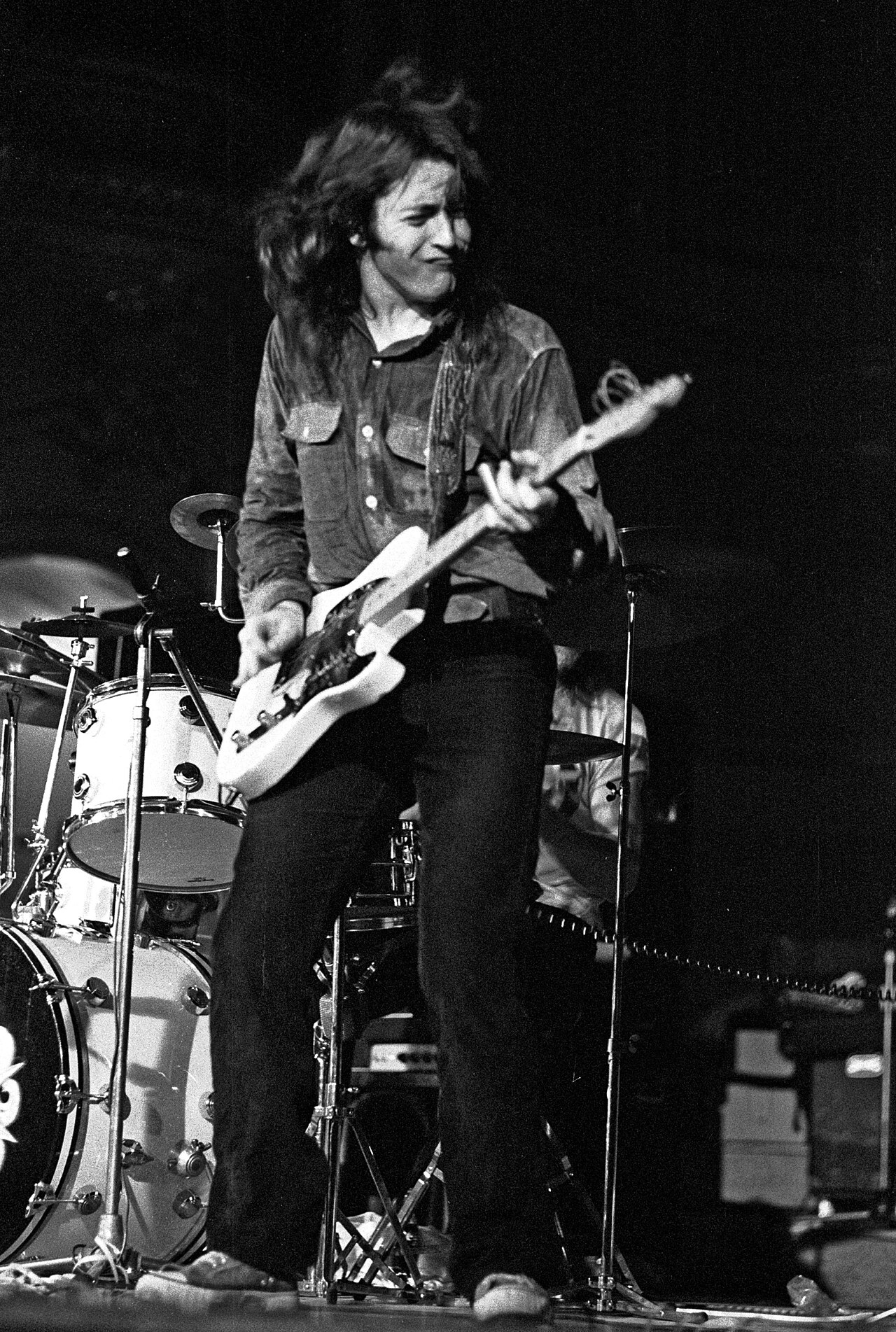
George Harrison died in November 2001. The Vox AC30HW2 was announced in September 2010. That is a gap of nine years. George Harrison cannot have used a Vox AC30HW2 because the instrument did not exist during his lifetime. His documented relationship with Vox amplifiers is genuinely significant — his use of AC30s during the Beatles’ early career (1962–1965) helped define the amp’s place in rock history — but none of that history involves the HW2. His name on an AC30HW2 artist list is a category error: he is an AC30 family icon being attributed to a specific model he never touched.
Rory Gallagher died in June 1995. The gap between his death and the HW2’s announcement is fifteen years. Gallagher used Vox AC30s throughout his career — particularly in his early days with Taste — and he is one of the AC30’s most celebrated advocates. His name on an HW2 list is again an attribution to a family, not an instrument. The HW2 did not exist when Rory Gallagher was alive.
These are not ambiguous cases or matters of contested attribution. They are simple arithmetic. Both musicians died before the product was manufactured.
The Edge of U2 is documented more carefully. His primary touring amplifiers are 1964 AC30 Top Boost combos, handwired to original JMI specification by his tech Dave Clarke, of which he owns more than thirty. When the AC30HW2X (the Alnico Blue variant) became available in 2010, Edge added one to his live rig for the 360 Tour — specifically the HW2X, not the HW2 with Greenbacks. User documentation on Equipboard places him on the AC30HW2 page (Equipboard treats the HW2 and HW2X as closely related), and his use of the hand-wired family is genuine. But his primary instrument is a vintage JMI amp maintained to period specification, not a 2010 production model, and his documented model is the X variant with Alnico Blues rather than the Greenback-loaded HW2 reviewed here. State this plainly rather than pretending the distinction doesn’t matter. The Edge is a real AC30 player; his relationship to the specific Greenback HW2 is less clear-cut than the roster implies. You can read more about his broader rig in our Edge gear guide.

Chris Shiflett of the Foo Fighters is the strongest verified AC30HW2 user in the professional record. He is a Vox official artist endorser, and the Vox artist page quotes him directly: “My VOX AC30 Hand-Wired gives me the tone I’ve been searching for forever. They deliver everything, from crashing fireworks to finest nuances.” His touring rig documentation places the AC30 Hand-Wired alongside his Friedman BE-100 heads — a combination that uses the Vox for clean and edge-of-breakup British chime while the Friedman covers higher-gain territory. Shiflett’s use is well-documented, primary-source verified, and specific to the hand-wired family. He belongs in any honest account of who actually played this amplifier.
Brian May‘s documented rig is built around Vox AC30s, but his relationship to the platform involves specific modifications that make the HW2 a poor match. May uses the Normal channel, not the Top Boost, run with a Dallas Rangemaster treble booster feeding the input and the master volume set to a level that allows the power stage to compress and saturate. He also uses the Tone Cut control at settings between 8 and 9 to darken the treble. His dedicated Vox signature product, the Vox MV50-BM, is a miniaturized version of a circuit engineered specifically around his approach. No primary source places May on an AC30HW2 specifically; his relationship is to the AC30 as a platform and to a particular channel architecture that he has used since Queen’s debut album in 1972. The HW2 shares that architecture, but “Brian May plays AC30s” does not mean “Brian May plays AC30HW2s.” They are different claims with different evidentiary standards.
Tom Petty used Vox AC30s through much of his career — a 1999 Guitar Player interview describes “an old, brown Vox AC30,” and Mike Campbell documented AC30 use live across decades of Heartbreakers performances. The HW2 existed from October 2010 through its discontinuation, giving Petty a potential use window before his death in October 2017. No primary source from that period specifically names the HW2 model. Petty is an AC30 family player whose name belongs in this context, but he belongs there as a broader endorser of the AC30 platform rather than a documented HW2 user. His name is included as genuine color, not as a verified attribution. His documented AC30 preference for the Normal channel aligns well with the HW2’s architecture, and the Heartbreakers sound — that locked groove between Petty’s rhythm and Campbell’s leads — is one of the clearest expressions of what the Normal channel does when you push it hard.
Troy Van Leeuwen of Queens of the Stone Age and Jonny Greenwood of Radiohead both appear in Equipboard’s broader AC30HW2 documentation. Jonny Greenwood has used AC30s throughout Radiohead’s career, beginning with an AC306TB in 1997; his documentation includes multiple AC30 variants and Alnico-loaded models, making the HW2X family plausible though not specifically confirmed on the Greenback HW2. Noel Gallagher‘s documented AC30 is the C2X (Alnico Blues), not the HW2. Paul Weller has used AC30s since The Jam and remains active in the platform’s community, though again specific HW2 documentation is limited.
How the AC30HW2 Actually Sounds
The AC30HW2 has two independent preamp circuits and two distinct sonic personalities that many players treat as separate amplifiers sharing a cabinet.
The Normal channel is the warmer, richer, more forgiving of the two. Its single volume control drives the preamp without the active cathode-follower tone stage that the Top Boost uses, resulting in a smoother, less edgy character with more natural compression as the volume increases. The Bright switch adds a fixed high-frequency lift without changing the gain structure, making it useful for humbucker-equipped guitars that tend to lose definition in the Normal channel’s midrange. This is the channel that Tom Petty’s Heartbreaker rhythm work describes — thick, slightly compressed, harmonically dense without becoming edgy or brittle. It handles open-chord strumming with a richness that the Top Boost’s active EQ can strip away if it’s not dialed carefully.
The Top Boost channel is the channel most people identify as “the Vox sound.” Its separate Treble and Bass controls feed an active cathode-follower tone stage driven by a full 12AX7 preamp tube — a circuit section that adds significant gain and an interactive EQ response where the controls affect each other rather than operating independently. The Hot/Cool switch (accessible via the VFS1 footswitch) adds or removes a gain stage: Cool delivers cleaner, more defined tones; Hot pushes the preamp harder for a more compressed, overdriven character. Premier Guitar’s 2026 review of the current AC30 Hand-Wired notes that the Top Boost “takes careful dialing in to work with a Telecaster or other bright single-coil guitar,” and that observation applies equally to the HW2. With the treble control above 6 and a single-coil plugged into the High input, the Top Boost can become brittle and fizzy. Reducing the treble to 4 or 5 and using the Low input smooths the response significantly and reveals the channel’s defining quality: that chimey, almost three-dimensional harmonic envelope that no other amplifier quite replicates.
The G12M Greenback speakers shape the HW2’s voice in ways that distinguish it from the HW2X. Where the Alnico Blues of the HW2X extend the amp’s natural top-end brightness and provide earlier compression onset, the Greenbacks pull the frequency response slightly downward — tighter low end, more focused midrange, a top end that yields before the blues’ shimmer begins. The result is an amplifier that sits differently in a band mix: the HW2 locks into the rhythm section more readily, while the HW2X rises above it. Neither approach is universally better; they’re optimized for different musical contexts.
The GZ34 tube rectifier adds voltage sag — a slight drop in plate voltage under sustained picking — that the HW2 shares with vintage JMI amplifiers and that solid-state rectifiers eliminate. This sag slows the amp’s transient response slightly (the note “breathes” before it speaks at full volume) and creates a compressed, touch-sensitive quality during sustained chords. Swapping the GZ34 for a solid-state rectifier substitute tightens the response and reduces the sag, which some players prefer for single-note lead work and others find removes the character they bought the amp for.
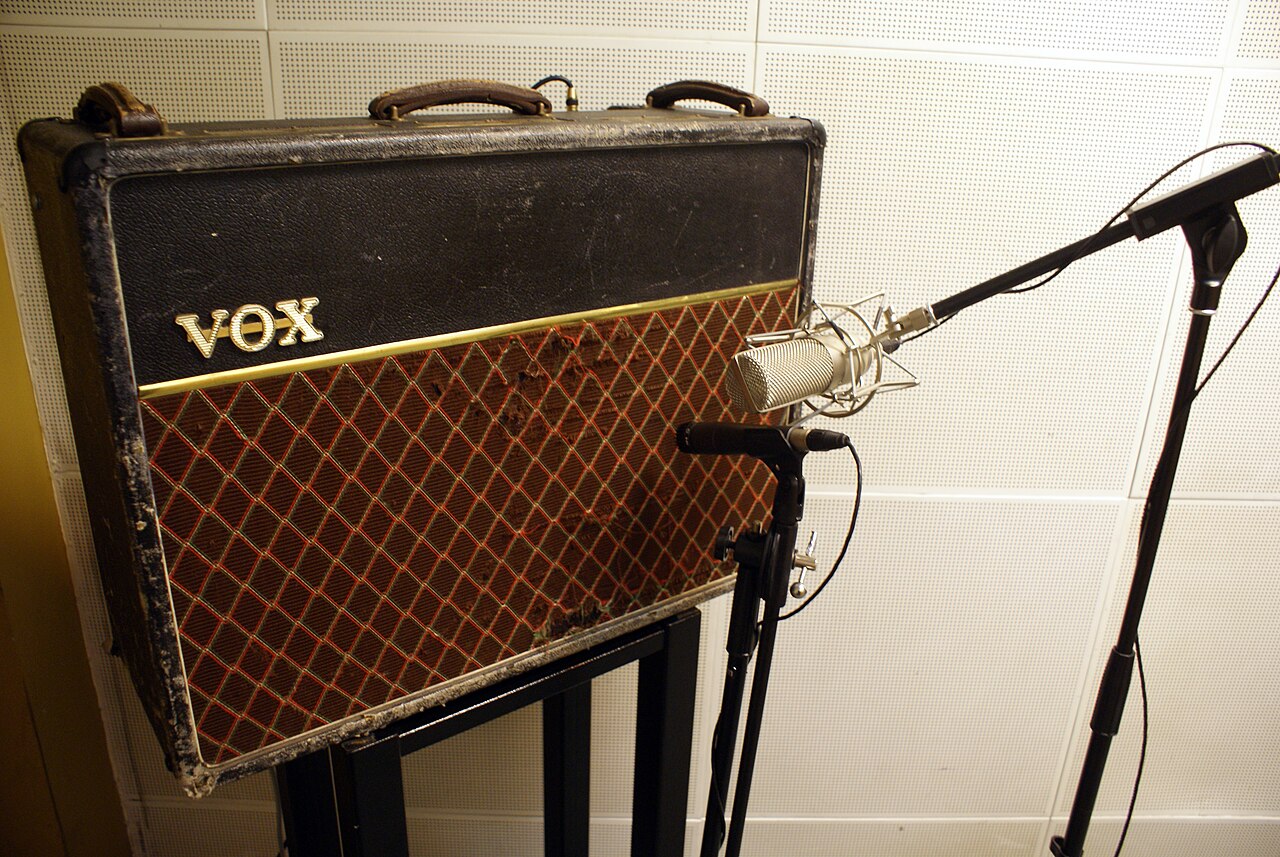
One critical difference between the HW2 and the PCB-based AC30C2: the MV/BYPASS switch. In bypass mode, the master volume section is removed from the signal path entirely and the amp runs in its most direct configuration, with the preamp channels connected directly to the output stage. In master volume mode, the output can be attenuated at the master control. This is the feature that makes the HW2 usable in a rehearsal room or small venue without requiring a separate power attenuator: run the channel volume for the character you want, then use the master to set the stage volume. The bypass mode delivers the purest signal path for recording or for players who want the amp to run the way JMI’s original circuit operated.
Tone Recipes and Settings
Recipe 1: The British Invasion Clean (Top Boost, Single-coil)
Plug a Rickenbacker or Casino into the Low input of the Top Boost channel. Set Treble to 4, Bass to 6, Volume to 5 (Cool mode). Set Master Volume to 6, MV mode active. This reproduces the clean-into-slightly-compressed character of 1963–1965 Vox recordings — the bright jangle without the brittleness that comes from the High input or excessive Treble settings. Pick attack controls dynamics dynamically; a hard strum compresses and blooms; a soft pick delivers articulated, clean notes. Add an Electro-Harmonix Deluxe Memory Man in the effects loop workaround (running it between guitar and amp, serial chain) for the slapback echo that completes the early-rock sonic picture.
Recipe 2: Tom Petty Rhythm (Normal Channel, Telecaster)
Use the Telecaster bridge pickup into the Low input of the Normal channel. Set Volume to 7, Bright switch off. Master Volume to 5. This replicates the “thick and gutsy” Normal channel character that Dave Hunter describes in the Premier Guitar AC30 Hand-Wired review — meaty Heartbreakers riffs and crunching alt-country. The Normal channel at this setting produces a slight preamp breakup at the peaks of hard strumming while remaining clean at lower attack levels. Run the Telecaster’s tone control at 7 (not full) to pull some of the single-coil’s edge back into warmth.
Recipe 3: Hot Top Boost Overdrive (Lead, ES-335 or P-90)
Select Hot mode on the Top Boost via the VFS1 footswitch. Set Treble 4, Bass 6, Volume 7. Master Volume 4. An ES-335 or a guitar with P-90 pickups pushes the Hot setting into a compressed, singing overdrive that Premier Guitar describes as “a sound responsible for countless classic solos.” The Top Boost in Hot mode with humbuckers at this setting cuts through a full band mix with the upper-midrange presence that makes lead lines audible even in dense arrangements. Avoid the treble above 5 in Hot mode with single coils — the combination is aggressive enough to become fatiguing at stage volumes.
Recipe 4: Brian May Normal Channel Approach
This recipe works on the HW2 even though Brian May has not been documented specifically using this model — it uses the same channel architecture he has relied on since 1972. Normal channel, Volume 10, Bright switch on. Master Volume 3–4. Place an Electro-Harmonix Big Muff Pi before the input for sustain, or use a treble booster (Dallas Rangemaster equivalent or modern treble boost pedal) into the Normal channel’s High input. The Bright switch’s high-frequency lift plus the treble booster produces May’s characteristic compressed, harmonically complex lead tone. This approach bypasses the Top Boost entirely; the Normal channel’s simpler preamp topology responds differently to overloaded inputs, producing a smoother, thicker saturation than the Top Boost achieves.
Recipe 5: Studio Recording with Half-Power and Room Mics
Engage the OP switch to reduce output to 15 watts. Top Boost channel, Volume 7, Treble 5, Bass 6, Hot mode. Master Volume 6, MV bypass off. Place a ribbon microphone 6–8 inches off-axis from one Greenback speaker and a room microphone at 8–10 feet in front of the cabinet. The 15-watt setting allows the power stage to compress without the full 30-watt SPL that makes close-miking an AC30 in a normal-sized room a battlefield. The G12M Greenbacks at 15 watts produce the mid-forward character that records well without needing extensive EQ correction. Blend the room mic at 20–30% to add dimension and air without losing the Greenback’s definition.
How It Compares to the Other AC30s in This Series
vs. Vox AC30C2 (PCB)
Our Vox AC30C2 guide covers the standard production AC30 in depth. The C2 and HW2 share their fundamental circuit topology but differ in construction method, component quality tier, and the presence/absence of the turret board. The C2 includes spring reverb and tremolo that the HW2 omits; the HW2 includes the MV/BYPASS switch that the C2 lacks. For a player who needs reverb built in, the C2 is more practical. For a player who wants the cleaner signal path and hand-soldered component variability, the HW2 is the more interesting instrument. Used, the C2 runs $900–$1,400; a clean HW2 runs $900–$1,500. The price difference is surprisingly small given the construction difference, which makes the HW2 a reasonable trade-up proposition on the secondary market.
vs. Vox AC30S1 OneTwelve
Our AC30S1 guide covers the stripped-down single-speaker variant. The S1 has a single Top Boost channel (no Normal, no Tone Cut, no tremolo), one Celestion VX12, and digital reverb. It is fundamentally a different proposition: a portable, single-channel, single-speaker take on the Top Boost voice. The HW2’s two Greenbacks produce a different frequency response than the S1’s single VX12, and the HW2’s Normal channel gives it tonal versatility the S1 entirely lacks. The S1 is the right choice for portability and simplicity; the HW2 is the right choice for the complete AC30 architecture.
vs. Vox AC30 Top Boost (Vintage JMI)
Our vintage JMI AC30 guide covers the original. The HW2 was explicitly designed to recapture the JMI spirit, and it succeeds in most respects — but the original 1963 copper-panel AC30 has characteristics that the HW2 approximates rather than replicates: specific transformer winding ratios, specific tube types from the period, speaker cone materials that have aged over sixty years. Vox’s own 2024 AC30HWR2X represents a second-generation attempt, based on detailed analysis of an original 1963 copper-panel instrument, with custom-wound transformers and a redesigned power circuit to recreate specific voltage sag behavior. Vintage JMI examples run $3,000–$8,000+ on Reverb, making the HW2’s $900–$1,500 used price a significant value proposition for players who want the architecture without museum-artifact pricing.
vs. Vox AC15C1
Our AC15C1 guide covers the half-power sibling. The AC15 runs 15 watts, one EL84 pair, one 12″ speaker — a smaller, lower-output version of the same basic circuit. For home players and small-venue performers, the AC15’s 15 watts often achieves useful power-stage compression at SPL levels that won’t clear a room. The HW2’s 30 watts and OP switch mean it can cover both territories, but the AC15’s single-speaker format and lower output make it more practically manageable for everyday practice use. The choice is a question of output requirements and cabinet size tolerance.
vs. Current Vox AC30HWR2X
The AC30HWR2X is Vox’s current (2024-onward) hand-wired AC30. It is not a continuation of the HW2 — it is a more thorough reconstruction, based on analysis of a specific 1963 copper-panel instrument, with custom-wound transformers, a redesigned power circuit for improved voltage sag authenticity, a copper control panel, brass vent grills, tube-driven spring reverb, and a buffered FX loop. The tube complement has changed: the HWR2X uses 4× ECC83 plus 1× ECC81 (12AT7 for the reverb recovery stage), whereas the HW2 used 3× ECC83 with no reverb tube. Premier Guitar’s May 2026 review (Dave Hunter) rates it 4.2 and praises the reverb as “lush and three-dimensional.” Street price is $1,999 for the head, with the combo version running over 70 pounds. If you want a hand-wired AC30 new, the HWR2X is the current option and a meaningfully more evolved instrument than the original HW2 series. If you want an HW2 specifically, you’re shopping the used market.

Buying Guide: Shopping the Discontinued Market
The AC30HW2 is out of production. Every example on the market has been owned and played; condition varies considerably. These are the things to verify before committing to a purchase.
Tube condition first. The HW2 runs a matched quad of EL84s and a GZ34 rectifier alongside three ECC83 preamp tubes. EL84s have a shorter service life than EL34s and shorter still in cathode-biased class-A configurations like the AC30, where they run continuously at full operating current. A set of EL84s in a well-used AC30 may need replacement after 500–800 hours of playing time; a set in a gigged amplifier may be on borrowed time. Budget $80–$150 for a fresh matched quad of EL84s (Ruby, Tung-Sol, JJ, or Mullard reissues are the standard options) and another $20–$40 for a GZ34. Ask the seller when tubes were last replaced and whether the amp has been biased — the AC30’s cathode-biased design is self-biasing in theory, but tube matching matters.
Speaker condition second. The Celestion G12M Greenbacks in the HW2 are rated at 25 watts each for a combined 50-watt rating against an amplifier producing 30 watts. This ratio is safe, but a G12M that has been driven hard at full volume for years may show cone fatigue, voice coil rubbing, or surround deterioration. Test by pressing gently on the cone edges — any scraping sound suggests voice coil issues. Listen for distortion at lower volumes that isn’t coming from the amp itself.
Cabinet condition third. The birch-ply cabinet is relatively robust, but the fawn vinyl can crack at corners and the natural high-frequency diffuser (a slotted wooden panel behind the baffle) can come loose and rattle. Inspect corners, hinges, and the diffuser panel.
Origin story fourth. Equipboard’s used pricing puts best available prices from $1,201.86 as of August 2026. Reverb listings for clean, mid-era examples run $900–$1,500. Anything below $900 warrants extra scrutiny on tubes and speakers. Anything above $1,600 should include documentation of recent service.
HW2 vs. HW2X on the used market. The HW2X (Alnico Blues) commands a premium over the HW2 (Greenbacks) on the secondary market because more players associate the Alnico Blue with the classic Vox chime. The spread is typically $100–$300. If you want Greenbacks, the HW2 is actually a better value than the HW2X would be at equivalent playing condition — same circuit, different speaker, lower price. If you want Alnico Blues in a hand-wired AC30, budget accordingly for the HW2X or consider a speaker swap on a clean HW2.
Speaker swap consideration. Many HW2 owners swap the G12M Greenbacks for Celestion Alnico Blues or Alnico Golds after purchase, effectively converting an HW2 to an HW2X-adjacent amp. The Alnico Blue’s 15-watt rating against the HW2’s 30-watt output creates a wattage mismatch risk; most players who do this keep the master volume conservative and use the 15-watt OP switch to manage power stage output. The Alnico Gold (rated 50 watts) is a safer substitute that retains alnico warmth without the mismatch risk. Celestion Creambacks (65 watts) provide the widest safety margin while delivering a more modern midrange character.
Ownership Notes
No reverb means external reverb. The AC30HW2 has no built-in reverb — this distinguishes it from the AC30C2 (spring reverb) and the current AC30HWR2X (tube-driven spring reverb). Any reverb must come from a pedal or outboard unit. A spring reverb tank unit running in the signal chain preserves the all-tube character; a Strymon Flint or Boss RV-6 runs in the effects chain with no loss. The absence of reverb is a design choice, not an oversight — purists argue that onboard reverb adds gain stages and routing that affect the direct signal.
No effects loop means serial pedal chains only. All modulation, delay, and reverb pedals run between guitar and amp, in series. For players using time-based effects, this means the effects are subject to the amp’s gain structure: pedals interact with preamp saturation rather than bypassing it. Many players prefer this for reverb and analog delay (the effect becomes part of the gain character); others find it makes multi-effect rigs difficult to control cleanly. The current AC30HWR2X adds a buffered FX loop as a direct response to this limitation.
Loud at stage volume. 30 watts of class-A cathode-biased EL84 output is louder than 30 watts of fixed-bias amplification. Perceived volume aligns closer to 50 watts of fixed-bias Marshall operation. The OP switch (15 watts) addresses this partially; a separate power attenuator (Weber Mass, Ox Amp Top Box, or Two-Notes Torpedo) addresses it more completely. The MV/BYPASS functionality allows running the amp at controlled volume without a power attenuator, though some of the power-stage saturation character is lost at attenuated master volume settings.
Tube access requires effort. The Premier Guitar review of the current HWR2X notes that replacing tubes “requires removal of the entire chassis — a significant investment in time and effort.” The HW2’s chassis access is similar. This is not unique to the hand-wired series — all AC30s are compact enough that tube access requires more disassembly than open-chassis amplifiers — but budget time for the process when replacing tubes. If you’re not comfortable with high-voltage electronics, have a qualified technician replace tubes and check bias (even cathode-biased amps benefit from tube matching and periodic inspection).
Running temperature and spacing. The four EL84 power tubes and GZ34 rectifier run hot. The AC30’s compact cabinet doesn’t provide generous airflow around the tube section. Leave at least 4 inches of clearance above and behind the amplifier for ventilation. Allow a full 20-minute warm-up before playing at high volumes. In warm or humid environments, the GZ34 is particularly susceptible to early failure — inspect it yearly.
The MV/BYPASS switch and hum. A small number of AC30HW2 owners report increased hum in MV/BYPASS mode versus MV mode. This is related to the direct signal path the bypass creates — any noise in the input chain (cable, guitar pickup, or pedal) is amplified without the master volume section’s slight buffering effect. Bypass mode is best for recording direct or for environments where the input chain is well-shielded. For live use with longer cable runs or noisy pedalboards, MV mode with a high master volume setting is usually quieter.
Frequently Asked Questions
What is the difference between the Vox AC30HW2 and the AC30HW2X?
The circuit is identical. The only difference is speakers: the HW2 uses two Celestion G12M Greenbacks (ceramic ferrite magnet, 25W each, combined 50W) and the HW2X uses two Celestion Alnico Blues (alnico magnet, 15W each, combined 30W — which is exactly the amp’s output rating). The Greenbacks produce a tighter, more midrange-focused sound; the Alnico Blues produce the shimmering, compressed top-end chime that most players associate with the word “Vox.” The HW2X speaker rating means there is no headroom between amplifier output and speaker capacity; the HW2’s Greenbacks have substantial headroom at 30W output.
Why is the AC30HW2 different from a standard AC30C2?
Both share the same fundamental circuit topology — Normal channel, Top Boost channel, EL84 quartet, GZ34 rectifier. The differences are construction method (HW2: hand-wired turret board, point to point; C2: printed circuit board), tube quality (HW2: matched Ruby Tubes; C2: standard production tubes), control features (HW2: MV/BYPASS switch, OP half-power switch, Hot/Cool footswitch; C2: spring reverb, tremolo, Tone Cut), and price (C2 was $1,799.99 new; HW2 was $2,199.99 new). The C2 is more feature-complete; the HW2 is more signal-path-pure.
Does the AC30HW2 have reverb?
No. The AC30HW2 has no built-in reverb of any kind. This distinguishes it from the AC30C2 (spring reverb) and the current AC30HWR2X (tube-driven spring reverb with Tone and Level controls). Any reverb with the HW2 must come from an external pedal or rack unit. Vox’s decision to omit reverb from the HW2 was consistent with the amp’s stripped-back approach — the goal was a direct path to hand-wired tube tone, not a feature set.
Can the AC30HW2 be used at bedroom volumes?
The OP half-power switch drops output from 30 watts to 15 watts, which helps, but class-A EL84 amplifiers at 15 watts are still louder than most bedroom situations can tolerate. The MV/BYPASS switched to MV mode and the master volume turned down achieves lower playable volumes, though some power-stage character is lost at very low master settings. For genuine bedroom use without tonal compromise, a power attenuator (Weber Mass, Ox Amp Top Box, or Two-Notes Torpedo) is the practical solution. Most home users find that 15 watts into a power attenuator set to reduce output by 10–15 dB achieves useful-sounding, apartment-friendly volumes.
Is the AC30HW2 worth more than a PCB-based AC30C2?
On the used market, the price difference between a clean HW2 and a similar-condition C2 is roughly $100–$400, which is a relatively small premium for the construction difference. Whether that premium is “worth it” depends entirely on what you value. The turret board construction offers a different behavioral character, superior repairability at the component level, and the satisfaction of owning an amplifier built the way the originals were. The C2’s onboard reverb and tremolo are absent from the HW2. Players who need reverb will either pay for it separately (pedal) or should prioritize the C2. Players who prioritize signal path purity and craftsmanship find the HW2 the more compelling instrument.
What is the current equivalent of the AC30HW2?
Vox’s current hand-wired AC30 is the AC30HWR2X (with Alnico Blues) or the AC30HWR2 Greenback variant, both part of the AC HWR series introduced around 2024. These are meaningfully different from the original HW2 — they are based on detailed analysis of an original 1963 copper-panel AC30, use custom-wound transformers, and add tube-driven spring reverb, a buffered FX loop, a copper control panel, and brass vent grills. Street price for the current combo version is approximately $1,999–$2,199. Premier Guitar’s May 2026 review (Dave Hunter) rated the current model 4.2 stars and praised the reverb as “lush and three-dimensional.”
Did George Harrison and Rory Gallagher use the AC30HW2?
No. This is a calendar question. George Harrison died in November 2001; Rory Gallagher died in June 1995. The Vox AC30HW2 was announced September 2, 2010, and began shipping in October 2010. Both musicians died before the instrument was manufactured. Their names appear on various AC30HW2 marketing lists because they are genuine AC30 family icons — both used JMI-era AC30s extensively — but their connection is to the AC30 platform broadly, not to the HW2 specifically.
Who are the documented AC30HW2 players?
Equipboard documents 39 professional artists using the AC30HW2 as of August 2026. The most prominently documented include Chris Shiflett (Foo Fighters), whose Vox artist page quotes him directly on the hand-wired series; The Edge (U2), whose 360 Tour rig included an AC30HW2X (the Alnico Blue variant); and Troy Van Leeuwen (Queens of the Stone Age). The broader Vox AC30 family has a player roster that includes virtually every major British rock artist of the 1960s and a significant proportion of subsequent musicians who have pursued British-voiced clean and edge-of-breakup tones. The HW2 specifically attracted players seeking that lineage in a hand-wired form unavailable from the standard production line.
Image credits
- Top image: GuitarGangsters AI-generated reference illustration, not a photograph.
- A Vox AC30 with a ShinyBox microphone and a Shure SM57 in a studio: Marc Wathieu from Huy, Belgium, Wikimedia Commons, CC BY 2.0.
- A Vox AC30 CC2 amplifier next to a Gretsch hollow body guitar: Massygo, Wikimedia Commons, CC BY 2.0.
- The Edge: iinchicore, Wikimedia Commons, CC BY-SA 4.0.
- Rory Gallagher: Heinrich Klaffs, Wikimedia Commons, CC BY-SA 2.0.
Latest News
Related

On This Day
Monday 9 November
From this week: