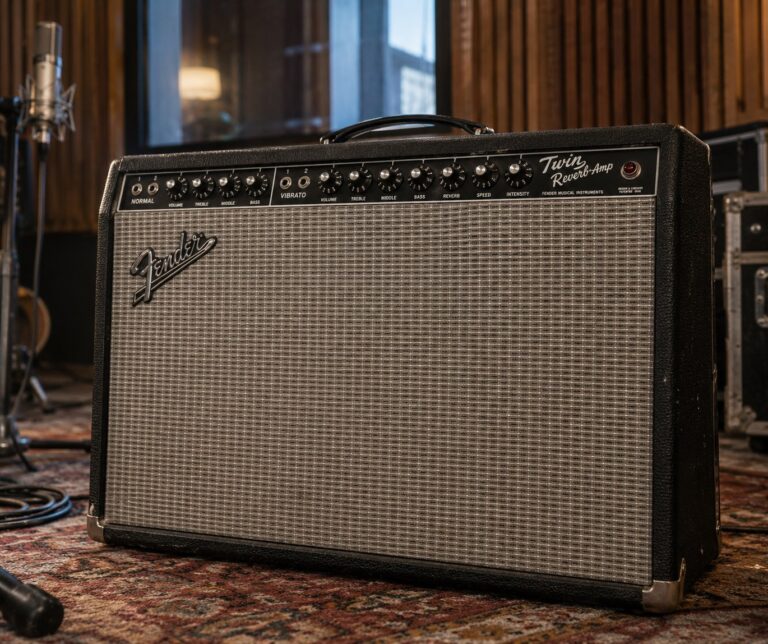
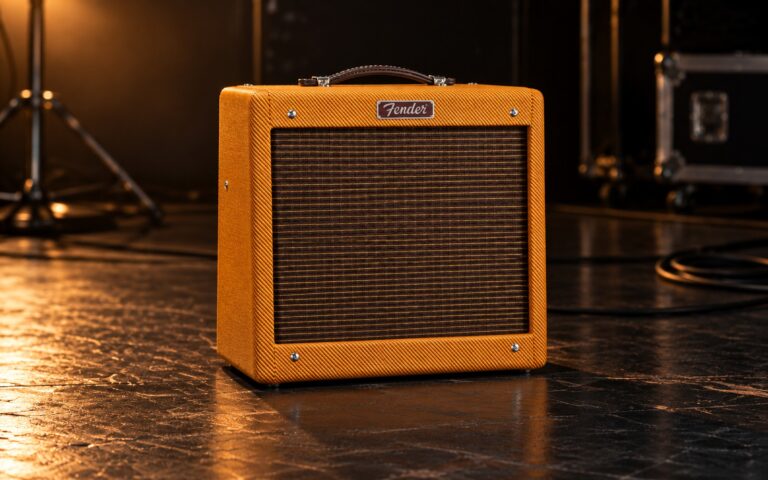
Forty Watts of Tweed Thunder: The Fender ’57 Custom Twin-Amp and the Radical Simplicity of Wanting Less
The Fender '57 Custom Twin-Amp: 40-watt handwired 5E8A tweed combo, USA-built. Eric Clapton's main stage amp from 2004. Full specs and buying guide.
At $3,989.99 in 2026, the Fender ’57 Custom Twin-Amp is one of the most expensive production guitar combo amplifiers in the Fender catalogue. It weighs 56 pounds. It has five controls. It produces no reverb. No tremolo. No effects loop. No master volume. No channel switching. You get Presence, Bass, Treble, and two Volume knobs — one per channel — plus four input jacks. That’s the whole instrument.
If that sounds like you’re paying nearly four thousand dollars for a deliberate subtraction of features, you’ve understood the pitch exactly. The ’57 Custom Twin-Amp is a hand-wired, all-tube, point-to-point recreation of the 1957 Fender Twin-Amp in its 5E8A “low-power” configuration: 40 watts of signal, split across two specially designed 12-inch Eminence alnico speakers, with Mercury Magnetics transformers and Fender Pure Vintage yellow coupling capacitors running the whole show. Every component chosen to replicate what one very specific vintage amplifier sounds like when it breathes.
Eric Clapton used it as his main stage amp for the better part of a decade. That’s not a coincidence. It’s an argument.
A Brief History of Twins: The One They Don’t Talk About
The Fender Twin-Amp has one of the most complex and frequently misunderstood histories in amplifier lore, partly because the name “Twin” covers at least four distinct circuits across three decades, and partly because the models that dominate the cultural conversation — the blackface Twin Reverb, the high-power silverface — are separated from the earliest versions by not just years but fundamentally different sonic architectures.
Leo Fender introduced the Twin Amp in 1952, presenting it at the Summer NAMM show as the company’s new professional flagship. The original model 5C8 ran in a wide-panel tweed cabinet and produced roughly 25 watts — a big amp for its day, but modest by later standards. By the mid-1950s, the line had evolved through several narrow-panel iterations, arriving at the 5E8-A: a 35-to-40-watt design featuring two 12-inch speakers, a Bright channel and a Normal channel with their own volume controls, shared Treble, Bass, and Presence controls, and — critically — two 5U4 tube rectifiers in a configuration that no other Fender amp shared.
This last detail matters enormously, and it’s where the ’57 Custom Twin-Amp’s tonal story begins. The 5U4 rectifier pair was not merely an engineering concession — it was a defining characteristic. Premier Guitar reviewer Bob Goffstein, writing in 2009 about the Custom Shop predecessor to this model, noted that removing one of the rectifier tubes during a session “didn’t result in much of a change, but a slight compression.” That compression, that slight squash of the note’s attack-and-decay envelope, is a substantial portion of what makes the 5E8-A feel different from everything that came after it. The rectifiers, the decreased negative feedback loop, the particular split-load (cathodyne) phase inverter all combine to give the low-power Twin a voice: punchy, vocal, harmonically present, with a mid-range directness that feels less like clean tone and more like the amp is actively participating in the conversation.
Then, in 1958, Leo changed everything. The model 5F8 — quickly refined into the 5F8-A — replaced the split-load phase inverter with a long-tailed pair, upgraded to a GZ34 rectifier, pushed the output to approximately 85 watts, and in doing so created the amp that Keith Richards, David Gilmour, and Joe Bonamassa would later chase across decades of vintage-market bidding wars. The 5F8-A high-power Twin is a genuinely different beast: louder, tighter at the bottom, generating different harmonic content because of the LTP inverter’s symmetric clipping characteristics. When Guitar Player magazine ran a piece noting that Clapton “often used” a vintage high-power Twin alongside “reproductions thereof, in addition to also using the earlier 40-watt iteration,” that distinction is not a footnote. The two amps are not interchangeable.

The reason this matters for anyone considering the ’57 Custom Twin-Amp purchase is simple: the Fender ’57 Custom Twin-Amp replicates the 5E8-A, not the 5F8-A. It is the low-power circuit. The famous vintage Twins that Gilmour toured with, that Richards has owned several of, that Bonamassa added to his rig in 2014 and that prompted Fender to release the ’59 Twin JB Edition in 2018 — those are the 85-watt high-power model. Beautiful amplifiers, but a different product family entirely. If you walk into a dealer intending to buy the sound of “Shine On You Crazy Diamond” or “Let It Bleed,” the ’57 Custom Twin-Amp is not the reissue you’re looking for.
What the ’57 Custom Twin-Amp does give you is the sound of approximately 1956-57 Fender at its most articulate and organic: a 40-watt amplifier that breaks up with warmth rather than ferocity, cleans up with superb touch sensitivity, and rewards a guitarist who plays dynamically rather than one who relies on a pedalboard to generate character.
From Custom Shop to Production Line: The Twelve-Year Journey
The modern reissue history of the 5E8-A circuit began “around 2004,” according to Premier Guitar’s 2009 review of the Custom Shop version of the amp. That model — built by the Fender Custom Shop, rated MSRP $3,880 and street around $3,100 at the time — was the amp that caught the attention of Eric Clapton.
According to groundguitar.com’s documented Clapton gear archive, the Custom ’57 Twin became his “main stage amp since around 2004/2005.” Based on concert photos from that era, Clapton typically ran two of them on stage simultaneously. When Fender released the EC Twinolux in 2011 — the formal Eric Clapton Signature version of this same circuit, cosmetically nearly identical to the Custom Shop original, distinguished primarily by a small “EC” badge on the lower right of the grille — the connection between Clapton and the 5E8-A platform became official.
The current production ’57 Custom Twin-Amp is the direct institutional descendant of that decade-long relationship. When Fender VP of Amplifiers Jim Ninesling announced the entire ’57 Custom Tweed series at Summer NAMM on June 30, 2016, he described them as “the culmination of a 12-year journey, from our highly successful ’57 reissues and Eric Clapton Signature amps to the landscape of today.” The twelve years trace back precisely to 2004 — the year the Custom Shop version entered production. This is not background flavor text. It is the institutional origin story of what you are buying.
The 2016 launch brought with it an important upgrade in consistency and accessibility: the new series was built and hand-wired in Corona, California, and sold as part of Fender’s American Hand-Wired line, putting the 5E8-A circuit into general production for the first time. Where the Custom Shop model was a limited specialty item, the ’57 Custom Twin-Amp is a catalogued production amplifier — still expensive, still handwired, still Mercury Magnetics, but available from authorized dealers and backed by the standard Fender warranty structure.
Full Specifications
Famous Players — What Is Claimed and What the Evidence Shows
The gear databases and manufacturer-adjacent marketing materials floating around the internet list five names as artists connected to the ’57 Custom Twin-Amp: Stevie Ray Vaughan, John Mayer, Eric Johnson, Mike Campbell, and Paul Gilbert. None of these connections holds up to per-SKU verification. The one artist whose connection is genuine and documented — Eric Clapton — is absent from most of these lists. Let’s go through this systematically.
Stevie Ray Vaughan died on August 27, 1990. The current Fender ’57 Custom Twin-Amp, as a production instrument, was announced at Summer NAMM on June 30, 2016. That is a 26-year gap. Even the Custom Shop predecessor to this model appeared “around 2004” per Premier Guitar — still 14 years after SRV’s death. Beyond the calendar impossibility, Vaughan’s documented amp arsenal was built around vintage Fender Vibroverbs (the 1963/64 1×15″ model — itself a completely different circuit), Dumble Steel String Singers, and Super Reverbs. He had no documented connection to the Twin family of any era.
.His documented amplifiers run toward Two-Rock Traditional Clean heads, Dumble SSS units, and the Fender Vibro-King. No primary source — rig rundown, interview, or manufacturer page — places him on a ’57 Custom Twin-Amp or its Custom Shop predecessor.
Eric Johnson is legitimately one of the world’s great Twin Reverb players, and that’s the problem. Johnson’s documented amp rig, per multiple Premier Guitar Rig Rundowns, centers on a pair of 1966 Fender Twin Reverbs that have been cut down to head format, running into a stereo Marshall cabinet with EVL speakers — plus Marshall plexi heads for lead. The 1966 Twin Reverb is a blackface AB763-derivative circuit with reverb and tremolo, which is a completely separate amp from the 1956/57 5E8-A tweed circuit this amp replicates. Calling Johnson a ’57 Custom Twin player because he plays “Twin” amps is the kind of error that the word “Reverb” in the name is designed to prevent. If the amp name has “Reverb” in it, it is not this amp.
Mike Campbell of Tom Petty and the Heartbreakers has been documented consistently as playing a 1963 Princeton Brownface as his principal Fender amp. Campbell’s rig has never, in any verified primary source, included a ’57 Custom Twin-Amp.
Paul Gilbert runs Marshalls. Confirmed, with a recent switch to the Fender Tone Master Pro for clinics and endorsement purposes. Gilbert is not a Fender tweed player by any documented reckoning.
Now for the artists the databases miss. Eric Clapton is the central legitimate connection to this amplifier. The groundguitar.com Clapton gear archive, maintained from concert photograph research and published interviews, documents the Custom ’57 Twin Tweed as his “main stage amp since around 2004/2005” — typically two units deployed simultaneously. The amp’s connection to Clapton was direct enough that Fender worked with him to develop the EC Twinolux in 2011, a Clapton-signature variant of essentially the same circuit. The Fender VP’s own 2016 press release explicitly identifies “Eric Clapton Signature amps” as part of the 12-year journey that led to the ’57 Custom series. This is as clean an artist-product connection as this series has documented. Clapton used the Custom ’57 Twin through the post-Cream-reunion era, a period that includes some of his most praised stage performances of the 2000s.
It is important to be precise about the Clapton connection: the amp he used from ~2004 was the Custom Shop version, not the 2016 production series instrument you can buy today. The two share the same 5E8-A circuit, Mercury Magnetics transformers, and alnico speaker configuration. From 2011 onward, Clapton moved to the EC Twinolux, which is cosmetically almost identical but carries the “EC” badge on the lower-right grille corner. The practical upshot: when you buy the current ’57 Custom Twin-Amp, you are buying the publicly accessible production version of the amplifier that Clapton refined over a decade and that Fender formally canonized as a Custom Shop collaboration.
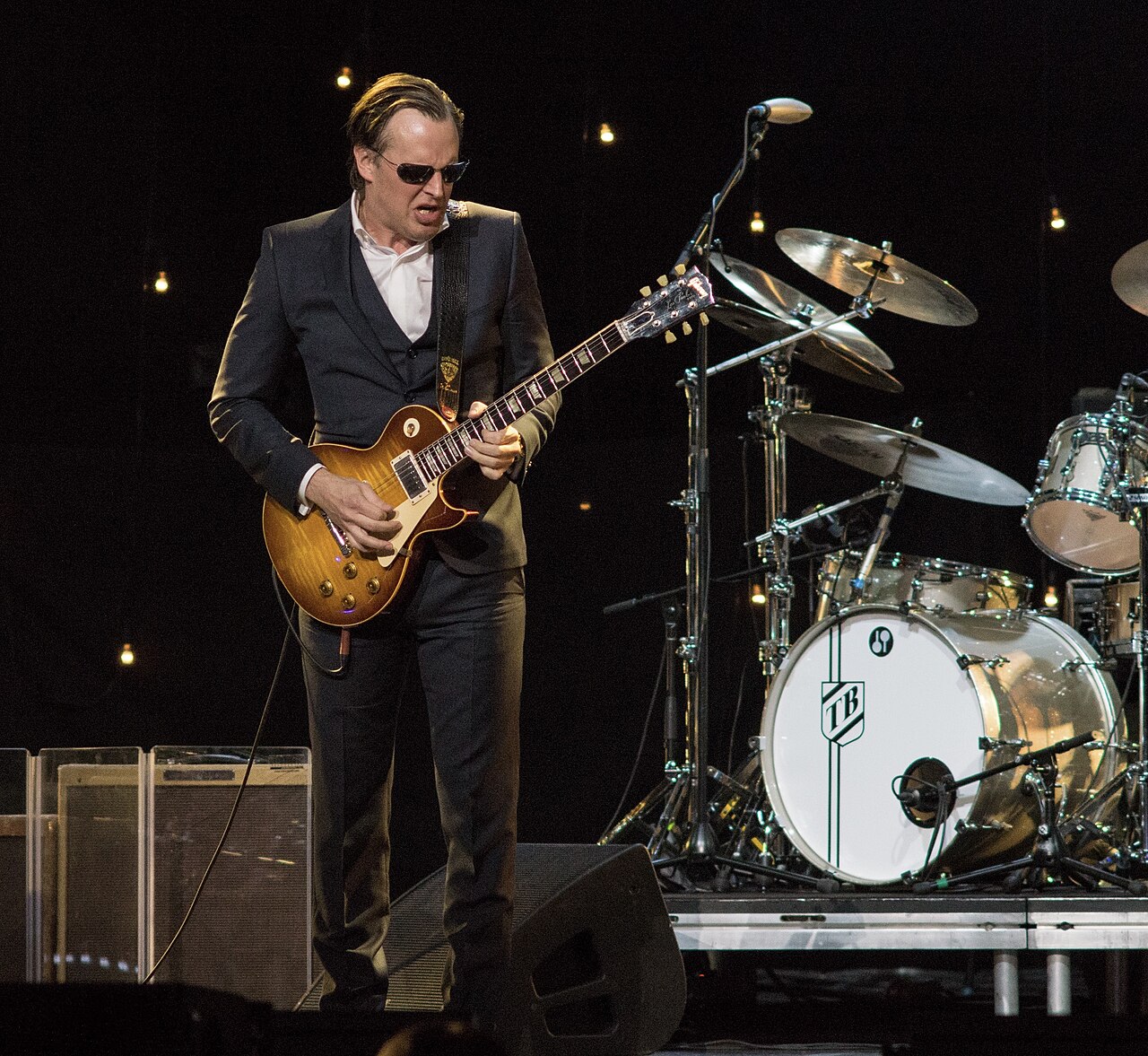
A note on the high-power players: Keith Richards, David Gilmour, and Joe Bonamassa are all genuinely associated with vintage Fender Twin-Amps, but with the 5F8-A high-power version from 1958-1960, not the 5E8-A. Gilmour’s well-worn 1958 Twin-Amp is documented in Guitar Player magazine’s photography. Richards has toured with multiple examples. Bonamassa added a pair to his rig in 2014, telling Guitar Player: “I plugged in a Les Paul, and we were just like, ‘Wow, that is just optimized sound!'” Fender built the ’59 Twin JB Edition in 2018 specifically to honor Bonamassa’s 85-watt obsession — a reissue of the 5F8-A high-power circuit that is a different product entirely from the amp being reviewed here. These players belong in any conversation about the Twin-Amp legacy, but not as users of this specific reissue.
Circuit Character and Tonal Personality
The 5E8-A circuit occupies a peculiar and coveted position in the Fender tonal taxonomy: it is the last of the “pure” tweed Twins before Leo Fender upgraded to the high-power architecture, which means it carries the warmth and mid-range saturation of the tweed era while producing enough output power to work on a live stage without external amplification. Forty watts into two 12-inch alnico speakers is not a shy combination.
The split-load (cathodyne) phase inverter used in the 5E8-A behaves differently from the long-tailed pair that came in the 5F8-A. The cathodyne clips asymmetrically and generates even-order harmonics that give it a warmer, rounder character under drive — which is part of why the low-power Twin sounds distinctly more vocal and organ-like when pushed than the high-power version, which clips symmetrically and has more of the bright, brittle edge-of-breakup quality associated with later Fender clean tones.
The two 5U4 tube rectifiers are a defining feature that players and technicians both note. Unlike a solid-state rectifier or a GZ34 at high power demands, the 5U4 pair creates a moderate amount of rectifier sag — the voltage compression that makes a note feel like the amp is breathing with you rather than simply reproducing your signal. At moderate playing levels this is subtle: the amp feels responsive rather than stiff. At higher volumes the sag becomes more pronounced, softening the transient of a hard pick attack and creating the bloomy, piano-with-sustain-pedal quality that defines the best tweed amp tones. The PG reviewer noted that removing one 5U4 — a modification the original circuit was designed to accommodate — adds additional compression; this is documented by Fender in the amp’s own manual as a sanctioned modification.
The Eminence Special Design alnico speakers, designed specifically for this amp, were developed to replicate the behavior of original Jensen P12N alnico drivers from the era. Bob Goffstein’s 2009 review noted they “sound remarkably like Weber P-12Ns,” which is high praise given Ted Weber’s reputation for vintage accuracy. Alnico magnets in general produce a softer, earlier power-compression than the ceramic magnets used in most modern speakers — they begin to compress and add warmth at lower power levels, contributing to the amp’s responsive, touch-sensitive character before the tubes themselves have begun to saturate.
The Pure Vintage yellow coupling capacitors are a component-level detail that matters more than it might appear. Fender describes them as generating “extra harmonic content and airiness” compared to modern film capacitors, and while capacitor tone debates can descend into audiophile abstraction quickly, the consistent testimony of multiple high-end tweed amp builders is that the original-style yellow capacitors do contribute to the harmonic envelope — particularly the subtle shimmer on the upper register and the smoothness of the midrange — in ways that standard replacements do not fully replicate.
Mercury Magnetics transformers are the final significant component worth singling out. Hand-wound in California, Mercury Magnetics transformers are specified by some of the most respected boutique amp builders in the world precisely because the output transformer is the single largest determinant of an amplifier’s low-end response and power-handling behavior. When Fender says “hand-wound to spec,” the spec is the electrical measurement of a specific vintage unit — the same methodology Goffstein described in 2009, when he noted that Fender “measured all the circuit parameters” of a particular admired vintage amp and used “tighter-tolerance components and handwound transformers that individually tested to spec” to replicate it.
The practical result of all these decisions is an amp that Goffstein described as sounding like “the missing link between Tweed and Blackface” — which is probably the most useful single-line tonal description available. At modest volume (Volume at 5 on both channels), the ’57 Custom Twin-Amp produces clean, articulate tone with excellent sustain and a subtly warm high end. Pushing toward 7-8 on the Normal channel brings clipping that Goffstein characterized as “smooth and creamy with just a hint of buzz.” The breakthrough tone, confirmed by multiple players, comes from Y-cording the two channels together — using the Bright and Normal channels simultaneously by plugging a Y-cable from the guitar into both channels. This creates a harmonic push where both preamp circuits interact, generating what Goffstein called “smooth distortion with good bite and a bit of upper-mid feedback” — the tone most often associated with Clapton’s Cream-era recordings, whether or not he was literally using this exact circuit at the time.

Tone Recipes and Settings
Clean Foundation — Big Stage Country and Blues
Normal Volume 5, Bright Volume 0, Treble 7, Bass 4, Presence 5. This is the amp at its most restrained — not quiet, because 40 watts into two alnico 12s is a substantial stage volume, but clean and focused. Pick attack is clear, individual notes ring separately, and the alnico compression is subtle enough that a fingerpicked passage has natural dynamics. This setting works with both humbuckers and single coils; single coils will pick up some hum (normal for a tweed circuit), but the character is worth managing with a noise gate if needed. Telecasters and P-90-equipped guitars respond especially well here — the midrange definition of those pickups fills out the 5E8-A’s relatively even frequency profile without fighting it.
Edge of Breakup — Clapton-Adjacent Blues Rock
Normal Volume 7, Bright Volume 0, Treble 7, Bass 4, Presence 6. This is the setting closest to what Clapton’s stage rig reportedly produced during the Custom Shop Twin era — a large, complex clean tone with enough harmonic content at the top of the pick attack that notes feel three-dimensional rather than flat. The difference between a quiet touch and a hard dig is enormous at this setting. This is a dynamically expressive amp and these settings reward that expressiveness. A humbucker-equipped guitar — a Les Paul or ES-335-style instrument — will push into natural breakup more readily; a Strat will stay cleaner and brighter, which is why Clapton typically ran multiple amps to cover both territories.
Y-Cord Drive — Both Channels Working
Y-cable from guitar into Bright Input 1 and Normal Input 1 simultaneously. Set Normal Volume 7, Bright Volume 5, Treble 6, Bass 4, Presence 5. This is the most satisfying rock-dirt tone the amp produces without any pedals. The two preamp circuits interact, creating harmonic complexity that neither channel delivers alone — smoother than a distortion pedal, more organic than cascaded gain stages, more responsive to picking velocity than either. Goffstein described it as “smooth distortion with good bite.” It is the sound of an amplifier being asked to do more than it was designed for and succeeding gracefully. Reduce the Bright Volume toward 3 to soften the high-end edge; raise it toward 7 to add presence and snarl.
One Rectifier Out — Compression and Sag
Remove one 5U4 rectifier tube (have a qualified tech confirm safe procedure; allow the amp to discharge before any work on the chassis). Set Normal Volume 6, Bright Volume 0, Treble 7, Bass 5, Presence 5. With one rectifier tube absent, the supply voltage sags more dramatically under hard playing, adding a compression and bloom to the note envelope that makes chords feel cushioned and single notes sustain longer before dying. The effect is more pronounced at higher volume settings. This is the spongy, slightly compressed quality that Delta blues players prize — notes don’t stab so much as swell — and it pairs well with slide playing and fingerstyle approaches where note decay is as important as attack. Reinstall the tube for full-power use at loud stages.
Pedal Platform — Transparent High-Gain
Normal Volume 4, Bright Volume 0, Treble 7, Bass 4, Presence 6. With the amp kept relatively clean, the 5E8-A circuit becomes one of the most transparent pedal platforms in the vintage-reissue category — it does not add its own coloration aggressively, so overdrive and fuzz pedals sit on top of the amp’s character rather than fighting it. An Ibanez TS9 with Gain low and Level up gives the classic Clapton push into the amp’s own natural saturation zone; a germanium fuzz (Tone Bender-style) in front of Normal Input 1 with Normal Volume at 4 produces the compression-and-warmth combination associated with the best classic rock rhythm tones. The key principle: set the amp’s Volume lower than you would without pedals, because this circuit responds dramatically to input level, and a hot overdrive into an already-cranked 5E8-A compresses into mush rather than sings.
Comparisons with Other Amps
The ’57 Custom Twin-Amp sits in a very specific and slightly lonely position in Fender’s current lineup: it is the only production handwired tweed Twin in the catalogue, and it exists in direct comparison to several blackface-era reissues that share the name “Twin” while being fundamentally different instruments. These comparisons are worth making carefully.
The Fender ’68 Custom Twin Reverb is, at $1,999.99, about half the price. It produces 85 watts, uses PCB construction, is built in Ensenada Mexico, runs Celestion G12V-70 ceramic speakers, and has reverb, tremolo, and both-channel effects access. It is a fundamentally more convenient and feature-complete amplifier. It is also a completely different circuit — the AB763 blackface with Bassman modifications — producing a tighter, cleaner, more powerful signal with less of the organic warmth and sag of the 5E8-A. Choose the ’68 Custom if you need volume headroom, stage flexibility, and built-in reverb. Choose the ’57 Custom if you want the tonal character of the tweed era and are willing to build your reverb and effects into your pedalboard.
The Fender ’65 Twin Reverb Reissue is the PCB blackface standard at its most recognizable: 85 watts, 2×12″, reverb, tremolo, Jensen C-12K Italian reissue speakers, built in Mexico, priced substantially below the ’57 Custom. Tonally it is the definition of clean Fender — vast headroom, piano-like bass, an essentially flat response that pedals can color without interference. The ’57 Custom Twin-Amp will distort before the ’65 Twin Reverb even begins to sweat. That’s not a criticism of either; it’s a description of what they’re for.
The Fender ’57 Custom Deluxe is the smaller sibling in the same series: the 5E3 circuit, 12 watts into a single 12-inch alnico Eminence, two channels. It is the Neil Young amp, the “Harvest Moon” amp, the amp that breaks up at living-room volumes and turns into a harmonic mess when pushed beyond midnight on the volume dial — beloved by players who want that compressed, two-chord-sounds-like-six quality that only extreme tweed saturation delivers. The ’57 Custom Twin-Amp, at 40 watts, is far more functional as a stage instrument: it can produce clean tones at gig volume, and its distortion is more controlled and usable for a wider range of playing styles.

The Fender ’57 Custom Champ is the 5F1 circuit at 5 watts, single channel, 1×8″ Weber alnico. It is the studio-and-home amp of the series — genuinely excellent for recording, genuinely impractical for live use without miking. Its relationship to the Twin-Amp is like a sketch versus an oil painting: same visual vocabulary, completely different scale and purpose.
The Fender ’65 Deluxe Reverb Reissue at 22 watts, 1×12″, with reverb and tremolo, represents the price/feature ratio that makes many players stop looking further up the Fender catalogue. For around $1,150 you get a functional, giggable, beautifully sounding blackface amp with built-in reverb. The comparison with the ’57 Custom Twin-Amp at $3,989.99 is not really a comparison — they’re for different players with different priorities. The ’65 Deluxe Reverb is a complete, practical gigging instrument. The ’57 Custom Twin-Amp is a philosophical statement about what you don’t need in an amplifier.
Buying Guide
The Fender ’57 Custom Twin-Amp retails new at $3,989.99 in the USA (July 2026). UK pricing via the Fender UK shop is approximately £2,419 at launch prices, though current UK pricing should be verified with a dealer. The amp is available from authorized Fender dealers globally.
On the used market, the ’57 Custom Twin-Amp commands considerably less than new. Examples in good-to-excellent condition typically list between $2,200 and $2,800 depending on age, condition, and whether the original protective cover is included. The earlier Custom Shop version (pre-2016) may trade somewhat differently — some collectors prize the original Custom Shop badge — but the circuits are functionally equivalent and the current production instruments benefit from greater component consistency due to tighter tolerances in the 2016 redesign.
If buying new, the single most important thing to do upon receiving the amp is to have a qualified technician check the output tube bias. Premier Guitar reviewer Bob Goffstein found his review unit shipped from the factory at 29mA — cold, producing a brittle, percussive top end with little of the sustain the amp is capable of. Adjusting to 45mA (within safe parameters for the 6L6 tubes) transformed the instrument. This is not a manufacturing defect; it is standard practice for factory bias to be set conservatively for shipment across varying conditions. Budget for a tech appointment as part of the purchase cost.
If buying used, inspect the following: the 5U4 rectifier tubes (pull them and check — they are an uncommon tube type, and NOS replacements are available from Sovtek and Electro-Harmonix but worth confirming at purchase), the output 6L6 tubes for any signs of arcing or grid-glow, the Eminence alnico speakers for any voice-coil rub (gently push each cone in and out — any scraping indicates damage), and the eyelet board for any cold solder joints. The leather handle on the original Custom Shop version was noted by multiple reviewers as fragile; Fender addressed this in the production version, but check any used example before trusting it to carry 56 pounds.
Living with the ’57 Custom Twin-Amp
This is a 56-pound amplifier without wheels. If you regularly move your own gear, the answer to “should I buy this?” begins with “can you carry it?” The leather handle is period-correct and adds visual authenticity; it does not add comfort on a long load-in. A hand truck or a two-person team is the practical answer. The amp’s physical footprint (24.5 inches wide) means it needs generous stage real estate.
Tube maintenance involves the following cadence: the 6L6 matched pair every 18-24 months of regular gigging, with a bias check at each change; the 12AY7 and 12AX7 preamp tubes every 3-5 years or on sound degradation; the 5U4 rectifier pair every 3-5 years, as these tubes are relatively robust but do age. Total tube replacement cost for a full set — 2×6L6, 2×12AY7, 2×12AX7, 2×5U4 — runs approximately $80-150 depending on tube brand, with JJ Electronics and Electro-Harmonix being the standard starting points for the power and rectifier positions. The 12AY7 is less commonly stocked than 12AX7; budget for them or buy a spare pair at initial purchase.
The amp has no effects loop, which means any time-based or modulation effects (delay, reverb, chorus, tremolo) go in front of the input. This is audibly different from an effects loop placement — in particular, reverb in front of the amp will interact with the amp’s gain and create a denser, more washy character at higher volumes. Many players who use a ’57 Custom Twin-Amp (or its EC Twinolux counterpart) run a high-quality spring reverb pedal — or an actual standalone Fender reverb tank — in front of the amp and find the result suits the vintage character better than an effects loop would anyway. A Boss RV-6, Strymon Flint, or a vintage-voiced spring reverb pedal all pair well here.
The 4-ohm output impedance and dual-speaker configuration means you are essentially locked into running the amp’s internal speakers or an additional external 4-ohm speaker load (calculated carefully — adding an 8-ohm external speaker to the existing 4-ohm load creates a 2.67-ohm combined load, which is below the output transformer’s design spec and will stress the amp over time). The internal speakers are well-suited to the circuit and not worth replacing in most use cases; if you do swap them, match 12-inch 4-ohm-compatible alnico drivers from Eminence or Weber to maintain the amp’s tonal character.
The amp produces a consistent 60-cycle hum with single-coil pickups — inherent to the circuit design, present on original vintage units, and not a sign of malfunction. If your primary guitar is a Stratocaster or Telecaster, test this in-store before committing. Many players find the hum acceptable in the context of live performance; recording engineers sometimes manage it with a noise gate positioned carefully in the chain. Humbuckers, P-90s, and noiseless single-coil designs eliminate the problem.
Frequently Asked Questions
What is the difference between the ’57 Custom Twin-Amp and the original Fender ’57 Twin Custom Shop version?
The Custom Shop version from around 2004 and the current production ’57 Custom Twin-Amp share the same 5E8A circuit and Mercury Magnetics transformers. The production version (2016-present) benefits from tighter component tolerances and a more systematic bias adjustment pot. Sonically they are very close; the production version is considered more consistent unit-to-unit. The Custom Shop version carries a Custom Shop badge and may appeal to collectors; for playing purposes the current production model is the more reliable choice.
Is this the same amp that David Gilmour and Keith Richards play?
No. Gilmour and Richards are associated with the vintage 1958-1960 Fender 5F8-A Twin-Amp, which is the “high-power” tweed Twin producing approximately 85 watts with a long-tailed pair phase inverter and GZ34 rectifier. The ’57 Custom Twin-Amp replicates the 5E8-A, the “low-power” 40-watt circuit from 1956-57. They share a cabinet style and brand heritage but are different circuits with different tonal characters. Fender built the ’59 Twin JB Edition (2018) as the high-power reissue for Joe Bonamassa — a separate product from this one.
Does the ’57 Custom Twin-Amp have reverb?
No. The original 1957 Fender Twin-Amp had no reverb — reverb did not appear in the Twin lineage until the Vibroverb (1963) and Twin Reverb (1963), which were blackface-era designs. If reverb is essential to your sound, you will need to add it via pedal. The Fender ’68 Custom Twin Reverb and the ’65 Twin Reverb Reissue both include onboard reverb at significantly lower prices.
Why does my ’57 Custom Twin-Amp sound harsh or thin?
The most common cause is a factory-cold bias setting. Premier Guitar’s 2009 review of the Custom Shop version found the amp shipped at 29mA — producing “brittle and percussive” high end — and adjusting to 45mA resolved the issue. Have a qualified amp technician check and adjust the bias immediately after purchase. The amp has a bias adjustment pot accessible internally; do not attempt to adjust it yourself unless you are properly trained to work safely with high-voltage circuits.
Can I remove one of the 5U4 rectifier tubes?
Yes, and Fender’s own documentation acknowledges this as a documented modification. Removing one 5U4 reduces the rectifier headroom, causing additional voltage sag under hard playing — which translates to more compression, a slightly softer attack, and a bloomer sustain quality. The effect is subtle at bedroom volumes and more pronounced at stage levels. Always reinstall the missing tube when returning to full-power use. Have a technician confirm the modification is safe for your specific unit before trying it.
What is the Y-cord trick and does it damage the amp?
Y-cording involves using a Y-splitter cable from your guitar into both the Bright Input 1 and Normal Input 1 simultaneously, so both preamp channels are driven together. This creates a harmonic push and more complex overdrive character than either channel produces alone. Premier Guitar’s reviewer described the result as “smooth distortion with good bite and a bit of upper-mid feedback.” This is not damaging to the amp — the original circuits were designed with this type of interaction in mind, and the technique was commonly used with vintage tweed Fenders.
How does the ’57 Custom Twin-Amp compare to its EC Twinolux sibling?
The EC Twinolux (introduced 2011 as an Eric Clapton Signature model) is based on the same 5E8A tweed Twin circuit with modifications developed in collaboration with Clapton. From 2011 forward it became difficult to distinguish the two on stage, as groundguitar.com notes — the primary external difference is the “EC” badge on the lower right of the Twinolux’s grille cloth. The ’57 Custom Twin-Amp is the general-public production version without the signature branding. Circuit-wise they are closely related, with the Twinolux potentially incorporating Clapton-requested voicing preferences not present in the standard production version.
What guitars pair best with the ’57 Custom Twin-Amp?
The 5E8-A circuit has a rich midrange that pairs well with instruments that share that characteristic. Les Pauls and ES-335-style guitars with PAF-type humbuckers push the amp into natural breakup beautifully, producing the vocal sustain quality the circuit is famous for. P-90-equipped guitars thread the needle between humbuckers and single coils well here. Telecasters produce excellent clean tones with the attack definition the alnico speakers emphasize. Stratocasters work but will introduce more 60-cycle hum than humbuckers; noiseless single-coil designs address this without losing the Strat character. Avoid instruments with very high-output active pickups — they will compress the 5E8-A’s input into mush before the power tubes have done their work.
Image credits
- Paul Gilbert: MrPanyGoff, Wikimedia Commons, CC BY-SA 3.0.
- Joe Bonamassa: Dmileson, Wikimedia Commons, CC BY-SA 4.0.
- Keith Richards: Raph_PH, Wikimedia Commons, CC BY 2.0.
- Eric Clapton: MerleEllaPatsy, Wikimedia Commons, CC0 1.0.
Latest News
Related
On This Day
Tuesday 10 November
From this week: