Fender ’57 Custom Champ: One Knob, Three Tubes, and Half the Records You Love
Fender '57 Custom Champ guide: 5F1 history, the 12AY7 vs 12AX7 change, verified players, tone recipes, comparisons and 2026 pricing.
There is a photograph that ought to hang in every guitar shop in the world. It shows a control panel with a single knob on it. No treble. No bass. No reverb, no tremolo, no channel switch, no master volume, no effects loop, no attenuator, no footswitch jack, no standby. One volume control, two input jacks, a red jewel light and a power switch. That is the entire user interface of the Fender Champ, and it has been on more hit records than most amplifiers with twelve knobs and a road crew.
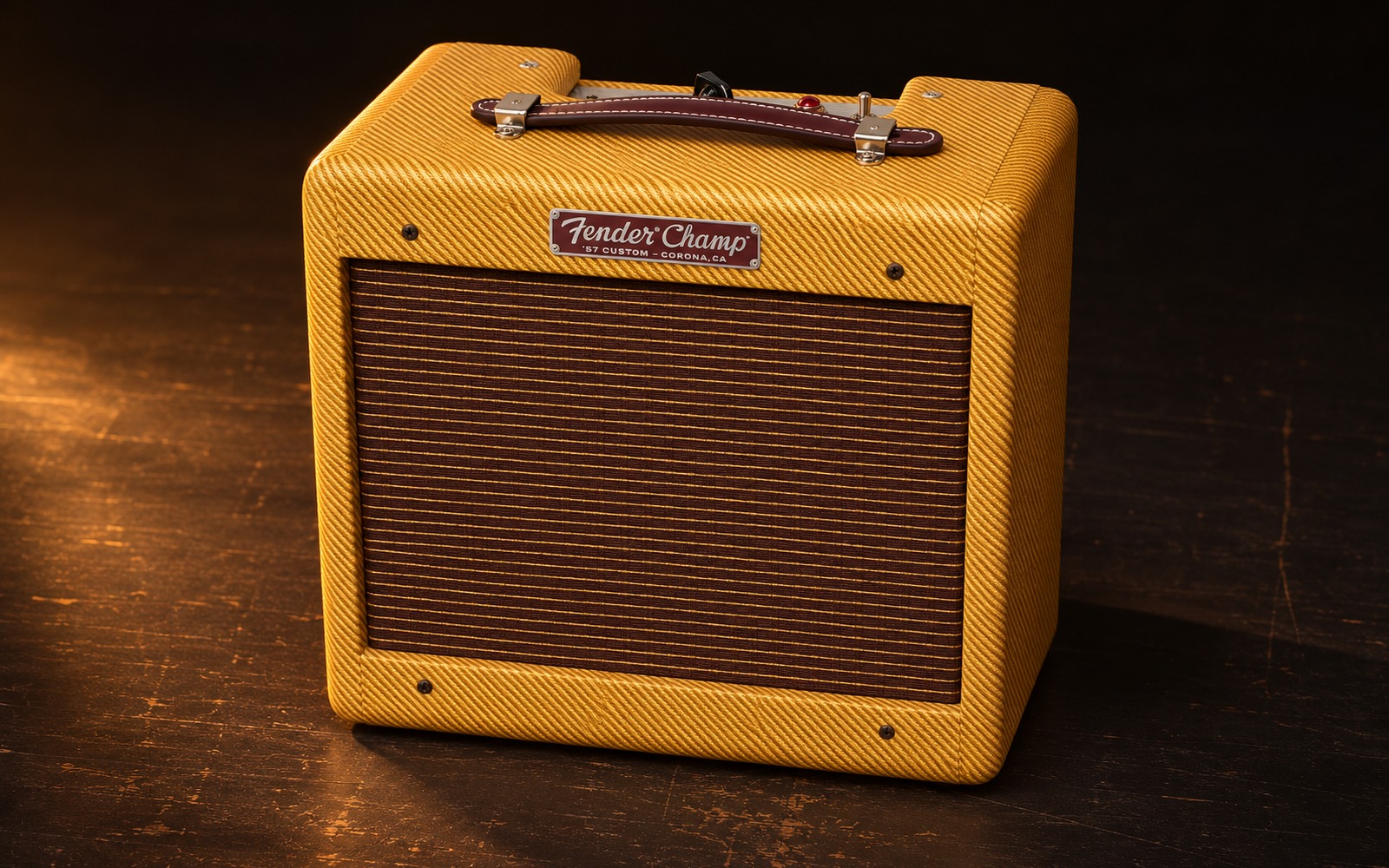
The ’57 Custom Champ is Fender’s current hand-wired recreation of that amp — five watts, one 8-inch speaker, three tubes, fifteen pounds, $1,369.99 at fender.com as of July 2026. It is the smallest amplifier in this entire gear guide that anybody serious would call an icon. It is also, by a comfortable margin, the one most likely to be misunderstood, because almost everything written about it online repeats two claims that turn out to be shakier than they look: that it is a faithful copy of the original, and that it is the amp on “Layla.”
Neither is quite true. Both are more interesting than the myth.
Where the Champ Came From: A Beginner’s Lap-Steel Amp
Fender launched its amplifier line in 1946 with the Princeton, the Deluxe and the Professional. In 1948 the company added something below all of them — a “beginner” package pairing a Hawaiian lap-steel guitar with an amp that sat one rung under the Princeton. It was called the Champion 800: four watts, a single 8-inch speaker, one volume knob, three tubes, a TV-front pine cabinet and a leather handle.
It did not last. Within a year Fender replaced it with the Champion 600, mechanically identical but smaller, with a 6-inch speaker and two-tone brown-and-white textured covering, plus the slanted rear-mounted control panel that would distinguish the Champion models from the rest of the range until 1955. In 1953 it moved into Fender’s wide-panel tweed cabinet. In 1955 it moved again, into the narrow-panel format that matched the rest of the line, and — critically — in 1956 it gained an 8-inch alnico Jensen and a slightly larger cabinet, by which point everybody had stopped saying “Champion” and was calling it the Champ.
That 1956-onward narrow-panel amp, running Fender’s 5F1 circuit, is the one the entire world means when it says “tweed Champ.” It stayed in production, essentially unchanged, until Fender covered it in black Tolex in 1963 and finally rolled it into the blackface line in the autumn of 1964. It was the last of the original-era tweed Fenders — it kept its tweed longer than any other model in the catalogue, outliving the brown-panel era entirely.
Worth noticing before we go further: the amp Fender calls the “’57” Champ got its defining 8-inch speaker in 1956, and the model designation on the tube chart is 5F1, which is Fender’s own shorthand for the 1957 revision of the fifth-generation circuit. The date on the badge is close enough to be honest and loose enough to be marketing. That will be a theme.
The Circuit: Almost Nothing, Deliberately
The reason players talk about the Champ the way they talk about a great microphone is that there is barely anything in it. Writing in Guitar Player in January 2025, Dave Hunter laid out the count: three tubes, each doing an entirely different job, and between the input jack and the output transformer there are just two coupling capacitors, one potentiometer and one resistor — the standard 68k grid stopper that Fender put after the input jack on everything it built.
That is the whole signal path. No tone stack to suck signal out of the circuit. No extra gain stages. No negative feedback loop. No phase inverter, because there is nothing to invert.
That last point is the big one. The Champ is single-ended: one output tube doing all the work by itself, with no partner to handle the other half of the waveform. This makes it a genuine Class A output stage — one of the few amplifiers on the market where the term is technically accurate rather than marketing shorthand borrowed for two- and four-tube push-pull designs that do not meet the definition. The practical consequence is a smoother onset of distortion and a richer harmonic content when the amp does break up, because the single tube generates a strong even-order harmonic series that a push-pull pair largely cancels out.
Put that alongside the two amps immediately before this one in the guide and the family logic becomes clear. The Princeton Reverb runs a cathodyne phase inverter into a push-pull pair of 6V6s and makes 12 watts. The ’57 Custom Deluxe runs the same cathodyne into a cathode-biased pair and makes roughly 12 to 15. The Champ throws the inverter away entirely, keeps one 6V6, and makes five. Each step down removes complexity and adds character. The Champ is the end of that road.
What the three tubes do
| Position | Tube (current ’57 Custom Champ) | Job |
|---|---|---|
| V1 | 1 x 12AY7 | Preamp — both triodes, two gain stages, feeding the volume pot |
| V2 | 1 x 6V6 | Single-ended Class A output stage |
| V3 | 1 x 5Y3GT | Tube rectifier — the source of the amp’s spongy, elastic attack |
The 5Y3 deserves its own sentence. It is a small, soft rectifier with substantial voltage drop under load, and in a five-watt amp that is being asked to work flat out most of the time, it sags constantly. That sag is the “give” people describe when they play a Champ — the note ducks slightly on the attack and then blooms back up. In a bigger amp this is a subtle effect. In a Champ it is most of the personality.
The Preamp Tube Question — and Why the “Custom” Matters
Here is the single most useful thing to know about this amplifier, and it is buried in a spec line that almost nobody reads.
The original 5F1 tweed Champ used a 12AX7 in V1. Fender’s current ’57 Custom Champ uses a 12AY7.
Both statements come from primary sources. Dave Hunter’s Guitar Player history describes the vintage circuit’s tube complement as “one 12AX7 preamp, one 6V6GT output and one 5Y3 rectifier.” Fender’s own product page for model 8160500100 lists the ’57 Custom Champ’s preamp tube as “1 x 12AY7.” These are not the same amplifier in the way people assume.
A 12AY7 has roughly half the gain of a 12AX7. Substituting one for the other in a single-preamp-tube amp is not a subtle voicing tweak; it moves the entire breakup threshold up the dial. And this is precisely the difference reported by owners who have had both Fender reissues side by side. The earlier ’57 Champ (2009-2011, hand-wired, a two-year run) was spec’d with the 12AX7 like the original, and by consistent owner account it broke up dramatically earlier. The ’57 Custom Champ that replaced it in the 2016 Custom tweed launch went to the 12AY7 and gained real clean headroom before the grit arrives.
We should be careful here: the owner reports are forum-level, not manufacturer statements, and we flag them as such. But the two published spec sheets say what they say, and the direction of the difference is not in doubt. If you have played a Fender ’57 Champ and found it too eager, and concluded that all small tweed Fenders break up too early for you, you may have been playing the other amp. If you want the earlier-breakup behaviour in a current ’57 Custom Champ, a 12AX7 in V1 is a five-minute, fully reversible change and easily the highest-value modification available to you.
This is the same lesson the ’57 Custom Deluxe article had to spell out about the ’57 Deluxe versus the ’57 Custom Deluxe, and it is now a documented pattern rather than a coincidence: within Fender’s tweed reissues, the word “Custom” marks a genuinely different amplifier, not a trim level. Read the model name in full, every time, before you buy anything.
Specifications
| Spec | ’57 Custom Champ (2026) | Original narrow-panel 5F1 (1956-63) |
|---|---|---|
| Model number | 8160500100 | 5F1 |
| Output | 5 W | ~5 W (earlier Champions 4 W) |
| Construction | Hand-wired, black eyelet board | Hand-wired eyelet board |
| Preamp tube | 1 x 12AY7 | 1 x 12AX7 |
| Power tube | 1 x 6V6, single-ended Class A | 1 x 6V6GT, single-ended Class A |
| Rectifier | 1 x 5Y3GT | 1 x 5Y3GT |
| Speaker | 8″ 4-ohm Weber Special Design alnico | 8″ alnico Jensen |
| Capacitors | Fender Pure Vintage yellow coupling caps | Period yellow/waxed paper types |
| Transformers | Schumacher | Various period suppliers |
| Controls | Volume. That is all. | Volume. That is all. |
| Inputs | Two 1/4″, input 2 padded -6 dB | Two 1/4″, one padded |
| Cabinet | Finger-joined solid pine, lacquered tweed | Finger-joined solid pine, tweed |
| Grille cloth | Bassman-style | Period tweed-era cloth |
| Control panel | Chrome, chicken-head pointer knob | Chrome, rear-mounted |
| Handle | Vintage-style leather, nickel hardware | Leather |
| Dimensions | 12.5″ H x 13.5″ W x 7.6″ D | Very slightly variable by year |
| Weight | 15 lb (6.8 kg) | ~15-17 lb |
| Included | Protective cover | Nothing |
| Price | $1,369.99 (fender.com, July 2026) | See vintage section below |
Note the absences, because they are the product. No tone control of any kind. No reverb, no tremolo, no standby switch, no line out, no attenuation, no effects loop, no footswitch. The ’57 Custom Champ is a fifteen-pound box that converts a guitar signal into a loudspeaker’s worth of air, and the only decision it offers you is how hard.
What It Actually Sounds Like
The Champ has a personality that people find surprising the first time, because a five-watt amp with an 8-inch speaker sounds on paper like a toy and does not behave like one.
Below about 3 on the dial it is genuinely clean, and cleaner in the ’57 Custom’s 12AY7 configuration than most people expect. It is also small — this is a narrow-bandwidth amplifier, rolled off at both ends by the 8-inch speaker and by an output transformer sized for five watts, and it lives in a midrange band that happens to be exactly where a close microphone hears best.
From 4 to 7 it starts to compress and thicken. Because there is no negative feedback and no tone stack, this happens with an immediacy that bigger amps mute. The touch sensitivity everyone talks about is real and it is mechanical: with only one pot in the whole signal path, your picking hand and your guitar’s volume knob are doing work that in most amps is done by circuitry.
Past 8 it saturates fully, and the 5Y3’s sag makes the attack elastic and slightly delayed — the note pushes in rather than snapping in. This is the sound. It is not a high-gain sound and it never will be; it is a fat, harmonically dense, mid-forward crunch with a soft ceiling.
And it is loud. Reviewers and owners consistently note that the amp is “deceivingly loud” for five watts and an 8-inch speaker, which is a genuine acoustic point rather than enthusiasm: a small, efficient speaker in a small sealed-ish pine box radiates midrange extremely well, and midrange is what human ears measure loudness by. It will not compete with a drummer. It will absolutely annoy your neighbours.
Famous Players: What Survives Verification
Eric Clapton — the big claim, and how firmly it is actually made
This is the Champ’s headline credit and it is worth reading the wording of each source very carefully, because they do not agree on how confident to be.

Fender states it flatly. The company’s own history of the model, by Jeff Owens, says: “A tweed Champ was Clapton’s main studio amp for 1970 Derek and the Dominos masterpiece Layla and Other Assorted Love Songs and for acclaimed 1974 solo album 461 Ocean Boulevard. When you hear ‘Layla,’ ‘Bell Bottom Blues’ and ‘I Shot the Sheriff,’ you’re hearing an original-era Champ.”
Guitar Player hedges. Dave Hunter, in the same publication that has covered this amp for fifty years, writes only that Clapton “famously used a tweed Champ on several songs, including, reportedly, ‘Layla.'” That “reportedly” is deliberate and it is doing work.
And the primary testimony is a mess. As we set out in the Princeton Reverb feature, the participants in those Criteria Studios sessions contradict each other. Producer Tom Dowd gave differing accounts over the years, variously naming Princetons, Deluxes, blackface Vibro-Champs and an unidentified Gibson combo. Engineer Howard Albert stated plainly that the amps on top of the closed piano lid, used by both Clapton and Duane Allman, were tweed Champs.
So: the Champ claim has the single strongest piece of eyewitness evidence in the whole tangle — an engineer who was in the room describing where the amps physically sat. It is more likely true than the competing Princeton claim. It is still not settled, one of the two best-placed witnesses keeps changing his story, and Fender’s marketing department is more certain about it than Guitar Player is. Believe it at about 75%, not 100%, and be suspicious of anyone who states it without a caveat.
The 461 Ocean Boulevard and “I Shot the Sheriff” attributions rest on Fender’s assertion alone and we could not find independent confirmation.
Joe Walsh — the best-documented Champ tone in rock
Joe Walsh used a tweed Champ on “Rocky Mountain Way” and other tracks, per Guitar Player‘s account, and the widely-repeated companion story is a Telecaster into a cranked Champ for the James Gang’s “Funk #49.” The second one circulates at community level rather than from an interview we could verify, so we report it as the well-established story it is rather than as a fact. The “Rocky Mountain Way” credit is the solid one, and it is instructive: that track’s guitar sound is enormous, and it came out of a fifteen-pound box in front of a microphone. Size on tape has almost nothing to do with size in the room.

Keith Richards, Billy Gibbons, Jeff Beck
All three are named by Guitar Player as players who “frequently turned to the Champ” in the studio. Richards, Gibbons and Beck are documented users at that level of specificity and no further — no particular track, no particular year. That is exactly as much as the source supports, so that is exactly as much as we will claim. Gibbons in particular has a long public history of using tiny amps for enormous-sounding records, which makes the credit plausible as well as sourced.
George Harrison — for slide, and hedged
Harrison “is said to have preferred his Champ for slide parts,” in Guitar Player‘s careful phrasing. Same hedge, same treatment: reported, not verified. It is a musically sensible claim — slide playing rewards compression and sustain over headroom, which is the Champ’s entire offer — but we have no primary source and neither, apparently, does anybody else.
Julian Lage — the modern one, and the interesting one
The contemporary name worth knowing is Julian Lage, who according to Guitar Player has used a tweed Champ in the studio and onstage. The onstage part is what makes it notable. A five-watt single-ended amp on a stage, in 2026, in front of paying customers, played by one of the most technically celebrated guitarists of his generation, is a deliberate statement about dynamics and about trusting the front-of-house engineer. He is the best living argument that this amp is not a novelty.
The honest summary
The Champ’s fame is real, heavily studio-based, and unusually poorly documented at the track level — because nobody photographs the small amp. The pattern across every source is the same: hedged verbs (“reportedly,” “is said to have”), no session dates, no serial numbers. What is beyond dispute is the category claim, which Fender’s own copy puts well: this is “the classic sound heard on thousands of recordings.” Which particular thousands, nobody wrote down.
Seven Tone Recipes
1. The session clean (Volume 2.5-3, input 1, guitar volume 10)
Bridge single-coil, flatpick, tone rolled back to 8 on the guitar. This is the Louie Shelton position translated to a smaller amp — clean, midrange-forward, no low end to speak of, and it sits in a mix without any EQ from the desk. Mic it slightly off-centre on the cone, six inches back.
2. Layla crunch (Volume 8-10, input 1, humbuckers)
Everything up. Neck humbucker for the thick, vocal version; bridge for the biting one. Because there is no tone stack, the only EQ available is the guitar’s tone control and the microphone’s position — move the mic toward the cone edge to lose treble, toward the centre to gain it. This is the sound the whole mythology is about, and it takes about four seconds to dial.
3. Padded input for pedals (input 2, Volume 6-7)
The second input is 6 dB down, which is exactly what you want in front of a boost or overdrive that would otherwise slam the single preamp tube into mud. Run an Ibanez TS9 with drive low and level high into input 2 and you get a tighter, more articulate overdrive than the amp makes on its own, plus a genuine clean-to-dirty footswitch that the amp itself does not provide.
4. Slide (Volume 7, neck pickup, guitar tone 6)
Compression and sustain are the requirements and the Champ has both in surplus. Roll the guitar tone back to tame the string noise a glass slide generates on wound strings. This is the setting behind the Harrison claim and it works whether or not the claim does.
5. The double-track trick (Volume 9, two passes, mic moved between them)
The Champ’s narrow bandwidth is a liability on a single track and an asset on two. Record the part twice at full volume, moving the microphone two inches between passes, and pan the results wide. The frequency differences between the takes do the work a stereo rig would otherwise have to do. This is one of the oldest small-amp production tricks in existence and the Champ is what it was invented on.
6. Big amp, small box (Volume 10, guitar volume as the control)
Set the amp flat out and never touch it again. Roll the guitar volume to 4 for clean, 7 for edge, 10 for full saturation. With only one pot between input and output transformer, the Champ cleans up from the guitar more convincingly than almost anything else at any price. This is the way the amp was designed to be used and the reason people who own one stop worrying about the missing controls.
7. Ambience from outside (Volume 8, delay in front)
There is no reverb and no loop, so time-based effects go in front and you accept the consequences. A tape-style delay like the Strymon El Capistan in front of a cranked Champ is a documented sixties workflow — this is how a small tweed amp got its space before spring tanks were standard equipment on everything.
An amp with one knob does not have settings, it has techniques. Every recipe below assumes the ’57 Custom Champ with its stock 12AY7; if you have swapped to a 12AX7, subtract roughly two from every volume number.
Six Comparisons
vs. the ’57 Custom Deluxe
The ’57 Custom Deluxe is the next rung up and a materially different proposition: two 6V6s in cathode-biased push-pull, a cathodyne phase inverter, a 12-inch speaker, two channels with separate volumes, roughly 12 watts and about twice the weight. It is louder, fuller and jumpable between channels. The Champ is simpler, more compressed, more single-mindedly midrange, and about $1,300 cheaper. If you will ever play with a drummer, buy the Deluxe. If the amp will live in a studio or a spare room, the Champ is the more characterful instrument.
vs. the Princeton Reverb
The Princeton Reverb is the obvious rival for the studio slot and it wins on versatility by a wide margin: 12 watts, a 10-inch speaker, a real tone stack, spring reverb and bias-wiggle tremolo, and a volume range that stays usable in a small room. The Champ wins on immediacy and on the specific single-ended texture the Princeton cannot produce. Also on price — the Princeton Reverb reissue is $1,579.99, and its Tone Master sibling is $1,099.99, both above and around the Champ.
vs. the Vox AC15
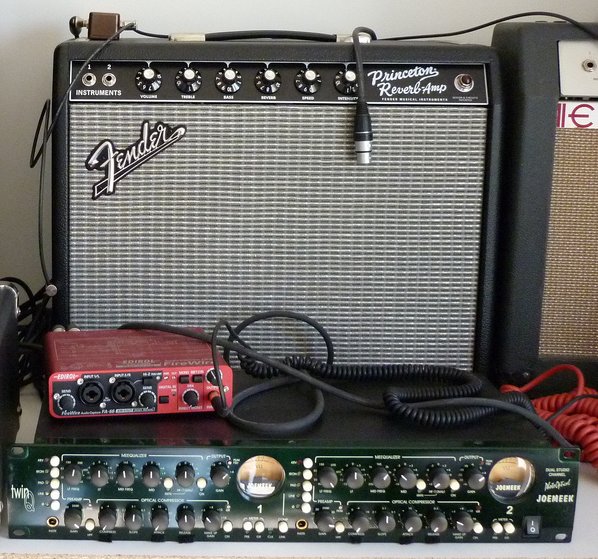
A Vox AC15 is three times the power, a 12-inch speaker, EL84s, a top-boost tone stack and tremolo, and a completely different midrange character — chime and bite rather than warmth and bloom. It is also five times the size and weight. Different countries, different decades, different jobs. The genuine overlap is that both are amps that sound best when worked hard.
vs. the Fender Blues Junior
The Blues Junior is the pragmatic modern answer: 15 watts, a 12-inch speaker, reverb, a three-band EQ, PCB construction, and around a third of the Champ’s price. It will do more things adequately. It will not do the one thing the Champ does. This is the clearest case in the whole Fender range of paying for character rather than capability, and it is worth being honest that a lot of players are better served by the cheaper amp.
vs. an original vintage tweed Champ
Vintage narrow-panel Champs have appreciated steeply and now trade well above what the reissue costs, frequently in the $2,000-3,500 range depending on year, originality and condition, with clean early examples higher. For that you get a genuinely original amplifier, a Jensen alnico, sixty-plus years of settling, and a set of liabilities: seventy-year-old filter caps, a two-prong power cord, no earth, and a speaker that may or may not still be the one that left Fullerton. The reissue is properly earthed, warrantied, and does not care if you take it to a gig. Buy the vintage one because you want the object; buy the reissue because you want the sound.
vs. the ’57 Champ (2009-2011)
Same cabinet, same three-tube architecture, hand-wired, discontinued after a two-year run. The difference that matters is V1: the older reissue used the 12AX7 the original had, the current Custom uses the 12AY7. If you find a clean ’57 Champ used, it is a legitimate alternative and it will break up earlier out of the box. Just know which one you are looking at before you send money — the names differ by a single word.
Buying Guide
New
The ’57 Custom Champ is $1,369.99 at fender.com in July 2026, model 8160500100, part of the American Hand-Wired series and the ’50s Collection. A protective cover is included; there is no footswitch because there is nothing to switch. Street pricing at major dealers tends to sit at or just under list, with periodic promotions. There is one finish: lacquered tweed.
What you are paying for, concretely: hand wiring on a black eyelet board, Fender Pure Vintage yellow coupling capacitors, Schumacher transformers, a finger-joined solid pine cabinet, an 8-inch 4-ohm Weber Special Design alnico speaker and a chrome control panel. That is a real bill of materials for a five-watt amp, and it is also, unavoidably, $1,370 for one knob. Whether that is good value depends entirely on whether the specific single-ended texture is something you need. It is not a beginner purchase, despite the amp’s ancestry as literally a beginner’s amp.
Used
The ’57 Custom Champ has been in production since 2016 and used examples surface regularly at a meaningful discount. Check the obvious: that the tweed lacquer has not been cracked by a fall, that the leather handle is intact (they dry out and tear, and replacements are cheap but fiddly), that the speaker cone has no repairs, and that the amp has not been “improved.” The most common modification is a V1 tube swap, which is harmless and reversible. The second most common is an added external speaker jack, which is not harmful either but should be reflected in the price.
Vintage
Original narrow-panel tweed Champs from 1956-1963 are the target, and prices have escalated hard in recent years — Guitar Player‘s own history notes the increase without pretending it makes sense. Verify the speaker against the chassis date using the same EIA-code method laid out in our Twin Reverb feature (Jensen is manufacturer code 220), demand a dated recap receipt naming the technician, and inspect the power cord: a seventy-year-old two-prong cable on an un-earthed chassis is a genuine safety issue, not patina. Rewiring to a modern three-prong grounded cord is the one modification that should never reduce value and that every vintage tweed amp should have.
Ownership Notes
- There is no standby switch. None of these amps ever had one and none is needed at this power level. Turn it on, wait thirty seconds, play.
- The speaker is 4 ohms, not 8. This catches people out when they go to fit an external cabinet or a replacement driver. The ’57 Custom Champ’s Weber is a 4-ohm unit and the output transformer is wound to match.
- There is no external speaker jack from the factory. The Eric Clapton EC Vibro-Champ had an internal speaker disconnect for exactly this purpose; the ’57 Custom does not. A tech can add one, and it is the most commonly requested modification on the model.
- Tube life is excellent. One output tube, cathode-biased territory, five watts and no bias adjustment to make. A 6V6 in a Champ can last a very long time. A 5Y3 rectifier will usually outlast it.
- V1 is the tone control you don’t have. 12AY7 stock for headroom; 12AX7 for early breakup; 5751 sits between the two if you want a smaller step. This is the single most useful thing you can do to the amp and it requires no soldering.
- It is fifteen pounds. The most underrated specification here. This amp goes anywhere, in one hand, alongside a guitar case, and that fact alone has probably put it on more records than its tone has.
- Mic placement is your EQ. With no tone controls, the microphone is the tone stack. Learn the difference between on-axis at the dust cap (bright, aggressive) and off-axis at the cone edge (warm, rounded), and you have effectively recovered the treble control the amp lacks.
Frequently Asked Questions
Is the ’57 Custom Champ an accurate reissue of a 1957 Champ?
Close, but not exact, and the difference is not cosmetic. The circuit architecture, the single-ended 6V6 output, the 5Y3 rectifier, the hand-wired eyelet board and the cabinet are all faithful. The preamp tube is not: Fender specifies a 12AY7 where the original 5F1 used a 12AX7, which raises the breakup threshold noticeably. The speaker is also a Weber rather than a Jensen. Treat it as a very good period-voiced amplifier rather than a replica.
What is the difference between the ’57 Champ and the ’57 Custom Champ?
They are two different products. The ’57 Champ ran 2009-2011 with a 12AX7 preamp tube. The ’57 Custom Champ arrived with Fender’s 2016 Custom tweed launch and uses a 12AY7. Owners who have compared them consistently report the older one breaking up much earlier. The word “Custom” is the entire tell.
Is five watts enough to gig with?
Not on its own with a drummer, no. Miked into a PA, yes, and Julian Lage has done exactly that on stage. The amp’s stage limitation is not really volume, it is that you cannot hear yourself once a band starts, which is a monitoring problem rather than an amplifier problem. If your gigs have a decent PA and a monitor mix, it works. If you are playing a bar with a vocal-only PA, it does not.
Why does an amp with one knob cost $1,370?
Because almost the entire cost is in labour and materials rather than features: hand wiring on an eyelet board is slow, the Weber alnico speaker and Schumacher transformers are real components, and the finger-joined solid pine cabinet is built the expensive way. You are paying for a small number of good parts assembled by a person. That is a legitimate answer and it is also completely fair to decide it is not worth it to you.
Can I use pedals with it?
Yes, and use input 2 when you do. The padded input gives you 6 dB of margin before the single preamp tube loses composure, which makes overdrives, boosts and fuzzes far more usable. Delay and modulation work fine in front. There is no effects loop, so anything you would normally put after the preamp goes in front and you live with the result — which, at these gain levels, is usually fine.
Does it really do Class A?
Yes, genuinely, which is unusual. Because it is single-ended — one output tube handling the whole waveform with no push-pull partner — it meets the actual technical definition, unlike most two- and four-tube amps that get called Class A in marketing copy. The audible result is a smoother distortion onset and stronger even-order harmonics.
What was actually used on “Layla”?
Nobody can say for certain. Fender asserts a tweed Champ flatly. Guitar Player says “reportedly.” Engineer Howard Albert, who was in the room, describes tweed Champs sitting on top of the closed piano lid for both Clapton and Duane Allman — which is the strongest single piece of evidence in favour. Producer Tom Dowd gave several different accounts over the years, variously naming Princetons, Deluxes and Vibro-Champs. The Champ version is the most likely, but “most likely” is not the same as “documented,” and anyone telling you flatly which amp it was is repeating a summary rather than a source.
Should I put a bigger speaker in it?
You cannot, not internally — the cabinet is 13.5 inches wide and built around an 8. Some owners add an external speaker jack and run a 1×12 cabinet, which gains low end and dispersion and loses the boxy midrange focus that is arguably the point of the amp. If you want a bigger speaker, the honest answer is that you want a ’57 Custom Deluxe.
Which small tweed Fender should I buy?
Champ for studio work, solo playing and maximum touch response at minimum size and cost. Deluxe if you need to be heard in a room with other people. Princeton Reverb if you want reverb and tremolo and a tone stack and are willing to give up the single-ended texture to get them. All three are excellent; they are answering different questions.
Image credits
- Top image: GuitarGangsters AI-generated reference illustration, not a photograph.
- Eric Clapton: MerleEllaPatsy, Wikimedia Commons, CC0 1.0.
- Joe Walsh: Steve Proctor, Wikimedia Commons, CC BY-SA 4.0.
- Fender Princeton Reverb reissue: sploshette, Flickr, CC BY 2.0.
- Vox AC15 Custom Classic: Roadside Guitars, Wikimedia Commons, CC BY-SA 2.0.
Latest News
Related
On This Day
Monday 9 November
From this week: